If a company uses $100 million of its cash to pay off debt, its stockholders’ equity will
increase $100 million.
Employee fraud is often grouped into three categories, including corruption, asset
misappropriation, and embezzlement.
Dividends in arrears are reported as current liabilities on the balance sheet.
State laws often restrict dividends to the amount of Retained Earnings.
Net income is increased when accounts receivable are collected.
All corporations acquire financing by issuing stock for sale on public stock exchanges.
Treasury stock is a corporation’s own stock that has been issued and subsequently
repurchased by the corporation.
A company performs a service, sells inventory that it purchases from others, or
manufacturers a product; it cannot serve more than one of these functions.
Stockholders are creditors of a corporation.
If a contra account of $20,000 is mistakenly included in the same column of the trial
balance as the account it offsets, the error will cause the debit and credit column totals
to differ by $40,000.
A petty cash fund is a separate checking account used to reimburse employees for
expenditures they have made on behalf of the organization.
The statement of cash flows explains the difference between the beginning and ending
balances of cash and cash equivalents.
The entry to record a bond retirement at maturity usually involves no gain or loss.
Cost of goods sold = Beginning inventory + Purchases – Ending inventory
One of the major advantages of making adjustments in order to improve the quality of
financial statements is that they:
A) ensure that revenues and expenses are recognized during the period they are earned
and incurred.
B) ensure that all estimates of future activities are eliminated from consideration.
C) ensure that revenues and expenses are recognized conservatively during the period
in which they are paid.
D) provide an opportunity to manipulate the numbers to the best advantage of the
reporting company.
The following accounts are taken from the December 31, Year 4 financial statements of
a company.
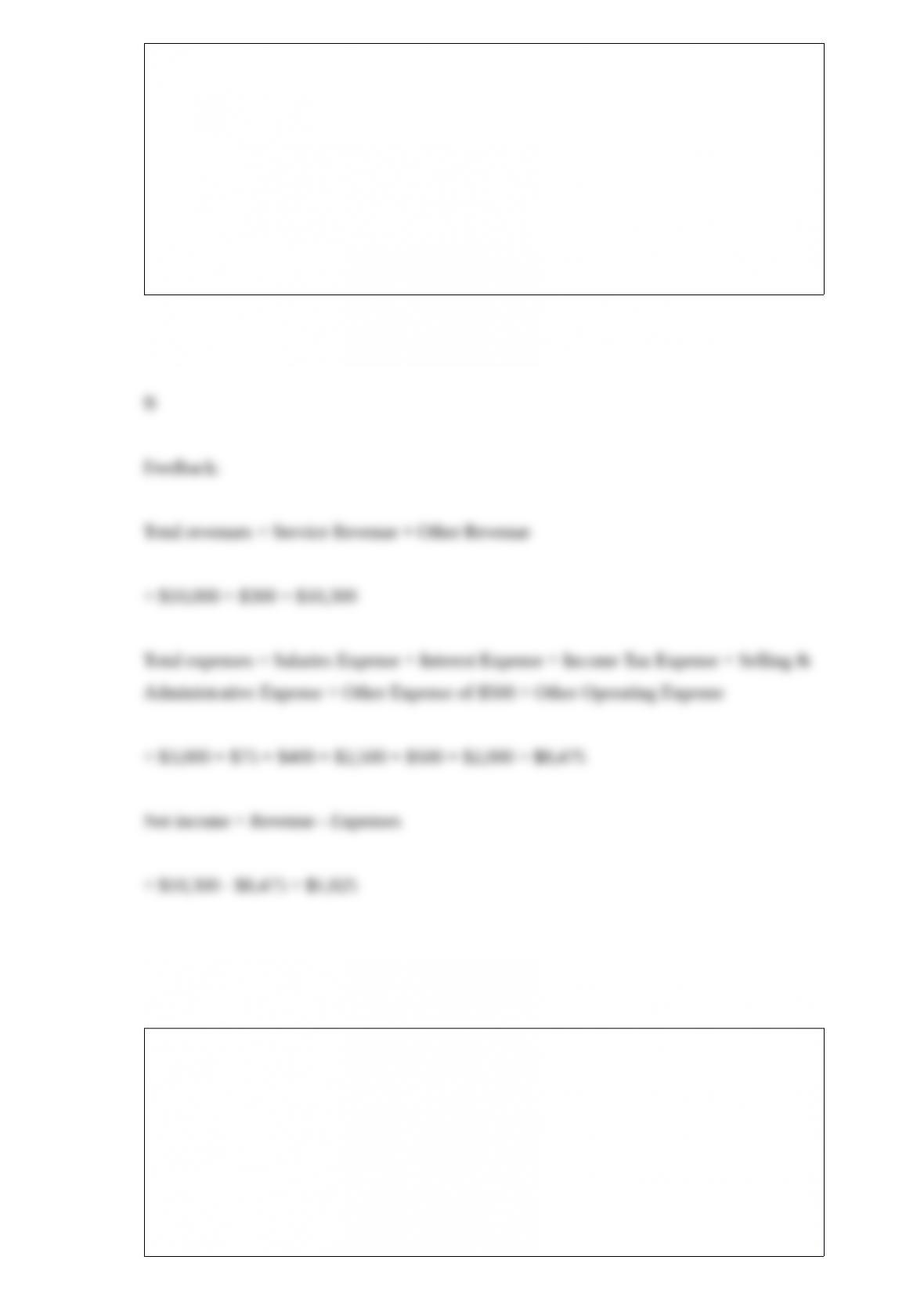
Use the information above to answer the following question. What is the amount of net
income for Year 4?
A) $3,825.
B) $1,825.
C) $10,300.
D) $5,625.
Supplemental disclosures required by companies using the indirect method include all
of the following except:
A) cash paid for interest.
B) cash paid for income tax.
C) cash paid for dividends.
D) noncash investing and financing activities.
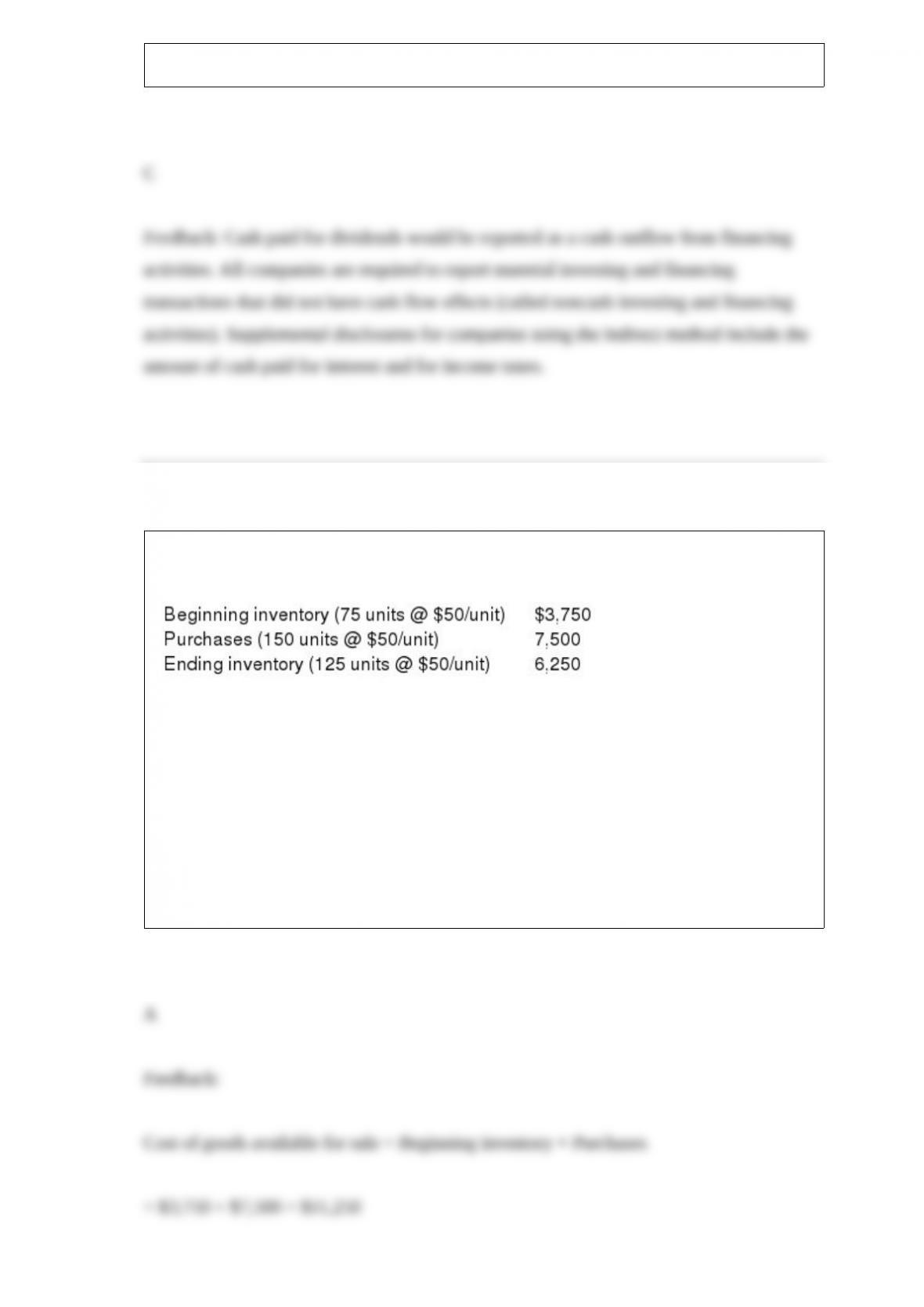
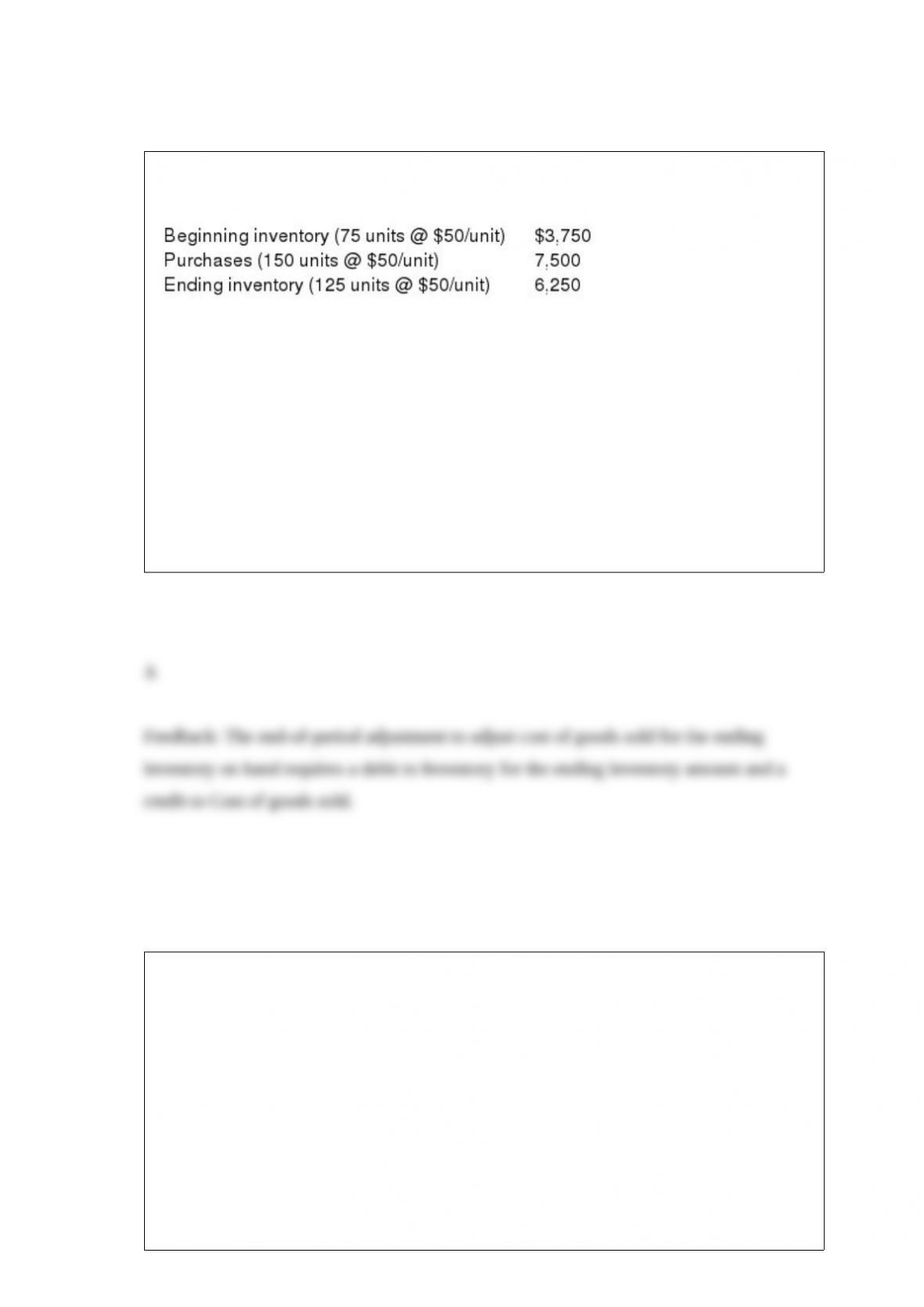
FAD Company uses a periodic inventory system and its inventory records for the period
contain the following information:
Use the information above to answer the following question. What is the amount of cost
of goods available for sale?
A) $11,250
B) $17,500
C) $5,000
D) $13,750
FAD Company uses a periodic inventory system and its inventory records for the period
contain the following information:
Use the information above to answer the following question. The journal entry
necessary at the end of the period to adjust cost of goods sold for the ending inventory
still on hand will include which of the following?
A) Debit Inventory for $6,250
B) Credit Cost of Goods Sold for $11,250
C) Credit Purchases for $10,200
D) Credit Inventory for $5,000
A company reported net income of $6 million. During the year the average number of
common shares outstanding was 3 million. The price of a share of common stock at the
end of the year was $5. There were 400,000 shares of preferred stock outstanding on
average and no dividends were declared and the preferred stock is noncumulative.
Use the information above to answer the following question. The EPS is approximately:
A) $0.40
B) $1.76.
C) $1.86.
D) $2.00.
Katy Company uses the allowance method. Katy writes off a customer account balance
when it becomes clear that the particular customer will never pay. How will this
write-off affect the company’s net income and accounts receivable turnover ratio?
A) Net income and the account receivable turnover ratio will both decrease.
B) Net income will decrease; the account receivable turnover ratio will not change.
C) Net income will not change; the account receivable turnover ratio will decrease.
D) Net income will not change; the account receivable turnover ratio will not change.
Use the information above to answer the following question. If the units-of-production
method is used, the depreciation rate is:
A) $0.95 per unit.
B) $0.19 per unit.
C) $0.05 per unit.
D) $1.00 per unit.
Cash flows from investing activities include cash:
A) inflows and outflows reflecting revenues and expenses reported on the income
statement.
B) inflows from the issuance of bonds.
C) inflows from the sale of long-term investments.
D) inflows from the sale of a company’s own stock to its stockholders.

Melody’s Piano School operations for the month of May were limited to the following
transactions:
Provided $400 of piano lessons to students who paid in cash.
Provided $100 of piano lessons on account.
Collected $300 from students who took piano lessons during April.
Paid April’s piano rental bill of $100.
Received May’s piano rental bill of $150 and set it aside for payment in June.
Use the information above to answer the following question. Assuming the company
uses accrual basis accounting, what is net income for May?
A) $400.
B) $300.
C) $350.
D) $600.
Your company buys a computer server that it expects to use for eight years and then sell
when it upgrades to a more powerful model. The server would probably be used by the
business that buys it at that time for another three years. The useful life of the server for
your company is:
A) eight years.
B) eleven years.
C) five years.
D) three years.
Transport Inc. has a fleet of 10 large trucks that cost a total of $1,410,000. The fleet is
expected to be driven a total of 1,000,000 miles during its estimated 10-year life and be
sold for $141,000 at the end of its useful life. If the fleet was driven 125,000 miles
during the current year, what is the amount of depreciation that would be calculated
using the straight-line and units-of-production methods, respectively?
A) $158,625 and $141,000
B) $141,000 and $158,625
C) $126,900 and $176,250
D) $126,900 and $158,625
Assume accrual basis accounting is used. Which of the following statements about
income statement accounts is correct?
A) Costs incurred to help generate revenue are only reported as expenses on the income
statement if they are paid in cash in the same period as the revenue received.
B) Revenue accounts are shown after the amount of expense accounts on the income
statement.
C) Revenue accounts include Cash, Accounts Receivable, and Unearned Revenue.
D) There is no Net Income account.
Which of the following statements about transaction analysis is not correct?

A) A transaction is an exchange or event that has a direct and measurable financial
effect.
B) Every transaction has at least two effects.
C) Cash is the account credited when a bank loan is repaid.
D) Notes Payable is the account debited when money is borrowed from a bank using a
promissory note.
A company bought $250,000 of equipment with an expected life of ten years and no
residual value. After six years the company sold the equipment for $94,000. If the
company uses straight-line depreciation and the indirect method is used to determine
cash flows from operating activities, which of the following reflects how the sale of the
equipment would be reported in the statement of cash flows?
A) $94,000 is recorded as a cash inflow from investing activities and no other sections
of the statement are affected.
B) $94,000 is recorded as a cash inflow from investing activities and $6,000 is added to
convert net income to net cash flow provided by operating activities.
C) $94,000 is recorded as a cash inflow from investing activities and $6,000 is
subtracted to convert net income to net cash flow provided by operating activities.
D) $94,000 is recorded as a cash inflow from operating activities.
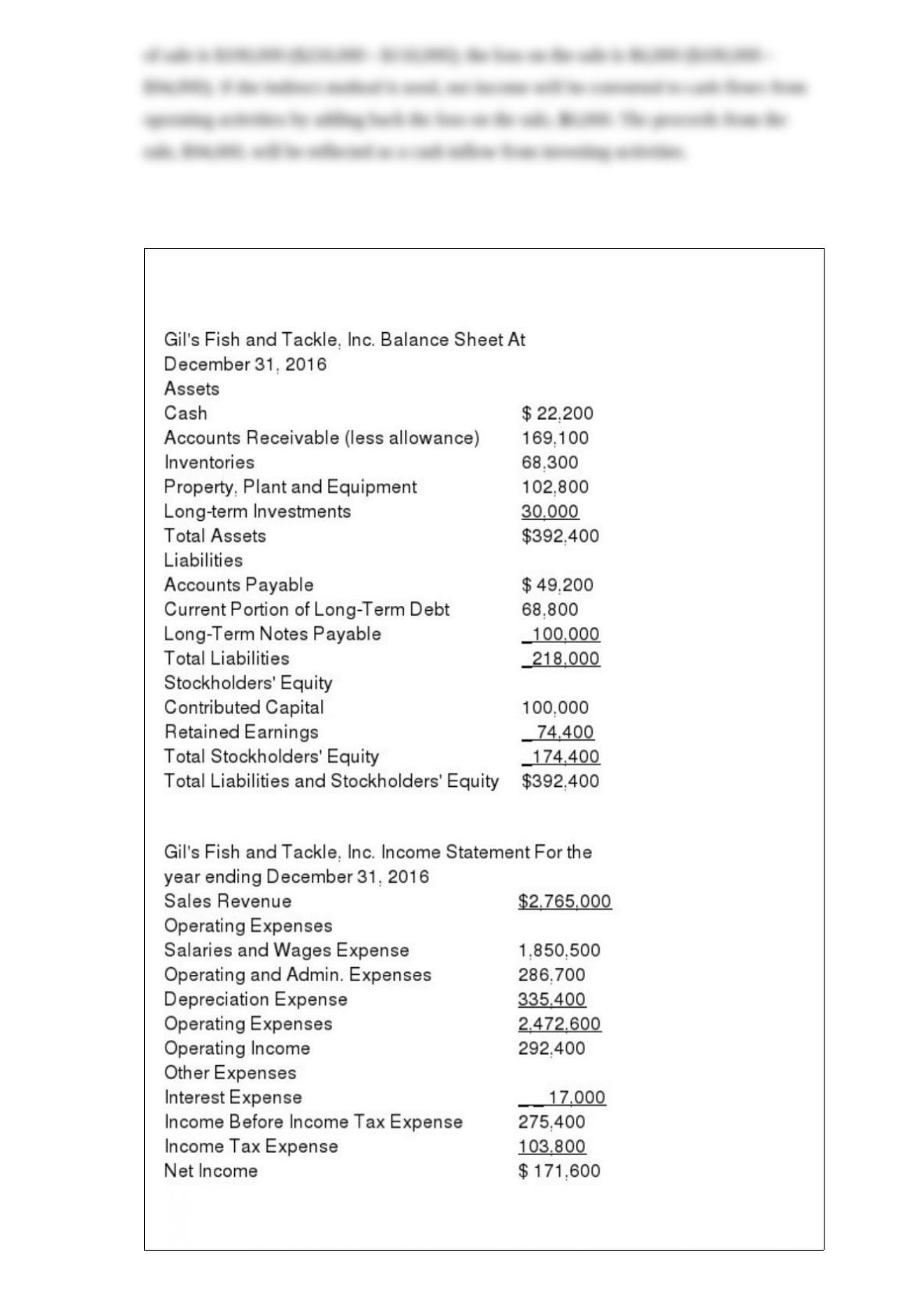
Consider the following information:
Required:
Part a. Calculate the debt-to-assets ratio.
Part b. Describe what the debt-to-assets ratio tells you and how to interpret it.
Part c. Calculate the times interest earned.
Part d. Comment on the results of your times interest earned analysis.