
When comparing the direct write-off method and the allowance method of accounting
for uncollectible receivables, a major difference is that the direct write-off method
A.uses a percentage of sales method to estimate uncollectible accounts.
B.is used primarily by large companies with many receivables.
C.is used primarily by small companies with few receivables.
D.uses an allowance account.
Answer:
At the beginning of the year, the balance in the Allowance for Doubtful Accounts is a
credit of $760. During the year, $120 of previously written-off accounts were reinstated
and accounts totaling $740 are written-off as uncollectible. The end of the year balance
(before adjustment) in the Allowance for Doubtful Accounts should be
A.$760
B.$120
C.$140
D.$740
Answer:
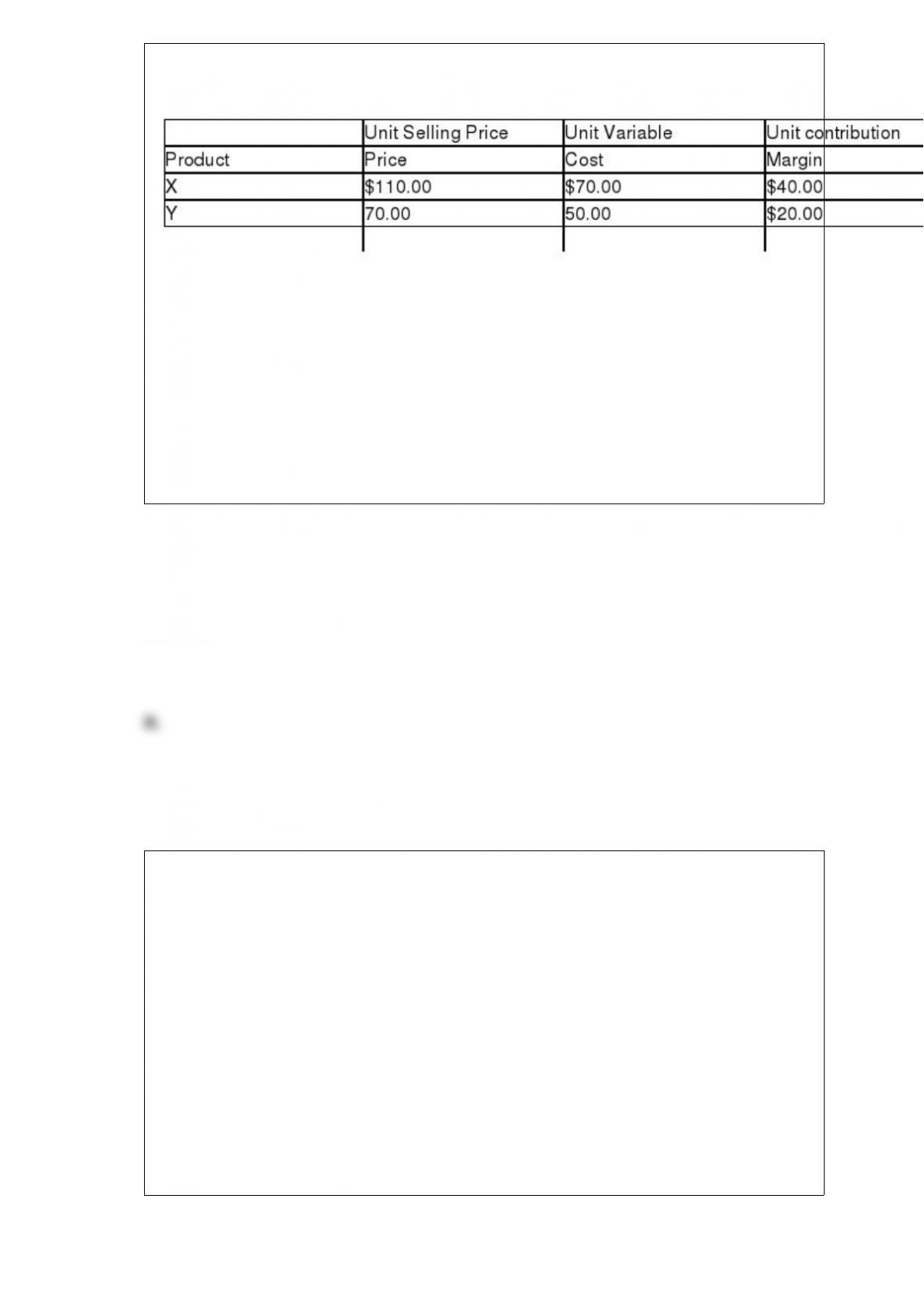
Rusty Co. sells two products, X and Y. Last year Rusty sold 5,000 units of X’s and
35,000 units of Y’s. Related data are:
What was Rusty Co.’s weighted average unit selling price?
A.$180.00
B.$75.00
C.$100.00
D.$110.00
Answer:
As of January 1 of the current year, the Grackle Company had accounts receivables of
$50,000. The sales for January, February, and March were as follows: $120,000,
$140,000 and $150,000. 20% of each month’s sales are for cash. Of the remaining 80%
(the credit sales), 60% are collected in the month of sale, with remaining 40% collected
in the following month. What is the total cash collected (both from accounts receivable
and for cash sales) in the month of March?
A.$74,800
B.$146,800
C.$102,000
D.$116,800

Answer:
Investment centers differ from profit centers in that they
A.are responsible for net income only.
B.are able to invest in assets.
C.have less responsibilities than cost centers and profit centers.
D.are only responsible for revenues.
Answer:
The Waterfall Company sells a product for $150 per unit. The variable cost is $80 per
unit, and fixed costs are $270,000. Determine the (a) break-even point in sales units,
and (b) break-even points in sales units if the company desires a target profit of
$36,000. Round your answer to the nearest whole number.
Answer:
Use the accounting equation to answer each of the independent questions below:
a. At the beginning of the year Norton Company assets were $75,000 and its owner’s
equity was $38,000. During the year, assets increased by $18,000 and liabilities
increased by $4,000. What was the owner’s equity at the end of the year?
b. At the beginning of the year Turpin Industries had liabilities of $44,000 and owner’s
equity of $66,000. If assets increased by $10,000 and liabilities decreased by $5,000,
what was the owner’s equity at the end of the year?
Answer:
The assets and liabilities of the company are $128,000 and $84,000, respectively.
Owner’s equity should equal
A.$212,000
B.$44,000
C.$128,000
D.$84,000
Answer:
If a company uses special journals
A.it must have one for cash, receivables, and payables
B.it may have no more than four
C.the quantity and design depend on the needs of the company
D.the design must comply with the FASB requirements
Answer:
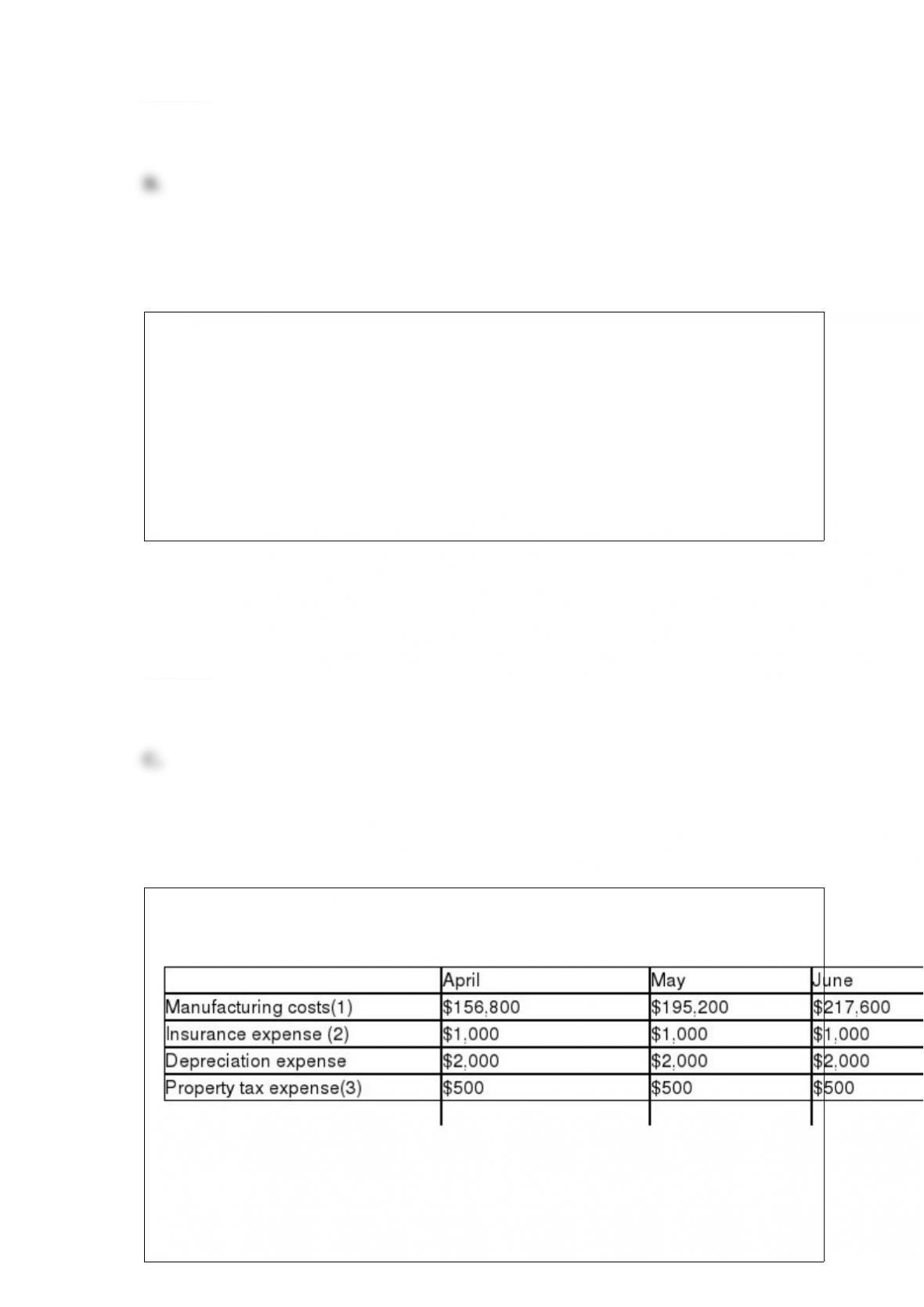
Finch Company began its operations on March 31 of the current year. Finch Co. has the
following projected costs:
(1) 3/4 of the manufacturing costs are paid for in the month they are incurred. 1/4 is
paid in the following month.
(2) Insurance expense is $1,000 a month, however, the insurance is paid four times

yearly in the first month of the quarter, i.e. January, April, July, and October.
(3) Property tax is paid once a year in November.
The cash payments for Finch Company in the month of June are:
A.$215,500
B.$188,800
C.$214,000
D.$212,000
Answer:
Some organizations use internal service departments to provide like services to several
divisions or departments within an organization. Which of the following would
probably not lend itself as a service department?
A.Inventory Control
B.Payroll Accounting
C.Information Systems
D.Human Resources
Answer:

The process of developing budget estimates by requiring all levels of management to
estimate sales, production, and other operating data as though operations were being
initiated for the first time is referred to as:
A.flexible budgeting
B.continuous budgeting
C.zero-based budgeting
D.master budgeting
Answer:
What is meant by the term B2C?
A.Balance to cash
B.Business to cash
C.Book to capital
D.Business to consumer
Answer:

The cash basis of accounting records revenues and expenses when the cash is
exchanged while the accrual basis of accounting
A.records revenues when they are earned and expenses when they are paid
B.records revenues and expenses when they are incurred.
C.records revenues when cash is received and expenses when they are incurred.
D.records revenues and expenses when the company needs to apply for a loan.
Answer:
Gerardo Company had a net income of $75,000, and other comprehensive income of
$12,500 for 2012. On January 1, 2012, the Retained Earnings balance was $525,000
and the Accumulated Other Comprehensive Income balance was $55,000. Determine
the (a) comprehensive income for 2012, (b) Retained Earnings balance on December
31, 2012, and (c) the Accumulated Other Comprehensive Income on December 31,
2012.
Answer:

The details concerning the costs incurred on each job order are accumulated in a work
in process account, which is supported by a:
A.stock ledger
B.materials ledger
C.cost ledger
D.creditors ledger
Answer:
The asset created by a business when it makes a sale on account is termed
A.accounts payable
B.prepaid expense
C.unearned revenue
D.accounts receivable
Answer:

Accompanying the bank statement was a debit memo for bank service charges. On the
bank reconciliation, the item is
A.a deduction from the balance per company’s records
B.an addition to the balance per bank statement
C.a deduction from the balance per bank statement
D.an addition to the balance per company’s records
Answer:
Transactions affecting owner’s equity include
A.owner’s investments and payment of liabilities
B.owner’s investments and owner’s withdrawals, revenues, and expenses
C.owner’s investments, revenues, expenses, and collection of accounts receivable
D.owner’s withdrawals, revenues, expenses, and purchase of supplies on account
Answer:
If a company uses a process costing system to account for the costs in its four
production departments, how many Work-in-Process will it use?
A.3
B.4
C.1
D.2
Answer:
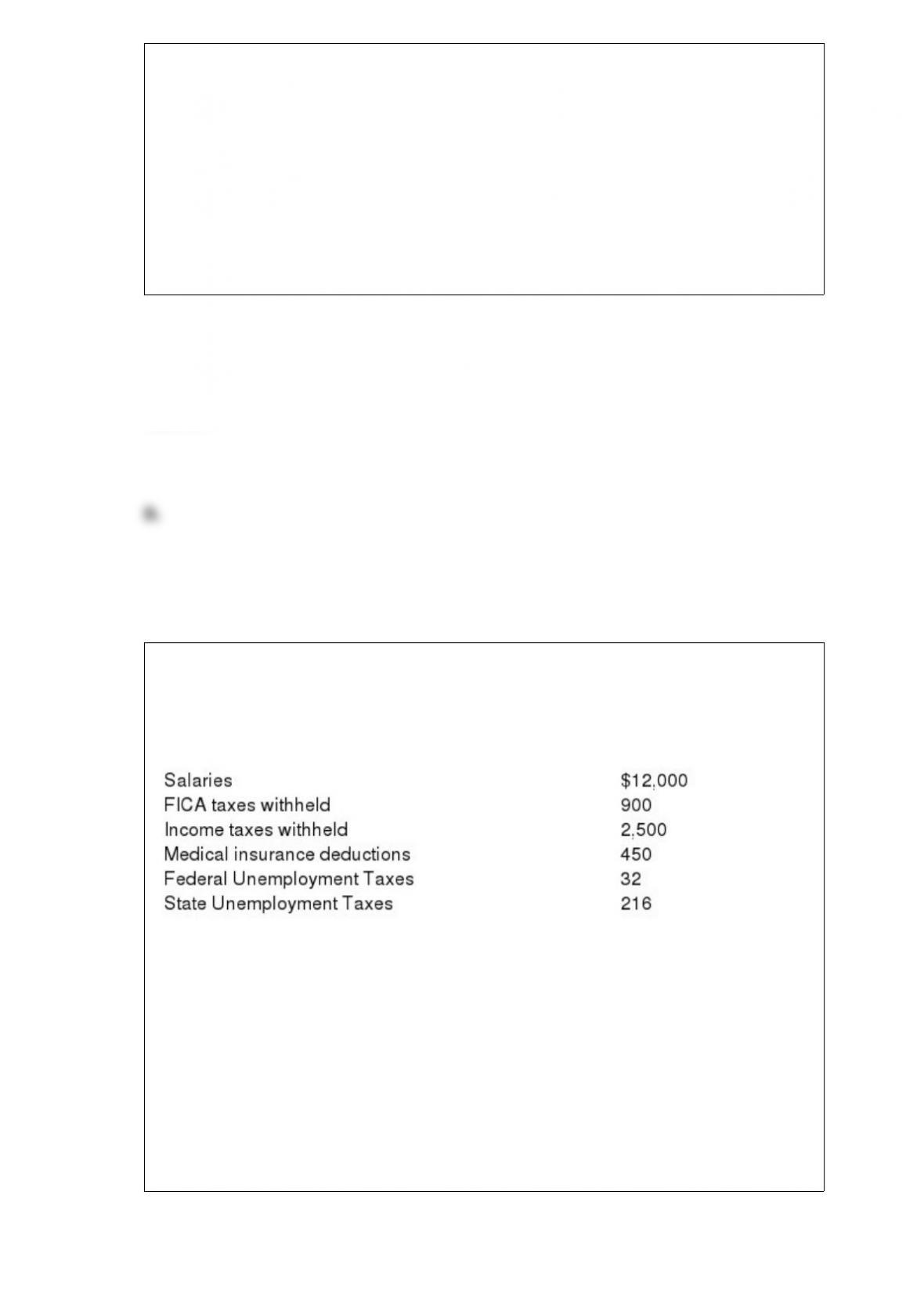
Use the following information to answer the following questions.
The following totals for the month of April were taken from the payroll register of
Magnum Company.
The journal entry to record the monthly payroll on April 30 would include a
A.credit to Salaries Payable for $8,150
B.debit to Salaries Expense for $7,902
C.debit to Salaries Payable for $8,150
D.debit to Salaries Payable for $7,902

Answer:
If at the end of the fiscal year the variances from standard are significant, the variances
should be transferred to the:
A.work in process account only
B.cost of goods sold account only
C.finished goods account only
D.work in process, cost of goods sold, and finished goods accounts
Answer:
Pia and Ramona are partners who share income in the ratio of 3:2. Their capital
balances are $90,000 and $130,000 respectively. Income Summary has a credit balance
of $40,000. What is Pia’s capital balance after closing Income Summary to Capital?
A.$70,000
B.$114,000
C.$110,000
D.$74,000

Answer:
Which of the following is not considered to be a liability?
A.Wages Payable
B.Accounts Receivable
C.Unearned Revenues
D.Accounts Payable
Answer:
On June 1, $40,000 of treasury bonds were purchased between interest dates. The
broker commission was $600. The bonds pay interest at 12%, which is paid
semiannually on January 1 and July 1. How much interest revenue will be recorded on
July 1?
A.$400
B.$406
C.$2,000
D.$2,400

Answer:
Rent expense incurred on a factory building would be treated as a(n):
A.indirect cost
B.period cost
C.product cost
D.both A and C are correct
Answer:
Equivalent production units, usually are determined for
A.direct materials and conversion costs.
B.direct materials only.
C.conversion costs only.
D.direct materials and direct labor costs only.
Answer:

Mandy Corporation sells a single product. Budgeted sales for the year are anticipated to
be 640,000 units, estimated beginning inventory is 98,000 units, and desired ending
inventory is 80,000 units. The quantities of direct materials expected to be used for each
unit of finished product are given below.
Material A .50 lb. per unit @ $ .60 per pound
Material B 1.00 lb. per unit @ $1.70 per pound
Material C 1.20 lb. per unit @ $1.00 per pound
The dollar amount of direct material C used in production during the year is:
A.$746,400
B.$724,800
C.$824,400
D.$758,160
Answer:
When a new partner is admitted to a partnership
A.a bonus may be attributable to the old partner
B.a bonus may only result from more cash being given by the new partner than the
value of the of the assets being purchased
C.a bonus agreed upon by the partners is recorded as an asset so long as the amount is
within the range set by the SEC
D.a bonus is not recorded
Answer:
A trial balance is prepared to
A.prove that there were no errors made in recording transactions into the journal
B.prove that no errors were made in posting to the ledger
C.prove that each account balance is correct
D.summarize the account balances to help prepare financial statements
Answer:
The units of an item available for sale during the year were as follows:
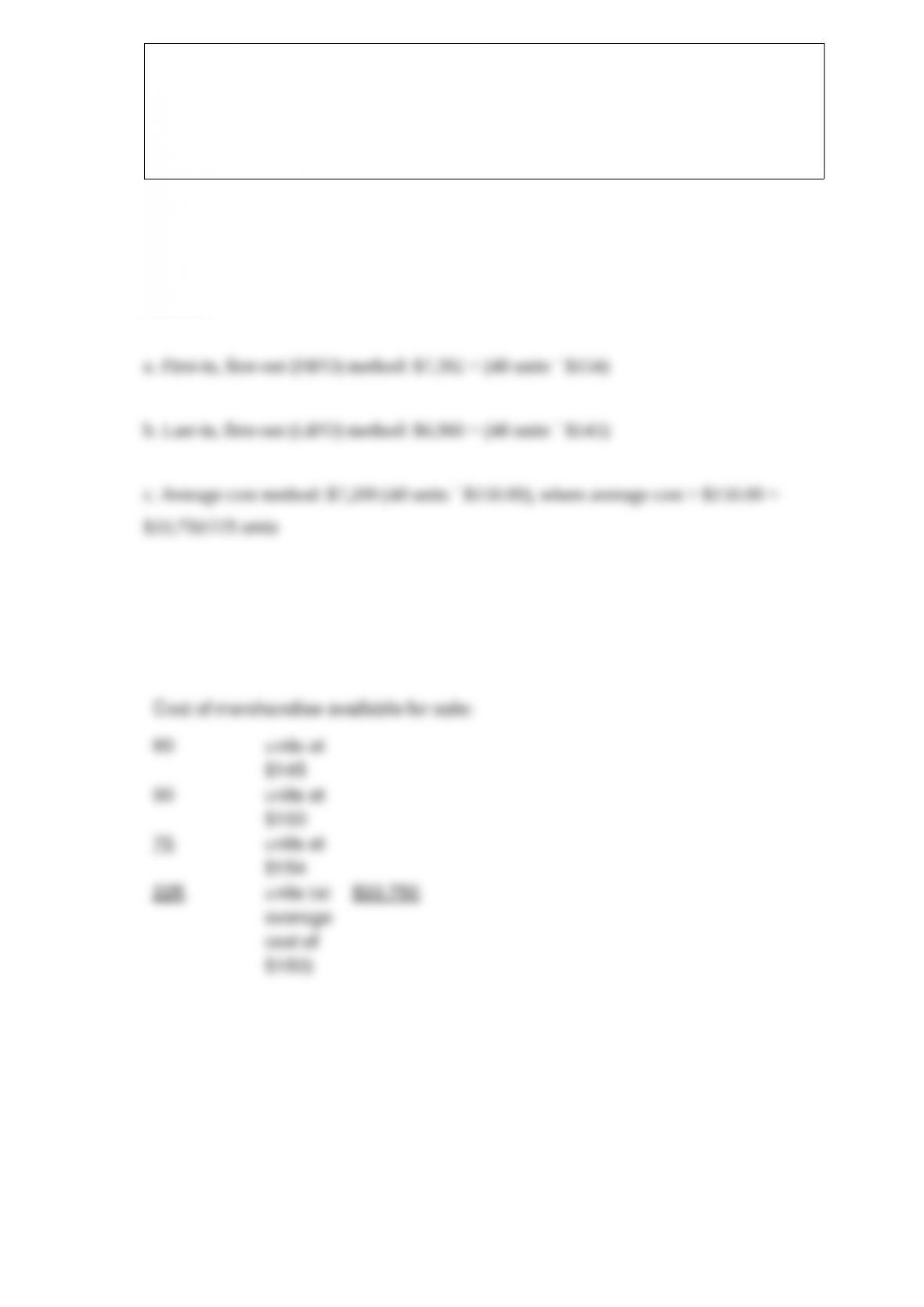
There are 48 units of the item in the physical inventory at December 31. The periodic
inventory system is used. Determine the inventory cost by (a) the first-in, first-out
method, (b) the last-in, first-out method, and (c) the average cost method. Show your
work.
Answer: