Liquidity measures the ability of a company to meet its current financial obligations.
The Securities and Exchange Commission (SEC) is the government agency that has
primary responsibility for setting accounting standards in the U.S.
Inventory is reported on the balance sheet as a current asset.
Accounts Payable, Notes Payable, and Salaries and Wages Payable are examples of
liabilities.
A company that pays no dividends is always a poor investment.
Manufacturers have three types of inventory, which include raw materials, work in
process, and finished goods, whereas merchandisers have only raw materials inventory.
When accrual basis accounting is used, net income equals the amount of cash generated
by the business.
The current ratio can be used to evaluate a company ‘s ability to pay liabilities in the
short term, and in general, a lower ratio means better ability to pay.
Amounts reported on financial statements are sometimes rounded to the nearest million.
Most companies report sales revenue, sales returns and allowances, and sales discounts,
as well as net sales on their externally reported income statements.
The asset, liability, and stockholders’ equity accounts are referred to as permanent
accounts.
During 2015, Maverick Law Firm had the following transactions with it clients
(customers):
On February 1, 2015, the company received cash of $5,000 from clients in payment of
their account balances as of December 31, 2014.
On November 1, 2015, the company received $2,000 cash as payments in advance for
law services to be performed in 2016.
The company received a total of $13,000 in cash for law services that were performed
during 2015.
The company sent bills totaling $4,000 to clients for services performed during 2015;
this amount was unpaid as December 31, 2015.
Use the information above to answer the following question. The journal entry prepared
by Seconds Best to record the March sales would include a debit to:
A) Cash for $10,000, debit to Accounts Receivable for $60,000, and credit to Sales
Revenue for $70,000.
B) Cash for $10,000, debit to Unearned Revenue for $60,000, and credit to Sales
Revenue for $70,000.
C) Cash for $10,000, debit to Accounts Payable for $60,000, and credit to Sales
Revenue for $70,000.
D) Cash and credit to Sales Revenue for $10,000.
Sinton Inc. uses a periodic inventory system. During the current year, its beginning
inventory was $5,200 and net purchases amounted to $24,600. At the end of the year,
after counting its inventory, the company determined that the dollar valuation of its
ending inventory was $4,100.
Required:
Part a. Calculate cost of goods available for sale.
Part a. Calculate cost of goods sold.
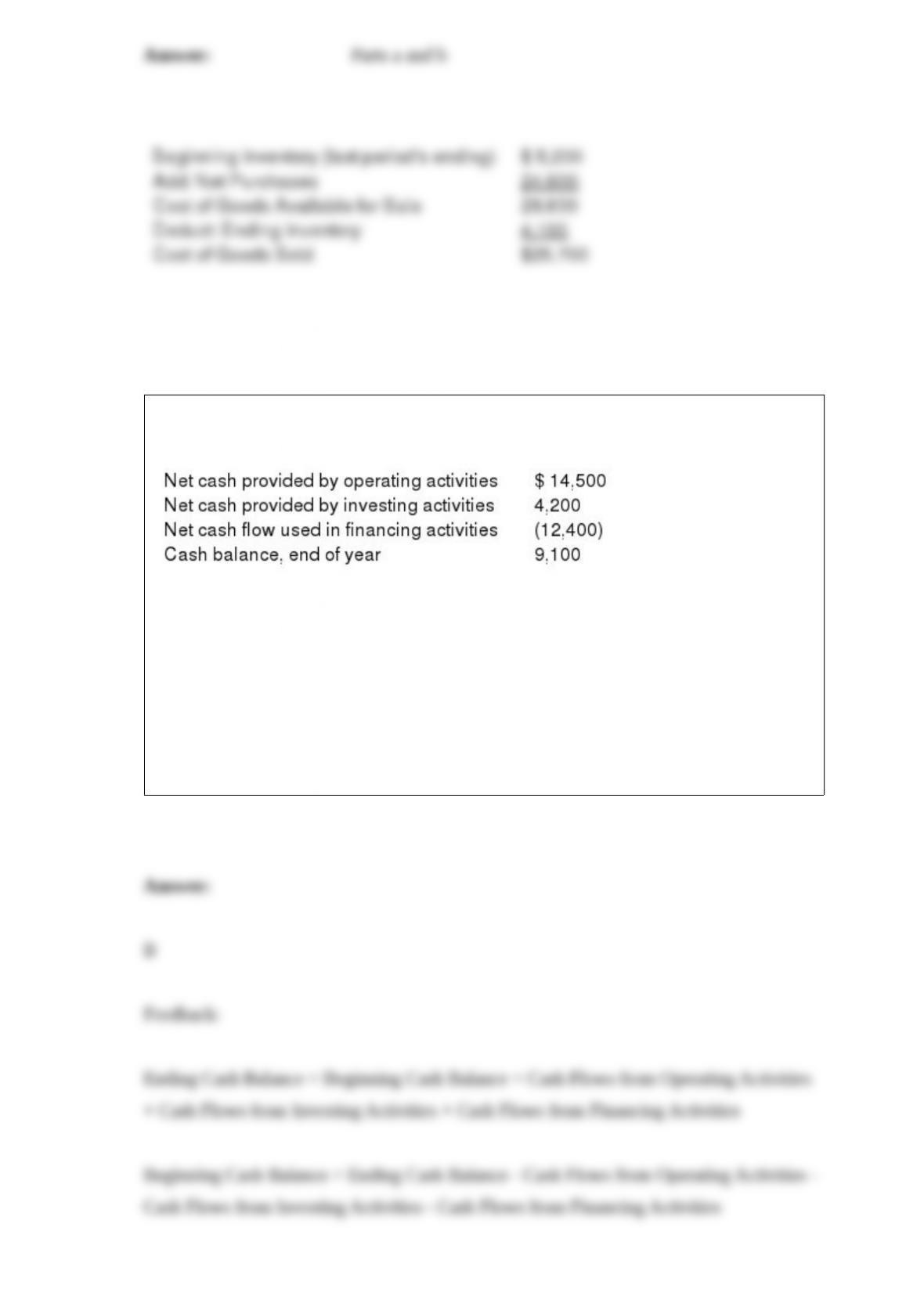
A corporation prepared its statement of cash flows for the year. The following
information is taken from that statement:
What is the cash balance at the beginning of the year?
A) $5,600
B) $2,800
C) $6,300
D) $15,400
A company buys equipment for $48,000, expects to use it for ten years, and then sell it
for $6,000. Using the straight-line method, the company should report annual
depreciation for the equipment of:
A) $4,200.
B) $8,400.
C) $4,800.
D) $9,600.
Your company is planning to issue $1,000 bonds with a stated interest rate of 7% and a
maturity date of July 15, 2022. If interest rates rise in the economy so that similar
financial investments pay 9%, your company will:
A) not be able to issue the bonds because no one will buy them.
B) receive a higher issue price to compensate buyers for the lower stated interest rate.
C) have to accept a lower issue price to attract buyers.
D) have to reprint the bond certificates to change the stated interest rate to 9%.
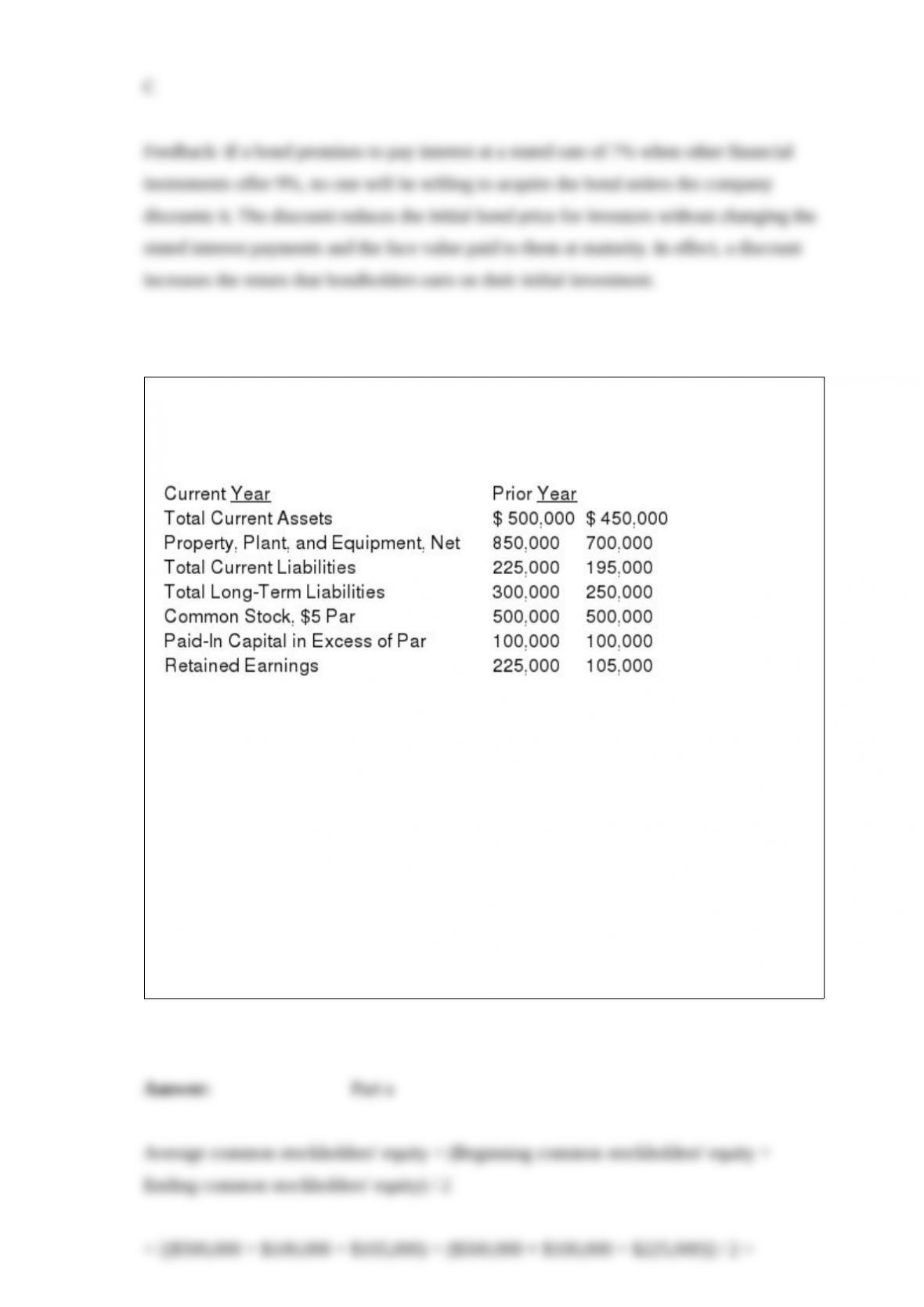
Carson Inc. reported net sales revenue of $850,000 and paid no dividends during the
current year. The following information is also available at the end of the current and
prior years:
There was no preferred stock outstanding during the current year.
Required:
Part a. Calculate the return on equity for the current year.
Part b. Calculate the debt-to-assets ratio for the current year.
Part c. Calculate the fixed asset turnover ratio for the current year.
Part d. Calculate the current ratio for the current year.
Round all ratios to two decimal points.
Which of these accounts would normally not be affected by an adjustment?
A) The Supplies account.
B) Revenue accounts.
C) Expense accounts.
D) The Cash Account.
A company started the current year with assets of $700,000, liabilities of $350,000 and
common stock of $200,000. During the current year, assets increased by $400,000,
liabilities decreased by $50,000 and common stock increased by $275,000. There was
no payment of dividends to owners during the year.
Use the information above to answer the following question. What was the amount of
net income for the year?
A) $225,000.
B) $275,000.
C) $175,000.
D) $450,000.
During one pay period, your company distributes $130,500 to employees as net pay.
The income tax withholdings were $19,000 and the FICA withholdings were $5,000.
Total payroll costs to the company for this pay period, excluding any unemployment
taxes, was:
A) $149,500.
B) $130,500.
C) $154,500.
D) $159,500.
Investing activities on the statement of cash flows arise from transactions:
A) with lenders, borrowing and repaying cash.
B) with stockholders, selling company stock and paying dividends.
C) directly related to running the business to earn profit.
D) related to buying or selling productive resources with long lives.
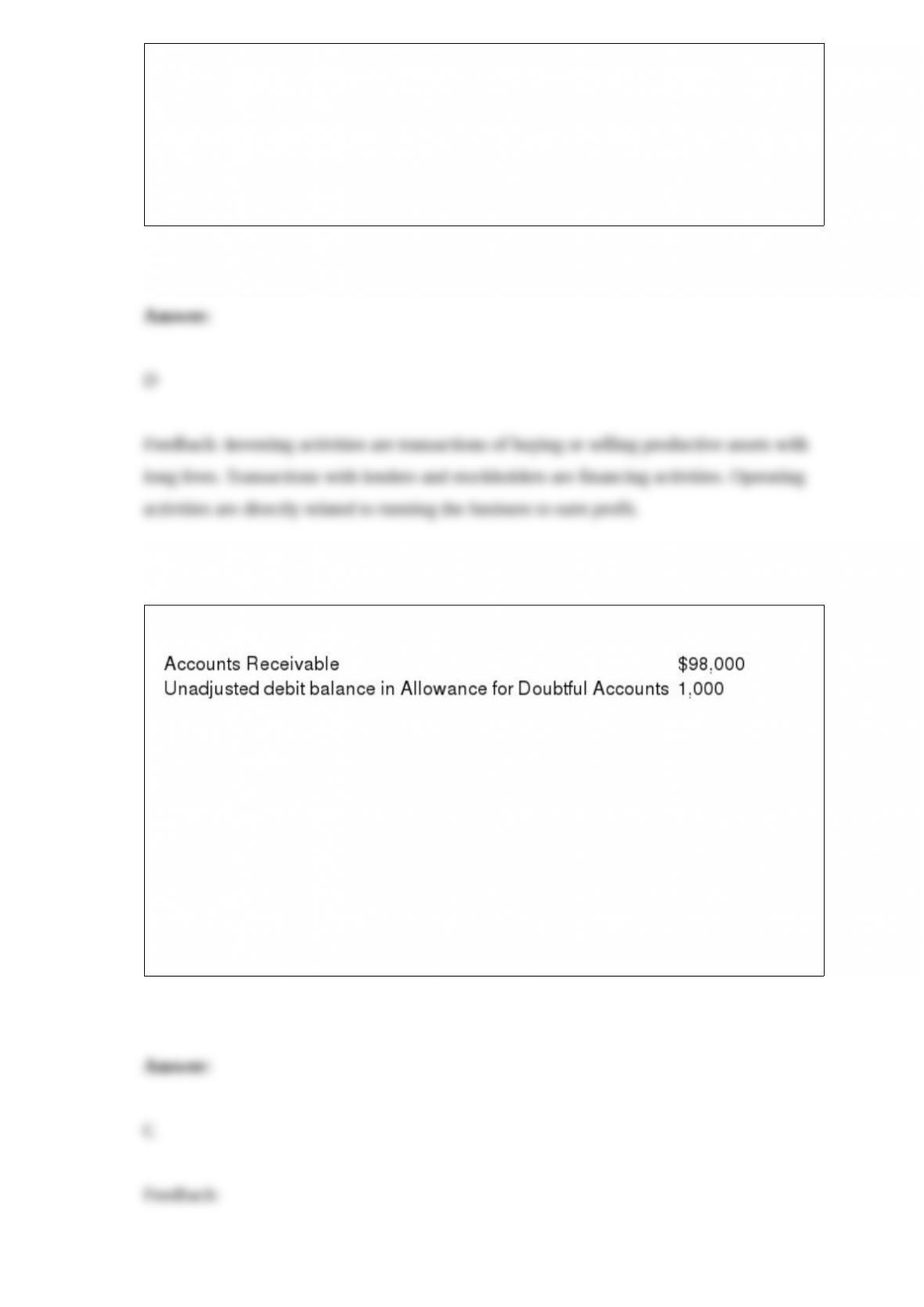
A company’s unadjusted trial balance at the end of the year includes the following:
The company uses the aging of accounts receivable method. Its estimate of
uncollectible receivables resulting from the aging analysis equals $5,800. What is the
amount of Bad Debt Expense to be recorded for the year?
A) $5,800
B) $4,800
C) $6,800
D) $7,800
A company reports Equipment on its classified balance sheet. The balance of the
Accumulated Depreciation account appears on a classified balance sheet as:
A) an addition to arrive at the amount of Equipment, Net.
B) a subtraction to arrive at the amount of Equipment, Net
C) part of Total Liabilities section.
D) a subtraction in the Total Liabilities section.
Which of the following is not needed to prepare a statement of cash flows?
A) Statement of Retained Earnings
B) Comparative balance sheets
C) Additional data concerning selected accounts that increase and decrease as a result of
investing and/or financing activities
D) A complete income statement
The T-account approach:
A) may be used with the direct method.
B) creates one big T-account for cash that replaces separate schedules to show all the
changes in the cash account.
C) shows cash provided as credits and cash used as debits.
D) does not determine the change in each balance sheet account.
Equipment, beginning of year $170,000
Equipment, end of year 210,000
Accumulated depreciation, beginning of year 95,000
Accumulated depreciation, end of year 92,000
Equipment with a cost of $10,000 and a book value of $3,000 was sold during the year
for cash of $9,000. Additional equipment was purchased during the year for cash.
At the end of the first year of an asset’s life, the declining-balance depreciation:
A) causes an asset to be carried at a higher book value than that computed using the
straight-line method.
B) causes an asset to be carried at a lower book value than that computed using the
straight-line method.
C) causes an asset to be carried at the same book value as that computed using the
straight-line method.
D) cannot be used if the resulting book value will be significantly different from that
which would result from using the straight-line method.
Under what circumstances should a company record an asset impairment loss?
A) When residual value is greater than the repairs and maintenance expenses needed to
keep up the asset
B) When book value is less than the residual value of the asset
C) When Accumulated Depreciation equals the purchase cost of the asset
D) When book value is greater than the fair value of the asset
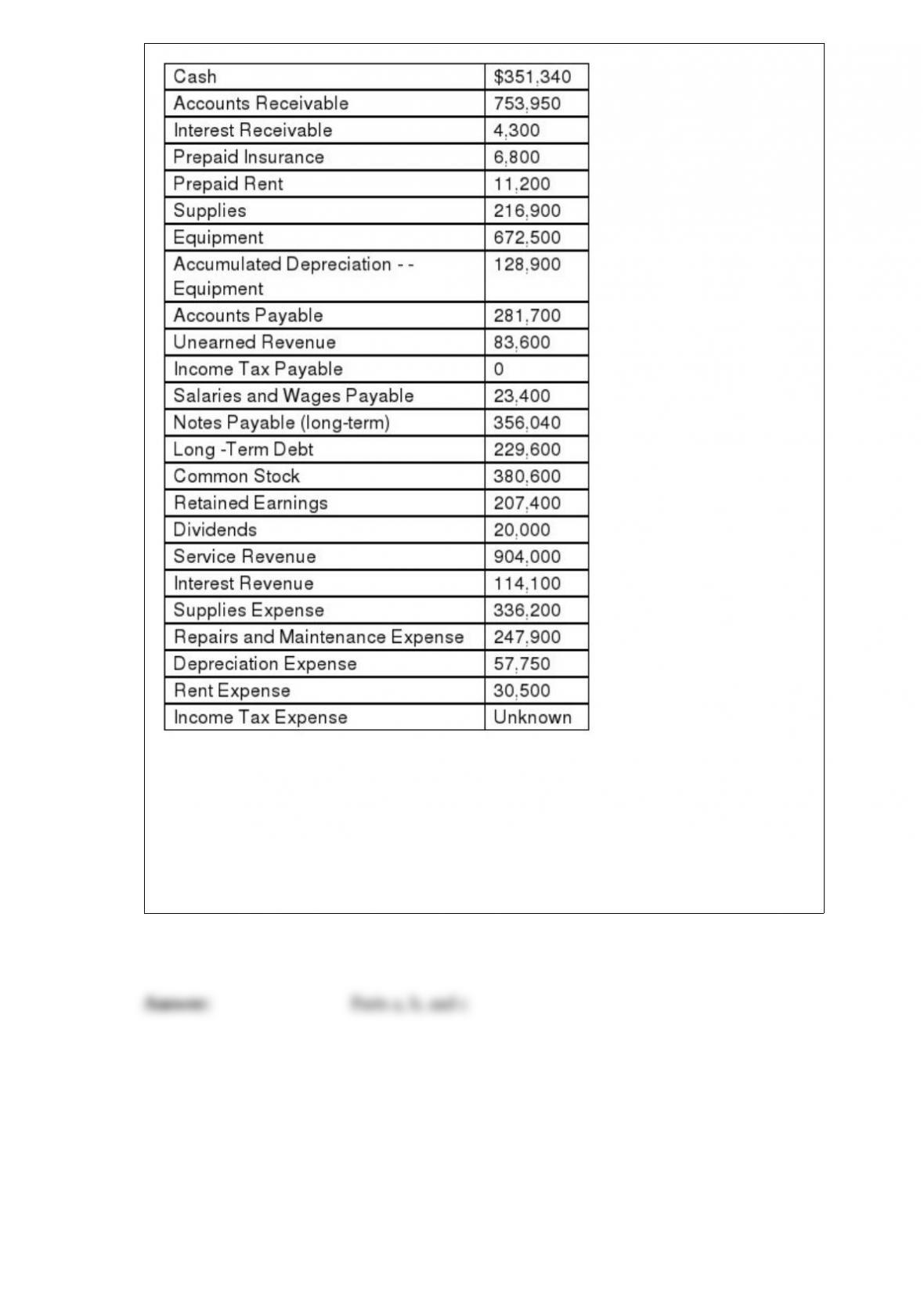
All of the accounts of the Grass is Greener Company have been adjusted as of
December 31, 2016, with the exception of income taxes incurred but not yet recorded.
Those account balances appear below. All have normal balances. The estimated income
tax rate for the company is 40%.
Required:
Part a. Calculate the income before income tax.
Part b. Calculate the income tax expense.
Part c. Calculate the net income.
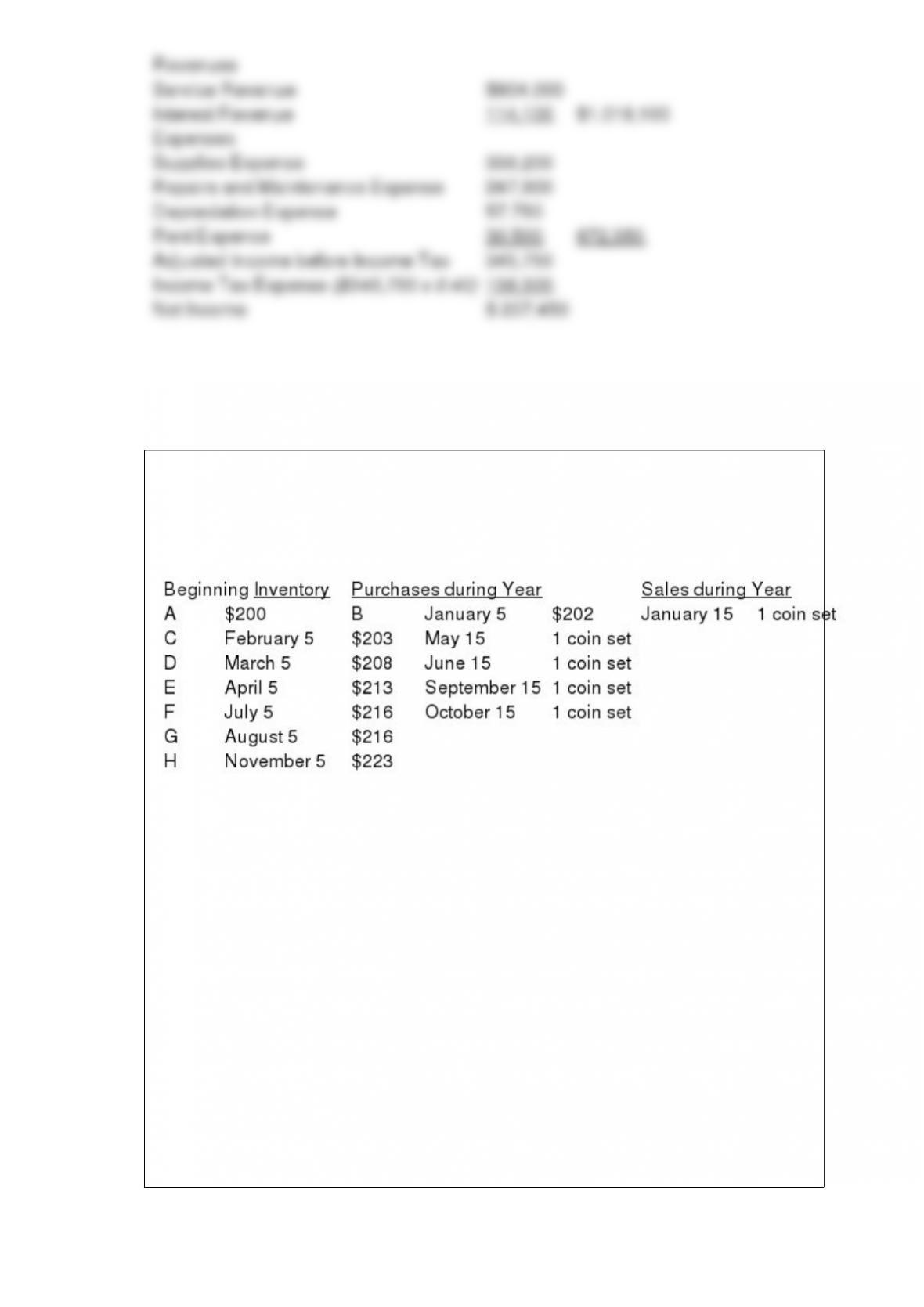
The following company purchases and sells collectors’ coin sets. The company uses the
LIFO inventory costing method. In the first two sections of the table below, each coin
set is identified by its letter and its cost. The third section indicates when coin sets were
sold.
Required:
For each inventory costing method given below, fill in the blanks to indicate the letter
of the coin set which will be used to calculate either cost of goods sold or the cost of
ending inventory.
Part a. Periodic Inventory System
Cost of Goods Sold = _____ + _____ + _____ + _____ + _____
Ending Inventory = _____ + _____ + _____
Part b. Perpetual Inventory System
Cost of Goods Sold = _____ + _____ + _____ + _____ + _____
Ending Inventory = _____ + _____ + _____
Which of the following would be classified as an investing activity on the statement of
cash flows?
A) Cash received from sale of land
B) Cash paid for interest
C) Cash received from stock issuance
D) Cash dividends paid