The ethical concept of integrity means that an individual must:
A. sign a pledge to abide by all laws and regulations.
B. report to a supervisor any violation of the code of conduct of her company that is
observed.
C. read, understand, and agree to follow all provisions of her employer’s code of
conduct.
D. attempt to be honest and forthright in dealings and communications with others.
Which of the following cost classifications would not be considered relevant in
comparing decision alternatives?
A. opportunity cost.
B. differential cost.
C. sunk cost.
D. none of the above.
The major difference between the indirect and the direct method of a statement of cash
flows appears in which of the following activities section(s)?
A. The investing activities and financing activities sections.
B. The investing activities section only.
C. The operating activities and financing activities sections.
D. The operating activities section only.
Which of the following is not an important qualitative factor to consider in the capital
budgeting decision?
A. regulations that mandate investment to meet safety, environmental, or access
requirements.
B. technological developments within the industry may require new facilities to
maintain customers or market share at the cost of lower ROI for a period of time.
C. commitment to a segment of the business that requires capital investments to achieve
or regain competitiveness even though that segment does not have as great an ROI as
others.
D. all of the above are important qualitative factors to consider.
The dollar amount of the common stock on the balance sheet of a corporation that has
common stock with a par value is the number of shares:
A. issued, multiplied by the amount received per share.
B. outstanding, multiplied by the amount received per share.
C. issued, multiplied by the par value per share.
D. outstanding, multiplied by the par value per share.
The Statement of Cash Flows:
A. shows how cash changed during the period.
B. is an optional financial statement.
C. shows the change in the fair value of the entity’s common stock during the period.
D. shows the dividends that will be paid in the future.
If the actual level of activity is different from the budgeted level, a _________ budget is
prepared for the actual level of activity:
A. continuous
B. zero-based
C. master
D. flexible
The following information was available for the year ended December 31, 2016:
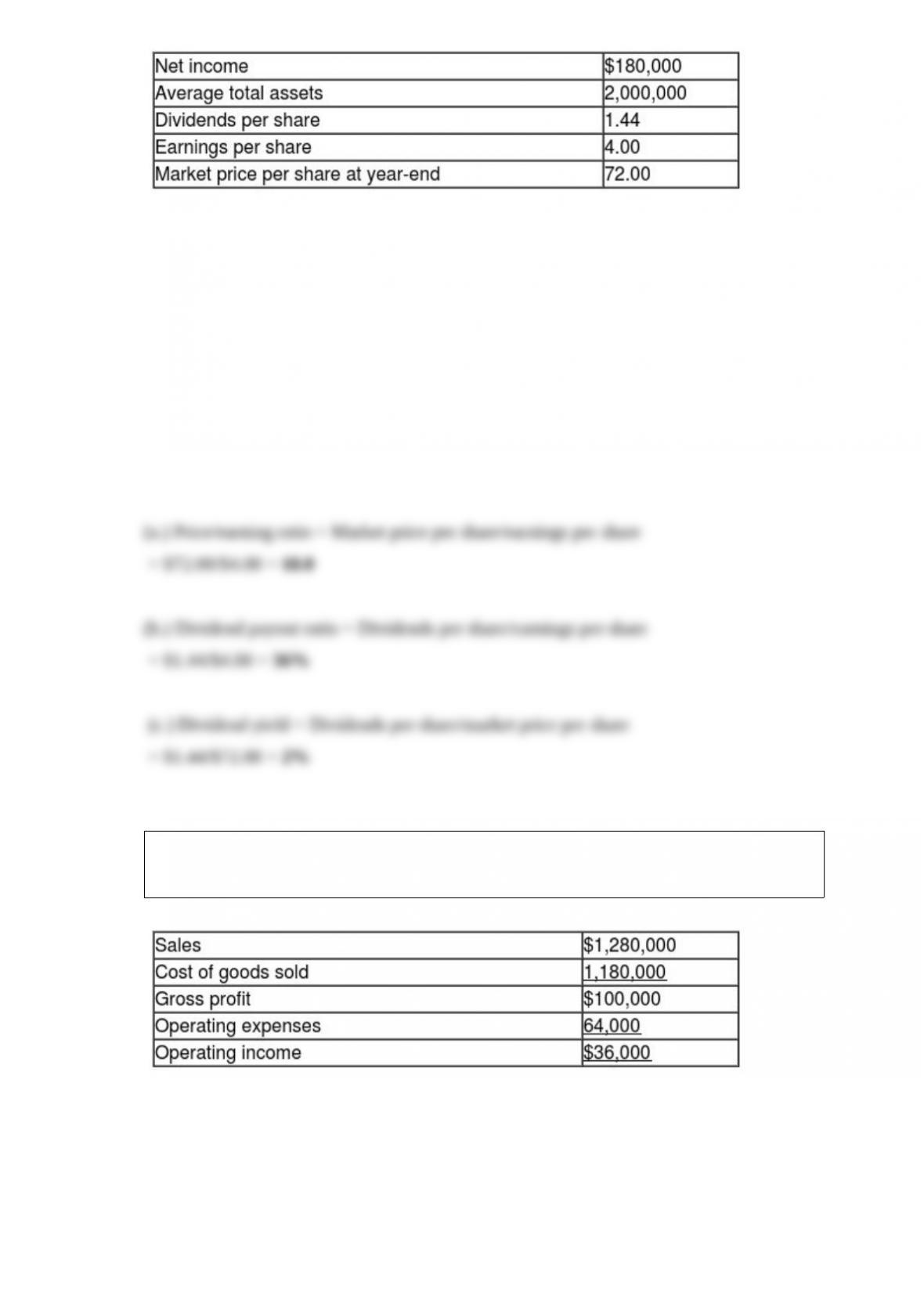
Required:
(a.) Calculate the price/earnings ratio for 2016.
(b.) Calculate the dividend payout ratio for 2016.
(c.) Calculate the dividend yield for 2016.
Presented below is the income statement for Ackee Food Center for the month of July:
Based on an analysis of cost behavior patterns, it has been determined that the company’s
contribution margin ratio is 15 percent.
(a.) Rearrange the above income statement to the contribution margin format.
(b.) If sales increase by 10 percent, what will be the firm’s operating income?
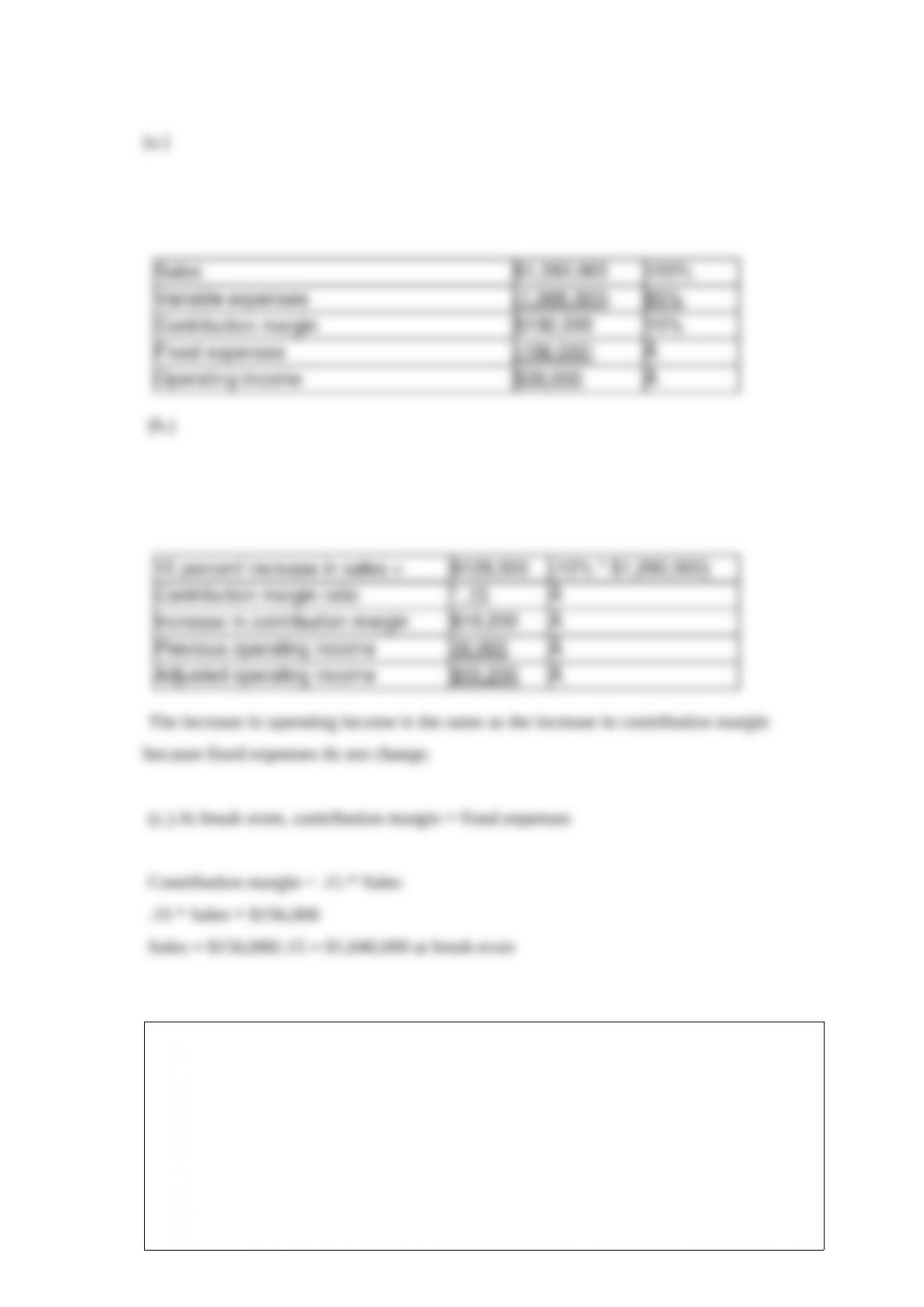
(c.) Calculate the amount of revenue required for Ackee’s Food Center to break even.
Digital Devices, Inc. has received a special order to manufacture 10,000 CD ROM
drives for an Italian computer manufacturer. Digital determines that the order will not
affect its current domestic sales of CD ROM drives and because of the special nature of
the order no sales commission would be paid. However, to process the order for export,
an additional handling cost of $10 per unit is estimated. The order indicates that the
price of the drives cannot exceed $200.
The company has the capacity to produce 100,000 units annually but is currently
operating at 75% of available capacity. Unit selling price and costs, based on estimated
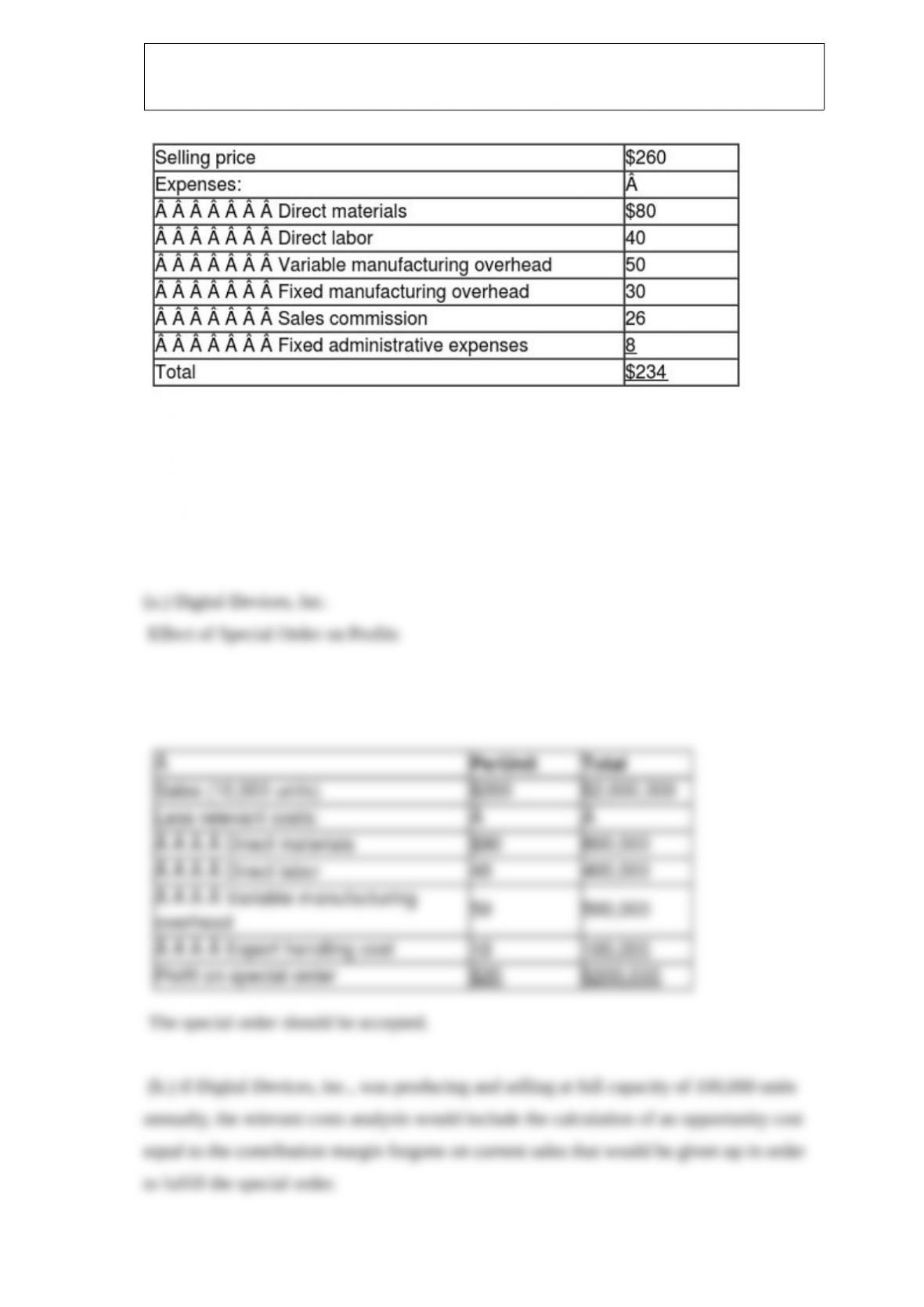
actual capacity being utilized, are as follows:
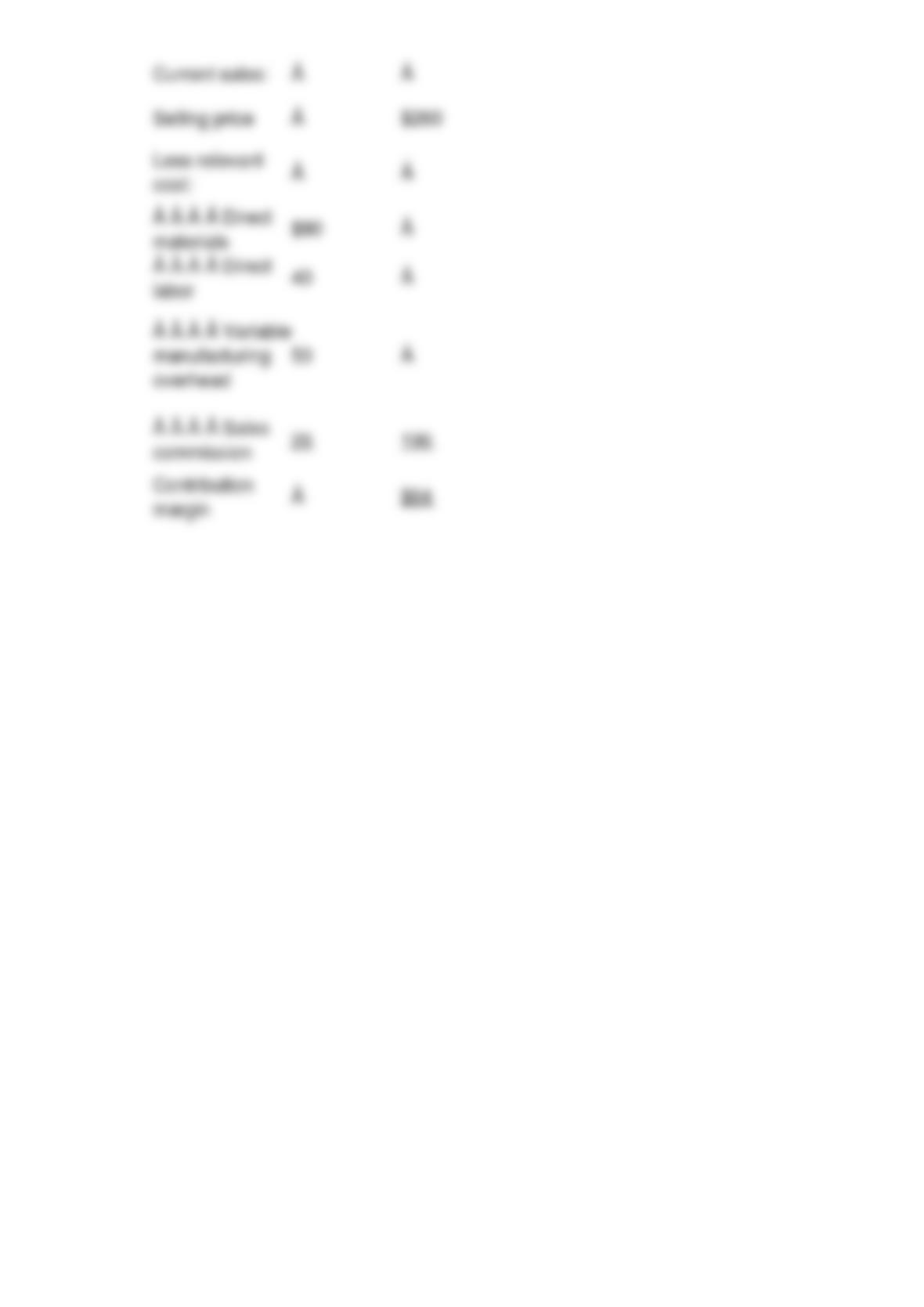
(a.) Prepare a relevant cost analysis showing the effect on profit if the company accepts
the special order.
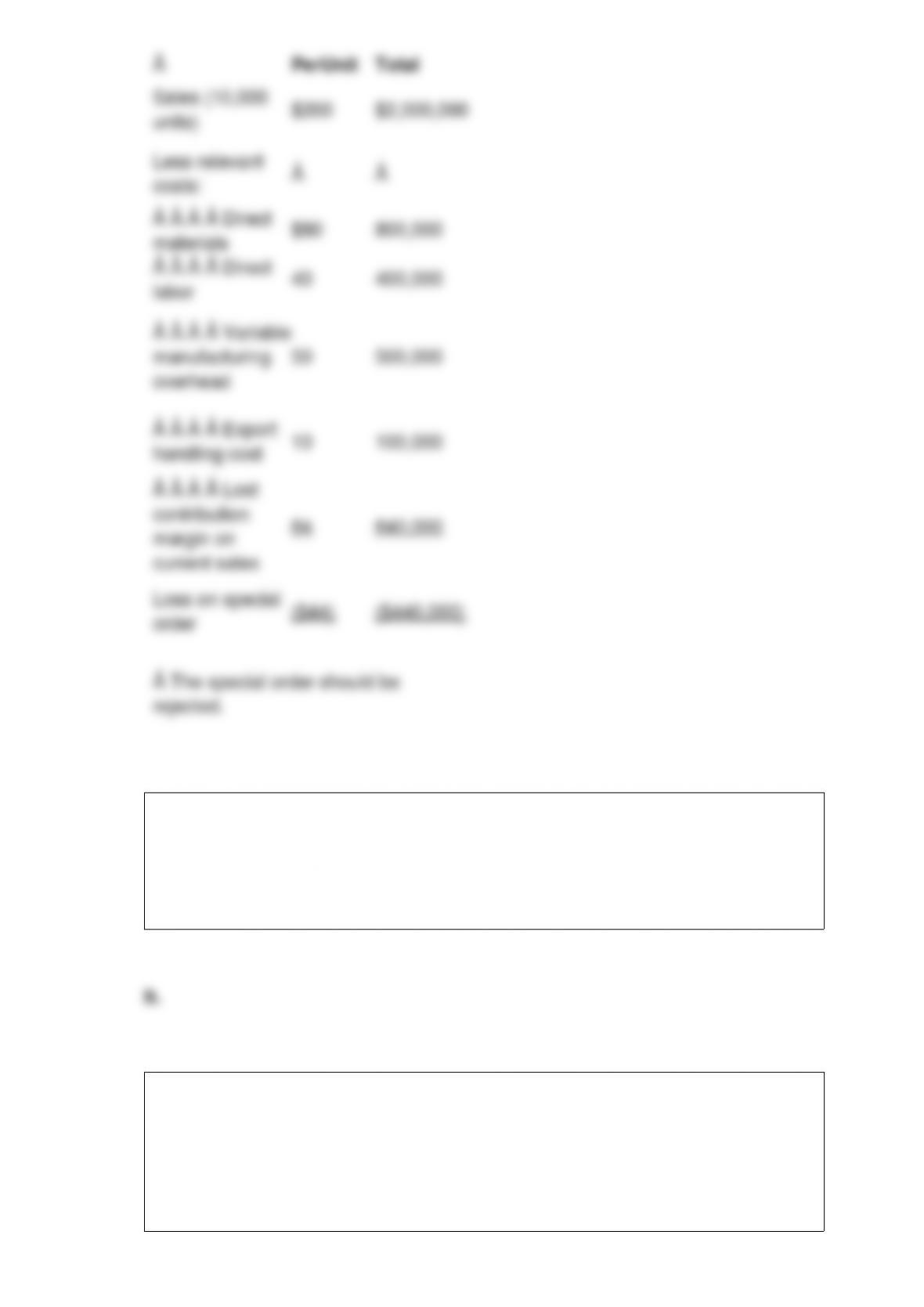
(b.) How would your analysis change if Digital Devices, Inc., was producing and selling
100,000 units annually?
The inventory cost flow assumption describes the flow of product cost:
A. from the warehouse to the customer.
B. from the asset (inventory) account and to the expense (cost of goods sold) account.
C. from the revenue (sales) account and to the expense (cost of goods sold) account.
D. from the asset (inventory) account and to the revenue (sales) account.
Which of the following is more relevant to management accounting than to cost
accounting?
A. accumulation and determination of product or service cost.
B. income measurement and inventory valuation.
C. generally accepted accounting principles.
D. providing managers information for planning and control purposes.

The use of activity-based costing information to support the decision-making process is
known as:
A. value chain analysis.
B. cost distortion analysis.
C. activity-based management.
D. cost-based management.
An example of a cost likely to have a fixed behavior pattern is:
A. sales force commission.
B. production labor wages.
C. advertising cost.
D. electricity cost for packaging equipment.
When a corporation has both common stock and preferred stock outstanding:
A. dividends on preferred stock are paid only if the company has current earnings.
B. dividends on preferred stock must be paid before dividends on common stock can be
paid.
C. preferred stockholders receive the same dividend per share as common stockholders.
D. dividends on preferred stock are paid only if dividends are to be paid on the common
stock.
When costs are rising over time:
A. LIFO results in higher profits that FIFO.
B. Cost of goods sold using the weighted average method will be greater than LIFO
cost of goods sold.
C. ending inventory balances will be greater under LIFO.
D. FIFO results in higher profits than LIFO.

Which of the following is not a topic that is likely to be discussed as a significant
accounting policy?
A. Depreciation method.
B. Earnings per share of common stock calculation details.
C. Inventory valuation method.
D. Method of estimating uncollectible accounts receivable.
The decision for solving production mix problems involving multiple products and
scarce production resources should focus on:
A. gross profit of each product.
B. sales price of each product.
C. contribution margin per unit of scarce resource.
D. contribution margin of each product.
Cost of Goods Manufactured can be computed as:
A. ending balance of work in process + raw materials used + direct labor costs incurred
+ manufacturing overhead costs applied – beginning balance of work in process.
B. beginning balance of work in process + raw materials purchased + direct labor costs
incurred + manufacturing overhead costs applied – ending balance of work in process.
C. ending balance of work in process + raw materials purchased + direct labor costs
incurred + manufacturing overhead costs applied – beginning balance of work in
process.
D. beginning balance of work in process + raw materials used + direct labor costs
incurred + manufacturing overhead costs applied – ending balance of work in process.
Which of the following entities would not require accounting information pertaining to
their economic activities?
A. Social clubs.
B. Not-for-profit entities.
C. State governments.
D. All of the above require accounting information.
E. None of the above requires accounting information.
The total variance for any particular cost component is referred to as the:
A. price variance.
B. efficiency variance.
C. budget variance.
D. none of the above.
Which of the following is true regarding notes receivables?
A. A notes receivable is always a long-term asset.
B. A notes receivable is always a current asset.
C. A note is a more formal document than an account receivable.
D. A note is a less formal document than an account receivable.
Which of the following is not one of the 5 questions of transaction analysis?
A. What’s going on?
B. Which accounts are affected?
C. Is this an accrual?
D. Does the balance sheet balance?
E. Does my analysis make sense?
The number of shares of a class of stock that are outstanding is:
A. the number of shares authorized minus the number of shares issued.
B. the number of shares authorized minus the number of shares held as treasury stock.
C. the number of shares issued minus the number of shares held as treasury stock.
D. the number of shares issued minus the number of shares owned by directors.
_____________ allows managers to focus their attention on maximizing an amount of
earnings above a minimum required ROI.
A. Optimization
B. The DuPont model
C. Residual income
D. Transfer pricing
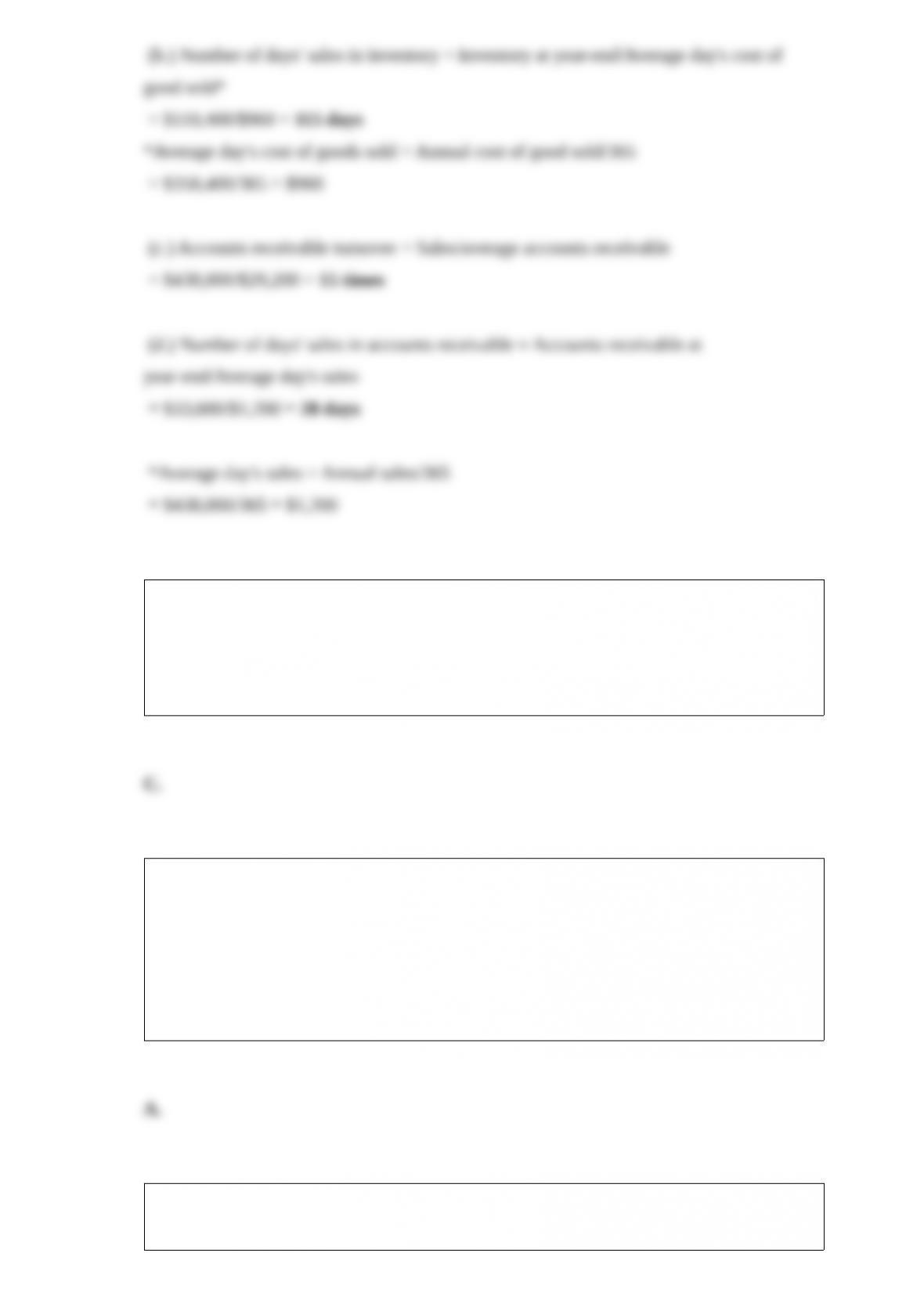
The following information was available for the year ended December 31, 2016:
Required:
(a.) Calculate the inventory turnover for 2016.
(b.) Calculate the number of days’ sales in inventory for 2016, using year-end inventories.
(c.) Calculate the accounts receivable turnover for 2016.
(d.) Calculate the number of days’ sales in accounts receivable for 2016, using year-end
accounts receivable
The Statement of Changes in Stockholders’ Equity shows:
A. the change in cash during a year.
B. revenues, expenses, and liabilities for the period.
C. net income and dividends for the period.
D. paid-in capital and long-term debt at the end of the period.
The officer of a corporation responsible for the firm’s published financial statements
would be most concerned about pronouncements of the:
A. FASB.
B. AICPA.
C. GASB.
D. SEC.
E. IRS.
Use the appropriate factors from Table 6 – 4 or Table 6 – 5 to answer the following
questions.
(a.) Yoko Co.’s common stock is expected to have a dividend of $3 per share for each of
the next four years, and it is estimated that the market value per share will be $42 at the
end of four years. If an investor requires a return on investment of 12%, what is the
maximum price the investor would be willing to pay for a share of Yoko Co. common
stock today?
(b.) Lashana bought a bond with a face amount of $1,000, a stated interest rate of 10%,
and a maturity date 20 years in the future for $1,025. The bond pays interest on a
semi-annual basis. Five years have gone by and the market interest rate is now 12%.
What is the market value of the bond today?
If a firm sells treasury stock for more than its cost:
A. a gain is recognized in the income statement.
B. retained earnings is increased.
C. additional paid-in capital is increased.
D. total stockholders’ equity does not change.
Which of the following are qualified to express an auditor’s opinion about an entity’s
financial statements?
A. A Comptroller.
B. A Certified Management Accountant.
C. A Certified Internal Auditor.
D. A Certified Public Accountant.
E. None of the above.
A predetermined overhead rate is used to:
A. keep track of actual overhead costs as they are incurred.
B. assign indirect costs to cost objects.
C. establish prices for manufactured products.
D. allocate selling and administrative expenses to manufactured products.
For most firms, the cost of capital is probably in the range of:
A. the prime rate, plus or minus 2 percentage points.
B. less than 10%.
C. between 10% and 20%.
D. more than 20%.
The annual per share dividend requirement of a 6%, $100 par value preferred stock that
was issued for $105 is:
A. $6.00
B. $6.38
C. $7.50
D. $10.00
The payment of a current liability will:
A. decrease net income.
B. decrease working capital.
C. increase working capital.
D. not affect working capital.
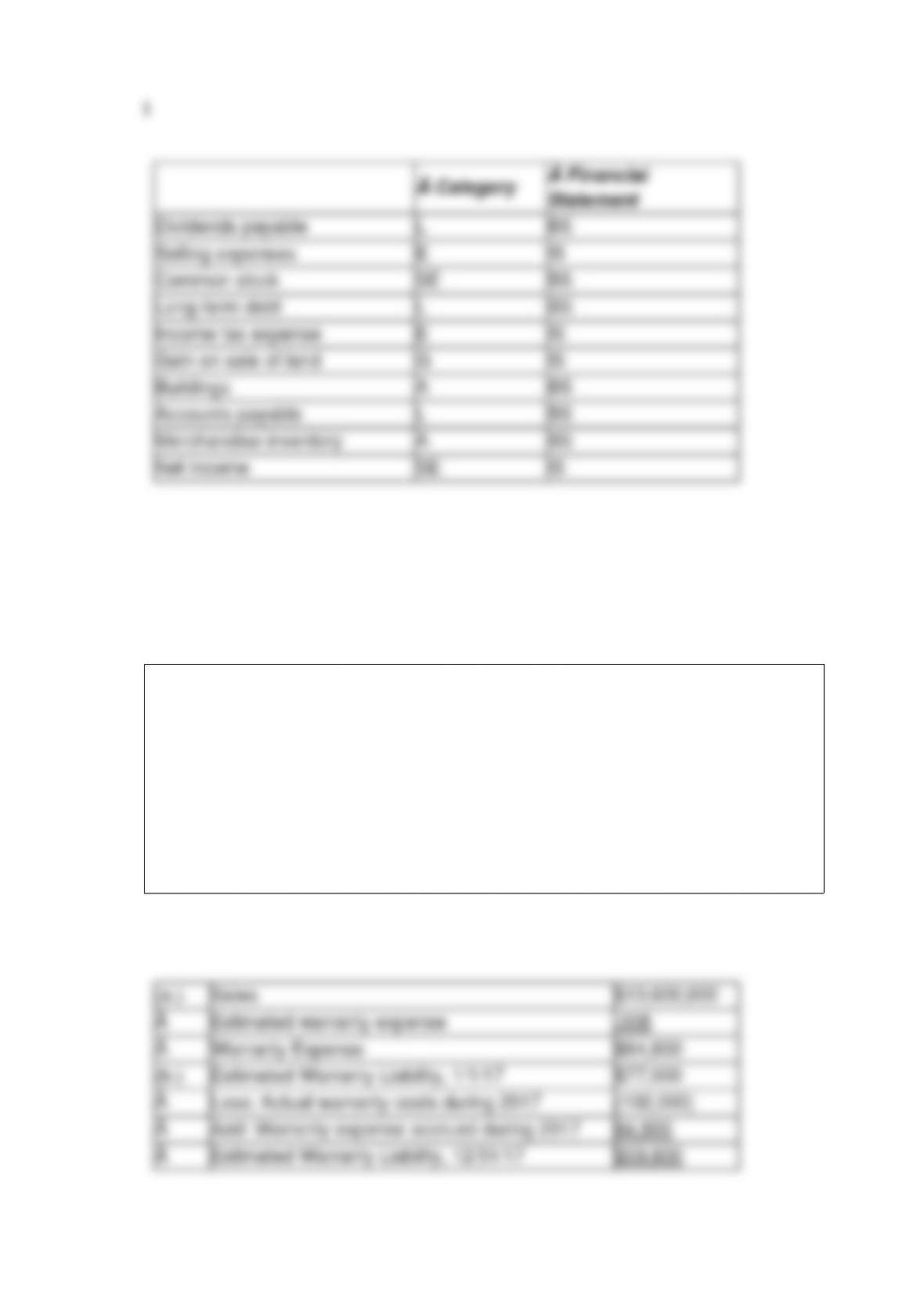
Listed below are a number of financial statement captions.
Claudette, Inc., provides warranties for many of its products. The January 1, 2017,
balance of the Estimated Warranty Liability account was $77,000. Based on an analysis
of warranty claims during the past several years, this year’s warranty provision was
estimated to be 0.8 percent of sales. During 2017, the actual costs of servicing products
under warranty were $102,000, and sales were $10,600,000.
(a.) What amount of Warranty Expense will appear on the income statement for 2017?
(b.) What amount will be reported in the Estimated Warranty Liability account on the
December 31, 2017, balance sheet?
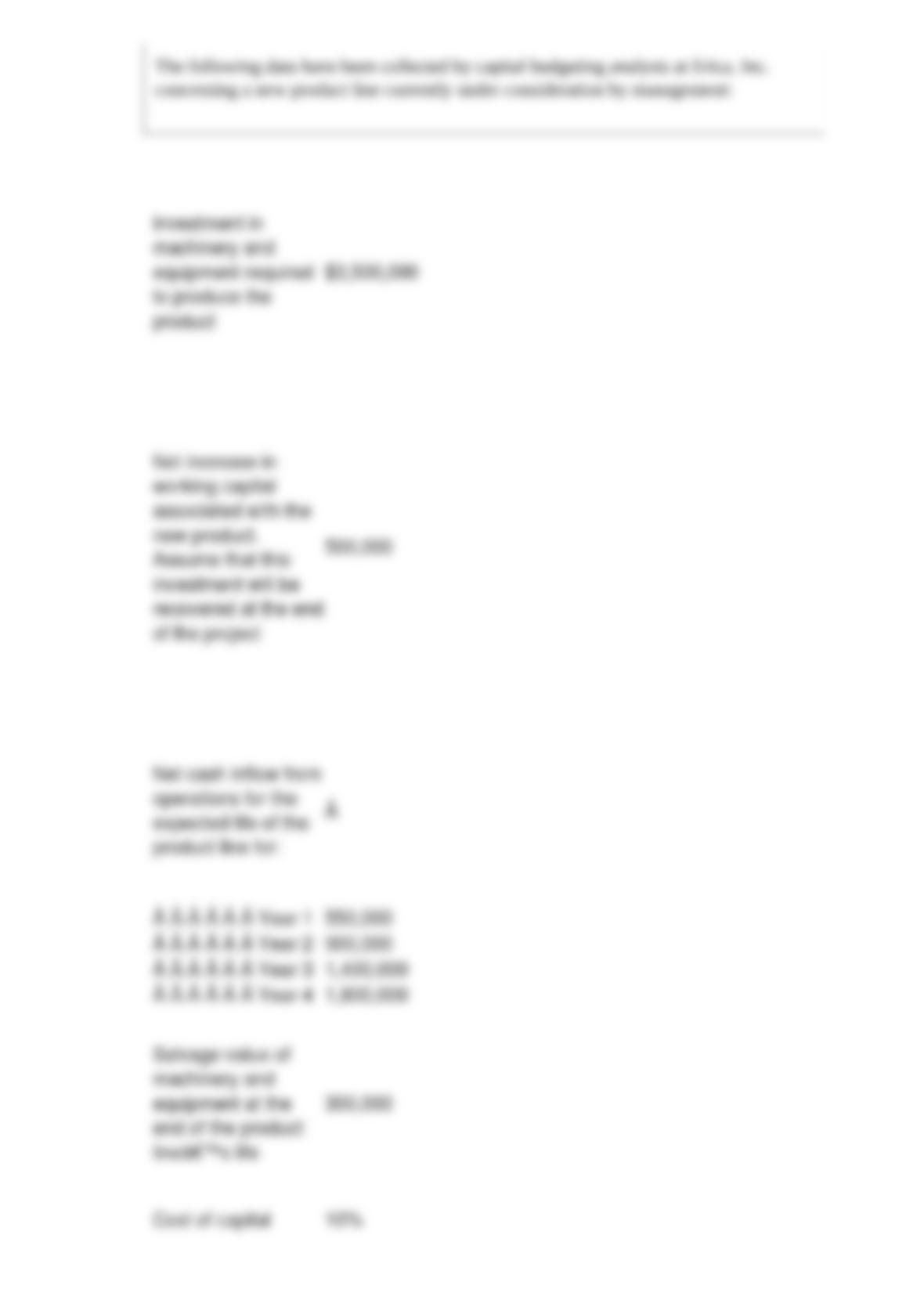
The following data have been collected by capital budgeting analysts at Erica, Inc.
concerning a new product line currently under consideration by management:
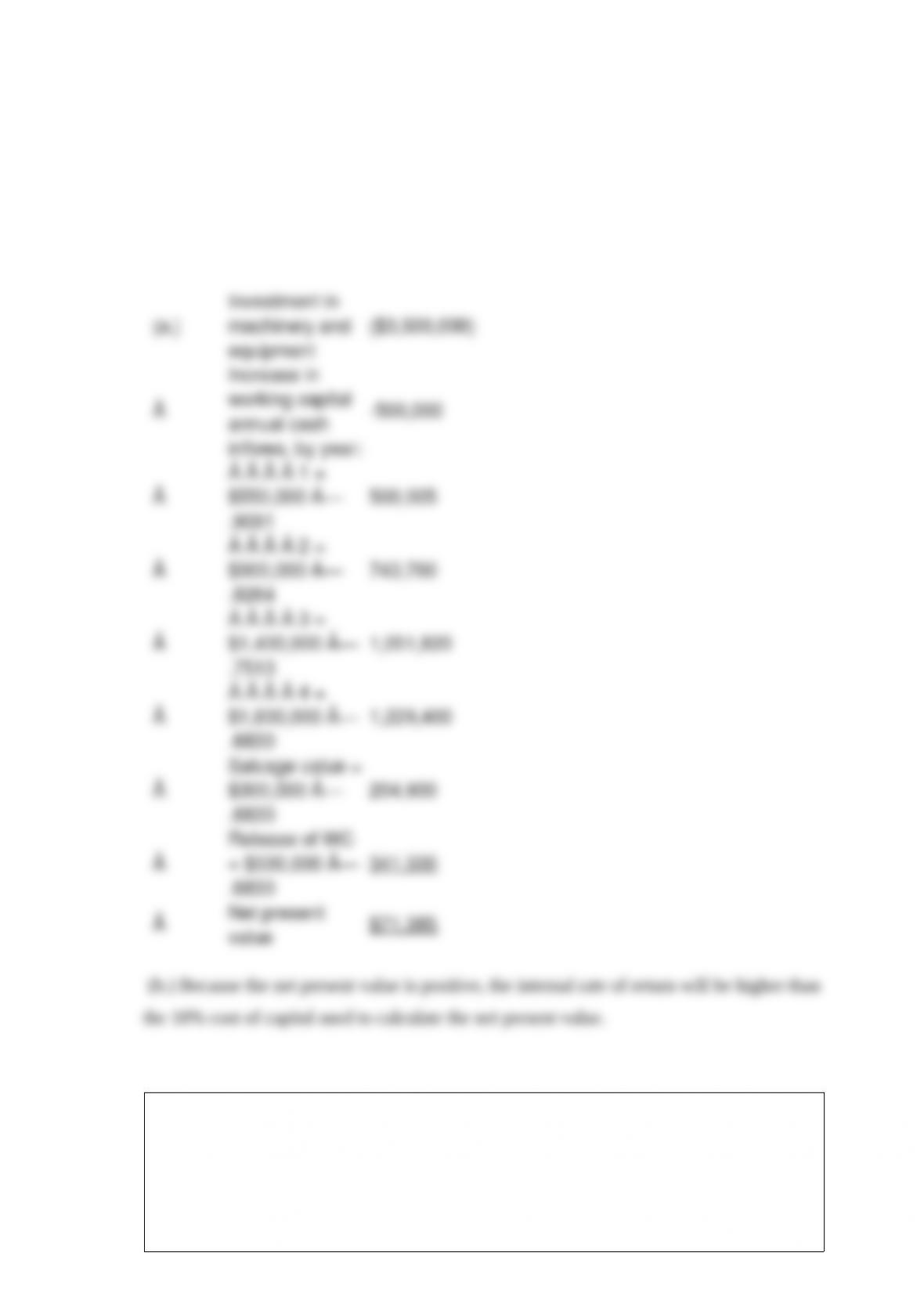
(a.) Calculate the net present value of the proposed investment in the new product line.
Ignore income taxes, and round all answers to the nearest $1.
(b.) What will the internal rate of return on this investment be relative to the cost of
capital? Explain your answer.
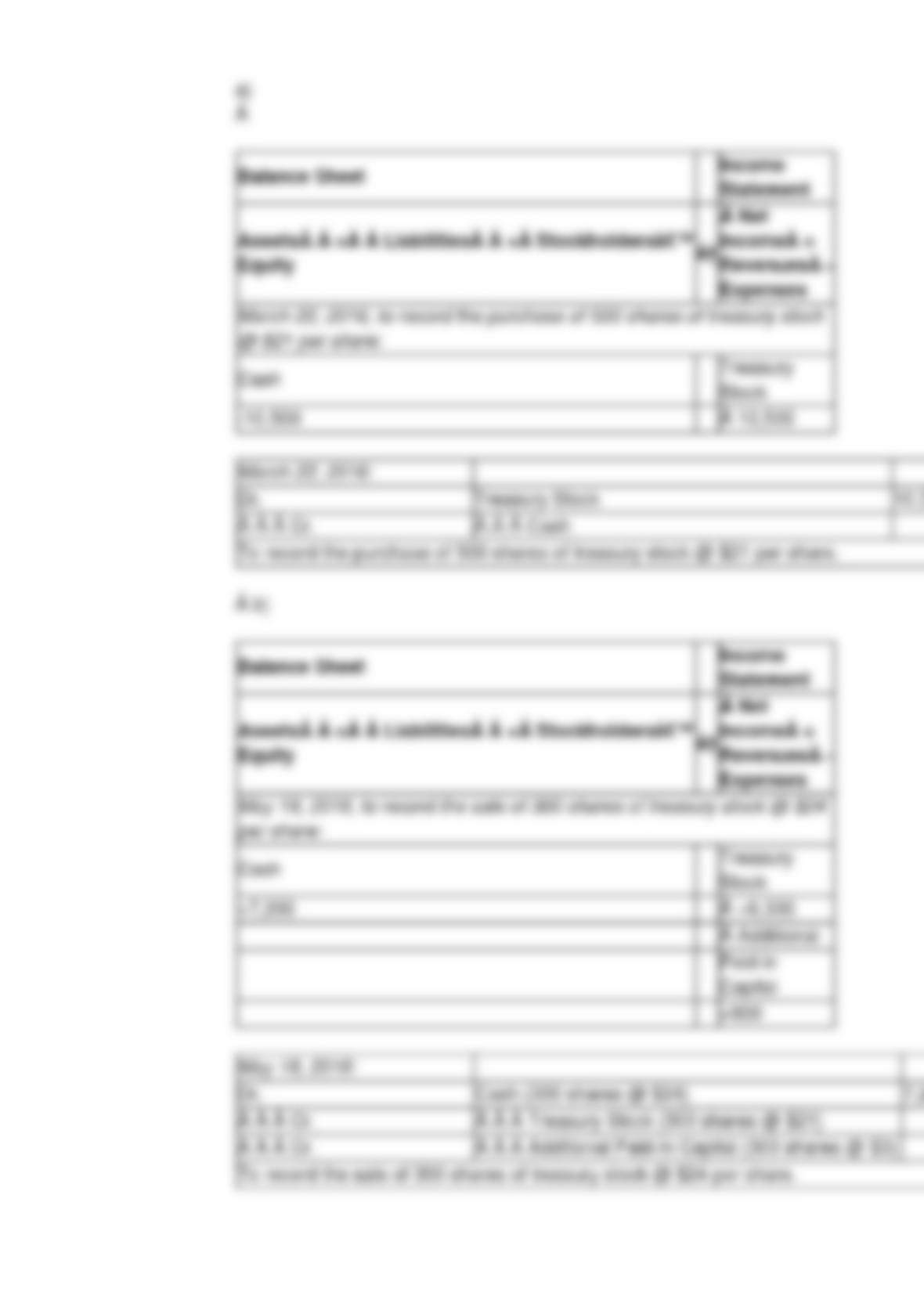
On March 22, 2016, Amelia, Inc., purchased 500 shares of its own common stock in the
market for $21 per share. On May 19, 2016, the company sold 300 of these shares in
the open market at a price of $24 per share.
Required:

Use the horizontal model (or write the entry) to show the effects on Amelia, Inc.’s
financial statements of:
(a.) The purchase of the treasury stock on March 22, 2016.
(b.) The sale of the treasury stock on May 19, 2016.
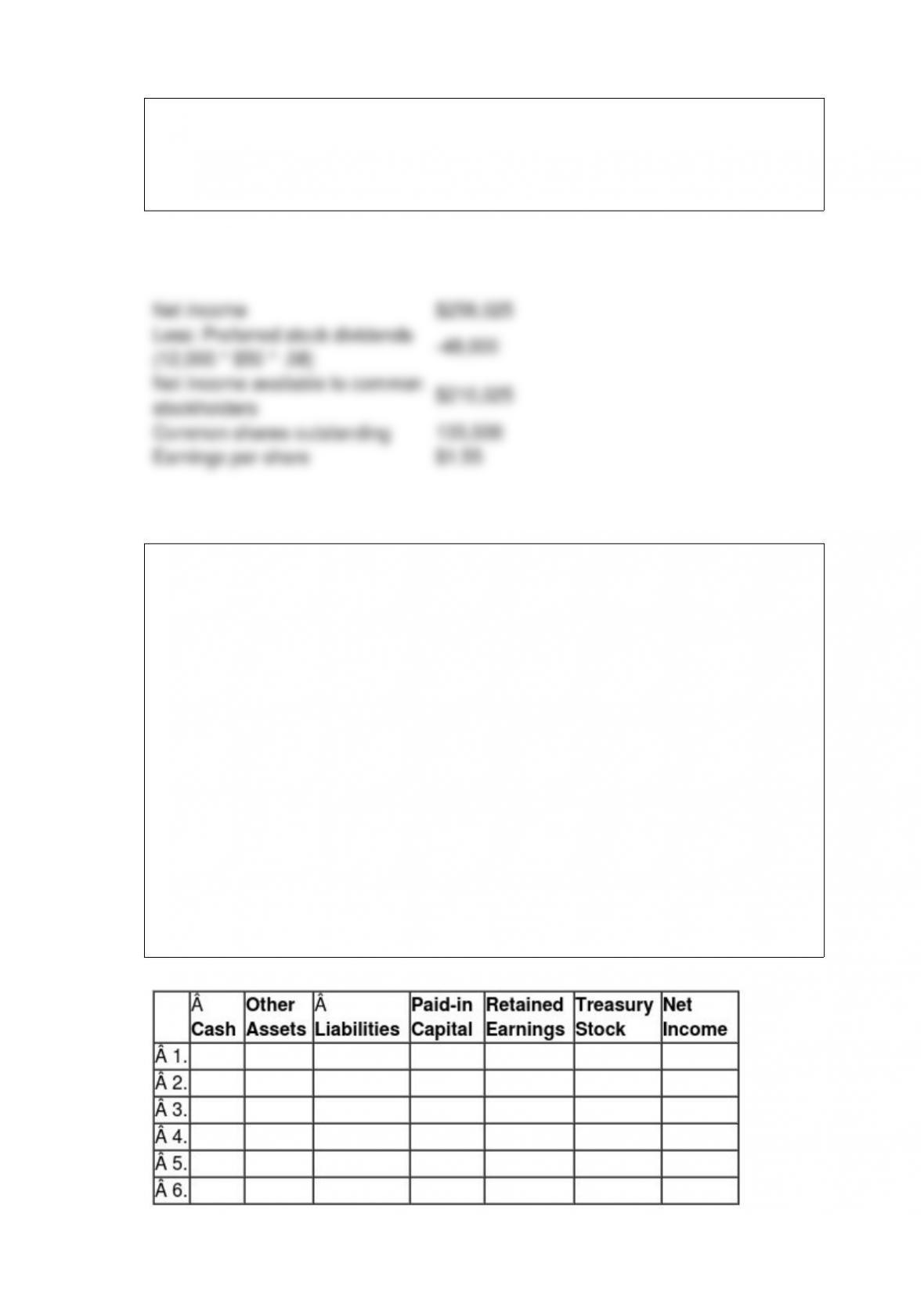
Sparkle Cleaners, Inc.Sparkle Cleaners, Inc., had net income of $258,025 for its fiscal
year ended September 30, 2017. During the year, the company had outstanding 12,000
shares of 8%, $50 par value preferred stock, and 135,500 shares of common stock.
Calculate the basic earnings per share of common stock for the 2017 fiscal year.
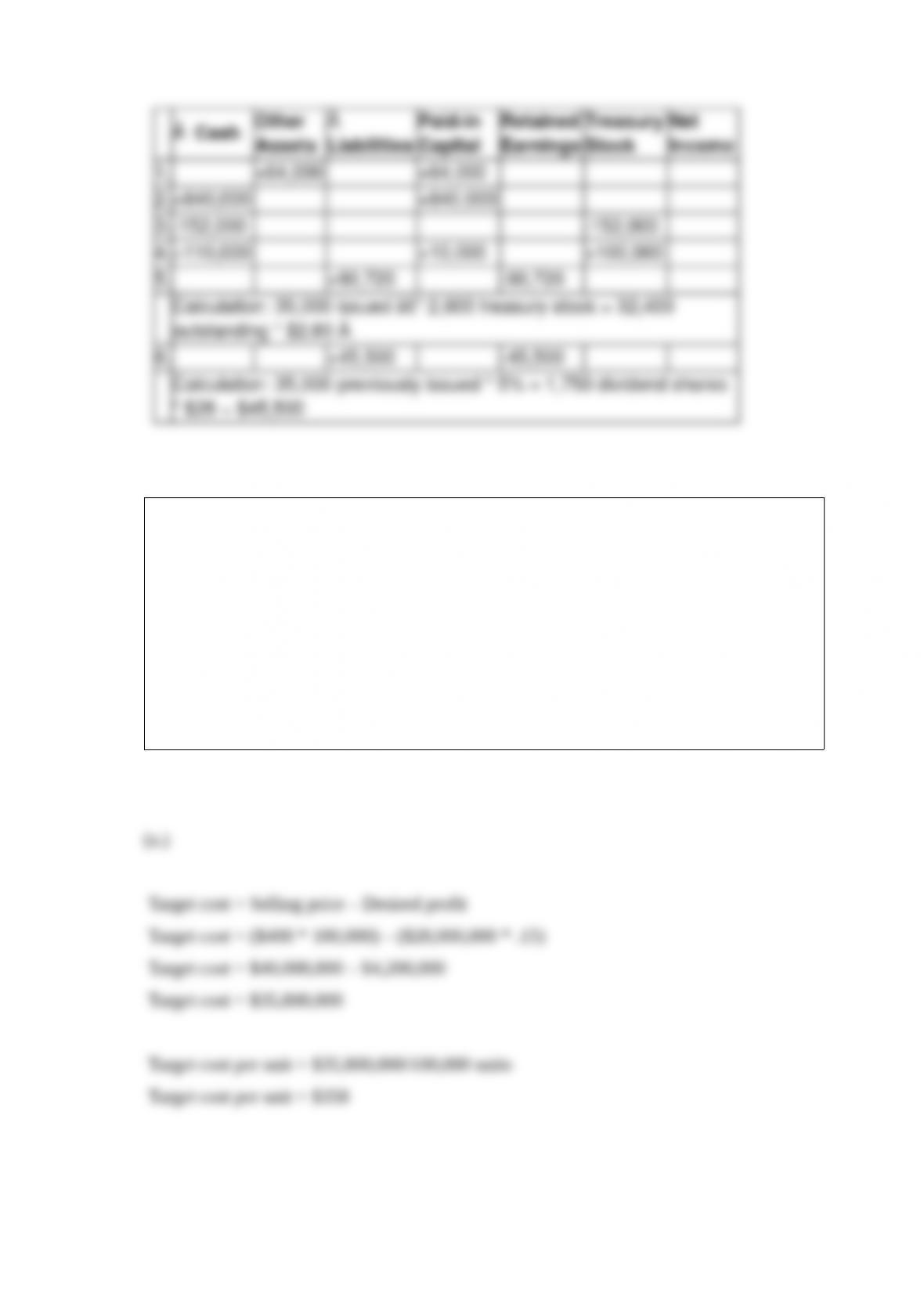
Using the column headings provided below, show the effect, if any, of the transaction
on each financial statement category by indicating whether it is an addition (+) or
subtraction (-) and by showing the amount in the appropriate column. For the treasury
stock column, show the effects, if any, of the transaction on total stockholders’ equity.
Do not show items that affect net income in the retained earnings column. You should
assume that the transactions occurred in the chronological sequence as indicated.
(1.) Issued 600 shares of $90 par value preferred stock in exchange for land that had an
appraised value of $64,000.
(2.) Issued 35,000 shares of $20 par value common stock for $24 per share.
(3.) Purchased 7,600 shares of common stock for the treasury at $20 per share.
(4.) Sold 5,000 shares of treasury stock purchased in transaction #3 for $22 per share.
(5.) Declared a cash dividend of $2.80 per share on the common stock outstanding, to
be paid early next year.
(6.) Declared and issued a 5% stock dividend on the common stock when the market
price per share of common stock was $26.
The market price for low-end laser printers is well established at $400 per unit. ABC
Technologies is considering entering this market and has enough available space in its
plant to accommodate a new production line. However, several pieces of new
manufacturing equipment would be required which are estimated to cost $28,000,000.
ABC Technologies requires a minimum ROI of 15% on any product line investment
and estimate that it can capture 100,000 units of the low-end laser printer market at the
prevailing market price.
(a.) Calculate the target cost per unit for ABC Technologies if it is to enter the low-end
laser printer market while earning the minimum 15% ROI.
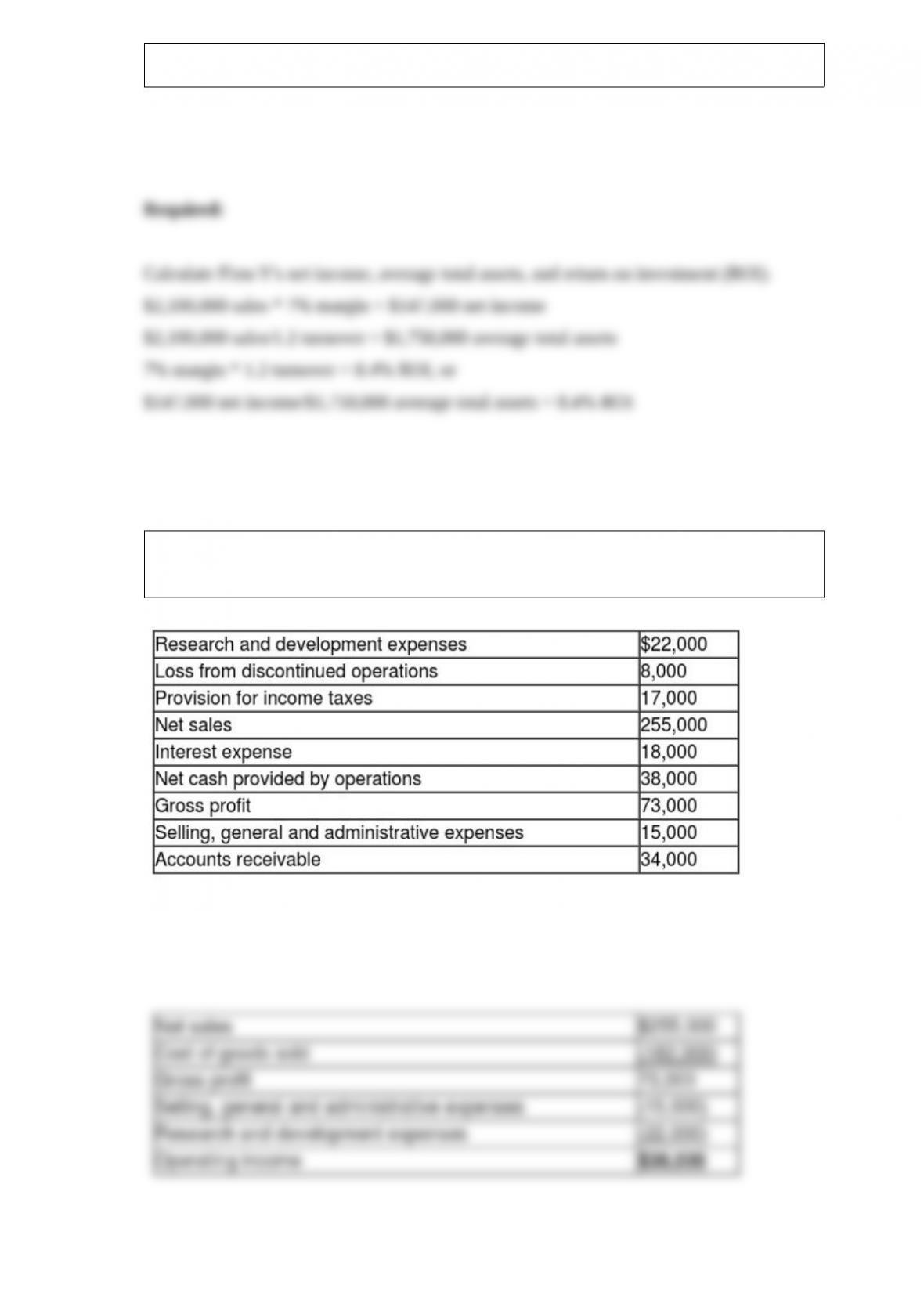
Firm Y has a margin of 7%, turnover of 1.2, and sales of $2,100,000.
Use the appropriate information from the data provided below to calculate operating
income for the year ended December 31, 2017.
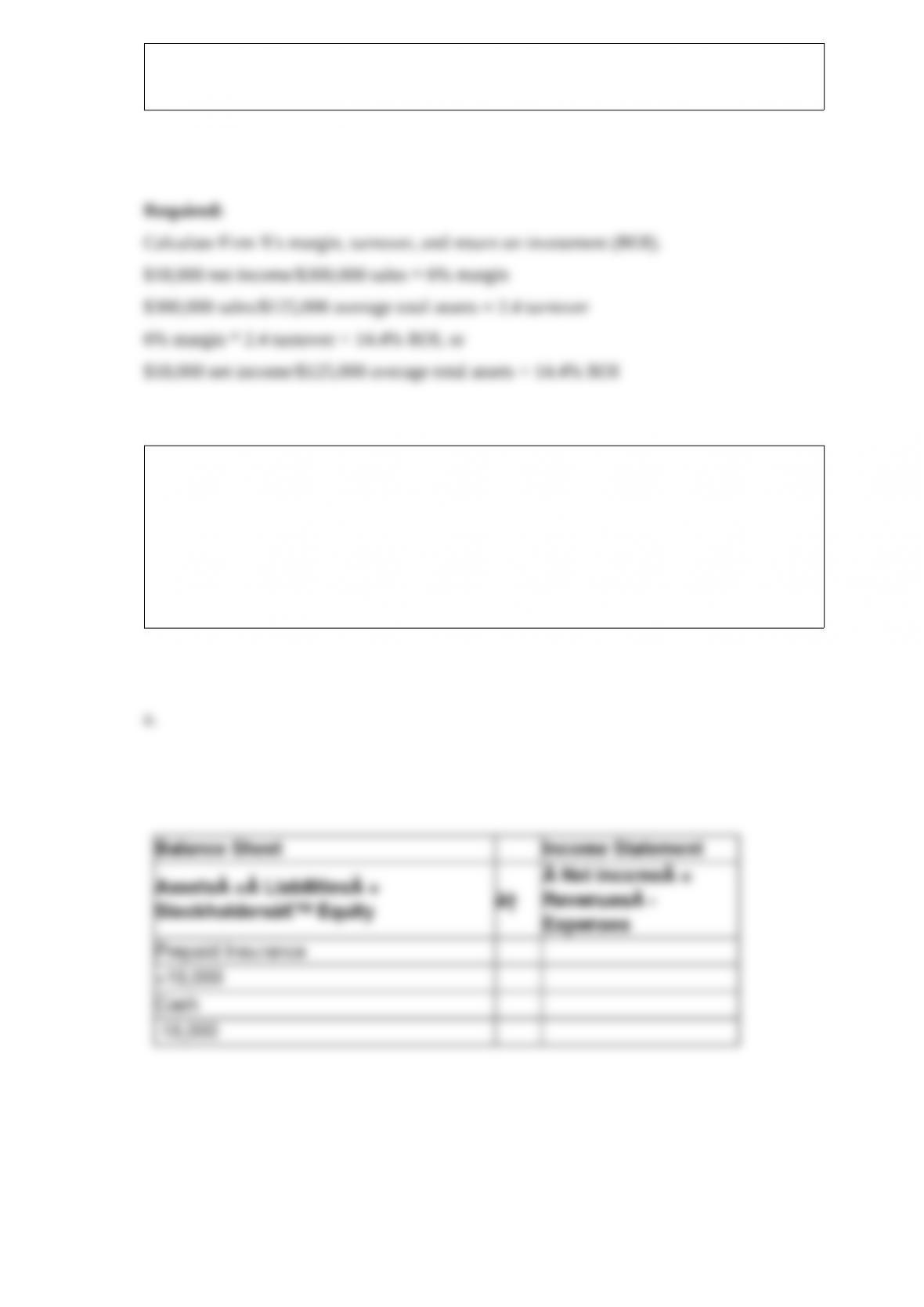
Firm X has net income of $18,000, sales of $300,000, and average total assets of
$125,000.
a. Use the horizontal model or write the journal entry to record the payment of a
one-year insurance premium of $18,000 on October 1, 2016.
b. Use the horizontal model or write the adjusting entry that will be made at the end of
every month to show the amount of insurance premium “used” that month.
c. Calculate the amount of prepaid insurance that should be reported on the December
31, 2016 balance sheet with respect to this policy.
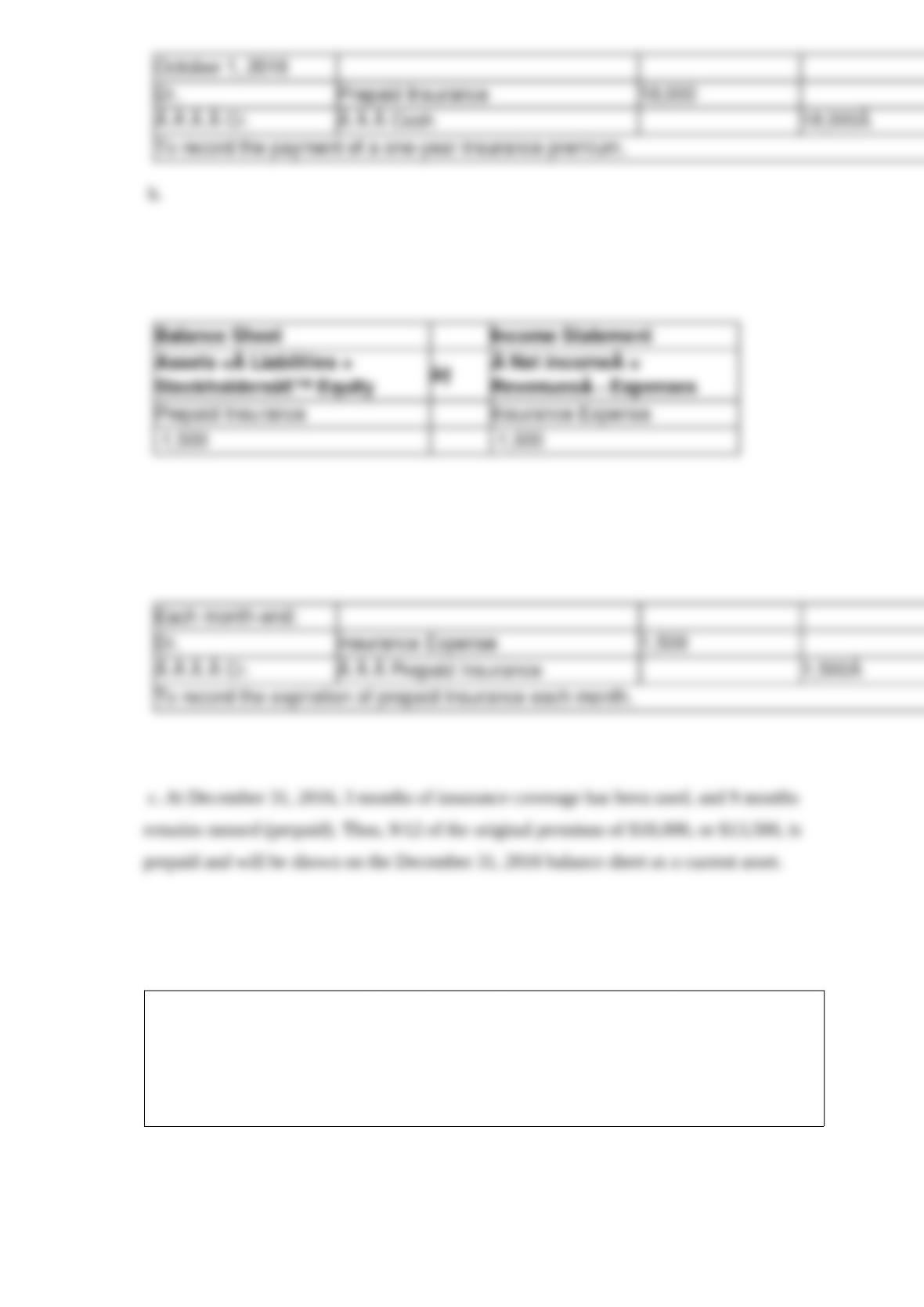
The monthly cash budgets for the first quarter of 2016 are shown below ($000 omitted)
for XYZ Company. A minimum cash balance of $40,000 is required. A line of credit has
been established with ABC’s bank at a 7.5% interest rate. Calculate the missing
amounts:
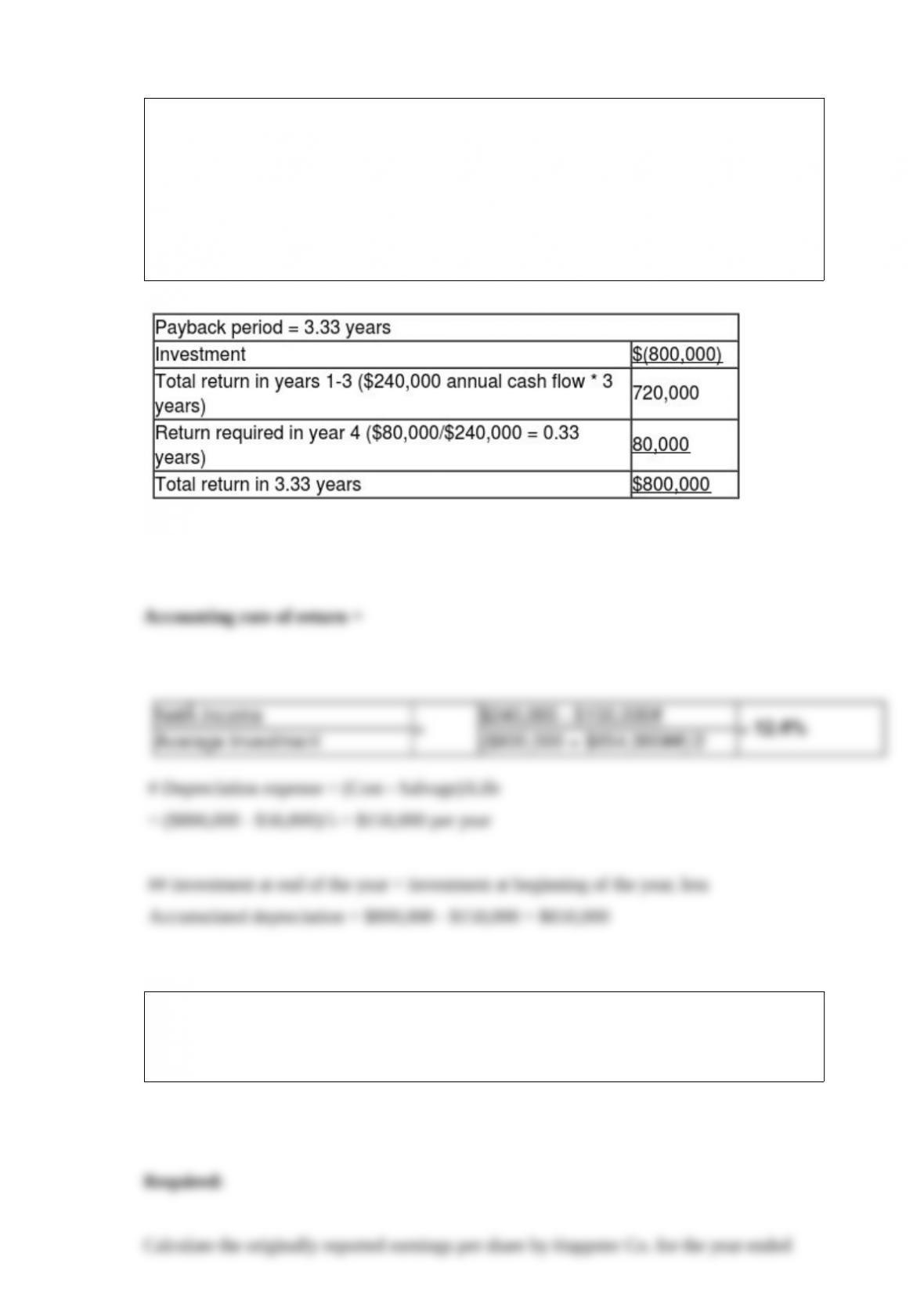
Acme Company is considering replacing outdated production equipment that will allow
for production cost savings of $20,000 per month. The new equipment will have a
five-year life and cost $800,000, with an estimated salvage value of $50,000. Acme’s
cost of capital is 10%.
Calculate the payback period and the accounting rate of return for the new production
equipment.
During the fiscal year ended September 30, 2017, Happster Co. had a 5-for-1 stock
split. In its annual report for 2017, the company reported earnings per share for the year
ended September 30, 2016, on a restated basis, of $0.85.
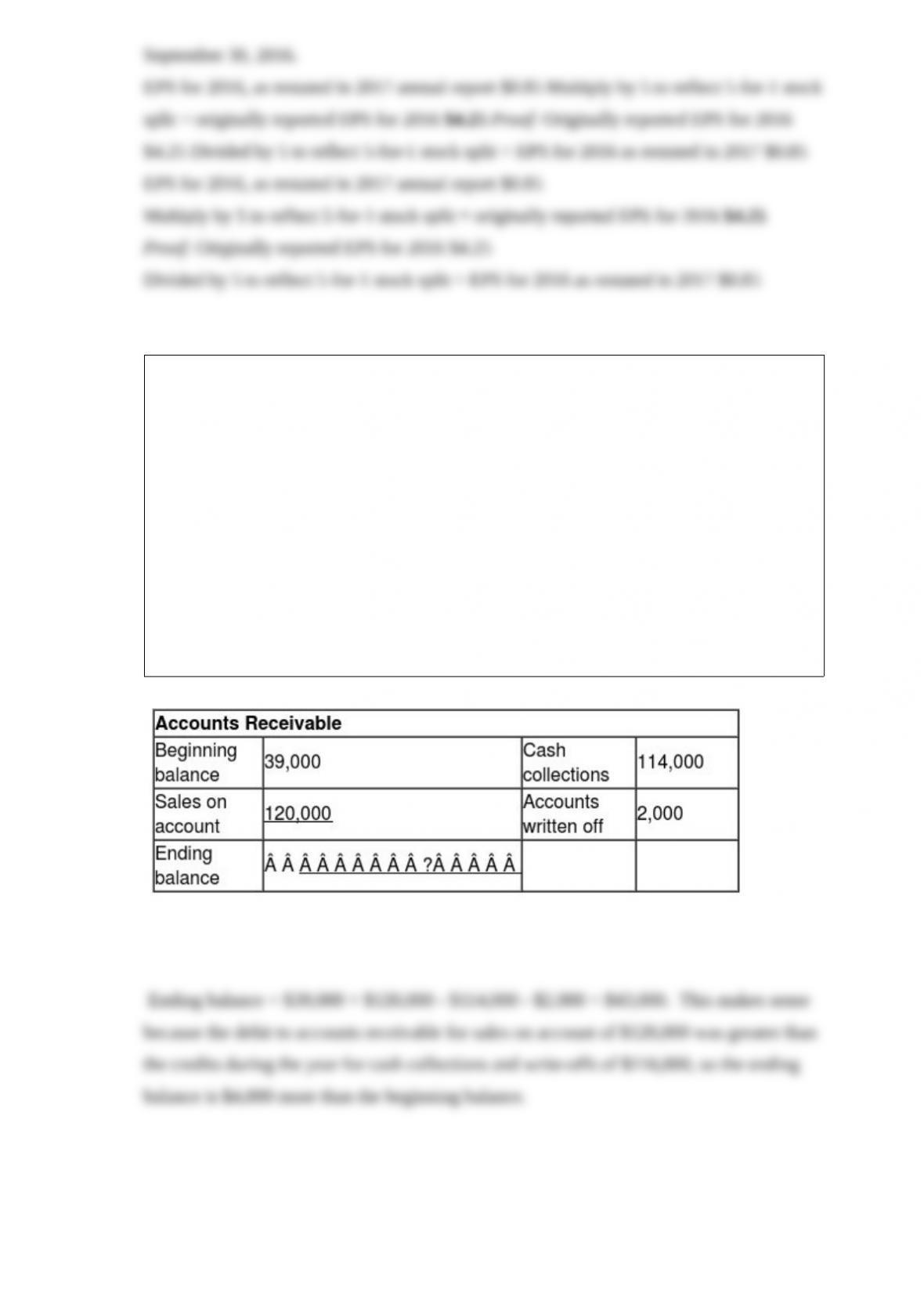
At the beginning of the year, accounts receivable were $39,000 and the allowance for
bad debts was $2,400. During the year, sales (all on account) were $120,000, cash
collections were $114,000, bad debts expense totaled $1,700, and $2,000 of accounts
receivable were written off as bad debts.
Required:
Calculate the balances at the end of the year for the Accounts Receivable and
Allowance for Bad Debts accounts. (Hint: Use T-accounts to analyze each of these
accounts, plug in the amounts that you know, and solve for the ending balances.)