
1) if two annuities have the same number of rents with the same dollar amount, but one
is an annuity due and one is an ordinary annuity, the present value of the annuity due
will be greater than the present value of the ordinary annuity.
2) companies report trading securities at fair value, with unrealized holding gains and
losses reported in net income.
3) the cost flow assumption adopted must be consistent with the physical movement of
the goods.
4) when a change in the tax rate is enacted, the effect is reported as an adjustment to
income tax payable in the period of the change.
5) gains or losses on disposals of assets do not distort periodic income when the group
or composite method is used to compute depreciation.
6) the notes to the financial statements should include information about acquired
intangible assets, and aggregate amortization expense for how many succeeding years?
a.6
b.5
c.4
d.3

7) on its december 31, 2012, balance sheet, trump co. reported its investment in
available-for-sale securities, which had cost $600,000, at fair value of $550,000. at
december 31, 2013, the fair value of the securities was $585,000. what should trump
report on its 2013 income statement as a result of the increase in fair value of the
investments in 2013?
a.$0
b.unrealized loss of $15,000
c.realized gain of $35,000
d.unrealized gain of $35,000
8) the accountant preparing the income statement for bakersfield, inc. had some doubts
about the appropriate accounting treatment of the seven items listed below during the
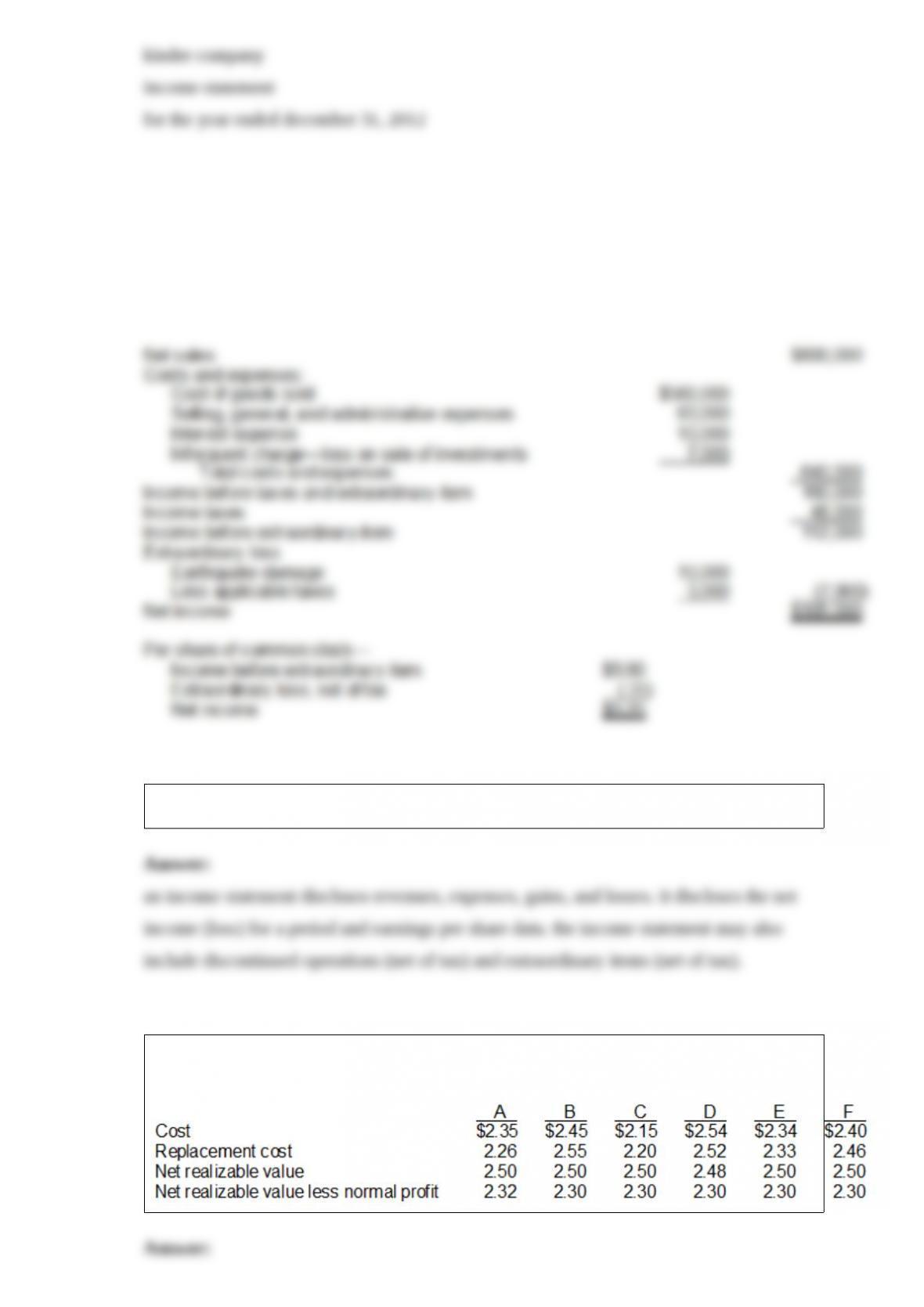
fiscal year ending december 31, 2012. assume a tax rate of 40 percent.
1>the corporation experienced an uninsured flood loss of $70,000 before taxes. while
this loss meets the criteria of an extraordinary item, it has not been recorded.
2>the corporation disposed of its sporting goods division during 2012. this disposal
meets the criteria for discontinued operations. the division correctly calculated income
from operating this division of $110,000 before taxes and a loss of $12,000 before taxes
on the disposal of the division. all of these events occurred in 2012 and have not been
recorded.
3>the company recorded advances of $10,000 to employees made december 31, 2012
as salaries and wages expense.
4>dividends of $10,000 during 2012 were recorded as an operating expense.
5>in 2012, bakersfield changed its method of accounting for inventory from the
first-in-first-out method to the average cost method. inventory in 2012 was correctly
recorded using the average cost method. the new inventory method would have resulted
in an additional $115,000 of cost of goods sold (before taxes) being reported on prior
years’ income statement.
6>office equipment purchased january 1, 2012 for $45,000 was incorrectly charged to
supplies expense at the time of purchase. the office equipment has an estimated
three-year service life with no expected salvage value. bakersfield uses the straight-line
method to depreciate office equipment for financial reporting purposes. this error has
not been recorded.
7>on january 1, 2008, bakersfield bought a building that cost $85,000, had an estimated
useful life of ten years, and had a salvage value of $5,000. bakersfield uses the
straight-line depreciation method to depreciate the building. in 2012, it was estimated
that the remaining useful life was eight years and the salvage value was zero.
depreciation expense reported on the 2012 income statement was correctly calculated
based on the new estimates. no adjustment for prior years’ depreciation estimates was
made.
part a. for each item, record corrections to income from continuing operations before
taxes, if any. denote any negative numbers by using brackets < >.
part b. at january 1, 2010, bakersfield, inc.’s retained earnings balance was
$200,000. assume that income from continuing operations (before taxes) and after
correctly considering any of the seven additional items was $1,200,000. prepare the
income statement and retained earnings statement. denote negative numbers by
using brackets < >. do not disclose earnings per share data.
9) on december 1, 2012, lester company issued at 103, four hundred of its 9%, $1,000
bonds. attached to each bond was one detachable stock warrant entitling the holder to
purchase 10 shares of lester’s common stock. on december 1, 2012, the market value of
the bonds, without the stock warrants, was 95, and the market value of each stock
purchase warrant was $50. the amount of the proceeds from the issuance that should be
accounted for as the initial carrying value of the bonds payable would be
a.$387,280
b.$391,400
c.$400,000
d.$412,000
10) the interest rate written in the terms of the bond indenture is known as the
a.coupon rate
b.nominal rate
c.stated rate
d.coupon rate, nominal rate, or stated rate
11) the failure to properly record an adjusting entry to accrue an expense will result in
an:
a.understatement of expenses and an understatement of liabilities
b.understatement of expenses and an overstatement of liabilities
c.understatement of expenses and an overstatement of assets
d.overstatement of expenses and an understatement of assets
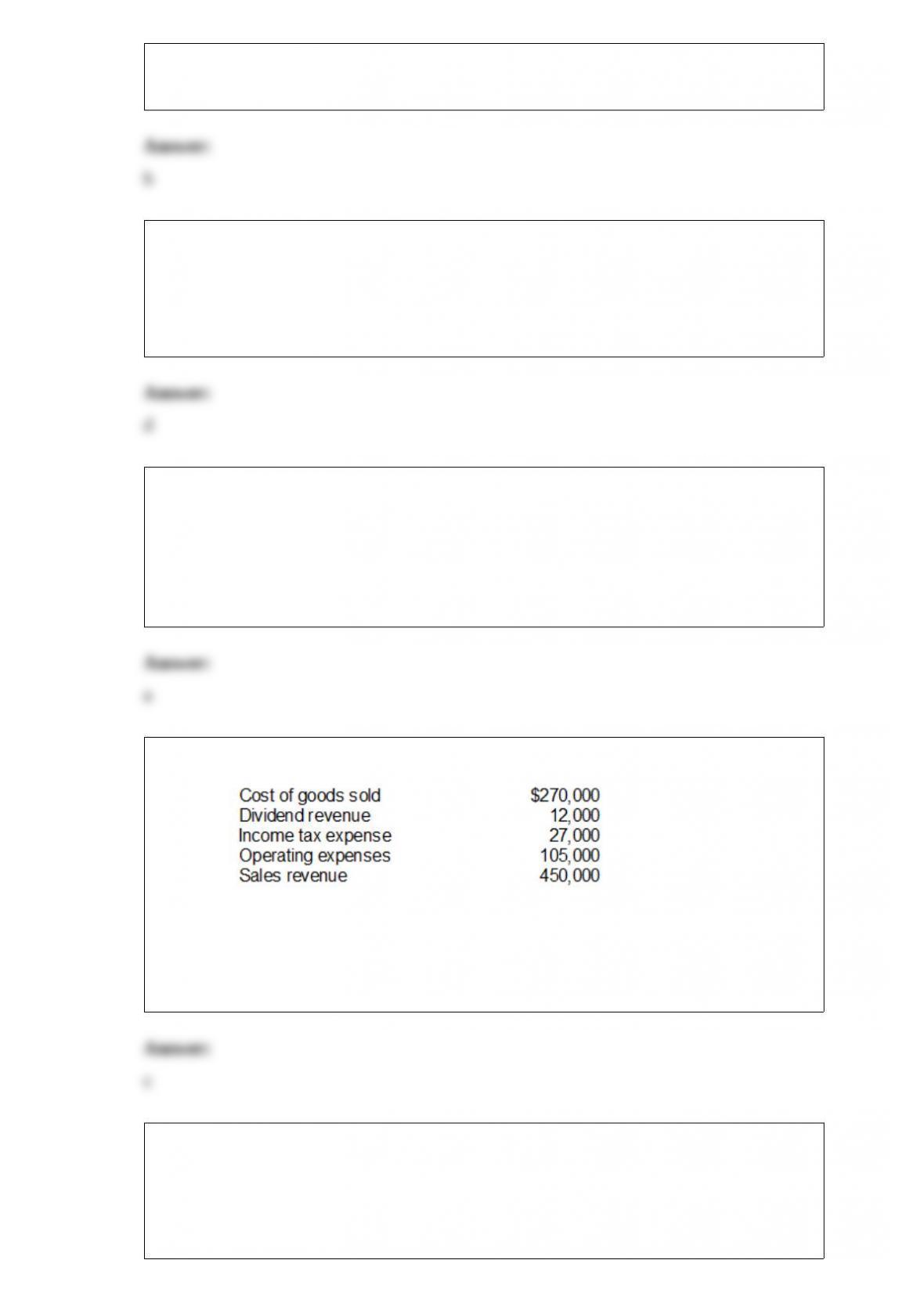
12) for rondelli company, the following information is available:
in rondelli’s multiple-step income statement, gross profit
a.should not be reported
b.should be reported at $60,000
c.should be reported at $180,000
d.should be reported at $192,000
13) which of the following is an example of “off-balance-sheet financing”?
1>non-consolidated subsidiary.
2>special purpose entity.
3>operating leases.
a.1
b.2
c.3
d.all of these are examples of “off-balance-sheet financing.”
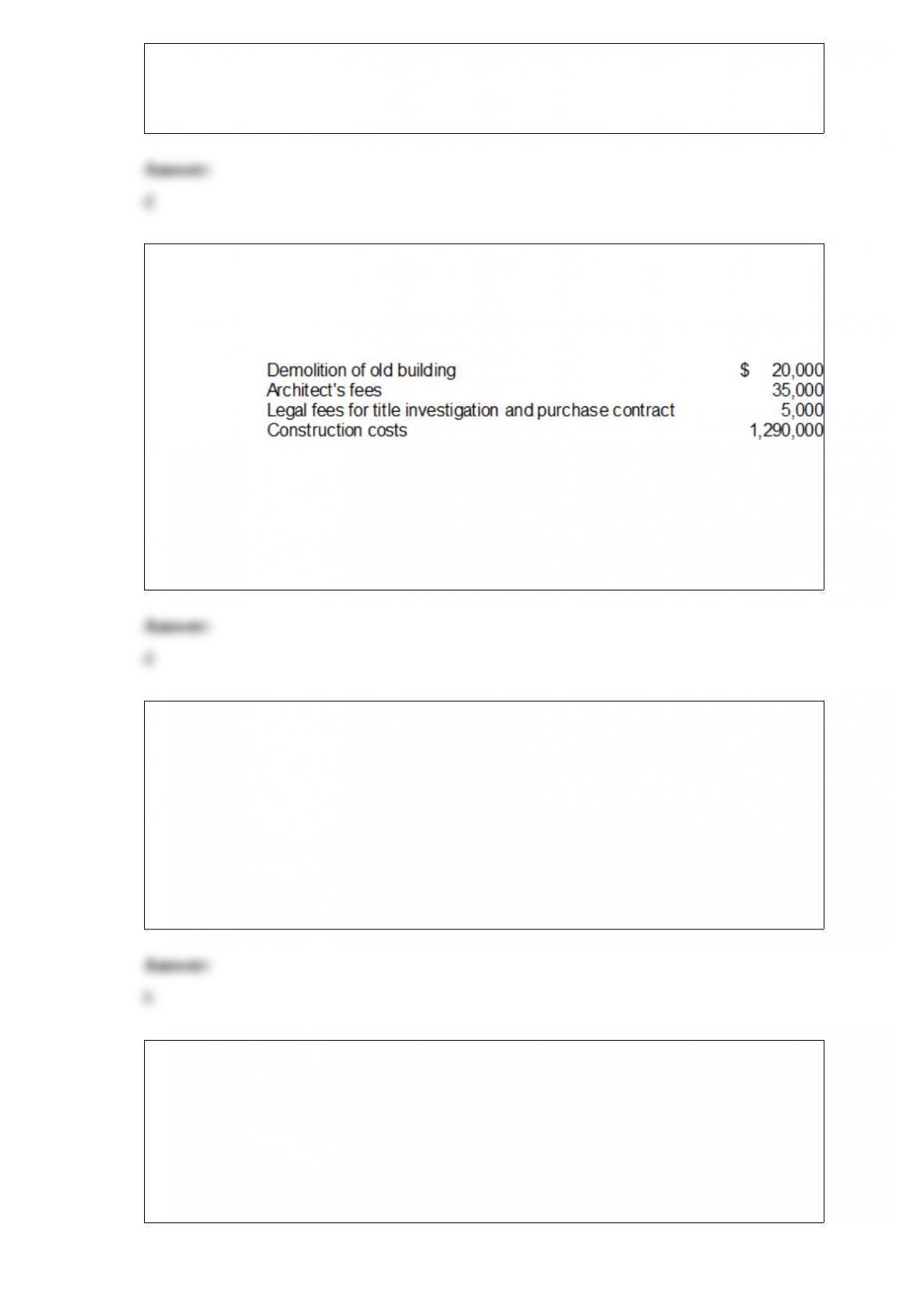
14) on february 1, 2012, nelson corporation purchased a parcel of land as a factory site
for $250,000. an old building on the property was demolished, and construction began
on a new building which was completed on november 1, 2012. costs incurred during
this period are listed below:
(salvaged materials resulting from demolition were sold for $10,000.)
nelson should record the cost of the land and new building, respectively, as
a.$275,000 and $1,315,000
b.$260,000 and $1,330,000
c.$260,000 and $1,325,000
d.$265,000 and $1,325,000
15) the accountant for the pryor sales company is preparing the income statement for
2012 and the balance sheet at december 31, 2012. pryor uses the periodic inventory
system. the january 1, 2012 merchandise inventory balance will appear
a.only as an asset on the balance sheet
b.only in the cost of goods sold section of the income statement
c.as a deduction in the cost of goods sold section of the income statement and as a
current asset on the balance sheet
d.as an addition in the cost of goods sold section of the income statement and as a
current asset on the balance sheet
16) which of the following is not a basic assumption of the gross profit method?
a.the beginning inventory plus the purchases equal total goods to be accounted for
b.goods not sold must be on hand
c.if the sales, reduced to the cost basis, are deducted from the sum of the opening
inventory plus purchases, the result is the amount of inventory on hand
d.the total amount of purchases and the total amount of sales remain relatively
unchanged from the comparable previous period
17) goods in transit which are shipped f.o.b. shipping point should be
a.included in the inventory of the seller
b.included in the inventory of the buyer
c.included in the inventory of the shipping company
d.none of these
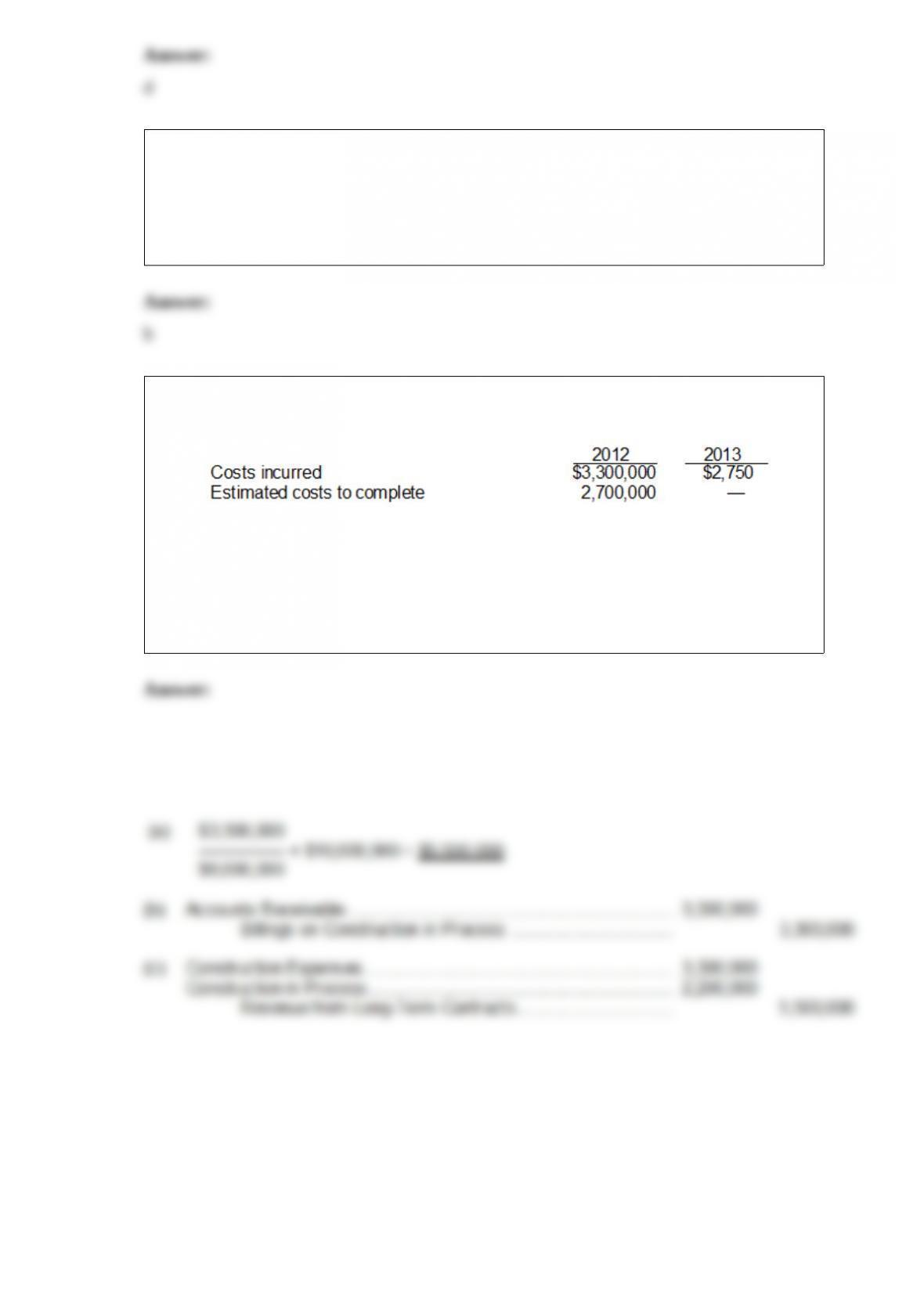
18) dalton construction co. contracted to build a bridge for $10,000,000. construction
began in 2012 and was completed in 2013. data relating to the construction are:
dalton uses the percentage-of-completion method.
instructions
(a)how much revenue should be reported for 2012? show your computation.
(b)make the entry to record progress billings of $3,300,000 during 2012.
(c)make the entry to record the revenue and gross profit for 2012.
(d)how much gross profit should be reported for 2013? show your computation.
19) according to the fasb’s conceptual framework, earnings
a.is the same as comprehensive income
b.excludes certain gains and losses that are included in comprehensive income
c.includes certain gains and losses that are excluded from comprehensive income
d.includes certain losses that are excluded from comprehensive income
20) compare the direct method and the indirect method by explaining each method.
21) at the financial statement date of december 31, 2012, the liabilities outstanding of
packard corporation included the following:
1>cash dividends on common stock, $40,000, payable on january 15, 2013.
2>note payable to galena state bank, $470,000, due january 20, 2013.
3>serial bonds, $1,400,000, of which $350,000 mature during 2013.
4>note payable to third national bank, $300,000, due january 27, 2013.
the following transactions occurred early in 2013:
january 15:the cash dividends on common stock were paid.
january 20:the note payable to galena state bank was paid.
january 25:the corporation entered into a financing agreement with galena state bank,
enabling it to borrow up to $500,000 at any time through the end of 2015. amounts
borrowed under the agreement would bear interest at 1% above the bank’s prime rate
and would mature 3 years from the date of the loan. the corporation immediately
borrowed $400,000 to replace the cash used in paying its january 20 note to the bank.
january 26:40,000 shares of common stock were issued for $350,000. $300,000 of the
proceeds was used to liquidate the note payable to third national bank.
february 1:the financial statements for 2012 were issued.
instructions
prepare a partial balance sheet for packard corporation, showing the manner in which
the above liabilities should be presented at december 31, 2012. the liabilities should be
properly classified between current and long-term, and appropriate note disclosure
should be included.
22) find the present value of an investment in equipment if it is expected to provide
annual savings of $20,000 for 10 years and to have a resale value of $50,000 at the end
of that period. assume an interest rate of 9% and that savings are realized at year end.
23) reed co. wishes to enter receipts and payments in such a manner that adjustments at
the end of the period will not require reversing entries at the beginning of the next
period. record the following transactions in the desired manner and give the adjusting
entry on december 31, 2012. (two entries for each part.)
1>an insurance policy for two years was acquired on april 1, 2012 for $12,000 .
2>rent of $15,000 for six months for a portion of the building was received on
november 1, 2012 .
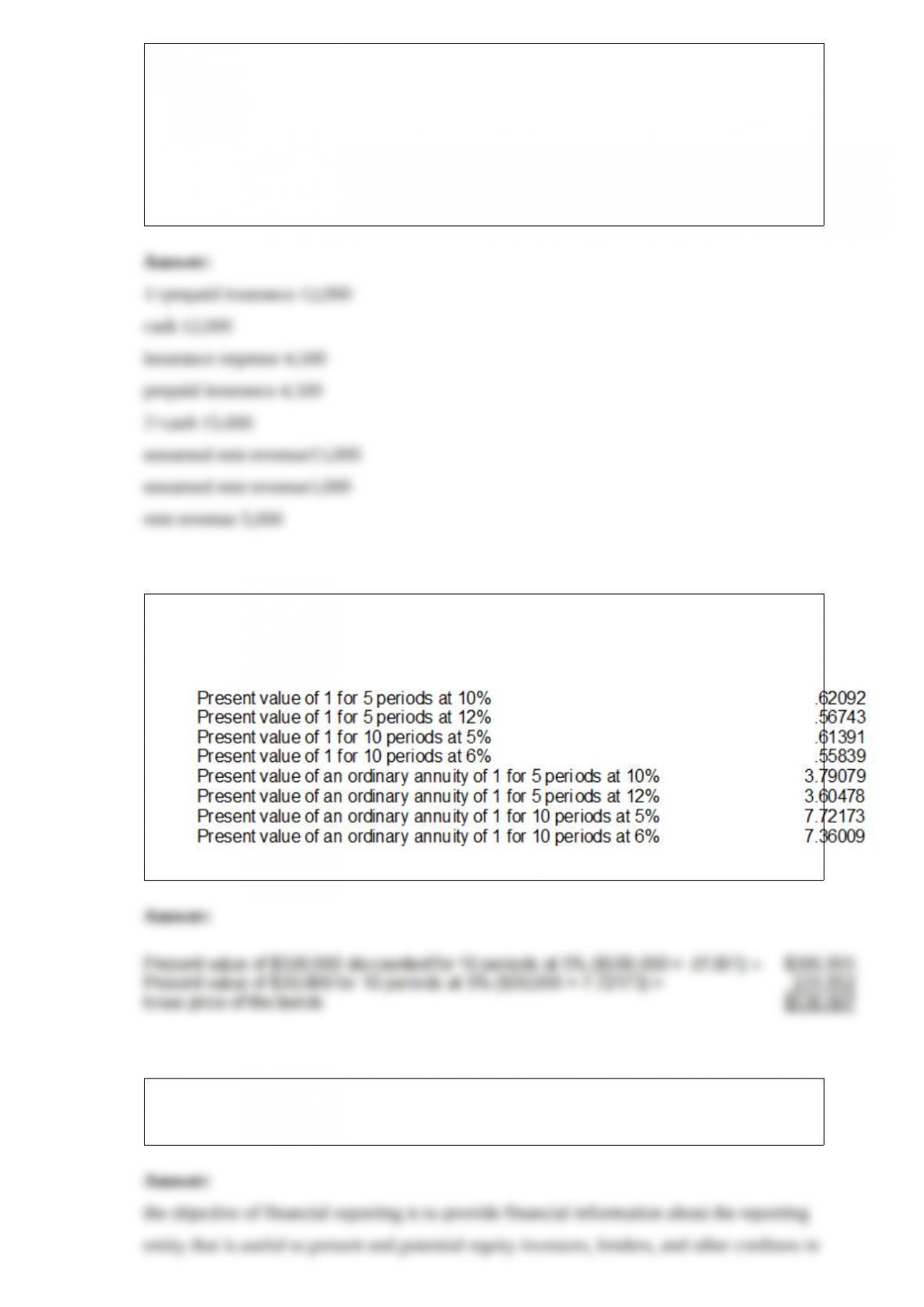
24) on january 1, 2012 lance co. issued five-year bonds with a face value of $500,000
and a stated interest rate of 12% payable semiannually on july 1 and january 1. the
bonds were sold to yield 10%. present value table factors are:
calculate the issue price of the bonds.
25) what is the objective of financial reporting? how do general-purpose financial
statements help meet this objective.

26) presented below is an income statement for kinder company for the year ended
december 31, 2012.
kinder company
income statement
for the year ended december 31, 2012
net sales
$800,000
costs and expenses:
cost of goods sold
560,000
selling, general, and administrative
expenses 70,000
other, net
20,000
total costs and expenses
650,000
income before income taxes
150,000
income taxes
45,000
net income
$105,000
additional information:
1. ‘selling, general, and administrative expenses” included a usual but infrequent
charge of $7,000 due to a loss on the sale of investments.
2. “other, net” consisted of interest expense, $10,000, and an extraordinary loss of
$10,000 before taxes due to earthquake damage. if the extraordinary loss had not
occurred, income taxes for 2012 would have been $24,000 instead of $21,000.
3. kinder had 20,000 shares of common stock outstanding during 2012.
instructions
using the single-step format, prepare a corrected income statement, including the
appropriate per share disclosures.
27) what is disclosed in an income statement? be specific.
28) determine the unit value that should be used for inventory costing following “lower
of cost or market value” as described in arb no. 43.

29) the components of other comprehensive income can be reported in a statement of
stockholders equity.