
Since the lease payments under a lease agreement are normally paid at the beginning of
each period, the appropriate compound interest table to be used to determine the
amount at which the leased asset should be recorded is the: A. Ordinary annuity table.
B. Present value of $1 table.
C. Present value of an annuity due table.
D. Future value of an annuity due table.
Answer:
Which of the following is a criterion for a debt instrument to be viewed as having a
lending or customer financing business purpose? A. Debt instrument is held for the
purpose of being sold.
B. Investor’s purpose is collecting cash flows.
C. Investor cannot renegotiate, sell, or settle the debt to minimize losses due to
deteriorating credit quality.
D. Investment is actively managed internally on a fair value basis but doesn’t qualify for
FV-OCI.
Answer:
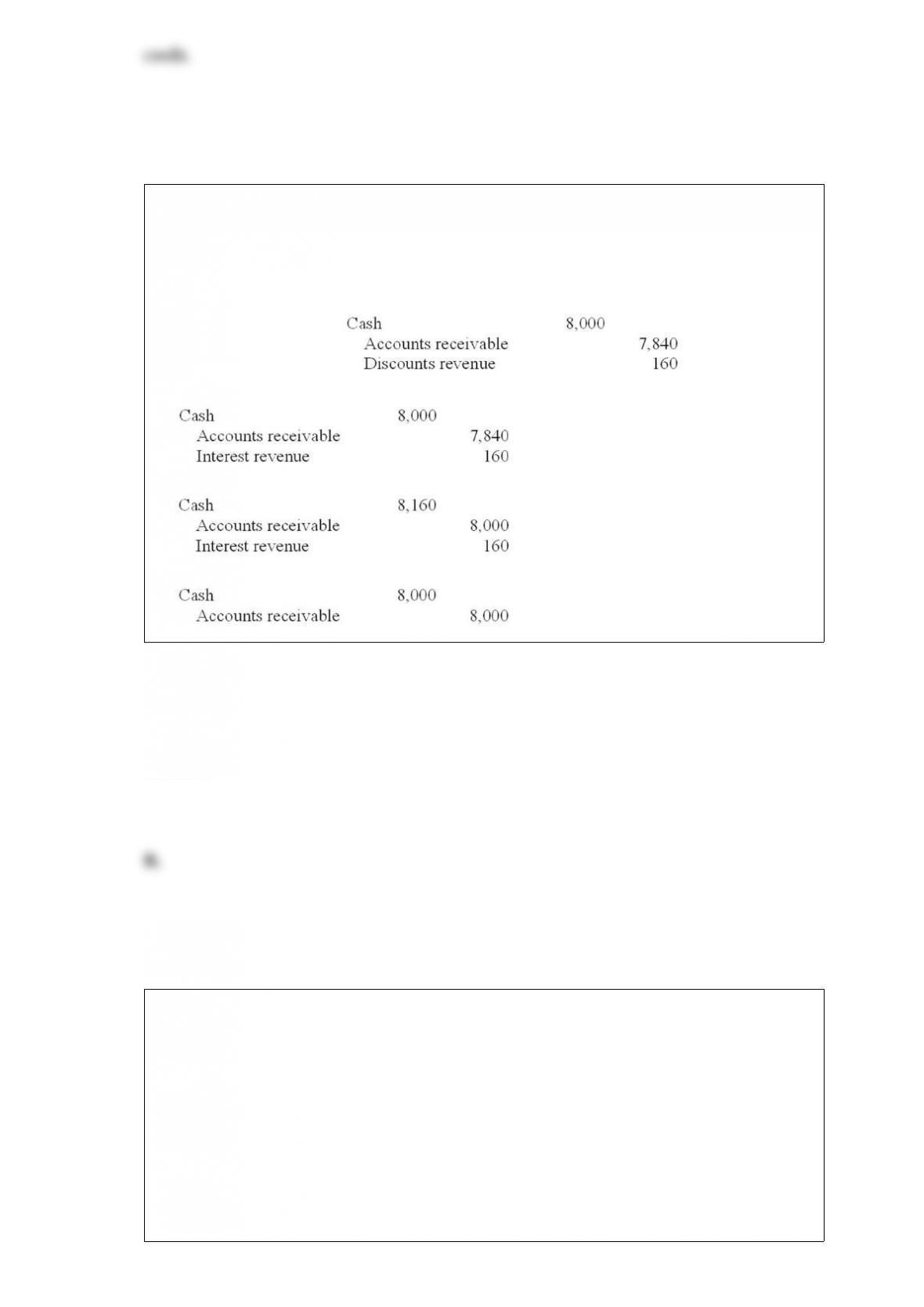
On November 10 of the current year, Cherokee Industries sold materials to a customer
for $8,000 with credit terms 2/10, n/30. Cherokee uses the net method of accounting for
cash discounts
What entry would Cherokee make on December 10, assuming the correct payment was
received on that date? A.
B.
C.
D.
Answer:
Carla Salons leased equipment from SmithCo on July 1, 2013. The present value of the
lease payments discounted at 10% was $80,000. Ten annual lease payments of $12,000
are due at the beginning of each fiscal year beginning July 1, 2013. SmithCo had
constructed the equipment recently for $66,000, and its retail fair value was $100,000.
Under the new ASU, what amount did SmithCo record as the net residual asset? A.
$6,400.
B. $13,200.
C. $14,000.
D. $20,000.
Answer:
Calistoga Produce estimates bad debt expense at ½% of credit sales. The company
reported accounts receivable and allowance for uncollectible accounts of $471,000 and
$1,650, respectively, at December 31, 2012. During 2013, Calistoga’s credit sales and
collections were $315,000 and $319,000, respectively, and $1,720 in accounts
receivable were written off.
Calistoga’s accounts receivable at December 31, 2013, are: A. $467,000.
B. $473,280.
C. $465,280.
D. $469,280.
Answer:
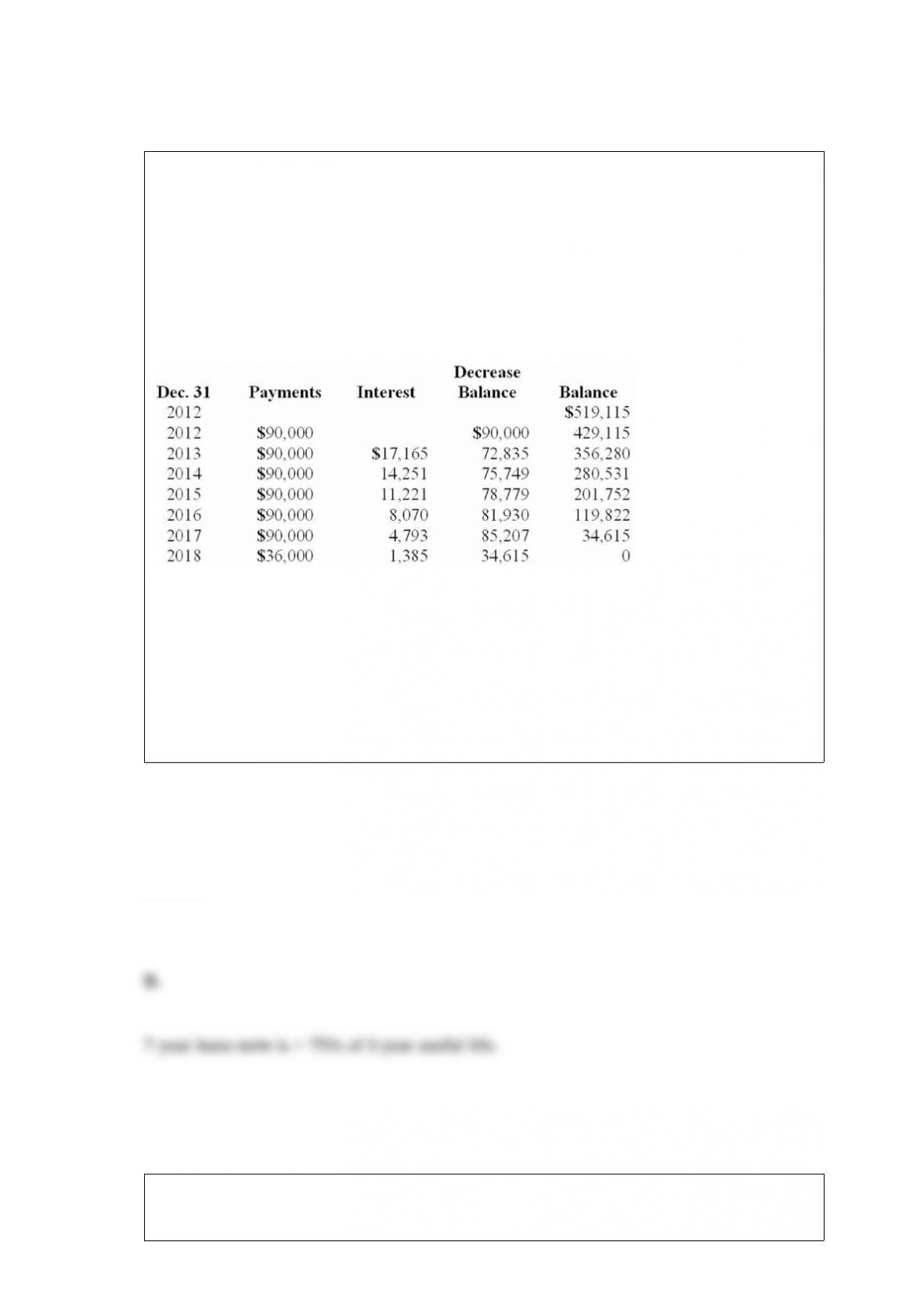
On December 31, 2012, Reagan Inc. signed a lease for some equipment having a
eight-year useful life with Silver Leasing Co. The lease payments are made by Reagan
annually, beginning at signing date. Title does not transfer to the lessee, so the
equipment will be returned to the lessor on December 31, 2018. There is no bargain
purchase option, and Reagan guarantees a residual value to the lessor on termination of
the lease.
Reagan’s lease amortization schedule appears below:
In this situation, Reagan: A. Is the lessee in a sales-type lease.
B. Is the lessee in a capital lease.
C. Is the lessor in a capital lease.
D. Is the lessor in a sales-type lease.
Answer:
If the leaseback portion of a sale-leaseback transaction is classified as a capital lease: A.
Any gain is deferred and recognized as a reduction of rent expense.

B. Any gain is deferred and recognized as a reduction of depreciation.
C. Any gain is recognized at the lease’s inception.
D. There can be no gain.
Answer:
Carter Appliances is preparing its annual report for the current fiscal year. The
company’s controller has asked for your help in determining how best to disclose
information about the following items:
1) A subsequent event.
2) Inventory costing method.
3) Composition of accrued liabilities.
4) Useful lives of depreciable assets.
5) Information on long-term leases.
6) Allowance for uncollectible accounts.
7) Revenue recognition policy.
8) Pension plans.
Required:
Indicate whether the above items should be disclosed (a) in the summary of significant
accounting policies note, (b) in a separate disclosure note, or (c) on the face of the
balance sheet
Answer:
Accounting for the pledging of accounts receivable as collateral for a loan requires: A.
Reporting the receivables net of the borrowed amount.
B. Removal of the pledged receivables from current assets and including them with
noncurrent investments.
C. Disclosure of the arrangement in notes to the financial statements.
D. None of the above.
Answer:
A broadcasting company failed to make a year-end accrual of $400,000 for fines due to
a violation of FCC rules. Its tax rate is 30%. As a result of this error, net income was: A.
Unaffected.
B. Overstated by $400,000.
C. Overstated by $280,000.
D. Overstated by $120,000.
Answer:
The use of LIFO during a long inflationary period can result in: A. A net increase in
income tax expense.
B. An inflated balance sheet.
C. Significant cash flow advantages over FIFO.
D. A reduction in inventory turnover over FIFO.
Answer:
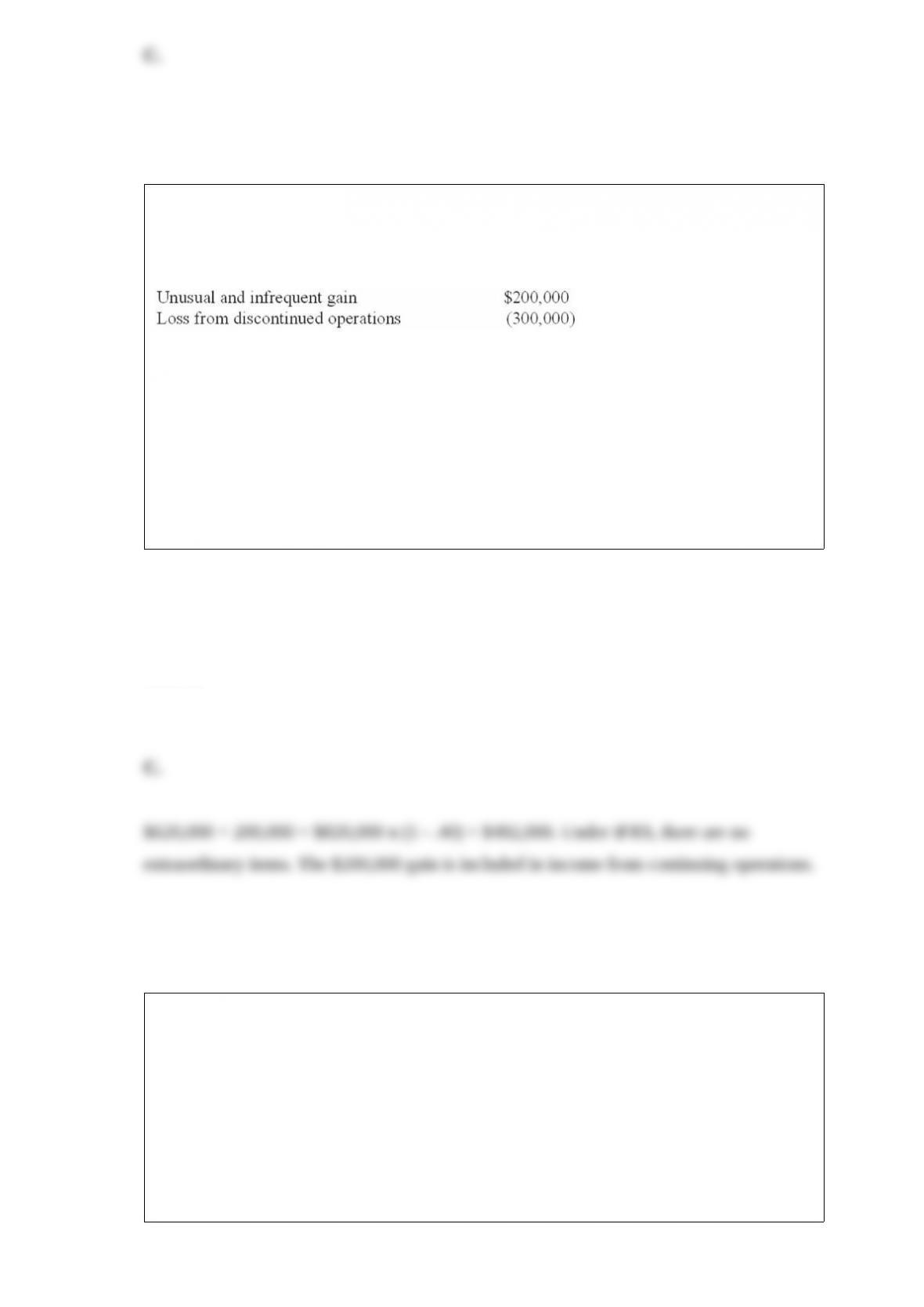
Jacobsen Corporation prepares its financial statement applying International Financial
Reporting Standards. During its 2013 fiscal year, the company reported before-tax
income of $620,000. This amount does not include the following two items, both of
which are considered to be material in amount:
The company’s income tax rate is 40%. In its 2013 income statement, Jacobsen would
report income from continuing operations of: A. $312,000.
B. $372,000.
C. $492,000.
D. $620,000.
Answer:
Stayman Associates has sold a good to a buyer and wants to recognize revenue. Which
of the following is an indicator that control of a good has passed from Stayman to the
buyer? A. Buyer has scheduled delivery.
B. Buyer has a strong credit history, such that bad debts are reasonably estimable.
C. Buyer has not scheduled delivery.
D. Buyer has assumed the risk and rewards of ownership.

Answer:
Large, highly rated firms sometimes sell commercial paper: A. To borrow funds at a
lower rate than through a bank.
B. To earn a profit on the paper.
C. To avoid paperwork.
D. Because the interest rate is locked in by the Federal Reserve Board.
Answer:
Bond X and bond Y both are issued by the same company. Each of the bonds has a
maturity value of $100,000 and each matures in 10 years. Bond X pays 8% interest
while bond Y pays 9% interest. The current market rate of interest is 8%. Which of the
following is correct? A. Both bonds sell for the same amount.
B. Bond X sells for more than bond Y.
C. Bond Y sells for more than bond X.
D. Both bonds sell at a discount.
Answer:
Incurring an expense for advertising on account would be recorded by: A. Debiting
liabilities.
B. Crediting assets.
C. Debiting an expense.
D. Debiting assets.
Answer:
Misty Company reported the following before-tax items during the current year:
Misty’s effective tax rate is 40%.

What is Misty’s net income for the current year? A. $148.
B. $168.
C. $112.
D. None of the amounts given are correct.
Answer:
Fad City sells novel clothes that are subject to a great deal of price volatility. A recent
item that cost $20 was marked up $12, marked down for a sale by $6 and then had a
markdown cancellation of $3. The latest selling price is: A. $23.
B. $26.
C. $29.
D. $35.
Answer:

Red Onion Restaurant classifies a six-month prepaid insurance policy as a current asset.
Its rationale is based on: A. Materiality.
B. Operating cycle.
C. Definition.
D. Liquidity.
Answer:
Listed below are 5 terms followed by a list of phrases that describe or characterize each
of the terms. Match each phrase with the correct term. 1)Specific identification
2)Net method
3)Gross profit ratio
4)Gross method
5)FIFO
A. Purchase discounts not taken are considered interest expense
B. Products that are not yet complete
C. Purchase discounts not taken are included in inventory
D. Most recent purchases will be included in ending inventory
E. 1 – (Cost of goods sold ÷ Net sales).
Answer:
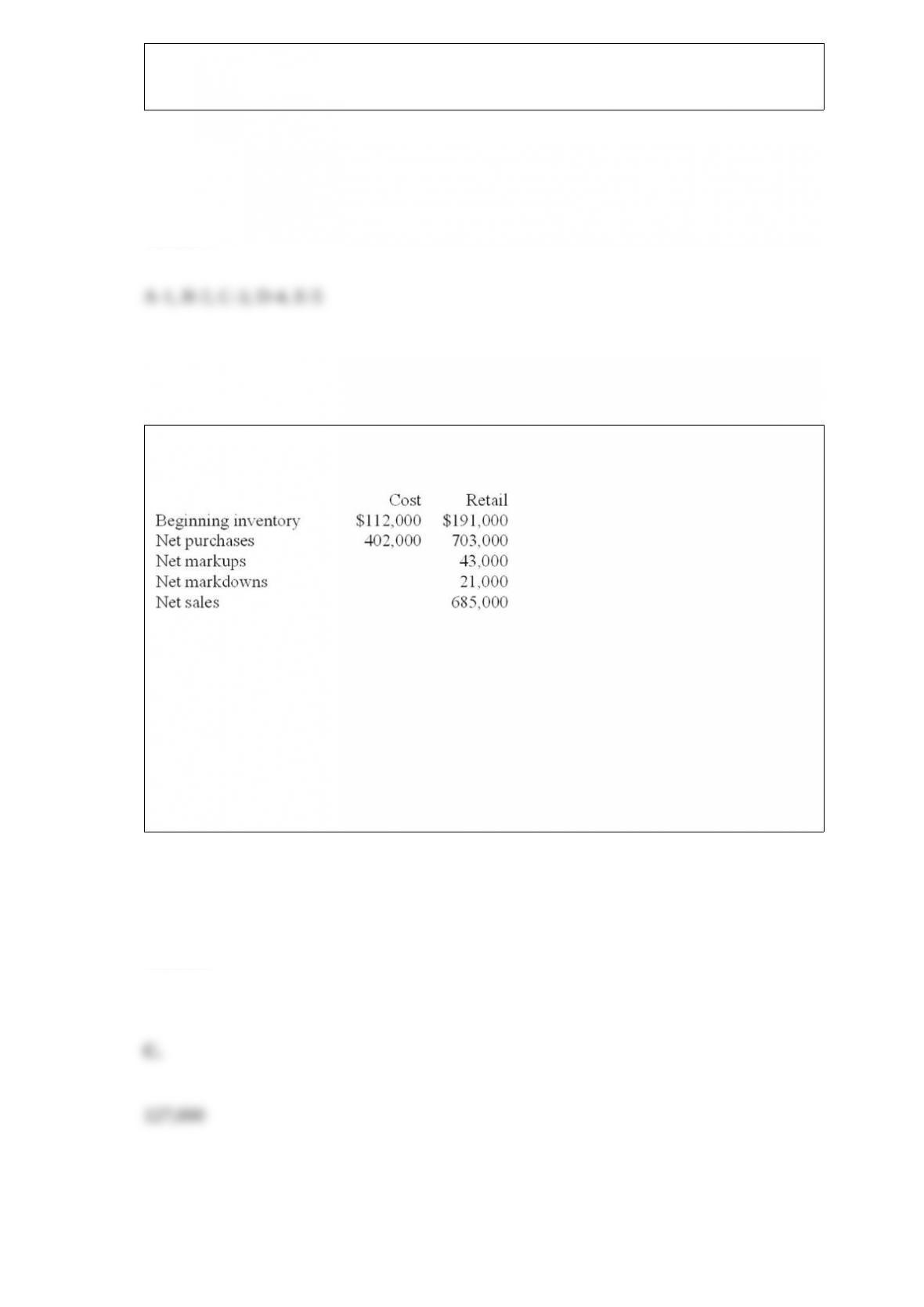
Clarabell Inc. uses the conventional retail method to estimate ending inventory. Cost
data for the most recent quarter is shown below:
To the nearest thousand, estimated ending inventory using the conventional retail
method is: A. $163,000.
B. $124,000.
C. $127,000.
D. $136,000.
Answer:

On September 1, 2013, Sam’s Shoe Co. issued $350,000 of 8% bonds. The bonds pay
interest semiannually on January 1 and July 1 of each year. The bonds were sold at the
face amount. How much cash did Sam’s receive upon sale of the bonds? A. $378,000.
B. $364,000.
C. $354,667.
D. $350,000.
Answer:
Tom’s Textiles shipped the wrong material to a customer, who refused to accept the
order. Upon receipt of the material, Tom’s would credit accounts receivable and debit:
A. Sales.
B. Sales discount.
C. Sales returns.
D. Sales allowances.
Answer:
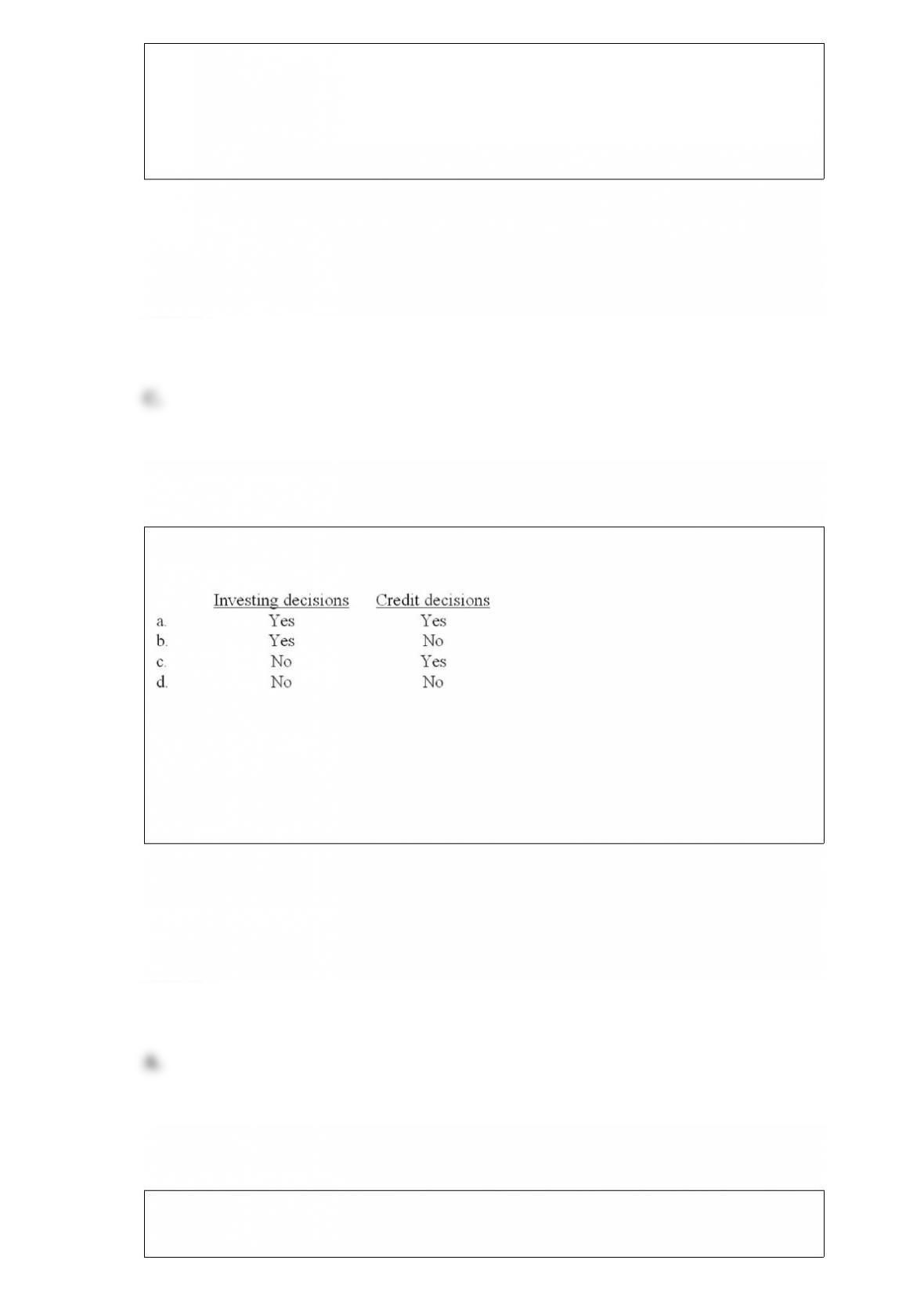
The primary focus for financial accounting information is to provide information useful
for:
A.Option a
B.Option b
C.Option c
D.Option d
Answer:
Black Enterprises reported the following ($ in 000s) as of December 31, 2013. All
accounts have normal balances.

During 2014 ($ in 000s), net income was $9,000; 25% of the treasury stock was resold
for $450; cash dividends declared were $600; cash dividends paid were $500
What ($ in 000s) was shareholders’ equity as of December 31, 2014? A. $38,100.
B. $37,450.
C. $38,450.
D. $38,350.
Answer:
When computing the cost-to-retail percentage for the average cost retail method,
included in the denominator are: A. Net markups and net markdowns.
B. Neither net markups nor net markdowns.
C. Net markups, but not net markdowns.
D. Net markdowns, but not net markups.
Answer:

On December 31, 2012, Albacore Company had 300,000 shares of common stock
issued and outstanding. Albacore issued a 10% stock dividend on June 30, 2013. On
September 30, 2013, 12,000 shares of common stock were reacquired as treasury stock.
What is the appropriate number of shares to be used in the basic earnings per share
computation for 2013? A. 303,000.
B. 342,000.
C. 312,000.
D. 327,000.
Answer:
Which of the following circumstances creates a future deductible amount? A. Earning
of non-taxable interest on municipal bonds.
B. Sales of property (installment method for tax purposes).
C. Prepaid advertising expense.
D. Accrued warranty expenses.
Answer:

Which of the following causes a change in cash? A. Accrual of interest payable.
B. Recording of depreciation expense.
C. Write-off of an uncollectible account.
D. Payment of a cash dividend declared in the previous fiscal year.
Answer:
On January 1, 2013, Oliver Foods issued stock options for 40,000 shares to a division
manager. The options have an estimated fair value of $5 each. To provide additional
incentive for managerial achievement, the options are not exercisable unless Oliver
Foods’ stock price increases by 5% in four years. Oliver Foods initially estimates that it
is not probable the goal will be achieved. How much compensation will be recorded in
each of the next four years? A. $10,000.
B. $45,000.
C. $50,000.
D. No effect.
Answer:

Blue Co. has a patent on a communication process. The company has amortized the
patent on a straight-line basis since 2009, when it was acquired at a cost of $36 million
at the beginning of that year. Due to rapid technological advances in the industry,
management decided that the patent would benefit the company over a total of six years
rather than the nine-year life being used to amortize its cost. The decision was made at
the end of 2013 (before adjusting and closing entries). What is the appropriate patent
amortization expense in 2013? A. $4 million.
B. $5 million.
C. $10 million.
D. $20 million.
Answer:

For its first year of operations, Tringali Corporation’s reconciliation of pretax
accounting income to taxable income is as follows:
Tringali’s tax rate is 40%. Assume that no estimated taxes have been paid.
What should Tringali report as income tax payable for its first year of operations? A.
$120,000.
B. $114,000.
C. $106,000.
D. $8,000.
Answer: