Transtech, Inc., processes silicon crystals into purified wafers and chips. Silicon crystals
cost $60,000 per tank-car load. The process involves heating the crystals for 12 hours,
producing 45,000 purified wafers with a market value of $20,000, and 15,000 chips
with a market value of $140,000. The joint cost of the heat process is $25,600.
Required:
a. If the crystal costs and the heat process costs are to be allocated on the basis of units
of output, what cost is assigned to each product?
b. If the crystal costs and the heat process costs are allocated on the basis of the net
realizable value, what cost is assigned to each product?
c. How much profit or loss does the purified wafers product provide using the data in
this problem and your analysis in requirement a.? Is it really possible to determine
which product is more profitable? Explain why or why not.
Actual costs and normal costs. Barefoot Bay Company uses a predetermined rate for
applying overhead to production using normal costing. The rates for Year 1 follow:
variable, 150 percent of direct labor dollars; fixed, 250 percent of direct labor dollars.
Actual overhead costs incurred follow: variable, $22,000; fixed, $25,000. Actual direct
materials costs were $7,500, and actual direct labor costs were $12,000. Canyon Ridge
produced one job in Year 1.
Required:
a. Calculate actual costs of the job.
b. Calculate normal costs of the job using predetermined overhead rates.

What are the four stages of a product’s life cycle?
A.design and development, growth, maturity, and decline.
B.development, controlling, feedback, and decline.
C.design, planning, redesign, and maturity.
D.planning, controlling, monitoring, and feedback.
The cost analyst must consider on a case-by-case basis whether assumptions made are
A.reasonable.
B.pedagogically correct.
C.theoretically correct.
D.correct under generally accepted accounting principles.
Another terms for engineered costs is:
A.fixed costs.
B.variable costs.
C.sunk costs.
D.opportunity costs.

Which of the following is included in an organizational plan?
A.organizational goals.
B.the strategic long-range profit plan.
C.the master budget or tactical short-range profit plan.
D.all of the above.
Which of the following costs is not part of manufacturing overhead?
A.Depreciation of factory equipment
B.Health insurance for sales staff
C.Salaries for the production supervisors
D.Electricity for the factory
The profit-volume graph shows one line that represents which of the following?
A.operating profits of the company for a given sales volume.
B.operating revenues of the company for a given sales volume.
C.total costs of the company for a given sales volume.
D.total profits of the company for a given sales volume.
How is the contribution margin ratio calculated?
A.variable costs/contribution margin.
B.fixed costs/contribution margin.
C.sales/contribution margin.
D.contribution margin/sales.
What is the third, or final, step in allocating service department costs to production
departments?
A.Assign overhead costs that are directly attributable to a service or production
department.
B.Allocate other overhead costs based on appropriate cost drivers.
C.Allocate service department costs to production departments.
D.None of the answers is correct.
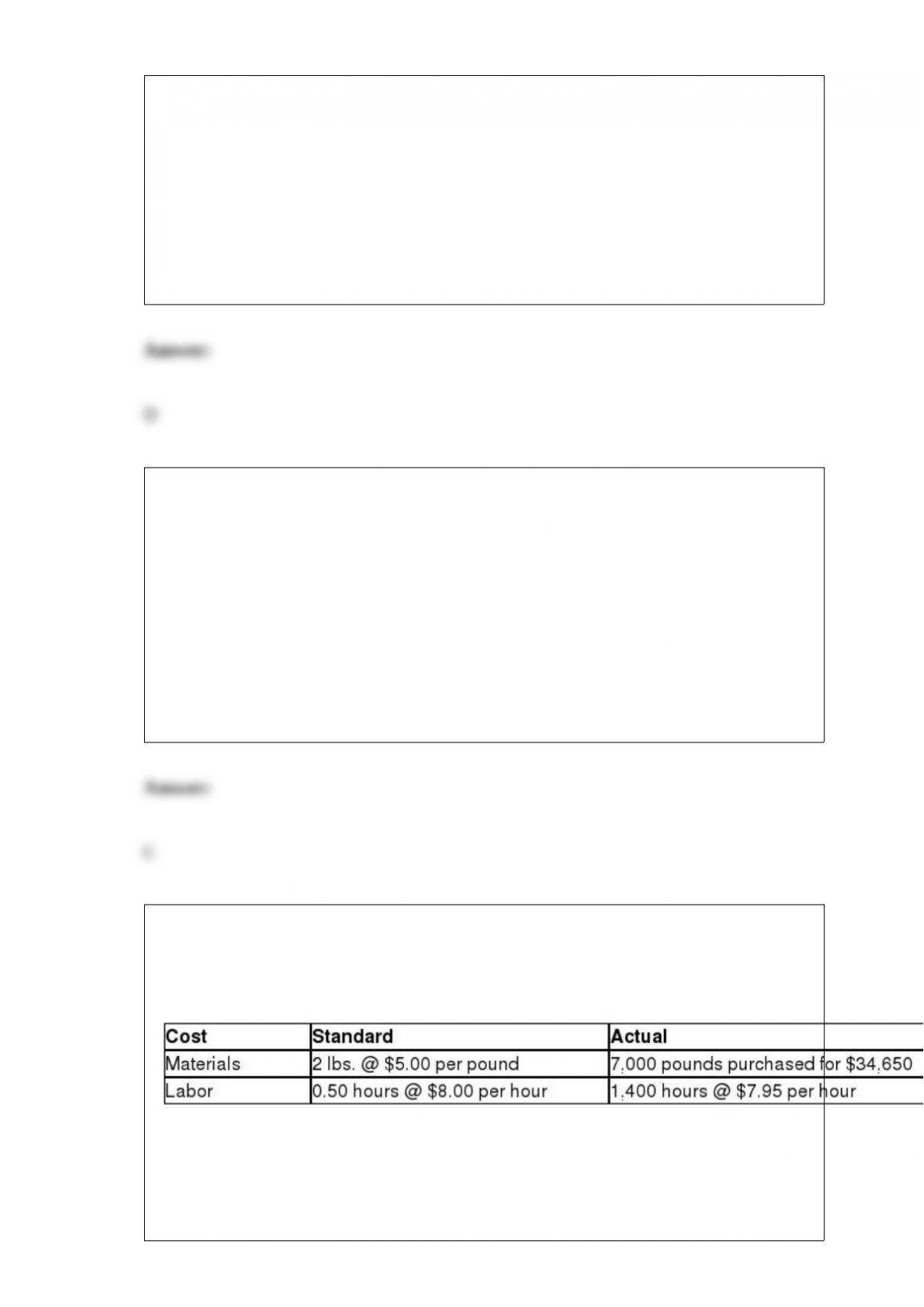
ABC Company
ABC Company reports the following information for the most recent period when 2,750
units were produced.
Refer to ABC Company. Calculate the direct materials efficiency variance.
A.$7,150 U
B.$7,500 U
C.$7,150 F
D.$7,500 F
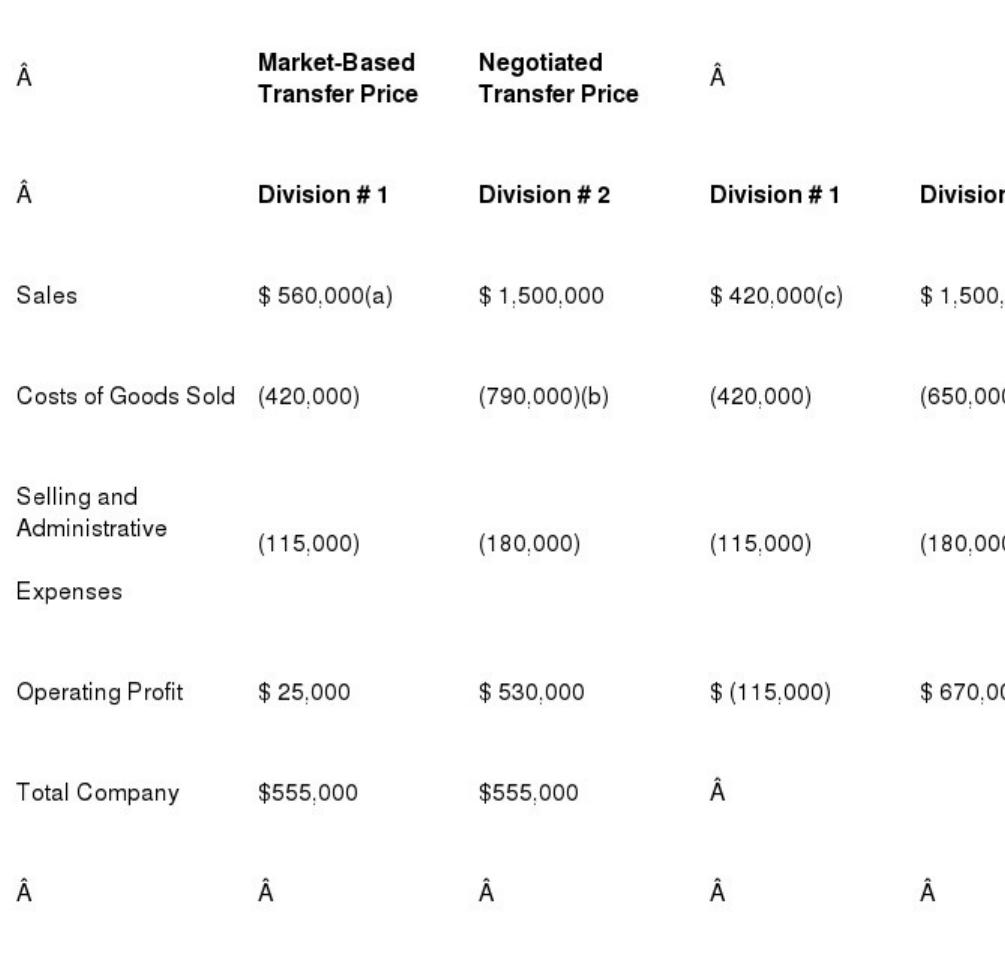
Brooks Beverage Company produces bottled drinks. Division #1 acquires the water,
adds carbonation, and sells it in bulk quantities to Division # 2 of Spring Waters and to
outside buyers. Division # 2 buys carbonated water in bulk, adds flavoring, bottles it,
and sells it. Last year, Division #1 produced 1,600,000 gallons, of which it sold
1,400,000 gallons to the Division # 2 and the remaining 200,000 gallons to outsiders for
$0.35 per gallon. Division #2 processed the 1,400,000 gallons, which it sold for
$1,500,000. Division #1’s variable costs were $420,000 and its fixed costs were
$115,000. The Division # 2 incurred an additional variable cost of $300,000 and
$180,000 of fixed costs. Both divisions operated below capacity.
Required:
a. Prepare division income statements assuming the transfer price is at the external
market price of $0.35 per gallon.
b. Repeat part a. assuming a negotiated transfer price of $0.25 per gallon is used.
c. Respond to the statement: “The choice of a particular transfer price is immaterial to
the company as a whole.”