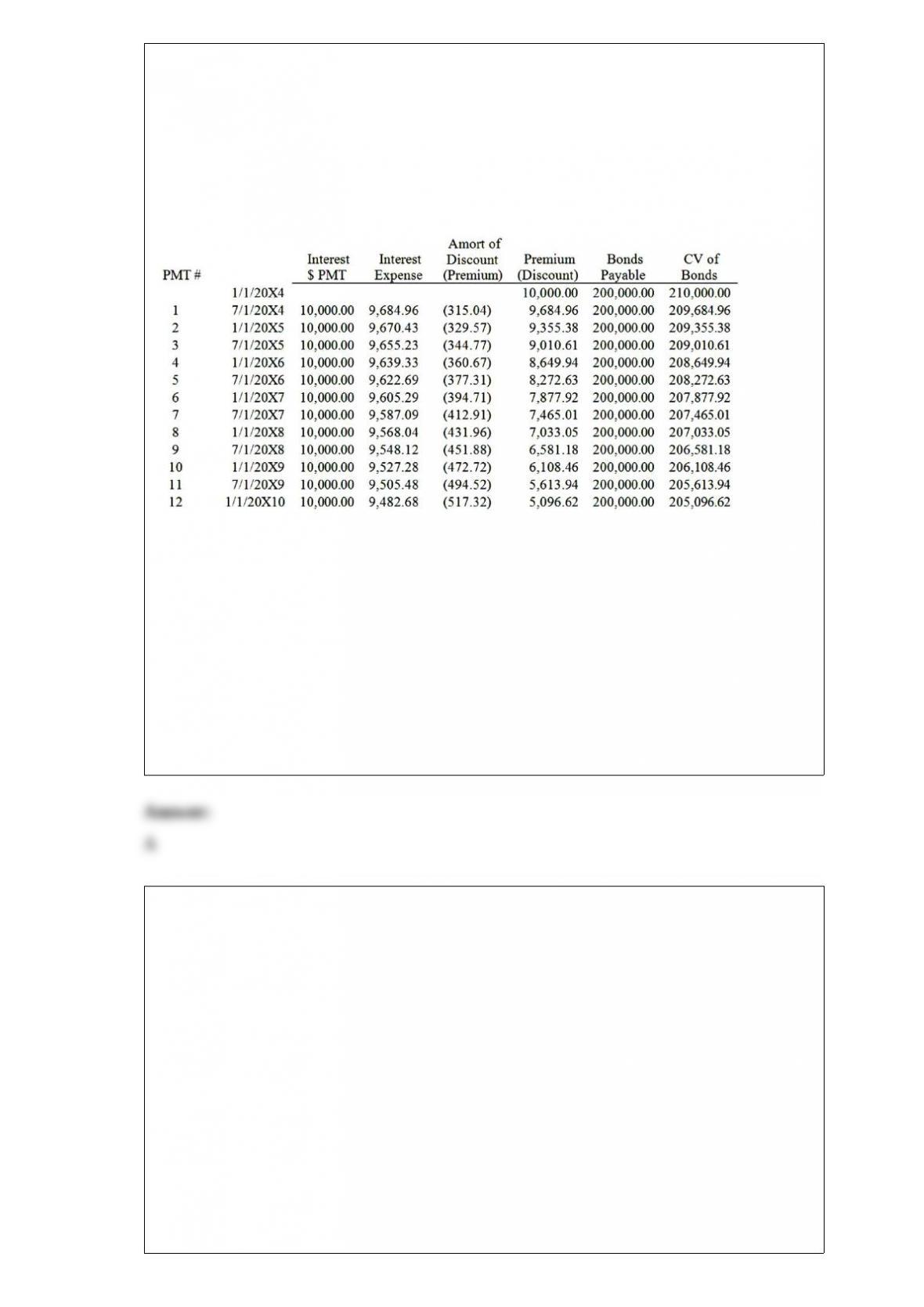
1) Granite Company issued $200,000 of 10 percent first mortgage bonds on January 1,
20X4, at 105. The bonds mature in 10 years and pay interest semiannually on January 1
and July 1. Mortar Corporation purchased $140,000 of Granite’s bonds from the
original purchaser on December 31, 20X8, for $125,000. Mortar owns 75 percent of
Granite’s voting common stock. Granite’s partial bond amortization schedule is as
follows:
Based on the information given above, what amount of premium on bonds payable will
be eliminated in the preparation of the December 31, 20X8 consolidated financial
statements?
A.$4,276
B.$6,108
C.$6,581
D.$4,607
2) Wakefield Company uses a perpetual inventory system. In August, it sold 2,000 units
from its LIFO-base inventory, which had originally cost $35 per unit. The replacement
cost is expected to be $45 per unit. The company is planning to reduce its inventory and
expects to replace only 1,500 of these units by December 31, the end of its fiscal year.
The company replaced 1,500 units in November at an actual cost of $50 per unit.
Based on the preceding information, in the entry to record the replacement of the 1,500
units in November, Accounts Payable will be credited for:
A.$67,500
B.$75,000
C.$62,500
D.$60,000

3) Burrough Corporation paid $80,000 to acquire all of Helyar Company’s net assets.
Helyar reported assets with a book value of $60,000 and fair value of $98,000 and
liabilities with a book value and fair value of $23,000 on the date of combination.
Burrough also paid $3,000 to a search firm for finder’s fees related to the acquisition.
What amount will be recorded as goodwill by Burrough Corporation while recording its
investment in Helyar?
A.$0
B.$5,000
C.$8,000
D.$13,000
4) ABC Corporation owns 75 percent of XYZ Company’s voting shares. During 20X8,
ABC produced 50,000 chairs at a cost of $79 each and sold 35,000 chairs to XYZ for
$90 each. XYZ sold 18,000 of the chairs to unaffiliated companies for $117 each prior
to December 31, 20X8, and sold the remainder in early 20X9 to unaffiliated companies
for $130 each. Both companies use perpetual inventory systems.
Based on the information given above, what amount of cost of goods sold must be
eliminated from the consolidated income statement for 20X9?
A.$187,000
B.$221,000
C.$1,422,000
D.$2,963,000
5) Private Not-For-Profit (NFP) Entities.
Select from this list of terms to answer the following questions.
A. Fair value
B. Unrestricted net assets
C. GASB
D. FASB

E. Statement of Revenues, Expenditures, and Changes in Fund Balance
F. Lower of cost or market
G. Accrual method
H. Statement of Activities
I. General fund, restricted fund, endowment fund
J. Modified accrual method
K. Permanently restricted net assets
L. Temporarily restricted net assets
M. Endowment fund
N. Unrestricted, temporarily restricted, permanently restricted
O. Depreciation
P. Works of art and other historical treasures
Q. General fund
R. Cost
Indicate your choice by entering the letter corresponding to the correct term. A term
may be used more than once or not at all.
“Basis for measuring investments in financial statements” describes which term listed
above?
6) In the computation of a partner’s Loss Absorption Power (LAP), which of the
following statements is incorrect?
I. The computation of LAPs for all partners allows cash to be distributed before all
partnership assets have been sold and all creditors have been paid.
II. The computation of LAPs for all partners indicates the relative strength of each
partner’s net capital position so that available cash is distributed in respective
loss-sharing ratios.
A.I
B.II
C.Both I and II
D.Neither I nor II
7) According to ASC 958, not-for-profit entities should report investments in the
financial statements at:
I. fair market value.

II. lower of cost or market.
A.I only
B.II only
C.Either I or II
D.Neither I nor II