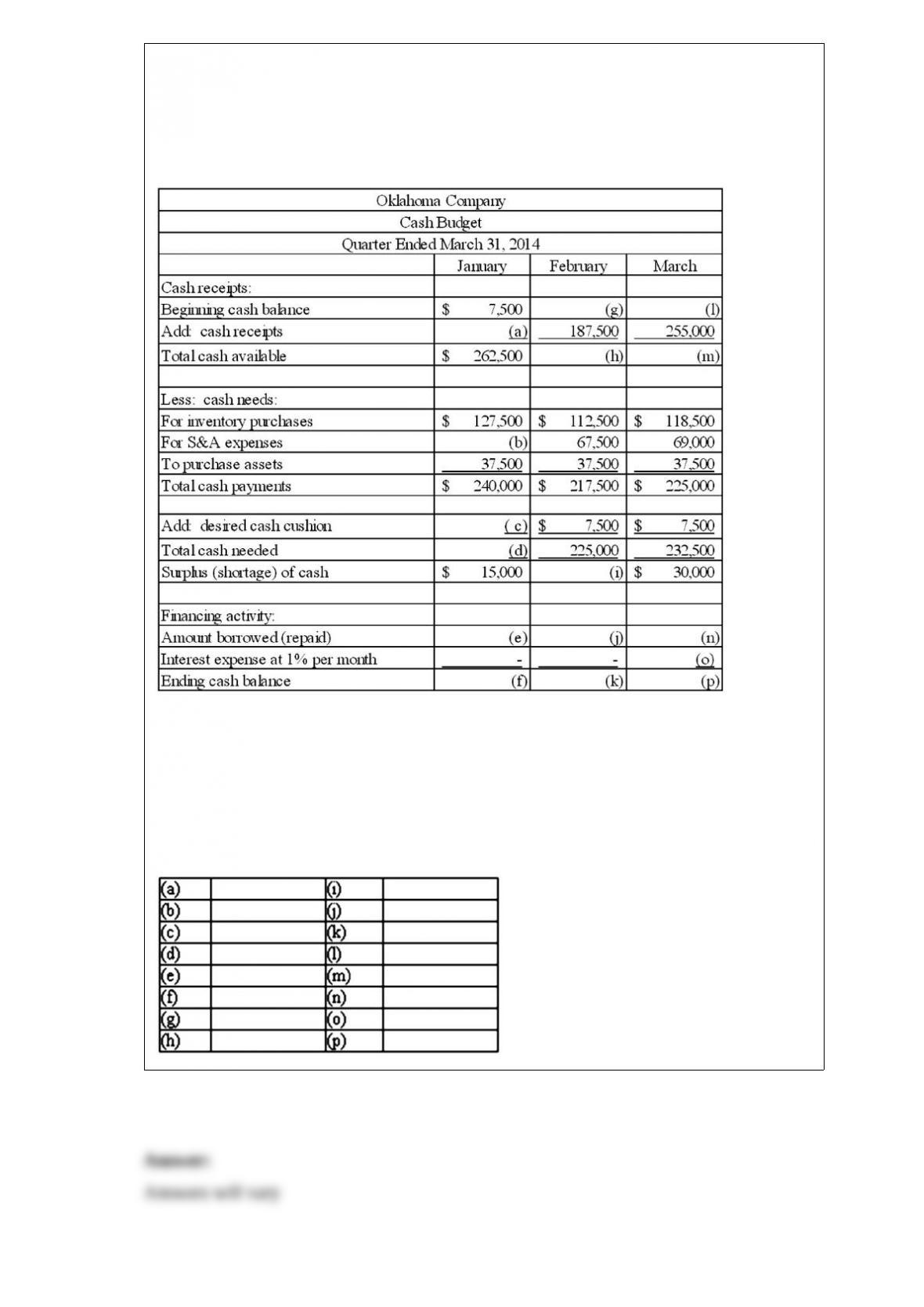
A management accountant was working on a cash budget for Oklahoma Company
when he accidentally spilled his coffee. Some of the liquid splattered on his working
papers rendering a few of the amounts illegible. The budget with missing amounts
indicated is provided below:
The company desires a cash cushion of $7,500 to start each month. In any month in
which there is cash shortage the company’s bank will extend it a loan equal to the
shortage amount. The loan is assumed to have been made on the last day of the month.
Any time the company has a cash surplus it must repay as much of any outstanding
loans as possible. The bank charges monthly interest of 1% on any outstanding loan
balance.Required:Compute the missing amounts and enter them in the following table:
What is the fraud triangle? Which element of the fraud triangle is most closely
connected with internal controls?
Roadmaster Tires produces a variety of auto and truck tires at its Indianapolis
manufacturing plant. The plant is highly automated and uses an activity-based costing
system to allocate overhead costs to its various product lines. The costs and cost drivers
associated with four activity cost pools are given below:
Production of 1,000 units of a small tractor tire required 200 labor hours, 2 setups, and
consumed 10% of the product sustaining activities.Required:
1) Instead of using ABC, suppose the company had used labor hours as a
company-wide allocation base. How much total overhead would have been allocated to
the tractor tire?
2) How much total overhead costs will be allocated to the tire under activity-based
costing?
3) The tire is priced on a cost plus basis. What price will be quoted if the product is
priced at 25% above cost? Compute the price under both the direct labor hours
approach and under activity-based costing. The direct manufacturing costs consist of
direct material of $20 and direct labor of $30.
4) What implications does ABC have on a company that bids on contracts using a cost
plus basis?
Indicate whether each of the following statements about job-order cost systems is true
or false.
A company using a job-order cost system assigns an identification number to each job
or batch of products.
With a job-order cost system, costs for all jobs worked on during a period are
accumulated together and then allocated to individual jobs.
Job-order costing systems involve some averaging in the calculation of the costs of
products.
In a job-order cost system, the work in process inventory account is a temporary
account.
In a job-order cost system, each job cost sheet includes direct material, direct labor, and
manufacturing overhead cost.
Groove Music Company produces compact discs of background music for restaurants
and other retail shops. Its disc recording machines are capable of producing 50 discs per
hour. The unit-related cost of producing the discs is $2.00. The discs sell for $10.00
each. Mood Music Co. has asked the company to produce 10,000 copies of a disc for
$9.00. Groove Music estimates that for this special order the unit-related cost of
producing the disc will be $4.00 and that, due to the unique nature of the recording, its
machines will only be able to produce 20 discs per hour. Groove Music has a total of
5,000 machine hours of capacity. In addition, to accept the special order, Groove Music
will have to lease an additional special-purpose machine that will cost
$6,500.Required:
Assume that existing demand for Groove Music’s compact discs is 200,000 units and
that the special order has to be either taken in full or rejected. Prepare an analysis that
indicates whether or not the special order should be accepted.
In 2013, Vanguard Company sold 80,000 of its only product at a selling price of $60 per
unit. Variable costs were $18 per unit, and Vanguard’s margin of safety for the year was
25,000 units.
Required:
1. Calculate Vanguard’s margin of safety ratio for 2013.
2. What was the amount of Vanguard’s fixed costs for 2013?
Assume that factory depreciation for the year is $240,000. What problem could result
from dividing that amount by 12 and assigning $20,000 in depreciation to the products
made each month?
Houston Company produces a product that sells for $175 per unit and has variable costs
of $50 per unit. Houston’s annual fixed costs are $200,000, and the company wishes to
earn a profit of $80,000.
Required:
Use the equation method to determine the sales volume in units and dollars required to
earn the desired profit.