Dukes Computing Systems
Dukes Computing Systems manufactures and sells various computer products and has
two decentralized divisions: (1) Production and (2) Marketing. The Marketing Division
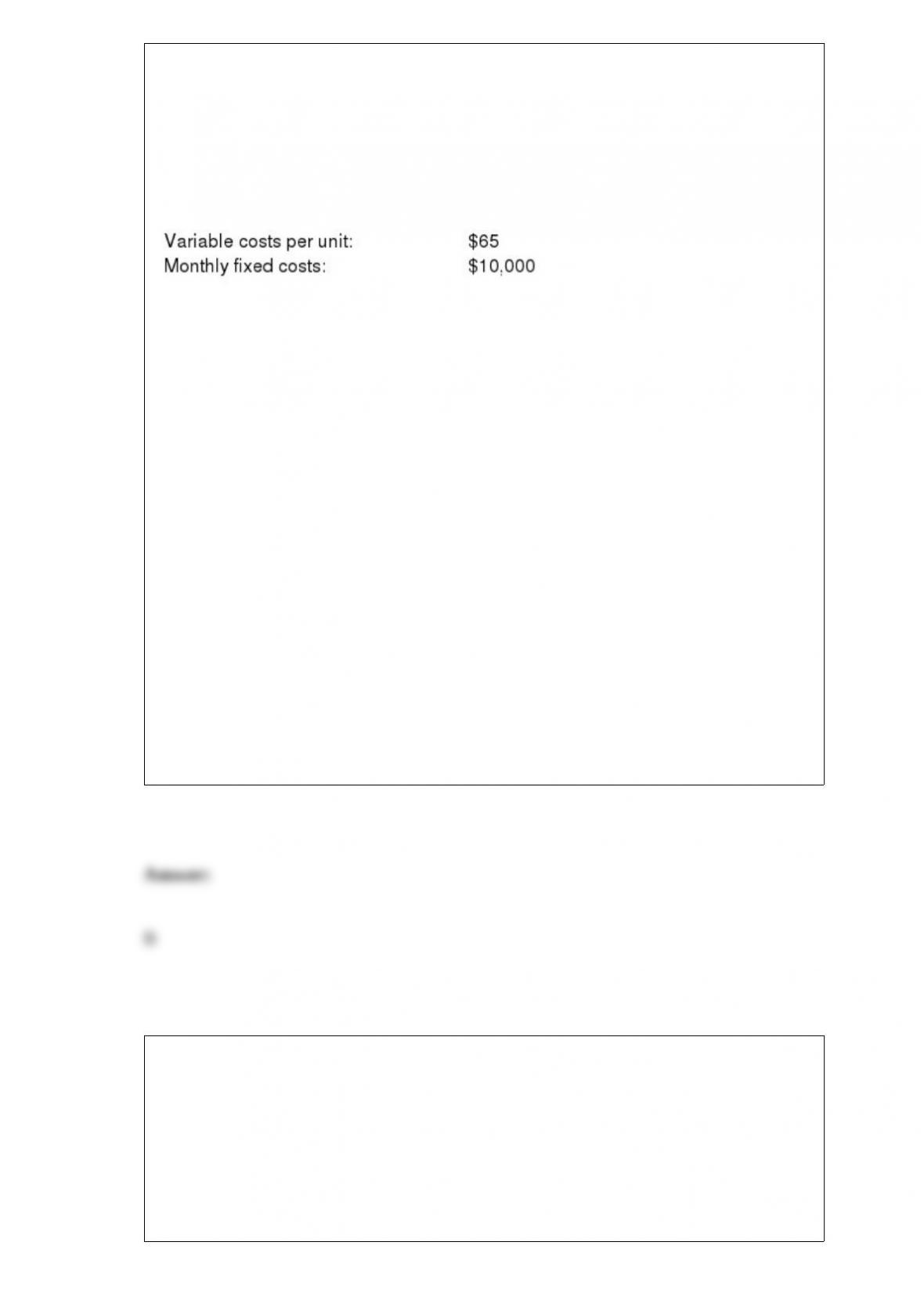
has always purchased a particular motherboard from Production at $65 per unit. The
Production Division is considering raising the price to $75 per unit. The Production
Division’s costs related to the motherboard production is as follows:
The Marketing Division handles the promotion and distribution of the motherboard
purchases from the Production Division and sells each motherboard for $125.
Marketing Division incurs monthly fixed costs of $5,000. Marketing Division sells
2,000 units per month. Marketing Division can buy the same motherboard from outside
suppliers for $75.
Refer to Dukes Computing Systems. If the Marketing Division purchases the
motherboard from outside suppliers, the facilities the Production Division uses to
manufacture the motherboard would remain idle. The Production Division is operating
below capacity because of weak global demand for the product.
What should be the motherboard transfer price be between the Production Division and
Marketing Division in order for Dukes’ to optimize profits?
A.$ 55
B.$ 65
C.$ 75
D.$125
Which is the best stage in the Value Chain to prevent quality problems?
A.Design
B.Production
C.Marketing

D.Research & Development
Which of the following represents a general framework for guiding management’s
operating decisions containing projected activity levels for a series of years?
A.organizational goals implementation plan.
B.strategic long-range profit plan.
C.master budget.
D.tactical short-range profit plan.
A major cause of difficulty in implementing activity-based costing is the failure to get
buy-in of which of the following?
A.engineering people in the organization
B.production people in the organization
C.marketing people in the organization
D.influential people in the organization

When does activity-based costing have the best results?
A.When it is used as a quick, one-time fix.
B.When the company has a short-term time horizon.
C.When it is used as a process that requires patience and participation.
D.When it is used as a means to motivate employees to work better.
Return on Investment (ROI) is equal to the
A.(Profit Margin/Division Costs) x (Division Costs/Division Investment).
B.(Profit Margin/Division Revenues) x (Division Revenues/Division Investment).
C.(Sales Margin/Division Revenues) x (Division Revenues/Division Investment).
D.(Sales Margin/Division Costs) x (Division Costs/Division Investment).
Which of the following costs are the responsibility of revenue center managers?
A.costs only.
B.revenues only.
C.both costs and revenues.

D.revenues, costs, and assets.
Which is a disadvantage for a company to use relative performance evaluations?
A.Forces managers to seek, new, more profitable opportunities.
B.Shields managers from the risk of managing a division in a poorly performing
industry.
C.Does not provide incentives for managers to move out of low-performing to
high-performing industries.
D.None of the answers are disadvantages.
For financial reporting purposes, how are fixed manufacturing costs treated?
A.As period costs.
B.As product costs.
C.As direct materials costs.
D.None of the above.
Big Sky Timber processes timber into Grade A and Grade B lumber. Timber costs $400
per unit, where one unit equals 1,000 board feet. The process involves cutting timber
into the two grades of lumber. Each unit of timber produces .25 unit (250 board feet) of
Grade A lumber with a market value of $560 and .75 unit (750 board feet) of Grade B
with a market value of $240. The joint cost of the production process is $100 per unit.
Required:
a. Assume that the joint costs of the two grades of lumber are to be allocated on the
basis of units of output. What cost is assigned to each product (for .25 unit of Grade A
and .75 unit of Grade B)?
b. If the joint costs are allocated on the basis of the net realizable value, what cost is
assigned to each product? How much profit or loss does the Grade A lumber earn? Is it
really possible to determine which product is more profitable? Explain why or why not.
Which of the following is a control that can be instituted to prevent financial fraud?
A.separation of duties.
B.internal auditors.
C.independent auditors.
D.All of the answers are correct.
Stephanie Company
Stephanie Company has two production departments: D and J. Stephanie also has 3
service departments: Personnel, Administration, and Shipping. Shipping costs are
allocated on the basis of number of packages, while Personnel and Administration costs
are allocated using number of employees. Assume that the ranking of the benefits
provided is in the order listed below.
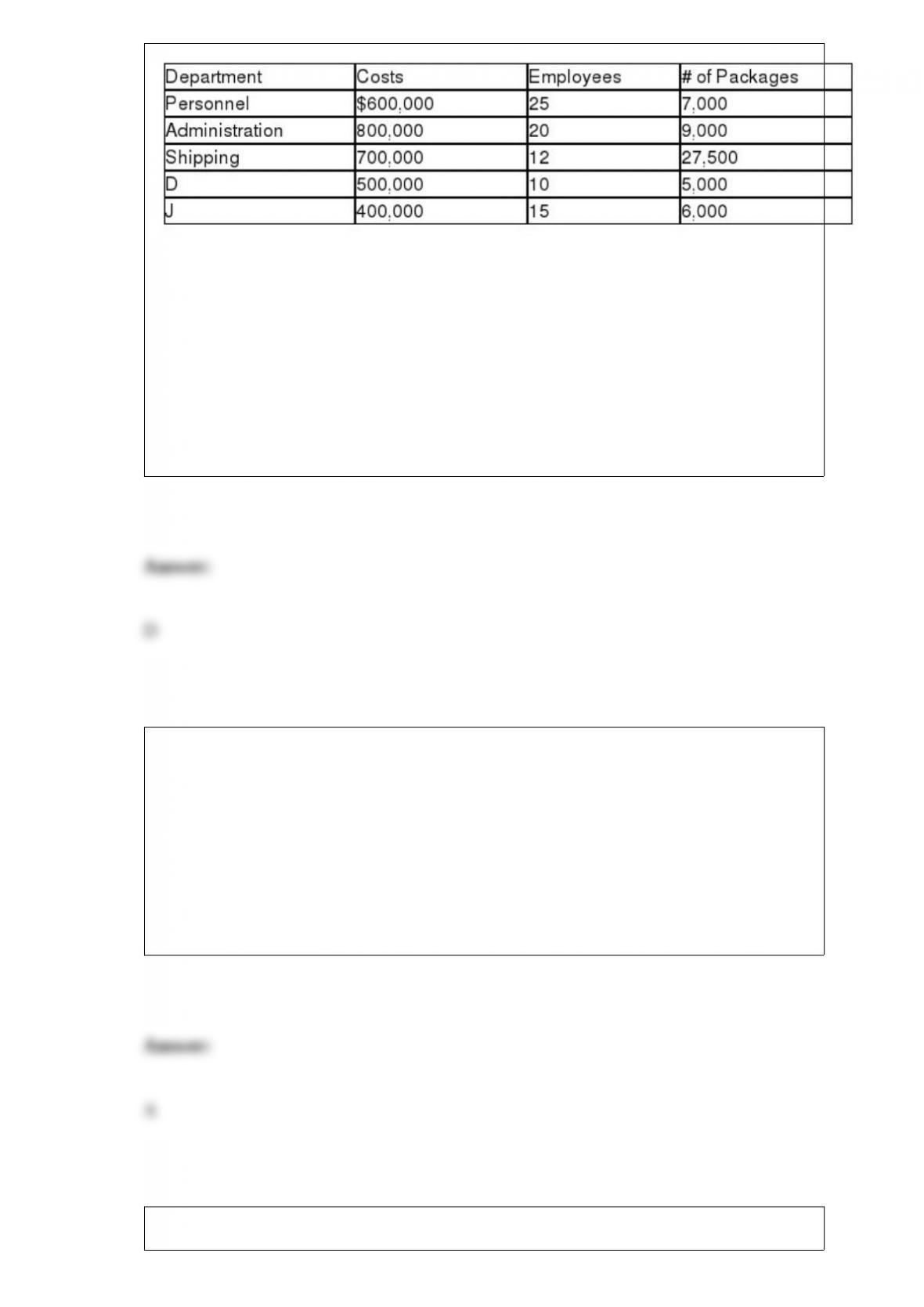
Refer to Stephanie Company. Using the step method, what amount of Shipping costs is
allocated to Department J (rounded to the nearest $)?
A.$304,348
B.$500,000
C.$524,570
D.$629,484
When is the master budget prepared?
A.before the budget period begins.
B.after the budget period begins, but before it ends.
C.about half way through the budget period begins.
D.at the end or after the budget period ends.
Which of the following is falseabout process costing?
A.Firms collect costs for each unit produced.
B.Firms accumulate costs in a department or production process during the accounting
period
C.Firms spread costs evenly over the units produced during the period, to determine an
average cost per unit.
D.The equation for determining average unit cost is Total Manufacturing Cost Incurred
during the Period divided by Total Units Produced during the period.
Which of the following is most likely to be a fixed cost for a company?
A.Sales commissions.
B.Depreciation on factory equipment
C.The cost of materials used in production.
D.The cost of shipping finished goods.
Relate activity-based management to the value chain.
Feed the Hungry Foundation
Feed the Hungry Foundation is a non-profit organization that has a cost of capital of 10
percent. The foundation is considering the replacement of a piece of equipment. The old
machine has a book value of $3,000 and a remaining estimated life of 5 years with no
salvage value at that time. The salvage value of the old machine is currently $1,500.
The new equipment will cost $10,000. It has an estimated life of 5 years with no
salvage value then. Annual cash operating costs are $4,000 for the old machine and
$2,000 for the new machine.
Refer to Feed the Hungry Foundation. What is the present value of the operating cash
outflows for the old machine?
Discuss the meaning of the terms “favorable” and “unfavorable” with regards to
variances. How does each type of variance affect operating profits? Do the terms refer
to good or bad variances? Give an example of each with the effect on profits and the
interpretation of the meaning of the term.
How are marketing and administrative costs allocated to departments for purposes of
performance evaluation?
Explain management’s role in assuring the integrity of financial information.
Evans Company processes a chemical, Exacto 7, through a pressure treatment
operation. The complete process has two outputs, X and Y. The January costs to process
Exacto 7 are $50,000 for materials and $100,000 for conversion costs. This processing
results in two outputs, X and Y, that sell for a total of $250,000. The sales revenue from
X amounts to $200,000 of the total.
Required:
Using the net realizable method, assign costs to X and Y for January.
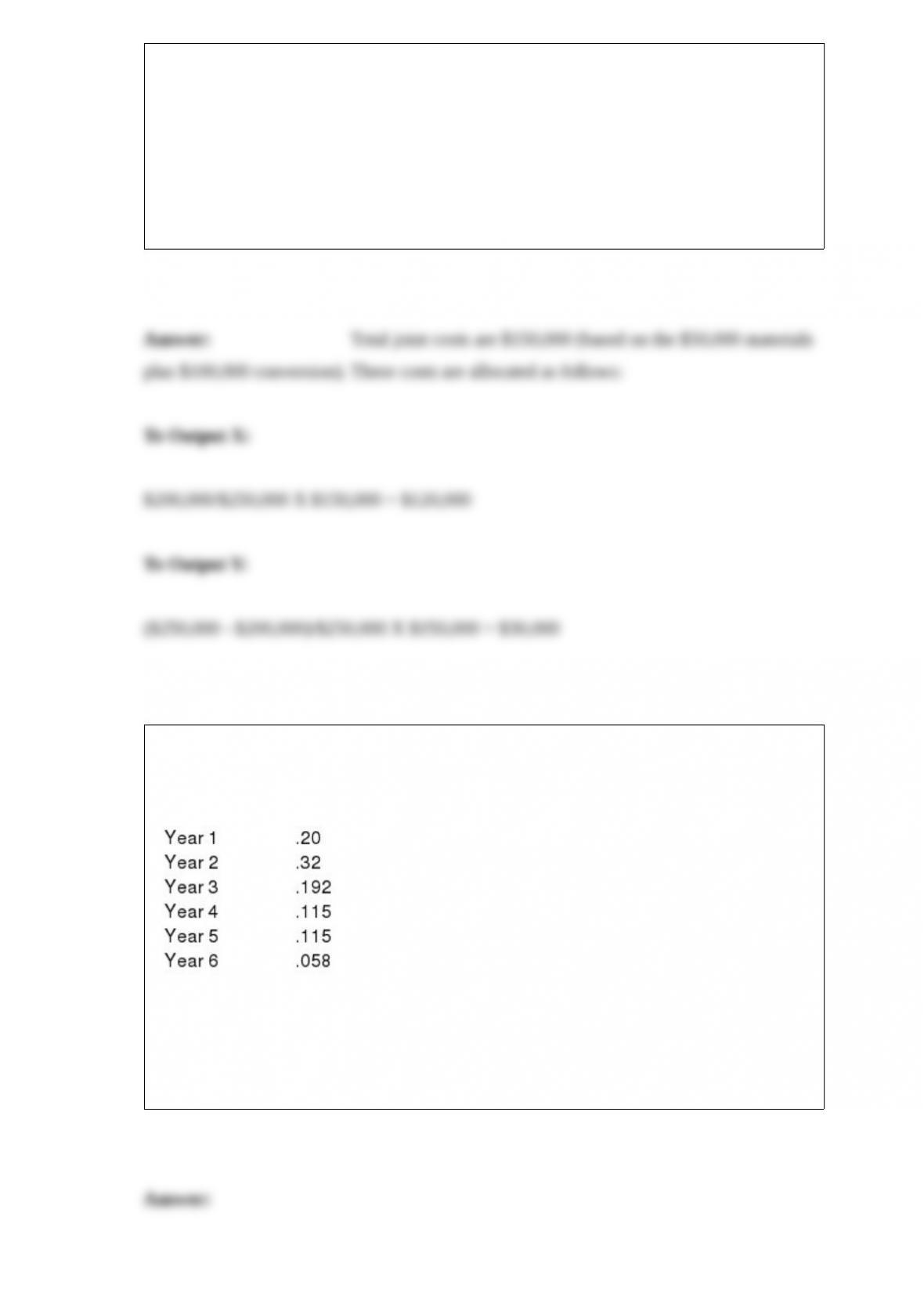
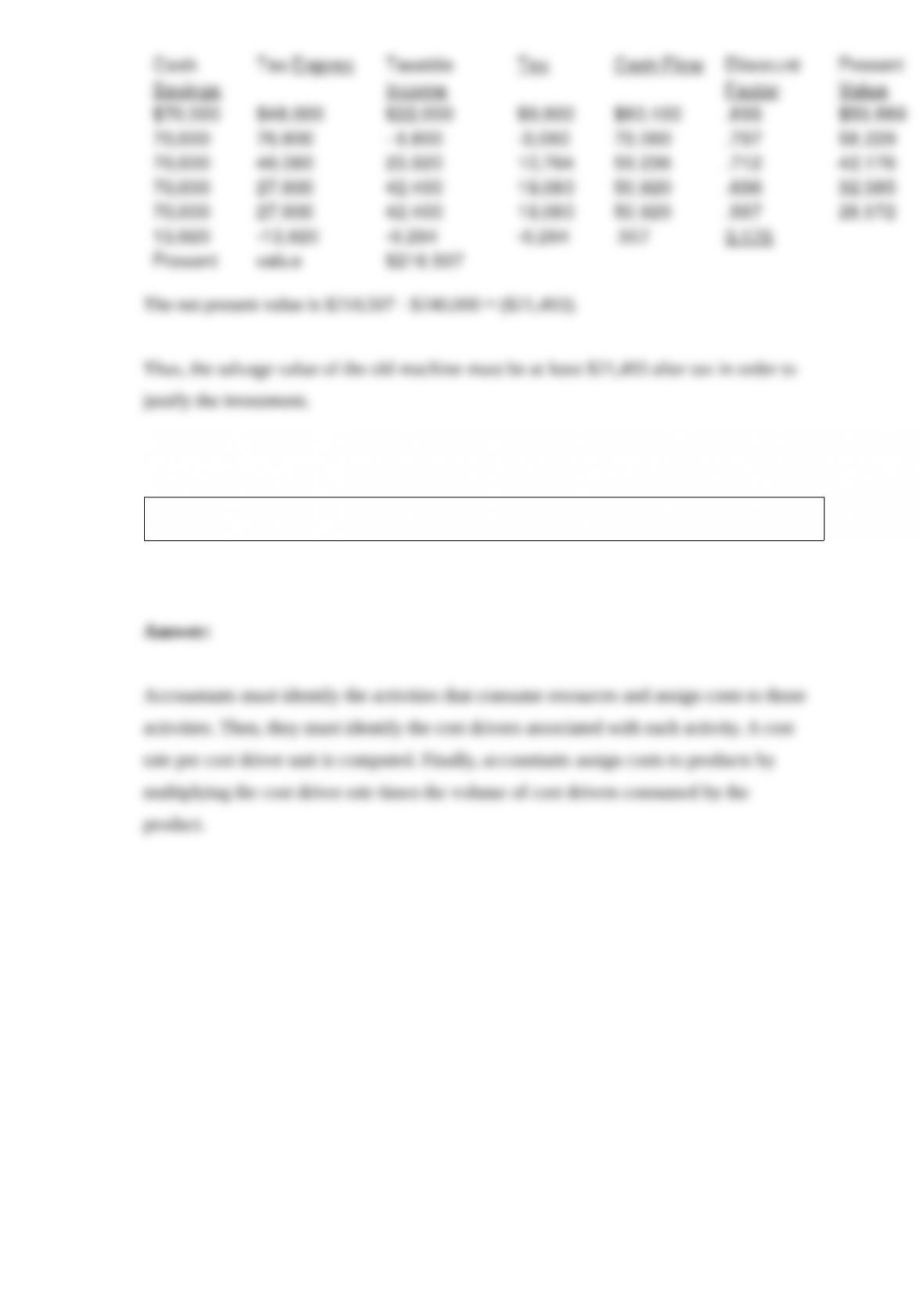
The Nova Company is considering replacing a machine that will cost $240,000. It
expects to realize cost savings of $70,000 a year before taxes for each of the next five
years. The company will use an accelerated method of depreciation as follows:
At the end of five years, the company expects the machine will have no salvage value.
The company has a tax rate of 45 percent and has determined that 12 percent is the
appropriate discount rate to use. Prepare an analysis showing the net present value.
Indicate what salvage value is necessary of the old machine in order to justify the
purchase of the new machine.
Describe the four steps accountants follow in activity-based costing.