The percentage of credit sales method is simpler but less accurate than the aging
method for calculating bad debts.
Answer:
Which of the following statements regarding the reporting of operating cash flows
using the direct method isTRUE?
A. Although most U.S. companies use the indirect method, the Financial Accounting
Standards Board (FASB) prefers the direct method of accounting for cash flows from
operating activities.
B. The FASB prefers the indirect method of calculating cash flows from operations
because it gives a more accurate calculation of cash provided by operating activities.
C. The direct method results in a larger amount of cash flow from operating activities
than does the indirect method.
D. The direct and indirect methods use different presentations for cash flows from
investing and financing activities.
Answer:
Net income is based on estimates.
Answer:
Every transaction increases at least one account and decreases at least one account.
Answer:
A company is either a service company, a merchandising company, or a manufacturer,
but cannot be more than one of these.
Answer:
Which of the following isTRUE of income statement accounts?
A. Costs incurred to help generate revenue are only reported as expenses on the income
statement if they are paid in cash in the same period as the revenue received.
B. Revenue accounts are shown after the amount of expense accounts on the income
statement.
C. Revenue accounts include accounts receivable, unearned revenue and cash accounts.
D. There is no net income account.
Answer:
A company started the year with a normal balance of $68,000 in the Inventory account.
During the year the following amounts were posted to the account:
Debits of $45,000 and credits of $55,000. Choose theTRUE statement.
A. After these amounts are posted, the balance in the Inventory account is a credit
balance of $58,000.
B. The normal balance of the Inventory account is a credit balance.
C. The inventory account is decreased by debits.
D. The debits and credits posted to the Inventory account caused it to decrease by
$10,000.
Answer:
If a company reports negative net cash flow from operating activities, positive net cash
flow from investing activities, and zero net cash flow from financing activities, this
suggests that the company is selling its productive assets to cover its operating activities
outflows.
Answer:
Trademarks and goodwill are intangible assets that are not amortized.
Answer:
The lower the inventory turnover ratio, the more efficiently the company manages its
inventory, all other things being equal.
Answer:
Which of the following statements regarding the multiple-step income statement
isTRUE?
A. Peripheral results come from the company’s main business activity.
B. Core results are presented after peripheral results.
C. Rent revenue may be properly classified as operating revenue by some companies,
and as non-operating revenue by others.
D. Investors are more interested in peripheral results than core results.
Answer:
The price-earnings ratio reveals information about the stock market’s expectations for a
company’s future growth in earnings.
Answer:
During the current accounting period, revenue from credit sales is $671,000. The
accounts receivable balance is $51,480 at the beginning of the period and $52,200 at the
end of the period. Which of the following statements isTRUE?
A. The receivables turnover ratio is 12.9.
B. On average, it takes 12.9 days to collect payment from credit customers.
C. The receivables turnover ratio is 28.3.
D. On average, the company sells its inventory every 28.3 days.
Answer:
The cost assigned to cost of goods sold and to inventory under the FIFO method will be
the same whether the perpetual or the periodic inventory system is used.
Answer:
The reporting of financing activities is identical under the indirect and direct methods
for the statement of cash flows.
Answer:
The Grass is Greener Corporation’s receivables turnover ratio decreases from 14.1 to
11.8. Which of the following statements isTRUE?
A. This indicates that the company is taking longer to collect credit payments.
B. This is an indication that the company is experiencing declining credit costs.
C. This could be an indication that the company is using more efficient collection
methods.
D. This is an indication that the company is buying and selling financial assets less
rapidly.
Answer:
Depreciation is an allocation method, not a valuation method.
Answer:
Which of the following statements isTRUE?
A. Expenses are listed before revenues on the income statement.
B. Operating income is listed before net income on the income statement.
C. The income statement is prepared after the balance sheet.
D. Dividends declared are listed on the income statement.
Answer:
A business is obliged to repay both debt and equity financing.
Answer:
A company issued 10-year, 8% bonds with a face value of $200,000. Interest is paid
annually. The market rate on the issue date was 7.5% and the company received
$206,948 in cash proceeds. Which of the following statements isTRUE?
A. The company must pay $184,000 at maturity plus $16,000 in interest each year for
10 years.
B. The company must pay $206,948 at maturity plus $15,000 in interest each year for
10 years.
C. The company must pay $200,000 at maturity plus $16,000 in interest each year for
10 years.
D. The company must pay $200,000 at maturity plus $15,000 in interest each year for
10 years.
Answer:
A net profit margin ratio of 0.2 means that $1 of profit is generated for every $5 of sales
revenue.
Answer:
Which one of the statements appearing below isTRUE regarding bank reconciliations?
A. A bank reconciliation is an external report prepared to report the cash balance to
investors and creditors.
B. After preparing a bank reconciliation, no adjusting journal entries need to be made
for outstanding checks or deposits in transit.
C. If a company’s records show a different cash balance from that shown on the
company’s bank statement, either the company or the bank has made an error.
D. The up-to-date ending cash balance on the bank statement side should not equal the
up-to-date ending cash balance on the book side.
Answer:
You mistakenly include a contra account of $20,000 in the same column of your trial
balance as the account it offsets. All other things equal, your debit and credit column
totals will differ by $40,000.
Answer:
Which of the following statements isTRUE?
A. Payroll deductions are an expense of the company.
B. When the payroll is recorded, the total wages expense is equal to the sum of all the
deductions.
C. The net pay is debited to wages expense when the payroll is recorded.
D. Gross pay is equal to the hours worked x the hourly pay rate.
Answer:
Prepaid expenses would be reported on the Balance Sheet.
Answer:
Which of the following statements about an adjusted trial balance isTRUE?
A. Debits should equal credits both before and after adjustments are made.
B. Debits will equal credits after adjustments are made but not necessarily before.
C. Debits will equal credits before adjustments are made but not necessarily after.
D. Debits do not have to equal credits in the adjusted trial balance but they must be
equal in the post-closing trial balance.
Answer:
At the end of the year, a company made an adjusting entry for prepaid insurance that
had expired. Which of the following isTRUE?
A. Net profit margin ratio will decrease and debt-to-assets ratio will increase.
B. Net profit margin ratio will increase and debt-to-assets ratio will not change.
C. Net profit margin ratio will decrease and debt-to-assets ratio will not change.
D. Net profit margin ratio will not change and debt-to-assets ratio will not change.
Answer:
Which of the following statements regarding inventory measures is notTRUE?
A. If the inventory turnover ratio increases, the days to sell measure decreases.
B. The days to sell measure can help managers make ordering decisions for inventory.
C. A higher inventory turnover ratio indicates that inventory is moving more quickly
from purchase to sale.
D. It is rare for a company with a lower gross profit percentage to have a faster
inventory turnover.
Answer:
A company sells three different products. The first costs $8 and sells for $16, the second
costs $18 and sells for $45, while the third costs $36 and sells for $120. Which of the
following is notTRUE?
A. The gross profit percentages on the individual products are 50%, 60%, and 70%,
respectively.
B. The third product has the highest gross profit.
C. If the company can persuade some customers to switch to the third product, overall
gross profit percentage will increase.
D. The product with the highest dollar amount of gross profit will always be the product
with the highest gross profit percentage.
Answer:
Major investing and financing activities that do not involve cash do not have to be
reported as part of the statement of cash flows.
Answer:
A deferral adjustment may involve one asset and one expense account.
Answer:

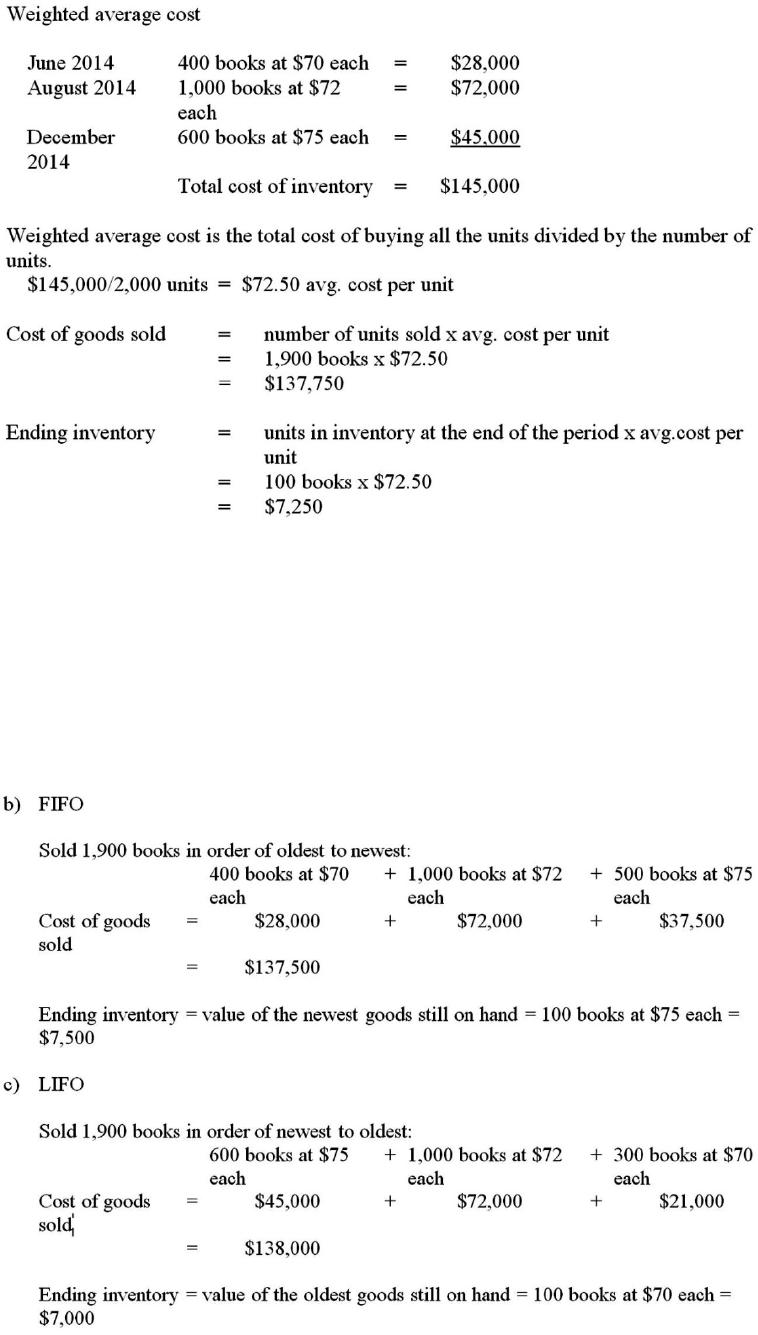
A new textbook is published in the spring of 2014. Your campus bookstore buys 400
copies at $70 each in June, an additional 1,000 copies in August at $72 each, and 600
copies in December at $75 each. At the end of December 2014, the bookstore has sold
1,900 copies of the text.
Calculate the cost of goods sold and the cost of ending inventory:
a) under the weighted average cost method.
b) under the FIFO method.
c) under the LIFO method.
Using your calculations as a guide, explain how different inventory costing methods
affect the numerator and denominator of the inventory turnover ratio when unit costs
are increasing. Conclude your explanation by identifying the method that produces the
highest (and lowest) inventory turnover ratio.
Answer:
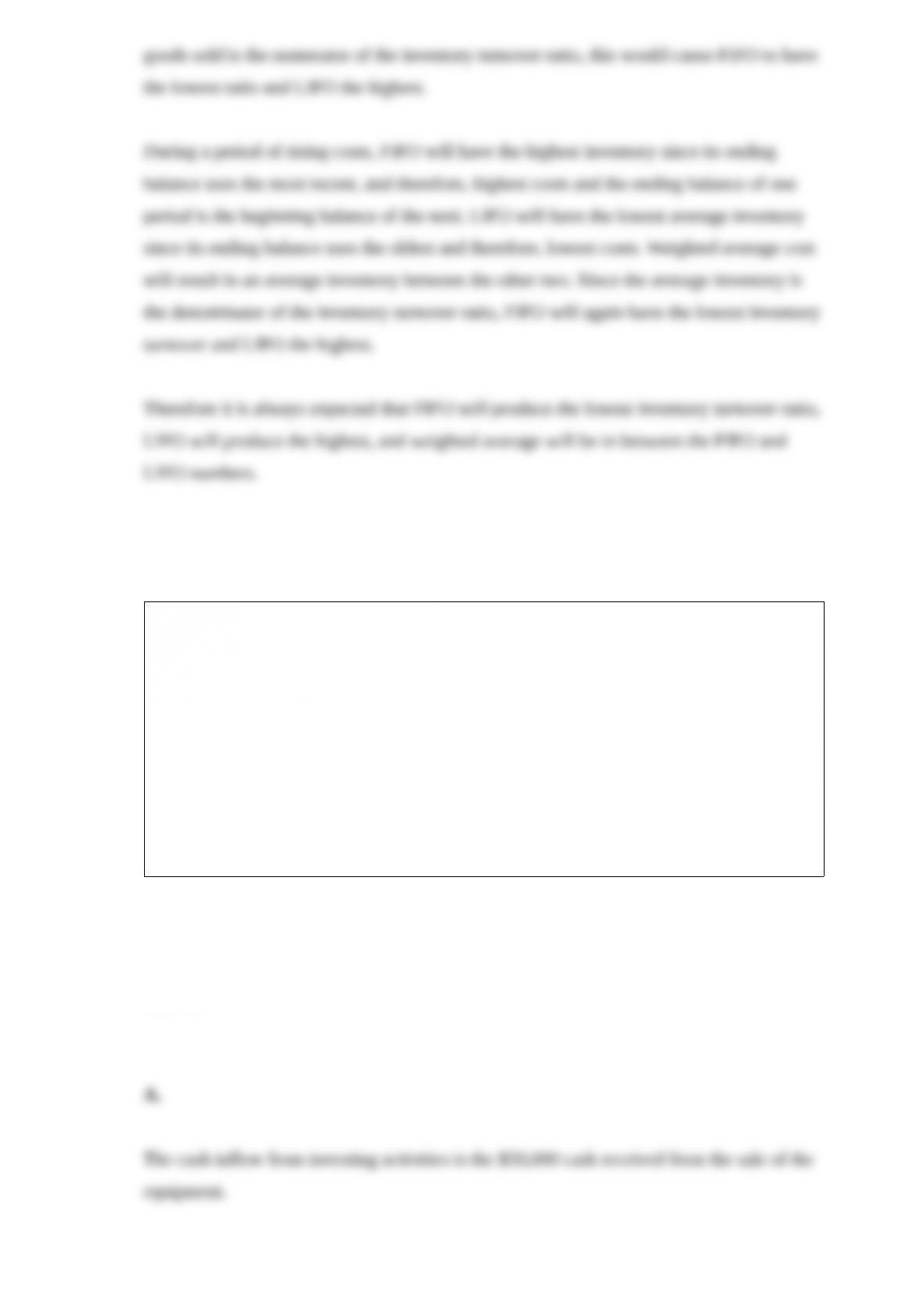
A piece of equipment with a cost of $130,000 and accumulated depreciation of $85,000
is sold for $50,000 cash. The amount that should be reported as a cash inflow from
investing activities is:
A. $50,000.
B. $5,000.
C. $45,000
D. $0. This is a financing activity.
Answer:

The Pet Sitters, Inc., had the following transactions during the month of January. For
each of the transactions, prepare journal entries.
A. Paid $5,000 cash for cat litter.
B. Paid $4,480 for wages for the month of January.
C. Paid $480 in advance for February rent.
D. Provided $12,000 in services on account.
E. Paid $800 on accounts payable.
F. Received $210 from customers as deposits for future pet sitting services.
G. Obtained $390 in vet services during the month, but will not pay the bill until
February.
H. Paid $780 for equipment.
Answer:
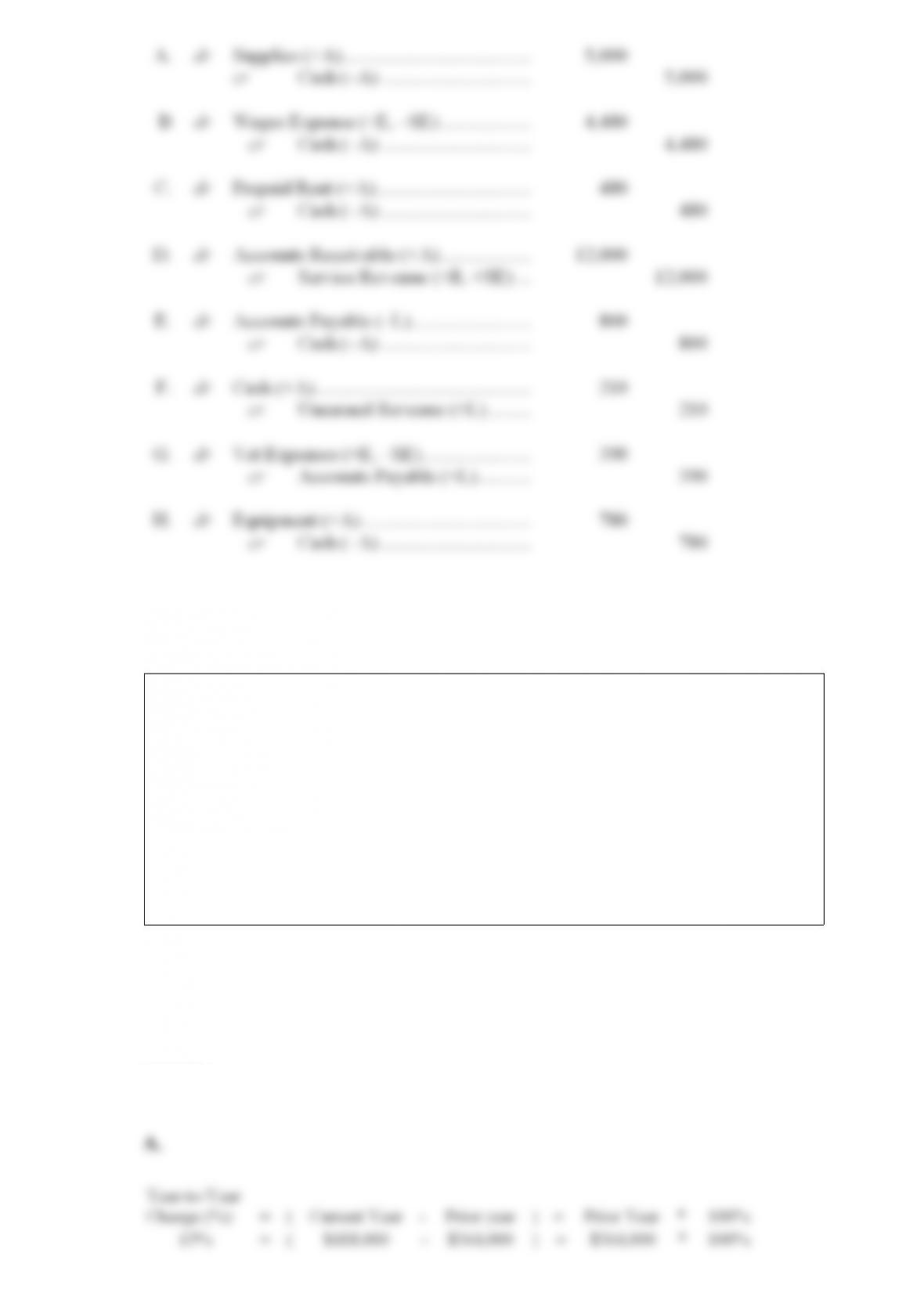
Net income was $418,600 in 2014 and $364,000 in 2013. The year-to-year percentage
change in net income is closest to:
A. 15%.
B. 55%.
C. 87%.
D. 13%.
Answer:
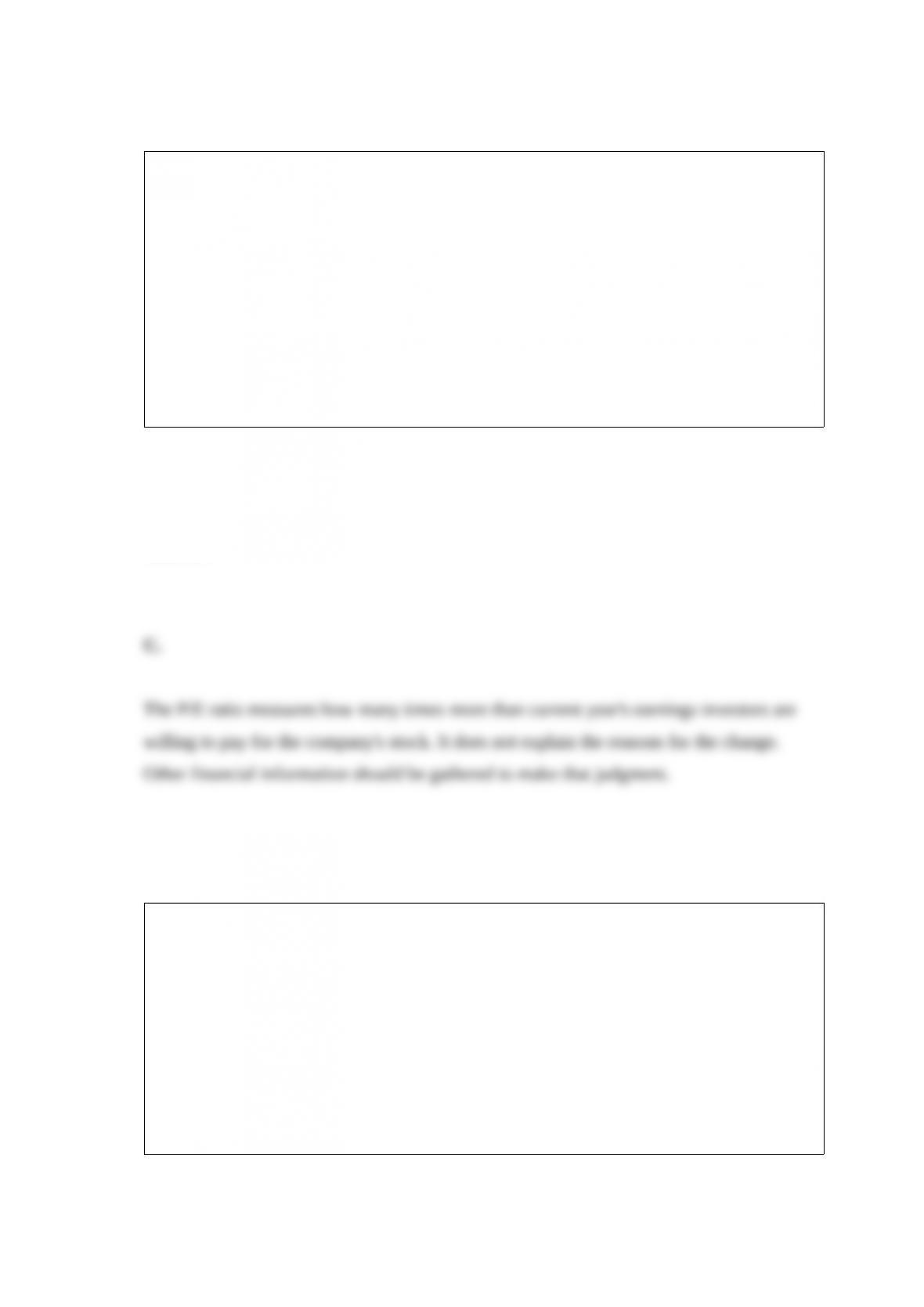
Company X has a P/E ratio of 16 in year 2013 and 16.5 in 2014. In 2015, its P/E ratio is
24. The best way to interpret these data is to conclude that:
A. the stock is overpriced and should be sold.
B. the stock has great growth capacity and should be bought.
C. other financial results and news should be examined to determine the cause of the
P/E ratio change.
D. the stock is underpriced and should be bought.
Answer:
Cost of goods sold divided by average inventory is the calculation for which of the
following ratios?
A. Net profit margin ratio.
B. Current ratio.
C. Inventory turnover ratio.
D. Asset turnover ratio.
Answer:
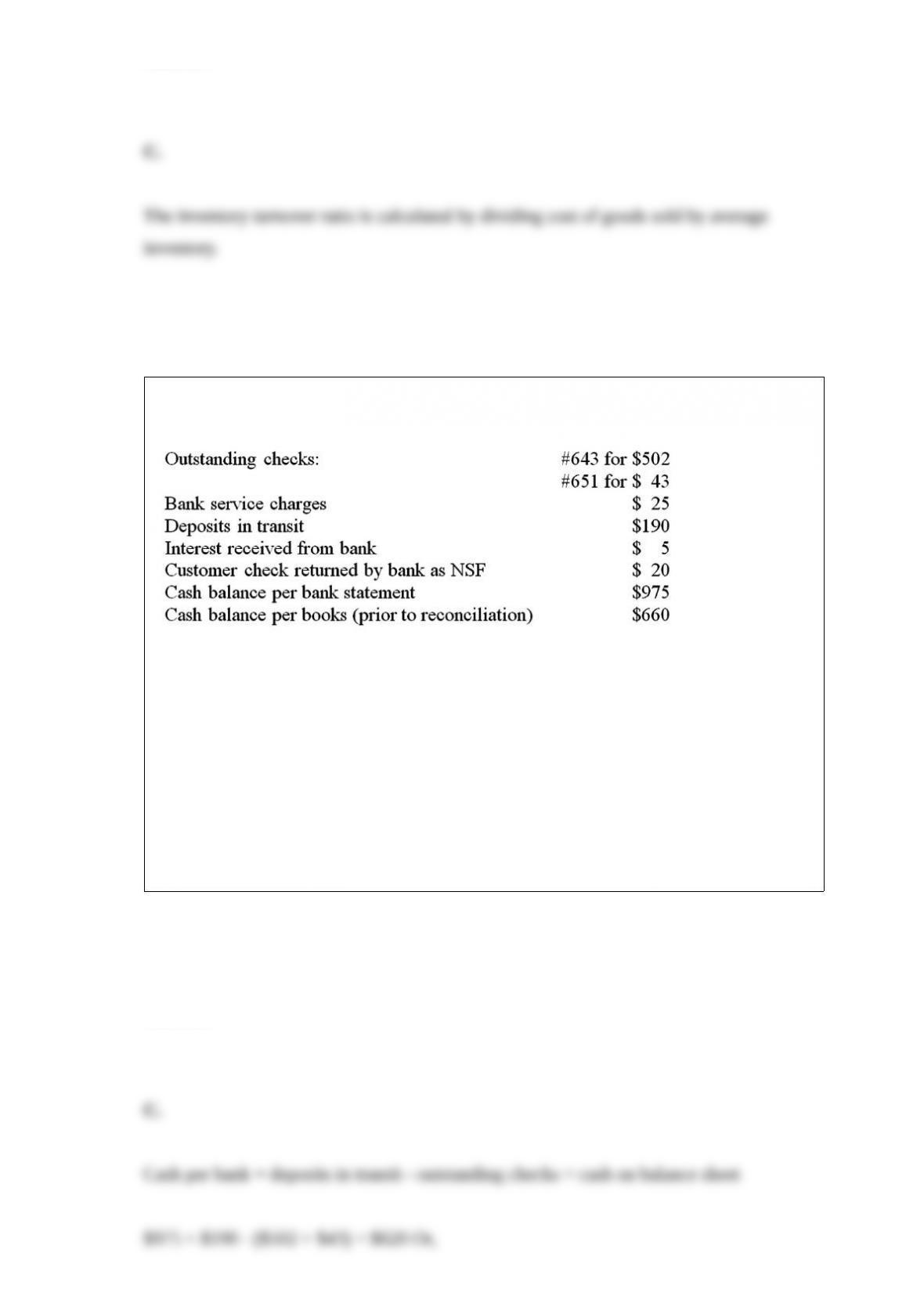
The following information was available to the accountant of Horton Company when
preparing the monthly bank reconciliation:
The amount of cash that should appear on the balance sheet following completion of the
reconciliation and adjustment of the accounting records is:
A. $660.
B. $640.
C. $620.
D. $305.
Answer:
When the effective-interest method of amortization is used, what happens to interest
expense as a bond moves toward maturity?
A. Interest expense falls for bonds sold at either a discount or a premium.
B. Interest expense rises for bonds sold at a discount and falls for bonds sold at a
premium.
C. Interest expense rises for bonds sold at either a discount or a premium.
D. Interest expense falls for bonds sold at a discount and rises for bonds sold at a
premium.
Answer:
A current ratio of 2.5 means that for every dollar of:
A. accounts payable, there is $2.50 of cash.
B. current liabilities, there is $2.50 of current assets.
C. current assets, there is $2.50 of current liabilities.
D. total liabilities, there is $2.50 of cash.
Answer:
When interest expense is calculated using the effective-interest amortization method,
interest expense on a bond that pays interest annually is equal to:
A. the actual amount of interest paid.
B. the carrying value of the bonds payable multiplied by the effective interest rate.
C. the maturity value of the bonds payable multiplied by the effective interest rate.
D. the carrying value of the bonds payable multiplied by the stated interest rate.
Answer:

Cash flows from operating activities include all of the following except:
A. a purchase of land.
B. collections from customers on account.
C. payments to employees for hours worked.
D. receipt of dividends.
Answer:
Multistep income statements:
A. are required by the FASB.
B. contain more detail than just listing revenues and expenses.
C. are required by the perpetual inventory method.
D. classify cost of goods sold as a selling expense.
Answer:

As of the beginning of 2013 a company had total contributed capital of $300,000 and
total retained earnings of $35,000. Total liabilities were $100,000. During the year
2013, the company had the following transactions:
– Issued stock for cash of $60,000.
– Declared and paid a cash dividend of $15,000.
– Reported total revenue of $160,000 and total expenses of $90,000.
Which is the amount of retained earnings that will be reported on the Statement of
stockholders’ equity at the end of 2013?
A. $90,000
B. $75,000
C. $150,000
D. $50,000
Answer:
Two types of closing journal entries are posted to retained earnings at year-end. These
are entries to:
A. transfer revenues and expenses to retained earnings.
B. transfer assets and liabilities to retained earnings.
C. transfer net income (or loss) and dividends declared to retained earnings.
D. close permanent and temporary accounts.
Answer:
If an expense has been incurred but will be paid later, then:
A. nothing is recorded on the financial statements.
B. a liability account is created or increased and an expense is recorded.
C. an asset account is decreased or eliminated and an expense is recorded.
D. a revenue and an expense are accrued.
Answer:
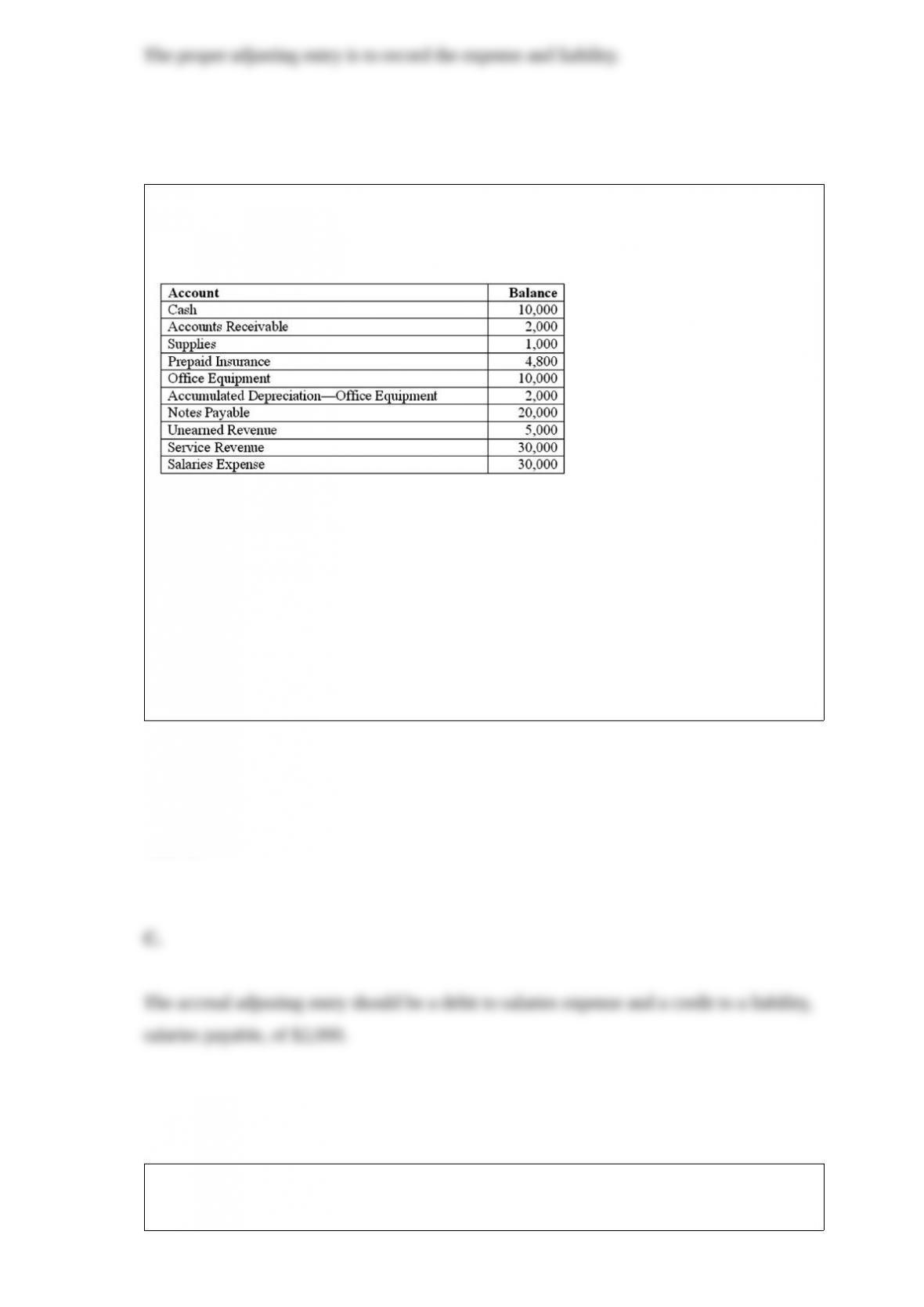
Presented below are selected accounts from the unadjusted trial balance of Sneetch Star
Makers Inc., a talent agency, at 12/31/13 (debit and credit labels have been omitted;
assume all balances are normal).
Accrued salaries at 12/31/13 are $2,000. The adjusting entry would include
A. a debit to salaries payable for $2,000.
B. a debit to salaries expense for $28,000.
C. a credit to salaries payable for $2,000.
D. a credit to salaries expense for $28,000.
Answer:
BAF Company uses a periodic inventory system and its inventory records for June
contain the following information:
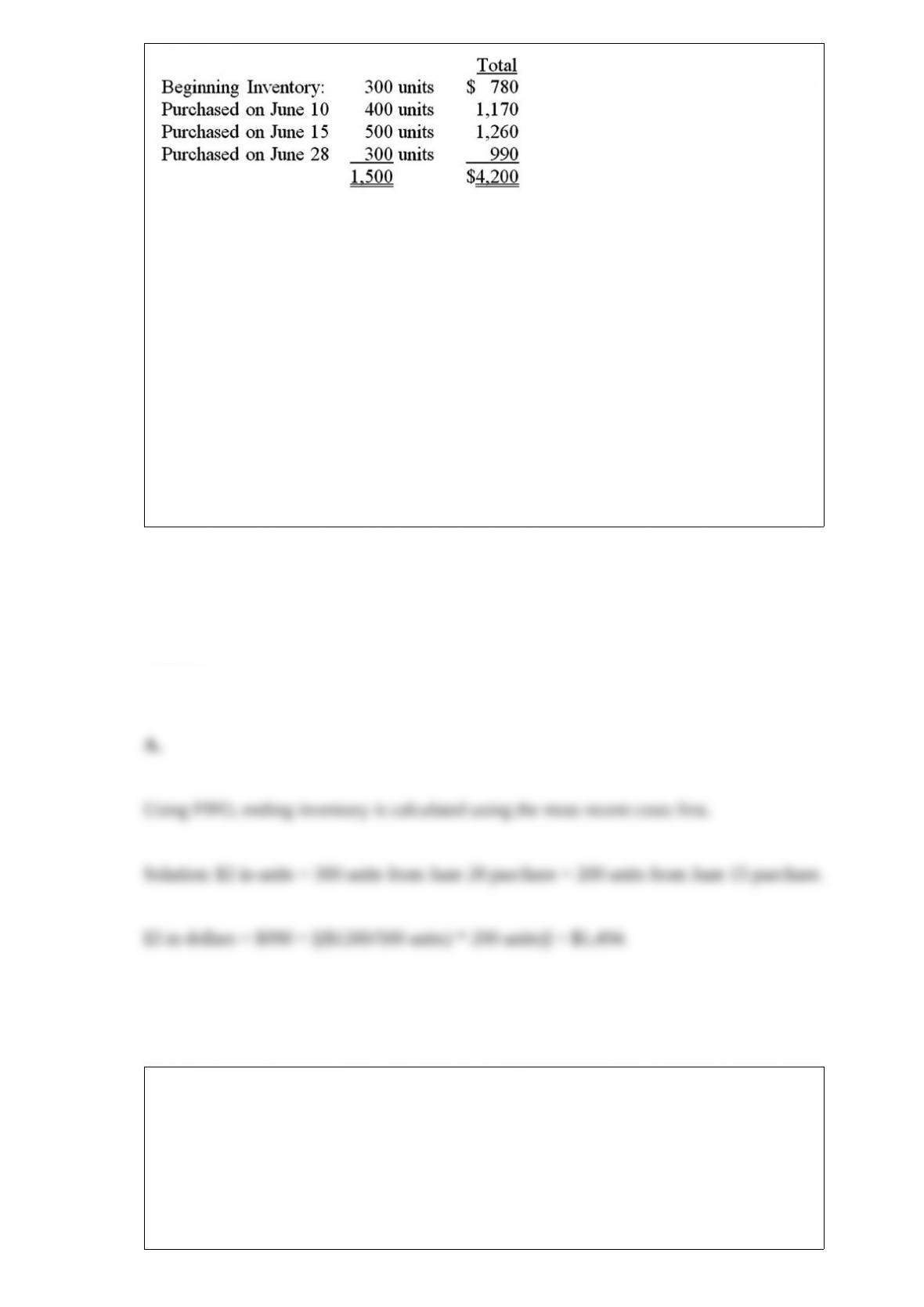
The company sold 1,000 units during June and 500 units were in its ending inventory
on June 30.
Use the information above to answer the following question. If the company uses the
FIFO costing method, what is the cost of its ending inventory?
A. $1,494.
B. $2,290.
C. $2,580.
D. $2,706.
Answer:
An asset is purchased on January 1 for $40,000. It is expected to have a useful life of
five years after which it will have an expected salvage value of $5,000. The company
uses the straight-line method. If it is sold for $30,000 exactly two years after it is
purchased, the company will record a:
A. gain of $6,000.
B. gain of $4,000.
C. loss of $4,000.
D. loss of $6,000.
Answer:
Over a two-year period, Coca-Cola’s gross profit percentage went from 70.4% to
69.7%. Which of the following could not have been the cause of this change?
A. Reduced selling prices.
B. Rising product cost as a percentage of sales.
C. Increased competition from Pepsi.
D. No change in selling price or product cost, but a decrease in sales volume.
Answer:
In March, BetterBuy purchases six plasma TVs from Toshiba for $1,500 each (serial
numbers 11534892 through 11534897). In April, the company purchases four more
identical TVs from Toshiba for $1,450 each (serial numbers 11542631 through
11542634). In May, the company purchases five more identical TVs for $1,600 each
(serial numbers 11550964 through 11550968). In June, BetterBuy sells two of these
TVs (serial numbers 11534894 and 11542631).
Use the information above to answer the following question. If BetterBuy uses the
specific identification method, its cost of goods sold will be:
A. $3,000.
B. $2,950.
C. $3,200.
D. $3,033.
Answer:
If a company is overly optimistic about debt collection, the company will understate
bad debt expense and:
A. overstate net income; and days to collect will decline.
B. overstate net income; but days to collect will increase.
C. understate net income; and days to collect will increase.
D. understate net income; and days to collect will decline.
Answer:
Use the information above to answer the following question. Which of the following is
closest to the company’s current ratio for 2015?

A. 2.22
B. 2.26
C. 2.57
D. 6.0
Answer:
When a company sells equipment for cash on a date other than the last day of the
accounting period, it must:
A. record depreciation expense for the entire accounting period during which the
equipment is sold.
B. record the disposal by reducing equipment and increasing revenue; a gain or loss is
reported if the decrease and increase are not equal.
C. first record depreciation expense for the period up to the date of sale, and then record
the disposal by decreasing both equipment and accumulated depreciation while
increasing cash; a gain or loss is reported if total assets increase or decrease.
D. record accumulated depreciation for the entire current accounting period.
Answer:
After preparing adjusting entries, the equality of recorded debits and credits is checked
by preparing a(n):
A. post-closing trial balance.
B. adjusted trial balance.
C. income statement.
D. balance sheet.
Answer:
If a company provides a service and receives payment at the same time,:
A. more than one journal entry is needed.
B. cash will be credited.
C. a revenue account will be increased with a debit.
D. stockholders’ equity will increase.
Answer:
Two years ago, your company bought $40,000 in bonds from another company. This
month, it sold half of those bonds for $20,640 and lent $1,000 to an employee with a
promissory note. On the statement of cash flows for this accounting period, your
company would report a net cash:
A. outflow of $19,640 from investing activities.
B. inflow of $19,640 from investing activities.
C. inflow of $20,640 from investing activities.
D. outflow of $20,640 from investing activities.
Answer:
Which of the following is a profitability measure?
A. Net income/Net sales
B. Total assets/Total stockholders’ equity
C. Total liabilities/Total stockholders’ equity
D. Cost of goods sold/Average inventory
Answer:
The direct exchange of debt for equipment would be shown:
A. on the statement of cash flows as an operating activity.
B. on the statement of cash flows as an investing activity.
C. on the statement of cash flows as a financing activity.
D. as a supplementary disclosure to the statement of cash flows.
Answer:
A company sells a piece of equipment half-way through the accounting period. The
straight-line rate of depreciation on the equipment is $40,000 per year. Before recording
the asset sale, the company should debit:
A. depreciation expense for $40,000 and credit accumulated depreciation for $40,000.
B. accumulated depreciation for $40,000 and credit cash for $40,000.
C. depreciation expense for $20,000 and credit accumulated depreciation for $20,000.
D. cash for $20,000 and credit depreciation expense for $20,000.
Answer:
Stockholders’ equity is
A. a liability of the business.
B. an economic resource controlled by the business.
C. the owners’ claims on the business.
D. the profit generated by the business.
Answer:
Which of the following would be classified as a financing activity on the statement of
cash flows?
A. Cash receipts from accounts receivable collections.
B. Cash receipts from sale of equipment.
C. Cash paid to purchase treasury stock.
D. Cash receipts from short-term notes receivable.
Answer:
Which of the following are used to determine cash flows from financing activities?
A. Short-term debt, accrued liabilities, contributed capital, and notes payable.
B. Long-term debt, contributed capital, and retained earnings.
C. Short-term debt, accrued liabilities, retained earnings, and bonds payable.
D. Long-term debt, notes payable, interest expense, and bonds payable.
Answer: