The inventory costing method that results in the lowest taxable income in a period of
inflation is the FIFO method.
Answer:
The entry to record a bond retirement at maturity usually involves no gain or loss.
Answer:
Sales discounts, sales returns & allowances, and cost of goods sold are all temporary
accounts which are closed to retained earnings at the end of the accounting period.
Answer:
Which of the following statements regarding financial information comparisons
isTRUE?
A. A time-series analysis compares a company’s financial results for one period to its
own results in other periods.
B. If we compare a company’s performance in the current period to its competitors’
performance, we are conducting a time-series analysis.
C. Benchmarks are used to compare companies in different industries.
D. Cross-sectional analysis refers to a ratio comparison across companies that are in
different industries.
Answer:
Choose theTRUE statement.
A. A company with Net Income will also have a cash increase from operating activities.
B. A company with Liabilities of $80,000 and Stockholders’ equity of $50,000 will have
Assets of $30,000.
C. If a company has total revenues of $80,000, total expenses of $50,000 and dividends
of $10,000, they will have net income of $20,000.
D. A company with total stockholders’ equity of $120,000 and contributed capital of
$75,000 must have total retained earnings of $45,000.
Answer:
A company entered into the following transaction: Purchased equipment for use in the
business at a cost of $12,000, one-fourth was paid in cash and the company signed a
note for the balance. Choose theTRUE statement about the journal entry to record this
transaction.
A. The journal entry will include a debit to Notes Payable of $9,000.
B. The journal entry will include a debit to Cash of $12,000.
C. The journal entry will include a credit to Notes Payable of $9,000.
D. The journal entry will include a debit to Equipment of $3,000.
Answer:
The method of bond amortization that results in varying amounts of amortization each
period is the straight-line amortization method.
Answer:
Which of the following isTRUE concerning cross-sectional analysis?
A. Cross-sectional analysis involves the comparison of a company’s results to its
competitors’ results.
B. Cross-sectional analysis compares results for a single company to itself over time.
C. Cross-sectional analysis does not compare different size companies in the same
industry.
D. Cross-sectional analysis is the same as financial ratio analysis.
Answer:
Which of the following statements regarding the need for adjustments is notTRUE?
A. Without adjustments, the financial statements present an incomplete and misleading
picture of the company.
B. Adjusting entries are intended to change the operating results to reflect
management’s objectives for operating performance.
C. Adjustments help the financial statements to present the best picture of whether the
company’s activities were profitable for the period.
D. Adjustments help the financial statements to present the economic resources the
company owns and owes at the end of the period.
Answer:
Which of the following statements isTRUE regarding the relationship of the
debt-to-assets ratio and the debt-to-equity ratio?
A. Debt to assets is usually greater than debt to equity.
B. Debt to assets is usually less than debt to equity
C. Debt to assets is usually equal to debt to equity.
D. There is no constant relationship between these two ratios.
Answer:
Which of the following statements regarding inventory calculations isTRUE?
A. Beginning inventory + net purchases – ending inventory = cost of goods sold.
B. Goods available for sale + ending inventory = cost of goods sold.
C. Beginning inventory + net purchases – ending inventory = goods available for sale.
D. Goods available for sale + cost of goods sold = ending inventory.
Answer:
A company’s ability to pay its short-term obligations depends on many factors,
including how quickly it sells its inventory.
Answer:
When credit card sales occur, the seller may receive cash immediately, or within a few
days, depending upon the specific credit card program being used.
Answer:
All corporations acquire financing by issuing stock for sale on public stock exchanges.
Answer:

A net profit margin of 14% means that the company used 84.6 cents of each sales dollar
to cover costs and expenses.
Answer:
Which of the following statements regarding the tradeoffs of extending credit is
notTRUE?
A. Extending credit to at least some customers is necessary in a competitive market to
avoid losing sales to competitors.
B. Even if a company were to collect in full from customers, there would be a cost of
extending credit to customers.
C. Even though additional costs are incurred if credit is extended, a company expects
that the additional revenue will be more than sufficient to offset the additional costs.
D. Even if there are no bad debts from credit sales, the delayed receipt of cash will
always increase additional costs beyond the increased revenue from the credit sales.
Answer:
The useful life of an asset is always measured in units of time, such as years or months.
Answer:
A company incurred $2,000 for utilities for the last month of the year. The company has
not paid this bill yet. Choose theTRUE statement.
A. $2,000 should be reported on the income statement as Utilities Expense.
B. Nothing should be reported about this in the current year’s financial statements.
C. $2,000 should be reported as Accounts receivable on the Balance Sheet at the end of
the year.
D. $2,000 should be reported as Utilities Expense on the Balance Sheet at the end of the
year.
Answer:
Which of the following statements regarding the P/E ratio is notTRUE?
A. The P/E ratio indicates how much investors are willing to pay for a share of a
company’s stock as a multiple of current earnings.
B. A high P/E ratio may mean that investors have pushed the price of the stock up in
anticipation of higher future net income.
C. If EPS decreases and there is no change in the market price of the stock, the P/E ratio
will decrease.
D. If the market price of the stock increases and there is no change in EPS, the P/E ratio
will increase.
Answer:
A company had total assets of $400,000. The debt-to-assets ratio was 35. Which of the
following is notTRUE?
A. Total liabilities are $140,000.
B. The debt-to-assets ratio of .35 indicates that the company relies less on equity
financing than on debt financing.
C. If other companies in the same industry are used as benchmarks and report a lower
debt-to-assets ratio, this indicates that this company has a more risky financing strategy.
D. If the ratio this year is lower than it was last year for this company, it indicates that
the company is relying less on debt financing this year.
Answer:
FICA payments consist of Social Security taxes and Medicare taxes.
Answer:
During the current year, a company issues $200,000 in long-term bonds and pays off
$200,000 in accounts payable. Which of the following statements isTRUE regarding the
company’s year-end ratios?
A. Both the quick ratio and times interest earned ratio will rise.
B. The quick ratio will fall but the times interest earned ratio will rise.
C. The quick ratio will rise but the times interest earned ratio will fall.
D. Both the quick ratio and times interest earned ratio will fall.
Answer:
Which of the following isTRUE regarding the account entitled Premium on Bonds
Payable?
A. It is an account that increases when amortization entries are made.
B. It is an account that appears on the balance sheet of the issuer as a deduction from
bonds payable.
C. It is an account that decreases when amortization entries are made and its balance is
equal to zero at the maturity date of the bond.
D. It is a contra account with a normal debit balance.
Answer:
Which of the following statements regarding issued and outstanding stock isTRUE?
A. Outstanding stock includes all stock issued by a corporation.
B. Issued stock equals the sum of outstanding stock and treasury stock.
C. Issued stock is equal to authorized stock.
D. Outstanding stock includes stock in the hands of investors, as well as treasury stock
in the hands of the corporation.
Answer:
If the debt-to-assets ratio is 0.63, it means that 37% of the company’s financing has
been provided by stockholders’ equity.
Answer:
A company has an asset turnover ratio of 1.15. Which of the following statements
isTRUE?
A. The company generates $1.15 of net income for every $1 in reported assets.
B. The company buys assets more frequently than it sells them.
C. The company generates $1.15 of sales revenue for every $1 in reported assets.
D. This is an improvement over the previous period when the asset turnover rate was
1.7.
Answer:
Which of the following isTRUE regarding the companies’ efficiency in asset use?
A. B.Darin Company has a higher debt-to-assets ratio which indicates better efficiency
in asset use.
B. S.Dee Company has a higher net profit margin ratio which indicates better efficiency
in asset use.
C. The asset turnover ratio of B.Darin Company is higher which indicates less
efficiency in asset use.
D. S. Dee has a lower debt to assets ratio which indicates greater reliance on equity
financing.
Answer:
The payment of dividends is a financing activity.
Answer:
Which of the following statements isTRUE?
A. The “net change in cash” reported on the statement of cash flows is also reported on
the statement of retained earnings.
B. Both the income statement and the statement of cash flows show the result of a
company’s operating activities.
C. The statement of cash flows is for a period of time while the income statement is at a
point in time.
D. The statement of cash flows is at a point of time while the income statement is for a
period of time.
Answer:
A company has outstanding 9 million shares of $2 par value common stock and 1
million shares of $4 par value preferred stock. The preferred stock has an 8% dividend
rate. The company declares $600,000 in total dividends for the year. Which of the
following isTRUE if dividends in arrears are $30,000?
A. Preferred stockholders will receive $350,000. Common stockholders will receive
$250,000.
B. Preferred stockholders will receive $60,000. Common stockholders will receive
$540,000.
C. Preferred stockholders will receive $320,000. Common stockholders will receive
$280,000.
D. Preferred stockholders will receive $90,000. Common stockholders will receive
$510,000.
Answer:
The aging of accounts receivable method is based upon the principle that the longer an
account is overdue, the higher the risk of nonpayment.
Answer:
The cost of developing a prototype would probably be capitalized by which of the
following companies?
A. Lego.
B. Southwest Airlines.
C. Walmart.
D. Cedar Fair.
Answer:
Which of the following was enacted by the government to prevent more corporate
accounting scandals?
A. Federal Accounting Standards Board Act.
B. Securities and Exchange Act.
C. Sarbanes-Oxley Act.
D. Clayton Act.
Answer:

Assume a company uses the indirect method to prepare its statement of cash flows. If
the supplies account increases and accounts payable decreases during an accounting
period, what does the company do with the changes in these accounts to calculate cash
flows from operating activities?
A. Both are added to net income.
B. The change in accounts payable is added to net income; the change in supplies is
subtracted.
C. Both are subtracted from net income.
D. The change in supplies is added to net income; the change in accounts payable is
subtracted.
Answer:
Assuming two companies use the same accounting methods, other things being equal,
the company with a higher fixed asset turnover ratio:
A. has a greater amount invested in fixed assets than a company with a lower fixed
asset turnover ratio.
B. has less invested in fixed assets than a company with a lower fixed asset turnover
ratio.
C. generates less sales revenue than a company with a lower fixed asset turnover ratio.
D. makes better use of its fixed assets to generate revenues than a company with a
lower fixed asset turnover ratio.
Answer:
Goodwill:
A. should be treated like most other intangible assets and amortized over a useful life of
not more than 40 years.
B. is an accounting measurement of how well a company’s employees behave towards
the company’s customers.
C. should be recorded as a negative value if a company is purchased for less than the
net carrying value of its assets.
D. is recorded when the purchasers of a business pay more than the fair value of the
assets purchased.
Answer:
On February 16, a company declares a 34¢ dividend to be paid on April 5. There are 2
million shares of common stock issued and 100,000 shares of treasury stock. What does
the company record in February?
A. A debit to Dividends Payable and a credit to Cash for $680,000.
B. A debit to Dividends Declared and a credit to Dividends Payable for $646,000.
C. A debit to Dividends Payable and a credit to Cash for $646,000.
D. A debit to Dividends Declared and a credit to Dividends Payable for $680,000.
Answer:
Which of the following would have an unfavorable effect on net income?
A. Omission of an adjusting entry to accrue revenue.
B. Understating the amount of depreciation recorded.
C. Failure to record the portion of prepaid rent that has expired.
D. Overstating the year-end count of supplies.
Answer:
When the lower of cost or market (LCM) rule requires an inventory adjustment:
A. the adjustment usually, but not always, reduces the book value of inventory.
B. the write-down is usually reported as a part of cost of goods sold.
C. the inventory adjustment is recorded in a contra-account called merchandise
allowances.
D. the write-down does not affect any of the financial statements.
Answer:
To determine net cash provided by or used in financing activities, one must analyze
A. notes receivable and bonds payable.
B. the cash account.
C. contributed capital and retained earnings.
D. interest expense and dividend income.
Answer:
Your company sells $50,000 of bonds for an issue price of $48,000. Which of the
following statements is correct?
A. The bond sold at a price of 96, implying a discount of $4,000.
B. The bond sold at a price of 48, implying a premium of $2,000.
C. The bond sold at a price of 48, implying a premium of $4,000.
D. The bond sold at a price of 96, implying a discount of $2,000.
Answer:
In a retail business that uses a perpetual inventory system, scanning a bar code does not:
A. calculate the amount owed by the customer.
B. identify the item sold to be removed from the Inventory account.
C. identify the item sold to be recorded in the Cost of Goods Sold account.
D. calculate the gross margin.
Answer:
One difference between the double-declining-balance method and the straight-line
method is that the double-declining-balance method:
A. takes book value below residual value.
B. does not consider the useful life of the asset in the calculation of depreciation.
C. cannot be used for tax purposes.
D. uses book value instead of depreciable cost in the calculation of depreciation.

Answer:
On January 1, 2014, a company has assets of $16 billion and stockholders’ equity of $8
billion. On January 1, 2015, the same company has assets of $20 billion and
stockholders’ equity of $9 billion. During 2014, the company had total sales revenue of
$9 billion and total expenses of $7 billion.
The company’s debt-to-assets ratio on January 1, 2015 is:
A. 0.55
B. 0.45
C. 0.035
D. 0.01
Answer:
A debit balance in retained earnings is called a(n)
A. discount.
B. accumulated deficit.
C. net loss.
D. It is impossible to have a debit balance in retained earnings.
Answer:
Which of the following represents a subtotal rather than an account?
A. Advertising Expense.
B. Service Revenue.
C. Supplies Expense.
D. Total Revenues.
Answer:
In a common size income statement, each item on the income statement is expressed as
a percentage of:
A. Net income.
B. Gross margin (gross profit).
C. Total expenses.
D. Sales revenue.
Answer:
An accumulated deficit would appear in which financial statements?
A. The balance sheet and the income statement.
B. The income statement and the retained earnings statement.
C. The balance sheet and the statement of stockholders’ equity statement.
D. The income statement and the statement of stockholders’ equity.
Answer:
An adjustment to ending inventory under the lower of cost or market (LCM) rule would
be most likely to be recorded by a company that sells:
A. Plastic storage containers.
B. Paper clips.
C. Body lotion.
D. Designer clothes.
Answer:
On a bank reconciliation, the amount of an unrecorded bank service charge is
A. added to the bank balance of cash.
B. added to the company’s balance of cash.
C. deducted from the bank balance of cash.
D. deducted from the company’s balance of cash.
Answer:
Accrued liabilities could include all of the following except:
A. salaries payable.
B. current portion of long-term debt.
C. income tax payable.
D. interest payable.
Answer:
When the amount of a contingent liability can be reasonably estimated and its
likelihood is possible but not probable, the company should:
A. include a description in the notes to the financial statements.
B. record the amount of the liability times the probability of its occurrence.
C. accrue the amount of the liability as a long-term liability.
D. exclude any information about the contingent liability from its financial statements
and notes.
Answer:
When a company issues bonds that do not pay periodic interest, the bonds are called:
A. convertible bonds.
B. debenture bonds.
C. serial bonds.
D. zero-coupon bonds.
Answer:
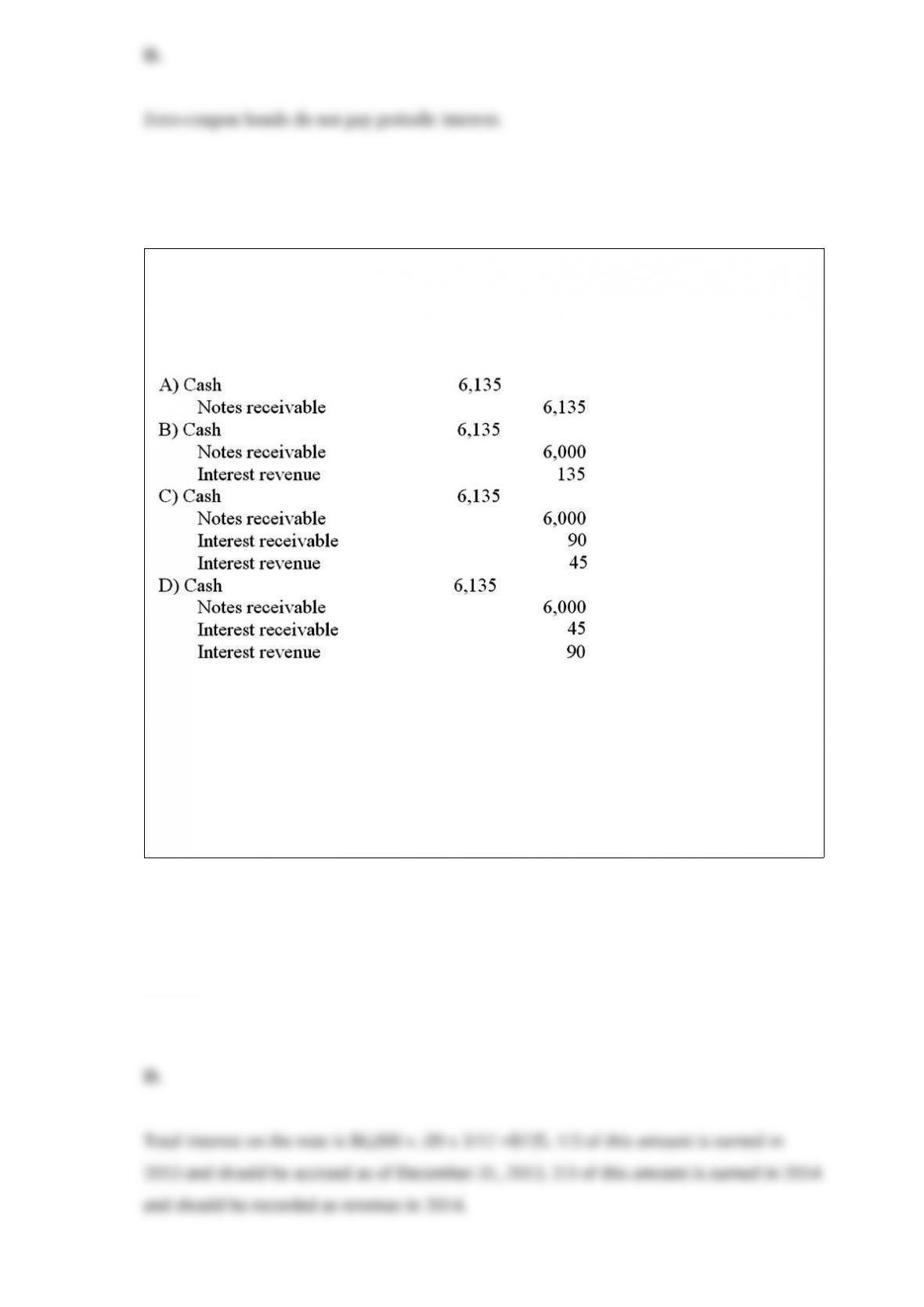
On December 1, 2013, a company accepted a $6,000, 9%, 3-month note from a
customer in payment of his overdue account. The company prepares year-end financial
statements on December 31. What entry should the company make on March 1, 2014,
when the note and interest are paid?
A. Option A
B. Option B
C. Option C
D. Option D
Answer:
Accounting information systems:
A. are summarized by reports that are published to the public.
B. capture and report the results of a business’s operating, investing, and financing
activities.
C. monitor business activities only in financial terms.
D. capture only the information that is needed by the owners of the company.
Answer:
Shaggy Limited purchased a new van on January 1, 2014. The van cost $20,000. It has
an estimated life of five years and the estimated residual value is $5,000. Shaggy uses
the double-declining-balance method to compute depreciation.
Use the information above to answer the following question. What is the depreciation
expense for 2014?
A. $4,000.
B. $3,000.
C. $6,000.
D. $8,000.
Answer:
Momentum Products Inc., just recorded an adjusting journal entry for the current year’s
estimate of bad debts. Assuming all else is equal, this adjusting journal entry will cause:
A. the accounts receivable turnover ratio to increase.
B. net income to increase.
C. total assets to remain unchanged.
D. net accounts receivable to increase.
Answer:
A company reported the following:
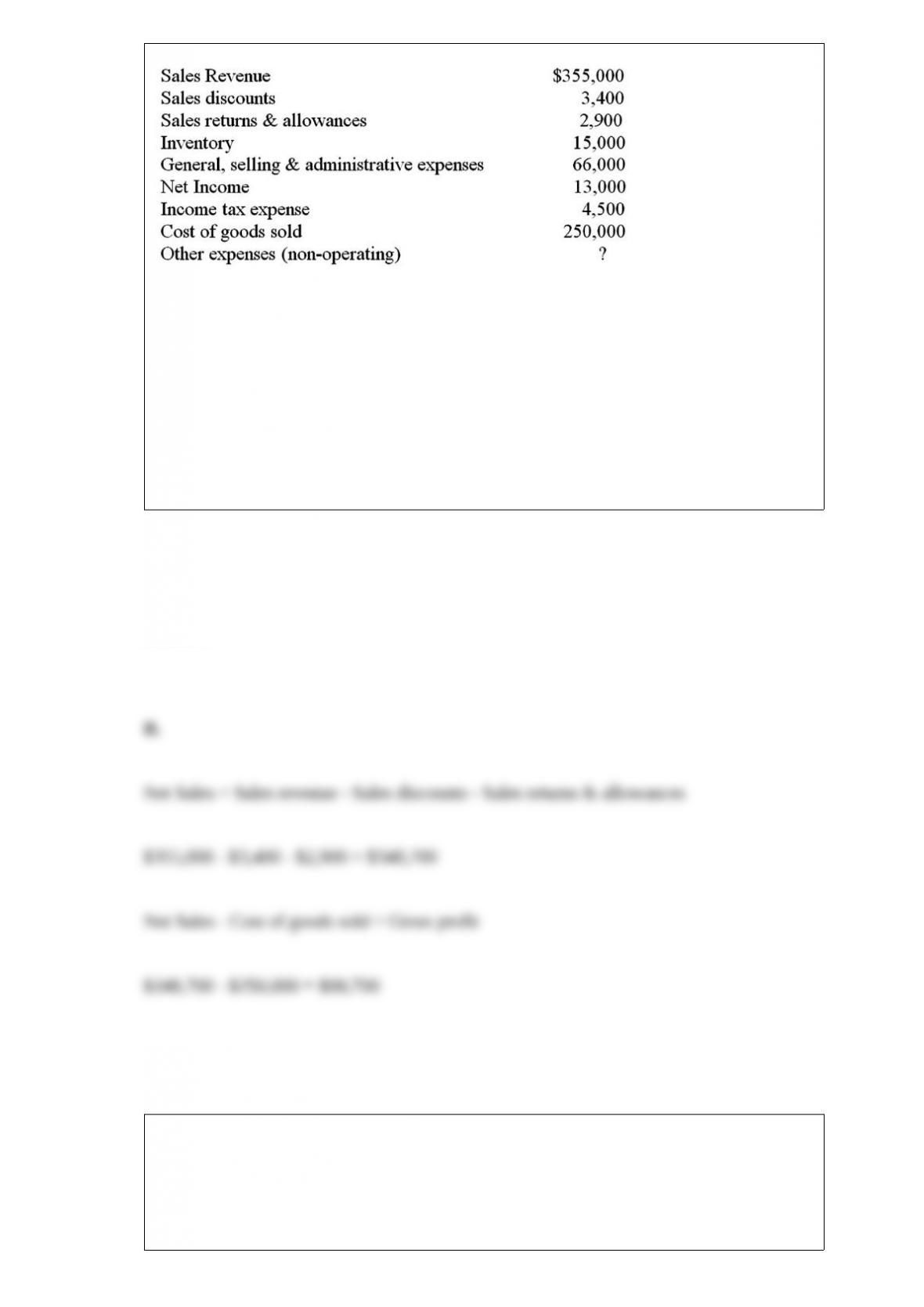
What is the amount of gross profit?
A. $94,200
B. $98,700
C. $105,000
D. $32,700
Answer:
The most commonly used inventory costing method in the U.S. is:
A. FIFO.
B. specific identification.
C. LIFO.
D. weighted average.
Answer:
At the end of the accounting period:
A. all accounts are closed.
B. temporary accounts are closed; permanent accounts are not.
C. permanent accounts are closed; temporary accounts are not.
D. only accounts with a credit balance are closed.
Answer:
To determine whether generally accepted accounting principles (GAAP) were followed
in the preparation of financial statements, an examination of:
A. tax documents would be performed by the IRS.
B. the annual report would be performed by the SEC.
C. the financial statements and related documents would be performed by an
independent auditor.
D. the financial statements and related documents would be performed by the FASB.
Answer:
EBITDA is equal to which of the following?
A. net income – interest expense – income taxes – depreciation expense – amortization
expense.
B. net income + interest expense + income taxes + depreciation expense + amortization
expense.
C. operating income – interest expense – income taxes.
D. operating income + depreciation expense + amortization expense.
Answer:
Paul Hauling has a fleet of 10 large trucks that cost a total of $1,410,000. The fleet is
expected to provide 1,000,000 miles of transportation during an estimated 10-year life,
and be sold for 10% of the original cost at the end of that time. If the fleet traveled
125,000 miles in the current twelve-month period, what would be the depreciation
expense under the straight-line (SL) and units-of-production (U-of-P) methods?
A. SL = $158,625 and U-of-P = $141,000.
B. SL = $141,000 and U-of-P = $158,625.
C. SL = $126,900 and U-of-P = $176,250.
D. SL = $126,900 and U-of-P = $158,625.
Answer:
Form 8-K, which is filed with the SEC, is also known as a(n):
A. quarterly report.
B. annual report.
C. current events report.
D. audit report.
Answer:
Which of the following statements is FALSE?
A. Cash flows from financing activities would appear on the Statement of Cash Flows.
B. Dividends would appear on the Statement of Retained Earnings.
C. Assets would appear on the Income Statement.
D. Revenues would appear on the Income Statement.
Answer:

Choose the appropriate letter to match the term and the definition. Not all definitions
will be used.
Term:
_____ 1/ Current liabilities
_____ 2/ Effective interest method of amortization
_____ 3/ Straight-line method of amortization
_____ 4/ Times interest earned ratio
_____ 5/ Long-term liabilities
_____ 6/ Liquidity
_____ 7/ Quick ratio
_____ 8/ Present value
Definition:
A. A bond feature that puts a creditor ahead of other creditors in order of payment.
B. Current liabilities divided by current assets.
C. These are liabilities that have to be paid in one year or less.
D. Net income before taxes and interest expense divided by interest expense.
E. Spreads a bond discount or premium evenly over the lifetime of the bond.
F. The amount of all the liabilities currently on the balance sheet at the close of the
period.
G. Where interest expense is the market interest rate times the bond’s carrying value.
H. Net income after taxes and interest expense divided by interest expense.
I. These are liabilities that do not have to be paid within the upcoming year.
J. The ability to pay current obligations.
K. Liquid assets divided by current liabilities.

L. A calculation that determines what some future payments are worth today.
Answer:
Indicate whether a debit (dr) or credit (cr) would be used to increase each of the
following accounts.
_____ 1/ prepaid expenses.
_____ 2/ rental revenue.
_____ 3/ salaries and wages expense.
_____ 4/ service revenue.
_____ 5/ property and equipment.
_____ 6/ wages expense.
_____ 7/ retained earnings.
_____ 8/ supplies expense.
Answer:

Answer:
Answer:
Choose the appropriate letter of the financial performance category to match the
following financial performance ratio of that category.
P – Profitability
L – Liquidity
S – Solvency
_____ 1/ Debt to assets ratio
_____ 2/ Receivables turnover ratio
_____ 3/ Fixed asset turnover ratio
_____ 4/ Current ratio
_____ 5/ Return on equity
_____ 6/ Price earnings ratio
_____ 7/ Times interest earned ratio
_____ 8/ Quick ratio
_____ 9/ Inventory turnover ratio
_____ 10/ Earnings per share
Answer:
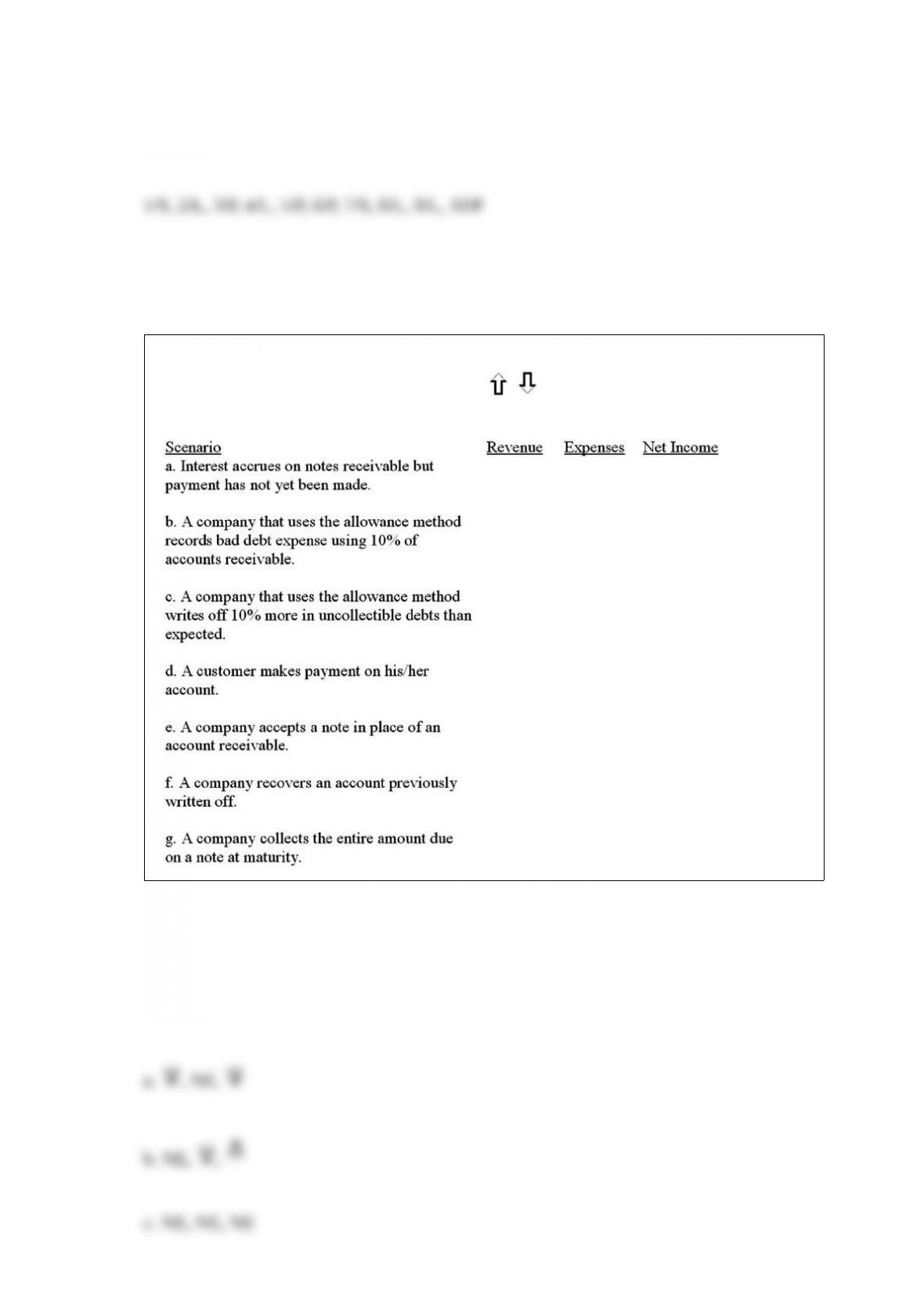
For each scenario below, indicate the appropriate change in current revenue, expenses
and net income. Use the following symbols: , , or NE for no effect.
Answer:

Answer:
Purrfect Pets bought 6,000 bags of dog food at a cost of $5 a bag. Purrfect Pets sold
6,000 bags of dog food this month for $10 each; 2,600 of these bags were sold to
customers who took advantage of their 3% early payment terms. Twenty bags were
returned by customers who did not take advantage of the early payment terms.
Calculate the gross profit and the gross profit percentage for Purrfect Pets, assuming
dog food is the company’s only product and that returned product had been opened so it
could not be put back in inventory but the customers were given a full refund which
was treated as a sales allowance. There was no beginning inventory of bags of dog
food.
Answer:
The following data are for the Grass is Greener Company at the end of 2014, after
adjustments, except for the calculation of income tax expense.
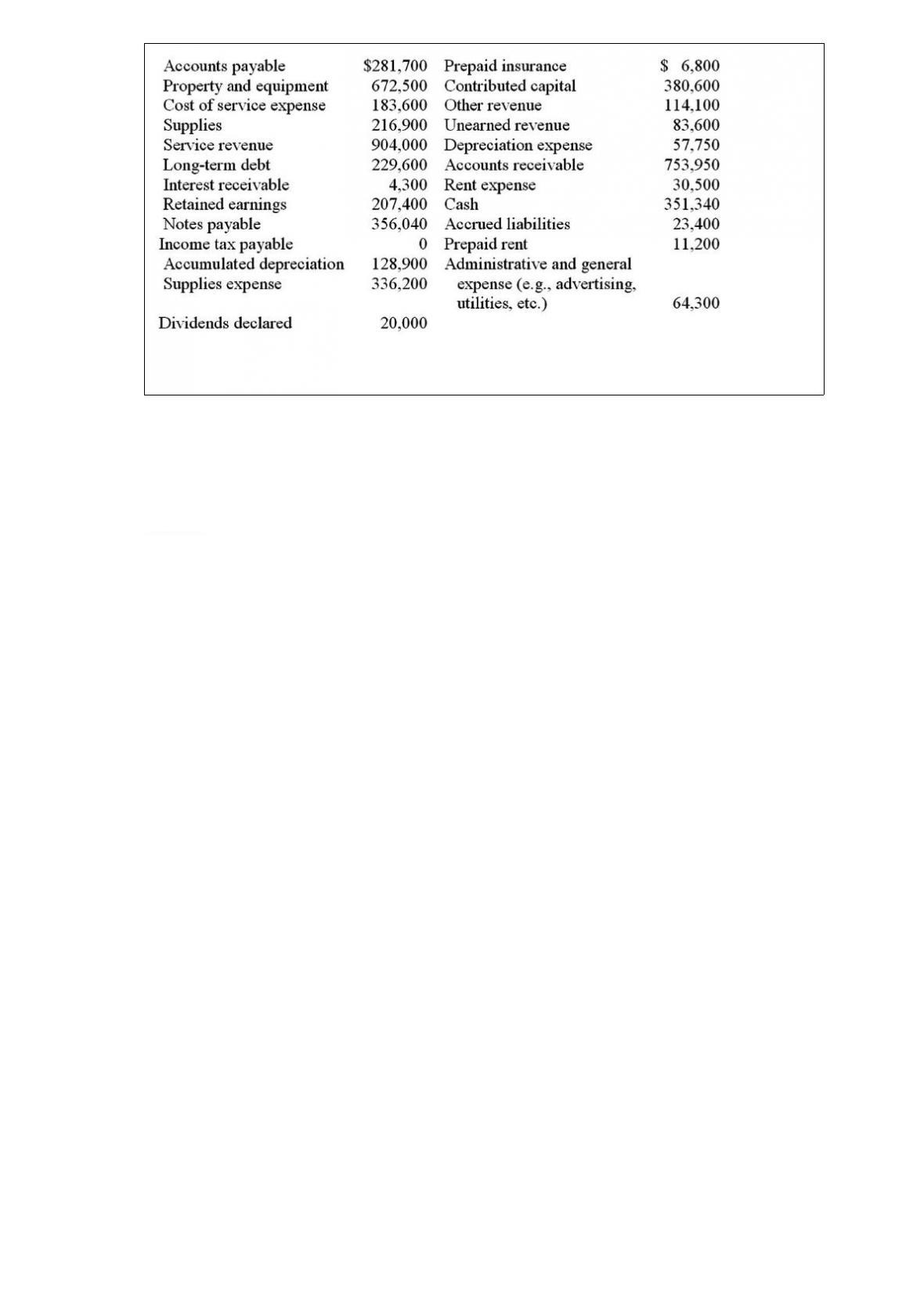
Prepare an income statement and a statement of retained earnings
Answer:
Answer:

Answer:
Identify whether each of the following list of items is an operating activity cash flow
(O), an investing activity cash flow (I), a financing activity cash flow (F), or none of
these (None).
_______ 1/ Sale of equipment.
_______ 2/ Cash collected from customers.
_______ 3/ Payments to suppliers.
_______ 4/ Stock repurchases.
_______ 5/ Repayment of bond principal.
_______ 6/ Payment of income tax.
_______ 7/ Purchases of bonds from other companies.
_______ 8/ Purchases of equipment financed with a note.
_______ 9/ Interest and dividends received.
_______ 10/ Payment of dividends.
Answer:
The following single-step income statement was prepared:
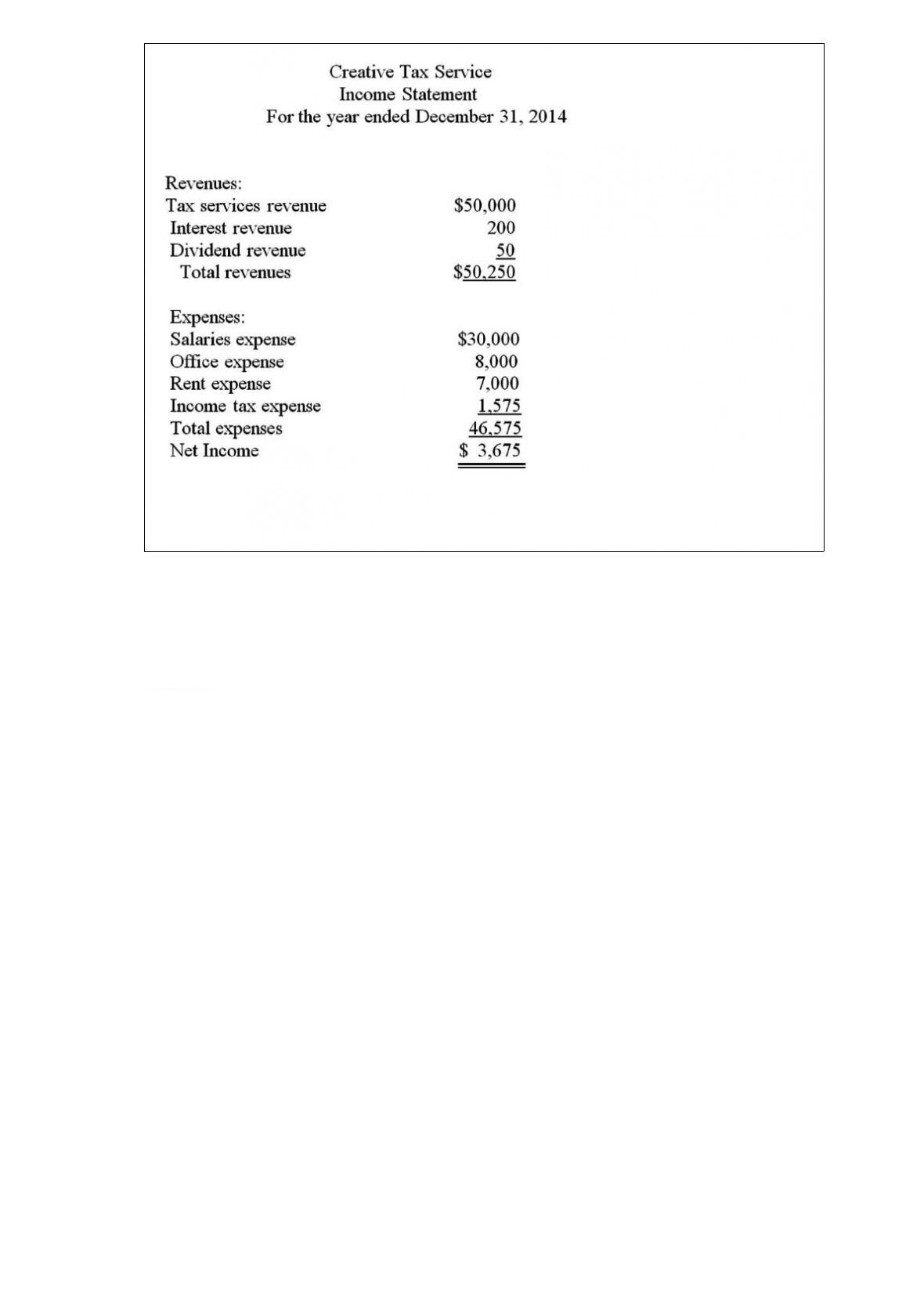
Prepare a multiple-step income statement for Creative Tax Service for the year ended
December 31, 2014.
Answer:

Match the letter with the correct item below to indicate how each revenue or expense
account on the income statement is adjusted when using the direct method to determine
net cash flow from operating activities.
A – Add item to revenue or expense
S – Subtract item from revenue or expense
N – No adjustment necessary
_______ 1/ increase in accrued expenses
_______ 2/ decrease in accounts receivable
_______ 3/ decrease in unearned income
_______ 4/ increase in prepaid expenses
_______ 5/ decrease in accounts payable
_______ 6/ increase in long-term notes payable
_______ 7/ decrease in prepaid insurance
_______ 8/ increase in inventory
_______ 9/ increase in interest payable
_______ 10/ increase in accumulated depreciation

Answer:
Answer:
Answer: