
1) Transactions with related parties must be disclosed in the financial statements if they
are deemed to be material.
A) True
B) False
2) The international standards for the professional practice of internal auditing include
which two categories of standards?
A) attribute and performance
B) competency and professional skepticism
C) performance and integrity
D) ethics and rules of conduct
3) The most important balance-related audit objectives in the audit of cash include all
but which of the following?
A) Existence
B) Accuracy
C) Completeness
D) Occurrence
4) Which of the auditor’s defenses is ordinarily not available when lawsuits are filed by
a third party?
A) Absence of causal connections
B) Contributory negligence
C) Non-negligent performance
D) Lack of duty
5) When management has an adequate level of integrity for the auditor to accept the
engagement but cannot be regarded as completely honest in all dealings, auditors
normally:
A) reduce acceptable audit risk and increase inherent risk

B) reduce inherent risk and control risk
C) increase inherent risk and control risk
D) increase acceptable audit risk and reduce inherent risk
6) A record of insurance policies in force and the due date of each policy is contained in
the:
A) voucher register
B) insurance register
C) insurance expense account
D) prepaid insurance account
7) Which of the following statements best describes the auditor’s responsibility with
respect to illegal acts that do not have a material effect on the client’s financial
statements?
A) Generally, the auditor is under no obligation to notify parties other than personnel
within the client’s organization
B) Generally, the auditor is under an obligation to inform the PCAOB
C) Generally, the auditor is obligated to disclose the relevant facts in the auditor’s report
D) Generally, the auditor is expected to compel the client to adhere to requirements of
the Foreign Corrupt Practices Act
8) A weak internal control system allows a department supervisor to “clock in” for a
fictitious employee and then approve the employee’s time card at the end of the pay
period. This fraud would be detected if other controls were in place, such as having an
independent party:
A) distribute paychecks
B) recompute hours worked from time cards
C) foot the payroll journal and trace postings to the general ledger and the payroll
master file
D) compare the date of the recorded check in the payroll journal with the date on the
canceled checks and time cards
9) When the auditor believes the year-end bank reconciliation may be intentionally

misstated, it is appropriate to perform extended tests of the year-end bank
reconciliation. Assuming the client has a October 31 year-end, these extended tests
would not include:
A) comparing all September 30 reconciling items with canceled checks and other
documents in the October bank statement
B) comparing all canceled checks and deposit slips in the October bank statement with
the October cash disbursements and receipts records
C) carrying out all proper procedures subsequent to the end of the year with the use of
the bank cutoff statement
D) determining that all outstanding checks had cleared by the date of the bank cutoff
statement
10) A document received from the vendor indicating such things as the description and
quantity of goods and services received, price including freight, cash discount terms,
and date of billing is called the voucher.
A) True
B) False
11) The quarterly reports submitted to the SEC by the client:
A) have to be audited and the CPA firm must be identified
B) do not have to be audited, but the CPA firm which does the year-end audit must be
identified
C) have to be audited, but the CPA firm does not have to be identified
D) do not have to be audited, but the CPA firm which does the year-end audit must
review the quarterly statements before they are submitted to the SEC
12) When comparing misstatements with a measurement base, the auditor must
consider the pervasiveness of the misstatement. Of the following examples, the most
pervasive misstatement is a(n):
A) understatement of inventory
B) understatement of retained earnings caused by a miscalculation of dividends payable
C) misclassification of notes payable as a long-term liability when it should be current
D) misclassification of salary expense as a selling expense

13) General controls have which of the following effects on the operating effectiveness
of application controls?
A) nominal
B) pervasive
C) mitigating
D) worsening
14) In an examination of vendor statements or vendor confirmations when doing
substantive tests of balances the auditor needs to perform the following:
A) reconciliation with the accounts payable master file
B) reconciliation with vendor invoices
C) reconciliation with purchase orders
D) reconciliation with receiving reports
15) When auditors use documentation to support recorded transactions and amounts, the
process is usually called:
A) tracing
B) confirmations
C) vouching
D) reperformance
16) Balance-related audit objectives are usually applied to the ending balance in income
statement accounts; transaction-related audit objectives are usually applied to
transactions reflected in balance sheet accounts.
A) True
B) False
17) Which of the following best describes an audit that emphasizes how efficiently and
effectively functions interact?
A) operational
B) compliance
C) financial
D) organizational

18) The auditor’s main concerns in verifying transfers of inventory do not include
whether:
A) recorded transfers exist
B) transfers represent appropriate uses of company resources
C) all actual transfers are recorded
D) the details of the transfer are accurately recorded
19) With respect to a small company’s system of purchasing supplies, an auditor’s
primary concern should be to obtain satisfaction that supplies ordered and paid for have
been:
A) requested by and approved by authorized individuals who have no incompatible
duties
B) used in the course of business and solely for business purposes during the year under
audit
C) received, counted, and checked to quantities and amounts on purchase orders and
invoices
D) properly recorded as assets and systematically amortized over the estimated useful
life of the supplies
20) A surprise payroll payoff in which employees must pick-up and sign for their pay
check is one means of:
A) identifying employees who do not have proper work credentials
B) establishing a tightly controlled, fraud-free work environment
C) testing for nonexistent employees
D) identifying employees who have not submitted proper W-2 forms
21) A financial institution sues the audit firm for failure to discover that a borrower’s
financial statements are materially misstated. This is an example of which of the
following legal liability concepts?
A) Liability to clients
B) Liability to 3rd parties under common law
C) Civil liability under federal securities law
D) Criminal liability
22) Which of the following procedures performed for the billing function may provide
evidence that the accounts receivable subsidiary ledger is in agreement with the
accounts receivable control account?
A) Making sure that all shipments have been billed
B) Making sure that no shipment has been billed more than twice
C) Making sure that each shipment is billed at the correct amount
D) Making sure that each shipment is billed to the proper customer
23) If an auditor performs an audit of a public company, the scope paragraph should
make reference to which standards?
A) GAAP
B) GAAS
C) Standards issued by the PCAOB (U.S.)
D) International Audit Standards
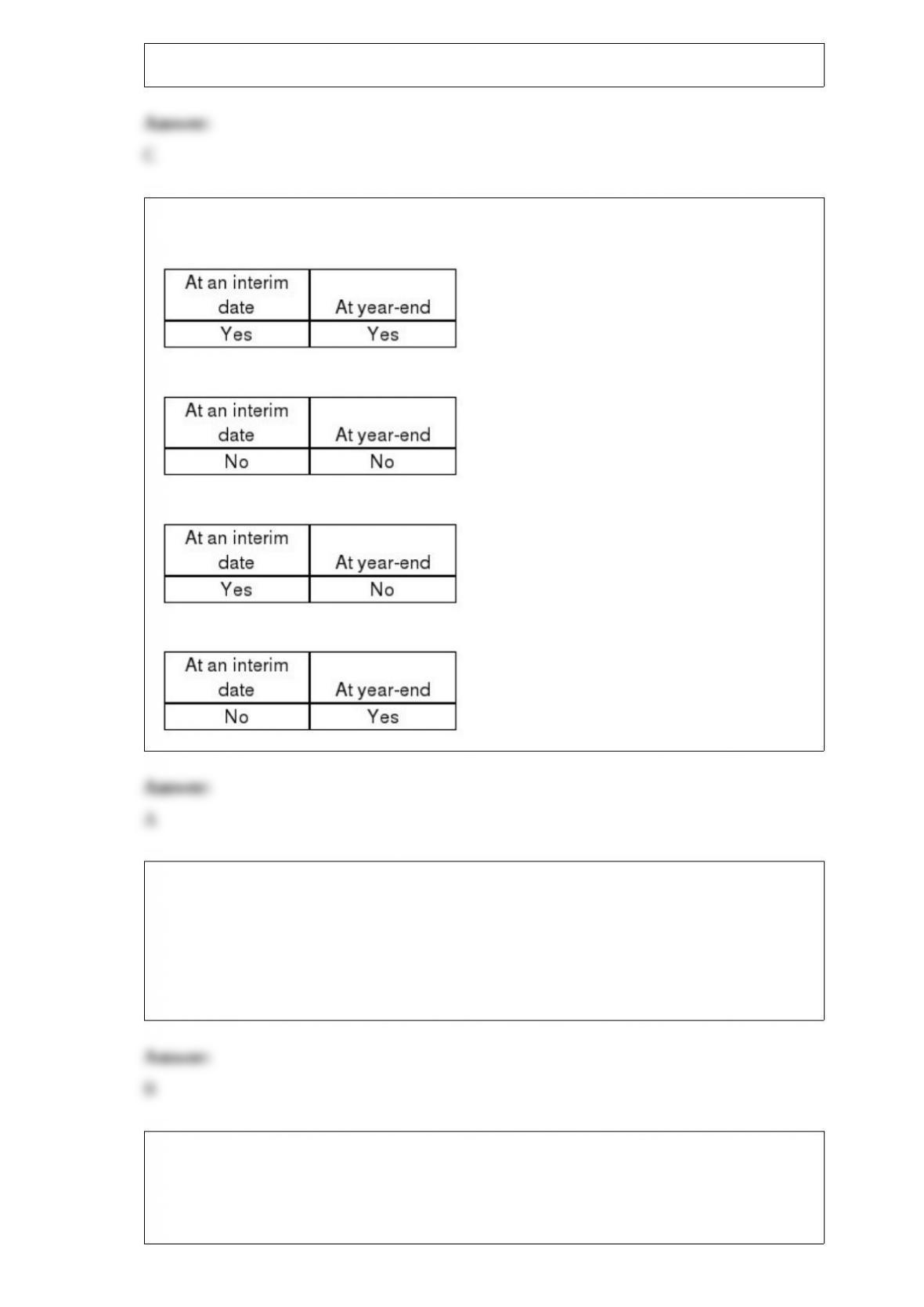
24) Listed below are four interbank cash transfers, indicated by the numbers 1, 2, 3, and
4, of a client for late December 2007 and early January 2008:
Based on the schedule of interbank transfers above, which of the cash transfers
indicates an error in cash cutoff at December 31, 2007?
A) 1
B) 2
C) 3
D) 4
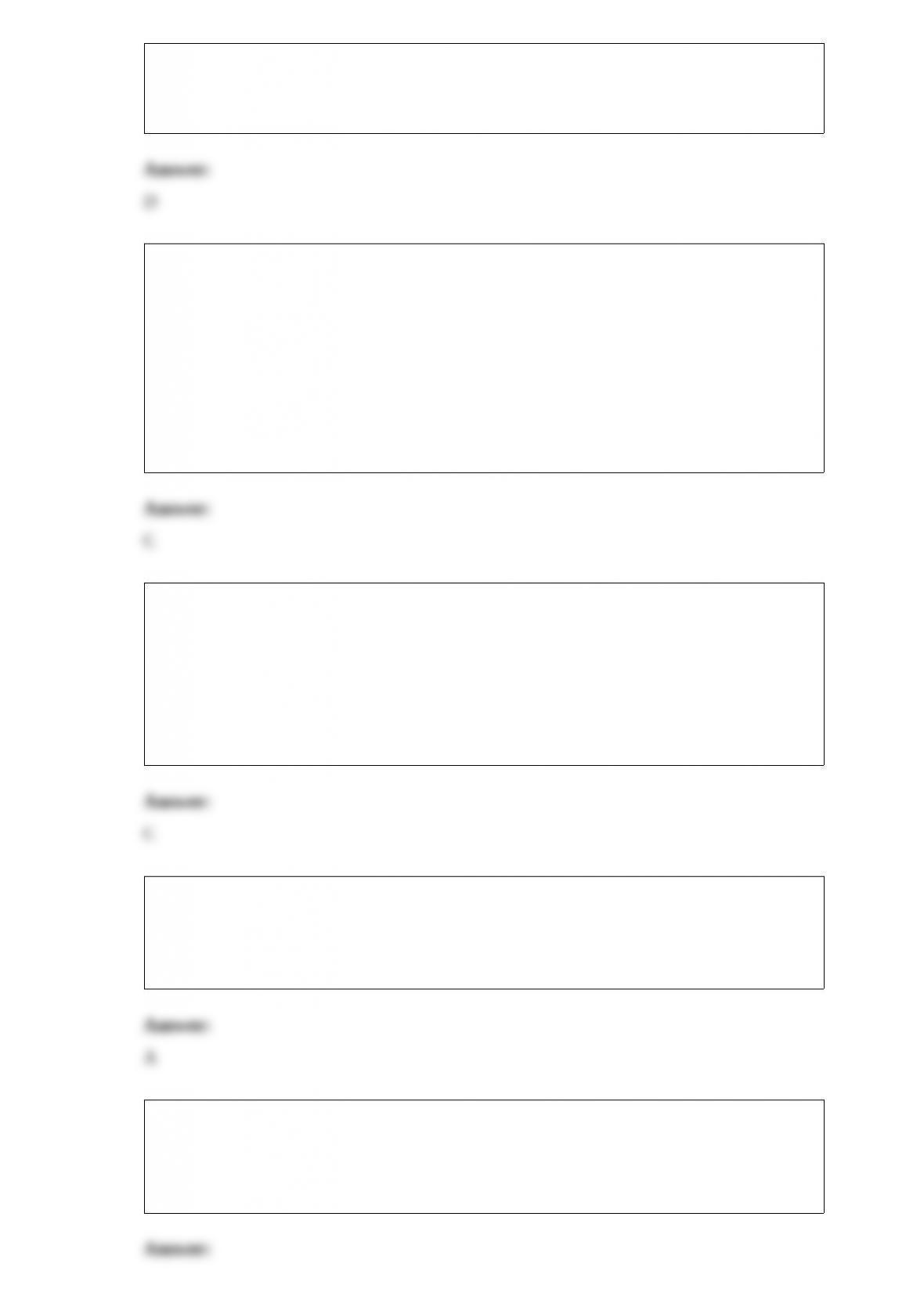
25) When may auditors observe the physical inventory count?
A)
B)
C)
D)
26) A document generally received from the vendor which indicates a reduction in the
amount owed due to the company granting an allowance is:
A) vendor invoice
B) debit memo
C) credit adjustment form
D) credit memo
27) The audit objective that requires that existing notes payable be included in the notes
payable schedule is satisfied by performing which of the following audit procedures?
A) confirm notes payable
B) trace the total of the notes payable schedule to the general ledger
C) review the notes payable schedule to determine whether any are related parties
D) obtain confirmations from creditors who have held notes from the client in the past
and are not currently included in the notes payable schedule
28) After considering a client’s internal controls, an auditor has concluded that it is well
designed and is functioning as intended. Under these circumstances the auditor would
most likely:
A) perform tests of controls to the extent outlined in the audit program
B) determine the control procedures that should prevent or detect errors and
irregularities
C) not increase the extent of predetermined substantive tests
D) determine whether transactions are recorded to permit preparation of financial
statements in conformity with generally accepted accounting principles
29) When designing audit procedures, tracing of source documents to the customers
subsidiary ledger and subsequently to the general ledger is done to satisfy what
assertion?
A) valuation
B) cutoff
C) completeness
D) classification
30) Statements on Auditing Standards (SASs) are considered to be interpretations of the
ten generally accepted auditing standards.
A) True
B) False
31) Benchmarking is one source of evaluation criteria for completing an operational
audit.
A) True
B) False
32) A measure of the auditor’s assessment of the likelihood that there are material
misstatements in an account before considering the effectiveness of the client’s internal
control is called:
A) control risk
B) acceptable audit risk
C) statistical risk
D) inherent risk
33) Paying employees for their services ends the payroll and personnel cycle.
A) True
B) False
34) Assuming the client’s internal controls are adequate, describe how the auditor can
verify proper cutoff of sales transactions.
35) Discuss the advantages and disadvantages of monetary-unit sampling over other
sampling methods.
36) An environmental clean-up lawsuit is pending against your client. What information
about the lawsuit would you as the auditor need in order to determine the “correct”
accounting?
37) Briefly explain each management assertion related to classes of transactions and
events for the period under audit.
38) State three lists or requests that should be included in a standard “inquiry of
attorney” letter.
39) When using nonstatistical sampling, the auditor must subjectively consider whether
the true population misstatement exceeds a tolerable amount. This is done by
considering five factors. One factor is the difference between the point estimate and
tolerable misstatement. State the other four factors the auditor must consider.
40) Discuss three of the following influences on the persuasiveness of evidence.
1>Relevance
2>Independence of provider
3>Effectiveness of client’s internal controls
4>Auditor’s direct knowledge
5>Degree of objectivity
6>Timeliness
41) When auditing disposals of property, plant, and equipment, the search for
unrecorded disposals is essential. State the four audit procedures frequently used for
verifying disposals.
42) List each of the five types of audit tests and list at least two types of evidence that
may be obtained from each type of test.
43) Auditors often use Generalized Audit Software during their testing of a client’s
internal controls. For the following uses of the software provide a description and an
example.
Verify extensions and footings
Print confirmation requests
Compare data on separate files