A personal allowance:
a. amounted to $2,000 in 2016.
b. may be claimed to exempt a portion of the employee’s earnings from withholding.
c. is indexed for inflation every calendar quarter.
d. may be claimed at the same time with each employer for whom an employee is
working during the year.
e. for one person is a different amount for a single versus a married taxpayer.
Which of the following noncash fringe benefits does not represent taxable income
subject to federal income tax withholding?
a. Flight on employer-provided airline
b. Personal use of company car
c. Sick pay
d. Employer-paid membership to a country club
e. All of the above are taxable.

Beech refuses to state her marital status on Form W-4 which she gave to you, the
payroll manager, when she was hired. You should:
a. tell Beech that it is OK since you know that she was recently divorced and is
reluctant to talk about it.
b. inform Beech that she will have to write the IRS and give her reasons for refusing to
state her marital status.
c. tell Beech that you will have to withhold income taxes as if she were married and had
claimed one allowance.
d. tell Beech that you will have to withhold income taxes according to the withholding
table for a single employee with no allowances.
e. advise Beech to write It is no business of yours. in the margin of her Form W-4.
Included under the definition of employees for FUTA purposes are:
a. independent contractors.
b. insurance agents paid solely on commission.
c. student nurses.
d. officers of a corporation.
e. members of partnerships.

Under the federal income tax withholding law, which of the following is not defined as
an employee?
a. Partner who draws compensation for services rendered the partnership
b. General manager, age 66
c. Payroll clerk hired one week ago
d. Governor of the state of Florida
e. Secretary employed by a not-for-profit corporation
A federal unemployment tax is levied on:
a. employees only.
b. both employers and employees.
c. employers only.
d. government employers only.
e. no one.

FICA excludes from coverage all of the following kinds of employment except:
a. domestic service performed in a college sorority by a student.
b. service performed by a 16-year-old child in the employ of the mother.
c. babysitting service performed by a 35-year-old person who receives $40 in cash
during the calendar quarter.
d. federal government secretaries hired in 1990.
e. services performed by a railroad worker for an employer covered by the Railroad
Retirement Tax Act.
To determine a pieceworkers regular hourly rate for one week:
a. divide the total weekly earnings from piece rates and all other sources by the hours
worked in the week.
b. divide the total weekly earnings from piece rates by the number of pieces produced.
c. divide the total weekly earnings from piece rates, less earnings from other sources, by
the hours worked in a week.
d. add the total weekly earnings from piece rates and all other sources and divide by the
total number of pieces produced.
e. do none of the above.

The employees earnings record provides information for each of the following except:
a. completing Forms W-2.
b. completing the journal entry to record the payroll.
c. determining when the accumulated wages of an employee reach cutoff levels.
d. preparing reports required by state unemployment compensation laws.
e. preparing the payroll register.
The FICA tax rates for the self-employed are:
a. 6.2% (OASDI) and 1.45% (HI).
b. 12.4% (OASDI) and 1.45% (HI).
c. 6.2% (OASDI) and 2.9% (HI).
d. 10.0% (OASDI) and 1.0% (HI).
e. none of the above.
The taxes imposed under the Social Security Act consist of:

a. two taxes on employers.
b. two taxes on employees.
c. OASDI and HI taxes.
d. taxes on the net earnings of the self-employed.
e. all of the above.
The Age Discrimination in Employment Act provides protection to virtually all workers
up to the age of:
a. 50.
b. 65.
c. 70.
d. 75.
e. 40.
Each of the following items is accurately defined under FICA as taxable wages except:

a. value of meals furnished employees for the employers convenience.
b. value of meals furnished employees for the employees convenience.
c. commissions.
d. dismissal pay.
e. $500 award for productivity improvement suggestion.
An employer must pay the quarterly FUTA tax liability if the liability is more than:
a. $3,000.
b. $500.
c. $1,000.
d. $1.
e. $100.
Which of the following forms is used to report rents paid over $600 to landlords?
a. Form 1099R

b. Form 1099INT
c. Form 1099MISC
d. Form 1099G
e. Form 8027
When recording the deposit of FUTA taxes owed, the proper entry is:
a. FUTA Tax Expense
Cash
b. Payroll Taxes
Cash
c. Payroll Taxes
FUTA Taxes Payable
d. FUTA Taxes Payable
Cash
e. FUTA Tax Expense
FUTA Taxes Payable

Ashe, an employer, has made timely deposits of FICA taxes and withheld income taxes
during the first quarter of 2016. The latest date on which she may file Form 941 is:
a. April 10.
b. April 30.
c. May 1.
d. May 10.
e. May 15.
The person who is not an authorized signer of Form 940 is:
a. the individual, if a sole proprietorship.
b. the accountant from the companys independent auditing firm.
c. the president, if a corporation.
d. a fiduciary, if a trust.
e. All of the above are authorized signers.

The highest paid executives of a firm are excluded from coverage under the Federal
Insurance Contributions Act (FICA).
Pre-hire questions pertaining to religion, gender, national origin, or age are allowed if:
a. all employees are asked the same questions.
b. only foreign-born applicants are asked these questions.
c. these factors are bona fide occupational qualifications for the job.
d. they are not in written form.
e. the applicant is married.
To be designated a semiweekly depositor, how much in employment taxes would an
employer have reported for the four quarters in the lookback period?
a. More than $50,000.
b. More than $100,000.
c. Less than $50,000.
d. More than $2,500.

e. None of the above.
In January 2016, the minimum hourly wage was:
a. $9.35.
b. $7.15.
c. $10.00.
d. $8.15.
e. none of the above.
For FUTA purposes, an employer can be any one of the following except:
a. an individual.
b. a partnership.
c. a trust.
d. a corporation.
e. All of the above can be employers.

If an employee works two jobs at two different wage rates for the same employer
during the same pay week, any overtime pay must be calculated by using an overtime
hourly rate of:
a. one and one-half the higher of the two wage rates.
b. one and one-half the lowest of the two wage rates.
c. one-half of the higher of the two wage rates.
d. one-half of the two rates combined.
e. none of the above.
NOTE: In the following problems, use the net FUTA tax rate of 0.6% on the first
$7,000 of taxable wages.
Aaron Norman earned $24,900 for the year from Marcus Company. The company is
subject to a SUTA tax of 4.7% on the first $9,900 of earnings. Determine:
(a) the employers FUTA tax on Normans earnings
(b) the employers SUTA tax on Normans earnings

A company must withhold federal income taxes from payments made to independent
contractors in which of the following cases?
a. When there is a signed contract between the parties
b. When the contractor is paid more than $10,000
c. When the contractor is a corporation
d. When the contractor has not provided a taxpayer identification number and the
contract is $600 or more
e. All of the above
Which of the following forms is used to report the amount of distributions from pension
and retirement plans?
a. Form W-2c
b. Form 1099-R
c. Form 1099-PEN
d. Form W-3p
e. Form W-4

Directors of corporations who only attend and participate in board of directors meetings
are not covered as employees under FUTA.
An employer must file an information return under all of the following conditions
except:
a. to report $1,000 of compensation paid to an individual who is not an employee.
b. to report the wages totaling $600 paid to an independent contractor during the
calendar year.
c. to report dividends totaling $600 paid to an individual during the calendar year.
d. to report commissions of $500 paid to a self-employed salesman.
e. An information return must be filed under each of the above conditions.

Employers may pay nonexempt employees who work fluctuating schedules a fixed
salary. In these cases, the extra pay is:
a. calculated at a time and one-half rate.
b. calculated at a double time rate.
c. calculated at the regular rate of pay.
d. unpaid.
e. none of the above.
Under the continental system of recording time, 9:20 p.m. is recorded as:
a. P2120.
b. 9:20P.
c. 2120.
d. 2220.
e. none of the above.

Unemployment taxes (FUTA and SUTA) do not have to be paid by an employer who
has only part-time employees.
NOTE: In the following problems, use the net FUTA tax rate of 0.6% on the first
$7,000 of taxable wages.
John Gercke is an employee of The Woolson Company. During the first part of the year,
he earned $6,800 while working in State A. For the remainder of the year, the company
transferred him to State B where he earned $16,500. The Woolson Companys tax rate in
State A is 2%, and in State B it is 3.15% on the first $7,000. Assuming that reciprocal
arrangements exist between the two states, determine the SUTA tax that the company
paid to:
(a) State A
(b) State B
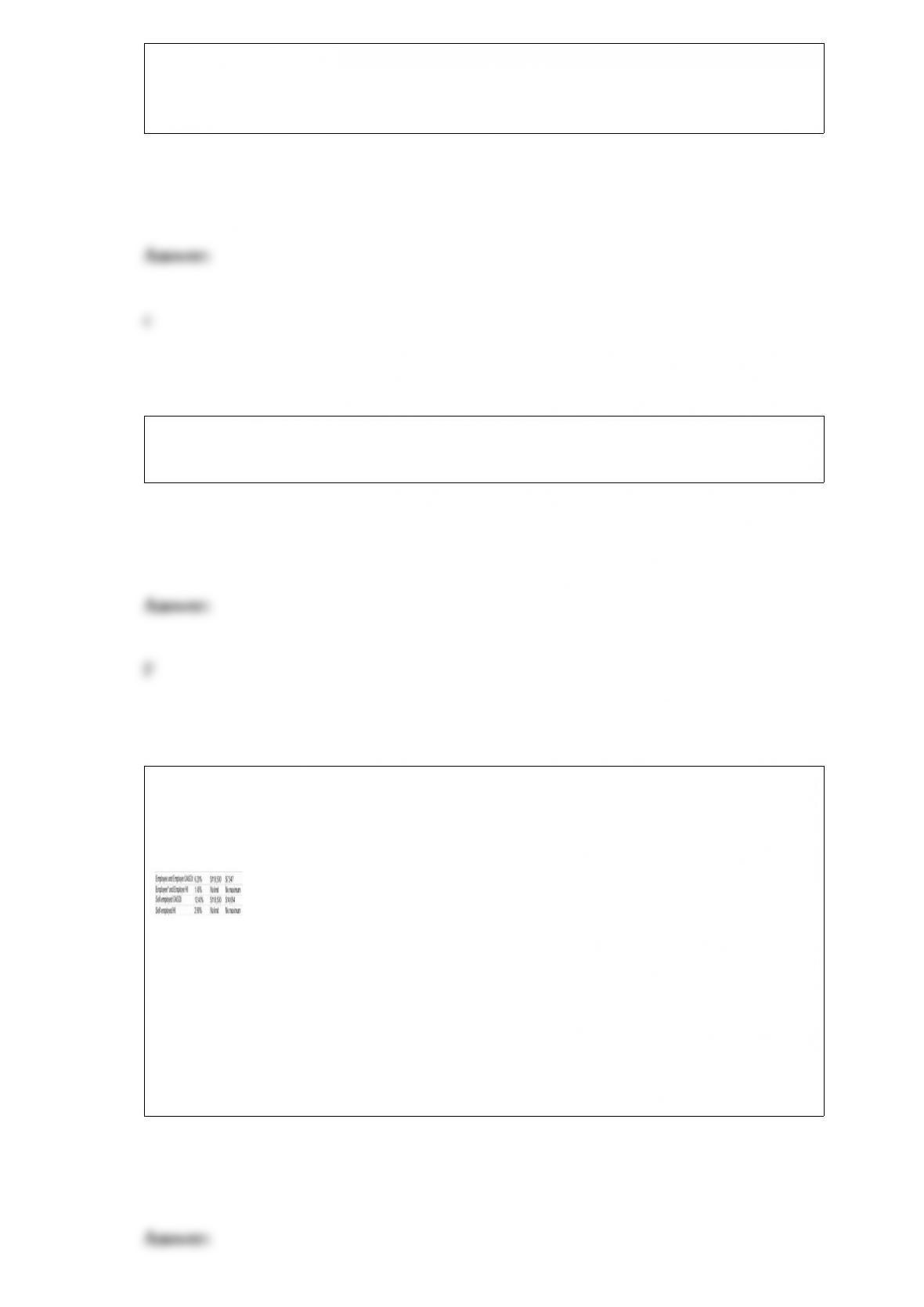
NOTE: In this chapter and in all succeeding work throughout the course, unless
instructed otherwise, use the following rates, ceiling, and maximum taxes.

For rounding rules refer to page 2-33.
*Employee HI: Plus an additional 0.9% on wages over $200,000. Also applicable
to self-employed. Jax Companys (a monthly depositor) tax liability (amount
withheld from employees wages for federal income tax and FICA tax plus
the companys portion of the FICA tax) for July was $1,210. No deposit was made by
the company until August 24, 20–.
Determine:
(a) The date by which the deposit should have been made
(b) The penalty for failure to make timely deposit ($1,210 × 5%)
(c) The penalty for failure to fully pay tax when due ($1,210 × 5%)
(d) The interest on taxes due and unpaid (assume a 3% interest rate),
($1,210 × 3% × 9/365)
Under the FLSA, overtime pay is required for:
a. any hours worked in excess of 8 in one day.
b. all work on Sunday.
c. all hours worked in excess of 40 in a workweek.
d. all hours worked on Christmas.
e. all of the above.
Engaged to wait and waiting to be engaged are both considered work time.
NOTE: In this chapter and in all succeeding work throughout the course, unless
instructed otherwise, use the following rates, ceiling, and maximum taxes.
For rounding rules refer to page 2-33.
*Employee HI: Plus an additional 0.9% on wages over $200,000. Also applicable to
self-employed.
Complete the following portion of Form 941 from the information presented in
Problem 12
Employer payments made directly to employees in lieu of health insurance coverage are
taxable wages.
The wage and salaries expense account is an operating expense account debited for total
net pay each payroll period.

Persons eligible for deductible IRA contributions may put aside a specified amount of
their compensation without paying federal income taxes on that amount.
Each year, the FICA (OASDI portion) taxable wage base is automatically adjusted
whenever a cost of living raise in social security benefits becomes available.
Advance payments for work done in the future are not taxable wages for FUTA
purposes.
NOTE: In the following problems, use the net FUTA tax rate of 0.6% on the first

$7,000 of taxable wages.
Hunter Company had a FUTA taxable payroll of $192,700 for the year. Since the
company is located in a state that has a 0.3% FUTA credit reduction due to unpaid
loans, determine Hunters FUTA tax liability for the year
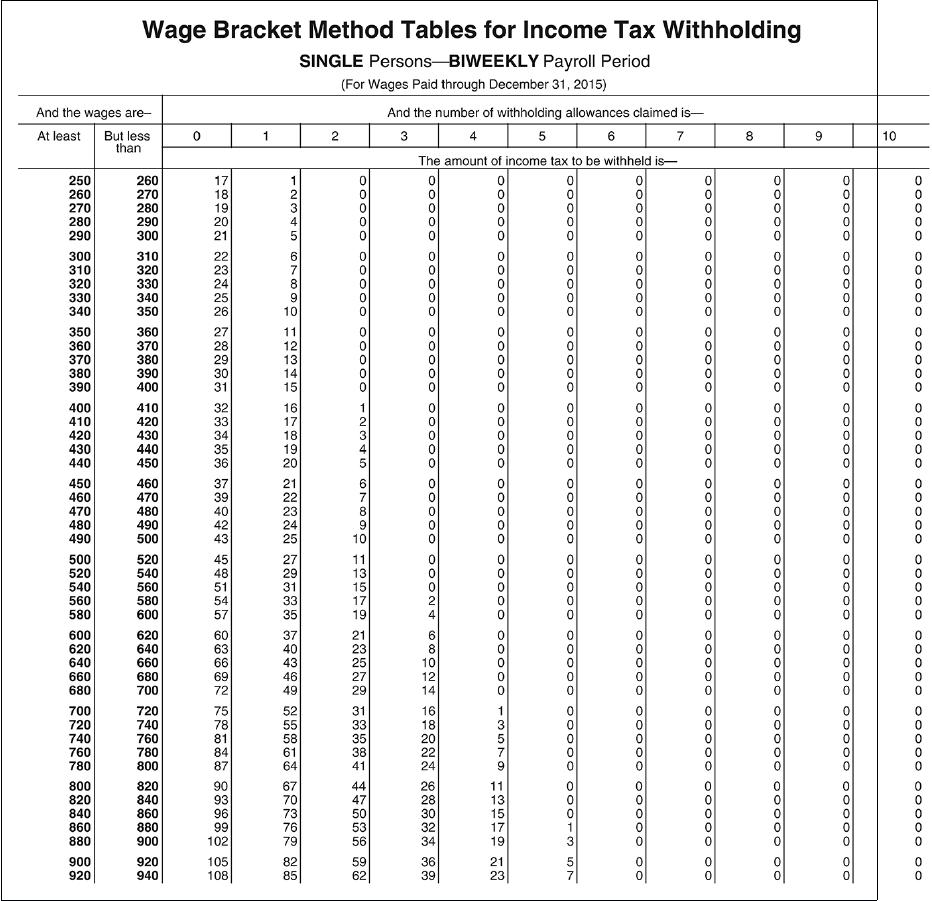
Note: Use the tables on the following pages to calculate the answers to the problems
listed.
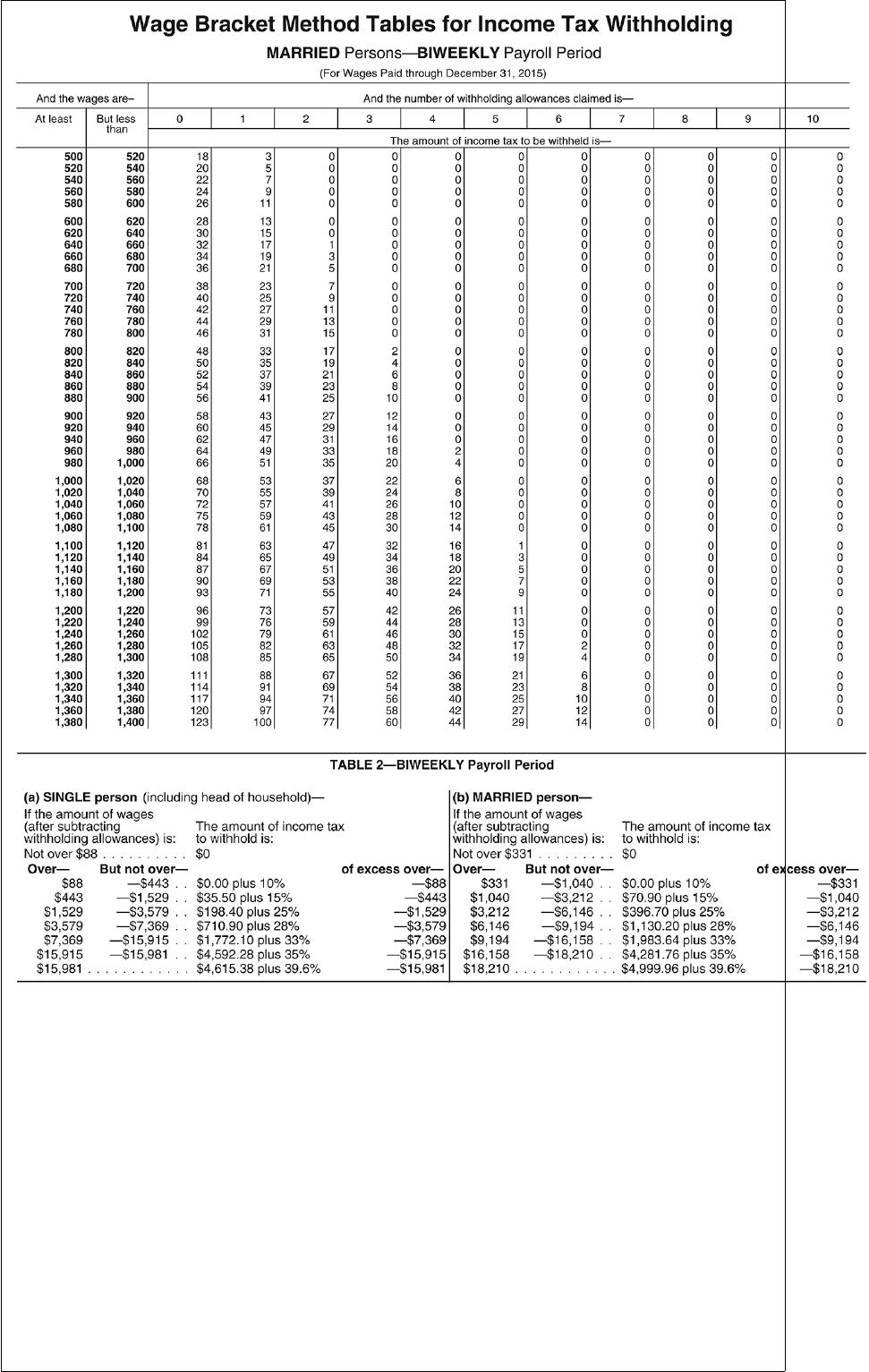
Source: Internal Revenue Service.
Determine the income tax to withhold from the biweekly wages of the
following employees (wage-bracket):
Karen Overton (single, 0 allowances), $900 wages
Nancy Haller (married, 4 allowances), $1,000 wages
Alan Glasgow (married, 1 allowance), $980 wages
Joseph Kerr (single, 4 allowances), $720 wages
Ginni Lorenz (single, 1 allowance), $580 wages

Under SECA, all of an individuals self-employment income is counted in determining
the HI tax.
Evers, who works for two employers, is entitled to three personal allowances. Evers
must claim the three allowances with each of the two employers during the entire
calendar year.

The payroll taxes account is an expense account that is debited for the FICA, FUTA,
and SUTA taxes on the employer.
An exception to the protection that the Age Discrimination in Employment Act provides
for all workers over 40 involves executives who are 65 or older and who have held high
policy-making positions during the two-year period prior to retirement.
Most firms are now using a standard reference inquiry form, supplied by the IRS.
Under the Civil Rights Act of 1964, the U.S. government is classified as an exempt
employer.

NOTE: In all problems, unless instructed otherwise, compute the hourly and overtime
rates as follows:
1) Carry the hourly rate and the overtime rate to 3 decimal places and then round off to
2 decimal places (round the hourly rate to 2 decimal places before multiplying by one
and one-half to determine the overtime rate).
2) If the third decimal place is 5 or more, round to the next higher cent.
3) If the third decimal place is less than 5, drop the third decimal place.
Also, use the minimum hourly wage of $7.25 in solving these problems and all that
follow. Hall receives 18½ cents for every unit produced. Hall produces 575 units in an
8-hour workday
The total of the net amount paid to employees each payday is credited to either the cash
account or the salaries payable account.
Institutions of higher education are extended coverage under FLSA without regard to
their annual sales volume.
Only one state has passed a law to provide disability benefits to employees absent from
their jobs due to illness, accident, or disease not arising out of their employment.
NOTE: In this chapter and in all succeeding work throughout the course, unless
instructed otherwise, use the following rates, ceiling, and maximum taxes.
For rounding rules refer to page 2-33.
*Employee HI: Plus an additional 0.9% on wages over $200,000. Also applicable
to self-employed.
From the information presented in Problem 12, complete Part 2 of Form