
1) Footing the sales journal and tracing the totals to the general ledger are tests relating
to the accuracy objective for sales.
A) True
B) False
2) The criterion that is most likely to be used as a framework in evaluating a company’s
internal control over financial reporting under Section 404 of the Sarbanes-Oxley Act is
the Enterprise Risk Management framework.
A) True
B) False
3) The major conclusion of the 1931 Ultramares case was that:
A) ordinary negligence is insufficient for liability to third parties
B) ordinary negligence is sufficient for liability to third-party beneficiaries
C) fraud or gross negligence is sufficient for liability to third parties
D) auditors have no liabilities to third parties
4) The auditor gets highly reliable evidence about individual transactions by examining:
A) vendors’ invoices
B) vendors’ statements
C) confirmations of accounts payable balances
D) detailed inventory counting instructions
5) When auditing the payroll and personnel cycle, tests of controls are routinely
performed.
A) True
B) False

6) Which of the following does NOT represent an increased opportunity to commit
fraud?
A) Related Party Transactions
B) the company founder is the CEO and Chairman of the Board
C) the financial statements involve accounting estimates
D) the company is a new audit client for the CPA firm
7) Each of the following situations involves a possible violation of the rule on
independence. For each situation, (1) decide whether the Code of Professional Conduct
has been violated, and (2) briefly explain how the situation violates (or does not violate)
the Code of Professional Conduct.
a. Harry Brown is a partner in the Topeka office of Hedley & Co., CPAs. Harry’s
brother is employed in an audit-sensitive position by Jensen Appliances, a publicly held
company in Kansas. Jensen Appliances is one of Hedley & Co.’s audit clients. Neither
Harry nor personnel from the Topeka office is involved in the audit of Jensen.
Violation? Yes No
Explanation:
b. John Woods is an audit manager with Calden & Co., CPAs, a one-office CPA firm.
John owns 100 shares of common stock in one of the firm’s audit clients, but he does
not provide any audit or non-audit services to the company.
Violation? Yes No
Explanation:
c. The accounting firm of Fine & Herman, CPAs, provides bookkeeping and tax
services for Henderson Corporation, a privately held company. Fine & Herman also
performs the annual audit of Henderson Corporation.
Violation? Yes No
Explanation:
d. Bob Shelton CPA, is the auditor of Cafe Ecko. A couple of weeks ago, Cafe Ecko’s
management commenced litigation against Bob, alleging he was negligent in last year’s
audit.
Violation? Yes No
Explanation:
e. Hamilton Appliance has not paid Karen Linwood, CPA, her audit fee for the past two
years. Karen is starting work on the current year’s audit of Hamilton.
Violation? Yes No
Explanation:
8) Which of the following forms of review are permissible under SSARS?
A) review without positive assurance
B) review on financial statements that omit substantially all disclosures
C) reviews without CPA independence
D) review without limited procedures
9) Which of the following most likely would be detected by a review of a client’s sales
cutoff?
A) Excessive sales discounts
B) Unrecorded sales for the year
C) Unauthorized goods returned for credit
D) Lapping of year-end accounts receivable
10) An individual who is not party to the contract between a CPA and the client, but
who is known by both and is intended to receive certain benefits from the contract is
known as:
A) a third party
B) a common law inheritor
C) a tort
D) a third-party beneficiary
11) An auditor is performing a credit analysis of customers with balances over 60 days
due. She is most likely obtaining evidence for which audit related objective?
A) realizable value
B) existence
C) completeness
D) occurrence

12) For a private company client, auditors are required to test any internal controls they
believe have not been operating effectively during the period under audit.
A) True
B) False
13) Reports on agreed-upon procedures are intended to be distributed:
A) to only the involved parties, who would have the requisite knowledge about those
procedures and the level of assurance resulting from them
B) to only the involved parties, who would have the requisite knowledge about those
procedures but not the level of assurance resulting from them
C) to any party to whom the client wishes
D) only to the stockholders of the client
14) Which of the following audit objectives is least important in the audit of capital
stock and paid-in-capital in excess of par?
A) Completeness
B) Accuracy
C) Rights and obligations
D) Presentation and disclosure
15) Distribution of which of the following types of reports is limited?
A) audit
B) review
C) agreed-upon procedures
D) examination
16) Controls over the acquisition and recording of insurance are a part of which of the
following transaction cycles?
A) Inventory and warehousing cycle

B) Capitalization cycle
C) Treasury cycle
D) Acquisition and payment cycle
17) When the auditor recomputes the unexpired portion of prepaid insurance, she is
satisfying which audit objective?
A) Completeness
B) Existence
C) Accuracy and detail tie-in
D) Rights
18) Under the federal securities acts, one significant result occurring directly due to the
Escott et al. v. Bar Chris Construction Corporation case was that SAS was changed to
require:
A) greater emphasis on subsequent events procedures
B) new standards for unaudited statements
C) a broader definition of third-party beneficiaries
D) more companies to file annual reports with the SEC
19) To issue an unqualified opinion on internal control over financial reporting, there
must be no identified material weaknesses and no restrictions on the scope of the audit.
A) True
B) False
20) Tolerable exception rate (TER) is inversely related to sample size.
A) True
B) False
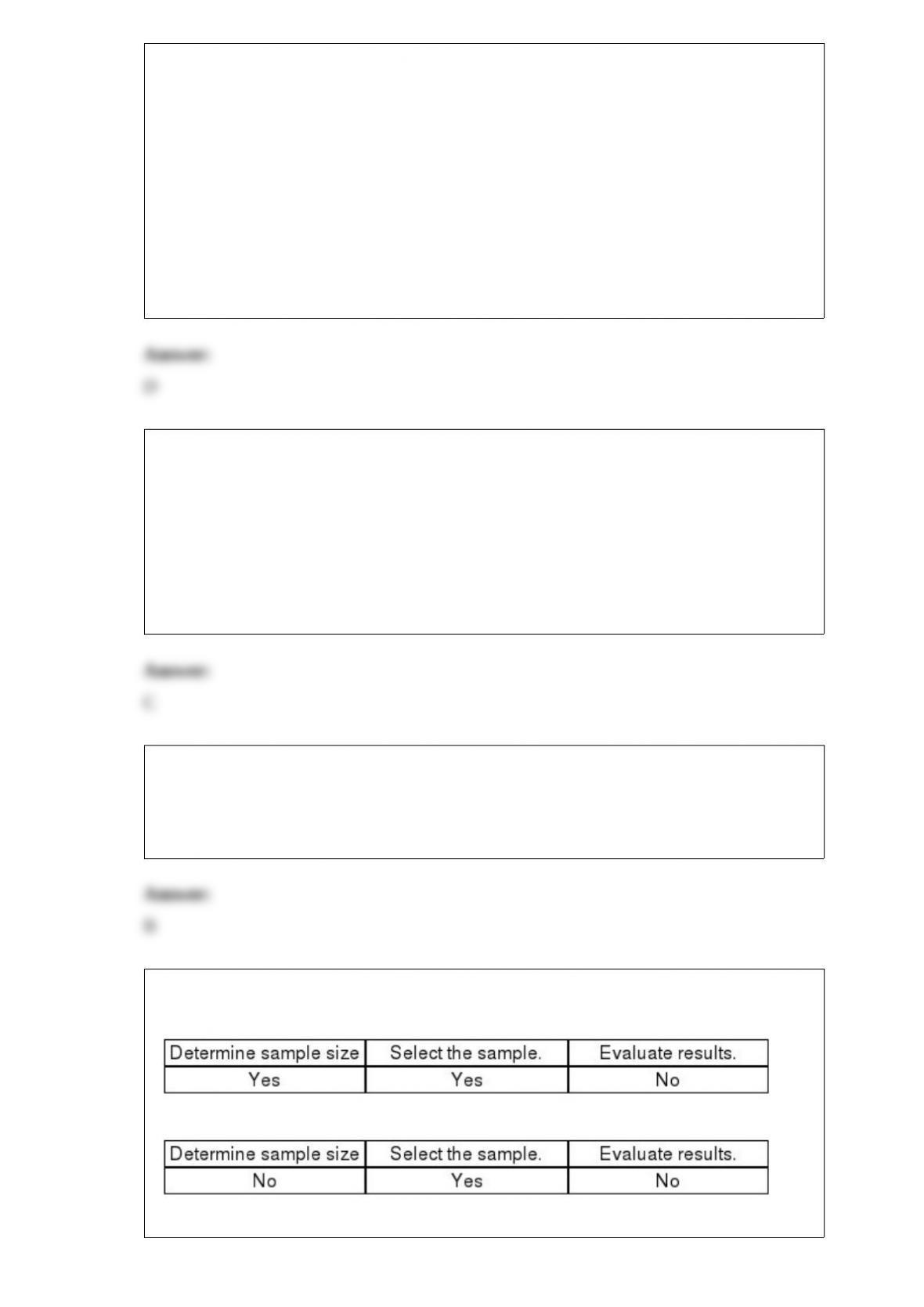
21) Readers of financial statements often interpret that the number of paragraphs in the
independent auditor’s report is a ‘signal” of the entity’s financial fairness. Which of the
following is not true regarding the number of paragraphs in an independent auditor’s
report?
A) More than three paragraphs indicates either a qualification or report modification
B) An additional paragraph is added before the opinion for a qualified, adverse or
disclaimer of opinion
C) An additional paragraph is added after the opinion when there is required
information the auditor must report when the opinion is unqualified
D) No explanatory paragraph is required for an unqualified shared report involving
other auditors, however, explanatory language is added in the introductory paragraph
22) Which of the following statements is most correct with respect to the evaluation of
non-probabilistic sample results?
A) It is acceptable to make non-probabilistic evaluations only when probabilistic
sample selection is used
B) It is acceptable to make non-probabilistic evaluations only if the auditor cannot
quantify sampling risk
C) It is never acceptable to evaluate a non-probabilistic sample using statistical methods
D) All of the above are correct
23) The criteria used by an external auditor to evaluate published financial statements
are known as generally accepted auditing standards.
A) True
B) False
24) Tolerable misstatement is used to:
A)
B)
C)

D)
25) When the auditor concludes that there is substantial doubt about the entity’s ability
to continue as a going concern, the appropriate audit report could be:
I.an unqualified opinion with an explanatory paragraph.
II.a disclaimer of opinion.
A) I only
B) II only
C) I or II
D) Neither I nor II
26) Gregory & Hedrick, a medium-sized CPA firm, employed Elise as a staff
accountant. Elise was negligent while auditing several of the firm’s clients. Under these
circumstances, which of the following statements is true?
A) Elise would have no personal liability for negligence
B) Gregory & Hedrick is not liable for Elise’s negligence because CPAs are generally
considered to be independent contractors
C) Gregory & Hedrick would not be liable for Elise’s negligence if Winters disobeyed
specific instructions in the performance of the audits
D) Gregory & Hedrick can recover against its insurer on its malpractice policy even if
one of the partners was also negligent in reviewing Elise’s work
27) Which of the following is not one of the categories of items included in the client
letter of representation?
A) subsequent events
B) Completeness of information
C) recognition, measurement, and disclosure
D) materiality

28) A lawsuit has been filed against your client. If, in the opinion of legal counsel, the
likelihood your client will lose the lawsuit is remote, no financial statement accrual or
disclosure of the potential loss would generally be required.
A) True
B) False
29) With which of the following client personnel would it generally not be appropriate
to inquire about commitments or contingent liabilities?
A) Controller
B) President
C) Accounts receivable clerk
D) Vice president of sales
30) Qualitative factors can affect an auditor’s assessment of materiality. Which of the
following qualitative factors could influence the assessment of materiality?
I.Misstatements that are otherwise immaterial may be material if they affect earnings
trends.
II.Minor misstatements resulting from the consequences of contractual obligations.
A) I only
B) II only
C) I and II
D) neither I nor II
31) Procedures to obtain an understanding of internal control may suffice for tests of
controls when the auditor is assessing control risk in a well defined transaction cycle
that has not contained material misstatements in prior audits.
A) True
B) False
32) According to the profession’s ethical standards, an auditor would be considered

independent in which of the following instances?
A) The auditor’s checking account, which is fully insured by a federal agency, is held at
a client financial institution
B) The auditor is also an attorney who advises the client as its general counsel
C) An employee of the auditor serves as treasurer of a charitable organization that is a
client
D) The client owes the auditor fees for two consecutive annual audits
33) Which of the following is the correct definition of “control deficiency”?
A) A control deficiency exists if the design or operation of controls does not permit
company personnel to prevent or detect misstatements on a timely basis
B) A control deficiency exists if one or more deficiencies exist that adversely affect a
company’s ability to prepare external financial statements reliably
C) A control deficiency exists if the design or operation of controls results in a more
than remote likelihood that controls will not prevent or detect misstatements
D) A control deficiency exists if the design or operation of controls results in a more
than probable likelihood that controls will prevent or detect misstatements
34) Which of the following situations would most likely require special audit planning?
A) Inventory consists of precious stones
B) Some items of factory and office equipment do not bear identification numbers
C) Depreciation methods used on the client’s tax return differ from those used on the
books
D) Assets costing less than $500 are expensed even though their expected life exceeds
one year
35) Which of the following explanations might satisfy an auditor who discovers
significant debits to an accumulated depreciation account?
A) Extraordinary repairs have lengthened the life of an asset
B) Prior years’ depreciation charges were erroneously understated
C) A reserve for possible loss on retirement has been recorded
D) An asset has been recorded at its fair value

36) The primary role of the United States General Accounting Office is the enforcement
of the federal tax laws as defined by Congress and interpreted by the courts.
A) True
B) False
37) Which of the following is not one of the reasons that auditors provide only
reasonable assurance on the financial statements?
A) The auditor commonly examines a sample, rather than the entire population of
transactions
B) Accounting presentations contain complex estimates which involve uncertainty
C) Fraudulently prepared financial statements are often difficult to detect
D) Auditors believe that reasonable assurance is sufficient in the vast majority of cases
38) Which of the following is responsible for establishing a private company’s internal
control?
A) Senior Management
B) Internal Auditors
C) Senior Management and auditors
D) Audit committee
39) Which of the following management assertions is not associated with
transaction-related audit objectives?
A) Occurrence
B) Classification and understandability
C) Accuracy
D) Completeness
40) While analytical procedures are commonly used when auditing balance sheet
accounts, they are normally not very useful when auditing income statement accounts.
A) True
B) False
41) Discuss the major activities and procedures performed by the auditor in the plan
and design of the audit approach.
42) Cutoff misstatements can occur for sales, sales returns, and cash receipts. List
below the threefold approach an auditor performs for each account above to determine
the reasonableness of the cutoff.
43) Explain why there is a special need for ethical conduct in the auditing profession.
44) Explain the purpose of testing the client’s bank reconciliation, and discuss the major
audit procedures involved.
45) Property, plant, and equipment is normally audited in a different manner than
current asset accounts. State three reasons why this is so, and discuss the differences in
how property, plant, and equipment is audited compared to current assets.
46) The “tone at the top” provides a foundation upon which a more detailed code of
conduct can be developed to provide specific guidance for the organization and its
employees. Components of a code of conduct may include sections on 1> general
employee conduct, 2> relationships with clients and suppliers and 3> conflicts of
interest. Give a narrative description of what might be included in each of the above
components of a code of conduct.
47) Briefly define general controls and application controls.
48) A financial statement review conducted in compliance with SSARS emphasizes five
activities, one of which is to “perform analytical procedures.” State the other four.