
1) A debit balance in the account Market Adjustment–Available-for-Sale Securities at
the end of a year should be interpreted as the net
a. unrealized holding gain for that year
b. realized holding gain for that year
c. unrealized holding gain to date
d. realized holding gain to date
2) Which of the following temporary differences ordinarily results in a deferred tax
liability?
a. Accrued warranty costs
b. Unrealized losses on marketable securities
c. Depreciation
d. Subscription revenue received in advance
3) Mercury Package Express Service properly capitalized at $93,598 a large truck it had
leased on January 1, 2014. The truck has a 14-year useful life. Title to the truck passes
to Mercury at the end of the 12-year lease term. Mercury depreciates other similar
trucks on the straight-line method with no salvage value. The lease agreement calls for
annual payments of $11,500 at the beginning of each year of the lease term. The interest
rate implicit in the lease (which is known by the lessee) is 8%.
How much depreciation and interest expense should Mercury record for 2015?
Depreciation Interest
Expense Expense
a. $7,803 $6,568
b. $6,686 $6,568
c. $6,686 $6,173
d. $7,830 $6,173
4)
5) Carbondale Enterprises had 200,000 shares of common stock issued and outstanding
at December 31, 2013. On July 1, 2014, Carbondale issued a 10 percent stock dividend.
Unexercised stock options to purchase 40,000 shares of common stock (adjusted for the
2014 stock dividend) at $20 per share were outstanding at the beginning and end of
2014. The market price of Carbondale’s common stock (which was not affected by the
stock dividend) was $25 per share during 2014. Net income for the year ended
December 31, 2014, was $1,100,000. What should be Carbondale’s 2014 diluted
earnings per common share, rounded to the nearest penny?
a. $5.00
b. $5.05
c. $4.82
d. $4.23

6) A company issued rights to its existing shareholders to purchase, for $30 per share,
unissued shares of $15 par value common stock. When the rights lapse,
a. Additional Paid-In Capital will be credited
b. Stock Rights Outstanding will be debited
c. Gain on Lapse of Stock Rights will be credited
d. no entry will be made
7) The completed-contract method of accounting for long-term construction-type
contracts is preferable when
a. a contractor is involved in numerous projects
b. the contracts are of a relatively long duration
c. estimates of costs to complete and extent of progress toward completion are
reasonably dependable
d. there are inherent uncertainties in the contract beyond normal business risks
8) Gunther Inc. purchased $400,000 of Malone Corp. ten-year bonds with a stated
interest rate of 8 percent payable quarterly. At the time the bonds were purchased, the
market interest rate was 12 percent. Determine the amount of premium or discount on
the purchase of the bonds.
a. $92,442 premium
b. $92,442 discount
c. $81,143 premium
d. $81,143 discount
9) Intraperiod tax allocation
a. involves the allocation of income taxes between current and future periods
b. associates tax effect with different items in the income statement
c. arises because certain revenues and expenses appear in the financial statements either
before or after they are included in the income tax return
d. arises because different income statement items are taxed at different rates

10) Analysis of a firms balance sheet provides information on its liquidity, which is the
ability to
a. satisfy short-term obligations
b. maintain profitable operations
c. maintain past levels of preferred and common dividends
d. survive a major economic downturn
11) An item that would create a permanent difference in pretax financial and taxable
incomes would be
a. using accelerated depreciation for tax purposes and straight-line depreciation for
book purposes
b. purchasing equipment previously leased with an operating lease in prior years
c. using the percentage-of-completion method on long-term construction contracts
d. paying fines for violation of laws
12) When using the installment sales method,
a. total revenues and costs are recognized at the point of sale, but gross profit is
deferred in proportion to the cash that is uncollected from the sale
b. gross profit is recognized only after the amount of cash collected exceeds the cost of
the item sold
c. revenue, costs, and gross profit are recognized proportionally as the cash is received
from the sale of product
d. gross profit is deferred until all cash is received, but revenues and costs are
recognized in proportion to the cash collected from the sale
13) Fortune One Corporation provides the following account balances for 2014 and
2013:
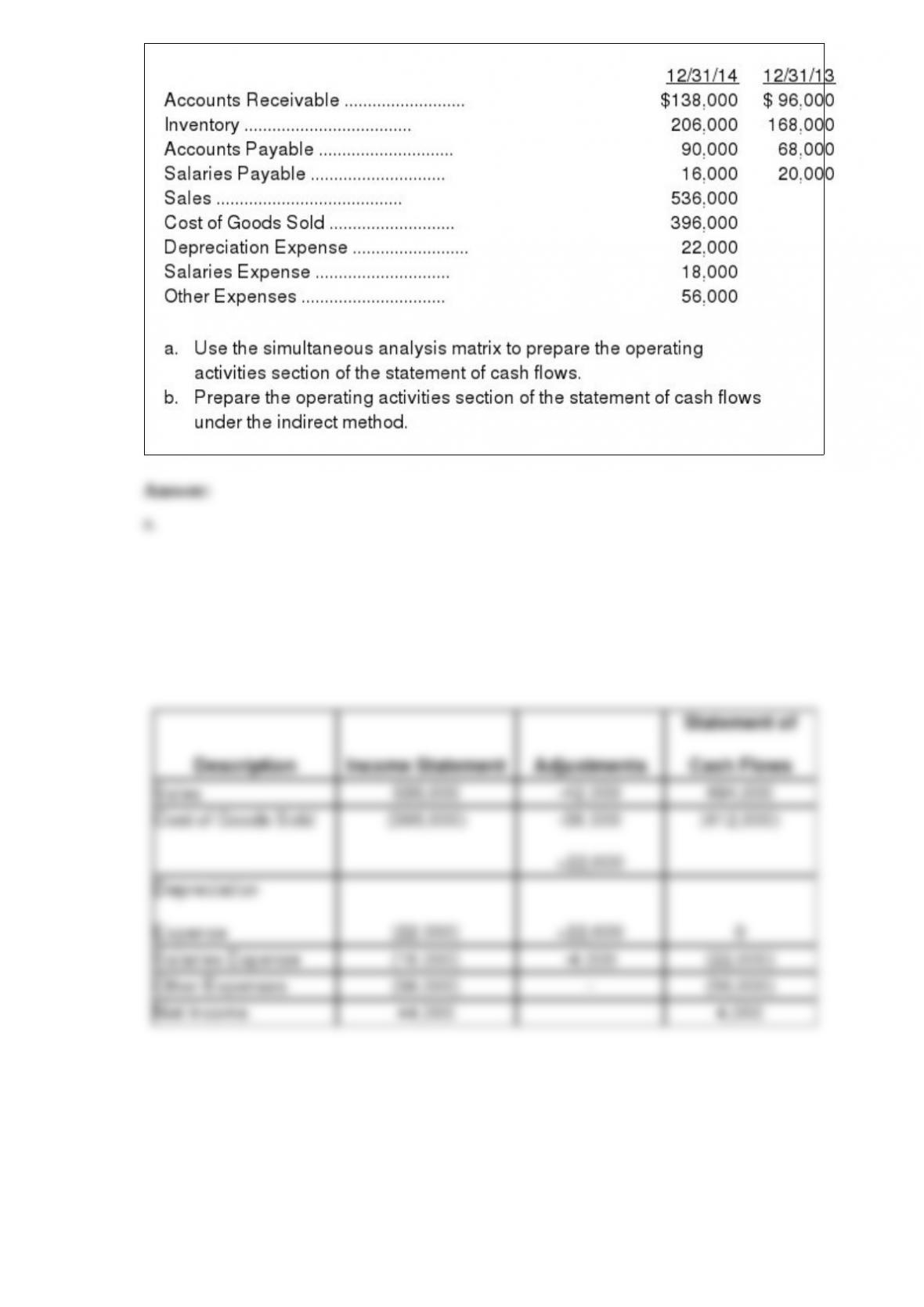
14) Aspen Company provides for doubtful accounts expense at the rate of 3 percent of
credit sales. The following data are available for last year:
The allowance for doubtful accounts balance at December 31, after adjusting entries,
should be
a. $45,000
b. $99,000
c. $90,000
d. $84,000
15) Brookville Corporation’s books disclosed the following information for the year
ended December 31, 2014:

Brookville’s accounts receivable turnover is
a. 3.75 times
b. 4.35 times
c. 5.00 times
d. 5.80 times
16) Under the provisions of FASB ASC Topic 825 (Financial Instruments),
a. the election of the fair value option for investment securities classified as
available-for-sale securities would result in unrealized gains and losses on these
securities being included in other comprehensive income
b. the election of the fair value option for investment securities classified as trading
securities would result in unrealized gains and losses on these securities being included
in other comprehensive income
c. the election of the fair value option for investment securities classified as
held-to-maturity securities would result in unrealized gains and losses on these
securities being included in earnings in the income statement
d. the election of the fair value option for investment securities currently classified as
trading, available-for-sale, or held-to-maturity is not available and can only be applied
to new securities that an entity purchases
17) The balance sheet category receivables represents claims to cash. Accounts
receivable typically constitutes the largest dollar value of receivables. An estimated
allowance for doubtful accounts should be deducted from the gross amount of accounts
receivable to arrive at the estimated amount collectible. Plant assets are reported on the
balance sheet at their historical cost less any accumulated depreciation. The allowance
for doubtful accounts and accumulated depreciation are both termed contra-asset
accounts. Which of the following statements regarding these two contra-asset accounts
is true?
a. Both result in the valuation of their related asset account at net realizable value
b. Accumulated depreciation deducted from the related asset account shows the
unallocated portion of the historical cost of the related asset
c. Accumulated depreciation deducted from the related asset account shows the net
realizable value of the related asset
d. Accumulated depreciation deducted from the related asset account shows the current
replacement cost of the related asset

18) Which of the following is an appropriate computation for return on investment?
a. Sales divided by total assets
b. Net income divided by total assets
c. Net income divided by sales
d. Sales divided by stockholders’ equity
19) Which of the following is presented in a balance sheet?
a. Prepaid expenses
b. Revenues
c. Net income
d. Gains
20) When an exchange of similar assets involves a gain,
a. the recorded amount of the new asset is the cost of the old asset plus any cash paid
b. the recorded amount of the new asset is the net book value of the old asset plus any
cash paid
c. the recorded amount of the new asset is its fair market value less any cash paid
d. None of these are true
21) On June 30, 2014, a fire in Walnut Company’s plant caused the total loss of a
production machine. The machine was being depreciated at $20,000 annually and had a
carrying amount of $160,000 at December 31, 2013. On the date of the fire, the fair
value of the machine was $220,000, and Walnut received insurance proceeds of
$200,000 in October 2014. In its income statement for the year ended December 31,
2014, what amount should Walnut recognize as a gain or loss on disposition?
a. $0
b. $20,000 loss
c. $40,000 gain
d. $50,000 gain

22) Which of the following statements regarding intangible assets is NOT correct?
a. Intangible assets represent long-term rights and privileges of a nonphysical nature
b. Intangible assets should be amortized over a period not to exceed 40 years
c. Intangible assets must be tested regularly to determine if their value has been
impaired
d. A trademark is an example of an intangible asset
23) An inventory loss from market decline of $1,200,000 occurred in April 2014.
Discus Company recorded this loss in April 2014 after its March 31, 2014, quarterly
report was issued. None of this loss was recovered by the end of the year. How should
this loss be reflected in the quarterly income statements of Discus Company?
Three months ended (2014):
March 31 June 30 September 30 December 31
a. 0 0 0 $900,000
b. 0 $400,000 $400,000 $400,000
c. 0 $1,200,000 0 0
d. $300,000 $300,000 $300,000 $300,000
24) Which combination is the correct statement regarding disclosure requirements for
earnings per share?
a. Only the EPS figure for net income must be presented and it must appear on the face
of the income statement
b. Income from continuing operations and net income may be presented on the face of
the income statement or in the notes
c. Income from continuing operations and net income are required to be presented on
the face of the income statement; presentation of EPS amounts for extraordinary items
and discontinued operations is optional
d. Income from continuing operations and net income are both required to be presented
on the face of the income statement; presentation of EPS amounts for extraordinary
items and discontinued operations may be presented on the face of the income
statement or in the notes
25) Moon Company purchased equipment on November 1, 2013, by giving its supplier
a 12-month, 9 percent note with a face value of $48,000. The December 31, 2013,
adjusting entry is
a. debit Interest Expense and credit Cash, $720
b. debit Interest Expense and credit Interest Payable, $720

c. debit Interest Expense and credit Interest Payable, $1,080
d. debit Interest Expense and credit Interest Payable, $4,320
26) On December 31, 2014, Endive Company leased a machine under a capital lease for
a period of ten years, contracting to pay $100,000 on signing the lease and $100,000
annually on December 31 of the next nine years. The present value at December 31,
2014, of the ten lease payments over the lease term discounted at 10 percent was
$676,000. At December 31, 2015, Endive’s total capital lease liability is
a. $486,000
b. $518,000
c. $533,600
d. $607,960
27) See information regarding Dingo Boot Company above. The net cash provided by
(used in) operating activities is
a. $60,000
b. $40,000
c. $30,000
d. $(20,000)
28) The following information pertains to Sensei Company on December 31, 2014:
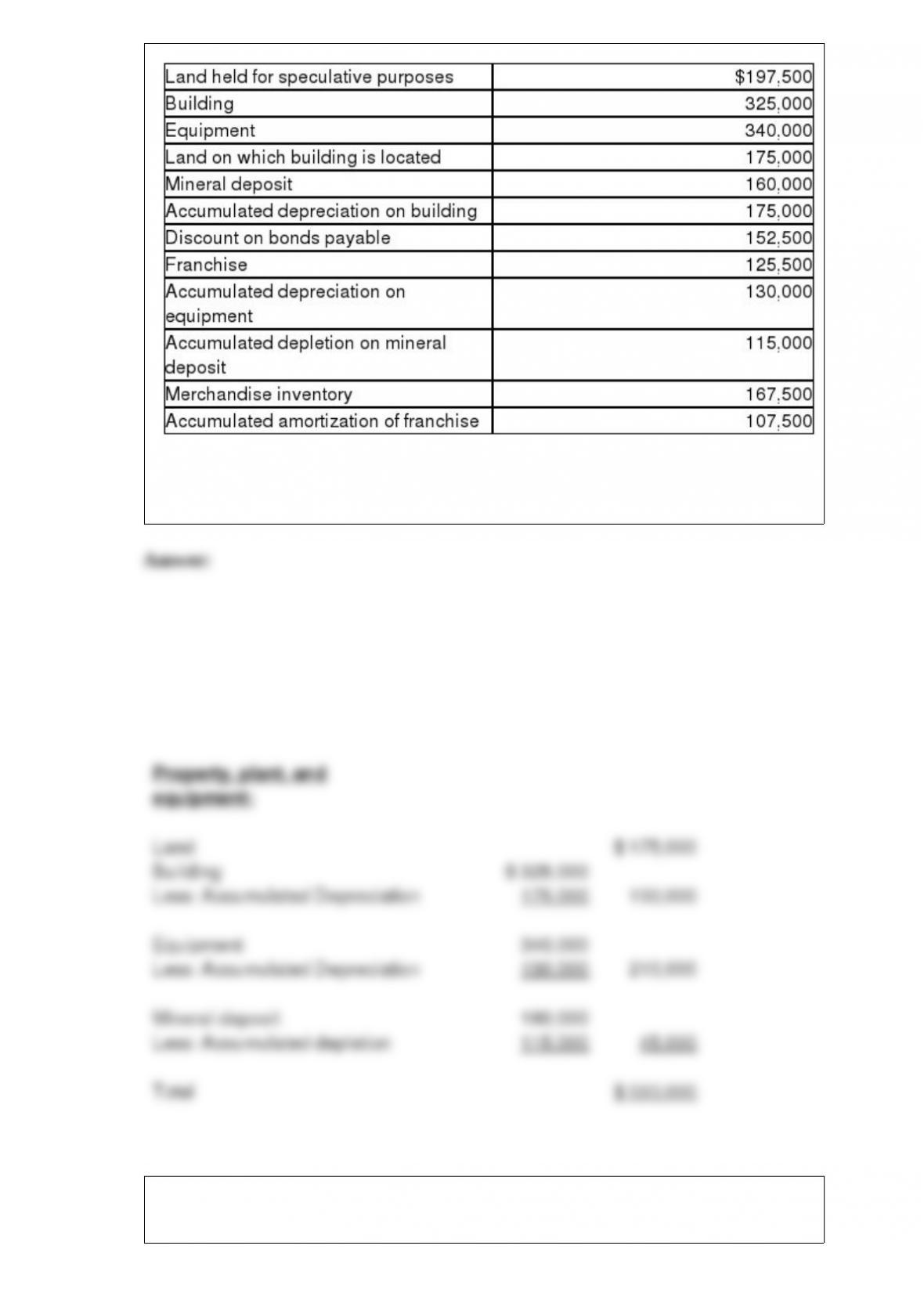
Required:
Prepare the property, plant, and equipment section of Sensei Companys balance sheet
on December 31, 2014.
29) Investments in debt securities currently are permitted to be classified as
held-to-maturity and accounted for at amortized cost if an enterprise has the positive
intent and ability to hold these securities to maturity. The held-to-maturity classification
is the most restrictive of the three classifications specified in accounting standards.
Despite the restrictiveness of the held-to-maturity classification, certain changes in
circumstances may occur that would necessitate transferring an investment in a debt
security from the held-to-maturity classification without calling into question the
investor’s general intention to hold other similarly classified investments to maturity.
What types of circumstances would cause an investor in debt securities classified as
held-to-maturity to change that classification without calling into question the intent of
the investor to hold other similarly classified investments to maturity?
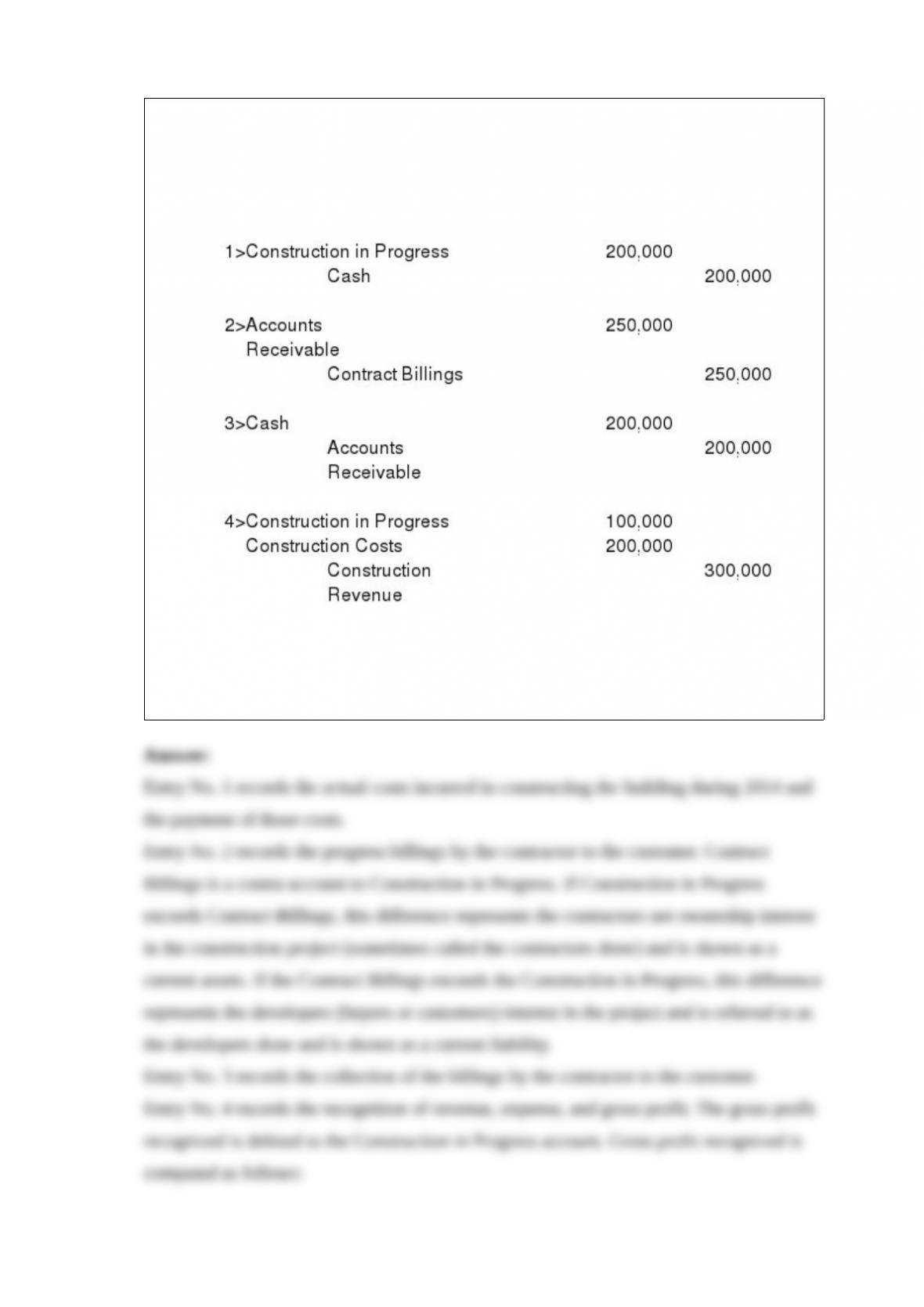
30) Soborne Construction, Inc., is constructing a building for another company.
Construction on the building began in 2014 and is expected to be complete in 2015. The
fixed contract price was $1,500,000. During 2014, the company made the following
entries:
Required:
Briefly explain the 2014 entries and why they occurred. Show the calculations and
include in your explanations the nature of and the reporting of the Contract Billings
account.
31) Earnings management can range from methods that suggest astute management to
outright fraud.
Required:
32) The equity method of accounting should be applied by an investor to an investment
in the voting stock of an investee of 20% or more of the voting stock of the investee. An
investment of 20% or more of the voting stock of an investee should lead to the
presumption (absent evidence to the contrary) that an investor has the ability to exercise
significant influence over an investor. The presumption in applying the equity method is
that an investor has significant influence over the operating and financial policies of an
investee even though the investor holds 50% or less of the voting stock of the investee.
Required:
Identify events or circumstances that suggest that an investor has significant influence
over an investee.
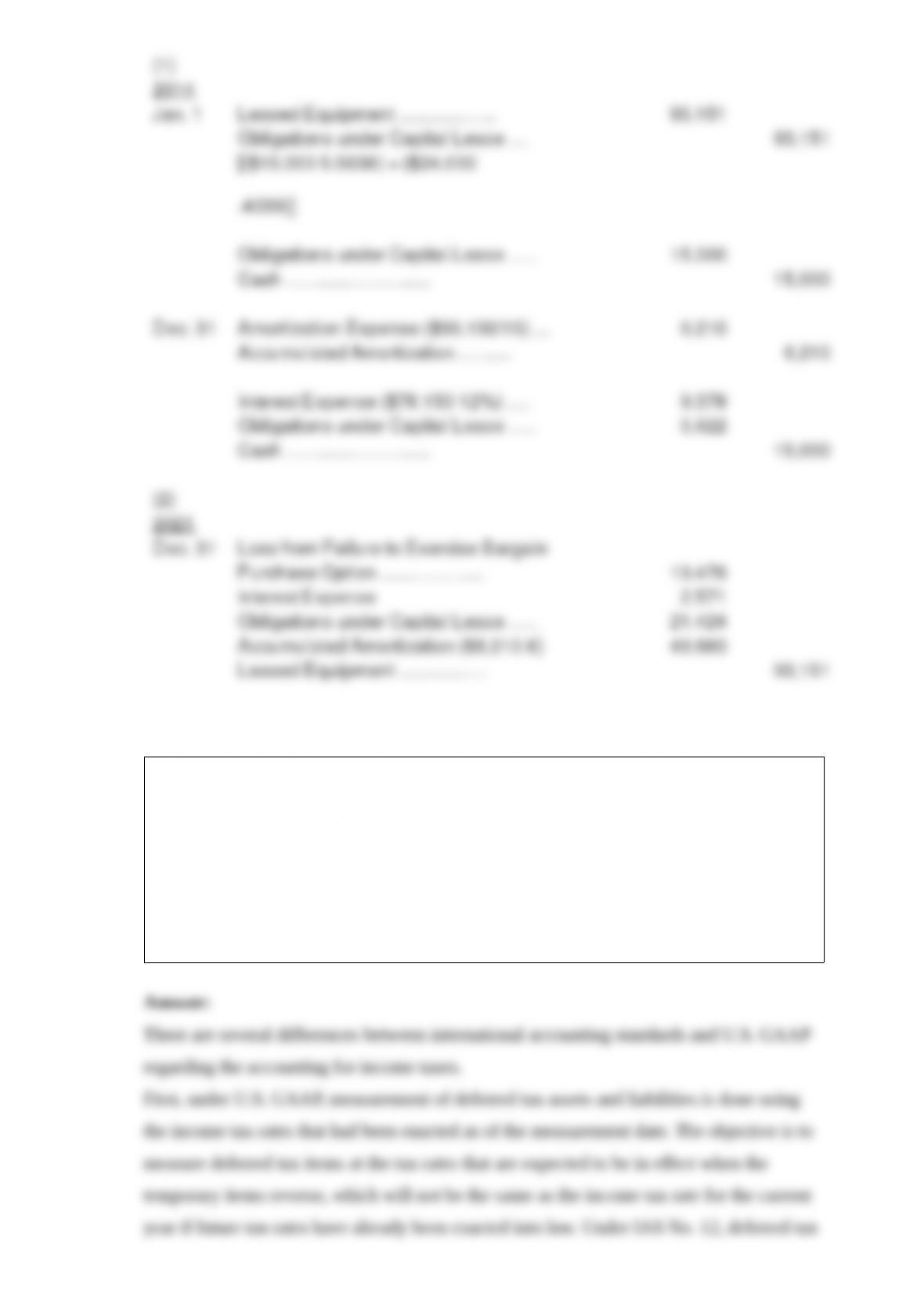
33) On January 1, 2014, Benjamin Industries leased equipment on an eight-year term at
$15,000 annual rental payments, paid in advance. There is a bargain purchase option on
December 31, 2021 (end of lease), of $24,000. The economic life of the equipment is
estimated to be 15 years. The interest rate is 12 percent.
34) IAS No. 12, Income Taxes, contains the provisions relating to accounting for
income taxes. The international standard is similar to U.S. GAAP in that it uses the
asset and liability approach for recording deferred income taxes. There are some
differences between IASB standards and U.S. GAAP relating to the asset-liability
approach, recognition, measurement, disclosure criteria, and implementation, however.
Required:
Identify and discuss the differences between U.S. GAAP and IAS No. 12 and other
international standards.
35) Accutron Company sponsors a defined-benefit pension plan. Portions of footnote 9
from the companys annual report appear below:
The company has qualified defined-benefit pension plans covering most full-time
employees. the status of the plans was follows (amounts in thousands of dollars):
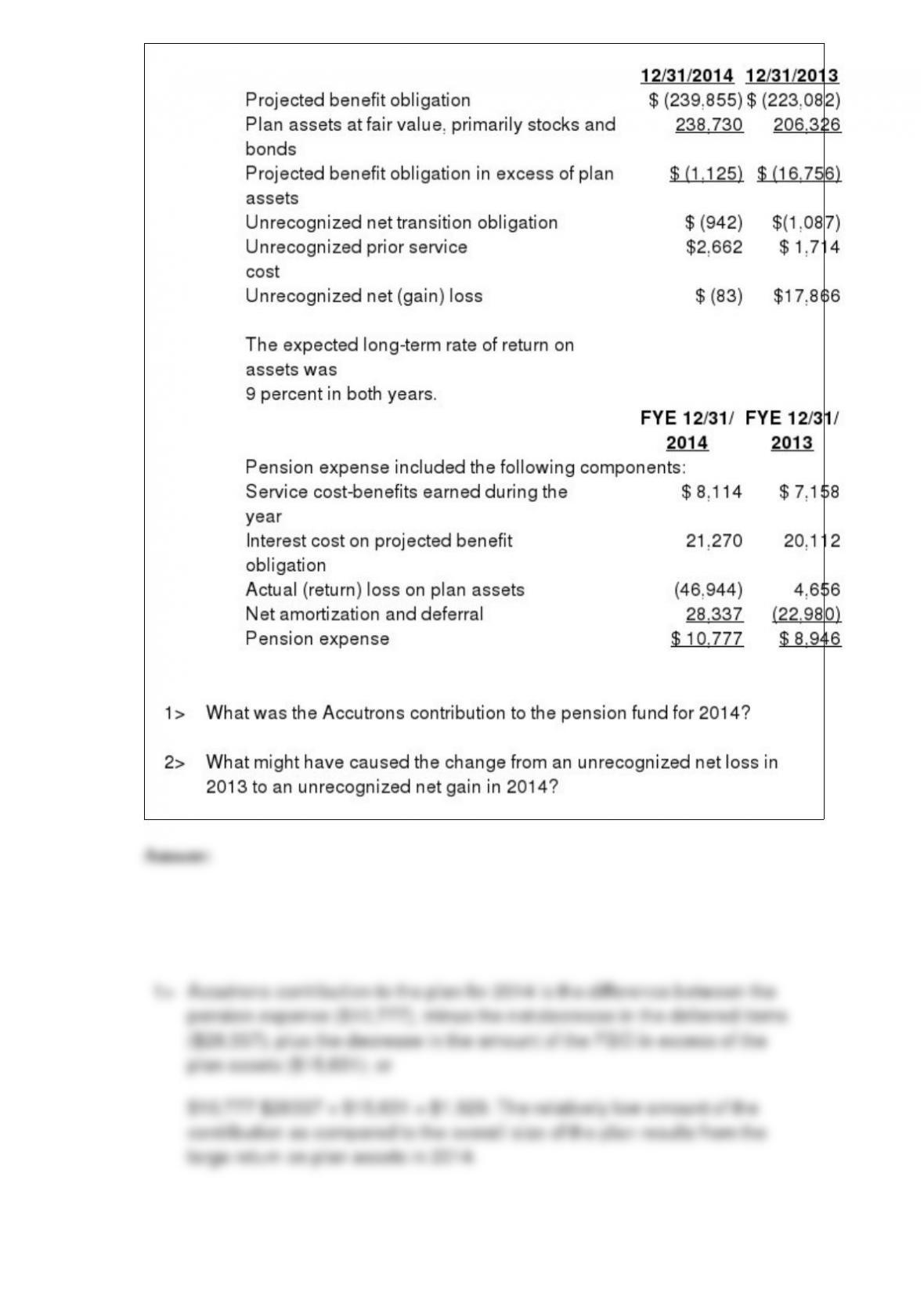
Required:
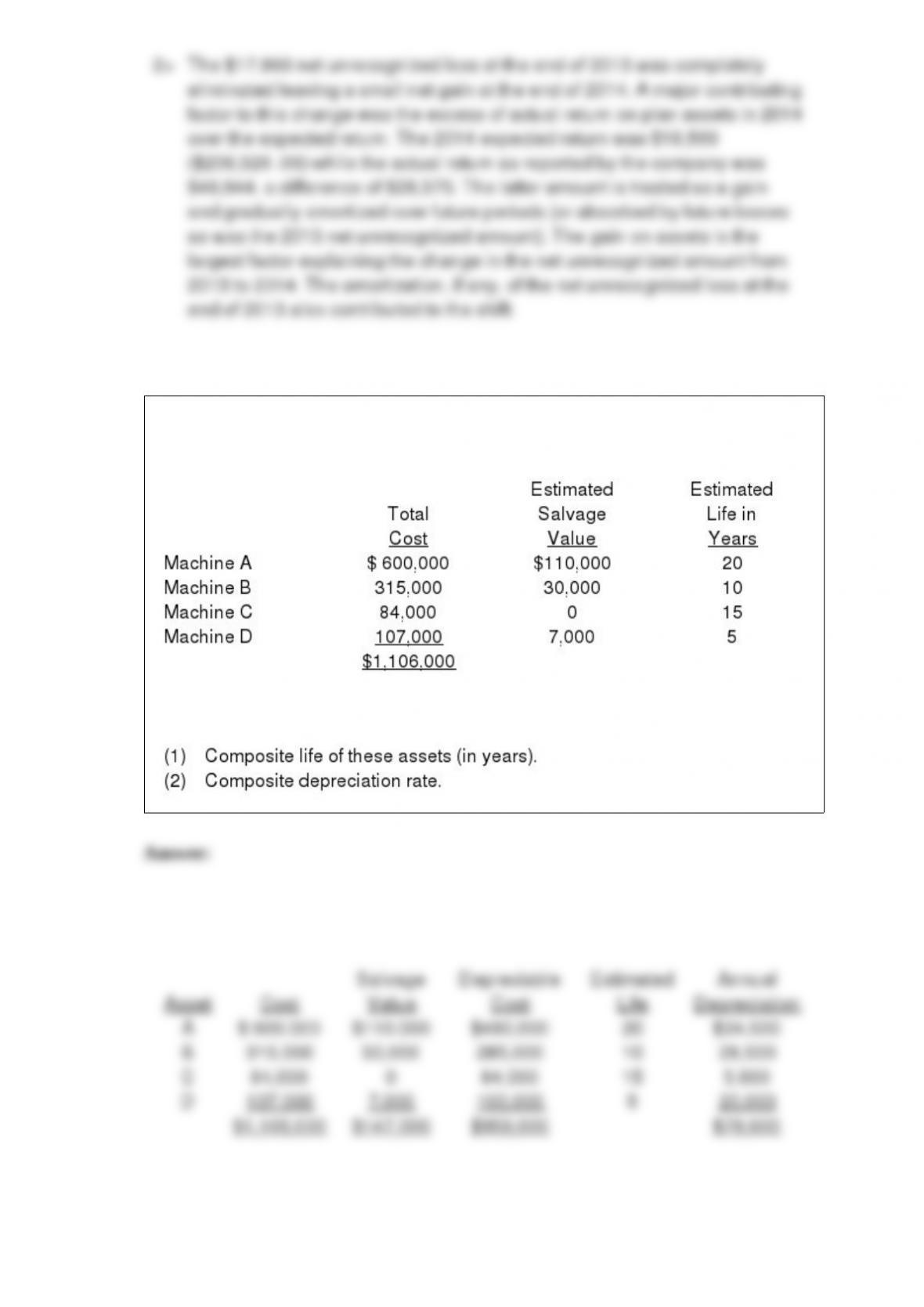
36) The following is a schedule of machinery owned by Stanton Manufacturing
Company.
Stanton computes depreciation on the straight-line basis. Based on the information
presented, compute the: