1) Which of the following statements concerning guaranteed residual values is
appropriate for the lessee?
a. The asset and related liability should be increased by the amount of the residual value
b. The asset and related liability should be decreased by the amount of the residual
value
c. The asset and related liability should be decreased by the present value of the residual
value
d. The asset and related liability should be increased by the present value of the residual
value
2) Chase Co. owned 30,000 common shares of Sanborn Corporation purchased in 2008
for $540,000. On September 20, 2014, Chase declared a property dividend of 1 share of
Sanborn for every 5 shares of Chase stock held by a stockholder. On that date, there
were 50,000 common shares of Chase outstanding, and the market value of Sanborn
shares was $30 per share. The entry to record the declaration of the property dividend
would include a debit to Retained Earnings of
a. $0
b. $300,000
c. $360,000
d. $540,000
3) Gain contingencies that are remote and can be reasonably estimated
a. must be disclosed in a note to the financial statements
b. may be disclosed in a note to the financial statements
c. must be reported in the body of the financial statements
d. should not be reported or disclosed
4) Hussong, Inc., appropriately uses the installment sales method of revenue
recognition. The company sold $1,500,000 on installment accounts during 2014. The
cost of items sold was $900,000. At December 31, 2014, Hussong reported a balance of
$100,000 in the Deferred Gross Profit account. How much cash did Hussong collect on
installment contracts during 2014?
a. $600,000
b. $500,000
c. $250,000

d. $1,250,000
5) Which of the following would be reported in the operating, investing, or financing
sections of the statement of cash flows prepared under the indirect method?
a. Declaration of an unpaid cash dividend
b. Acquisition of a factory warehouse by issuing long-term debt
c. Gain on the sale of cash equivalents
d. Write-off of an uncollectible account receivable
6) The following differences between financial and taxable income were reported by
Angostura Corporation for the current year:
(a) Excess of tax depreciation over book depreciation …. $60,000
(b) Interest revenue on municipal bonds ……………… 9,000
(c) Excess of estimated warranty expense over actual
expenditures ………………………………….. 54,000
(d) Unearned rent received …………………………. 12,000
(e) Fines paid ……………………………………. 30,000
(f) Excess of income reported under percentage-of-completion accounting for financial
reporting over completed-contract accounting used for tax reporting . 45,000
(g) Interest on indebtedness incurred to purchase tax-exempt
securities ……………………………… 3,000
(h) Unrealized losses on marketable securities recognized for financial
reporting ………………………… 18,000
Assume that Angostura Corporation had pretax accounting income [before considering
items (a) through (h)] of $900,000 for the current year. Compute the taxable income for
the current year.
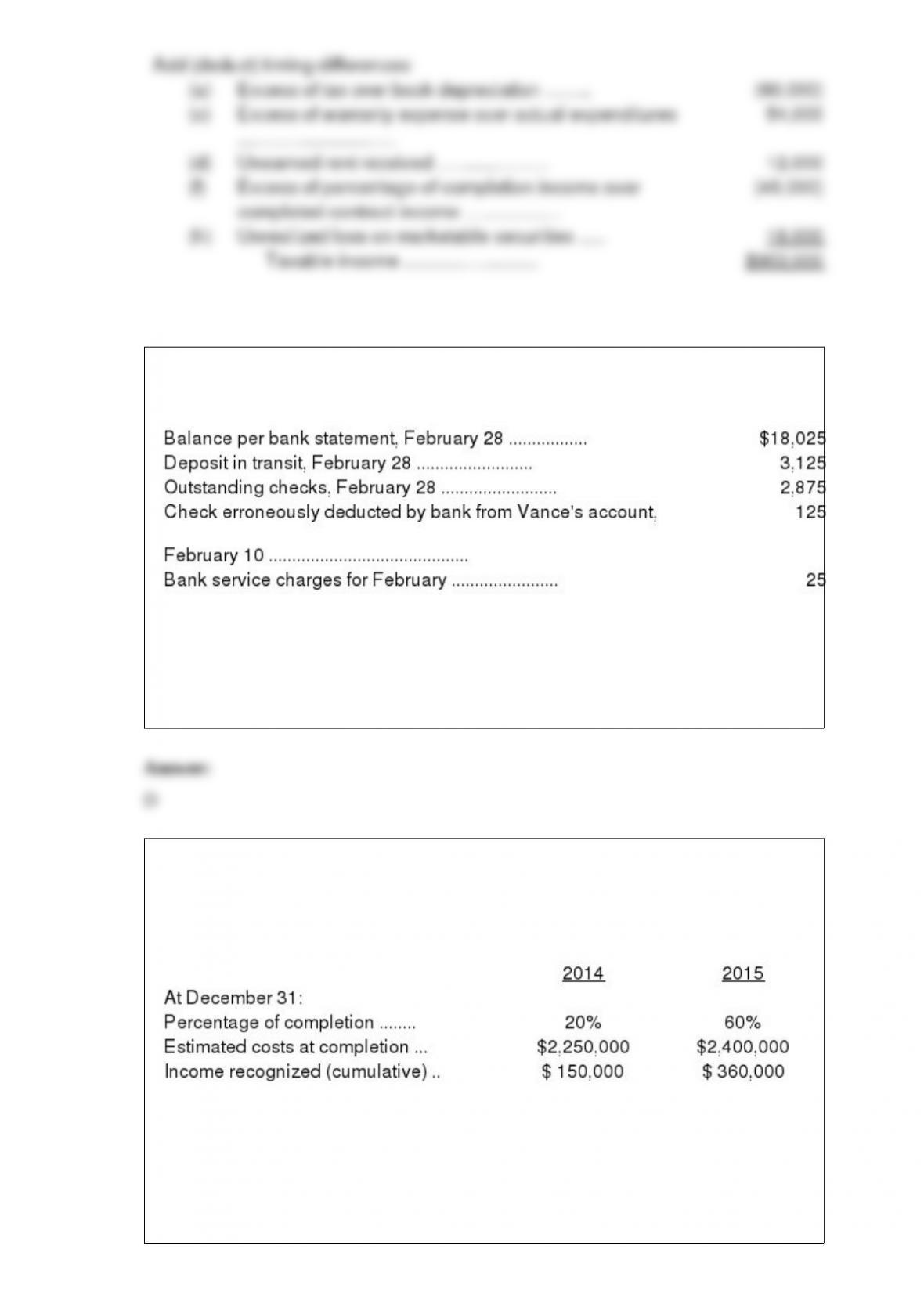
7) In preparing its bank reconciliation for the month of February, Vance Company has
available the following information:
What is the corrected cash balance at February 28?
a. $18,125
b. $18,150
c. $18,275
d. $18,400
8) On May 1, 2014, Lavender Construction Company entered into a fixed-price contract
to construct an apartment building for $3,000,000. Lavender appropriately accounts for
this contract under the percentage-of-completion method. Information relating to the
contract is as follows:
What is the amount of contract costs incurred during the year ended December 31,
2015?
a. $600,000
b. $960,000
c. $990,000
d. $1,440,000

9) Which of the following criteria must be met before an event should be recorded for
accounting purposes?
a. The event must be an arm’s-length transaction
b. The event must be repeatable in a future period
c. The event must be measurable in financial terms
d. The event must be disclosed in the reported footnotes
10) Which of the following situations would require interperiod income tax allocation
procedures?
a. A temporary difference exists because the tax basis of capital equipment is less than
its reported amount in the financial statements
b. Proceeds from an insurance policy on capital equipment lost in a fire exceed the book
value of the equipment
c. Last period’s ending inventory was understated causing both net income and income
tax expense to be understated
d. Nontaxable interest payments are received on municipal bonds
11) According to the FASB’s conceptual framework, comprehensive income includes
which of the following?
Gross Profit Operating Income
a. NoNo
b. NoYes
c. YesYes
d. YesNo
12) The following information was taken from Andson Company’s accounting records:

There was no work-in-process inventory at the beginning or end of the year. Andson’s
cost of goods sold is
a. $497,500
b. $487,500
c. $482,500
d. $475,000
13) Which of the following items of the earnings management continuum is in the
correct order?
a. Strategic matching, change in methods or estimates with full disclosure, non-GAAP
accounting
b. Change in methods or estimates with little or no disclosure, non-GAAP accounting,
fictitious transactions
c. Strategic matching, change in methods or estimates with little of no disclosure,
fictitious transactions
d. Change in methods or estimates with full disclosure, non-GAAP accounting,
fictitious transactions
14) On November 30, Monet Company consigned 90 freezers to Vangogh Company for
sale at $1,600 each and paid $1,200 in transportation costs. A report of sales was
received on December 30 from Vangogh reporting the sale of 20 freezers, together with
a remittance of the $27,200 balance due. The remittance was net of the agreed 15%
commission. How much, and in what month, should Monet recognize as consignment
sales revenue?
November December
a. $0 $32,000
b. $0 $27,200
c. $144,000 $0
d. $142,800 $0
15) If an investment in stock is reclassified from available-for-sale securities to trading
securities, the stock should be recorded on the date it is reclassified at the
a. market value at the date of acquisition
b. book value at the date of reclassification
c. market value at the date of reclassification
d. lower-of-cost-or-market value at the date of reclassification

16) Which of the following is true regarding the traditional approach to estimating the
fair value of an intangible asset?
a. The traditional approach requires the use of the risk-free rate of interest
b. The traditional approach requires the use of various possible outcomes and their
probability of occurrence
c. The traditional approach requires the use of judgment in determining a risk-adjusted
rate of interest
d. The traditional approach requires the assumption that cash flows occur at the
beginning of each period (an annuity due)
17) Excessive earnings management typically begins as a result of
a. a regulatory investigation
b. pressure to meet the expectations of stakeholders
c. a downturn in business
d. a violation of generally accepted accounting principles
18) At January 1, 2014, a company had a net valuation allowance account credit
balance for investments in securities available-for-sale of $20,000. At December 31,
2014, the total cost of the relevant portfolio was $300,000, and total market value was
$275,000. The entry required on December 31, 2014, would reflect a
a. $5,000 decrease in net income
b. $25,000 decrease in net income
c. credit of $5,000 to the valuation allowance account
d. debit of $25,000 to the unrealized loss account
19) At the beginning of the fiscal year, office supplies inventory amounted to $600.
During the year, office supplies amounting to $8,800 were purchased. This amount was
debited to office supplies expense. An inventory of office supplies at the end of the
fiscal year showed $400 of supplies remaining. The beginning of the year balance is
still reflected in the office supplies inventory account. What is the required amount of
the adjustment to the office supplies expense account?
a. $9,000 debit
b. $200 debit
c. $8,400 credit

d. $8,800 credit
20) Under international accounting standards, the pension-related asset or liability is
recognized on the balance sheet as the
a. net amount of the difference between the projected benefit obligation and plan assets
and the deferred items (prior service cost, deferred pension gain/loss)
b. difference between the projected benefit obligation and plan assets
c. difference between the accumulated benefit obligation and plan assets
d. difference between the vested benefit obligation and plan assets
21) On March 1, Suki Corporation entered into a firm commitment to purchase
specialized equipment from the Sashimi Trading Company for 80,000,000 on June 1.
The exchange rate on March 1 is 100 = $1. To reduce the exchange rate risk that could
increase the cost of the equipment in U.S. dollars, Suki pays $20,000 for a call option
contract. This contract gives Suki the option to purchase 80,000,000 at an exchange rate
of 100 = $1 on June 1. On June 1, the exchange rate is 105 = $1. How much did Suki
save by purchasing the call option (answers rounded to the nearest dollar)?
a. $20,000
b. $27,619
c. $47,619
d. Suki would have been better off not to have purchased the call option.
22) Total pension expense recognized over the life of a pension plan will be
a. the same as the amount of the cash funding (including interest earned)
b. more than the amount of the cash funding (including interest earned)
c. less than the amount of the cash funding (including interest earned)
d. the amount contributed over the life of the plan less the total actual return on plan
assets
23) Amengual Corporation began operations in 2011 and had operating losses of
$400,000 in 2012 and $300,000 in 2013. For the year ended December 31, 2014,
Amengual had a pretax financial income of $600,000. For 2012 and 2013, assume an
enacted tax rate of 30 percent, and for 2014 a 35 percent tax rate. There were no

temporary differences in any of the years. In Amengual’s 2014 income statement, how
much should be reported as income tax expense?
a. $0
b. $30,000
c. $180,000
d. $210,000
24) How would retained earnings be affected by the declaration of each of the
following?
Stock Dividend Stock Split
a. Decrease Decrease
b. No effect Decrease
c. Decrease No effect
d. No effect No effect
25) Earnings per share disclosures are required only for
a. companies with complex capital structures
b. companies that change their capital structures during the reporting period
c. public companies
d. private companies
26) Which of the following is true about international accounting standards?
a. Significant differences exist between U.S. GAAP and GAAP of other countries
b. Few differences exist between U.S. GAAP and GAAP of other countries
c. The IASB is the standards-setting body of France
d. It is unlikely that the differences between U.S. GAAP and GAAP of other countries
will diminish over time
27) When valuing raw materials inventory at lower of cost or market, what is the
general meaning of the term “market”?
a. Net realizable value
b. Net realizable value less a normal profit margin
c. Current replacement cost

d. Discounted present value
28) In 2014, a company changed from the FIFO method of accounting for inventory to
LIFO. The companys 2013 and 2014 comparative financial statements will reflect
which method or methods?
2013 2014
a. LIFO LIFO
b. LIFO FIFO
c. FIFO FIFO
d. LIFO either LIFO or FIFO
29) Basilia Corporation purchased a machine for $180,000 on January 1, 2013. Basilia
will depreciate the machine using the straight-line method using a five-year period with
no residual value. As a result of an error in its purchasing records, Basilia did not
recognize any depreciation for the machine in its 2013 financial statements. Basilia
discovered the problem during the preparation of its 2014 financial statements. What
amount should Basilia record for depreciation expense on this machine for 2014?
a. $0
b. $36,000
c. $44,000
d. $72,000
30) When a portion of stockholders’ original investment is returned in the form of a
dividend, it is called a
a. compensating dividend
b. liquidating dividend
c. property dividend
d. equity dividend
31) Five percent bonds with a total face value of $12,000 were purchased at par during
the year. The last interest payment for the year was received on July 31. The bonds pay
interest semiannually. The adjusting entry at December 31 would include a
a. debit to interest revenue of $600

b. debit to interest revenue of $250
c. credit to interest revenue of $300
d. credit to interest revenue of $250
32) On July 31, 2013, Rangers Corporation purchased 500,000 shares of Tigers
Corporation. On December 31, 2014, Rangers distributed 250,000 shares of Tigers
stock as a dividend to Rangers’ stockholders. This is an example of a
a. liquidating dividend
b. investment dividend
c. property dividend
d. stock dividend
33) Which of the following need not be disclosed in a statement of cash flows as a
noncash exchange?
a. Dividend paid in capital stock of the company (stock dividend)
b. Acquisition of fixed assets in exchange for capital stock
c. Retirement of a bond issue through the issuance of another bond issue
d. Conversion of convertible debt to capital stock
34) At the beginning of the year, a firm leased equipment on a capital lease, capitalizing
$60,000 in its lease receivable account. The contract calls for December 31 payments of
$15,000. The lessors annual reporting period ends December 31 and the contract
reflects 10% interest. The lessee made the first payment as required. The direct method
statement of cash flows for the lessor should reflect which of the following in the first
year of the lease contract (ignore noncash disclosures)?
a. $15,000 operating cash flow
b. $6,000 operating cash flow; $9,000 investing cash flow
c. $6,000 operating cash flow; $9,000 addition reconciling adjustment
d. $9,000 investing cash flow
35) Yakuzi Bakeries specializes in making cakes, cookies, and other pastries out of rice
flour which they grind themselves. Yakuzi anticipates purchasing 40,000 pounds of rice
in January 2015. On November 1, 2014, Yakuzi entered into a futures contract with
Rising Sun Growers to purchase 40,000 pounds of rice on January 1, 2015, at $0.50 per
pound. On December 31, 2014, and January 1, 2015, the prevailing market price for
rice is $0.55 per pound. Yakuzi purchases the rice and settles the futures contract on
January 1, 2015.
Make the necessary entries on Yakuzi’s books at
(a) November 1, 2014
(b) December 31, 2014
(c) January 1, 2015
36) The GAAP Oval best represents the
a. fact that only one true earnings number exists
b. flexibility managers have within GAAP to report one earnings number from among
many possibilities
c. philosophy that earnings management within limits is ethical
d. fact that GAAP is not subject to interpretation

37) Which of the following is true regarding the provisions of International Accounting
Standard No. 39, Financial Instruments: Recognition and Measurement (amended
2005)?
a. IAS No. 39 applies only to financial assets
b. IAS No. 39 applies only to financial liabilities
c. IAS No. 39 applies only to accounting for derivatives and loans and receivables
d. IAS No. 39 applies to both financial assets and financial liabilities
38) Which of the following is correct?
a. The fair value of internally generated intangible assets should be estimated and
recorded on the books of the entity that developed the assets even in the absence of a
business acquisition
b. The fair value of internally generated intangible assets may be estimated but should
not be recorded on the books or displayed on the financial statements of the entity
c. Managers may value their own companies and recognize goodwill in the company
accounts even though an entity has not been acquired in a business acquisition
d. Goodwill should be recognized in the accounts whenever the value of the firm
increases based on current market prices of the firm’s common stock
39) On January 1, 2011, Mardi Gras Shipping bought a machine for $1,500,000. At that
time, this machine had an estimated useful life of six years, with no salvage value. As a
result of additional information, Mardi Gras determined on January 1, 2014, that the
machine had an estimated useful life of eight years from the date it was acquired, with
no salvage value. Accordingly, the appropriate accounting change was made in 2014.
How much depreciation expense for this machine should Mardi Gras record for the year
ended December 31, 2014, assuming Mardi Gras uses the straight-line method of
depreciation?
a. $125,000
b. $150,000
c. $187,500
d. $250,000
40) The equity method of accounting for an investment in the common stock of another
company should be used when the investment
a. is composed of common stock and it is the investor’s intent to vote the common stock
b. ensures a source of supply such as raw materials
c. enables the investor to exercise significant influence over the investee
d. gives the investor voting control over the investee
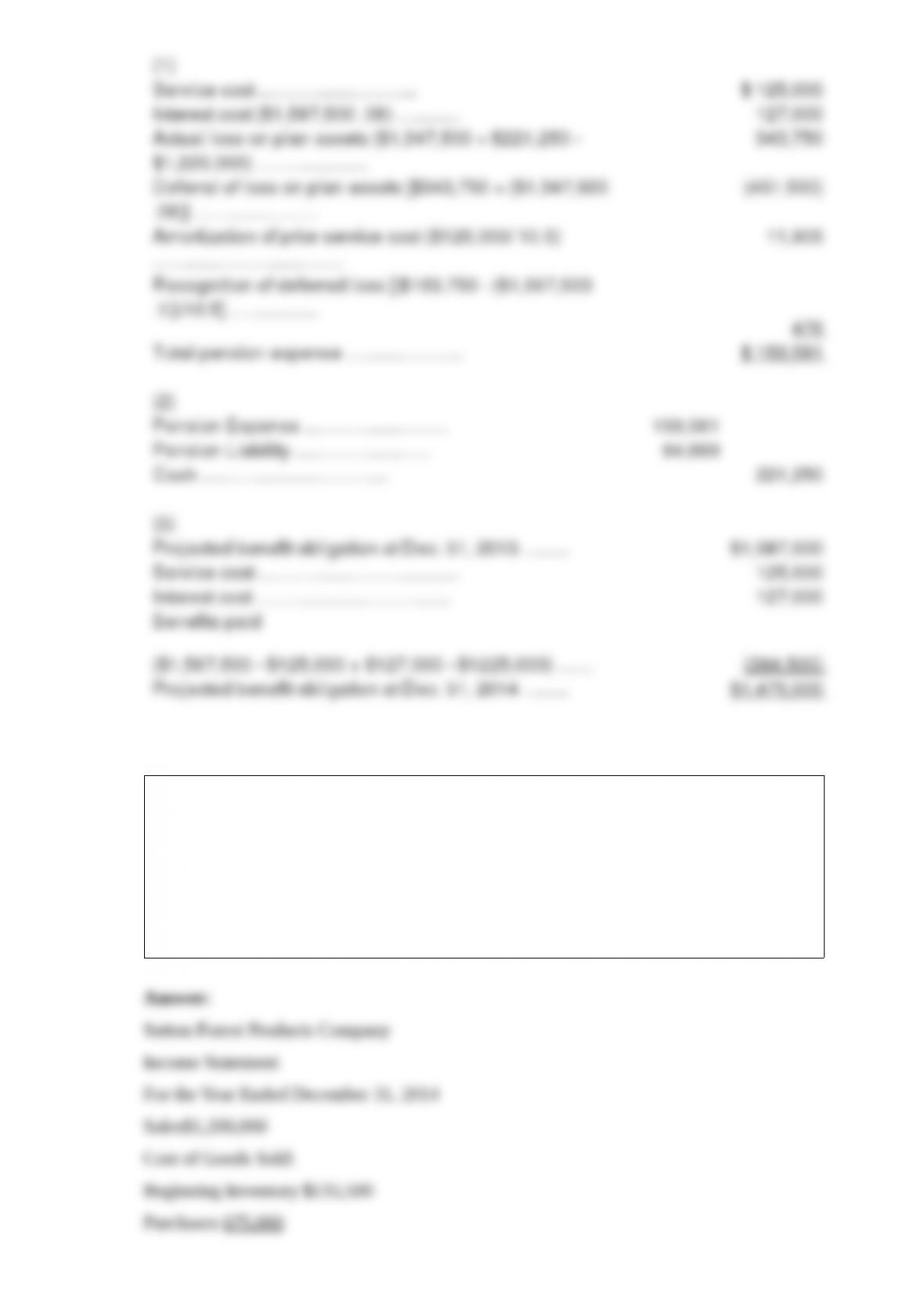
41) Feinberg, Inc., provides a noncontributory defined benefit plan for its 200
employees. Information from the company’s pension footnote for the year ended
December 31, 2013, and partial information for the year ended December 31, 2014, are
given below:
The company’s actuary indicated that the settlement rate and expected rate of return on
plan assets were both 8% for 2013 and 2014. The company contributed $221,250 to the
plan at the end of 2014. Service cost for 2014 was $125,000.
On January 1, 2013, the company amended its plan to grant retroactive credit for prior
service rendered by employees prior to the amendment. This amendment increased
unrecognized prior service cost by $125,000 at that date. The prior service cost is being
amortized over the average remaining service life of the employees affected by the
amendment. The average remaining service life of the workforce in each year has been
constant at 10.5 years.
42) The Sutton Forest Products Company had sales during 2014 of $1,200,000. Sutton
operates at a gross profit of 50%. Purchases of inventory during 2014 totaled $675,000
and ending inventory totaled $210,500. Selling expenses were 20% of sales and general
and administrative expenses were 75% of the selling expenses. Suttons tax rate is 40%
and the company has 50,000 shares of common stock outstanding.
Prepare an income statement for Sutton Forest Products, including earnings per share
data, for the year ended December 31, 2014
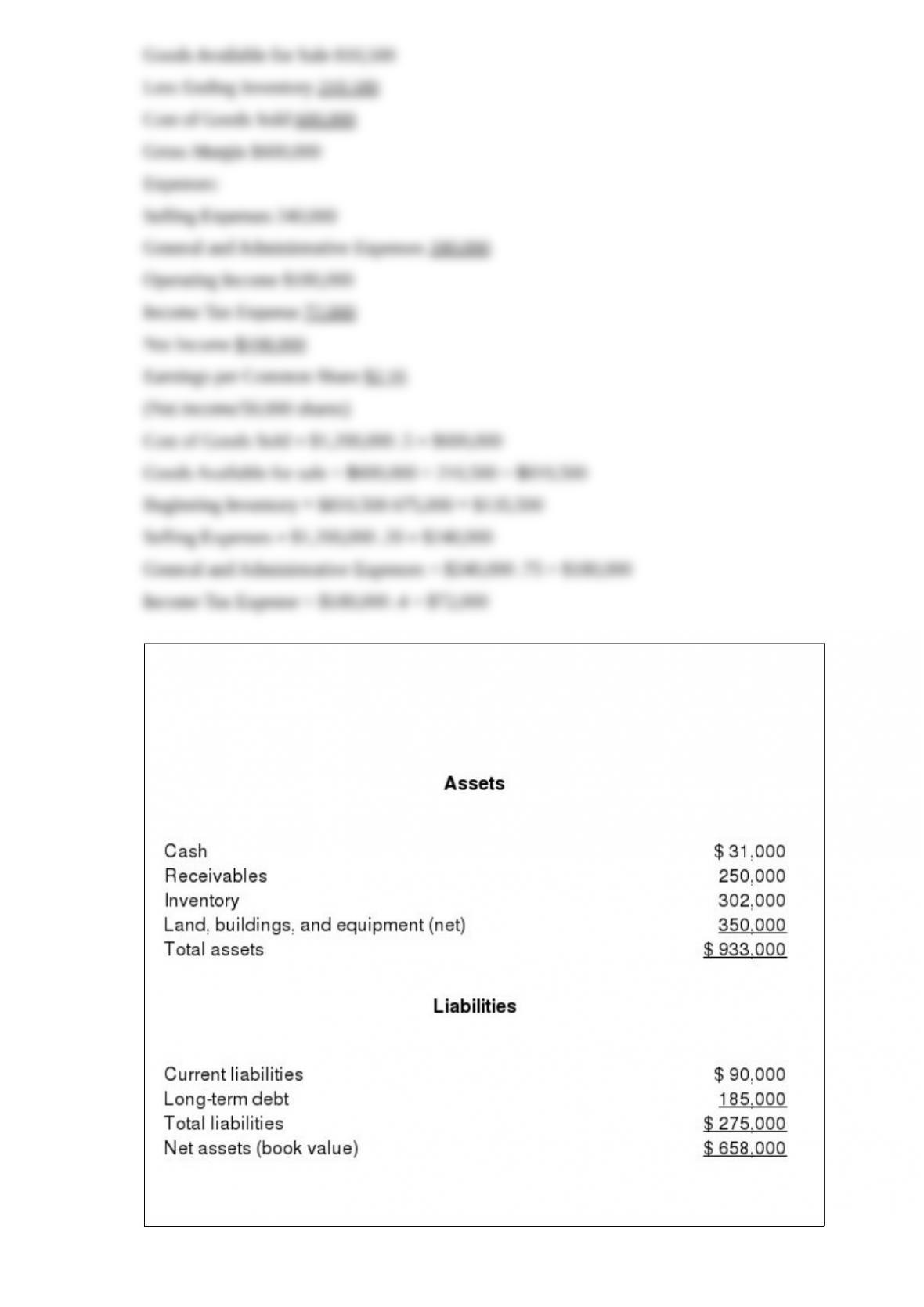
43) Grabber Industries purchased the net assets of Easy Company for $1,300,000,
comprised of $1,200,000 of cash and a contingent performance condition of $100,000.
A schedule of the net assets of Easy Company, as recorded on Easy Company’s books at
the time of the acquisition, is as follows:
The following schedule shows the differences between the recorded costs and market
values of the assets of Easy Company at the date of the acquisition:
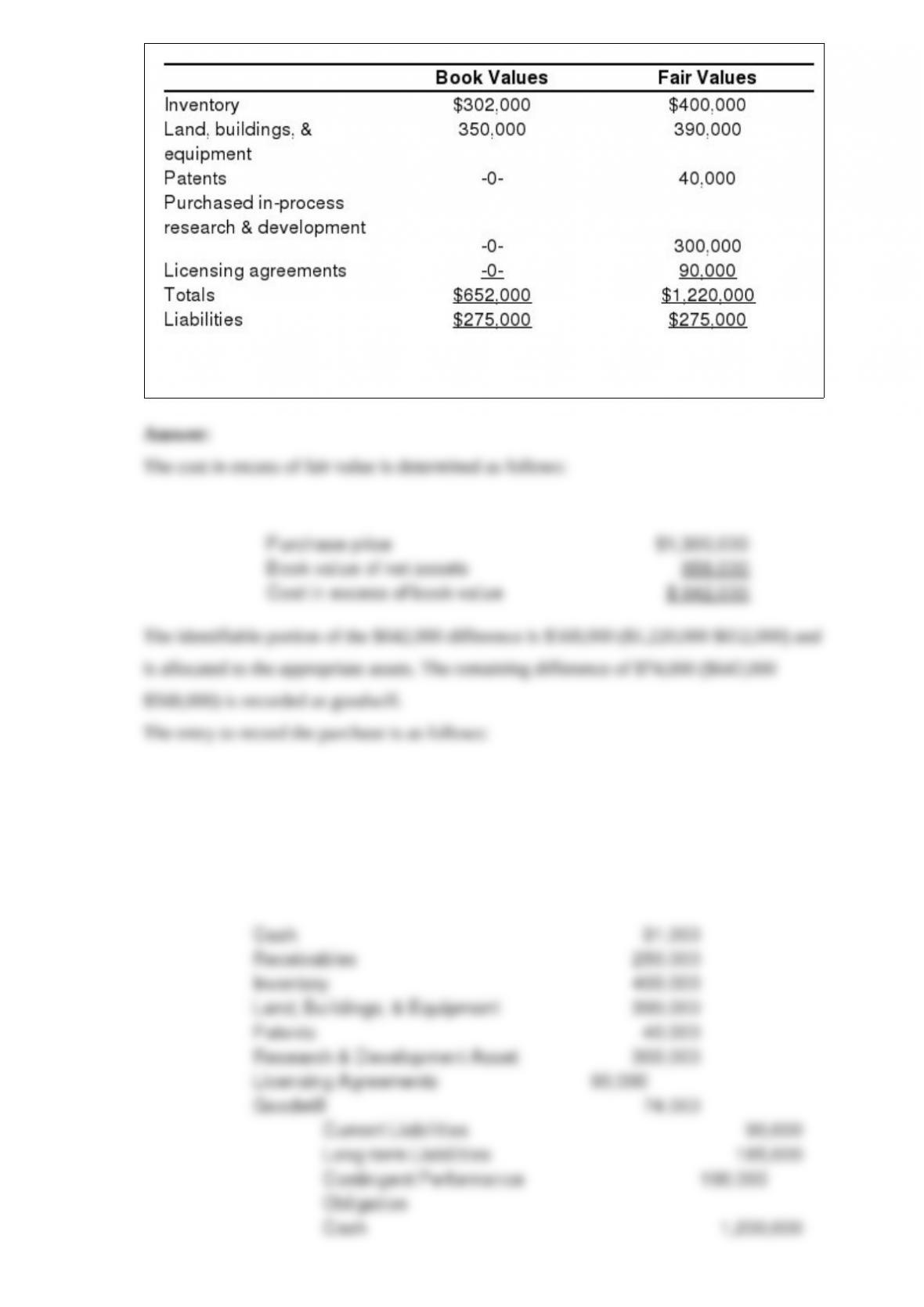
Prepare the journal entry to record this acquisition using the acquisition method
prescribed by SFAS 141R,, Business Combinations.
44) The accounting profession has wrestled for many years with the issue of interperiod
allocation of income tax. Since 1967, the authoritative position of the profession has
been that interperiod tax allocation is appropriate. Some in the profession have not
agreed with the authoritative position. Some respondents to the Discussion
Memorandum for SFAS No. 109 advocated that income tax expense for financial
reporting should be the amount of taxes payable for the year as determined by the tax
return.
Required:
Assume that you advocate the use of the amount of taxes payable for the year as
determined on the tax return as the income tax expense for financial reporting purposes.
Provide arguments to support your position.
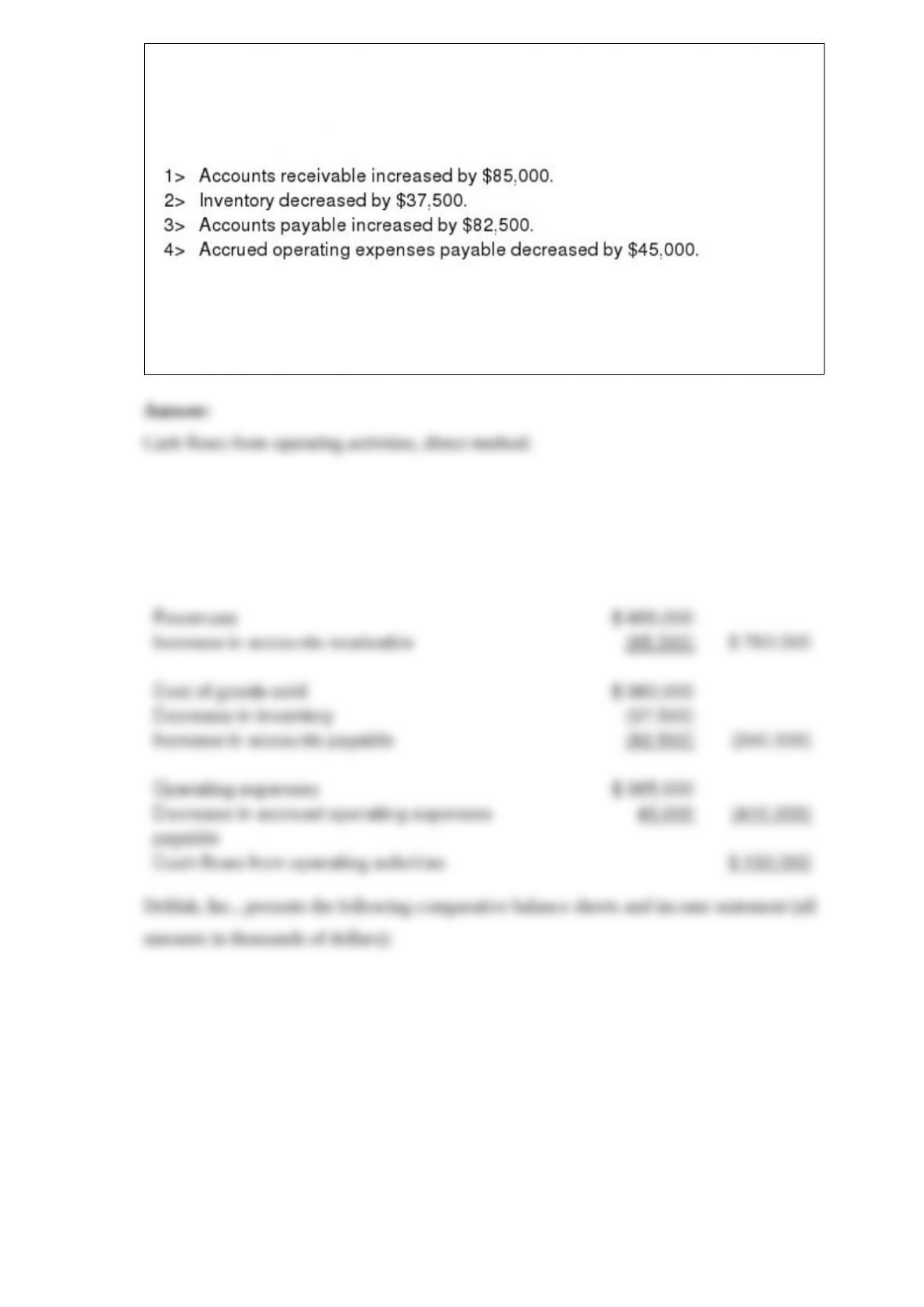
45) Net income for the Hot Springs Company for the most recent year was $150,000,
consisting of $865,000 of revenues, $360,000 of cost of goods sold, and $365,000 of
operating expenses. The following changes in current assets and current liabilities have
been identified:
Required:
Calculate the cash flows from operating activities for the year, applying the direct
method. Identify the individual amounts that would be disclosed in the statement of
cash flows where possible.