A company loaned $1,000,000 with interest at 7% to another company. The interest
revenue from this loan would be reported on the statement of cash flows as a:
A) cash inflow from operating activities.
B) cash inflow from investing activities.
C) cash inflow from financing activities.
D) noncash investing and/or financing activity.
Contributed capital totals $30,000, Retained Earnings equals $65,000, Treasury Stock
equals $18,000, and Common Stock equals $10,000. If the company does not have any
accumulated other comprehensive income (loss), stockholders’ equity, what is the total
amount of stockholders’ equity?
A) $113,000
B) $77,000
C) $123,000
D) $87,000
A company had been selling its product for $20 per unit, but recently lowered the
selling price to $15 per unit. The company ‘s current inventory consists of 200 units
purchased at $16 per unit. The market value of this inventory is currently $13 per unit.
At what amount should the company ‘s inventory be reported on the balance sheet?
A) $2,600
B) $3,200
C) $3,000
D) $4,000
Public corporations are businesses:
A) owned by two or more people, each of whom is personally liable for the debts of the
business.
B) whose stock is bought and sold on a stock exchange.
C) whose stock is bought and sold privately.
D) where stock is not used as evidence of ownership.
A company issued 8% preferred stock with a $100 par value. This means:
A) Preferred stockholders are entitled to 8% of the annual net income.
B) Only 8% of total contributed capital can be preferred stock.
C) Preferred stockholders are guaranteed a dividend.
D) The potential dividend to preferred stockholders is $8 per share per year.
Which of the following statements concerning a voucher is not correct?
A) The voucher consists of the purchase requisition, the purchase order, the receiving
report, and the invoice.
B) The voucher is marked “paid” so that it cannot be accidentally or intentionally
resubmitted for duplicate payment
C) The voucher must be prepared before the goods or services are ordered.
D) After the voucher is prepared, the company processes a check or electronic funds
transfer to pay for the items purchased and received.
Transactions include which two types of events?
A) Direct events, indirect events
B) Monetary events, production events
C) External exchanges, internal events
D) Past events, future events
Fronthouse Corp. issues 10,000 shares of no-par value preferred stock for cash at $60
per share. The journal entry to record the transaction will consist of a debit to Cash for
$600,000 and a credit (or credits) to:
A) Preferred Stock for $600,000.
B) Preferred Stock for $20,000 and Additional Paid-in Capital for $580,000.
C) Preferred Stock for $20,000 and Retained Earnings for $580,000.
D) Retained Earnings for $600,000.
If an analyst wants to examine a company’s short-run ability to survive, which of the
following would best be considered?
A) Liquidity
B) Market share
C) Profitability
D) Solvency
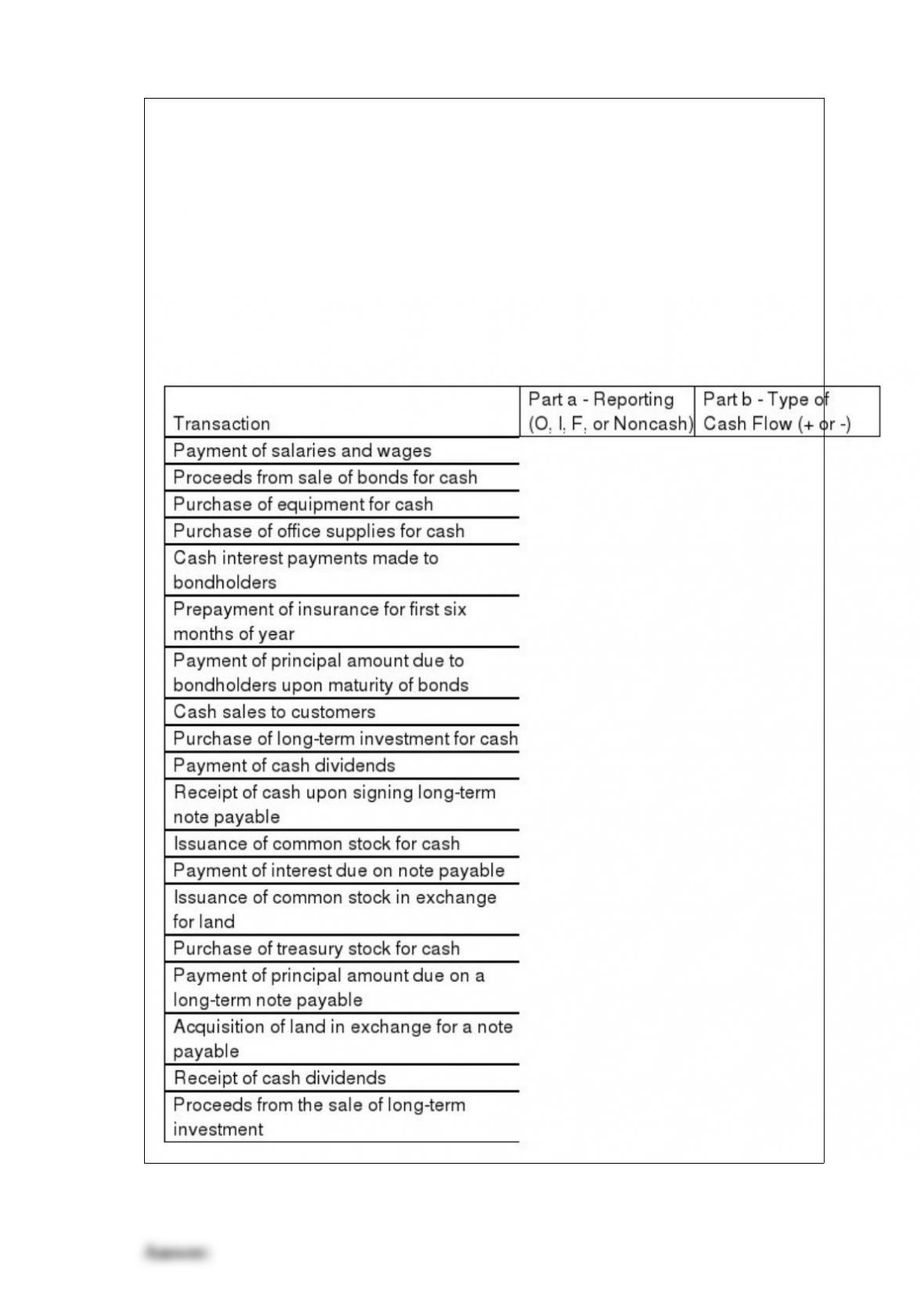
Complete the last two columns in the following table by indicating whether each
transaction would be reported:
Part a. In the operating (O), investing (I), or financing (F) activities section of the
statement of cash flows or if the transaction would be reported instead as a noncash
investing and/or financing transaction (Noncash).
Part b. As a cash inflow (+) or a cash outflow (-) on the statement of ash flows. (Leave
this cell blank if you entered “Noncash” for part a.)
The statement of cash flows cannot be used to determine:
A) changes in working capital.
B) expenditures on long-term assets.
C) profitability as measured by specific revenues and expenses.
D) reliance on external financing.
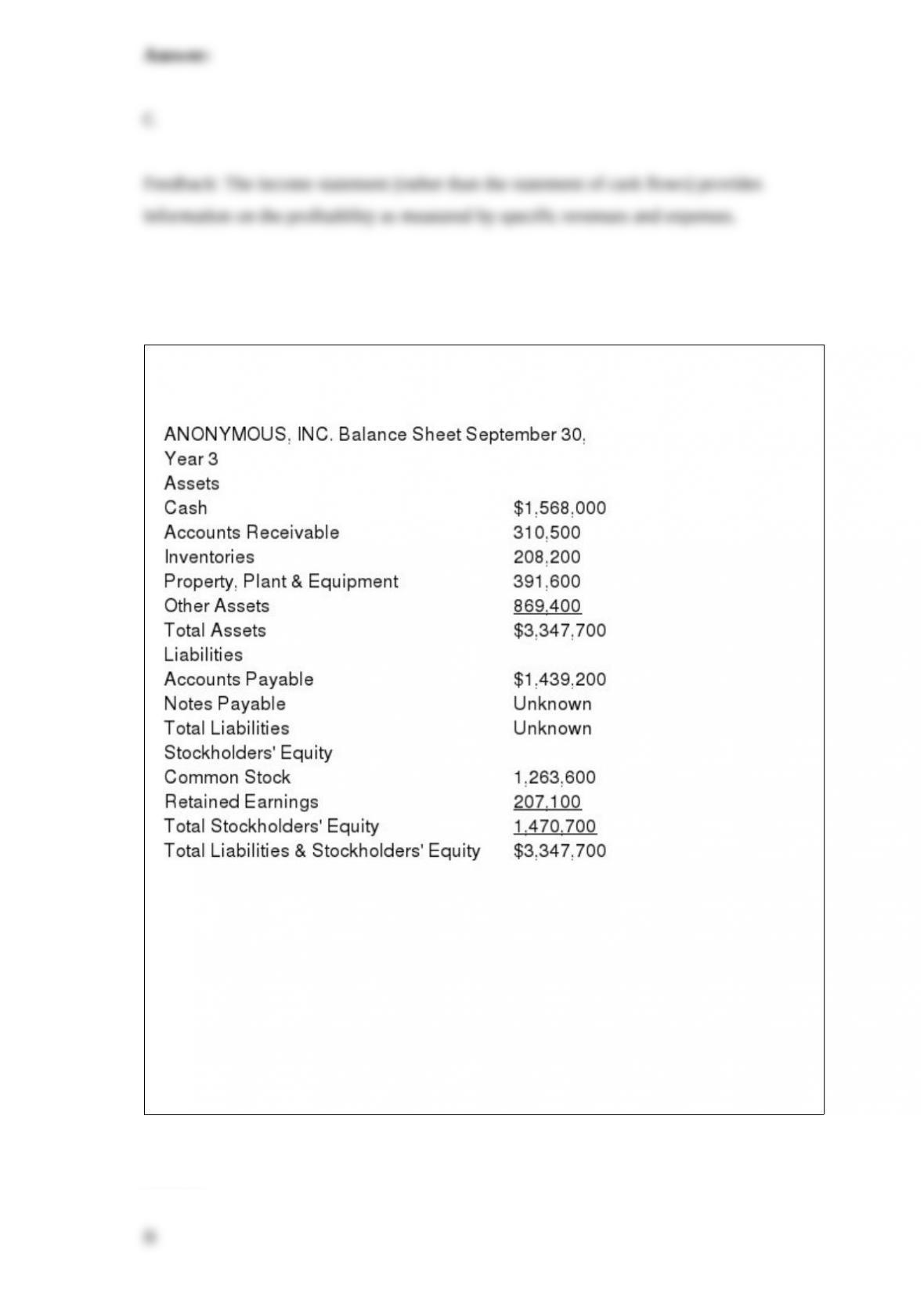
Use the information above to answer the following question. As of September 30, Year
3, who provided more financing for Anonymous, Inc.?
A) Owners
B) Creditors
C) Both provided equal financing
D) Neither provided any financing
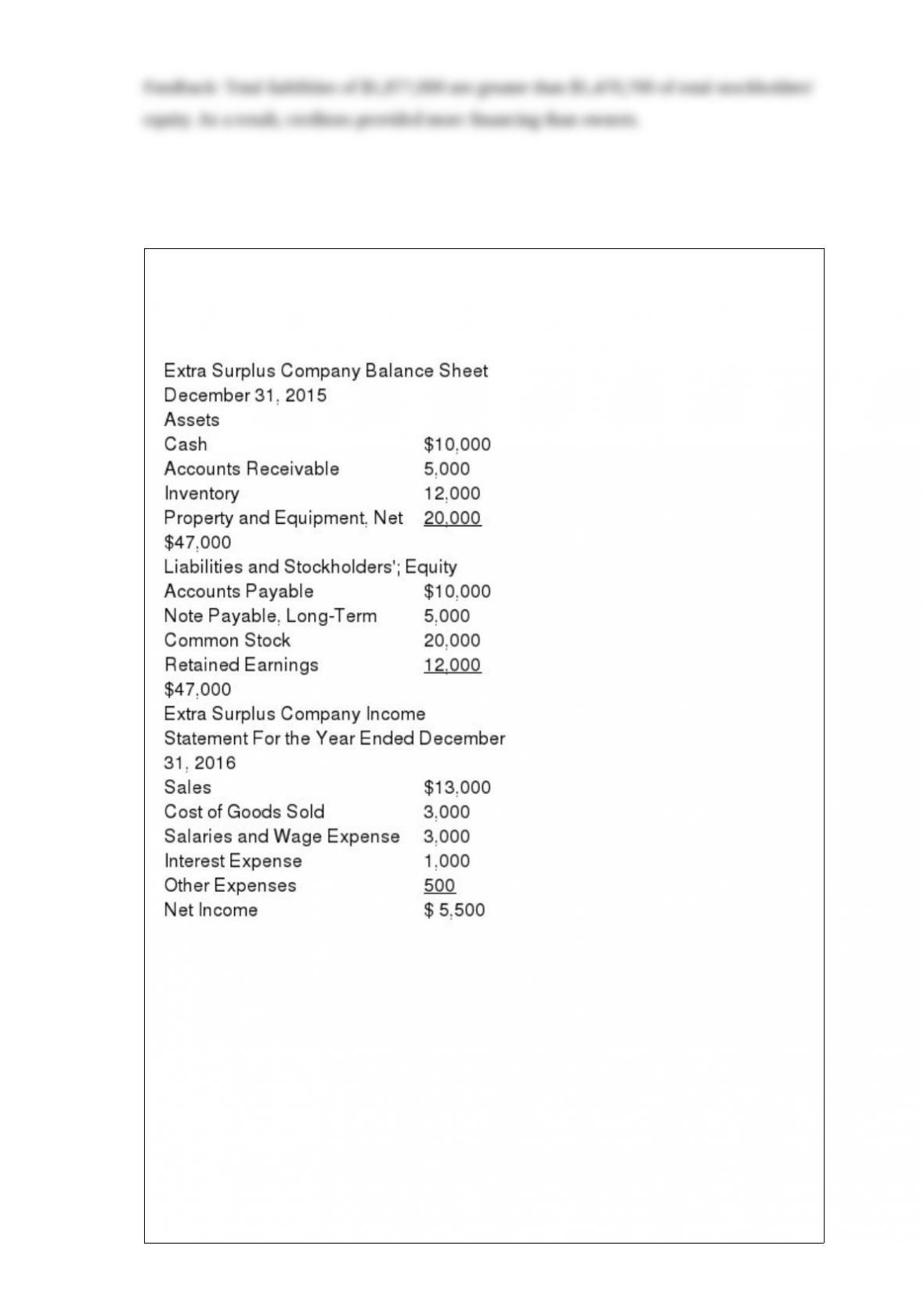
The Extra Surplus Company’s Balance Sheet for December 31, 2015 and the Income
Statement for 2016 are shown below.
Additional data:
Sales were $13,000; $8,000 in cash was received from customers.
Bought new land for cash, $10,000.
Sold other land for its book value of $5,000.
Paid $1,000 principal on the long-term note payable and $1,000 in interest.
Issued new shares of stock for $10,000 cash.
Cash dividends of $1,000 were declared and paid to stockholders.
Paid $5,500 on accounts payable.
No inventory purchases were made; other expenses were incurred on account.
All wages were paid in cash.
Other expenses were on account.
Required:
Part a. Prepare a balance sheet at December 31, 2016.
Part b. Prepare the statement of cash flows using the direct method.
On October 31, 2015, your company’s records say that the company has $16,451.03 in
its checking account. A review of the bank statement shows you have three outstanding
checks totaling $5,643.01, and the bank has paid you interest of $12.19 and charged you
$9.00 in service charges. The bank statement dated October 31, 2015 would report a
balance of:
A) $22,090.85.
B) $16,454.22.
C) $22,097.23.
D) $10,804.83.