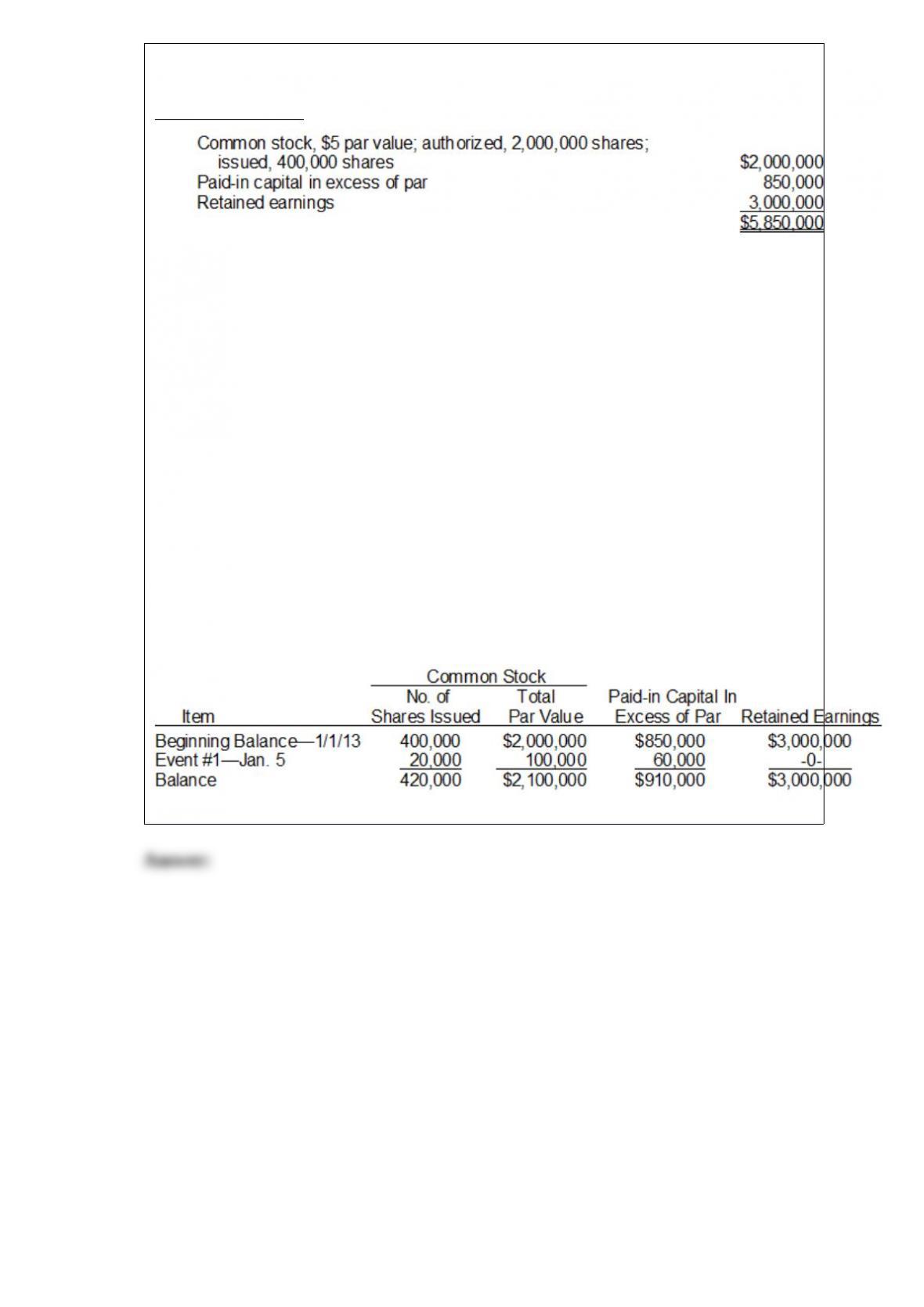
1) the stockholders’ equity section of benton corporation’s balance sheet as of december
31, 2012 is as follows:
stockholders’ equity
the following events occurred during 2013:
1>jan. 520,000 shares of authorized and unissued common stock were sold for $8 per
share.
2>jan. 16declared a cash dividend of 20 cents per share, payable february 15 to
stock-holders of record on february 5.
3>feb. 1030,000 shares of authorized and unissued common stock were sold for $12 per
share.
4>march 1a 30% stock dividend was declared and issued. fair value per share is
currently $15.
5>april 1a two-for-one split was carried out. the par value of the stock was to be
reduced to $2.50 per share. fair value on march 31 was $18 per share.
6>july 1a 15% stock dividend was declared and issued. fair value is currently $10 per
share.
7>aug. 1a cash dividend of 20 cents per share was declared, payable september 1 to
stockholders of record on august 21.
instructions
enter the above events into the following work sheet showing how each event affects
the column. event no. 1 will serve as an example.
event # 2jan. 16 (and events 3 through 7)
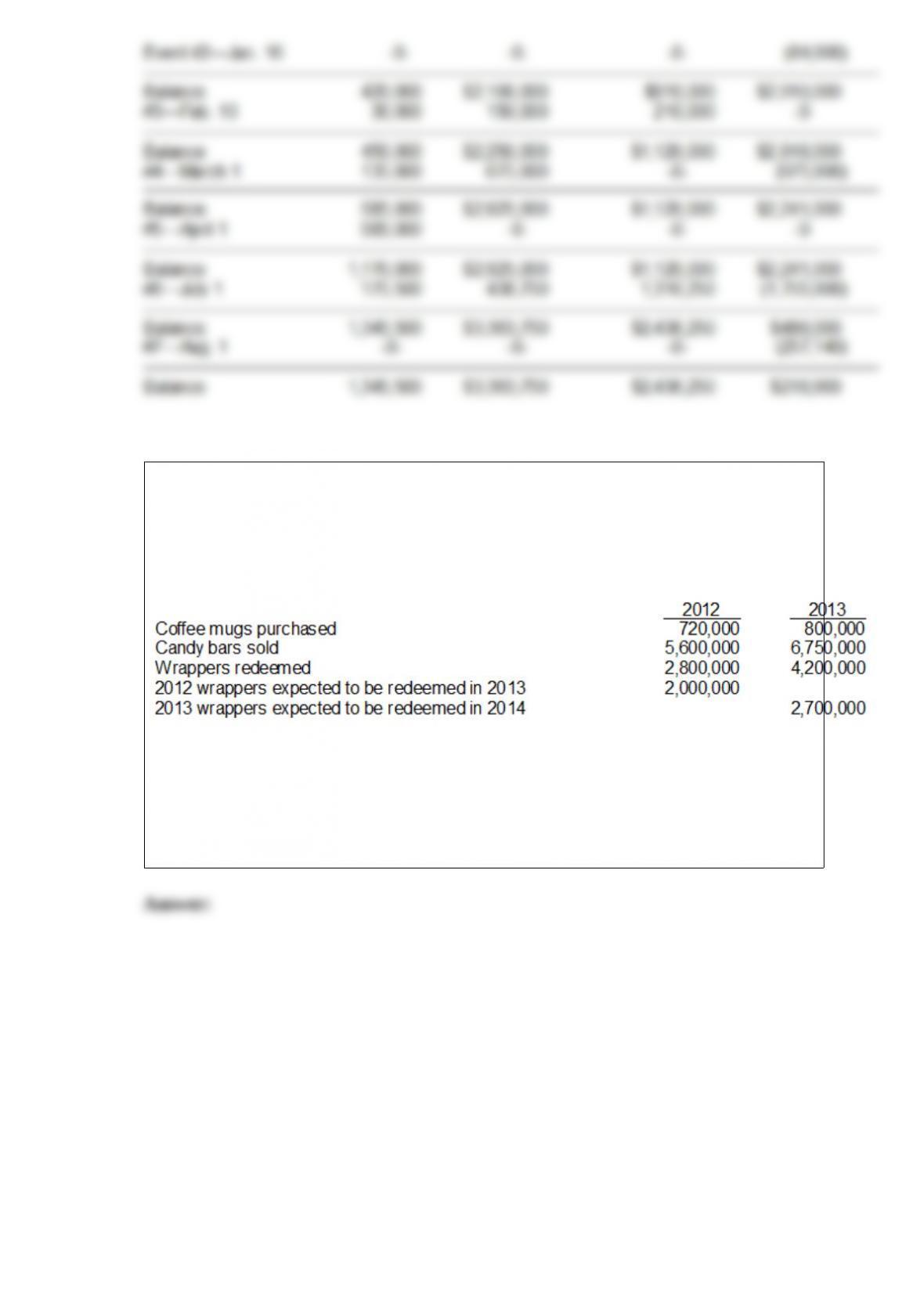
2) paige candy company offers a coffee mug as a premium for every ten $1 candy bar
wrappers presented by customers together with $2. the purchase price of each mug to
the company is $1.80; in addition it costs $1.20 to mail each mug. the results of the
premium plan for the years 2012 and 2013 are as follows (assume all purchases and
sales are for cash):
instructions
(a)prepare the general journal entries that should be made in 2012 and 2013 related to
the above plan by paige candy.
(b)indicate the account names, amounts, and classifications of the items related to the
premium plan that would appear on the paige candy company balance sheet and income
statement at the end of 2012 and 2013.
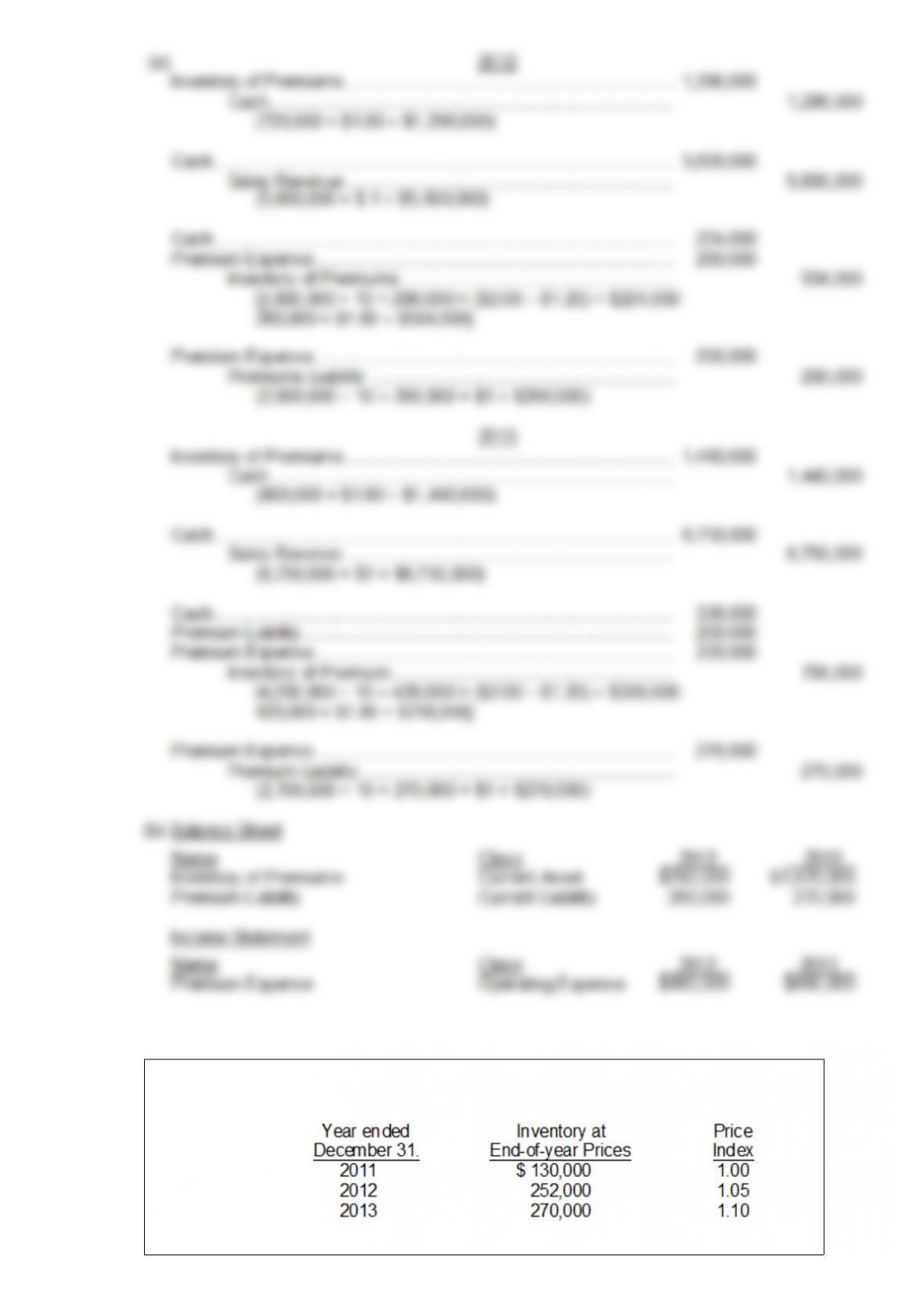
3) opera corp. uses dollar-value lifo method of computing its inventory cost. data for the
past four years is as follows:
what is the 2013 inventory balance using dollar-value lifo?

a.$270,000
b.$257,000
c.$245,500
d.$251,500
4) on december 1, 2012, kelso company acquired new equipment in exchange for old
equipment that it had acquired in 2009. the old equipment was purchased for $70,000
and had a book value of $26,600. on the date of the exchange, the old equipment had a
fair value of $28,000. in addition, kelso paid $91,000 cash for the new equipment,
which had a list price of $126,000. the exchange lacked commercial substance. at what
amount should kelso record the new equipment for financial accounting purposes?
a.$91,000
b.$117,600
c.$119,000
d.$126,000
5) the basis for classifying assets as current or noncurrent is conversion to cash within
a.the accounting cycle or one year, whichever is shorter
b.the operating cycle or one year, whichever is longer
c.the accounting cycle or one year, whichever is longer
d.the operating cycle or one year, whichever is shorter
6) where should goods in transit that were recently purchased f.o.b. destination be
included on the balance sheet?
a.accounts payable
b.inventory
c.equipment
d.not on the balance sheet
7) under igaap, the characteristics that would imply segregation of receivables would
include
a.past-due status
b.industry

c.collateral type
d.all of these could be used to determine whether segregation of receivables is implied
8) farmer company issues $20,000,000 of 10-year, 9% bonds on march 1, 2012 at 97
plus accrued interest. the bonds are dated january 1, 2012, and pay interest on june 30
and december 31. what is the total cash received on the issue date?
a.$19,400,000
b.$20,450,000
c.$19,700,000
d.$19,100,000
9) an example of a correction of an error in previously issued financial statements is a
change
a.from the fifo method of inventory valuation to the lifo method
b.in the service life of plant assets, based on changes in the economic environment
c.from the cash basis of accounting to the accrual basis of accounting
d.in the tax assessment related to a prior period
10) on january 1, 2013, frost corp. changed its inventory method to fifo from lifo for
both financial and income tax reporting purposes. the change resulted in a $900,000
increase in the january 1, 2013 inventory. assume that the income tax rate for all years
is 30%. the cumulative effect of the accounting change should be reported by frost in its
2013
a.retained earnings statement as a $630,000 addition to the beginning balance
b.income statement as a $630,000 cumulative effect of accounting change
c.retained earnings statement as a $900,000 addition to the beginning balance
d.income statement as a $900,000 cumulative effect of accounting change
11) a prepaid expense can best be described as an amount
a.paid and currently matched with revenues
b.paid and not currently matched with revenues
c.not paid and currently matched with revenues
d.not paid and not currently matched with revenues
12) when is revenue generally recognized?
a.when cash is received
b.when the warranty expires
c.when production is completed
d.when the sale occurs
13) june corp. sells one product and uses a perpetual inventory system. the beginning
inventory consisted of 20 units that cost $20 per unit. during the current month, the
company purchased 120 units at $20 each. sales during the month totaled 90 units for
$43 each. what is the cost of goods sold using the lifo method?
a.$400
b.$1,800
c.$2,400
d.$3,870
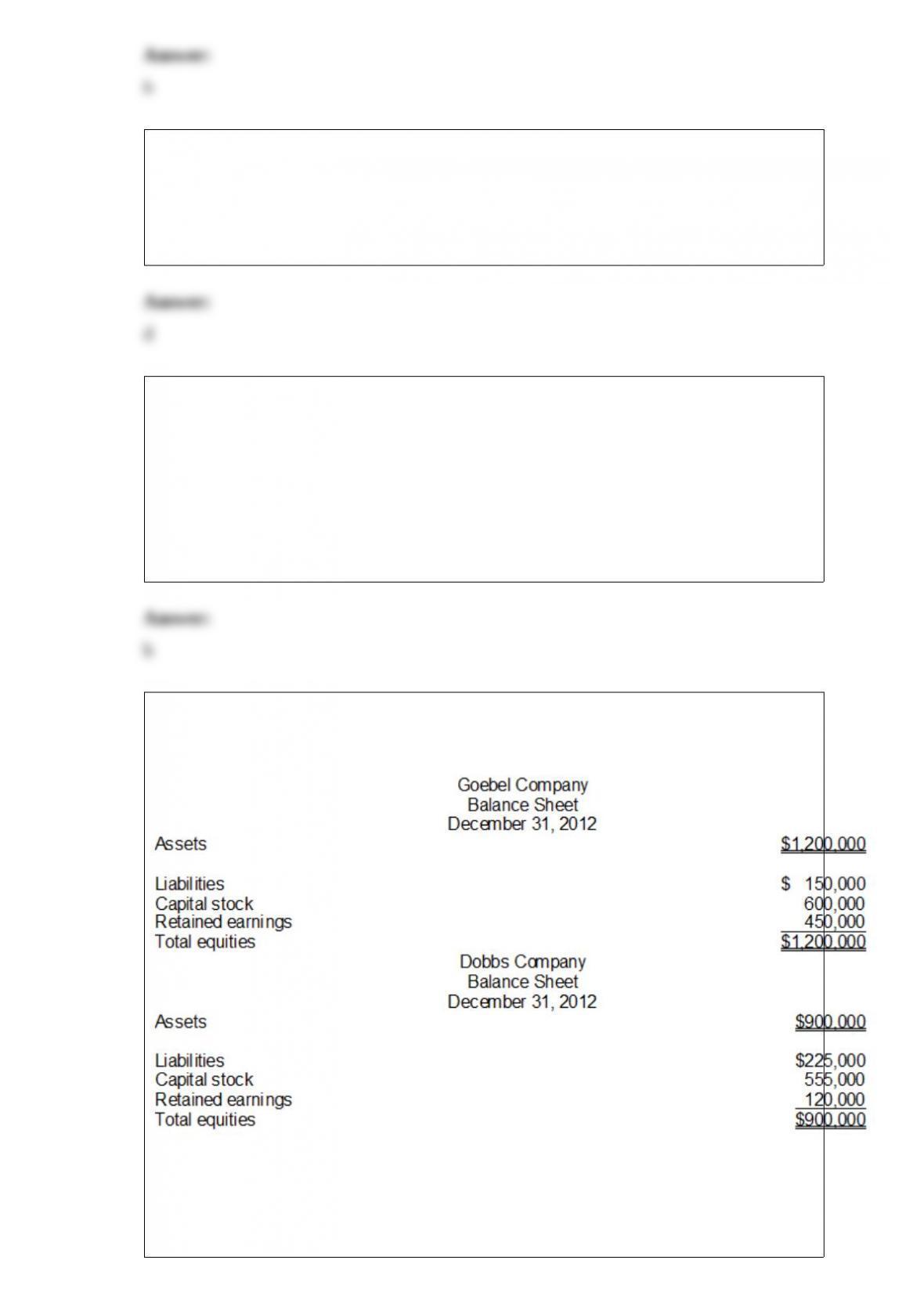
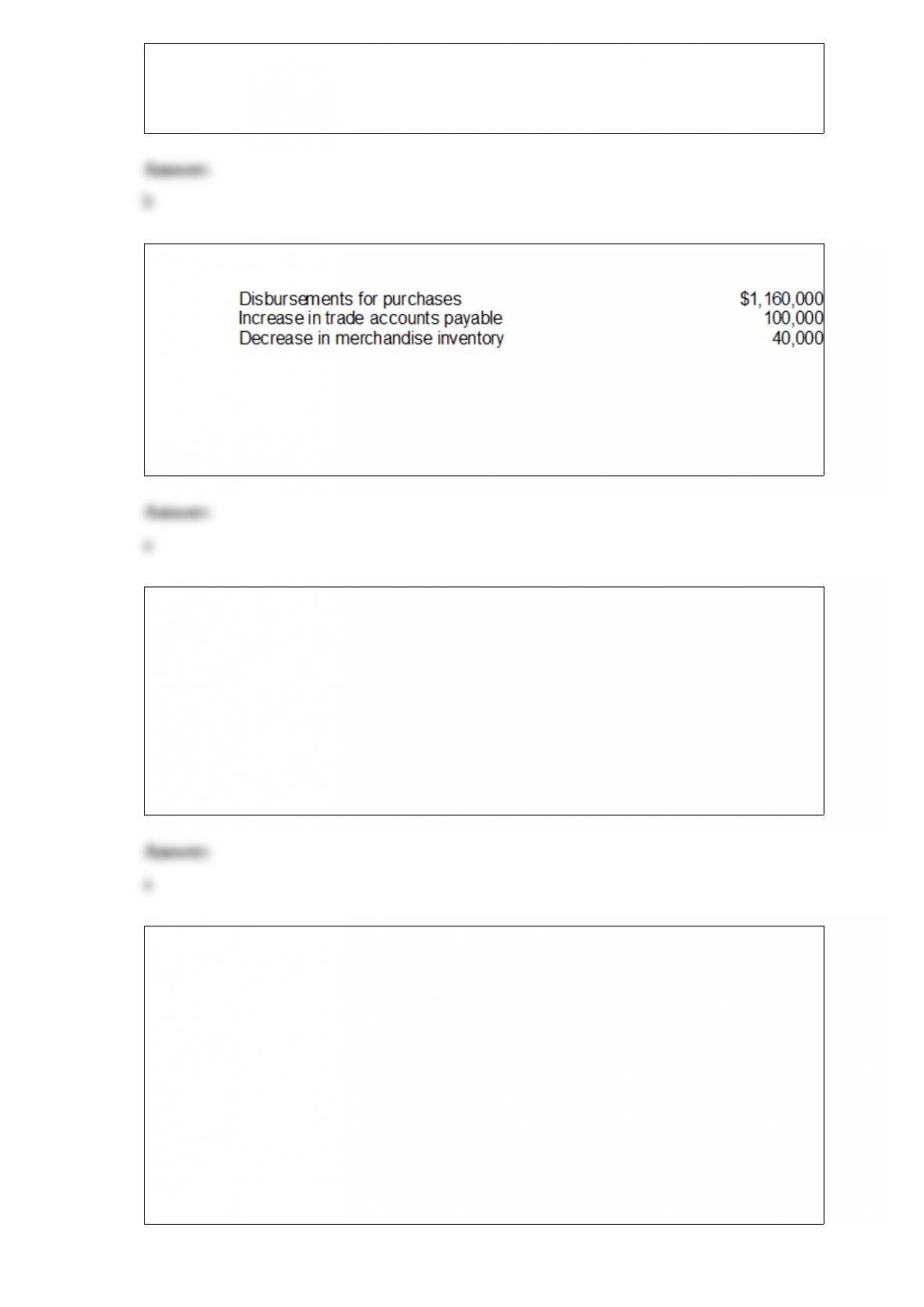
14) the summarized balance sheets of goebel company and dobbs company as of
december 31, 2012 are as follows:
if goebel company acquired a 20% interest in dobbs company on december 31, 2011 for
$135,000 and during 2013 dobbs company had net income of $75,000 and paid a cash
dividend of $30,000, applying the fair value method would give a debit balance in the
equity investments (dobbs) account at the end of 2013 of
a.$111,000
b.$135,000
c.$150,000
d.$144,000
15) the following information is available for ace company for 2012:
cost of goods sold for 2012 was
a.$1,300,000
b.$1,220,000
c.$1,100,000
d.$1,020,000
16) horner corporation has a deferred tax asset at december 31, 2013 of $120,000 due to
the recognition of potential tax benefits of an operating loss carryforward. the enacted
tax rates are as follows: 40% for 20102012; 35% for 2013; and 30% for 2014 and
thereafter. assuming that management expects that only 50% of the related benefits will
actually be realized, a valuation account should be established in the amount of:
a.$60,000
b.$24,000
c.$21,000
d.$18,000
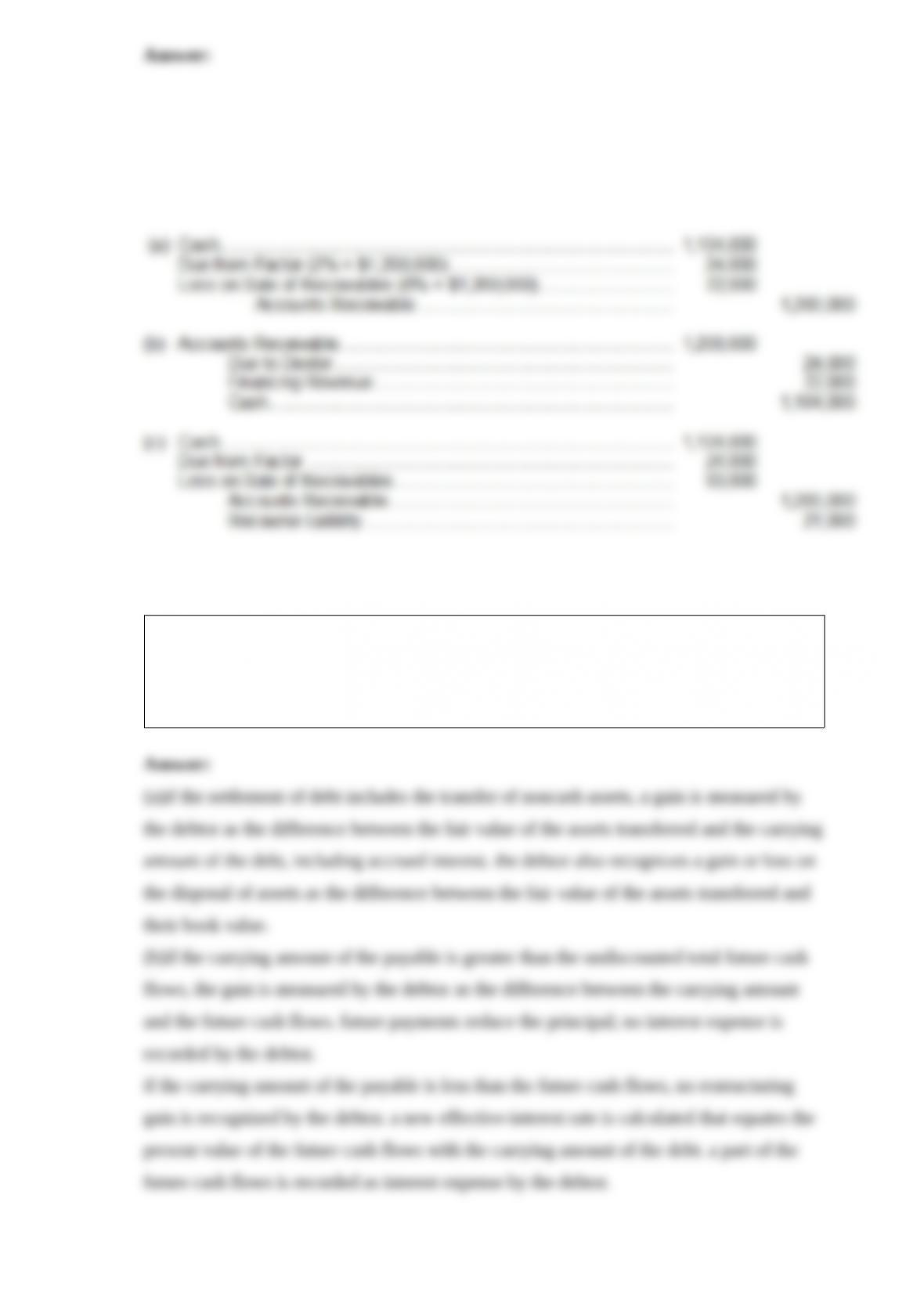
17) on may 1, dexter, inc. factored $1,200,000 of accounts receivable with quick
finance on a without recourse basis. under the arrangement, dexter was to handle
disputes concerning service, and quick finance was to make the collections, handle the
sales discounts, and absorb the credit losses. quick finance assessed a finance charge of
6% of the total accounts receivable factored and retained an amount equal to 2% of the
total receivables to cover sales discounts.
instructions
(a)prepare the journal entry required on dexter’s books on may 1.
(b)prepare the journal entry required on quick finances books on may 1.
(c)assume dexter factors the $1,200,000 of accounts receivable with quick finance on a
with recourse basis instead. the recourse provision has a fair value of $21,000. prepare
the journal entry required on dexters books on may 1.
18) (a)what are the general rules for measuring and recognizing a gain or loss by the
debtor on a settlement of troubled debt which includes the transfer of noncash assets?
(b)what are the general rules for measuring and recognizing a gain and for recording
future payments by the debtor in a troubled debt restructuring?