
Conceptually, the service method provides a better matching of costs and benefits in
amortizing prior service cost than does the straight-line method.
Under IFRS, if it is probable that a contingent liability will result in a future payment
but there is a range of equally likely amounts that will be paid, the midpoint of the
range should be accrued as a loss.
Cash paid for taxes and interest must be disclosed on the face of the statement or in the
disclosure notes under both the direct and indirect methods of reporting cash flows from
operating activities.
When changing from the average cost method to FIFO, the current year’s income
includes the cumulative after-tax difference that would have resulted if the company
had used FIFO in all prior years.

If the seller is an agent, the seller typically is vulnerable to risk associated with
delivering the product or service.
The interest capitalization period for a self-constructed asset ends either when the asset
is substantially complete and ready for use or when interest costs no longer are being
incurred.
The Public Reform and Investor Protection Act of 2002 (Sarbanes-Oxley) changed the
entity responsible for setting auditing standards in the United States.

Illegal acts will only need to be disclosed if the impact of the act is material.
Companies must always use the equity method when they hold between 25% and 50%
of the common stock of an investee.
In a bank reconciliation, adjustments to the book balance could include adding or
subtracting company errors.
The FASB’s framework for measuring fair value doesn’t change the situations in which
fair value is used under current GAAP.

When the right of return exists and a seller cannot make reliable estimates of future
returns, the installment method can be used.
Using the balance sheet approach, bad debt expense is an indirect result of estimating
the net realizable value of accounts receivable.
Under GAAP, the declaration of a property dividend may require the recognition of a
gain or loss if the fair value of the property is different from its carrying value on the
declaration date.

In a statement of cash flows prepared under International Financial Reporting
Standards, interest paid is most often classified as a financing cash flow.
Under IFRS, accounts receivable can be accounted for at fair value whenever company
management wants to do so.
Use of the installment sales method indicates little uncertainty about collection of the
receivable.
Gains or losses result, respectively, from the disposition of business assets for greater
than, or less than, their book values.
The fair value of the asset, debt, or equity securities given in a noncash acquisition
should determine the value of the consideration received.
For a purchase commitment extending beyond the current fiscal year, if the market
price on the purchase date declines from the previous year-end price, the purchase is
recorded at the market price.
Gains, but not losses, from discontinued operations must be separately reported in an
income statement.

SAB 101 was issued by the FASB to clarify its guidelines on revenue recognition.
Earnings quality refers to the ability of reported earnings (income) to predict future
earnings.
Under the equity method of accounting for a stock investment, cash dividends received
are considered a reduction of the investee’s net assets.
Under the completed contract method, gross profit or loss is never recognized until the
contract is completed.

A company that prepares its financial statements according to International Financial
Reporting Standards accounts for a government grant by recognizing revenue for the
amount of the grant.
Under the percentage-of-completion method, amounts billed and the cash actually
received affect income recognition.
IFRS provides detailed guidance concerning accounting for revenue with respect to
multiple-element contracts.

The primary responsibility for properly applying GAAP when communicating with
investors and creditors through financial statements lies with a firm’s auditors.
The cost of promotional offers should be recorded as expenses in the accounting period
when the offers are redeemed by customers.
Disclosure notes would not include: A. Depreciation methods used and estimated useful
life.
B. Definition of cash equivalents.
C. Details of pension plans.
D. Data to adjust the financial statements so that they are not misleading.

Orange Co. can estimate the amount of loss that will occur if a foreign government
expropriates some of the company’s asset in that country. If expropriation is reasonably
possible, a loss contingency should be:A. Disclosed but not accrued as a liability.
B. Disclosed and accrued as a liability.
C. Accrued as liability but not disclosed.
D. Neither accrued as a liability nor disclosed.
Each of the following would be reported as items of other comprehensive income
except: A. Foreign currency translation gains.
B. Unrealized gains on investments accounted for as securities available for sale.
C. Deferred gains from derivatives.
D. Gains from the sale of equipment.
Which of the following would be disclosed in the summary of significant accounting
policies disclosure note?
A. Option a

B. Option b
C. Option c
D. Option d
Interest cost is calculated by multiplying the: A. ABO by the expected return on the
plan assets.
B. ABO by the discount rate.
C. PBO by the expected return on plan assets.
D. PBO by the discount rate.
The cost of customer premium offers should be charged to expense: A. When the
related product is sold.
B. When the premium offer expires.
C. Over the life cycle of the product to which the premium relates.
D. When the premiums are claimed.

In 2013, Holyoak Inc. offers a $20 cash rebate coupon to customers who purchased one
of its new line of products. Holyoak sold 10,000 of these products during the year. By
year-end of 2013, 7,600 of the rebates had been claimed, and 7,100 had been paid.
Holyoak’s historical experience with such rebates indicates that 85% of customers claim
the rebates.
In the current year, Hanna Company reported warranty expense of $190,000 and the
warranty liability account increased by $20,000. What were warranty expenditures
during the year? A. $190,000.
B. $170,000.
C. $210,000
D. $0.
In applying LCM, market cannot be: A. Less than net realizable value minus a normal
profit margin.
B. Net realizable value less reasonable completion and disposal costs.
C. Greater than net realizable value reduced by an allowance for normal profit margin.
D. Less than cost.

Fundamental qualitative characteristics of accounting information are: A.Relevance and
comparability.
B.Comparability and consistency.
C.Faithful representation and relevance.
D.Neutrality and consistency.
On June 1, 2013, Blue Co. distributed to its common stockholders 200,000 outstanding
common shares of its investment in Red, Inc., an unrelated party. The carrying amount
on Blue’s books of Red’s $1 par common stock was $2 per share. Immediately after the
declaration, the market price of Red’s stock was $2.50 per share. In its income statement
for the year ended June 30, 2013, what amount should Blue report as gain before
income taxes on disposal of the stock? A. $0.
B. $100,000.
C. $400,000.
D. $500,000.
Listed below are account balances (in $ millions) taken from the records of Symphony
Stores. All of these are permanent accounts, except the last two that have yet to be
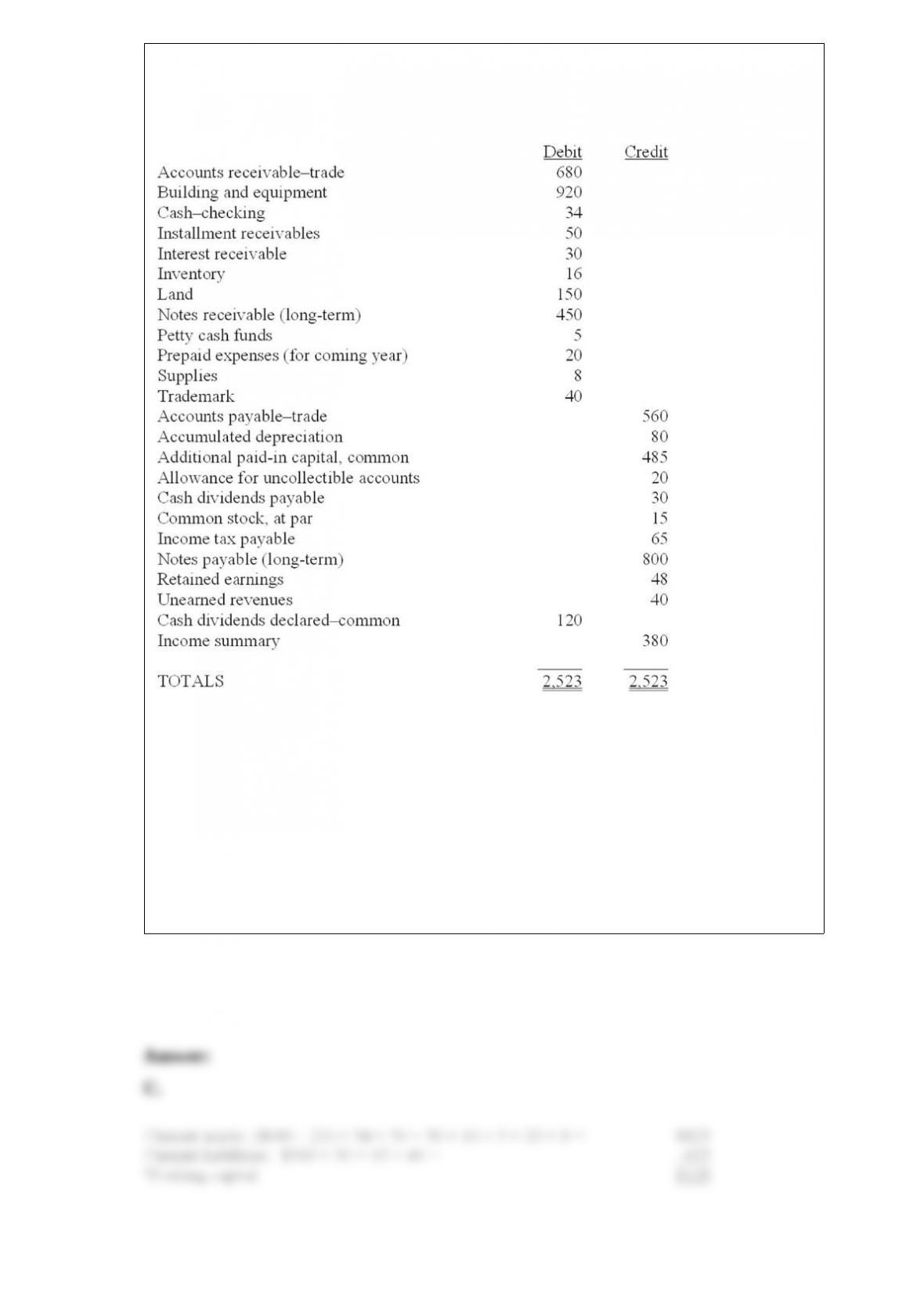
closed. The installment receivables are current. Symphony uses a perpetual inventory
system.
What is the amount of working capital for Symphony?
A. $98.
B. $143.
C. $128.
D. $113.
Robertson Inc. prepares its financial statements according to International Financial
Reporting Standards. At the end of its 2013 fiscal year, the company chooses to revalue
its equipment. The equipment cost $540,000, had accumulated depreciation of $240,000
at the end of the year after recording annual depreciation, and had a fair value of
$330,000. After the revaluation, the accumulated depreciation account will have a
balance of: A. $240,000.
B. $264,000.
C. $270,000.
D. None of the above is correct.
A direct financing lease is classified in the lessor’s balance sheet as: A. An asset.
B. A liability.
C. Interest revenue.
D. A contra account to lease liability.
The following incomplete (columns have missing amounts) pension spreadsheet is for
Old Tucson Corporation (OTC).
What was the prior service cost at the beginning of the year? A. $48.
B. $54.
C. $56.
D. $60.
A contingent loss should be reported in a disclosure note to the financial statements
rather than being accrued if: A. The likelihood of a loss is remote.
B. The incurrence of a loss is reasonably possible.
C. The incurrence of a loss is more likely than not.
D. The likelihood of a loss is probable.
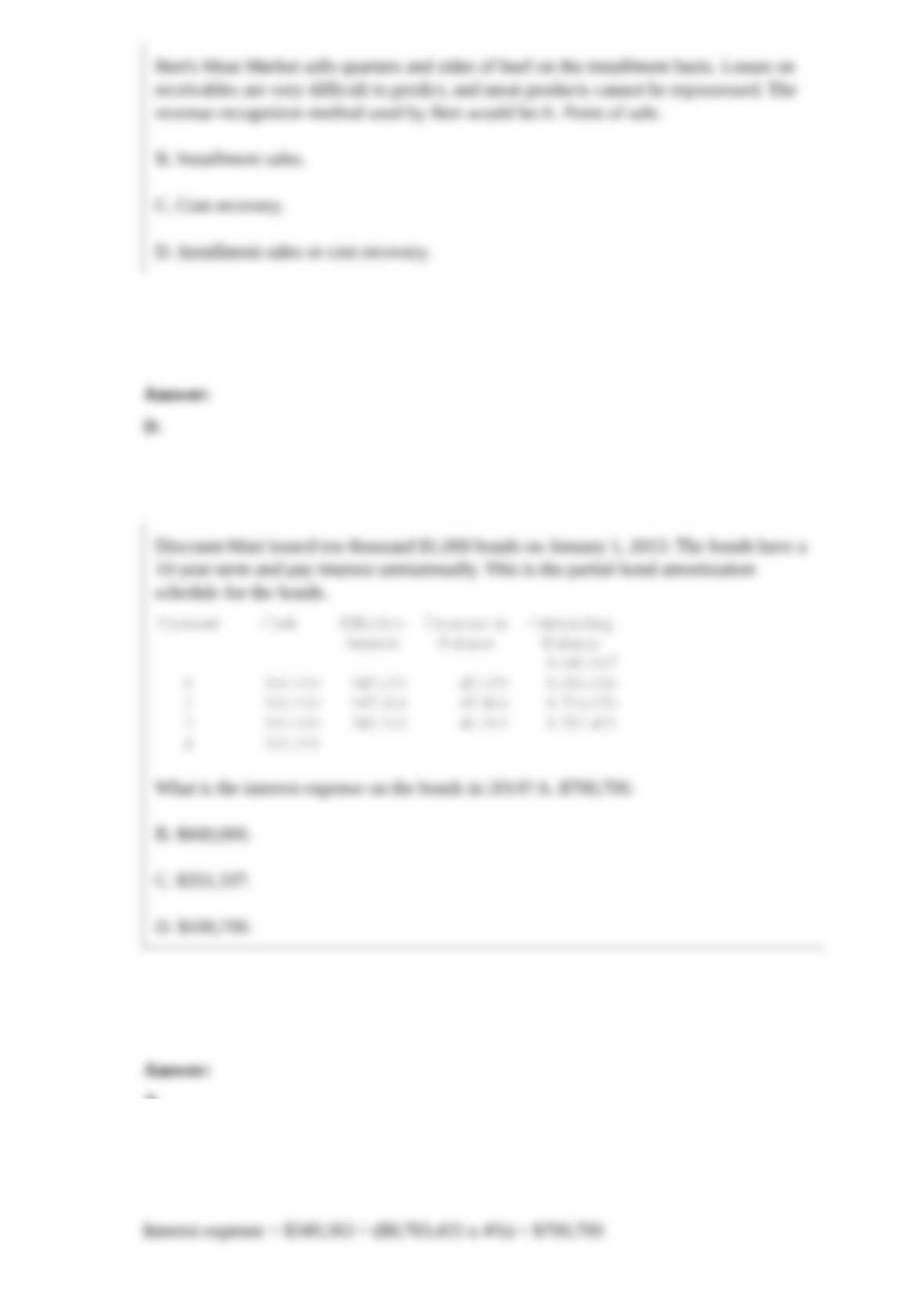
Hanson Company had the following account balances for 2013:
Hanson reported net income of $90,000 for 2013. Assuming no other changes in current
account balances, what is the amount of net cash provided by operating activities for
2013 reported in the statement of cash flows? A. $70,000.
B. $80,000.
C. $100,000.
D. $110,000.
Bert’s Meat Market sells quarters and sides of beef on the installment basis. Losses on
receivables are very difficult to predict, and meat products cannot be repossessed. The
revenue recognition method used by Bert would be:A. Point of sale.
B. Installment sales.
C. Cost recovery.
D. Installment sales or cost recovery.
Discount-Mart issued ten thousand $1,000 bonds on January 1, 2013. The bonds have a
10-year term and pay interest semiannually. This is the partial bond amortization
schedule for the bonds.
What is the interest expense on the bonds in 2014? A. $700,700.
B. $600,000.
C. $351,337.
D. $100,700.
The Stevens Company purchased a debt investment that meets the characteristics of a
simple debt instrument. Stevens is holding the debt for purposes of managing risk.
Might Stevens have to recognize an impairment loss on the debt? A. Yes.
B. No, because the debt is accounted for at FV-NI, so any fair value changes are already
recognized as unrealized gains and losses.
C. No, because the debt is accounted for at amortized cost, so fair value changes are not
included in earnings.
D. Insufficient information is available to answer this question.
A weakness of __________ is that firms can increase or decrease net income by
choosing to sell particular investments with net unrealized gains or unrealized losses. A.
the available-for-sale approach
B. the trading-securities approach
C. both the available-for-sale and trading-securities approaches
D. neither the available-for-sale and trading-securities approaches
Summary data for Benedict Construction Co.’s (BCC) Job 1227, which was completed
in 2013, are presented below:
Assuming BCC used the cost recovery method to recognize revenue under IFRS, what
would gross profit have been in 2012 and 2013 (rounded to the nearest thousand)?
A. Choice A
B. Choice B
C. Choice C
D. Choice D
Below is information relative to an exchange of equipment by Pensacola Inc. Assume
the exchange has commercial substance.
In Case A, Pensacola would record the new equipment at: A. $68,000.
B. $63,750.
C. $67,250.
D. $80,000.
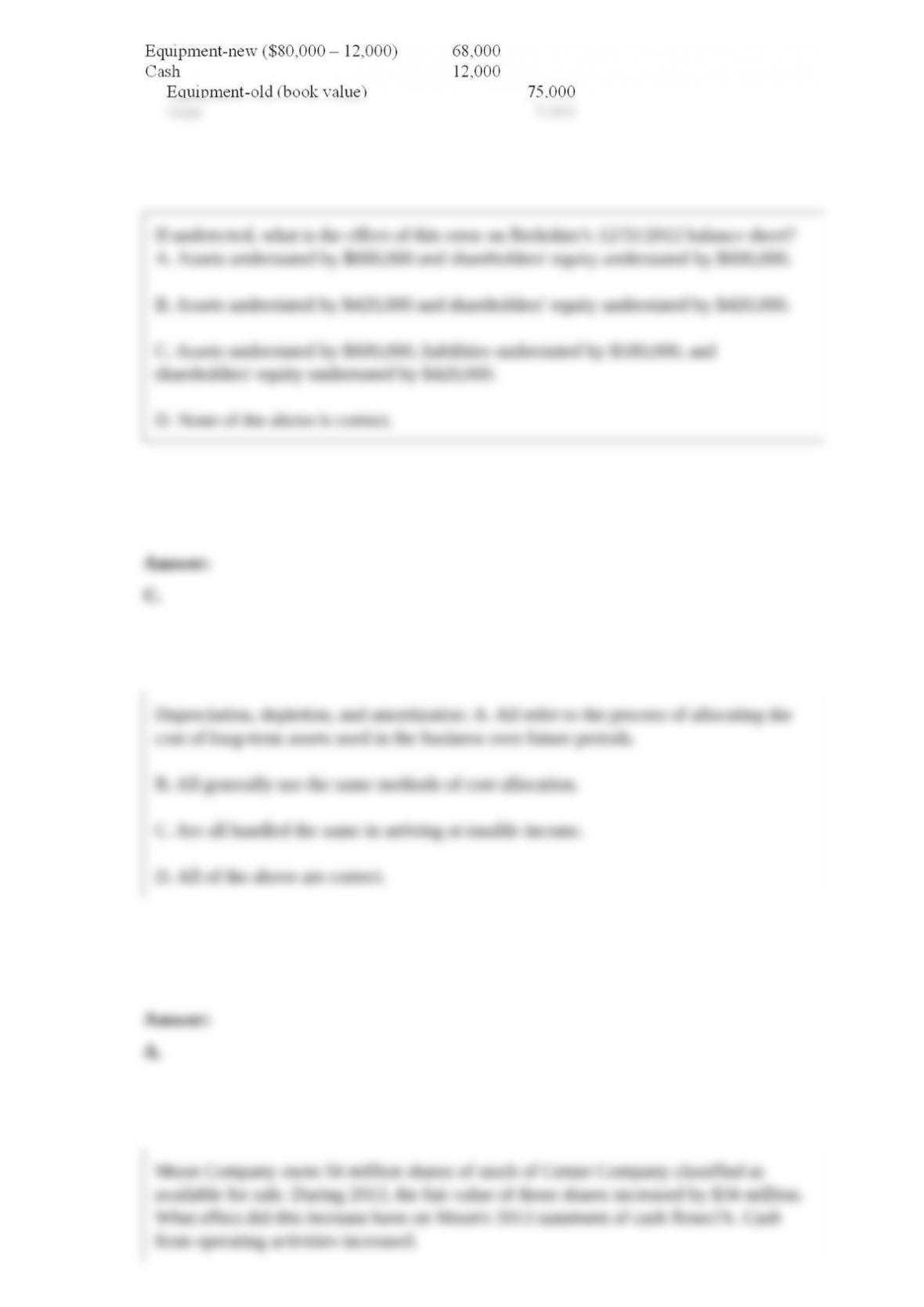
If undetected, what is the effect of this error on Berkshire’s 12/31/2012 balance sheet?
A. Assets understated by $600,000 and shareholders’ equity understated by $600,000.
B. Assets understated by $420,000 and shareholders’ equity understated by $420,000.
C. Assets understated by $600,000, liabilities understated by $180,000, and
shareholders’ equity understated by $420,000.
D. None of the above is correct.
Depreciation, depletion, and amortization: A. All refer to the process of allocating the
cost of long-term assets used in the business over future periods.
B. All generally use the same methods of cost allocation.
C. Are all handled the same in arriving at taxable income.
D. All of the above are correct.
Moon Company owns 56 million shares of stock of Center Company classified as
available for sale. During 2013, the fair value of those shares increased by $34 million.
What effect did this increase have on Moon’s 2013 statement of cash flows?A. Cash
from operating activities increased.
B. Cash from investing activities increased.
C. Cash from financing activities increased.
D. No effect.
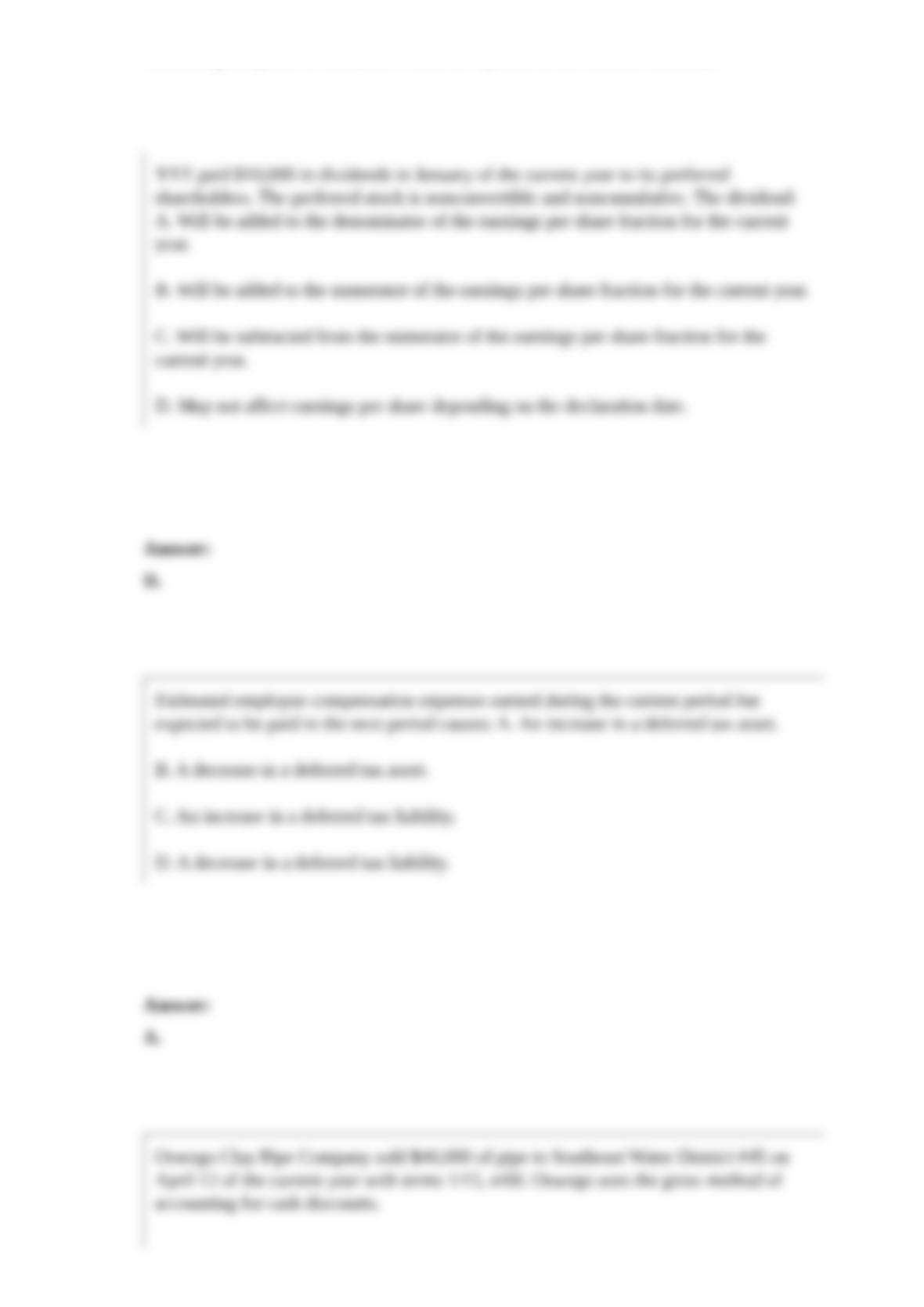
On December 15, 2013, Rigsby Sales Co. sold a tract of land that cost $3,600,000 for
$4,500,000. Rigsby appropriately uses the installment sale method of accounting for
this transaction. Terms called for a down payment of $500,000 with the balance in two
equal annual installments payable on December 15, 2014, and December 15, 2015.
Ignore interest charges. Rigsby has a December 31 year-end.
At December 31, 2014, Rigsby would report in its balance sheet:A. Realized gross
profit of $500,000.
B. Deferred gross profit of $400,000.
C. Realized gross profit of $400,000.
D. Cost of installment sales $1,600,000.
XYZ paid $10,000 in dividends in January of the current year to its preferred
shareholders. The preferred stock is nonconvertible and noncumulative. The dividend:
A. Will be added to the denominator of the earnings per share fraction for the current
year.
B. Will be added to the numerator of the earnings per share fraction for the current year.
C. Will be subtracted from the numerator of the earnings per share fraction for the
current year.
D. May not affect earnings per share depending on the declaration date.
Estimated employee compensation expenses earned during the current period but
expected to be paid in the next period causes: A. An increase in a deferred tax asset.
B. A decrease in a deferred tax asset.
C. An increase in a deferred tax liability.
D. A decrease in a deferred tax liability.
Oswego Clay Pipe Company sold $46,000 of pipe to Southeast Water District #45 on
April 12 of the current year with terms 1/15, n/60. Oswego uses the gross method of
accounting for cash discounts.
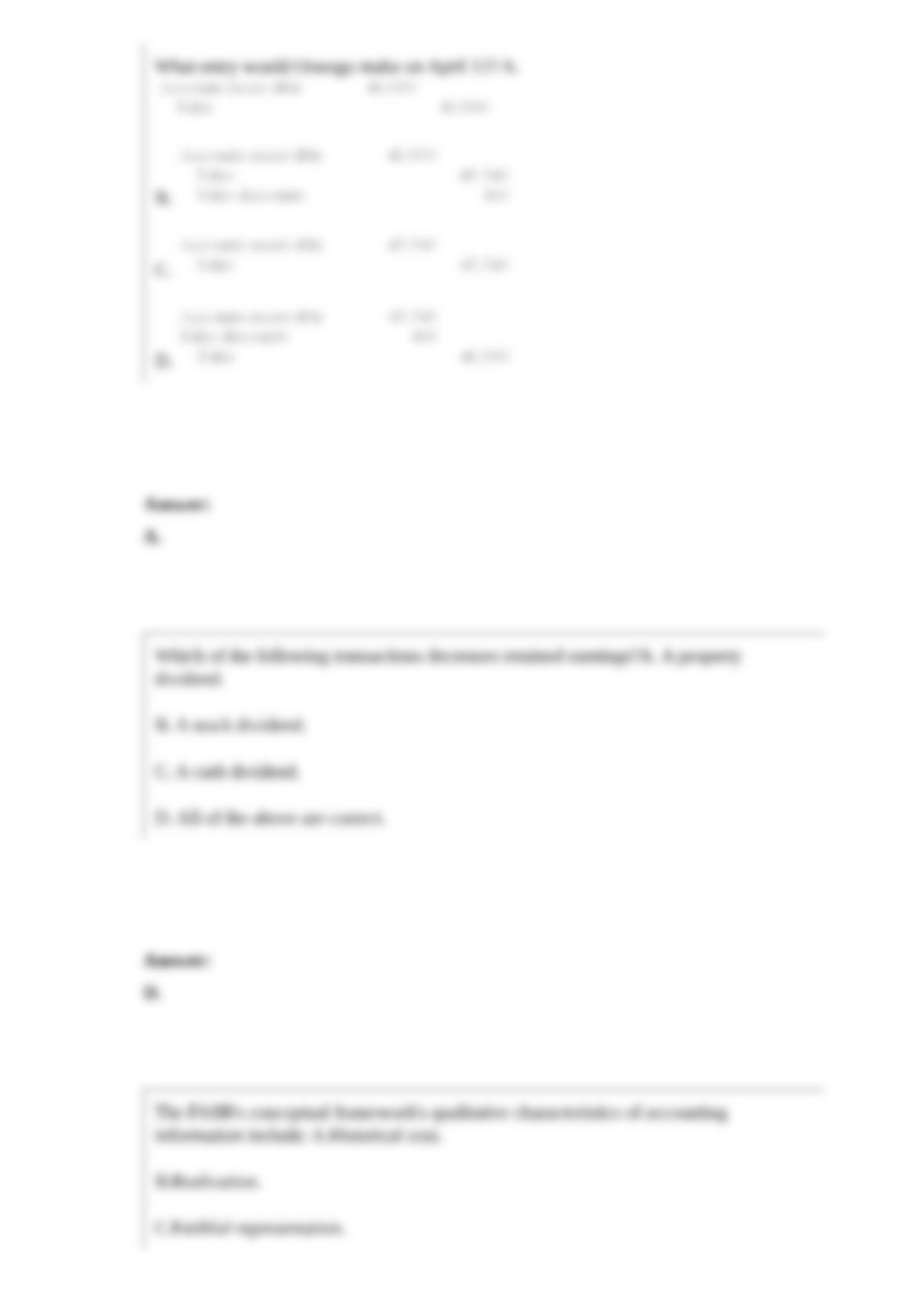
What entry would Oswego make on April 12? A.
B.
C.
D.
Which of the following transactions decreases retained earnings?A. A property
dividend.
B. A stock dividend.
C. A cash dividend.
D. All of the above are correct.
The FASB’s conceptual framework’s qualitative characteristics of accounting
information include: A.Historical cost.
B.Realization.
C.Faithful representation.
D.Full disclosure.
Coy, Inc., initially issued 200,000 shares of $1 par value stock for $1,000,000 in 2011.
In 2012, the company repurchased 20,000 shares for $200,000. In 2013, 10,000 of the
repurchased shares were resold for $160,000. In its balance sheet dated December 31,
2013, Coy, Inc.’s treasury stock account shows a balance of: A. $0.
B. $40,000.
C. $100,000.
D. $200,000.
Poodle Corporation was organized on January 3, 2013. The firm was authorized to issue
100,000 shares of $5 par common stock. During 2013, Poodle had the following
transactions relating to shareholders’ equity:
Issued 30,000 shares of common stock at $7 per share.
Issued 20,000 shares of common stock at $8 per share.
Reported a net income of $100,000.
Paid dividends of $50,000.
What is total paid-in capital at the end of 2013? A. $420,000.
B. $370,000.
C. $470,000.
D. $320,000.
Which of the following is always reported as an outflow of cash? A. The accrual of
warranty expense.
B. The declaration of a cash dividend.
C. The purchase of equipment for cash.
D. Amortization expense.
When the income statement includes separately reported items such as discontinued
operations or extraordinary items, which amounts require per share presentation?
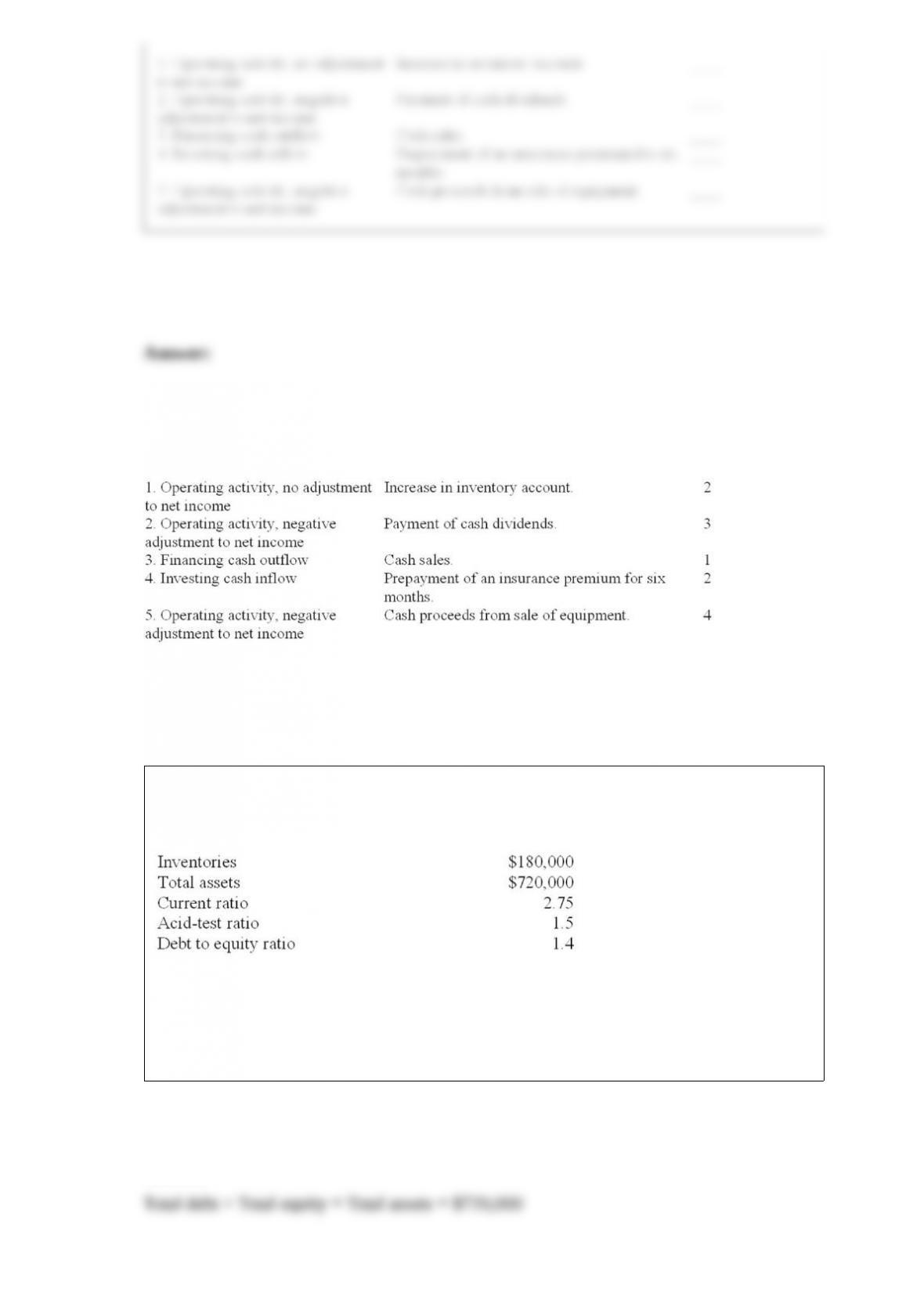
On April 1, 2013, Parks Co. purchased machinery at a cost of $42,000. The machinery
is expected to last 10 years and to have a residual value of $6,000.
Required: Compute depreciation for 2013 and 2014 and the book value of the
machinery at December 31, 2013 and 2014, assuming the sum-of-the-years’-digits
method is used.
Listed below are reporting classifications for a statement of cash flows using the
indirect method for reporting operating cash flows. Indicate the reporting classification
that would apply to each of the five transactions described below by placing the number
of the reporting classification in the space provided by each transaction.
Contrast the role of the conceptual framework in U.S. GAAP and IFRS.
The following partial income statement and balance sheet information (in $millions)
comes from the Annual Report of Saratoga Springs Co. for the year ending 12/31/2013:
Required: Compute the following amounts for Saratoga Springs Co.
Its return on stockholders’ equity for 2013. Round your answer to one decimal place,
e.g., .1234 as 12.3%.
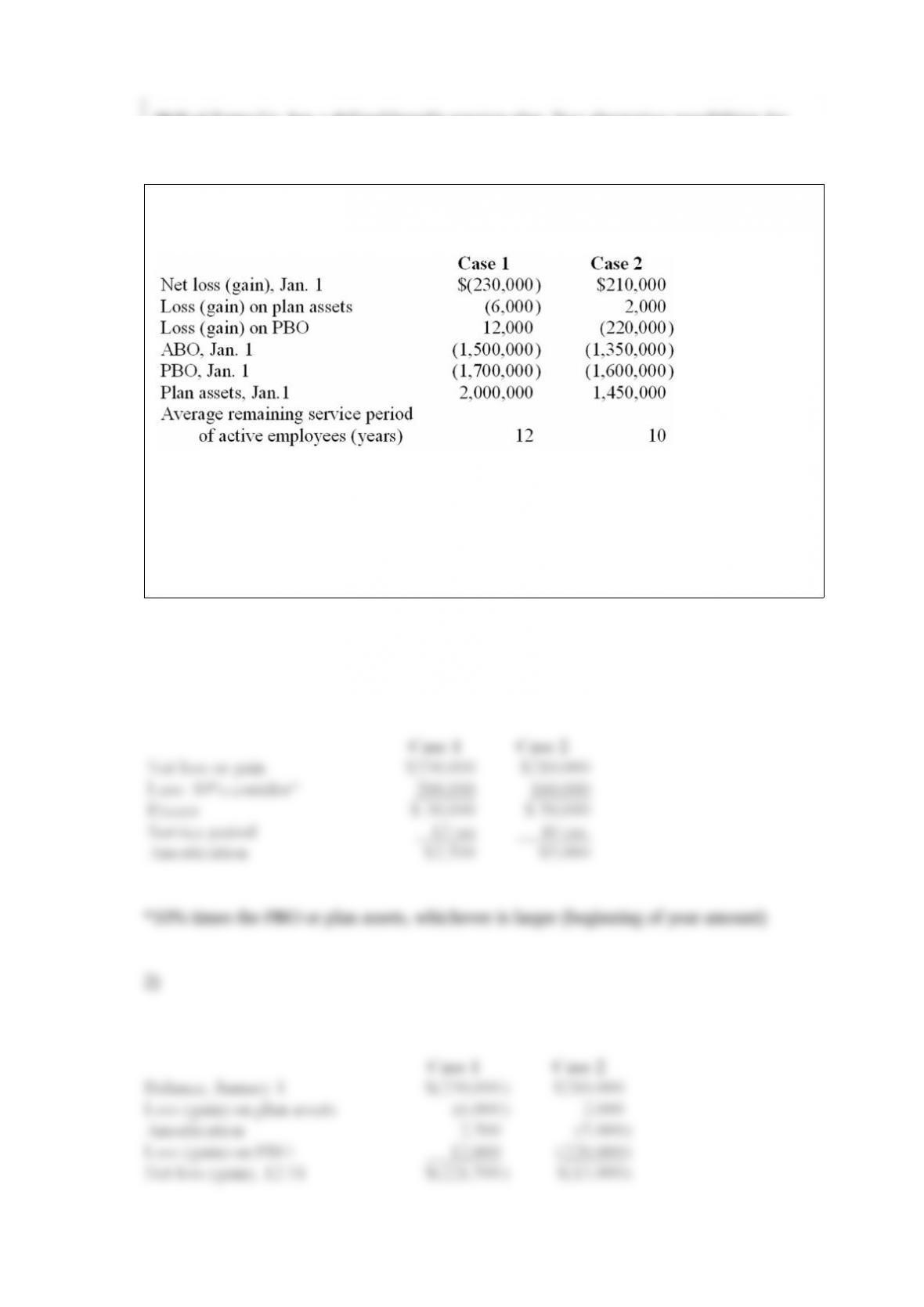
Hall of Fame Co. has a defined benefit pension plan. Two alternative possibilities for
pension-related data for the current calendar year are shown below:
Required:
1) For each independent case, calculate amortization of the net loss or gain that should
be included as a component of pension expense for the current year.
2) Determine the net loss or gain as of December 31 of the current year.
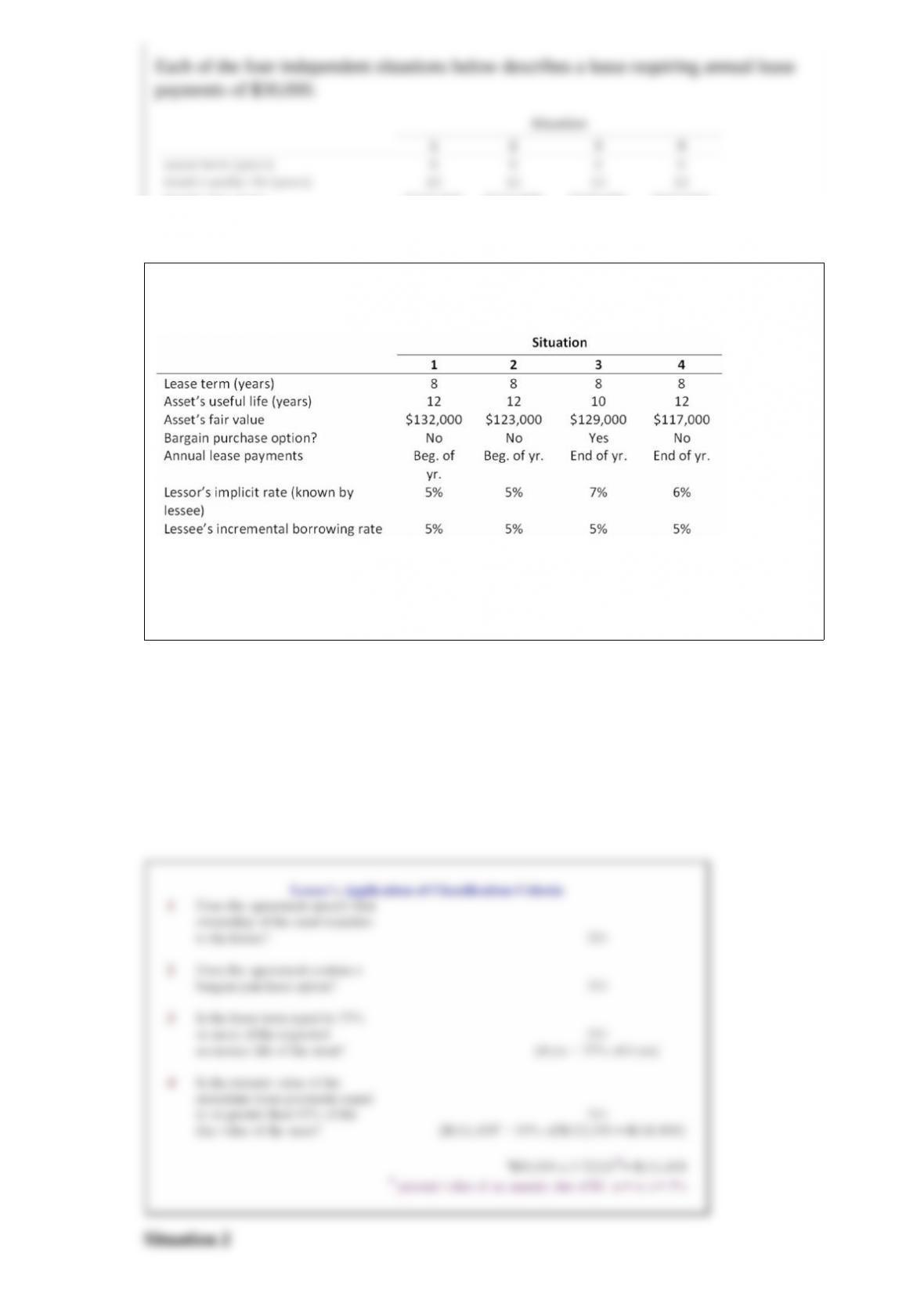
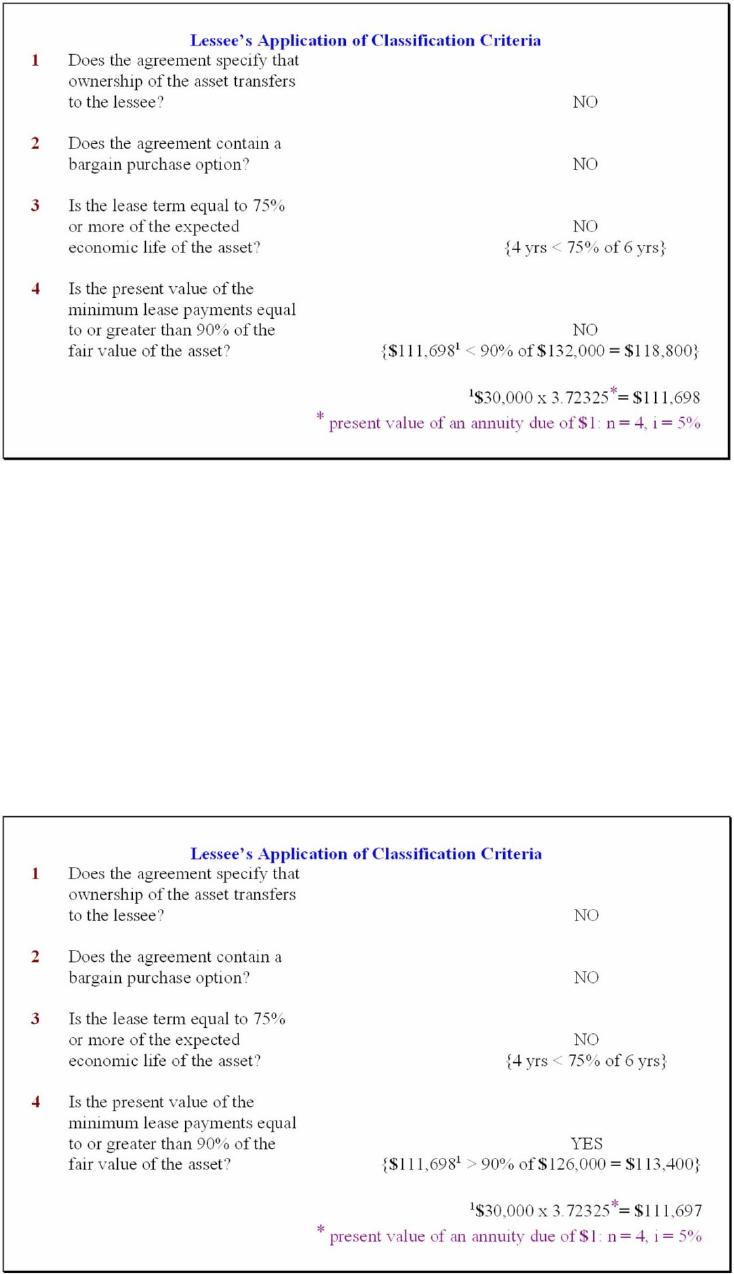
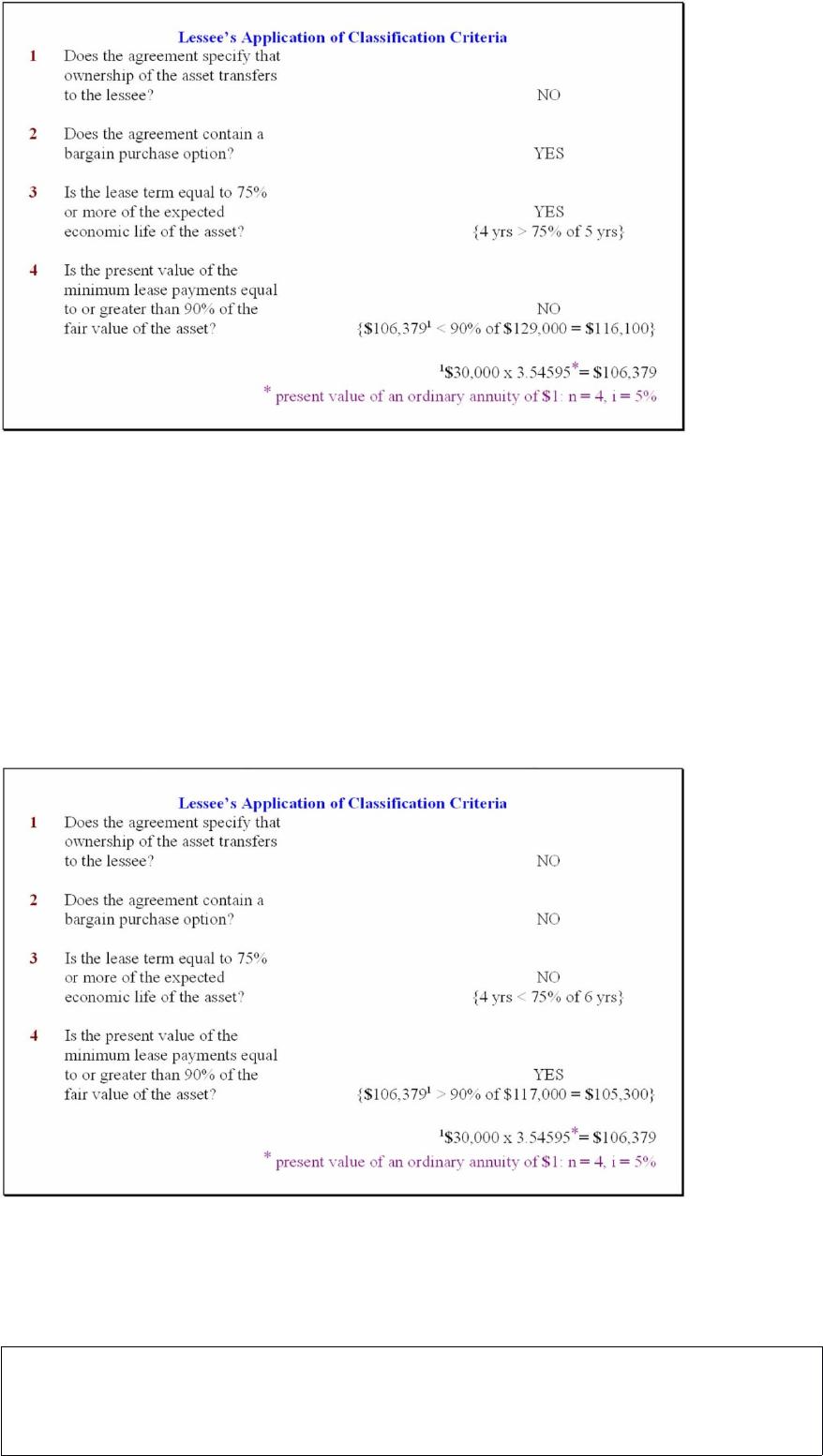
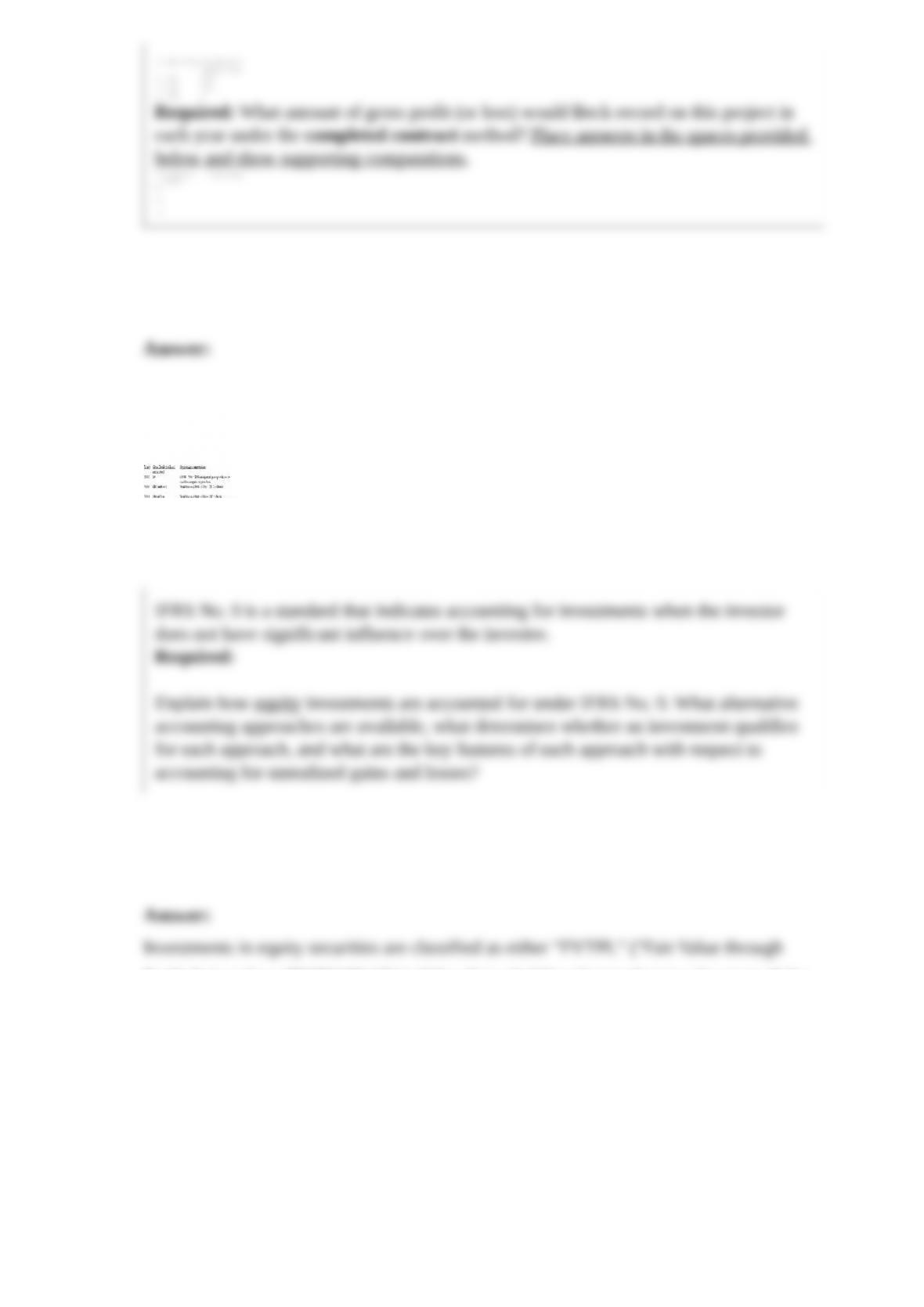
Each of the four independent situations below describes a lease requiring annual lease
payments of $30,000.
Required:
For each situation, determine the appropriate lease classification by the lessee and
indicate why.
IFRS No. 9 is a standard that indicates accounting for investments when the investor
does not have significant influence over the investee.
Required:
Explain how equity investments are accounted for under IFRS No. 9. What alternative
accounting approaches are available, what determines whether an investment qualifies
for each approach, and what are the key features of each approach with respect to
accounting for unrealized gains and losses?
The following information is taken from the accounting records of Rapid Runner Inc.
for the year 2013. Missing information has been left blank.
Required:
Compute the missing amounts.
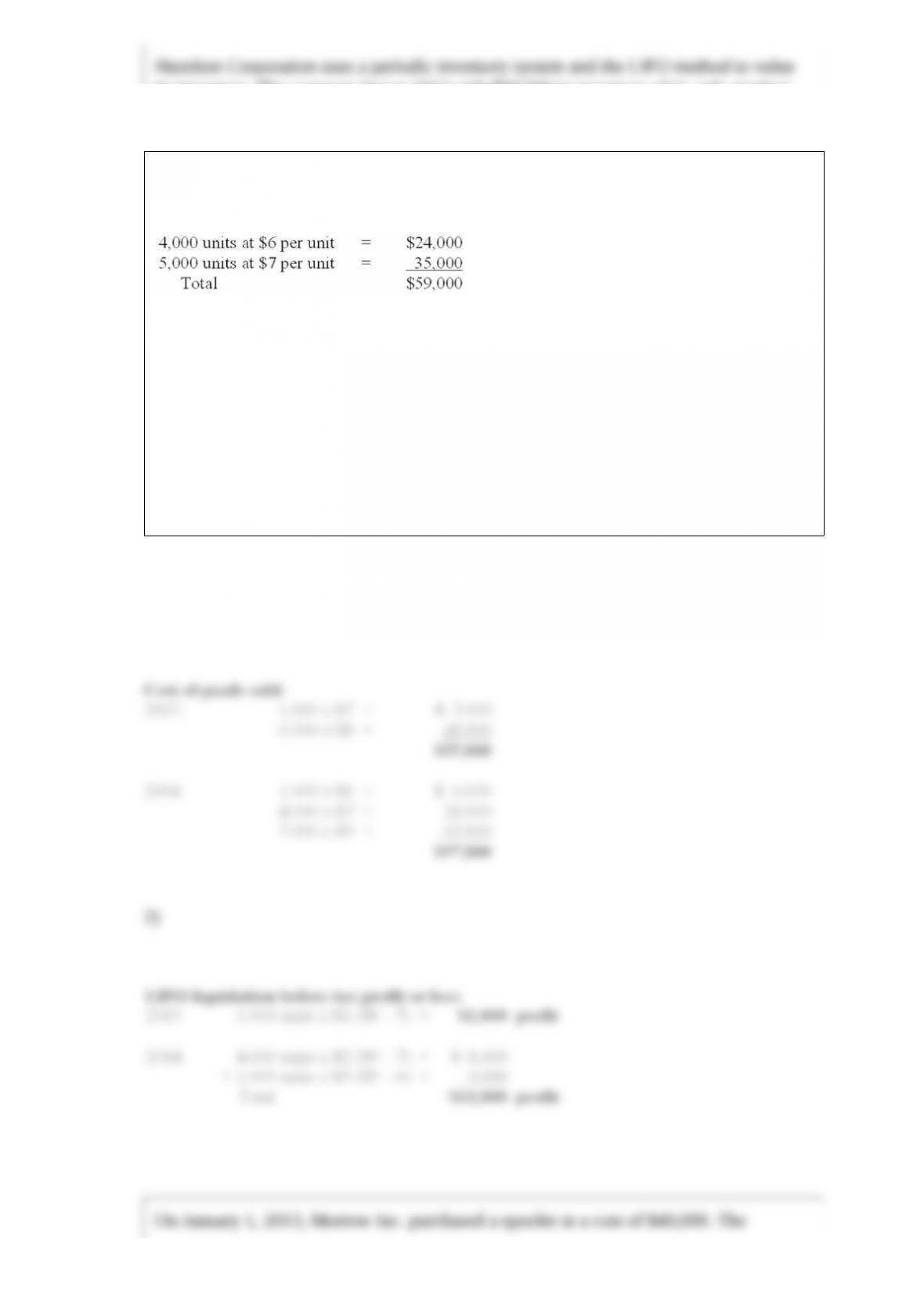
Hazelton Corporation uses a periodic inventory system and the LIFO method to value
its inventory. The company began 2013 with $59,000 in inventory of its only product.
The beginning inventory consisted of the following layers:
During 2013, 6,000 units were purchased at $8 per unit and during 2014, 7,000 units
were purchased at $9 per unit. Sales, in units, were 7,000 and 12,000 during 2013 and
2014, respectively.
Required:
1) Calculate cost of goods sold for 2013 and 2014.
2) Disregarding income tax, determine the LIFO liquidation profit or loss, if any, for
2013 and 2014.
On January 1, 2013, Morrow Inc. purchased a spooler at a cost of $40,000. The
equipment is expected to last eight years and have a residual value of $4,000. During its
eight-year life, the equipment is expected to produce 250,000 units of product. In 2013
and 2014, 42,000 and 76,000 units respectively were produced.
Required:
Compute depreciation for 2013 and 2014 and the book value of the spooler at
December 31, 2013 and 2014, assuming the double-declining-balance method is used.
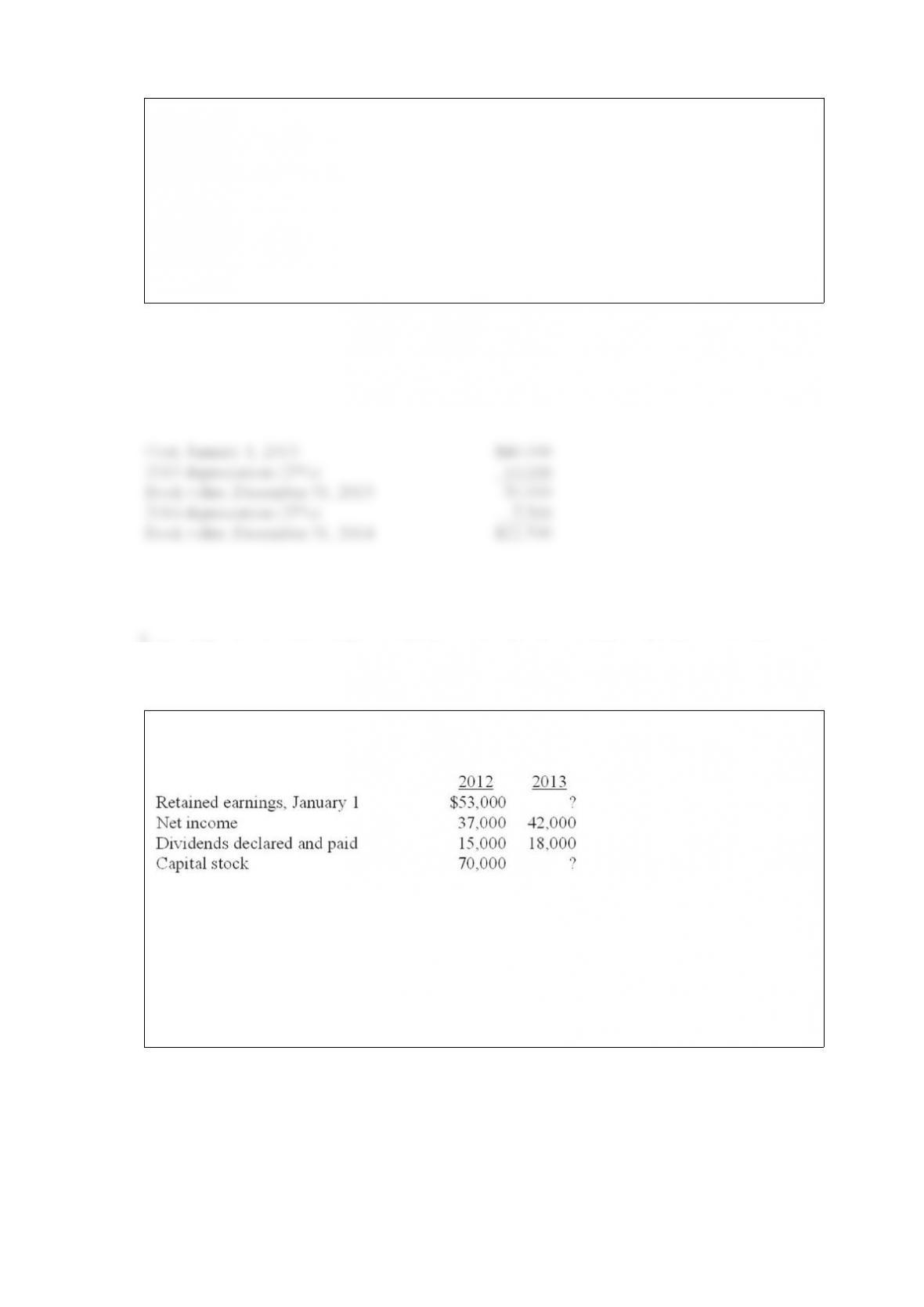
The following is selected financial information for Osmond Dental Laboratories for
2012 and 2013:
Osmond issued 2,000 shares of additional capital stock in 2013 for $20,000. There were
no other capital transactions.
Required:
Prepare a statement of shareholders’ equity for Osmond Dental Laboratories for the year
ended December 31, 2013.