Revenue is recognized upon sale of gift cards, rather than being deferred.
Stock options will be dilutive and included in the calculation of dilutive EPS if the
exercise price is greater than the average market value of the stock.
Comprehensive income reports an expanded version of income to include certain types
of gains and losses not included in traditional income statements.
Changes in enacted tax rates only affect income tax expense in the years those changes
affect tax payable.

Most, but not all, changes in accounting principle are reported using the retrospective
approach.
The transaction price is only allocated to goods and services that are both capable of
being distinct and that are separately identifiable.
If the seller is a principal, the seller should recognize gross revenue and cost of sales
associated with the transaction.
Long-term debt that is callable by the creditor in the upcoming year should be classified
as a current liability only if the debt is expected to be called.

Under IFRS No. 9, investments for which the investor lacks significant influence use
basically the same reporting classifications as those used under U.S. GAAP.
The balance of net receivables represents the amount expected to be collected.
Determining fair value by calculating the present value of future cash flows is a level 1
type of input.
Unless specific sales criteria are met, the factoring of accounts receivable with recourse
is accounted for as a loan.

The purchase of treasury stock is an investing cash outflow.
The basic issue in deciding whether to record a valuation allowance for a deferred tax
asset is if probable taxable income is anticipated to be insufficient to realize the tax
benefit.
No allocation of contract price is required if the transaction involves a performance
obligation to be satisfied over time.
On March 1, 2016, Doll Co. issued 10-year convertible bonds at 106. During 2019, the
bonds were converted into common stock when the market price of Doll’s common
stock was 500 percent above its par value. Doll prepares its financial statements
according to International Financial Reporting Standards (IFRS). On March 1, 2016,
cash proceeds from the issuance of the convertible bonds should be reported as:
a. A liability for the entire proceeds.

b. Paid-in capital for the entire proceeds.
c. Paid-in capital for the portion of the proceeds attributable to the conversion feature
and as a liability for the balance.
d. A liability for the face amount of the bonds and paid-in capital for the premium over
the par value.
Liabilities payable within the coming year are classified as long-term liabilities if
refinancing is completed before date of issuance of the financial statements under:
a. U.S. GAAP.
b. IFRS.
c. Either U.S. GAAP and IFRS.
d. Neither U.S. GAAP and IFRS.
Under its executive stock option plan, Z Corporation granted options on January 1,
2016, that permit executives to purchase 15 million of the company’s $1 par common
shares within the next eight years, but not before December 31, 2018 (the vesting date).
The exercise price is the market price of the shares on the date of grant, $18 per share.
The fair value of the options, estimated by an appropriate option pricing model, is $4
per option. No forfeitures are anticipated. The options expired in 2022 without being
exercised. By what amount will Z’s shareholder’s equity be increased?
a. $ 60 million
b. $270 million.
c. $315 million.
d. $330 million.
Orange Corp. constructed a machine at a total cost of $70 million. Construction was
completed at the end of 2012 and the machine was placed in service at the beginning of
2013. The machine was being depreciated over a 10-year life using the
sum-of-the-years’-digits method. The residual value is expected to be $4 million. At the
beginning of 2016, Orange decided to change to the straight-line method. Ignoring
income taxes, what will be Orange’s depreciation expense for 2016?
a. $4.8 million.
b. $5.4 million.
c. $6.6 million.
d. $9.4 million.
Fellingham Corporation purchased equipment on January 1, 2014, for $200,000. The
company estimated the equipment would have a useful life of 10 years with a $20,000
residual value. Fellingham uses the straight-line depreciation method. Early in 2016,
Fellingham reassessed the equipment’s condition and determined that its total useful life
would be only six years in total and that it would have no salvage value. How much
would Fellingham report as depreciation on this equipment for 2016?
a. $24,000.

b. $27,333.
c. $36,000.
d. $41,000.
Universal Travel Inc. borrowed $500,000 on November 1, 2016, and signed a 12-month
note bearing interest at 6%. Interest is payable in full at maturity on October 31, 2017.
In connection with this note, Universal Travel Inc. should report interest payable at
December 31, 2016, in the amount of:
a. $ 8,000.
b. $30,000.
c. $ 5,000.
d. $25,000.

Which of the following is not true about accounting for long-term construction
contracts?
a. Long-term construction contracts could show a contract asset or contract liability,
depending on the relation between construction in progress and billings.
b. Billings on contracts in progress is a contra account to accounts receivable.
c. Gross profit is debited to construction in progress.
d. When a customer is billed for payment due, billings on contracts in progress is
credited at the same time accounts receivable is debited.
Pension benefits and postretirement health benefits typically are similar in their:
a. Application of present value concepts.
b. Vesting policies.
c. Coverage for eligible dependents.
d. Relationship between cost of coverage and length of service.

Patrick Rach International issued 5% bonds convertible into shares of the company’s
common stock. Rach applies International Financial Reporting Standards (IFRS). Upon
issuance, Patrick Rach International should record:
a. The proceeds of the bond issue as part debt and part equity.
b. The proceeds of the bond issue entirely as debt.
c. The proceeds of the bond issue entirely as equity.
d. The proceeds of the bond issue entirely as debt if the bonds are mandatorily
redeemable.
The income statement reports changes in fair value for which type of securities?
a. Securities reported under the equity method.
b. Trading securities.
c. Held-to-maturity securities.
d. Securities available for sale.
Vijay Inc. purchased a three-acre tract of land for a building site for $320,000. On the
land was a building with an appraised value of $120,000. The company demolished the

old building at a cost of $12,000, but was able to sell scrap from the building for
$1,500. The cost of title insurance was $900 and attorney fees for reviewing the
contract were $500. Property taxes paid were $3,000, of which $250 covered the period
subsequent to the purchase date. The capitalized cost of the land is:
a. $336,400.
b. $336,150.
c. $334,650.
d. $201,150.
Under the dollar-value LIFO retail method, to determine the value of a LIFO layer:
a. Divide the LIFO layer by the layer-year price index and multiply by the layer-year
cost-to-retail percentage.
b. Multiply the LIFO layer by the base year price index and the current year
cost-to-retail percentage.
c. Multiply the LIFO layer by the layer-year price index and by the layer-year
cost-to-retail percentage.

d. Divide the LIFO layer by the layer-year cost-to-retail percentage and multiply by the
layer-year price index.
The following facts apply to TinyPart Toy Company’s pending litigation as of
December 31, 2016: a. TinyPart is defending against a lawsuit and believes there is a
51% chance it will lose in court. If it loses, TinyPart estimates that damages will be
$100,000.
b. TinyPart is defending against another lawsuit for which management believes it is
virtually certain to lose in court. If it loses the lawsuit, management estimates damages
will fall somewhere in the range of $30,000 to $50,000, with each amount in that range
equally likely to occur.
c. TinyPart is defending against another lawsuit that is identical to item (b), but the
relevant losses will only occur far into the future. The present values of the endpoints of
the range are $15,000 and $25,000. TinyPart’s management believes the effects of time
value of money on these amounts are material, but also believes the timing of these
amounts is uncertain.
d. TinyPart is defending against a fourth lawsuit and believes there is only a 25%
chance it will lose in court. If TinyPart loses, it believes damages will fall somewhere in
the range of $35,000 to $40,000, with each amount in that range equally likely to occur.
Indicate how TinyPart would disclose or account for the lawsuit described in part (b)
under U.S. GAAP and under IFRS in the financial statements for the year ended
December 31, 2016.
Peecher accepted a three-year, noninterest-bearing note in exchange for merchandise
sold. Which of the following is true?
a. Peecher would credit a discount on note receivable when recording the sale.
b. Peecher would debit interest revenue over the life of the note.
c. Peecher would debit notes receivable when the note is collected
d. Peecher would multiply sales revenue by the effective interest rate to determine
interest revenue each period
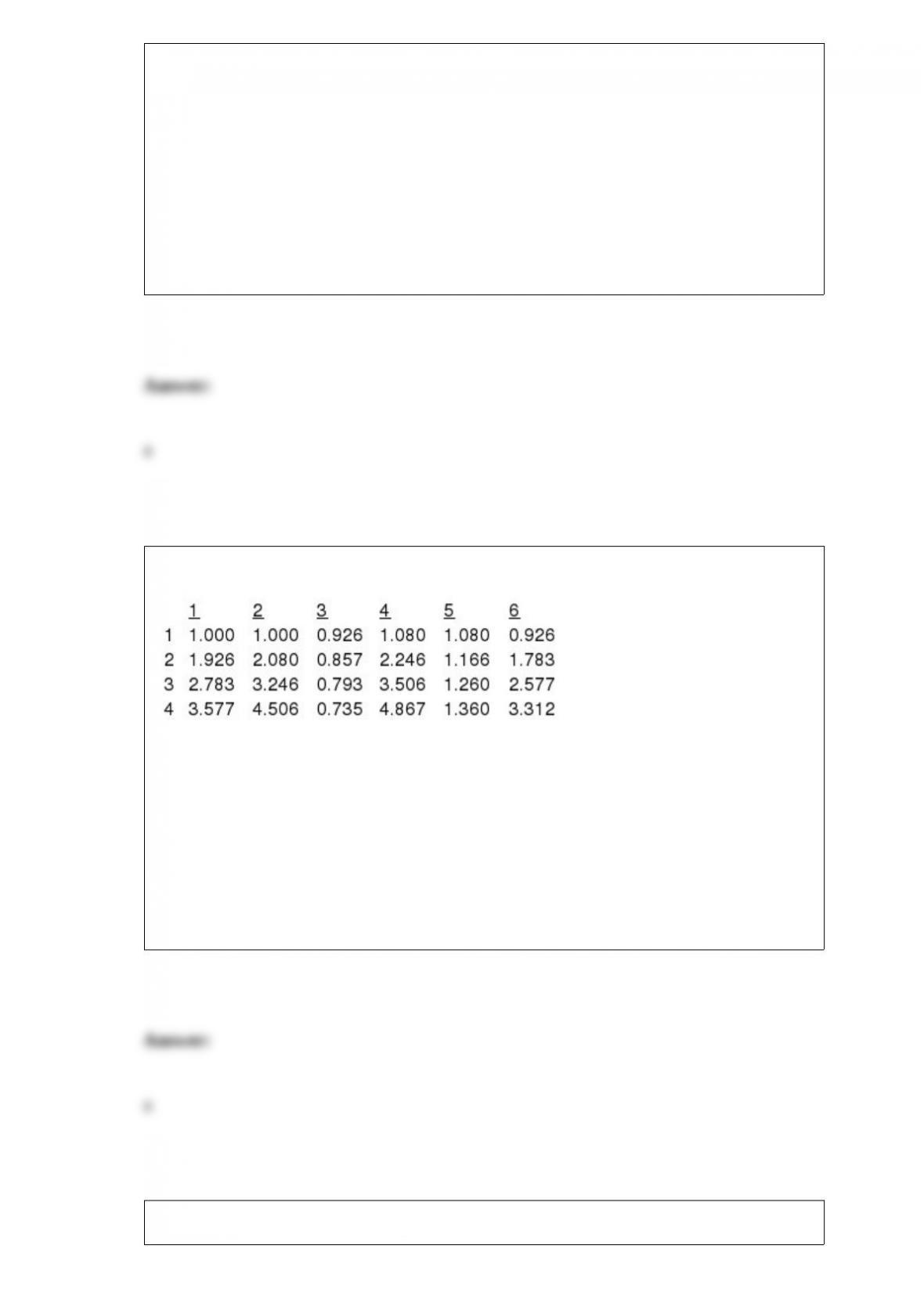
Below are excerpts from time value of money tables for the 8% rate.
Column 3 is an interest table for the:
a. Present value of 1.
b. Future value of 1.
c. Present value of an ordinary annuity of 1.
d. Present value of an annuity due of 1.
Castillo Company has a defined benefit pension plan. At the end of the reporting year,
the following data were available: beginning PBO, $75,000; service cost, $18,000;
interest cost, $5,000; benefits paid for the year, $9,000; ending PBO, $89,000; the
expected return on plan assets, $10,000; and cash deposited with pension trustee,
$17,000. There were no other pension-related costs. The journal entry to record the
annual pension costs will include a credit to the PBO for:
a. $13,000.
b. $17,000.
c. $18,000.
d. $23,000.
General Product Inc. distributed 100 million coupons in 2016. The coupons are
redeemable for 30 cents each. General anticipates that 70% of the coupons will be

redeemed. The coupons expire on December 31, 2017. There were 45 million coupons
redeemed in 2016 and 30 million redeemed in 2017. What was General’s coupon
promotion expense in 2016?
a. $30.0 million.
b. $21.0 million.
c. $13.5 million.
d. $7.5 million.
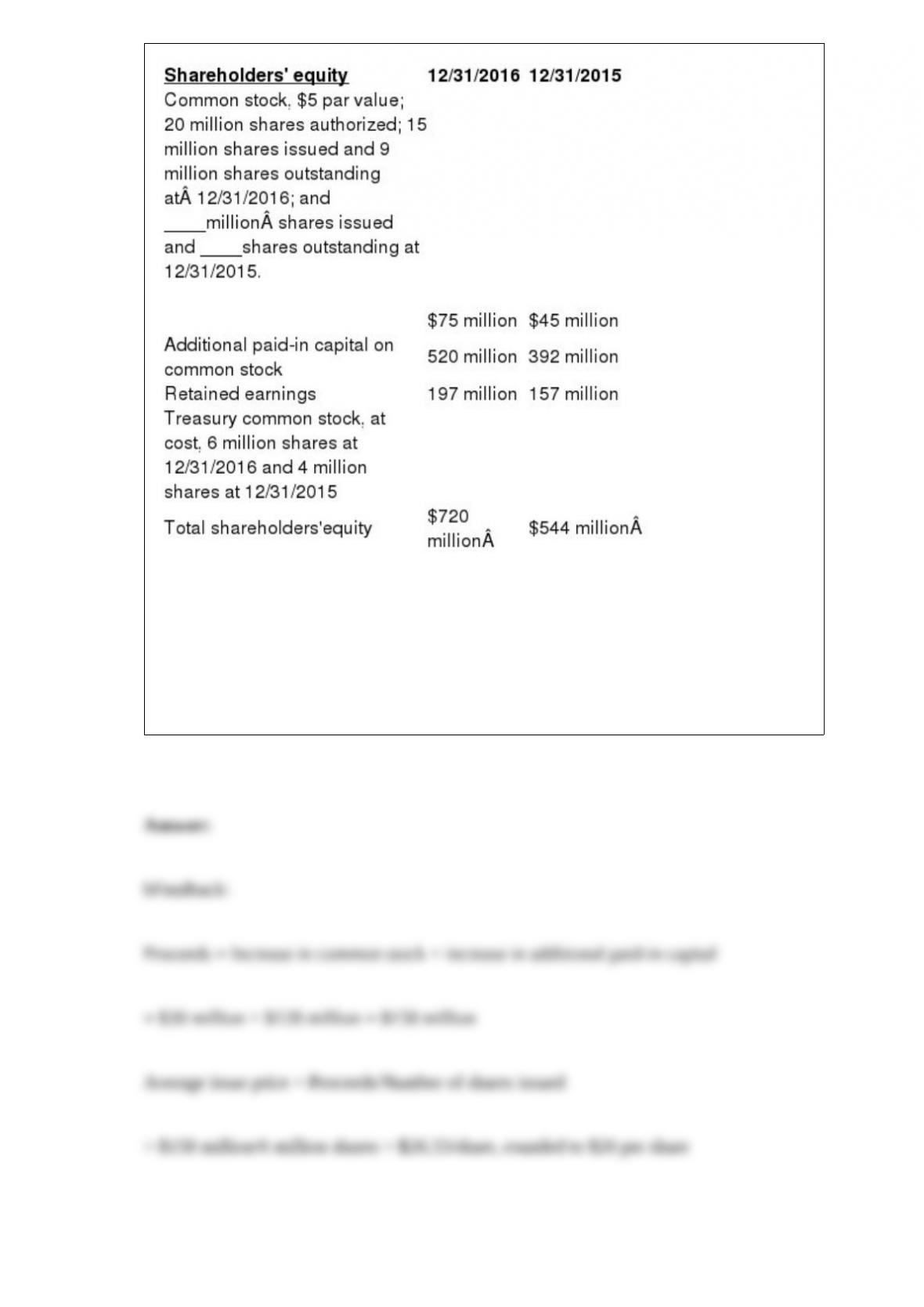
What was the average price (rounded to the nearest dollar) of the additional shares
issued by Levi in 2016?
The following partial information is taken from the comparative balance sheet of Levi
Corporation:
a. $5 per share.
b. $26 per share.
c. $39 per share.
d. Cannot be determined from the given information.
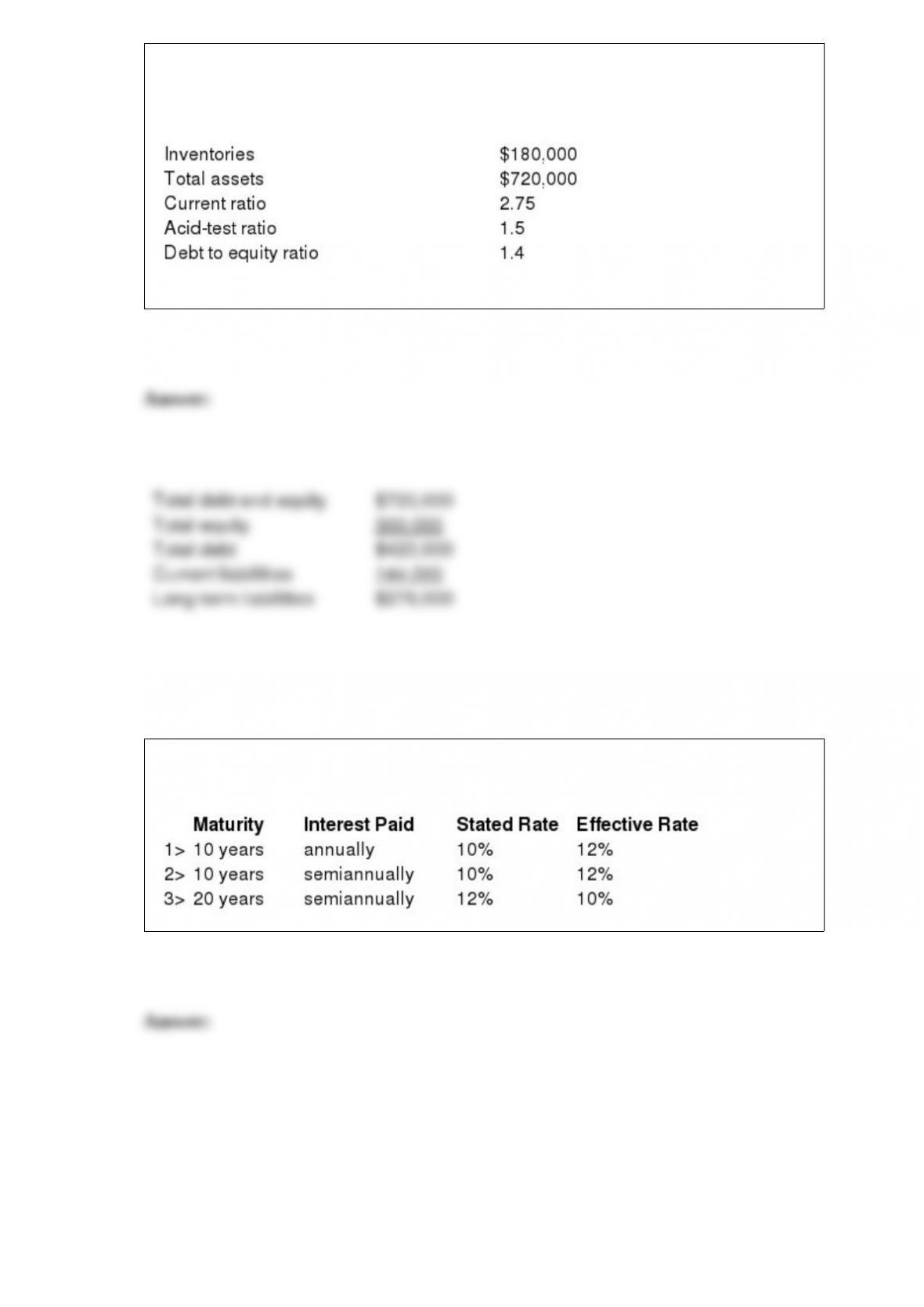
Spartan Sportswear’s current assets consist of cash, marketable securities, accounts
receivable, and inventories. The following data were abstracted from a recent financial
statement:
Required: Compute the following for Spartan: Long-term liabilities
Determine the price of a $500,000 bond issue under each of the following independent
assumptions:

Meca Concrete purchased a mixer on January 1, 2014, at a cost of $45,000.
Straight-line depreciation for 2014 and 2015 was based on an estimated eight-year life
and $3,000 estimated residual value. In 2016, Meca revised its estimate and now
believes the mixer will have a total service life of only six years, and that the residual
value will be only $2,000.
Required:
Compute depreciation for 2016 and 2017.

Prepare a list of how retiree health benefits differ from pension benefits with respect to
accounting, funding, regulation, and employee benefits.

Briefly explain the advantages of dollar-value LIFO (DVL).
CompuTime Center sells a full assortment of computer parts, including motherboards,
video cards, and cables. It also offers complementary computer assembly services. A
customer places an order for an advanced workstation, and CompuTime asks for
$3,500. If CompuTime were to sell only the parts in an advanced workstation, with no
assembly, the price would be $3,300.
Required: Assuming that computer parts and assembly service are separate
performance
obligations, estimate the stand-alone selling price of the assembly service based on the
residual
approach.
Explain briefly how IFRS and U.S. GAAP differ in determining whether a transfer of
an accounts receivable qualifies as a sale.

Describe the way we account for an error when that error is discovered in a subsequent
reporting period.
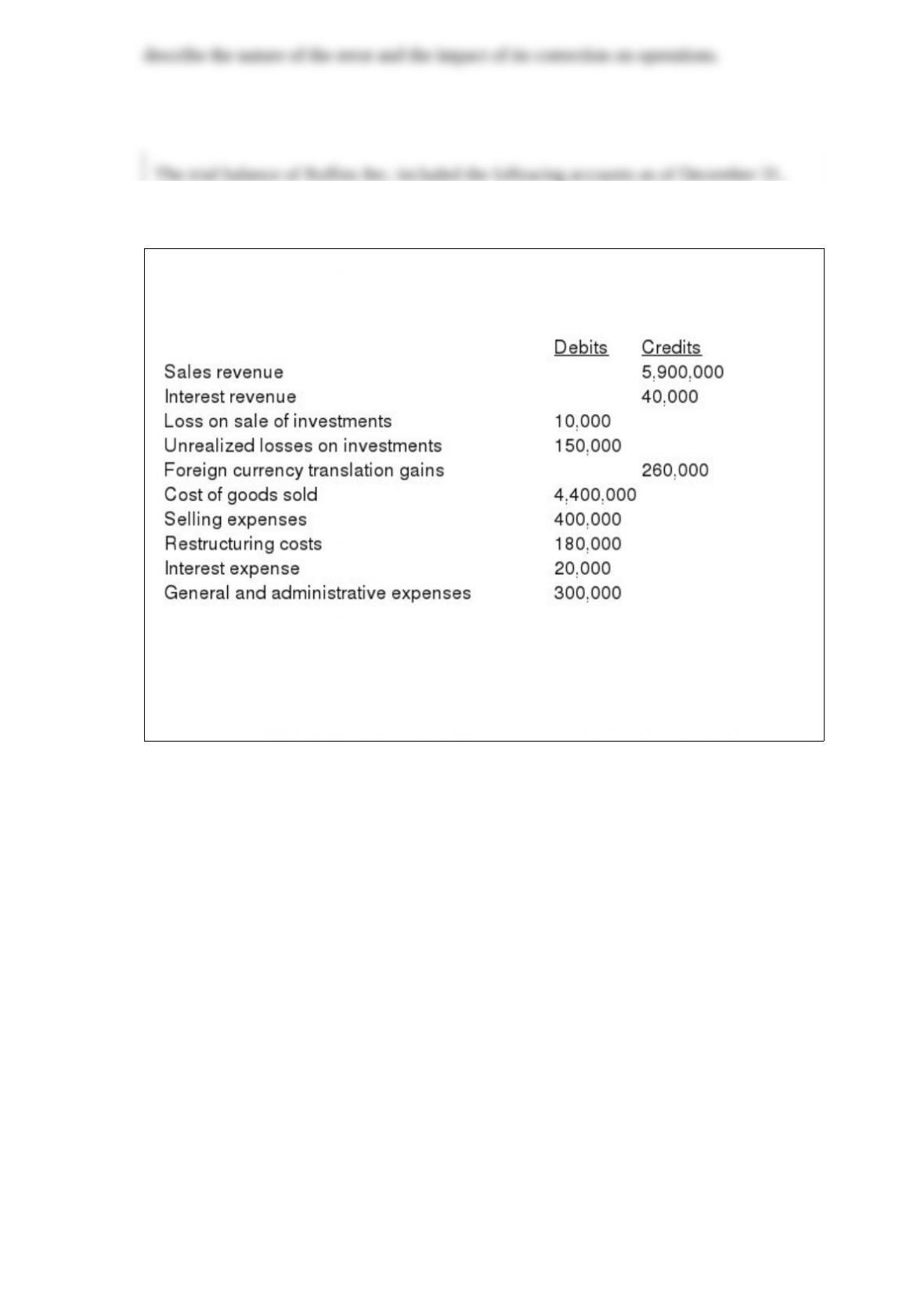
The trial balance of Rollins Inc. included the following accounts as of December 31,
2016:
Rollins had 100,000 shares of stock outstanding throughout the year. Income tax
expense has not yet been accrued. The effective tax rate is 40%.
Required: Prepare a 2016 single, continuous statement of comprehensive income for
Rollins Inc. Use a multiple-step income statement format.