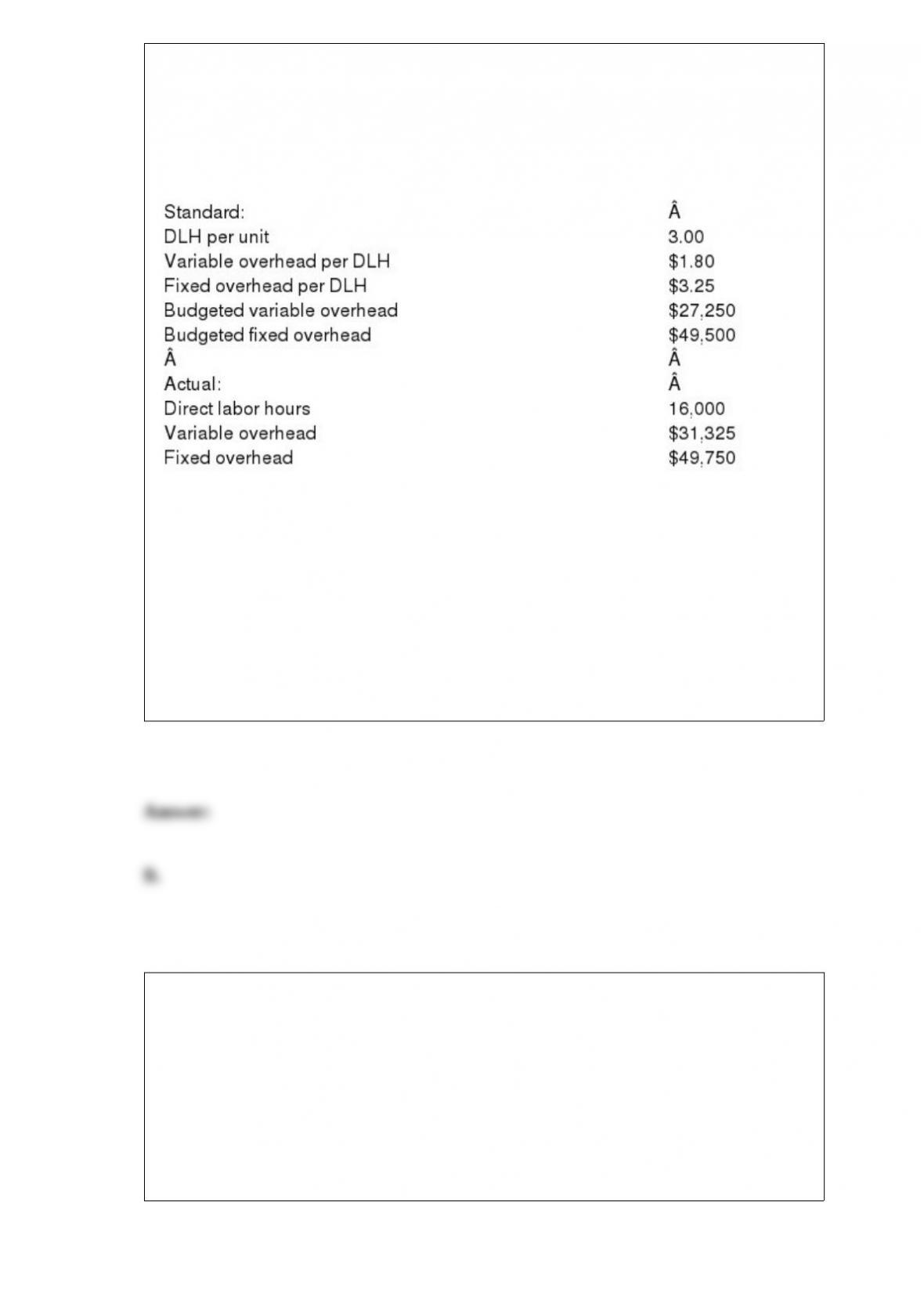
Commodore Company
Commodore Company uses a standard cost system for its production process and
applies overhead based on direct labor hours. The following information is available for
September when Commodore produced 5,000 units:
Refer to Commodore Company. Using the four-variance approach, what is the volume
variance?
A. $ 750 F
B. $ 750 U
C. $1,000 F
D. $1,000 U
The level of discretionary costs
A. are set by management for one period at a time.
B. cannot be changed in the short run.
C. are determined when capital investment is undertaken.
D. always varies with sales.

The method of pricing by-products/scrap where no value is assigned to these items
until they are sold is known as the
A. net realizable value at split-off point method.
B. sales value at split-off method.
C. realized value approach.
D. approximated net realizable value at split-off method.
In evaluating the profitability of a specific organizational segment, all ____ would be
ignored.
A. segment variable costs
B. segment fixed costs
C. costs allocated to the segment
D. period costs
A value chart indicates
A. all steps in a process and the time it takes for them to be completed.
B. the value-added steps in a process and the time it takes for them to be completed.
C. the time and cost of all value-added steps in a process.
D. the time and costs of all value-added and non-value-added steps in a process.
Transfer pricing is primarily incurred in
A. foreign corporations exporting their products.
B. decentralized organizations.
C. multinational corporations headquartered in the U.S.
D. closely held corporations.
The net realizable value approach is normally used when the NRV is expected to be
A. yes yes
B. no yes

C. no no
D. yes no
The term “cell” is used to describe
A. a grouping of one or more automated machines within a company.
B. a storage bin for “C” type inventory in an ABC inventory system.
C. files in a CAD/CAM system.
D. a factory’s area of conversion activity.
Most studies have indicated that what percent of a product’s total life-cycle costs are
determined in the development/design stage?
A. 60%-70%
B. 70%-80%
C. 80%-90%
D. 90%-95%

Kelly Company has 20,000 units in inventory that had a production cost of $4 per unit.
These units cannot be sold through normal channels due to a significant technology
change. These units could be reworked at a total cost of $30,000 and sold for $35,000.
Another alternative is to sell the units to a junk dealer for $10,500. The relevant cost for
Kelly to consider in making its decision is
A. $80,000 of original product costs.
B. $30,000 for reworking the units.
C. $110,000 for reworking the units.
D. $35,000 for selling the units to the junk dealer.
Which of the following is a false statement about scrap and by-products?
A. Both by-products and scrap are salable.
B. A by-product has a higher sales value than does scrap.
C. Management’s goal is to produce both scrap and by-products.
D. Both scrap and by-products are incidental outputs to the joint process.
Assume a company produces three products: A, B, and C. It can only sell up to 3,000
units of each product. Production capacity is unlimited. The company should produce
the product (or products) that has (have) the highest
A. contribution margin per hour of machine time.
B. gross margin per unit.
C. contribution margin per unit.
D. sales price per unit.
Conversion cost does not include
A. direct labor.
B. direct material.
C. factory depreciation.
D. supervisors’ salaries.
Tuscaloosa Company applies overhead to jobs at the rate of 40 percent of direct labor
cost. Direct material of $1,250 and direct labor of $1,400 were expended on Job #145
during September. On August 31, the balance of Job #145 was $2,800. The balance on
September 30 is:
A. $3,210.
B. $4,760.

C. $5,450.
D. $6,010.
CVP analysis is based on concepts from
A. standard costing.
B. variable costing.
C. job order costing.
D. process costing.
A unit that is rejected at a quality control inspection point, but that can be reworked
and sold, is referred to as a
A. spoiled unit.
B. scrap unit.
C. abnormal unit.
D. defective unit.