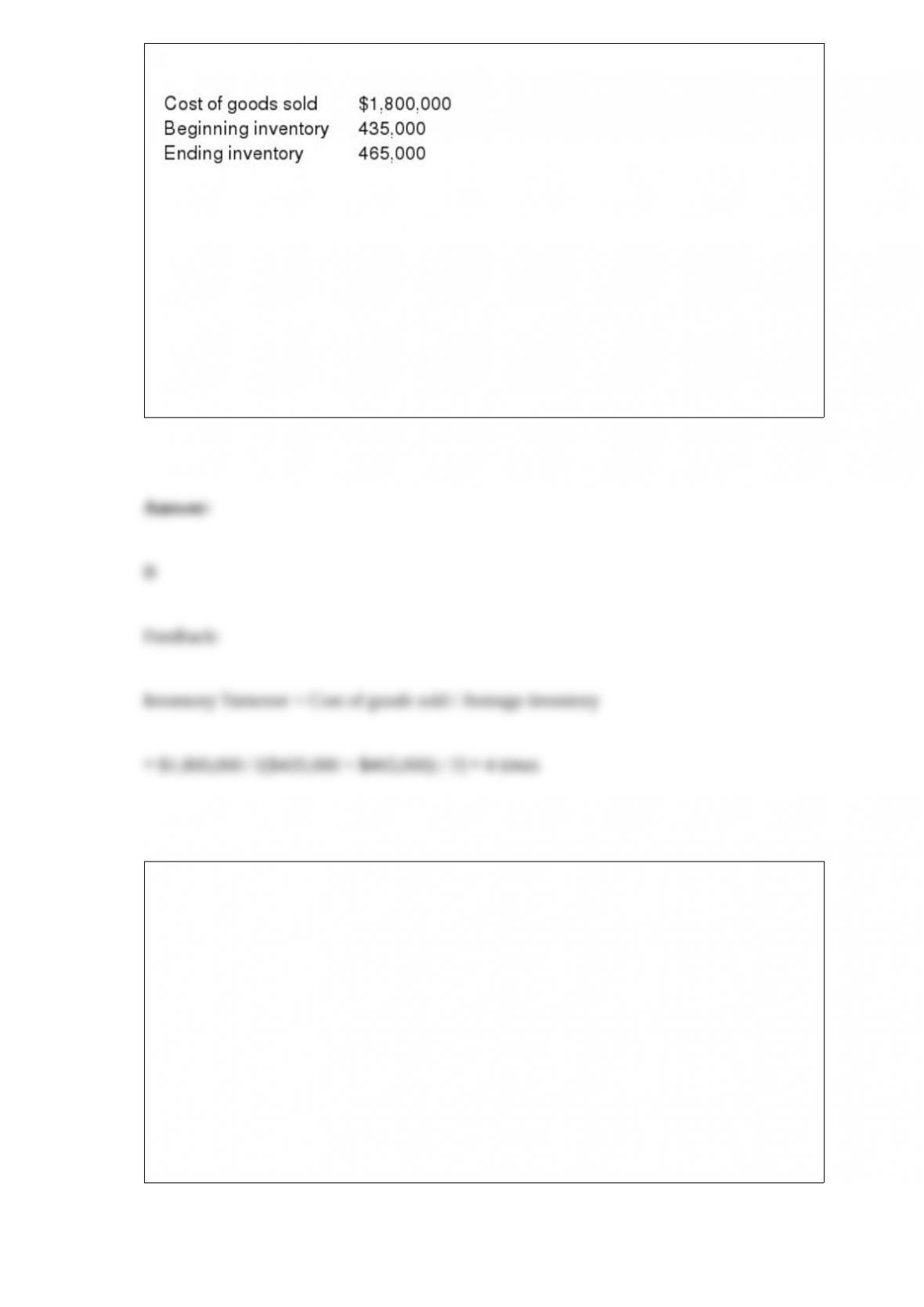
The records of Alberta Inc. included the following information:
Use the information above to answer the following question. What is the inventory
turnover ratio?
A) 3.87 times
B) 4.00 times
C) 4.14 times
D) 2.00 times
A retail chain sells 100 designer sheet sets for $199.99 a set; the company purchased
these sheet sets at $69.95 per set. The company also sells 1,000 basic sheet sets for
$49.99 a set. The company purchased these sheet sets at $24.99 per set. Operating
expenses equal $10,000.
Required:
Part a. Calculate the gross profit percentages of each product (rounded to the nearest
whole number).
Part b. Calculate the total gross profit.
Part c. Calculate income before income tax expense
Seconds Best Retail Store receives and immediately pays a $3,500 utility bill from the
City Gas & Electric Company. City Gas & Electric Company will record the receipt of
this payment with a journal entry that includes a:
A) credit to Accounts Payable
B) credit to Utilities Expense.
C) debit to Utilities Revenue.
D) debit to Cash.
The costs assigned to the individual assets acquired in a basket purchase are based on
their relative:
A) historical costs.
B) market values.
C) book values.
D) depreciable costs.
Which account is least likely to be credited when an expense is recorded?
A) Cash
B) Accounts Payable
C) An account with the word “Prepaid” in its title
D) Accounts Receivable
Which of the following statements about gross profit percentages is correct?
A) Because gross profit percentages are so consistent from period to period, they are
not very useful for analyzing one company over time.
B) Because gross profit percentages are so variable across industries, they are most
useful in comparing companies from different industries.
C) Because gross profit percentages are so variable across industries, they are more
useful in analyzing one company over time.
D) Because gross profit percentages are so consistent across industries, they are most
useful in comparing companies from different industries.
Extraordinary repairs:
A) are revenue expenditures.
B) extend an asset’s life beyond the original estimate.
C) are expensed as incurred.
D) are credited to Accumulated Depreciation.
A negative times interest earned ratio suggests that the company:
A) is using resources very efficiently.
B) has a serious financial problem.
C) has a very high interest expense.
D) has a high level of sales revenue.
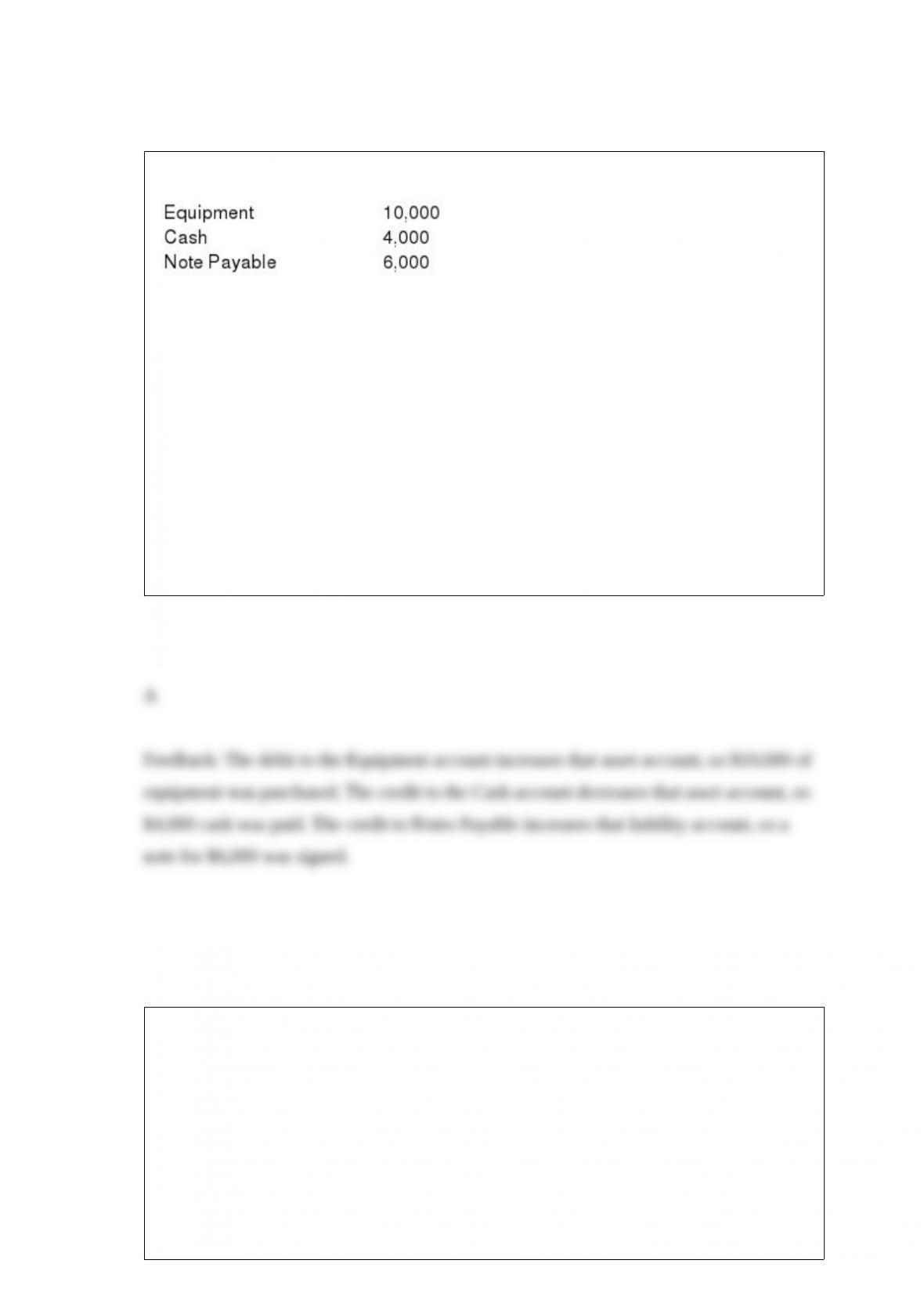
Consider the following journal entry:
Which of the following explanations best describes this journal entry?
A) The company buys $10,000 of equipment, pays cash of $4,000, and signs a note for
$6,000.
B) The company receives $4,000 in cash and $6,000 in notes payable in exchange for
selling $10,000 of equipment.
C) The company buys $10,000 of equipment, pays $4,000 cash, and promises to cancel
a debt owed to the company in the amount of $6,000.
D) The company sells $10,000 of equipment, receives $4,000 in cash, and pays off
$6,000 it owes on the equipment.
A company receives $100,000 cash from investors in exchange for stock. Several weeks
later, the company buys a $250,000 machine using all of the cash from the stock issue
and signing a promissory note for the remainder. The accounts involved in these two
transactions are:
A) Cash; Equipment; Noncurrent Investments; and Accounts Payable.
B) Cash; Noncurrent Investments; Common Stock; and Notes Payable.
C) Cash; Equipment; Common Stock; and Notes Payable.
D) Equipment; Notes Payable; and Retained Earnings.
When the lower of cost or market rule requires an inventory adjustment, the:
A) adjustment usually, but not always, reduces the book value of inventory.
B) write-down is usually reported as a part of cost of goods sold.
C) inventory adjustment is recorded in a contra-account called Inventory Allowances.
D) write-down does not affect any of the financial statements.
If a company receives $20,000 cash from its customers on account and uses the cash to
pay $20,000 to its suppliers on accounts, the net result is that:
A) assets would increase by $20,000 while liabilities would decrease by $20,000.
B) liabilities would decrease by $20,000 while stockholders’ equity would increase by
$20,000.
C) assets would decrease by $20,000 and liabilities would decrease by $20,000.
D) liabilities would decrease by $20,000 and stockholders’ equity would decrease by
$20,000.
Expenses are reported on the:
A) income statement in the time period in which they are paid.
B) income statement in the time period in which they are incurred.
C) balance sheet in the time period in which they are paid.
D) balance sheet in the time period in which they are incurred.
On the payment date for a cash dividend, the company:
A) debits Dividends and credits Dividends Payable for the amount of the dividend.
B) debits Dividend Expense and credits Cash for the dividend amount.
C) debits Dividends Payable and credits Cash for the dividend amount.
D) establishes who will receive the dividend payment.
Lakeview Inc. uses the allowance method. During the year, Lakeview concludes that
specific customers will never pay their account balances, which total $6,844. The entry
to record the write-off of these accounts receivable would debit:
A) Accounts Receivable and credit Allowance for Doubtful Accounts for $6,844.
B) Accounts Receivable and credit Bad Debt Expense for $6,844.
C) Bad Debt Expense and credit Accounts Receivable for $6,844.
D) Allowance for Doubtful Accounts and credit Accounts Receivable for $6,844.
Which of the following is not a characteristic of tangible long-lived assets?
A) Productive
B) Used over one or more years
C) Not intended for resale
D) Amortized over their useful lives