
1) the percentage-of-completion method must be used when certain conditions exist.
which of the following is not one of those necessary conditions?
a.estimates of progress toward completion, revenues, and costs are reasonably
dependable
b.the contractor can be expected to perform the contractual obligation
c.the buyer can be expected to satisfy some of the obligations under the contract
d.the contract clearly specifies the enforceable rights of the parties, the consideration to
be exchanged, and the manner and terms of settlement
2) didde company issues $15,000,000 face value of bonds at 96 on january 1, 2011. the
bonds are dated january 1, 2011, pay interest semiannually at 8% on june 30 and
december 31, and mature in 10 years. straight-line amortization is used for discounts
and premiums. on september 1, 2014, $9,000,000 of the bonds are called at 102 plus
accrued interest. what gain or loss would be recognized on the called bonds on
september 1, 2014?
a.$900,000 loss
b.$408,000 loss
c.$540,000 loss
d.$680,000 loss
3) thomas company, a company who uses ifrs reporting standards, is disposing of a
plant asset. the amount of gain or loss from this disposal is
a.reported as the difference between the sales proceeds and the carrying amount of the
asset
b.not reported
c.reported as the fair value less the recoverable amount
d.reported as the difference between the net cash flows of the productive years of the
asset and its carrying value
4) the statement of cash flows reports all of the following except
a.the net change in cash for the period
b.the cash effects of operations during the period
c.the free cash flows generated during the period
d.investing transactions
5) according to the fasb’s conceptual framework, the process of reporting an item in the
financial statements of an entity is
a.recognition
b.realization
c.allocation
d.matching
6) in classifying the elements of financial statements, the primary distinction between
revenues and gains is
a.the materiality of the amounts involved
b.the likelihood that the transactions involved will recur in the future
c.the nature of the activities that gave rise to the transactions involved
d.the costs versus the benefits of the alternative methods of disclosing the transactions
involved
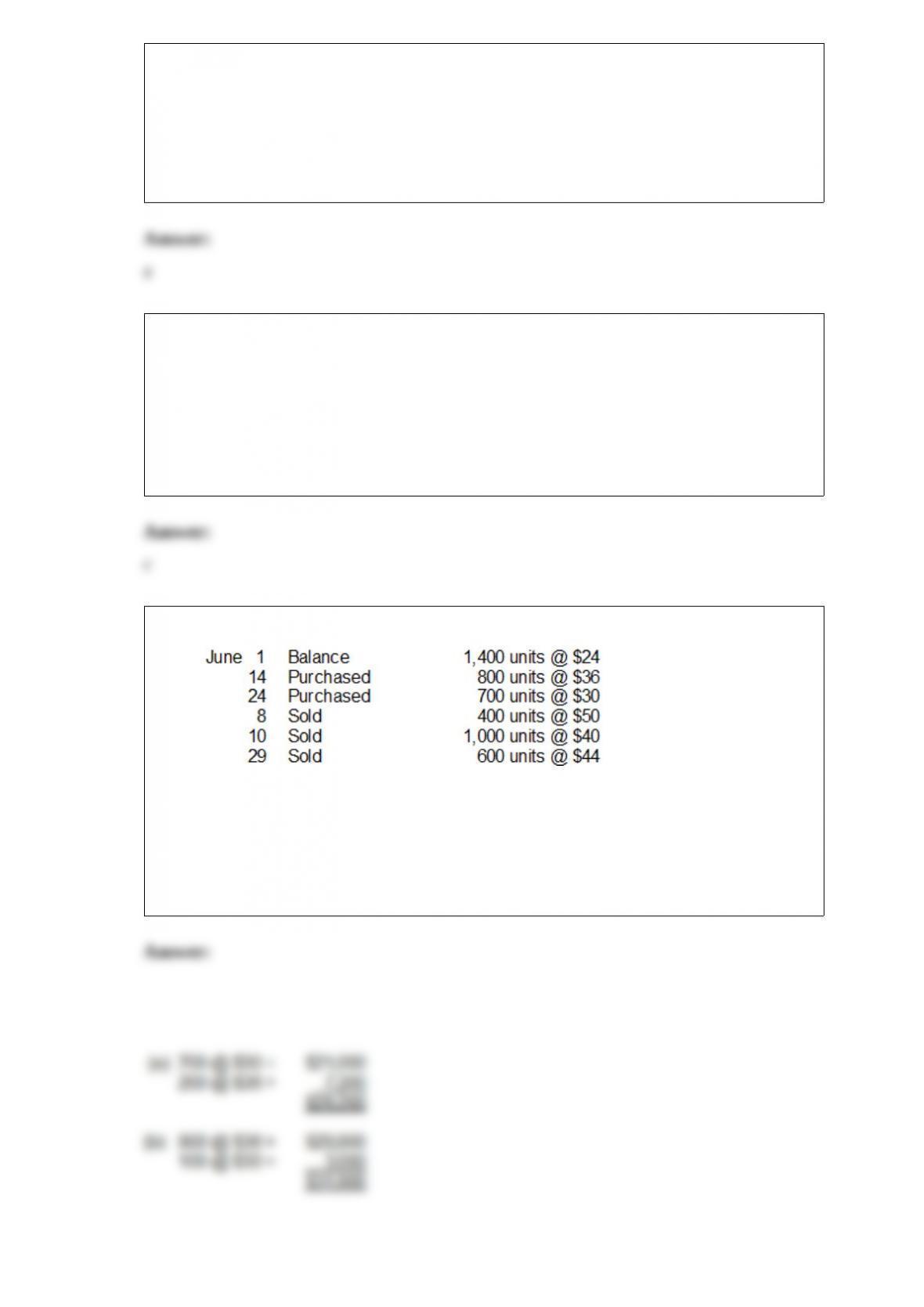
7) during june, the following changes in inventory item 27 took place:
perpetual inventories are maintained.
instructions
what is the cost of the ending inventory for item 27 under the following methods?
(show calculations.)
(a)fifo.
(b)lifo.

8) the following information was extracted from the accounts of essex corporation at
december 31, 2012:
cr(dr)
total reported income since incorporation$3,400,000
total cash dividends paid(1,600,000)
unrealized holding loss(240,000)
total stock dividends distributed(400,000)
prior period adjustment, recorded january 1, 2012150,000
what should be the balance of retained earnings at december 31, 2012?
a.$1,310,000
b.$1,400,000
c.$1,160,000
d.$1,550,000
9) the statement of cash flows helps meet the objective of financial reporting, which is
to assess all of the following except the
a.amount of future cash flows
b.source of future cash flows
c.timing of future cash flows
d.uncertainty of future cash flows
10) which of the following research and development related costs should be
capitalized and depreciated over current and future periods?
a.research and development general laboratory building which can be put to alternative
uses in the future
b.inventory used for a specific research project
c.administrative salaries allocated to research and development
d.research findings purchased from another company to aid a particular research project
currently in process
11) on january 1, martinez inc. issued $4,000,000, 11% bonds for $4,260,000. the
market rate of interest for these bonds is 10%. interest is payable annually on december
31. martinez uses the effective-interest method of amortizing bond premium. at the end
of the first year, martinez should report unamortized bond premium of:
a.$246,840
b.$246,000
c.$231,400

d.$220,000
12) the income statement reveals
a.resources and equities of a firm at a point in time
b.resources and equities of a firm for a period of time
c.net earnings (net income) of a firm at a point in time
d.net earnings (net income) of a firm for a period of time
13) percy corporation was organized on january 1, 2012, with an authorization of
1,200,000 shares of common stock with a par value of $6 per share. during 2012, the
corporation had the following capital transactions:
january 5issued 900,000 shares @ $10 per share
july 28purchased 120,000 shares @ $11 per share
december 31sold the 120,000 shares held in treasury @ $18 per share
percy used the cost method to record the purchase and reissuance of the treasury shares.
what is the total amount of additional paid-in capital as of december 31, 2012?
a.$-0-.
b.$2,760,000
c.$3,600,000
d.$4,440,000
14) securities which could be classified as held-to-maturity are
a.redeemable preferred stock
b.warrants
c.municipal bonds
d.treasury stock
15) anna has $30,000 to invest. she requires $50,000 for a down payment for a house. if
she is able to invest at 6%, how many years will it be before she will accumulate the
desired balance?
a.6 years
b.7 years
c.8 years

d.9 years
16) which of the following would represent the least likely use of an income statement
prepared for a business enterprise?
a.use by customers to determine a company’s ability to provide needed goods and
services
b.use by labor unions to examine earnings closely as a basis for salary discussions
c.use by government agencies to formulate tax and economic policy
d.use by investors interested in the financial position of the entity
17) woodson company, a company who uses ifrs reporting standards, has identified a
group of plant assets for disposal. on january 1, 2012, the carrying value of these assets
was
$17.5 million. the assets were revalued to $16.5 million on january 5, 2012, when they
were identified as property for the disposal group. in addition, woodson thinks that it
will cost
$1.5 million to sell these assets. what carrying amount should these assets reflect for
year-end financial statements to be prepared on january 10, 2012?
a.$17.5 million
b.$16.5 million
c.$16.0 million
d.$15.0 million
18) when a company uses lifo for external reporting purposes and fifo for internal
reporting purposes, an allowance to reduce inventory to lifo account is used. this
account should be reported
a.on the income statement in the other revenues and gains section
b.on the income statement in the cost of goods sold section
c.on the income statement in the other expenses and losses section
d.on the balance sheet in the current assets section
19) simpson company applies revaluation accounting to plant assets with a carrying
value of $1,600,000, a useful life of 4 years, and no salvage value. depreciation is

calculated on the straight-line basis. at the end of year 1, independent appraisers
determine that the asset has a fair value of $1,500,000.
the journal entry to adjust the plant assets to fair value and record revaluation surplus in
year one will include a
a.debit to accumulated depreciation for $100,000
b.credit to depreciation expense for $300,000
c.credit to plant assets for $300,000
d.credit to revaluation surplus for $300,000
20) on february 1, 2012, henson company factored receivables with a carrying amount
of $500,000 to agee company. agee company assesses a finance charge of 3% of the
receivables and retains 5% of the receivables. relative to this transaction, you are to
determine the amount of loss on sale to be reported in the income statement of henson
company for february.
assume that henson factors the receivables on a with recourse basis. the recourse
obligation has a fair value of $2,500. the loss to be reported is
a.$15,000
b.$17,500
c.$25,000
d.$42,500