Additional paid-in-capital represents:
A. The difference between the total amounts invested by the stockholders and the par or
stated value of the stock.
B. Distributions of earnings that have been made to the stockholders.
C. Distributions of earnings that have not been made to the stockholders.
D. The summation of the total amount invested by the stockholders and the par or stated
value of the stock.
In the buyer’s records, the purchase of merchandise on account would:
A. increase assets and increase expenses.
B. increase assets and increase liabilities.
C. increase liabilities and increase paid-in capital.
D. have no effect on total assets.
Another term frequently used to describe stockholders’ equity is:
A. net assets.
B. gross assets.
C. paid-in capital.
D. capital stock.
Cost accounting is concerned with:
A. accumulation and determination of product, process or service cost.
B. income measurement and inventory valuation.
C. generally accepted accounting principles.
D. all of the above.
Which of the following would not appear in the operating expense budget?
A. sales commissions.
B. delivery expense.
C. advertising.
D. depreciation on the production equipment.
Major classifications of accounting activity would not include:
A. financial accounting, internal auditing, public accounting.
B. internal auditing, governmental accounting, managerial accounting.
C. financial accounting, national accounting, cost accounting.
D. auditing, income tax accounting, governmental accounting.
The principal reason for converting a customer’s account receivable to a note receivable
is:
A. the note receivable earns interest and the account receivable does not.
B. the receivable is less likely to have to be written off as uncollectible.
C. working capital is immediately increased.
D. the customer is more likely to continue purchasing the company’s products.
If variable costs are 35% of sales and sales increase by $50,000 this month because of a
special promotion, by how much will contribution margin increase?
A. $17,500.
B. $25,500.
C. $32,500.
D. $50,000.
Which of the following accounts/captions are not ever included in the calculation for
Gross Profit?
A. Revenues.
B. Cost of Goods Sold.
C. Net Sales.
D. General and Selling Expenses.
Which of the following is NOT an inventory account for a manufacturing company?
A. Cost of goods sold.
B. Work-in-process.
C. Raw materials.
D. Finished goods.
When a company issues a bond at a discount:
A. the company will pay less than the face amount of the bond at its maturity.
B. the company will pay more than the face amount of the bond at its maturity.
C. the company’s interest expense will be less than the interest paid each year.
D. the company’s interest expense will be more than the interest paid each year.
The adjusting entry to accrue Interest Expense results in:
A. an increase in Interest Expense.
B. a decrease in Interest Expense.
C. a decrease in Cash.
D. a decrease in Interest Payable.
Southern Company’s accountant failed to accrue as of 12/31/16 some employee fringe
benefit program expenses that were incurred in 2016 and that will be paid in 2017. The
result of this omission is to:
A. overstate 2016 net income and understate noncurrent liabilities at 12/31/16.
B. understate 2016 expenses and understate current liabilities at 12/31/16.
C. understate 2016 expenses and overstate current liabilities at 12/31/16.
D. understate 2016 net income and overstate assets at 12/31/16.
Which of the following is not an important factor to consider when preparing a sales
forecast?
A. the state of the economy.
B. seasonal demand variations.
C. a change in the management team.
D. competitors’ actions.
At the beginning of the fiscal year, the balance sheet showed assets of $2,728 and
stockholders’ equity of $1,672. During the year, assets increased $148 and liabilities
decreased $76.
Liabilities at the end of the year totaled:
A. $980
B. $1,056
C. $1,672
D. $1,820
A firm has an ROI of 15%, turnover of 3, and sales of $12 million. The firm’s margin is:
A. $1,800,000
B. 5%
C. 30%
D. $600,000 15% = ? * 3

An unqualified auditors’ opinion about an entity’s financial statements:
A. is a clean bill of health.
B. means that all of the entity’s transactions during the audited period were checked out.
C. guarantees that the entity was not involved in or the victim of any fraudulent
activities during the audited period.
D. states that they are presented in conformance with U.S. generally accepted
accounting principles.
The financial leverage characteristic of long-term debt results in:
A. a reduction of the risk that creditors will not be paid.
B. a magnification of ROE relative to what it would be without long-term debt.
C. a magnification of ROI relative to what it would be without long-term debt.
D. the deductibility, for income tax purposes, of dividends to stockholders.
Income from operations is:
A. sometimes called the “bottom line.”
B. sometimes used in the ROI calculation.
C. usually used in the ROE calculation.
D. usually calculated after income tax expense.
Cost management initiatives along an organization’s value chain functions begins with
__________ and concludes with __________.
A. marketing; production
B. research and development; customer service
C. design; production
D. production; distribution
Discounting a future cash inflow at an 8% discount rate will result in a higher present
value than discounting it at a:
A. 7% rate.
B. 8% rate.
C. 9% rate.
D. all of the above.
Val’s travel budget for October was $720, based on her plan to drive 3,000 miles at a
cost of $0.24 per mile. During October, she actually drove 2,800 miles at a total cost of
$700. A flexed budget performance report would show a variance of:
A. $50 F.
B. $20 F.
C. $28 U.
D. $30 U.
Business segment information is included in the notes to financial statements because:
A. the amounts shown on the financial statements of most companies are just too large
to comprehend.
B. current and potential investors can make more informed judgments about the
company.
C. net income from various geographic areas can be clearly determined.
D. by combining these amounts for each segment, ROI and cash flows for the company
as a whole can be determined.
The current assets of most companies are usually made up of:
A. assets that are currently used in the operations of the company.
B. cash and assets expected to be converted to cash within a year.
C. a very small proportion (less than 10%) of the total assets of the entity.
D. cash, marketable securities, and accounts and notes receivable.

The fixed manufacturing overhead variance caused by actual activity being different
from the estimated activity used in calculating the predetermined overhead application
rate is called the:
A. spending variance.
B. budget variance.
C. efficiency variance.
D. volume variance.
Managerial accounting, as opposed to financial accounting, is primarily concerned
with:
A. preparing the current balance sheet of the company.
B. present and future planning and control.
C. providing information to investors and creditors.
D. historical results of operations.
Many current liabilities are affected by accrual accounting entries. This happens
because:
A. liabilities are usually paid when they are incurred.
B. accrual accounting involves recognizing liabilities before they are paid.
C. the only way to reduce a liability account balance is with an adjusting entry.
D. accrual accounting frequently involves recognizing liabilities before they are
incurred.
Selling price per unit $100 Variable expenses per unit $40 Fixed expenses per month
$60,000
If sales volume were to decrease 10%, from 4,000 units per month to 3,600 units per
month, operating income would:
A. not change.
B. decrease $10,000.
C. decrease $24,000.
D. decrease $40,000.
Preferred stock is used much less than long-term debt in the capital structure of most
industrial and merchandising companies principally because:
A. the preferred stock dividend requirement is a fixed claim against income, but interest
on long-term debt is not a fixed amount.
B. preferred stock has a fixed liquidation or redemption value, but long-term debt does
not have a fixed maturity value.
C. preferred stock may be convertible to common stock, but long-term debt cannot be
convertible.
D. for income tax purposes, dividends paid on preferred stock are not deductible, but
interest on long-term debt is deductible.
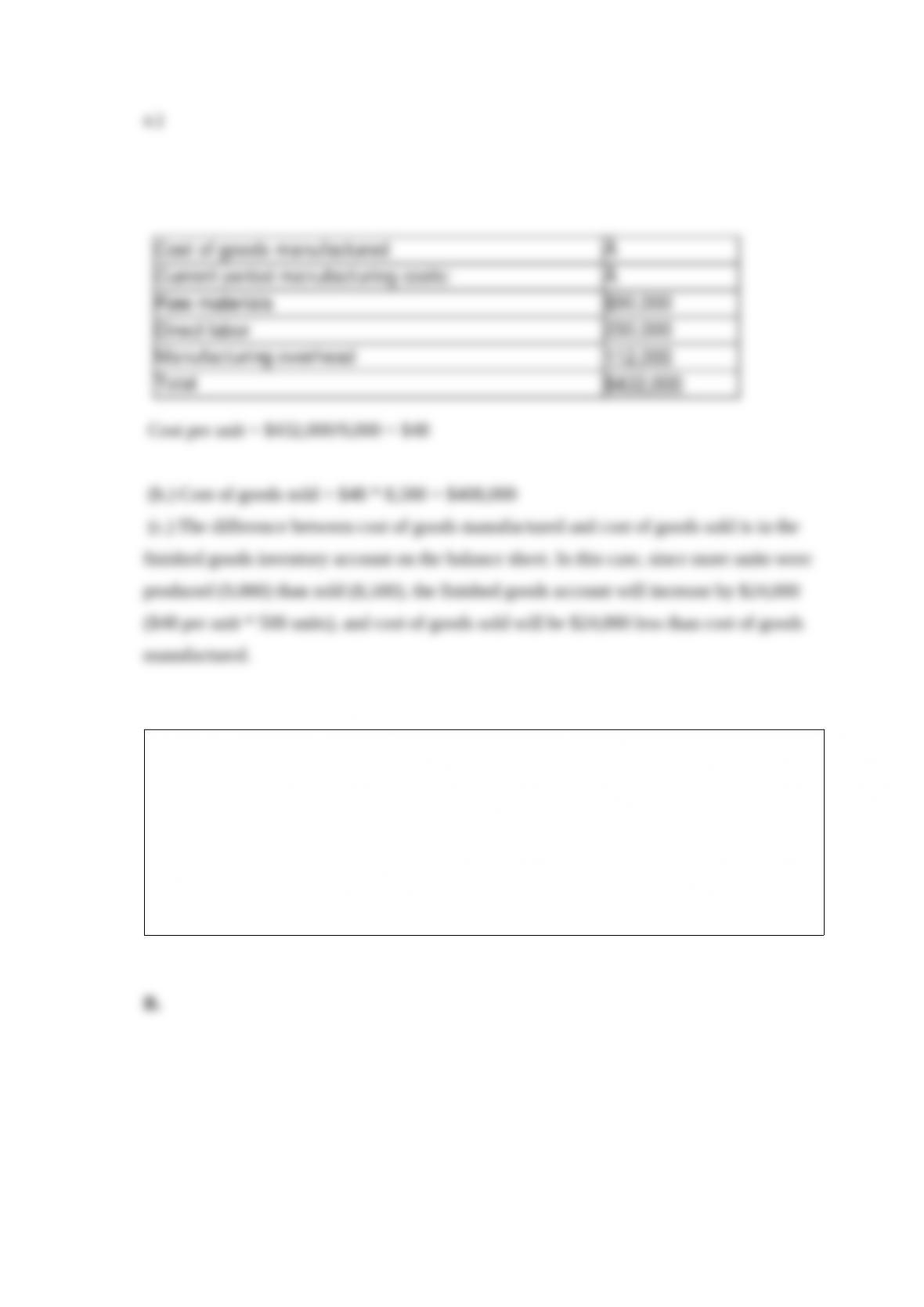
AAA Plumbing Co. incurred the following costs during August:
During the month, 9,000 units of product were manufactured and 8,500 units of product
were sold. On August 1, AAA Plumbing carried no inventories.
(a.) Calculate the cost of goods manufactured during August and the average cost per unit
of product manufactured.
(b.) Calculate the cost of goods sold during August.
(c.) Where in the financial statements will the difference between cost of goods
manufactured and cost of goods sold be classified?
The concept of matching revenue and expense refers to the fact that:
A. expenses for a period equal the revenues for the period.
B. all costs incurred in the process of earning revenues during a period are recorded as
expenses in that period.
C. all cash disbursements during a period are subtracted from all cash receipts during
the period.
D. costs incurred in the process of earning revenues during a period are deferred and
expensed in a future period.