When referring to a cost function, plausibility refers to whether you can rely upon the
cost function for predicting the future.
Two popular methods for allocating service department costs to user departments are
the direct method and the step-up method.
Full cost means the total of all manufacturing costs.
Customers, departments and territories are examples of cost objects.
Good performance measures should only focus on long-term concerns.
Free cash flow equals net cash from operating activities minus capital expenditures.
The variable-costing method regards fixed manufacturing costs as a period expense
when incurred.
Period costs become expenses during a future period.
Variable costing is more important for external reports than internal reports.
Account analysis is used to identify appropriate cost drivers and their effects on the
costs of making a product or providing a service.
Budgeted performance goals generally provide a better basis for evaluating actual
performance than past performance.
The Investment in Subsidiary account appears on a consolidated balance sheet.
It is profitable to extend processing or to incur additional costs on a joint product if the
additional revenue exceeds the joint cost.
Cash dividends are reported as an expense on the Income Statement.
Accountants are sometimes forced to trade relevant information for accurate
information.
Liquidity ratios focus on whether there are sufficient current assets to satisfy current
liabilities as they come due.
In a multinational setting, low transfer prices generally lead to low import duties.
In job-order costing, the journal entry to record applied overhead costs would include a
Debit to Work-in-Process Inventory.
Additional costly information should be acquired when the expected benefit of an
improved decision exceeds the cost of the information.
Elimination entries avoid double-counting assets, liabilities and stockholders’ equity on
the consolidated financial statements.
When the amount of overhead applied to a product exceeds the amount incurred to
make the product, the difference is called overapplied overhead.
The present value of tax savings from depreciation is greater for straight-line
depreciation than an accelerated depreciation method.
When allocating fixed costs from service departments to user departments, a
predetermined lump-sum allocation based on the long-range capacity available to the
user should be used.
A well-designed management control system ignores nonfinancial objectives and
focuses on financial objectives to develop and report performance measures.
A decision made during long-range planning includes whether to delete a product from
a company’s product line.
Computer-integrated manufacturing systems do not use robots.
A cash payment of accounts payable does not affect stockholders’ equity.
The CVP graph shows how costs behave over different relevant ranges.
The minimum desired rate of return for an investment under the NPV method is based
on the cost of capital.
In perfect competition, the marginal revenue curve is a vertical line equal to the price
per unit at all volumes of sales.
A full-cost transfer price can potentially create dysfunctional decisions.
Incentives do not increase managerial effort toward goal congruence.
Variances are deviations from planned results.
Outsourcing is the purchase of products or services by a company from an outside
supplier.
A subsidiary is a company that owns more than 50 percent of another company’s
outstanding common stock.
Naperville Corporation has a joint process that produces three products: P, G and A.
Each product may be sold at split-off or processed further and then sold.
Joint-processing costs for a year amount to $25,000. The production level for each
product is 10,000 units. Other data follows:
Sales Value Separable Processing Sales Value
Product at Split-Off Costs after Split-Off at Completion
P $12 $8 $21
G 10 4 17
A 15 6 19
Processing Product P beyond the split-off point will cause profits to ________.
A) be unchanged
B) increase by $10,000
C) increase by $80,000
D) increase by $90,000
Differential revenue is the difference in ________ between two alternatives.
A) average revenue
B) marginal revenue
C) median revenue
D) total revenue
Which budget guides day-to-day operations in a business?
A) sales budget
B) strategic plan
C) master budget
D) long-range plan
Arizona Company is considering two investments. The relevant data follows:
Project A Project B
Cost $205,010 $259,770
Annual cash savings (end of year) $50,000 $60,000
Terminal salvage value $0 $0
Estimated useful life in years 5 5
Minimum desired rate of return 10% 10%
Method of depreciation Straight-line Straight-line
Present Value Present Value
Of $1 of Ordinary
for 5 periods Annuity of $1
for 5 periods
5% 0.7835 4.3295
6% 0.7473 4.2124
7% 0.713 4.1002
8% 0.6806 3.9927
10% 0.6209 3.7908
12% 0.5674 3.6048
14% 0.5194 3.4331
Ignore taxes. Using the internal rate of return method, which project should be
accepted?
A) Project A only
B) Project B only
C) Project A and Project B
D) neither Project A nor Project B
The statement of changes in stockholders’ equity shows the changes in ________.
A) retained earnings only
B) dividends only
C) each of the stockholders’ equity accounts
D) fixed assets only
In a process costing system, which of the following entries is prepared to transfer a
finished food product from the cooking process to the packaging process?
A) Debit Work-In-Process Inventory—Cooking, Credit Work-In-Process Inventory—
Packaging
B) Debit Finished Goods Inventory—Credit Work-In-Process Inventory—Packaging
C) Debit Work-In-Process Inventory—Packaging, Credit Work-In-Process Inventory—
Cooking
D) Debit Work-In-Process Inventory—Packaging, Credit Finished Goods Inventory
________ is the additional cost resulting from producing and selling one additional
unit.
A) Marginal cost
B) Common cost
C) Opportunity cost
D) Target cost
Assuming a company uses a cost-based pricing system for transfer pricing, which of the
following items would NOT be used?
A) variable-costing only
B) full-costing plus profit only
C) full-costing only
D) fixed-costing only
The internal rate of return method and the ________ method usually result in the same
investment decisions.
A) payback period
B) accounting rate of return
C) net present value
D) return on investment
Purple Company has three service departments, X, Y and Z and two production
departments, P1 and P2. Costs in Departments X and Y are allocated based on square
feet and costs in Department Z are allocated based on direct labor hours.
The following data are available:
Direct costs Square feet occupied Direct labor hours
Service Department:
X $100,000 6,000 13,000
Y $225,000 4,000 7,000
Z $480,000 2,000 4,000
Producing Department:
P1 $750,000 10,000 20,000
P2 $600,000 6,000 10,000
Assume the direct method of allocating service department costs is used.
Required:
A) What is the total cost of Producing Department P1 after allocating the service
departments’ costs?
B) What is the total cost of Producing Department P2 after allocating the service
departments’ costs?
Jennifer is the management accountant in Beck Company. A supplier to Beck Company
offers Jennifer free tickets to several NASCAR races. If Jennifer accepts the supplier’s
offer, she violates the IMA’s ethical standard of ________.
A) competence
B) confidentiality
C) credibility
D) integrity
The proration method of disposing of overhead variances assigns the variance in
proportion to the sizes of the ending account balances of ________.
A) work-in-process inventory, finished goods inventory and direct materials inventory
B) work-in-process inventory, direct materials inventory and cost of goods sold
C) work-in-process inventory and direct materials inventory
D) work-in-process inventory, finished goods inventory and cost of goods sold
Which of the following is NOT a valid step when designing an activity-based cost
accounting system?
A) Determine the key components of the system.
B) Determine the relationships between cost objects, activities, and resources.
C) Collect relevant data concerning costs and cost drivers.
D) Use a process map to identify areas for operational improvement.
A disadvantage of the high-low method to estimate a cost function is ________.
A) historical data may hide past inefficiencies
B) historical data may be obsolete
C) historical data may not reflect changes made in the organization
D) all of the above
Michael Company manufactures two models of pens, a standard model and a deluxe
model. Three activities have been identified in the production of the pens. The
following information is available:
Number of Number of Number of Direct
Product Setups Components Labor Hours
Standard 22 8 375
Deluxe 28 12 225
Cost Pool Total Costs Cost Driver
Setup Costs $15,000 Number of setups
Assembly Costs $36,000 Number of components
Labor Costs $9,000 Number of direct labor hours
If activity-based costing is used, the total cost assigned to the deluxe model is
________.
A) $22,500
B) $26,625
C) $33,375
D) $37,500
The adjusting entry that recognizes revenue earned on deferred revenues results in a(n)
________.
A) increase in liabilities and a decrease in stockholders’ equity
B) decrease in liabilities and a decrease in stockholders’ equity
C) increase in liabilities and an increase in stockholders’ equity
D) decrease in liabilities and an increase in stockholders’ equity
The West and East Divisions are divisions in the same company. Currently the East
Division buys a part from West Division for $384 per unit. The West Division wants to
increase the price of the part it sells to East Division by $96 to $480. The manager of
the East Division has stated that he cannot pay that much insofar as the division’s profit
goes below zero. The manager of the East Division can buy the part from an outside
supplier for $448 per unit. The cost data pertaining to the part is supplied by the West
Division:
Direct materials $136
Direct labor 200
Variable overhead 40
Fixed overhead 42
If West Division does not produce the parts for the East Division, it will be able to
avoid one-third of the fixed manufacturing overhead costs. The West Division has
excess capacity but no alternative uses for the facilities. West Division normally sells
the part outside the company for $400 per unit. What is the minimum transfer price per
unit that West Division should charge East Division?
A) $376
B) $390
C) $400
D) $448
Which of the following outputs would NOT use a process costing system?
A) flour
B) glass
C) toothpaste
D) building
Seidner Company has the following information available:
Total fixed costs $80,000
Targeted after-tax net income $18,000
Contribution margin per unit $2.00
Tax rate 40%
How many units must be sold to achieve the targeted after-tax net income?
A) 45,400
B) 49,000
C) 55,000
D) 62,500
A plant asset of $180,000 is expected to generate $80,000 in operating cash savings
(excluding depreciation expense) annually for three years. Assume straight-line
depreciation is used. The useful life is 3 years. The asset has no expected residual value.
Ignore income taxes. The accounting rate of return based on the initial investment is
________.
A) 11.11%
B) 16.67%
C) 33.33%
D) 44.44%
The Helium Company held a Christmas party. The company expected attendance of 100
people and prepared the following budget:
Hotel room rental $500
Food 500
Entertainment 800
Decorations 300
Total Costs $2,100
One hundred people attended the party. The following costs were incurred:
Hotel room rental $575
Food 640
Entertainment 750
Decorations 350
Total Costs $2,315
What is the variance for total costs?
A) $215 Unfavorable
B) $215 Favorable
C) $25 Favorable
D) $140 Unfavorable
Which of the following statements is FALSE?
A) Traditional costing systems generally assign only production costs to products.
B) Traditional costing systems use a single cost pool for all indirect production costs.
C) Traditional cost systems work well with simple production processes.
D) Traditional cost systems allocate a cost pool to cost objects using multiple cost
drivers.
Jerome Company has two service departments, Maintenance and Human Resources.

Jerome Company also has two production departments, Mixing and Finishing.
Maintenance costs are allocated based on square footage while Human Resource costs
are allocated based on number of employees. The following information has been
gathered for the current year:
Human
Maintenance Resources Mixing Finishing
Direct costs $126,000 $84,000 $105,000 $175,000
Square footage 800 400 1,600 1,200
Number of employees 8 12 24 32
If the direct method is used to allocate service department costs, then the total cost of
the Finishing Department after allocation would be ________.
A) $48,000
B) $102,000
C) $175,000
D) $277,000
Bradley Company manufactures generic notebooks. Material is introduced at the
beginning of the process in the Printing Department. Conversion costs are applied
uniformly throughout the process. The weighted-average method of process costing is
used. Data for the Printing Department for the month of June follow:
Work-In-Process Inventory, June 1:
Units 15,000
Direct materials (100% complete) $34,000
Conversion costs (30% complete) $14,000
Units started in June 65,000
Units completed in June 62,000
Work-In-Process Inventory, June 30 18,000
Direct materials added in June $285,000
Conversion costs added in June $210,000
With regard to the Work-In-Process Inventory on June 30, materials are 100 percent
complete and conversion costs are 50 percent complete. What are the equivalent units
for conversion costs for June?
A) 62,000
B) 68,300
C) 71,000
D) 80,000
A five-year MACRS asset that cost $50,000 was sold at the end of its useful life for
$20,000. The book value of the asset at the time of sale was $0. The asset had no
expected terminal value. The tax rate is 20%. What is the net after-tax cash effect from
the sale of the asset?
A) $16,000 cash inflow
B) $16,000 cash outflow
C) $24,000 cash inflow
D) $24,000 cash outflow
Cudahy Company had the following transactions:
1. The owner started the company by investing $10,000 of cash.
2. The company paid $2,000 for six months of rent. The rent was paid in advance.
3. The company acquired $3,000 in inventory for cash.
4. The company sold inventory costing $1,400 for $2,900 on account.
After all these transactions, what is the balance in the cash account?
A) $2,100
B) $3,500
C) $5,000
D) $8,000
I want to know where a company stands financially at December 31, 2014. Which
financial statement should I use?
A) statement of cash flows
B) statement of stockholders’ equity
C) statement of retained earnings
D) balance sheet
________ models are mathematical models that can react to any set of assumptions
about sales, costs and product mix.
A) Strategic
B) Long-range
C) Financial planning
D) Operating budget
Which of the following cost is relevant to the decision whether to process joint products
beyond the split-off point?
A) joint costs
B) allocated joint costs
C) separable costs
D) additional revenue from further processing beyond split-off point
If market prices are not available for transfer prices, most companies use ________
transfer prices.
A) negotiated
B) average
C) cost-based
D) activity-based
Rainbow Company is considering the production of a new product. Rainbow Company
has the following data available:
Expected product life 5 years
Expected sales (units) over product life 2,000
Variable production costs $42 per unit
Variable selling costs $16 per unit
Annual fixed production costs $15,000
Annual fixed selling costs $5,000
What is the total fixed cost of the product over the product life cycle?
A) $20,000
B) $100,000
C) $116,000
D) $464,000
No matter how many technical experts a company uses in forecasting, the sales budget
should ultimately be the responsibility of the ________.
A) economists
B) CEO
C) line managers
D) market research staff
If an employee observes unethical behavior in an organization, the employee is first
obligated to ________.
A) report the behavior to the police
B) report the behavior to his or her supervisor
C) report the behavior to the Securities and Exchange Commission
D) follow the company’s policies for unethical behavior
When comparing projects using the total project approach, a manager should choose the
project with the ________.
A) smallest net present value
B) largest net present value
C) zero net present value
D) largest differential net present value
The balances on December 31, 2015 are available for Jennifer Company:
Accounts payable $2,550
Accounts receivable 3,550
Accumulated depreciation 6,250
Retained earnings, December 31, 2014 ?
Cash 2,300
Cost of goods sold 52,300
Depreciation expense 2,500
Dividends declared 8,800
Equipment 29,000
Income tax expense 10,700
Interest expense 1,150
Inventory 6,250
Long-term notes payable 11,500
Paid-in capital 4,450
Prepaid rent 350
Rent expense 4,000
Sales 118,600
Wage expense 31,900
Wages payable 3,000
Required:
Prepare a classified balance sheet at December 31, 2015.
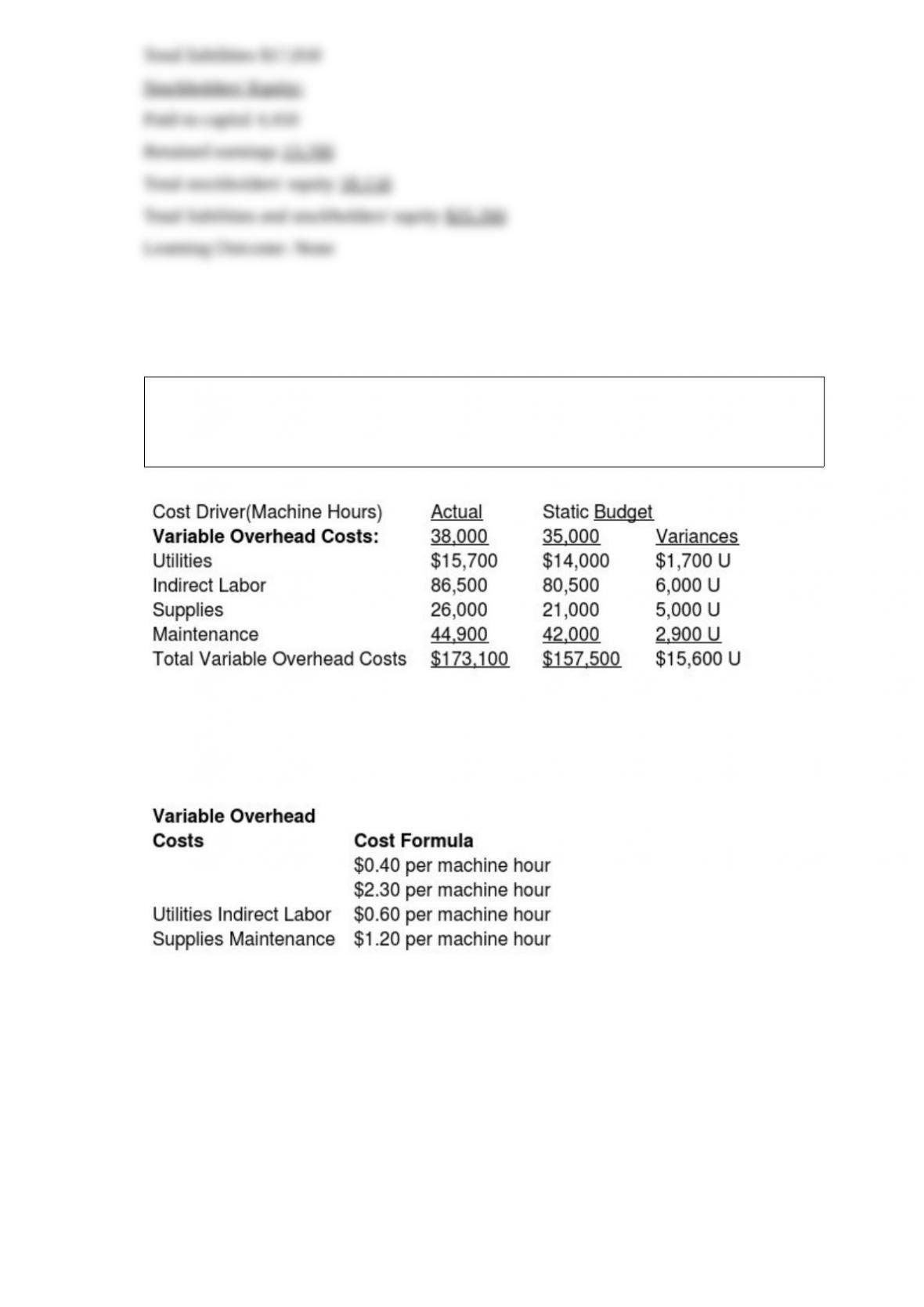
Sunday Corporation prepared the following performance report for variable overhead
costs for the last quarter of the year. Machine hours are the cost driver for all overhead
costs.
The cost formulas used for the variable overhead costs are:
Your boss called you into the office and reprimanded you for the unfavorable variances.
The boss says you are fired unless you can explain why the variances are all unfavorable.
Required:
Calculate the flexible budget variances and the activity-level variances for each cost.
Jorgensen Company has the following data:
Month Budgeted Sales
April $154,000
May 160,000
June 142,000
July 136,000
Budgeted Operating Expenses Per Month
Wages $12,600
Advertising 27,200
Depreciation 19,000
Rent 20,400
Freight-out 20% of sales
Sales commission 5% of sales
Required:
Prepare a schedule of cash disbursements for operating expenses for April, May and
June. All cash expenses are paid when incurred.
Foward Company had the following data available:
Net income for the year ending December 31, 2015 $50,000
Dividends declared during 2015 $47,000
Dividends paid during 2015 $32,000
Paid-in capital, January 1, 2015 $45,000
Retained earnings, January 1, 2015 $59,000
Required:
Prepare a statement of retained earnings for Forward Company for the year ended
December 31, 2015.
Kulvekowski Company manufactures aircraft parts. A backflush costing system is used
and standard costs for the part follow:
Direct materials $1.50
Conversion costs $2.00
The parts are scheduled for production only after orders are received. They are shipped
immediately upon completion. Product costs are charged directly to Cost of Goods
Sold. In July, 6,000 parts were produced and immediately shipped to the customer.
Materials were purchased for cash at a cost of $10,000 and actual conversion costs were
$12,000.
Required:
Prepare the necessary journal entries.
Whitney Company has just completed its first year of operations. The company’s
accountant has prepared an absorption costing income statement for the year as seen
below:
Sales (35,000 units at $25) $875,000
Beginning Inventory 0
Cost of Goods Manufactured (35,000 × $12) + $160,000 = 580,000
Cost of Goods Available 580,000
Ending Inventory 0
Cost of Goods Sold 580,000
Gross Margin 295,000
Selling and Administrative Expenses 280,000
Net Income $15,000
The variable production costs per unit are determined as follows:
Direct materials $5
Direct labor 6
Variable production 1
Total variable production costs $12
The company’s fixed production costs are $160,000 per year. The company’s selling and
administrative expenses consist of $210,000 per year in fixed expenses and $2 per unit
in variable expenses.
Required:
Prepare the company’s income statement in the contribution format.
Wyoming Company had the following information for the year ended December 31,
2015 and December 31, 2016.
December 31, 2016 December 31, 2015
Equipment $186,000 $156,000
Accumulated depreciation 62,000 54,000
Depreciation expense for the year ended December 31, 2016 was $18,000. Equipment
that cost $20,000 was sold at a $3,000 loss. The equipment had accumulated
depreciation of $10,000.
Required:
Prepare the investing section of the statement of cash flows for the year ended
December 31, 2016.
A manufacturing company has identified several costs. Indicate whether each of the
following costs is an Inventoriable cost(I) or a Period cost(P):
_____ 1. Rent Expense on factory equipment
_____ 2. Cost of subassemblies used in producing product
_____ 3. Wages of machine operators in factory
_____ 4. Rent Expense on computers at corporate office
_____ 5. Wage Expense for janitors in factory
_____ 6. Repairs Expense for factory equipment
_____ 7. Office Supplies Expense at corporate office
_____ 8. Wage Expense for janitors at corporate office
_____ 9. Wages of security guards at corporate office
_____ 10. Property taxes on factory building and land
_____ 11. Wages of security guards at factory
_____ 12. Wages of forklift driver in factory
_____ 13. Supplies Expense for factory
_____ 14. Wages of forklift operators in factory
_____ 15. Distribution Expenses

GEM Company has the following information available:
Quality engineering of products $20,000
Quality training of employees $2,000
Net cost of scrap $30,000
Rework labor $4,500
Warranty repairs $100,000
Product recalls $200,000
Liability arising from defective products $1,000,000
Maintenance of test equipment $44,000
Quality improvement projects $55,000
Setups for testing $3,000
Supplies used in testing $5,500
Downtime caused by defects $70,000
Disposal of defective products $80,000
Required:
Prepare the quality cost report for the GEM Company.
Trebowski Company prepared the following absorption-costing income statement for
the first year of operations. The income statement is for the fiscal year ended May 31,
2015:
Sales (16,000 units) $320,000
Cost of Goods Sold 216,000
Gross Margin 104,000
Selling and administrative expenses 46,000
Operating income $58,000
Additional data follow:
Variable selling and administrative expenses $1.50 per unit
Variable manufacturing costs $11.00 per unit
Direct materials inventory, May 31, 2015 0
Work-in-process inventory, May 31, 2015 0
Units produced 17,500 units
Units expected to be produced 17,500 units
Required:
Assume actual fixed costs were equal to budgeted fixed costs. Prepare a
variable-costing income statement for the year ended May 31, 2015.
The income statement and comparative balance sheets for Sterling Company are
presented below:
Sterling Company
Income Statement
For the Year Ended December 31, 2015
Sales $586,000
Cost of goods sold 311,000
Depreciation expense 14,000
Amortization expense 3,000
Wage expense 88,000
Rent expense 24,000
Loss on sale of fixed assets 2,600
Interest expense 4,900
Income tax expense 56,000
Total expenses 503,500
Net income $82,500
December 31, 2014 December 31, 2015
Cash $16,300 $19,900
Accounts receivable 27,900 36,300
Inventory 53,900 48,200
Prepaid rent 1,800 2,000
Land 22,000 32,000
Fixed assets 118,000 130,000
Accumulated depreciation (39,000) (46,000)
Patent 11,000 12,000
Total assets $211,900 $234,400
Accounts payable 21,100 27,700
Wages payable 5,700 6,200
Interest payable 400 1,600
Taxes payable 7,900 6,800
Bonds payable, due 2020 36,000 44,000
Common stock 32,000 35,000
Retained earnings 108,800 113,100
Total liabilities and
Stockholders’ equity $211,900 $234,400
Required:
Prepare a statement of cash flows using the indirect method for the year ended
December 31, 2015. No land was sold in 2015. Land was purchased using bonds
payable for $8,000 and cash for $2,000. A fixed asset was sold in 2015 for $4,100.
Purchases of fixed assets and patents were for cash.
Foward Company had the following data available:
Net income for the year ending December 31, 2015 $50,000
Dividends declared during 2015 $47,000
Dividends paid during 2015 $32,000
Paid-in capital, January 1, 2015 $45,000
Retained earnings, January 1, 2015 $59,000
Required:
Prepare a statement of retained earnings for Forward Company for the year ended
December 31, 2015.
Use the following data to prepare a flexible budget for possible production levels of
5,000, 5,500 and 6,000 units. Assume all levels of production are in the same relevant
range.
Sales price $12.00 per unit
Variable costs:
Manufacturing $6.00 per unit
Administrative $1.50 per unit
Selling $0.50 per unit
Fixed costs(at 5,000 units):
Manufacturing $15,000
Administrative $5,000
Kulvekowski Company manufactures aircraft parts. A backflush costing system is used
and standard costs for the part follow:
Direct materials $1.50
Conversion costs $2.00
The parts are scheduled for production only after orders are received. They are shipped
immediately upon completion. Product costs are charged directly to Cost of Goods
Sold. In July, 6,000 parts were produced and immediately shipped to the customer.
Materials were purchased for cash at a cost of $10,000 and actual conversion costs were
$12,000.
Required:
Prepare the necessary journal entries.
The following balances are available for Thompson Company on December 31, 2015:
Accumulated depreciation $21,800
Accounts payable 11,200
Accounts receivable 9,800
Additional paid-in capital 24,000
Common stock 6,000
Cash 7,400
Fixed assets 89,400
Interest payable 2,400
Inventory 13,600
Long-term notes payable 28,000
Prepaid rent 2,500
Retained earnings ?
Wages payable 6,400
Required:
Prepare a classified balance sheet at December 31, 2015.