
1) Net cash provided by operating activities is $2.3 million. Planned capital
expenditures are $2 million. Depreciation expense is $1 million per year. What is free
cash flow?
A) ($700,000)
B) $300,000
C) $1,000,000
D) $1,300,000
2) An Investment in Available-for-Sale Securities are purchased for $400,000 and have
a fair value of $420,000 at the end of the year. The required journal entry at year-end
will have a credit to:
A) Retained Earnings
B) Unrealized Gain on Investment in Available-for-Sale Securities
C) Investment in Available-for-Sale Securities
D) Investment in Trading Securities
3) The direct method of preparing the statement of cash flows:
A) has an identical operating activities section as the indirect method
B) is used by a vast majority of companies
C) is preferred by FASB
D) is much easier for companies to compute
4) Treating a capital expenditure as an immediate expense:
A) overstates assets and stockholders’ equity in the year of the error
B) understates assets and stockholders’ equity in the year of the error
C) understates assets and overstates stockholders’ equity in the year of the error
D) overstates assets and understates stockholders’ equity in the year of the error
5) All of the following will appear on the bank statement EXCEPT for:
A) checks paid and deposits made before the cutoff date on the bank statement
B) book errors
C) checks paid and deposits made after the cutoff date on the bank statement
D) B and C
6) When an investor owns between 20% and 50% of the outstanding stock of another
company, the ________ method is used to account for the stock investment.
A) fair value
B) equity
C) consolidated
D) available-for-sale
7) The Diamond Store began business on June 1 During the month of June, it had cash
payments of $9,000 At the end of June, it had a $14,000 balance in Cash Based on this
information, the cash receipts for the month of June were:
A) $5,000
B) $14,000
C) $23,000
D) $32,000
8) The CORRECT data flow from one financial statement to the next is:
A) statement of retained earnings, income statement, balance sheet, statement of cash
flows
B) balance sheet, statement of retained earnings, income statement, statement of cash
flows
C) statement of retained earnings, income statement, statement of cash flows, balance
sheet
D) income statement, statement of retained earnings, balance sheet, statement of cash
flows

9) Accumulated Other Comprehensive Income is reported in the:
A) income statement
B) statement of comprehensive income
C) statement of retained earnings
D) balance sheet
10) An important rule of debits and credits is:
A) credits increase a revenue account
B) debits decrease an asset account
C) revenues are increased by a debit
D) expenses are increased by a credit
11) Which of the following is NOT a business transaction?
A) A company buys goods on account
B) A company sells land for cash
C) A company fired 10 percent of the employees due to lackluster sales
D) A company borrows money from the bank
12) A tax accountant prepares tax returns for clients and bills them after the work is
completed. It usually takes two weeks of work to prepare the tax returns. It takes 30
days on average to receive payment from the clients. The accountant uses cash-basis
accounting. When should the accountant record revenue?
A) when he starts working on the tax returns
B) when he completes working on the tax returns
C) when he bills the clients
D) when the clients send in their payments
13) On January 1, 2014, a company purchased long-term available-for-sale securities in
one company. The cost was $100,000 and the investor owns 5% of the outstanding
common stock of the investee. The investor does not use an allowance account to adjust
the investment. At December 31, 2014, the fair value of the investment is $97,000.
What journal entry is needed on December 31, 2014?
A) debit Unrealized Loss on Investment in Available-for-Sale Securities for $3,000 and

credit Investment in Available-for-Sale Securities for $3,000
B) debit Investment in Available-for-Sale Securities for $2,000 and credit Unrealized
Gain on Investment in Available-for-Sale Securities for $2,000
C) debit Investment in Available-for-Sale Securities for $5,000 and credit Unrealized
Gain on Investment in Available-for-Sale Securities for $5,000
D) debit Investment in Available-for-Sale Securities for $3,000 and credit Unrealized
Gain on Investment in Available-for-Sale Securities for $3,000
14) The carrying amount of bonds issued at a discount is calculated by:
A) subtracting Discount on Bonds Payable from Bonds Payable
B) subtracting the sum of Discount on Bonds Payable and Interest Payable from Bonds
Payable
C) subtracting Interest Payable from Bonds Payable
D) subtracting Interest Expense from Bonds Payable
15) Which statement is FALSE?
A) LIFO is not allowed in several countries outside the United States
B) IFRS does not permit the use of LIFO
C) FIFO and average cost are allowed in Australia and the United Kingdom
D) If LIFO is no longer allowed to be used in the United States, the tax burden on many
companies will be lower
16) A company recorded a cash receipt on account incorrectly. They debited Accounts
Receivable for $500 and credited Cash for $500. Is the trial balance out of balance?
A) No
B) Yes, by $500
C) Yes, by $1,000
D) Yes, by $1,500
17) Comprehensive income includes net income plus:
A) Unrealized Gains on Investments in Available-for-Sale Securities
B) Foreign-Currency Transaction Gain
C) Realized Gains on Investments in Available-for-Sale Securities
D) Unrealized Gains on Investments in Trading Securities
18) When preparing the financial statements of a company:
A) liabilities are not classified on the balance sheet
B) current assets are the most liquid assets
C) the balance sheet must be prepared using the account format
D) the income statement can be prepared using the multi-step or report format
19) Marie’s Clothing Store had an accounts receivable balance of $420,000 at the
beginning of the year and a year-end balance of $510,000. Net credit sales for the year
totaled $2,100,000. The average collection period of the receivables was:
A) 41 days
B) 52 days
C) 81 days
D) 91 days
20) Which of the following is NOT a way to circumvent a strong system of internal
control?
A) management override
B) collusion
C) mandatory vacations
D) employee negligence
21) Trading securities purchased in 2012 for $90,000, had a fair value of $92,000 on
December 31, 2012. At December 31, 2013 the securities had a fair value of $95,000.
The journal entry on December 31, 2013 would include a:
A) debit to the Investment in Trading Securities account for $5,000
B) debit to the Investment in Trading Securities account for $3,000
C) credit to the Unrealized Gain on Trading Securities account for $5,000
D) debit to the Unrealized Loss on Trading Securities account for $3,000
22) On January 2, 2015, Mumford Corporation acquired equipment for $80,000. The
estimated life of the equipment is 4 years. The estimated residual value is $5,000. What
is the amount of depreciation expense for 2016, if the company uses the
double-declining-balance method of depreciation?
A) $18,750
B) $20,000
C) $37,500
D) $40,000
23) On June 1, 2014, Starbucks paid the rent of $60,000 for 30 different stores in
Washington and California. The rent covers the period, June 1, 2014 through November
30, 2014. On June 1, Starbucks will record ________. On June 30, Starbucks will
record ________.
A) Rent Expense of $60,000; nothing
B) nothing; Rent Expense of $60,000
C) nothing; Rent Expense of $10,000
D) Prepaid Rent of $60,000; Rent Expense of $10,000
24) The selling price of a television is $1,000 and the cost to the retailer is $725. What
is the retailer’s gross profit from the sale of the television?
A) $0
B) $275
C) $725
D) $1,000
25) If a corporation issues 5,000 shares of $5 par value common stock for $95,000, the
journal entry would include a credit to:
A) Common Stock for $95,000
B) Paid-in Capital in Excess of ParCommon for $95,000
C) Common Stock for $70,000
D) Paid-in Capital in Excess of ParCommon for $70,000
26) Nichols, Inc. has 5,000 shares of 5%, $100 par value, cumulative preferred stock
and 75,000 shares of $1 par value common stock outstanding at December 31, 2012.
What is the annual dividend on the preferred stock?
A) $5,000
B) $25,000
C) $100,000
D) $0. Preferred stockholders do not receive dividends.
27) Einstein Corporation reported a decrease in inventory of $15,000. The cost of goods
sold for the year was $180,000. There was also a $5,000 decrease in accounts payable
from the beginning of the year to the end of the year. What is Einstein’s cash payment to
suppliers for inventory?
A) $158,000
B) $170,000
C) $188,000
D) $202,000
28) If a posting error has occurred whereby a debit is posted as a credit, then the
out-of-balance amount on the trial balance will be evenly divisible by:
A) 11
B) 9
C) 2
D) 5
29) On January 1, 2015, Brewers Corporation issued $800,000 of 6%, 5-year bonds at
98, with interest paid annually. Using the straight-line amortization method, what is the
carrying value of the bonds on January 1, 2015?
A) $784,000
B) $785,600
C) $787,200
D) $790,400
30) According to DuPont analysis, the impact of debt on a company’s profitability is
measured by the:
A) return on sales ratio
B) return on assets ratio
C) return on equity ratio
D) leverage ratio
31) Robin’s Nest had net credit sales for the current period of $500,000 and average net
receivables were $39,000. What is Robin’s Nest’s average daily sales?
A) $13
B) $28
C) $107
D) $1,370
32) How does the declaration and distribution of a 10% stock dividend affect
stockholders’ equity?
A) The total amount of stockholders’ equity will increase
B) The total amount of stockholders’ equity will decrease
C) The balances of different accounts in stockholders’ equity will change, but total
stockholders’ equity is unchanged
D) There is no change
33) Using the percentage-of-sales method, you estimate that total uncollectible accounts
is $6,322. The Allowance for Uncollectible Accounts prior to adjustment has a debit
balance of $2,635. The Accounts Receivable balance is $44,320. The amount of the
adjusting entry for Uncollectible-Accounts Expense is:
A) $2,635
B) $3,687
C) $6,322
D) $8,957
34) The following accounts are up-to-date and need no adjustment at the end of the
period:
A) Cash, Common Stock and Prepaid Rent
B) Prepaid Rent, Supplies and Unearned Rent Revenue
C) Cash, Land and Common Stock
D) Cash, Dividends and Unearned Rent Revenue
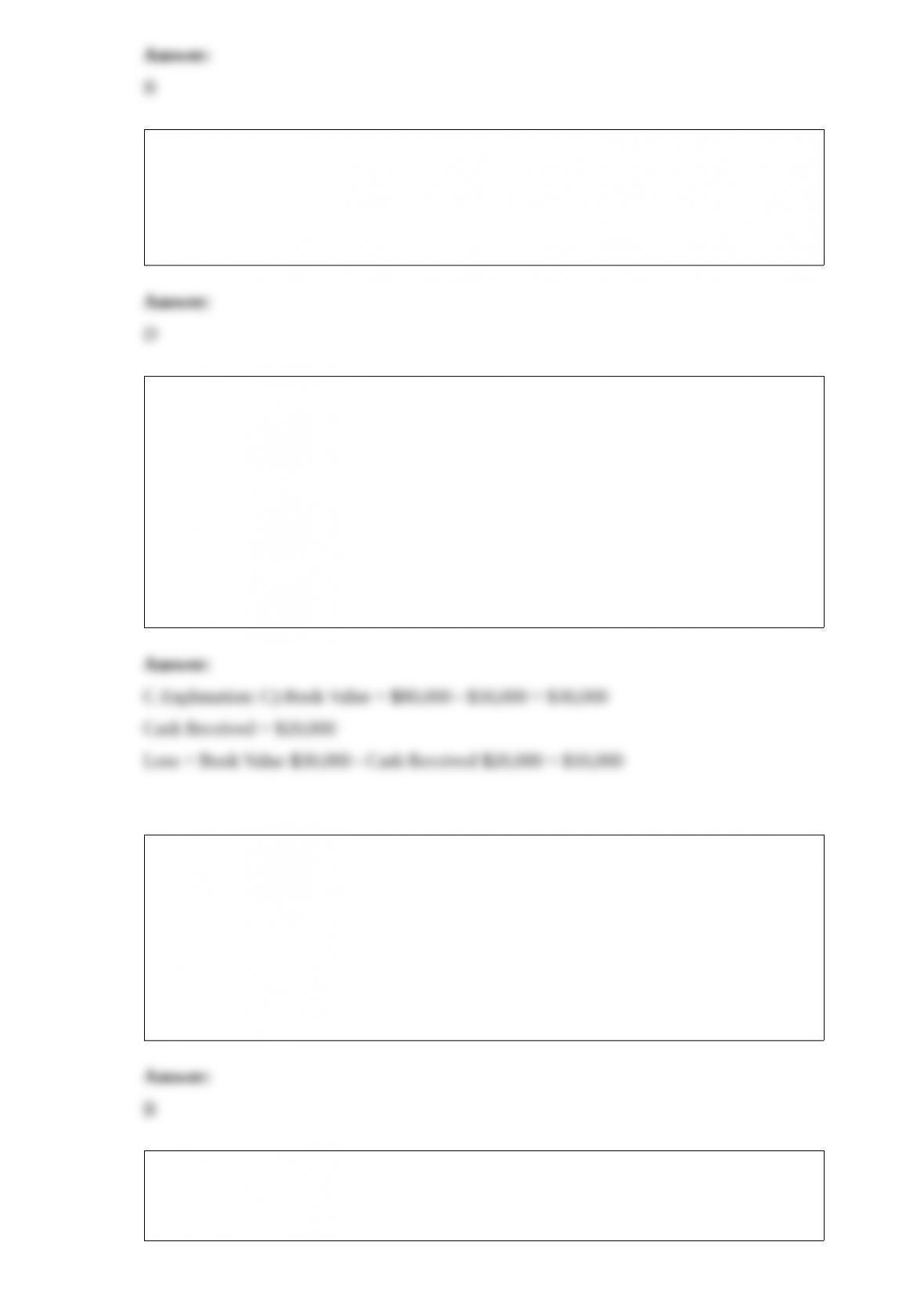
35) Wilhelm Company’s gross profit percentages for the past 3 years are:
Based on the above data, what can be said about the Wilhelm Company?
A) The sales volume is decreasing
B) The company is decreasing the income tax expense
C) The company is controlling operating expenses
D) The company is controlling cost of goods sold
36) When listing the accounts on the trial balance, where is the account Dividends
listed?
A) It is not listed on the trial balance
B) After Retained Earnings
C) After Service Revenue or Sales Revenue
D) After all the expense accounts
37) In the cash budget, examples of cash disbursements do NOT include:
A) purchase of inventory with cash
B) payment of operating expenses
C) payment of dividend
D) depreciation expense
38) Remini Company sells a piece of equipment for $20,000 cash. The equipment has a
historical cost of $80,000 and accumulated depreciation of $50,000. What is the journal
entry to record the sale of the equipment?
A) debit Cash for $20,000 and credit Gain on Sale of Equipment for $20,000
B) debit Cash for $20,000, debit Accumulated Depreciation for $50,000 and credit
Equipment for $70,000
C) debit Loss on Sale of Equipment for $10,000, debit Cash for $20,000, debit
Accumulated Depreciation for $50,000 and credit Equipment for $80,000
D) debit Cash for $20,000, debit Accumulated Depreciation for $50,000, debit Gain on
Sale of Equipment $10,000 and credit Equipment for $80,000
39) The cost of capital is defined as the:
A) sum of liabilities and stockholders’ equity accounts
B) weighted average of the returns demanded by the company’s stockholders and
lenders
C) rate of return demanded by stockholders times the rate of return demanded by
lenders
D) rate of return demanded by the stockholders divided by the rate of return demanded
by lenders
40) Lorna Company has the following account balances at the end of the first year of
operations:
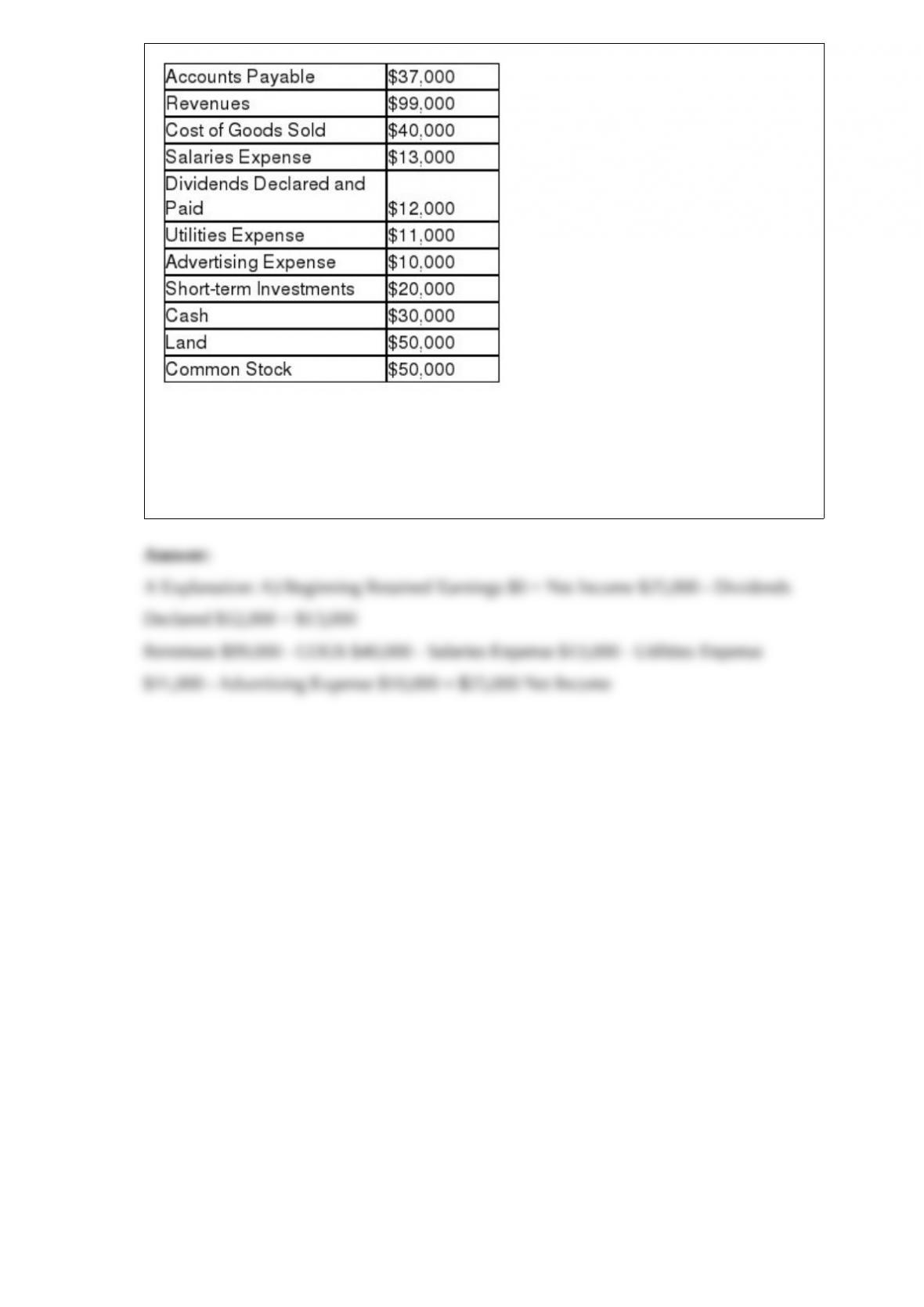
What is the ending balance in Retained Earnings?
A) $13,000
B) $23,000
C) $25,000
D) $53,000