In the decline phase, the company continues to enjoy positive operating cash flows but
stops spending cash on investing activities and instead uses its cash for financing
activities such as repaying lenders and returning excess cash to shareholders.
The receivables turnover ratio is calculated using the total net receivables.
The general ledger is an internal report that lists all the accounts and their balances and
is used to check that total debits equals total credits.
If the debt-to-assets ratio is 0.63, it means that 37% of the company’s financing has
been provided by stockholders’ equity.
The purpose of adjusting entries is to transfer net income and dividends to Retained
Earnings.
In a periodic inventory system, the cost of goods sold is recorded as each sale occurs.
A company can use different methods for inventories that differ in nature or use.
If the market rate exceeds the stated interest rate, a bond will sell at a premium.
When credit card sales occur, the seller may receive cash immediately, or within a few
days, depending upon the specific credit card program being used.
When the times interest earned ratio increases, the likelihood of default on liabilities
decreases.
If inventory is sold with terms of FOB shipping point, the goods belong to the customer
while in transit.

Credit card companies charge a fee to the seller that accepts the credit cards. This fee is
recorded by the seller as a non-operating expense on its income statement.
Bonds that are backed by a company’s assets are referred to as ‘secured” bonds.
When accounts receivable are collected:
A) stockholders ‘ equity increases.
B) total assets increase.
C) total assets decrease.
D) the amount of total assets is unchanged.

In order to calculate shrinkage:
A) both periodic and perpetual inventory systems are needed.
B) a periodic inventory system is more effective.
C) a perpetual inventory system requires an occasional count of actual inventory.
D) it does not matter which system one uses.
When a company lends cash to a customer who signs a promissory note:
A) total assets decrease when the lending transaction occurs, but increase when the
amount borrowed by the customer is repaid.
B) total assets increase when the lending transaction occurs and revenues increase when
the amount borrowed by the customer is repaid.
C) total assets increase and liabilities increase when the lending transaction occurs.
D) total assets and net income do not change when the lending transaction occurs.

Use the information above to answer the following question. What journal entry will be
recorded by Flynn Company on November 8?
A) Debit Inventory and credit Cost of Goods Sold for $800
B) Debit Accounts Payable and credit Inventory for $800
C) Debit Inventory and credit Accounts Payable for $800
D) Debit Accounts Payable and credit Purchase Returns for $800
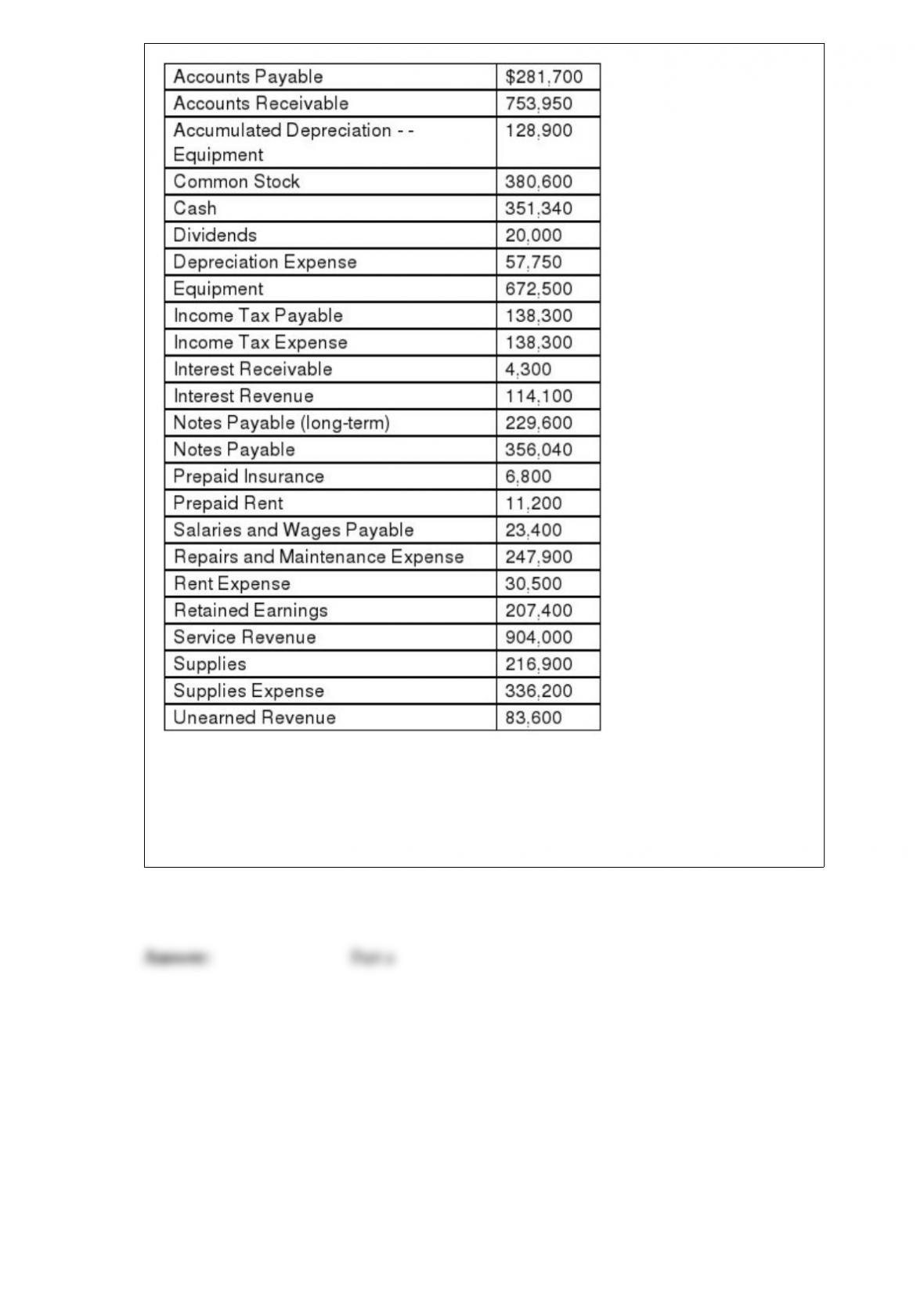
The following account balances are included in the adjusted trial balance of Delta Inc.
as of April 30, 2015. All of the accounts have normal balances.
Required:
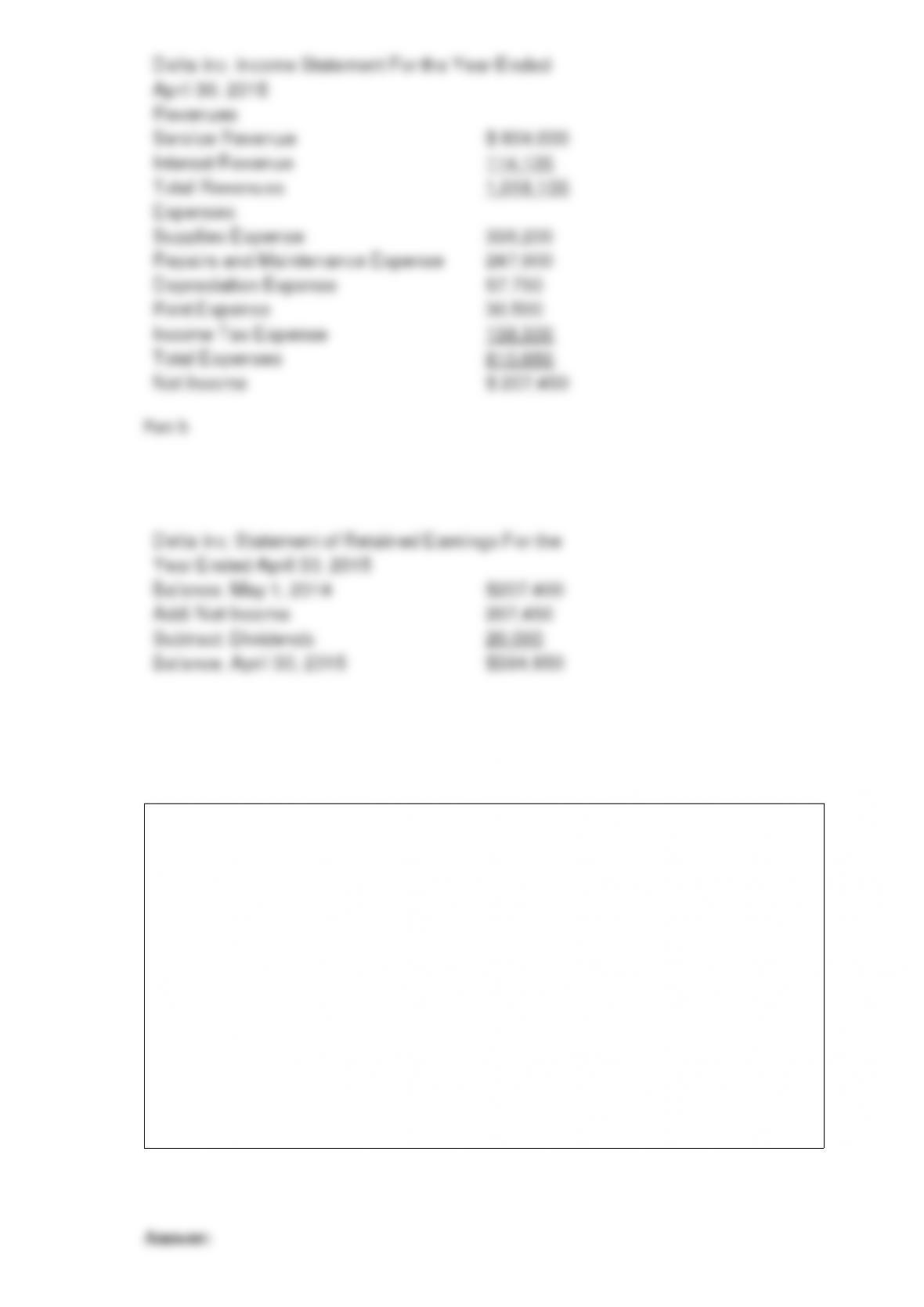
Part a. Prepare an income statement.
Part b. Prepare a statement of retained earnings
Which of the following statements about financial statements and the trial balance is
correct?
A) Financial statements are prepared only after the adjusted trial balance has shown that
debits equal credits.
B) A post-closing trial balance should be prepared before temporary accounts are
closed.
C) An adjusted trial balance reflects the amount of Retained Earnings to be shown on
the Balance Sheet.
D) A post-closing trial balance lists the account balances of the accounts that are
reported the income statement.
Solvency ratio data are primarily concerned with the ability of a company to:
A) produce profits.
B) maintain long-term survival and repay its debt.
C) manage its cash flow.
D) provide income for stockholders.
BetterBuy sells $50,000 of TVs to a customer. The credit terms state a 2% discount if
paid in 7 days and a 1% discount if paid in 8-14 days. The customer pays in 12 days.
How would BetterBuy record the customer’s payment?
A) Debit Cash for $50,000 and credit Accounts Receivable for $50,000
B) Debit Accounts Receivable for $50,000, credit Cash for $49,500, and credit
Inventory for $500

C) Debit Cash for $49,500, credit Accounts Receivable for $50,000, and debit Sales
Discounts for $500
D) Debit Cash for $49,500, credit Accounts Receivable for $49,000, and credit Sales
Returns & Allowances for $500
Match the term with its definition. (There are more definitions than terms.)
TERM
_____ (1) Duality Of Effects
_____ (2) Journal Entry
_____ (3) Posting
_____ (4) Debit
_____ (5) Chart Of Accounts
_____ (6) T-Account
_____ (7) Credit
_____ (8) Cost Principle
DEFINTION
A. A journal entry that lowers the balance of the account.
B. When journal entries are recorded in the appropriate T-account.
C. The concept that a company must keep separate accounts by time period.

D. A simplified version of an account in the General Ledger.
E. The mechanism used to record each transaction in the General Journal.
F. When a company’s balance sheet has been verified by an outside auditor.
G. The concept that any transaction must have at least two effects on the accounting
equation.
H. When a dollar value is assigned to an item recorded in the accounting system.
I. Compares balance sheet items from two different time periods.
J. An amount that is posted on the left side of a T-account or ledger.
K. The principle that a company should use the least optimistic measure, when
uncertainty exists.
L. Assets are initially recorded at the amount paid to acquire them.
M. A journal entry that raises the balance of the account.
N. A balance sheet where assets appear on the top, liabilities in the middle and
stockholders’ equity appears on the bottom.
O. An amount that is posted on the right side of a T-account.
P. A summary of account names and numbers.
Which of the following statements concerning financial reporting is not correct?
A) Accounting rules in the U.S. are called GAAP.
B) Accounting rules developed by the IASB are called IFRS.
C) Both GAAP and IFRS share the same goal, which is to ensure useful information to
users of financial statements.
D) There are no differences between the accounting rules developed by FASB and those
developed by IASB.