Which of the following ratios is a solvency ratio?
A) Net profit margin ratio
B) Current ratio
C) Fixed asset turnover ratio
D) Debt-to-assets ratio
Which of the following statements about disposal of long-lived assets is not correct?
A) The gain or loss resulting from the disposal of a long-lived asset always appears
below the “Income from Operations” line on the income statement.
B) A journal entry is usually needed to update depreciation expense on a long-lived
asset at the time of disposal.
C) A company may dispose of long-lived assets by selling them, trading them in on new
assets, or by scrapping them.
D) The amount of the gain or loss on disposal of a long-lived asset before the end of its
useful life will be influenced by the depreciation method that had been used.
After net income has been determined, it is then transferred to the:
A) balance sheet.
B) income statement.
C) statement of cash flows.
D) statement of retained earnings.
On January 1, 2016, a company purchased a machine for $138,000 with an expected
life of 5 years and a residual value of $12,000. In addition, the company paid delivery
costs of $1,200 and $4,800 to have the machine installed. The company uses the
double-declining-balance method of depreciation.
Use the information above to answer the following question. If the company sells the
machine at the end of 5 years and receives $11,500, the journal entry to record the sale
will include which of the following?
A) Debit to Accumulated Depreciation for $138,000
B) Credit to Machine for $138,000
C) Debit to Loss on Sale for $500
D) Credit to Residual Value for $12,000
The direct write-off method for uncollectible accounts is required:
A) by the IRS.
B) by GAAP
C) by IFRS.
D) for external financial reporting.
Which of the following statements about the interpretation of the receivables turnover
ratio is not correct?
A) Analysts often interpret a sudden increase in the receivables turnover ratio as a
signal of a developing problem.
B) The smaller the receivables turnover ratio the larger the days to collect will be.
C) A change in the receivables turnover ratio may indicate a change in the company’s
credit granting policies.
D) A change in the receivables turnover ratio may indicate a change in economic
conditions.
In a period of falling prices, the inventory costing method that will cause the company
to have the lowest cost of goods sold is:
A) LIFO.
B) FIFO.
C) Weighted average.
D) Specific identification.
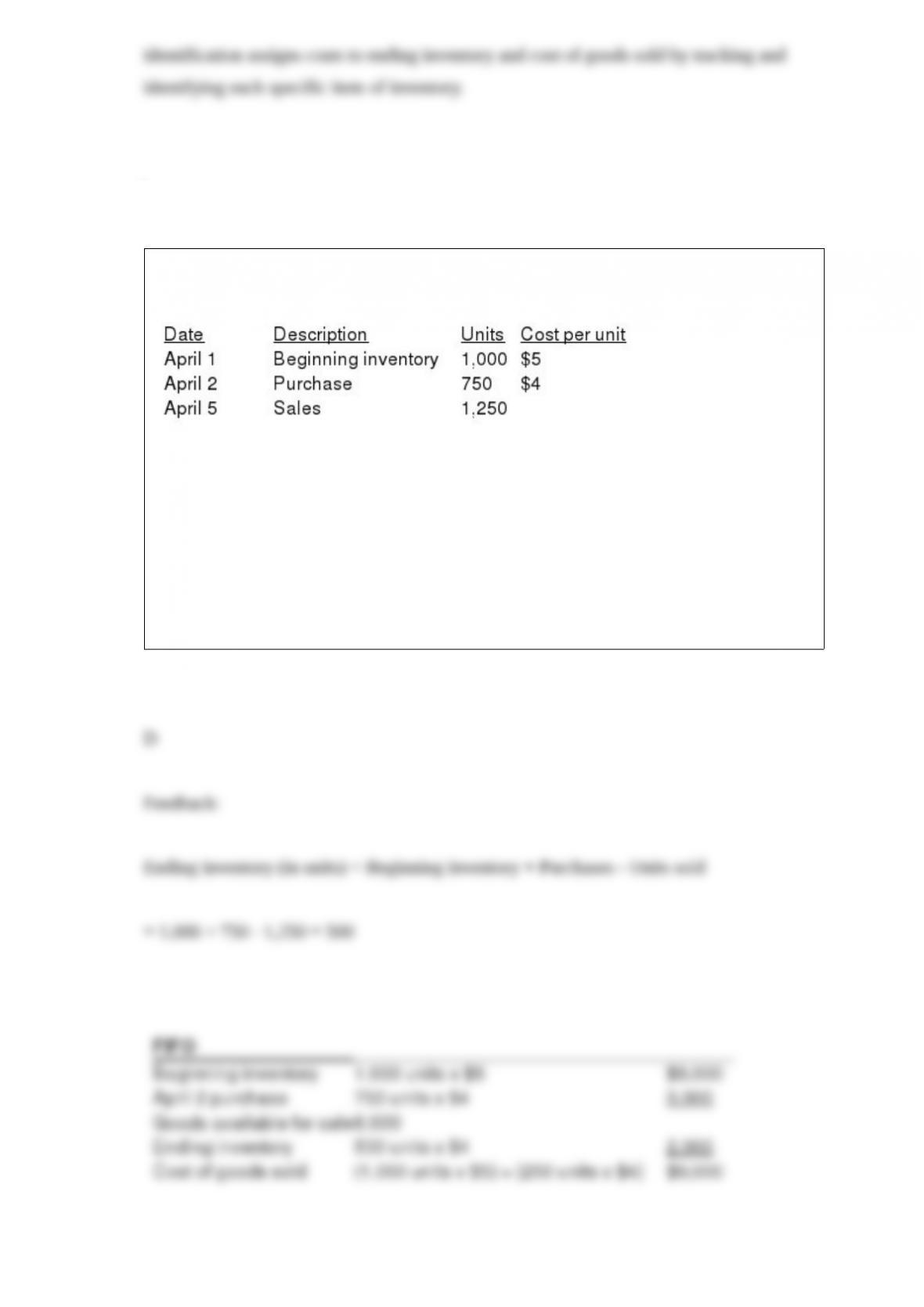
Pearl Company has a perpetual inventory system. The company uses the FIFO method
to assign costs to inventory and cost of goods sold. Consider the following information:
What amounts would be reported as cost of goods sold and ending inventory for April?
A) Cost of goods sold $6,250; Ending inventory $1,750
B) Cost of goods sold $7,550; Ending inventory $2,250
C) Cost of goods sold $5,500; Ending inventory $2,500
D) Cost of goods sold $6,000; Ending inventory $2,000
Which of the following statements about the recording of interest on notes receivable is
correct?
A) Interest on notes receivable is recorded as revenue only when the cash is received.
B) When a company makes an interest payment on a note, the payment is debited to
Interest Receivable.
C) Interest on notes receivable is recognized when it is earned, which is not necessarily
when the interest is received in cash.
D) Interest earned but not yet received must be recorded in an adjusting entry which
includes a debit to Interest Revenue.
Bolster Soda had an accounts receivable turnover ratio of 9.9 this year and 11.0 last
year. Castor Soda had a turnover ratio of 9.3 this year and 9.3 last year. This implies:
A) Castor’s receivables turnover ratios were better than Bolster’s for both years.
B) Bolster’s receivables turnover ratios were better than Castor’s for both years.
C) Castor has credit policies that need to be tightened.
D) Castor collected receivables more quickly than Bolster in both years.
On December 1, 2015, a company lends a new employee $20,000 to assist with her
relocation expenses. The employee signs a 6-month note, with interest of 9%. The
company prepares year-end financial statements at December 31. What is the required
adjusting entry at December 31 as a result of this note transaction?
A) Debit Interest Revenue and credit Interest Receivable for $900
B) Debit Interest Receivable and credit Interest Revenue for $900
C) Debit Interest Revenue and credit Interest Receivable for $150
D) Debit Interest Receivable and credit Interest Revenue for $150
Sparkling Pools performed $1,600 of pool maintenance services during July; the
customers had paid in advance for these services in June. The company performed
$1,000 of pool maintenance services during July and collected payment from those
customers in August. Also, during July, the company accepted an order to perform $500
of pool maintenance services in August; the customers will pay for these services in
August. The company uses accrual basis accounting. The Service Revenue account
should be credited for:
A) $1,600 in June, $1,000 in July, and $500 in August.
B) $1,600 in June, $0 in July, and $1,500 in August.
C) $0 in June, $1,600 in July, and $1,500 in August.
D) $0 in June, $2,600 in July, and $500 in August.
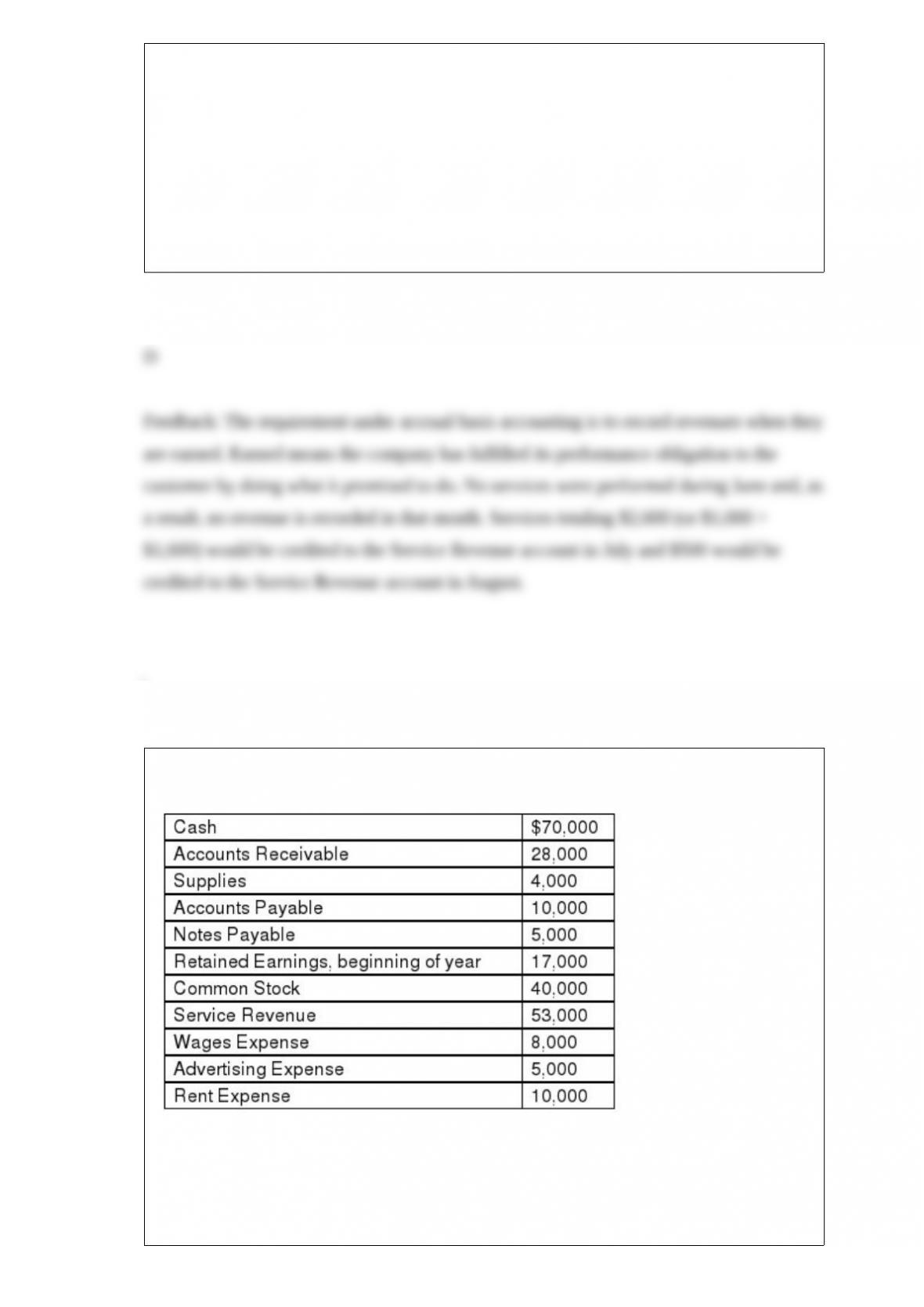
A company’s financial records at the end of the year including the following amounts:
Use the information above to answer the following question. What is the amount of
total stockholders’ equity that would be reported on the Balance Sheet at the end of the
year?
A) $30,000.
B) $57,000.
C) $87,000.
D) $102,000.
The repayment of the principal of a loan which had been used to finance the purchase
of equipment should be reported on the statement of cash flows as a:
A) cash outflow from investing activities.
B) cash outflow from operating activities.
C) cash outflow from financing activities.
D) noncash investing and financing activities in a supplemental disclosure.
Inventory shipped FOB shipping point and in transit on the last day of the year should
be included in:
A) the inventory balance of the seller.
B) the inventory balance of the buyer.
C) neither the inventory balance of the buyer or the seller.
D) both the inventory balance of the buyer and the seller.
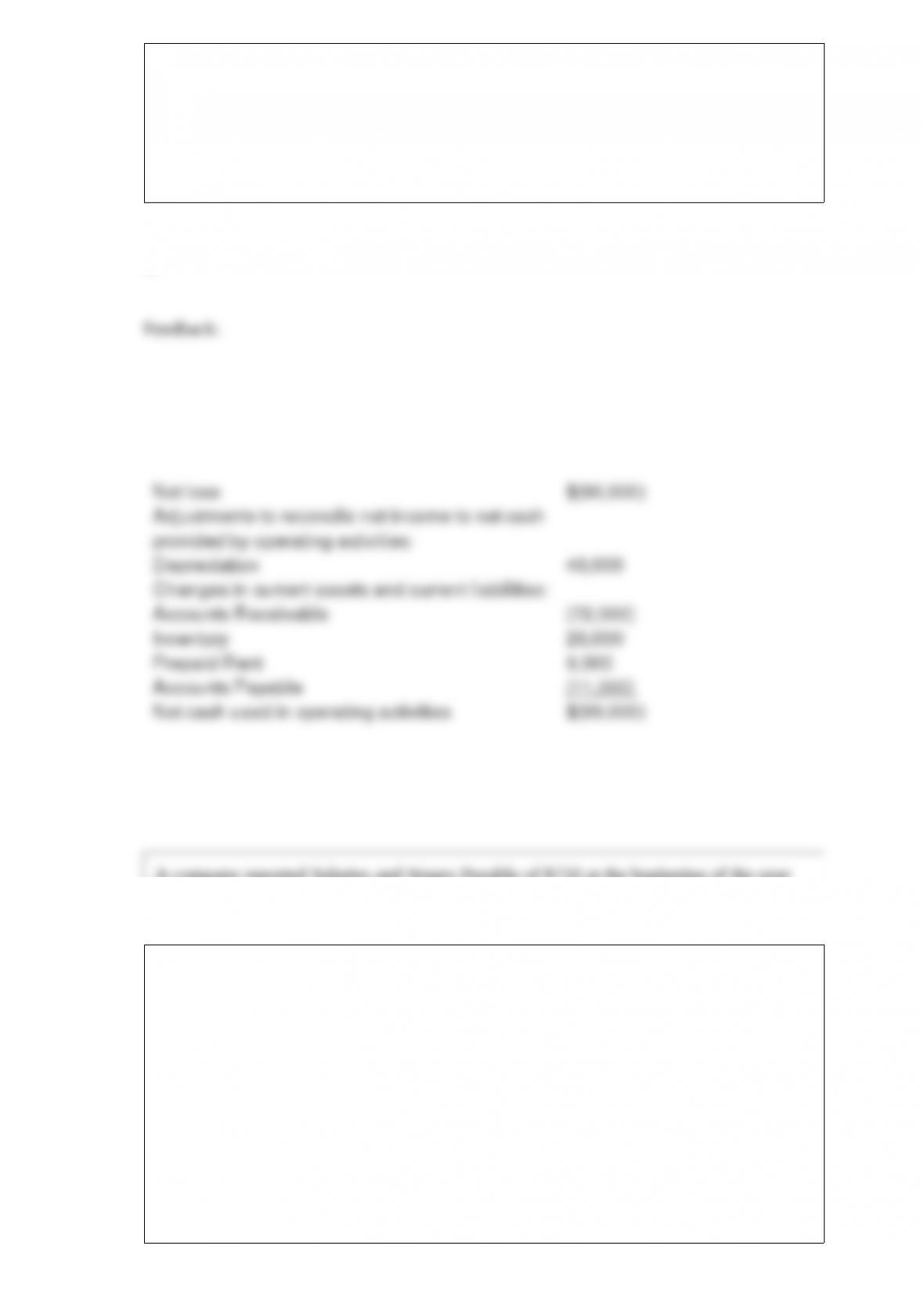
A company’s income statement for the year shows a net loss of $90,000. Additional
information for the year follows:
What is the net cash provided by (used in) operating activities?
A) ($99,000)
B) $27,000
C) $13,000
D) ($45,000)
A company reported Salaries and Wages Payable of $750 at the beginning of the year
and $2,500 at the end of the year. The income statement for the year reported Salaries
and Wages Expense of $56,200. How much cash was paid for salaries and wages during
the year?
A) $52,950
B) $56,200
C) $54,450
D) $53,700
At the end of the year, accrual adjustments could include a:
A) debit to an expense and a credit to an asset.
B) credit to a revenue and a debit to an expense.
C) debit to cash and a credit to Common Stock.
D) debit to an expense and a credit to a liability.