
The following information relates to Franklin Freightways for its first year of
operations (data in millions of dollars):
The applicable tax rate is 40%. There are no other temporary or permanent differences.
Franklin’s taxable income ($ in millions) is: A. $40.
B. $165.
C. $110.
D. $160.
Answer:
Information for Kent Corp. for the year 2013:
Reconciliation of pretax accounting income and taxable income:
Cumulative future taxable amounts all from depreciation temporary differences:
The enacted tax rate was 30% for 2012 and thereafter.
What would Kent’s income tax expense be in the year 2013? A. $42,300.
B. $45,900.
C. $49,500.

D. None of the above is correct.
Answer:
At December 31, 2013, Moonlight Bay Resorts had the following deferred income tax
items:
Deferred tax asset of $54 million related to a current liability
Deferred tax asset of $36 million related to a noncurrent liability
Deferred tax liability of $120 million related to a noncurrent asset
Deferred tax liability of $72 million related to a current asset
Moonlight Bay should report in the current section of its December 31, 2013, balance
sheet a: A. Noncurrent asset of $90,000 and a non-current liability of $192,000.
B. Current tax liability of $18,000.
C. Noncurrent asset of $84,000 and a non-current liability of $45,000.
D. Noncurrent liability of $30,000.
Answer:

Listed below are five terms followed by a list of phrases that describe or characterize
each of the terms. Match each phrase with the correct term. 1) Change from the equity
method
2) Unrealized losses
3) Unrealized gains
4) Change to the equity method
5) Financial instruments
A. Change accounted for prospectively
B. Encompass cash, equity securities, and debt securities
C. Result from a decline in fair value prior to sale
D. Change accounted for retrospectively
E. When related to trading securities, they increase net income
Answer:
Theodore Enterprises had the following pretax income (loss) over its first three years of
operations:
For each year there were no deferred income taxes and the tax rate was 30%. In its 2012
tax return, Theodore elected a loss carryback. No valuation account was deemed
necessary for the deferred tax asset as of December 31, 2012. What was Theodore’s
income tax expense for 2013? A. $450,000.
B. $330,000.
C. $270,000.
D. $180,000.
Answer:
Data related to the inventories of Alpine Ski Equipment and Supplies is presented
below:
In applying the LCM rule, the inventory of supplies would be valued at: A. $45,000.
B. $54,000.
C. $41,000.
D. $42,000.
Answer:

During 2013, WW Inc. reduced its LIFO eligible inventory quantities due to a problem
with its major supplier. The effect of this liquidation was to increase its cost of goods
sold by approximately $50 million. WW has a 40% income tax rate. If WW had not
experienced these supplier problems and the resulting liquidation: A. Its 2013 net
income would have been $30 million lower because inventory purchase prices were
rising.
B. Its 2013 net income would have been $30 million lower because inventory purchase
prices were declining.
C. Its 2013 net income would have been $30 million higher because inventory purchase
prices were rising.
D. Its 2013 net income would have been $30 million higher because inventory purchase
prices were declining.
Answer:

Auerbach issued the bonds: A. At par.
B. At a premium.
C. At a discount.
D. Cannot be determined from the given information.
Answer:
A magazine publisher collects one year in advance for subscription revenue. In the year
of providing the magazines to customers, the company would record: A. An increase in
a deferred tax asset.
B. A decrease in a deferred tax asset.
C. An increase in a deferred tax liability.
D. A decrease in a deferred tax liability.
Answer:
Hemmer Company reported net income for 2013 in the amount of $40,000. The
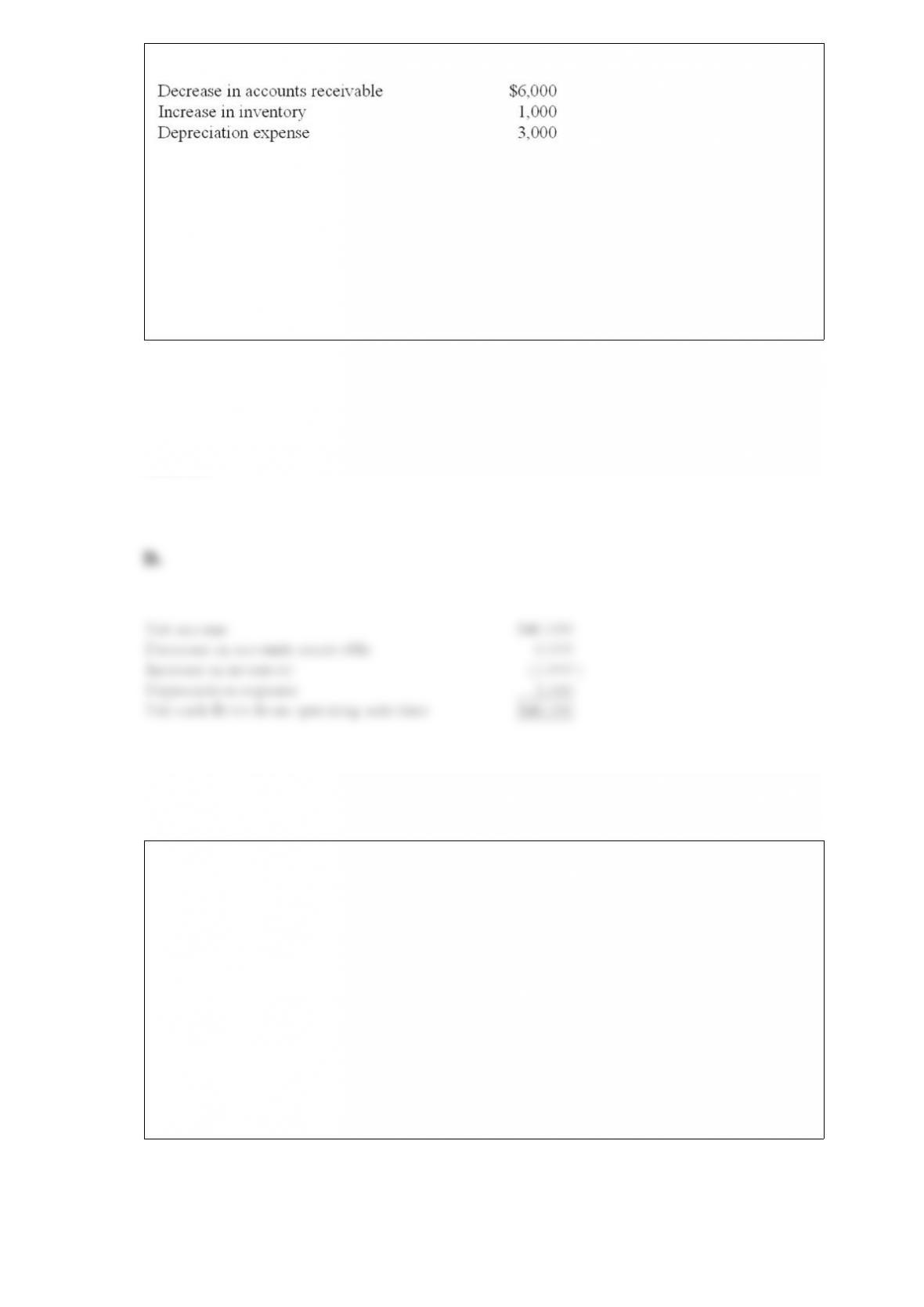
company’s financial statements also included the following:
What is net cash provided by operating activities? A. $38,000.
B. $43,000.
C. $35,000.
D. $48,000.
Answer:
Castillo Company has a defined benefit pension plan. At the end of the reporting year,
the following data were available: beginning PBO, $75,000; service cost, $18,000;
interest cost, $5,000; benefits paid for the year, $9,000; ending PBO, $89,000; the
expected return on plan assets, $10,000; and cash deposited with pension trustee,
$17,000. There were no other pension-related costs. The journal entry to record the
annual pension costs will include a credit to the PBO for: A. $13,000.
B. $17,000.
C. $18,000.
D. $23,000.
Answer:
The rate of return on assets indicates:A. The margin of safety provided to creditors.
B. The extent of “trading on the equity” or financial leverage.
C. Profitability without regard to how resources are financed.
D. The effectiveness of employing resources provided by owners
Answer:
Lake Power Sports sells jet skis and other powered recreational equipment. Customers
pay one-third of the sales price of a jet ski when they initially purchase the ski, and then
pay another one-third each year for the next two years. Because Lake has little

information about the ability to collect these receivables, it uses the cost recovery
method to recognize revenue on these installment sales. In 2012, Lake began operations
and sold jet skis with a total price of $900,000 that cost Lake $450,000. Lake collected
$300,000 in 2012, $300,000 in 2013, and $300,000 in 2014 associated with those sales.
In 2013, Lake sold jet skis with a total price of $1,500,000 that cost Lake $900,000.
Lake collected $500,000 in 2013, $400,000 in 2014, and $400,000 in 2015 associated
with those sales. In 2015, Lake also repossessed $200,000 of jet skis that were sold in
2013. Those jet skis had a fair value of $75,000 at the time they were repossessed.
In its December 31, 2013, balance sheet, Lake would report:A. Deferred gross profit of
$700,000.
B. Deferred gross profit of $600,000.
C. Installment receivables (net) of $700,000.
D. Installment receivables (net) of $400,000.
Answer:
In its 2013 income statement, WME reported $58,000 for insurance expense. WME
paid $72,000 in insurance premiums during 2013. In its reconciliation schedule, WME
should: A. Show a $14,000 positive adjustment to net income under the indirect method
for the increase in prepaid insurance.
B. Show a $14,000 negative adjustment to net income under the indirect method for the
decrease in prepaid insurance.
C. Show a $14,000 negative adjustment to net income under the indirect method for the
increase in prepaid insurance.
D. Show a $14,000 positive adjustment to net income under the indirect method for the
decrease in prepaid insurance.

Answer:
Listed below are five terms followed by a list of phrases that describe or characterize
each of the terms. Match each phrase with the correct term. 1)Multiple-step income
statement
2)Discontinued operations
3)Gain/loss from sale of investments
4)Comprehensive income
5)Direct method
A. Total nonowner changes in equity for a reporting period.
B. Reported net of tax immediately after income from continuing operations.
C. Reported in the nonoperating section of the income statement.
D. Reports intermediate subtotals in arriving at net income.
E. Reports the cash effects of each operating activity directly on the statement.
Answer:
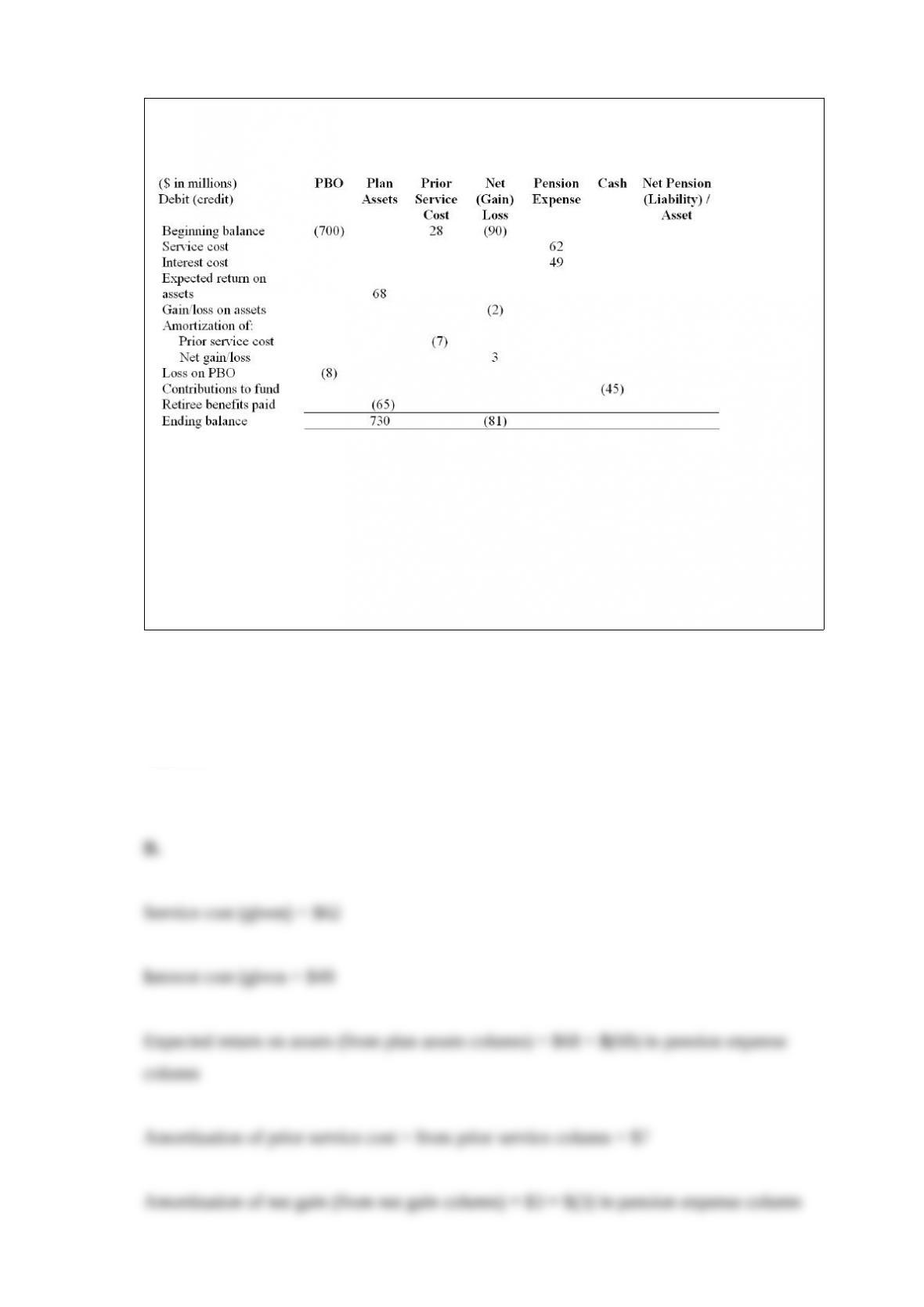
The following incomplete (columns have missing amounts) pension spreadsheet is for
the current year for First Republic Corporation (FRC).
What was FRC’s pension expense for the year? A. $44.
B. $47.
C. $49.
D. $107.
Answer:

The enhancing qualitative characteristic of understandability means that information
should be understood by: A.Those who are experts in the interpretation of financial
information.
B.Those who have a reasonable understanding of business and economic activities.
C.Financial analysts.
D.CPAs.
Answer:
Slotnick Chemical received customer deposits on returnable containers in the amount of
$300,000 during 2013. Fifteen percent of the containers were not returned. The deposits
are based on the container cost marked up 20%. How much profit did Slotnick realize
on the forfeited deposits? A. $0.
B. $7,500.
C. $9,000.
D. $45,000.
Answer:
In deciding whether financing with receivables is a secured borrowing or a sale under
IFRS, the critical element is the extent to which:A. The transferee has received
substantially all the risks and rewards of ownership.
B. The age of the receivables transferred differs from the average age of the receivables.
C. The transferor of the receivable surrenders control over the assets transferred.
D. The transferee relies on funds from the transferor to maintain operations.
Answer:
For the lessor to account for a lease as a capital lease, the lease must meet: A. Any one
of first four classification criteria and both of the last two additional conditions
specified by GAAP regarding accounting for leases.
B. Any one of the six criteria specified by GAAP regarding accounting for leases.
C. All four of the criteria specified by GAAP regarding accounting for leases.
D. Any one of the four criteria specified by GAAP regarding accounting for leases.
Answer:

Listed below are 5 terms followed by a list of phrases that describe or characterize each
of the terms. Match each phrase with the most correct term. 1) Implicit rate of interest
2) Mortgage bond
3) Sinking fund
4) Interest expense
5) Bond indenture
A. Conceptually equal to effective rate times balance
B. Secured by real property
C. Promises made to bondholders
D. Used by a trustee to repurchase bonds in the open market
E. Used when the rate is not stated or is materially different from the market rate
Answer:
Goodfellow Corporation reported insurance expense of $477 for the current year. The
beginning and ending balances in the prepaid insurance account were $50 and $30,
respectively. What was the amount of cash paid for insurance? A. $477.
B. $457.
C. $497.
D. None of the above is correct.

Answer:
Which of the following must Franklin Freightways disclose related to the income tax
expense reported in the income statement ($ in millions)? A. Only the current portion of
tax expense of $66.
B. Only the total tax expense of $82.
C. Both the current portion of the tax expense of $66 and the deferred portion of the tax
expense of $16.
D. None of the above.
Answer:
In 2013, Holyoak Inc. offers a $20 cash rebate coupon to customers who purchased one
of its new line of products. Holyoak sold 10,000 of these products during the year. By
year-end of 2013, 7,600 of the rebates had been claimed, and 7,100 had been paid.

Holyoak’s historical experience with such rebates indicates that 85% of customers claim
the rebates.
What is the rebate promotion liability that Holyoak should report in its December 31,
2013, balance sheet? A. $20,000.
B. $28,000.
C. $18,000.
D. None of the above is correct.
Answer:
The current ratio is given by: A. Current assets divided by noncurrent assets.
B. Current assets divided by total assets.
C. Current assets divided by current liabilities.
D. Current assets divided by total liabilities.
Answer:

Which of the following is true? A. A projected benefits approach is used to determine
the periodic pension expense.
B. An accumulated benefits approach is used to determine the periodic pension
expense.
C. A vested benefits approach is used to determine the periodic pension expense.
D. The pension expense is unrelated to the pension obligation.
Answer:
Listed below are five independent situations. For each situation indicate (by letter)
whether it will create (A) a deferred tax asset, (L) a deferred tax liability, or (N) neither.
Answer:
How many types of potential common shares must a corporation have in order to be
said to have a complex capital structure? A. Three.
B. Two.
C. One.
D. Zero.
Answer:
Under the conventional retail method, the denominator in the cost-to-retail percentage
includes: A. Net markups and net markdowns.
B. Neither net markups nor net markdowns.
C. Net markups, but not net markdowns.
D. Net markdowns, but not net markups.
Answer:
Marilee’s Electronics uses a periodic inventory system and the average cost retail
method to estimate ending inventory and cost of goods sold. The following data is
available from the company records for the month of June 2013:
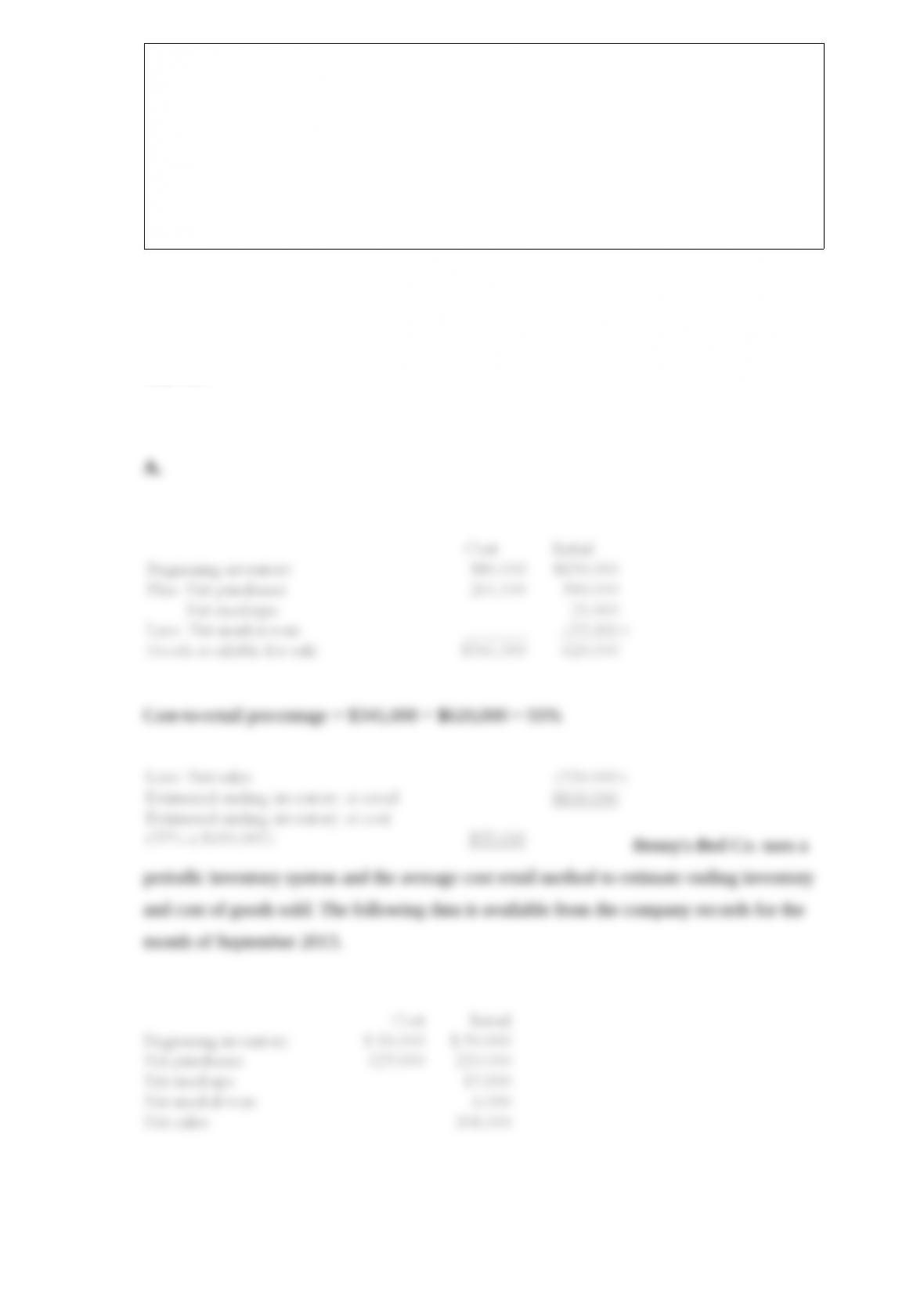
To the nearest thousand, estimated ending inventory is: A. $55,000.
B. $52,000.
C. $57,000.
D. None of the above is correct.
Answer:

In its first year of operations, Woodmount Corporation reported pretax accounting
income of $500 million for the current year. Depreciation reported in the tax return in
excess of depreciation in the income statement was $60 million. The excess tax will
reverse itself evenly over the next three years. The current year’s tax rate of 40% will be
reduced under the current law to 35% next year and 30% for all subsequent years. At
the end of the current year, the deferred tax liability related to the excess depreciation
will be: A. $21 million.
B. $24 million.
C. $18 million.
D. $19 million.
Answer:
A company failed to record unrealized gains of $20 million on its trading security
investments. Its tax rate is 30%. As a result of this error, total shareholders’ equity
would be: A. Understated by $14 million.
B. Understated by $7 million.
C. Understated by $20 million
D. Unaffected.
Answer:
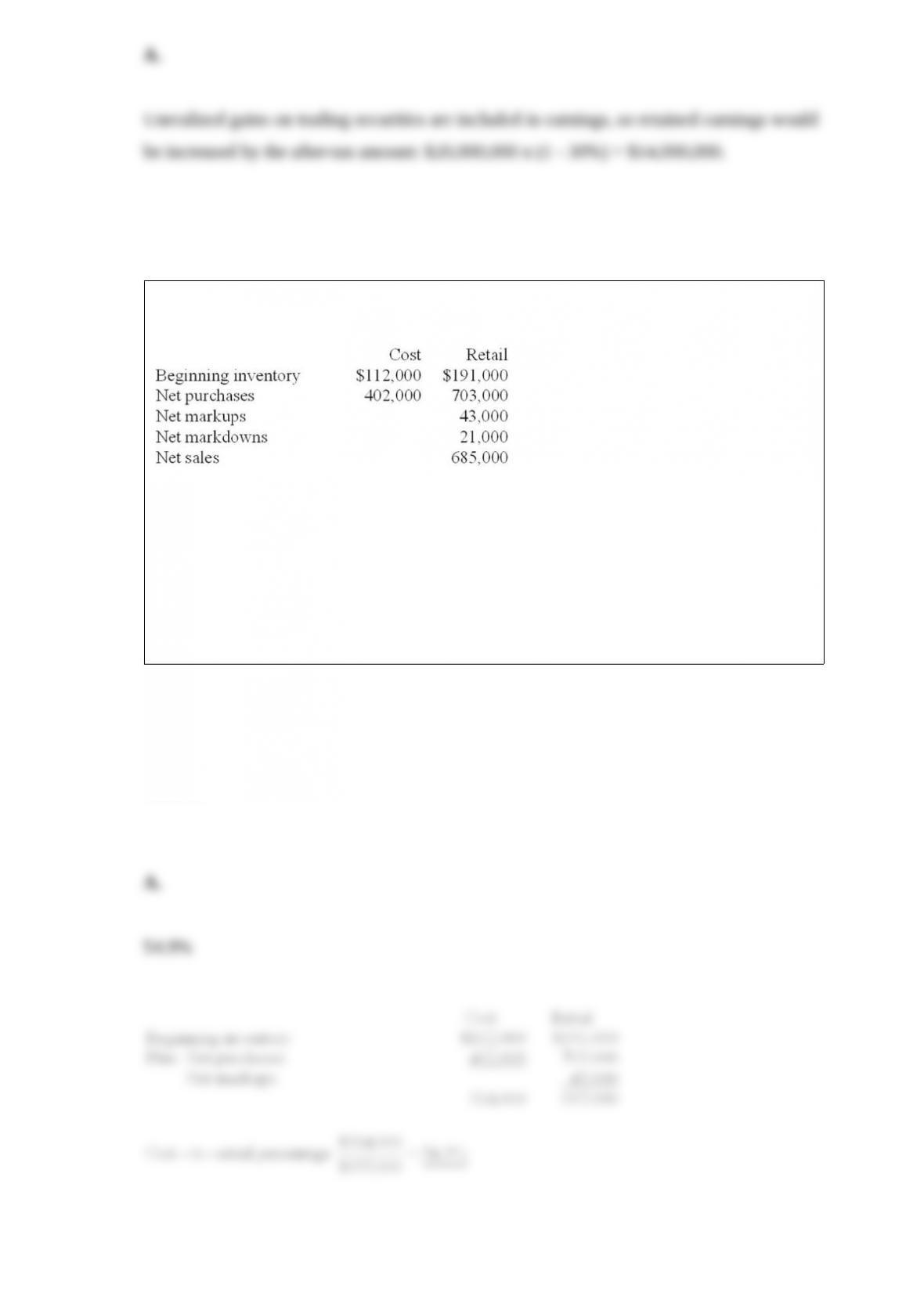
Clarabell Inc. uses the conventional retail method to estimate ending inventory. Cost
data for the most recent quarter is shown below:
The conventional cost-to-retail percentage (rounded) is: A. 54.9%.
B. 58.9%.
C. 53.6%.
D. 70.6%.
Answer:
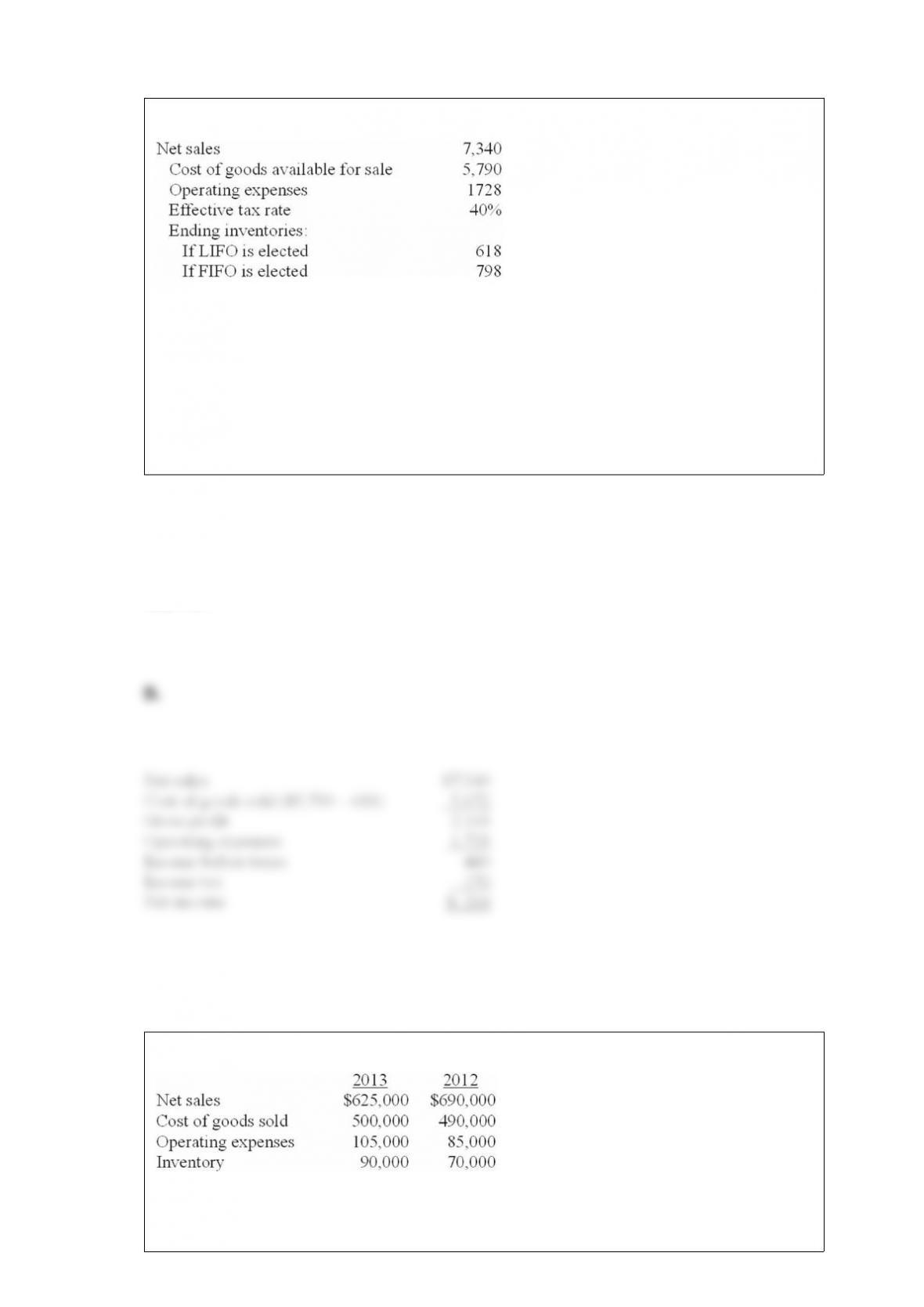
Nueva Company reported the following pretax data for its first year of operations.
What is Nueva’s net income if it elects LIFO? A. $440.
B. $264.
C. $620.
D. $372.
Answer:
Selected financial statement data from Western Colorado Stores is shown below.
Required:
1) Compute the gross profit ratio for 2013.

2) Compute the inventory turnover ratio for 2013.
Answer:
Below is a list of accounts in no particular order. Assume that all accounts have normal
balances.
Required:
In column A, indicate whether a debit will:
1. Increase the account balance, or
2. Decrease the account balance.
In column B, classify each account according to the following scheme. For contra
accounts, indicate the classification of the account to which it relates.
1. A current asset in the balance sheet.
2. A noncurrent asset in the balance sheet.
3. A current liability in the balance sheet.
4. A long-term liability in the balance sheet.
5. A permanent equity account in the balance sheet.
6. A revenue account in the income statement.
7. An expense account shown in the income statement.
8. Account does not appear in either the balance sheet or the income statement.
Capital stock
Answer:
Define a loss contingency and give two examples that almost always are accrued.
Answer:
Indicate by letter whether each of the terms or phrases listed below is more associated
with financial statements prepared in accordance with U.S. GAAP (U) or International
Financial Reporting Standards (I).

Answer:
Iowa Development (ID) made the following land sales and had the following cash
collections:
Assume ID cannot estimate uncollectible accounts accurately and recognizes revenue
using the installment method.
Required: Prepare journal entries to record the sale, cash collections, and recognition
of gross profit (if appropriate) in 2012 and
Answer:
Partial balance sheets and additional information are listed below for Julius Company.
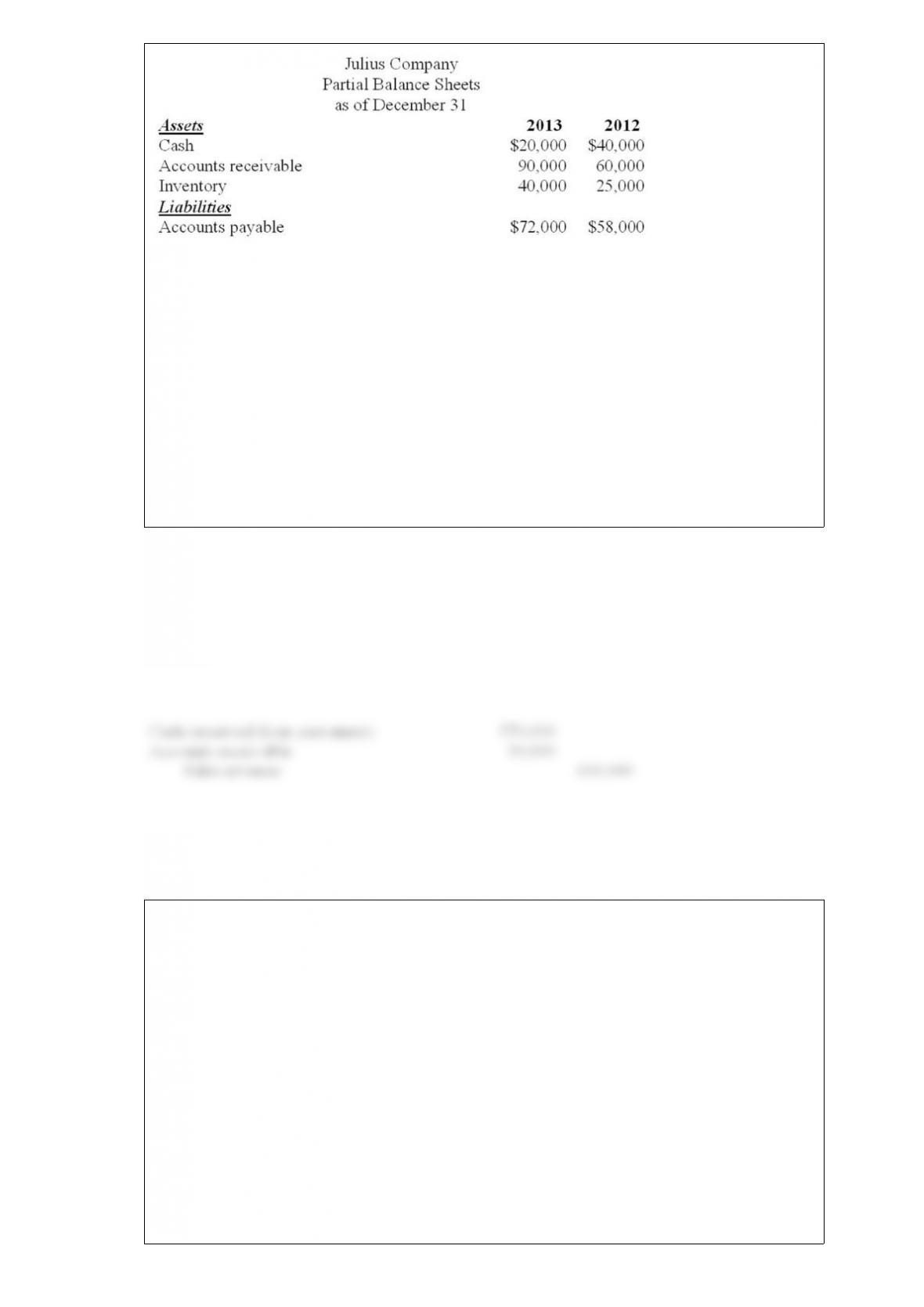
Additional information for 2013:
Net income was $70,000.
Depreciation expense was $30,000.
Sales totaled $600,000.
Cost of goods sold totaled $325,000.
Required:
Calculate the amount of cash received from customers during 2013.
Answer:
On January 1, 2013, Club Company purchased 10% bonds, dated January 1, 2013, with
a face amount of $20 million. The bonds mature in 2022 (10 years). For bonds of
similar risk and maturity, the market yield is 12%. Interest is paid semiannually on June
30 and December
Required:
1) Determine the price of the bonds at January 1, 2013.
2) Prepare the journal entry to record the bond purchase by Club on January 1, 2013.
3) Prepare the journal entry to record interest on June 30, 2013, using the straight-line
method.
4) Prepare the journal entry to record interest on December 31, 2013, using the
straight-line method.
Answer:
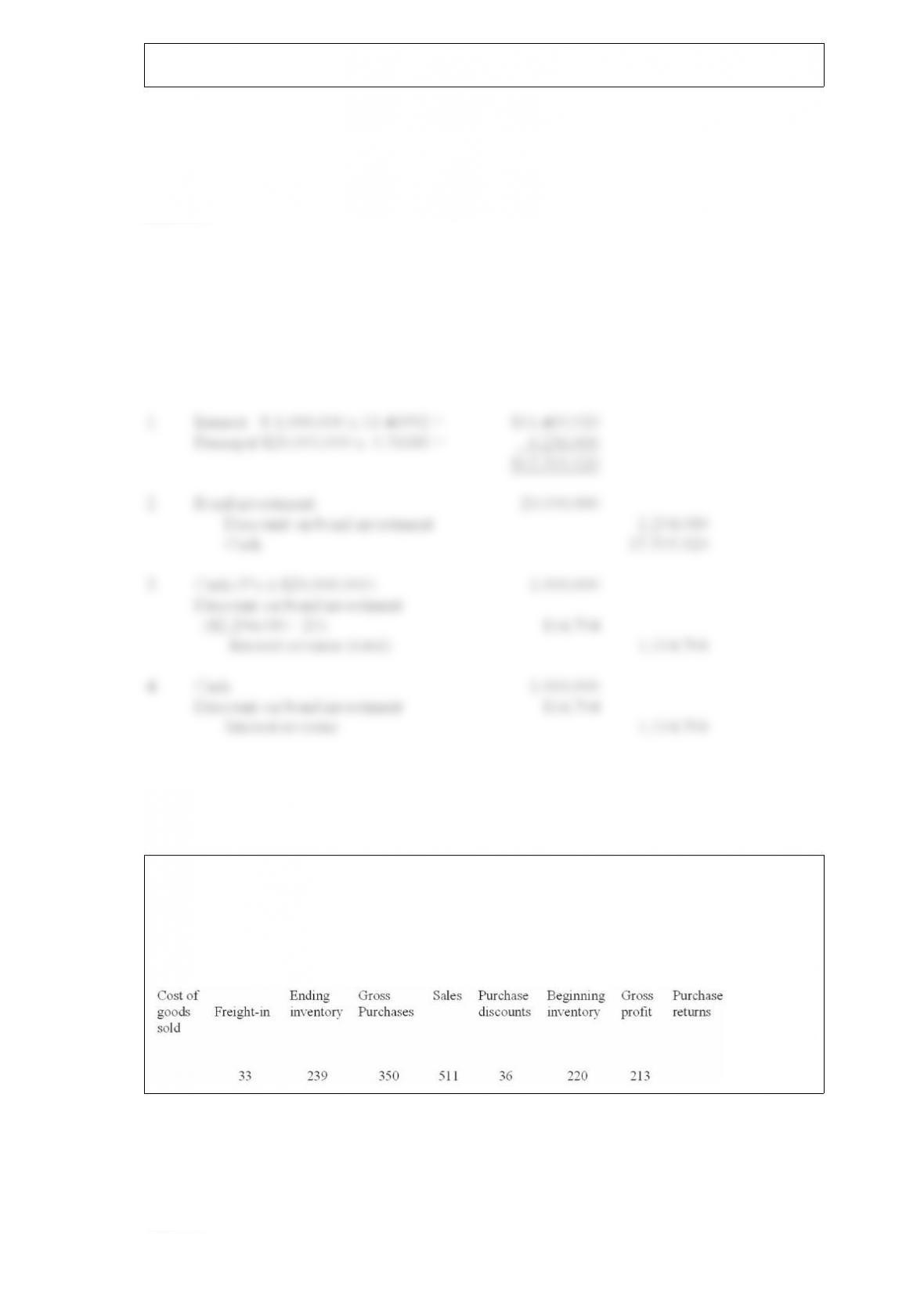
The following information is taken from the accounting records of Rapid Runner Inc.
for the year 2013. Missing information has been left blank.
Required:
Compute the missing amounts.
Answer:
On January 1, 2013, Rare Bird Ltd. purchased 12% bonds dated January 1, 2013, with a
face amount of $20 million. The bonds mature in 2022 (10 years). For bonds of similar
risk and maturity, the market yield is 10%. Interest is paid semiannually on June 30 and
December
Required:
1) Determine the price of the bonds at January 1, 2013.
2) Prepare the journal entry to record the bond purchase by Rare Bird on January 1,
2013.
3) Prepare the journal entry to record interest on June 30, 2013, using the effective
interest method.
4) Prepare the journal entry to record interest on December 31, 2013, using the effective
interest method.
Answer:
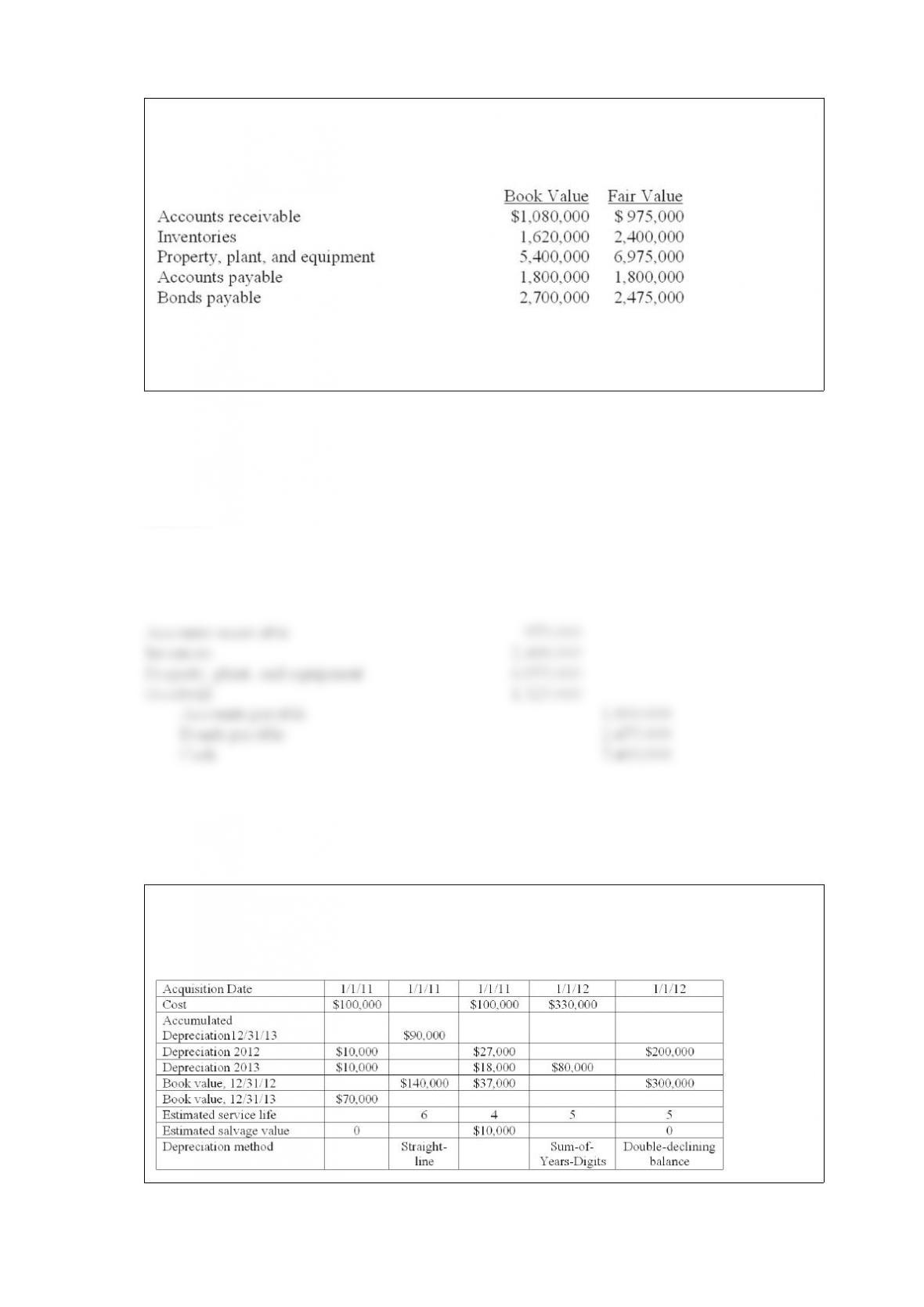
On August 15, 2013, Willis Inc. acquired all of the outstanding common stock of Bork
Inc. paying $7,400,000 cash. The book values and fair values of Willis’ assets and
liabilities are listed below:
Required:
Prepare the journal entry to record the acquisition by Willis Inc.
Answer:
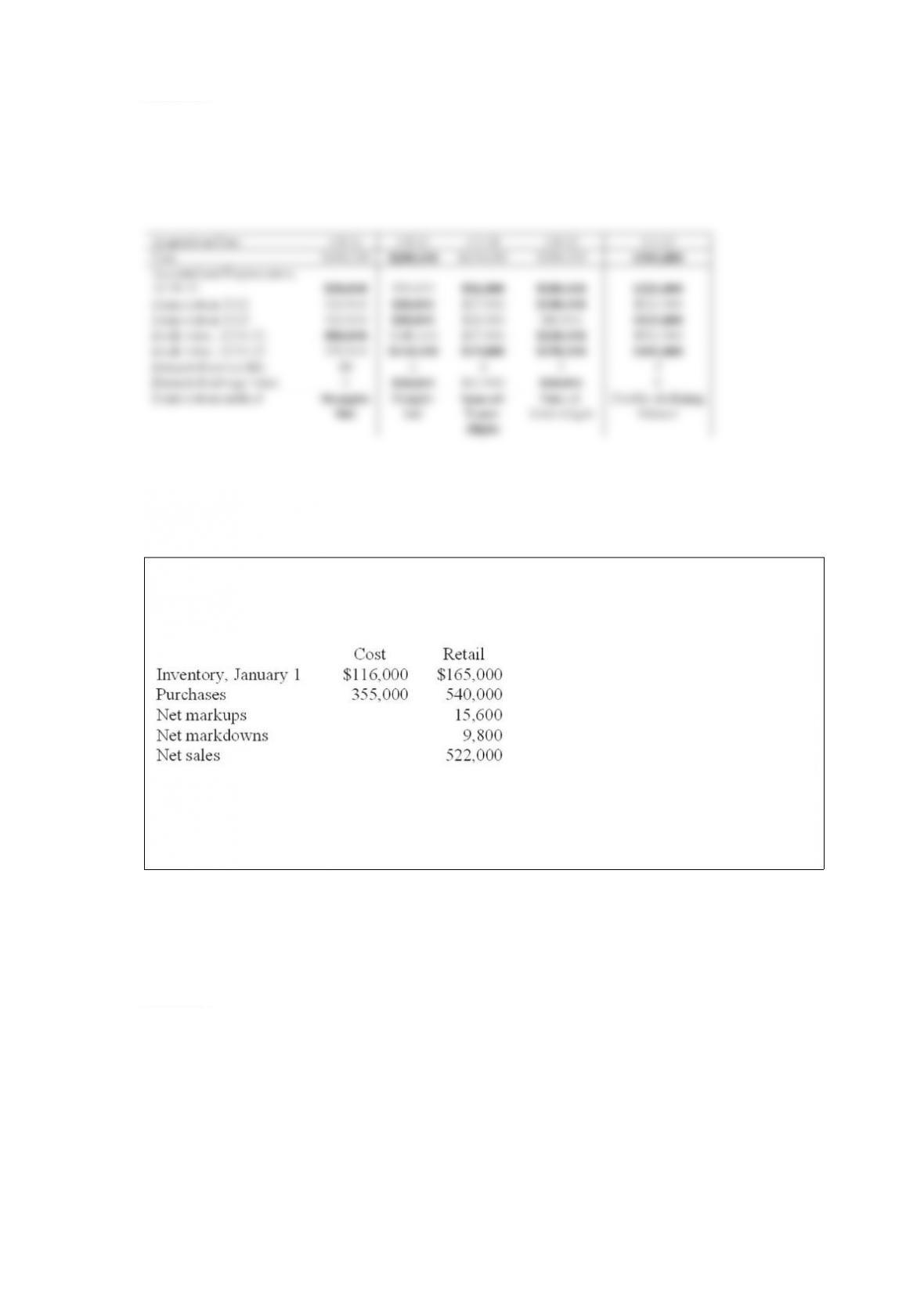
The table below contains data on depreciation for equipment.
Required:
Fill in the missing data in the table.
Answer:
Murdock Industries uses a periodic inventory system and the LIFO retail method to
estimate its ending inventories. The following data has been summarized for December
31, 2013:
Required:
Estimate the LIFO cost of ending inventory. Assume stable retail prices during the
period.
Answer:
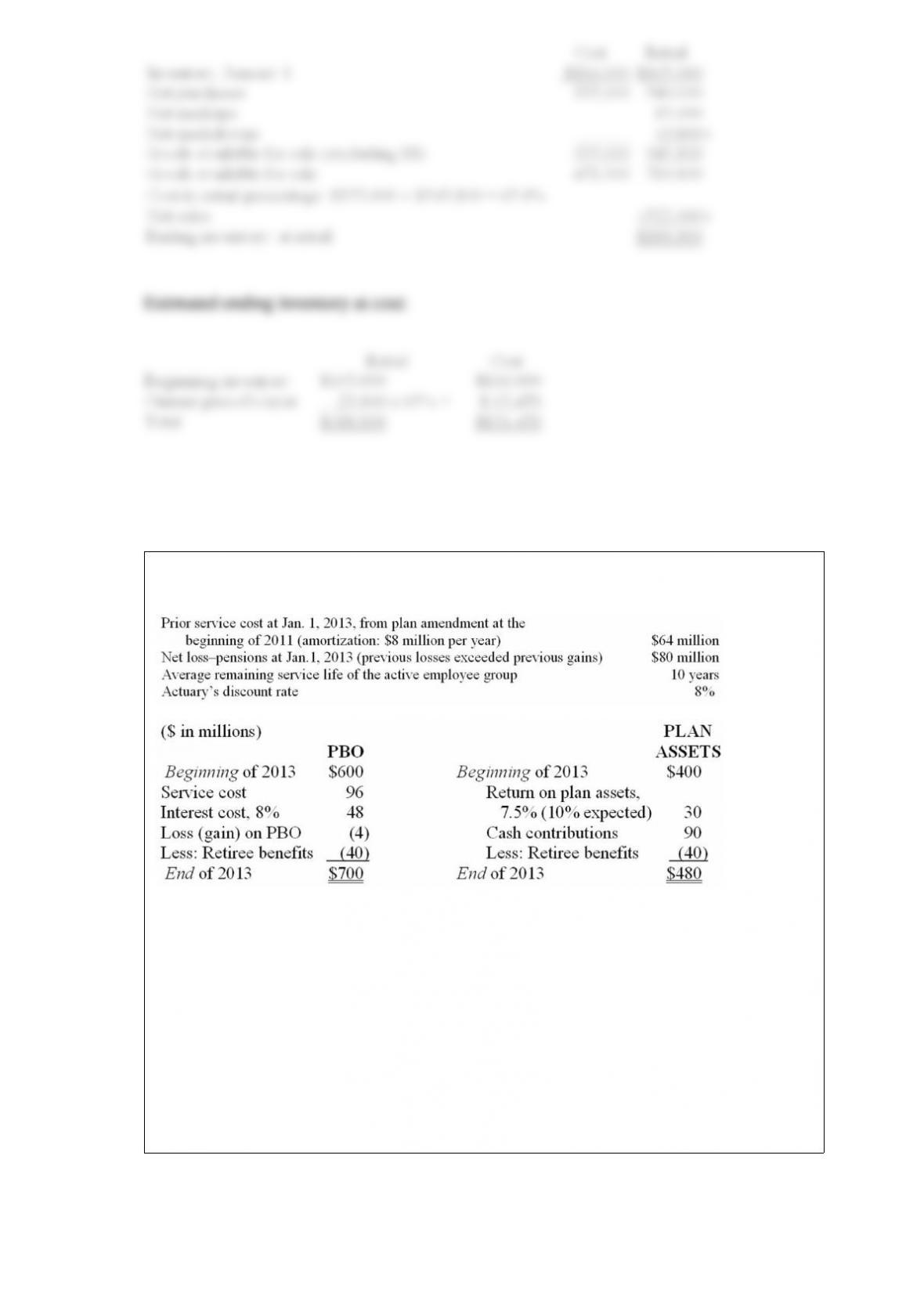
Actuary and trustee reports indicate the following changes in the PBO and plan assets
of Reeves Uniforms during 2013:
Required:
1) Determine Reeves’ pension expense for 2013 and prepare the appropriate journal
entries to record the expense as well as the cash contribution to plan assets.
2) Determine the new gains and/or losses in 2013 and prepare the appropriate journal
entry to record them.
3) Prepare a pension spreadsheet to assist you in determining end of 2013 balances in
the PBO, plan assets, prior service cost, the net loss-AOCI, and the pension
liability-AOCI.
Answer:
In 2013, Cap City Inc. introduced a new line of televisions that carry a two-year
warranty against manufacturer’s defects. Based on past experience with similar
products, warranty costs are expected to be approximately 1% of sales during the first
year of the warranty and approximately an additional 3% of sales during the second
year of the warranty. Sales were $6,000,000 for the first year of the product’s life and
actual warranty expenditures were $29,000. Assume that all sales are on credit.
Required:
1) Prepare journal entries to summarize the sales and any aspects of the warranty for
2013.
2) What amount should Cap City report as a liability at December 31, 2013?
Answer:
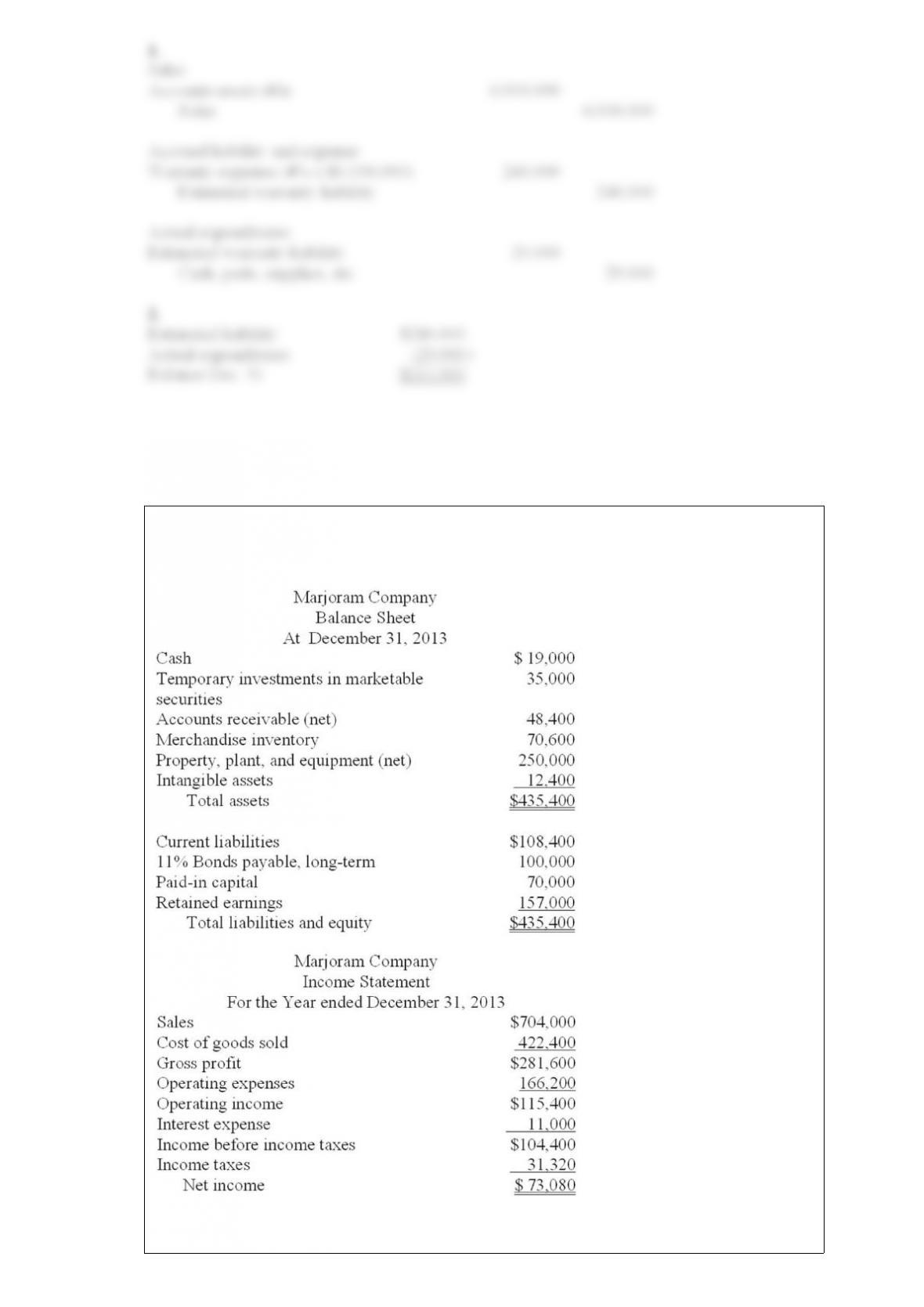
The condensed balance sheet and income statement for Marjoram Company are
presented below.
Compute the debt to equity ratio for Marjoram Company. Round your answer to two

decimal places.
Answer:
Beavis Construction Company was the low bidder on a construction project to build an
earthen dam for $1,800,000. The project was begun in 2012 and completed in 2013.
Cost and other data are presented below:
Assume that Beavis uses the completed contract method for revenue recognition.
Required: Prepare all journal entries to record costs, billings, collections, and profit
recognition.
Answer:
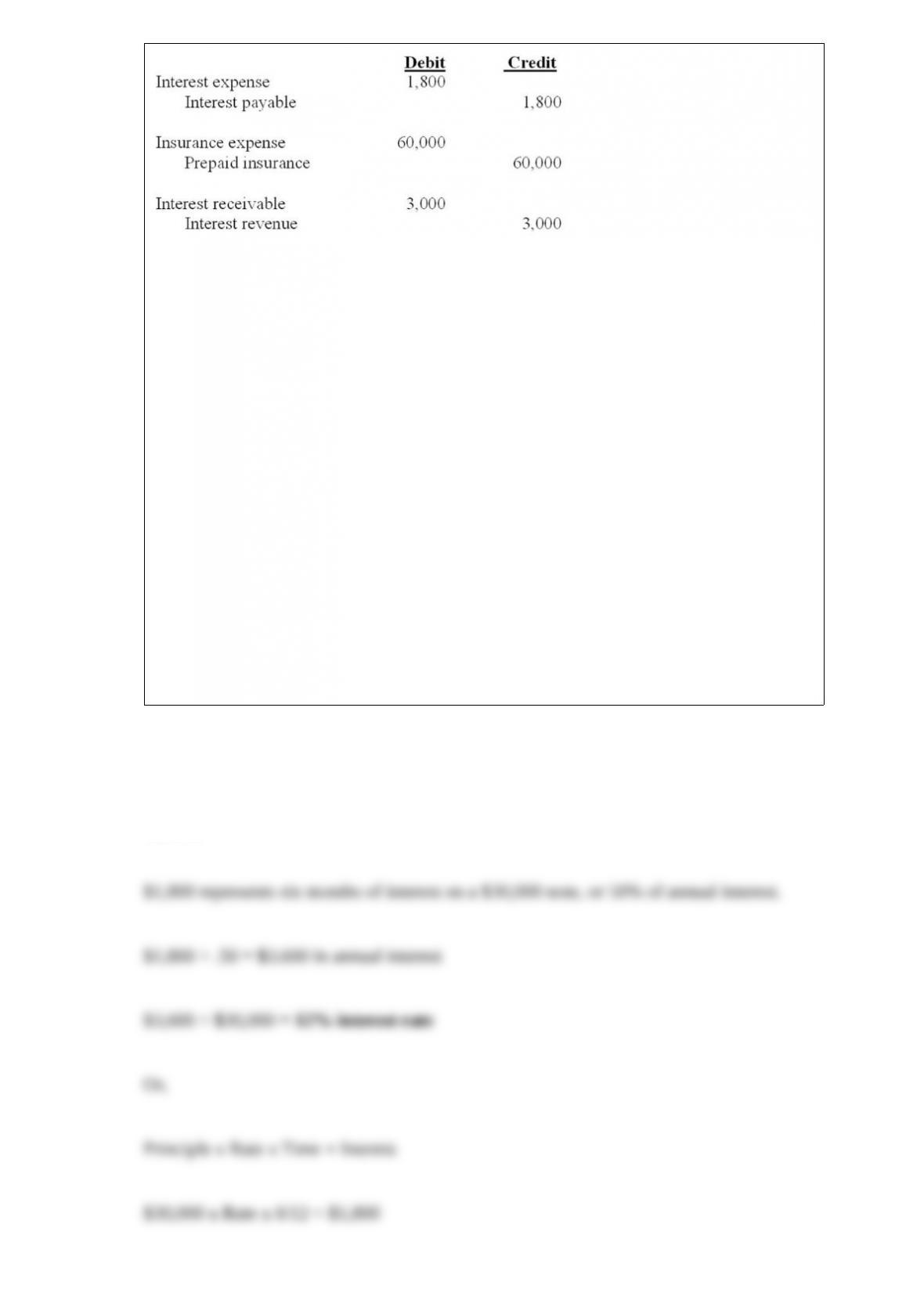
The Yankel Corporation’s controller prepares adjusting entries only at the end of the
fiscal year. The following adjusting entries were prepared on December 31, 2013:
Additional information:
1. The company borrowed $30,000 on June 30, 2013. Principal and interest are due on
June 30, 2014. This note is the company’s only interest-bearing debt.
2. Insurance for the year on the company’s office buildings is $90,000. The insurance is
paid in advance.
3. On August 31, 2013, Yankel lent money to a customer. The customer signed a note
with principal and interest at 9% due in one year.
Required:
Determine the following:
1. What is the interest rate on the company’s note payable?
2. The 2013 insurance payment was made at the beginning of which month?
3. How much did Yankel lend its customer on August 31?
Answer:
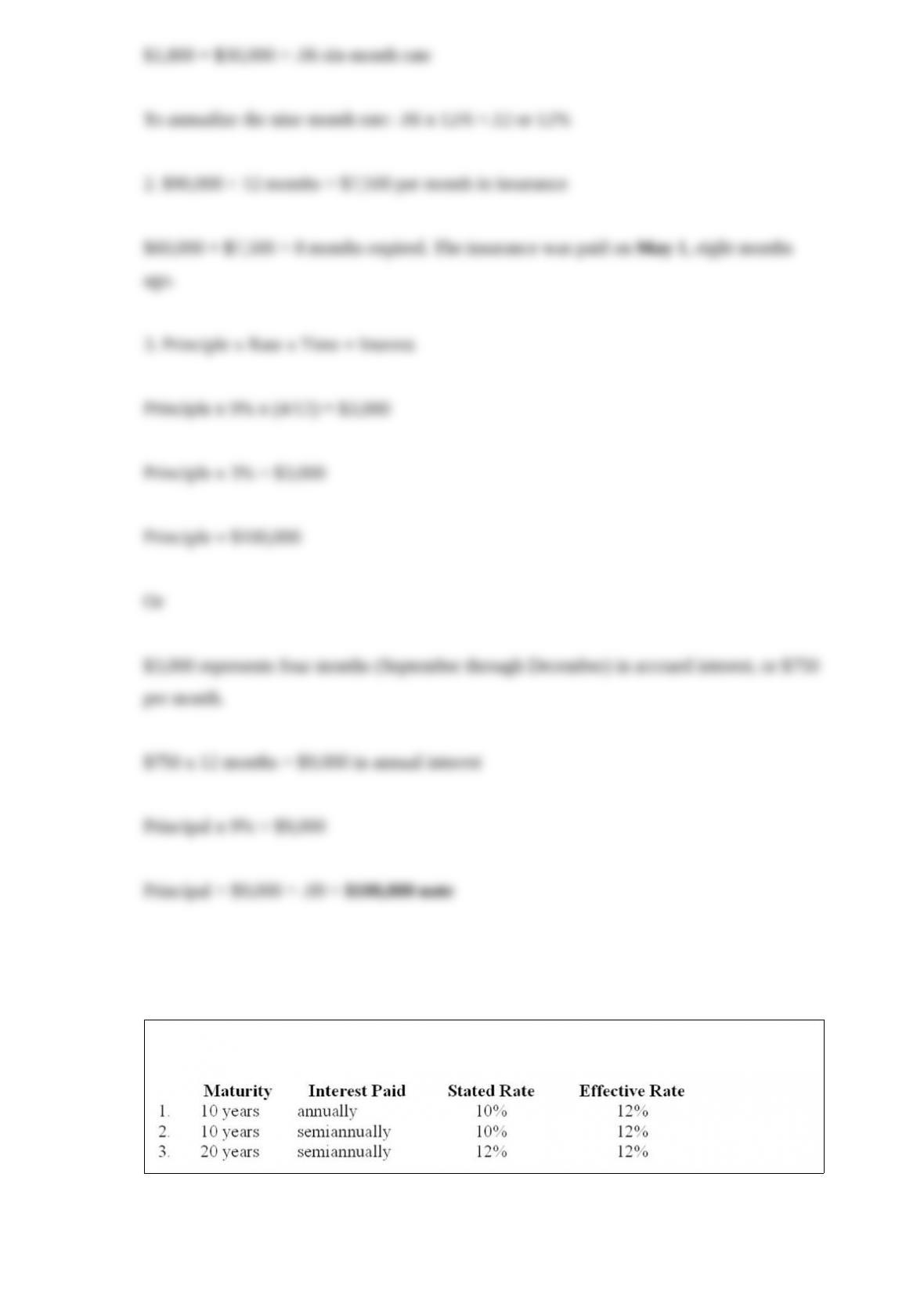
Determine the price of a $200,000 bond issue under each of the following independent
assumptions:

Answer: