Under GAAP, with respect to multiple-element arrangements, if the revenue for a
particular part of a multiple-part arrangement does not qualify for separate recognition,
it is: A. Never recognized.
B. Recognized when the contract is signed or persuasive evidence of an arrangement
exists.
C. Recognized when revenue for the other parts is recognized.
Answer:
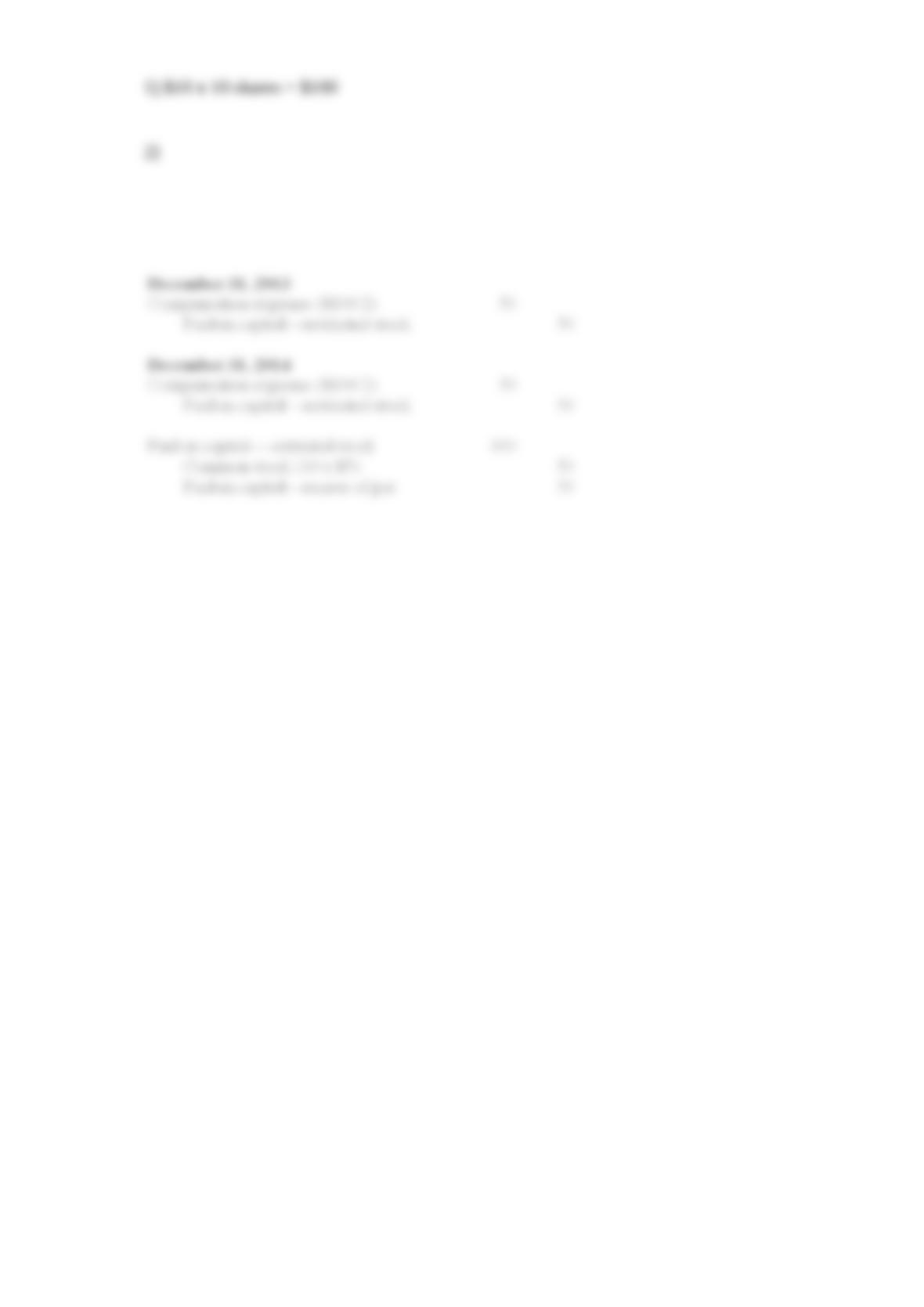
The compensation associated with a share of restricted stock under a stock award plan
is: A. The market price of a share of similar fixed income securities.
B. The market price of an unrestricted share of the same stock.
C. The book value of an unrestricted share of the same stock.
D. The book value of a share of similar stock.
Answer:
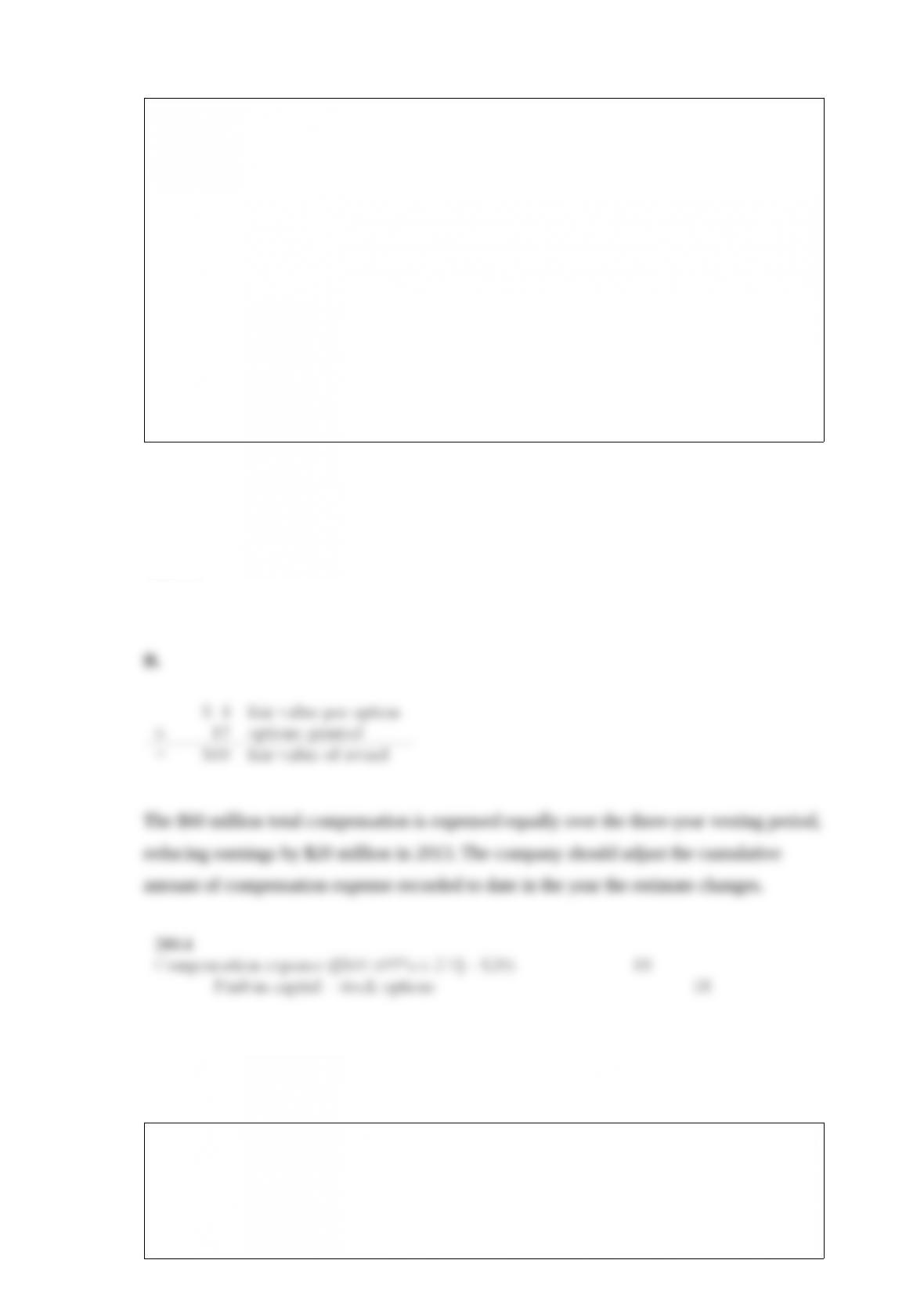
Under its executive stock option plan, M Corporation granted options on January 1,
2013, that permit executives to purchase 15 million of the company’s $1 par common
shares within the next eight years, but not before December 31, 2015 (the vesting date).
The exercise price is the market price of the shares on the date of grant, $18 per share.
The fair value of the options, estimated by an appropriate option pricing model, is $4
per option. No forfeitures were anticipated; however, unexpected turnover during 2014
caused the forfeiture of 5% of the stock options. Ignoring taxes, what is the effect on
earnings in 2014? A. $18.5 million.
B. $18 million.
C. $20 million.
D. $19 million.
Answer:
Accounting changes occur for which of the following reasons?A. Management is being
fair and consistent in financial reporting.
B. Management compensation is affected.

C. Debt agreements are impacted.
D. All of the above.
Answer:
In the balance sheet at the end of its first year of operations, Dinty Inc. reported an
allowance for uncollectible accounts of $82,000. During the year, Dinty wrote off
$32,000 of accounts receivable it had attempted to collect and failed. Credit sales for
the year were $2,200,000, and cash collections from credit customers totaled
$1,950,000.
In Dinty’s adjusting entry for bad debts at year-end, which of these would be included?
A. Debit to bad debt expense for $114,000.
B. Credit to allowance for uncollectible accounts for $82,000.
C. Debit to accounts receivable for $32,000.
D. All of the above are correct.
Answer:
Oregon Co.’s employees are eligible for retirement with benefits at the end of the year
in which both age 60 is attained and they have completed 35 years of service. The

benefits provide 15 years reimbursement for health care services of $20,000 annually,
beginning one year from the date of retirement.
Ralph Young was hired at the beginning of 1977 by Oregon after turning age 22 and is
expected to retire at the end of 2015 (age 60). The discount rate is 4%. The plan is
unfunded.
The PV of an ordinary annuity of $1 where n = 15 and i = 4% is 11.11839.
The PV of $1 where n = 2 and i = 4% is 0.92456
With respect to Ralph, what is Oregon’s accumulated postretirement benefit obligation
(APBO) at the end of 2013, rounded to the nearest dollar? A. $130,544.
B. $205,593.
C. $195,050.
D. None of the above is correct.
Answer:
Listed below are five terms followed by a list of phrases that describe or characterize
each of the terms. Match each phrase with the correct term by placing the number
designating the best term in the space provided by the phrase. 1) Convertible preferred
stock dividends
2) Undeclared preferred dividends
3) Contingently issuable shares

4) Stock dividends and splits
5) Price-earnings ratio
A. Expresses the market value of a stock as a multiple of EPS
B. Factored into EPS if the stock is cumulative.
C. Omitted from the EPS numerator under the “if converted” method
D. Included in diluted EPS when performance criterion is met
E. Handled retroactively in computing current and prior years’ EPS
Answer:
Amortizing prior service cost for pension plans will: A. Increase retained earnings and
increase accumulated other comprehensive income.
B. Decrease retained earnings and decrease accumulated other comprehensive income.
C. Increase retained earnings and decrease accumulated other comprehensive income.
D. Decrease retained earnings and increase accumulated other comprehensive income.
Answer:

Companies may report interest received and dividends received as investing activities
using: A. U.S. GAAP.
B. IFRS.
C. Both U.S. GAAP and IFRS.
D. Neither U.S. GAAP nor IFRS.
Answer:
Gershwin Wallcovering Inc. shipped the wrong shade of paint to a customer. The
customer agreed to keep the paint upon being offered a 15% price reduction. Gershwin
would record this reduction by crediting accounts receivable and debiting: A. Sales.
B. Sales discounts.
C. Sales returns.
D. Sales allowances.
Answer:
If restricted stock is forfeited because an employee leaves the company, the appropriate
accounting procedure is to: A. Reverse related entries previously made.

B. Do nothing.
C. Prepare correcting entries.
D. Record an income item.
Answer:
Of the four criteria for a capital lease, the one that most often is the decisive criteria is:
A. The 75% of economic life test.
B. The transfer of title.
C. The 90% of fair value test.
D. The bargain purchase option.
Answer:
Prescott Corporation issued ten thousand $1,000 bonds on January 1, 2013. The bonds
have a 10-year term and pay interest semiannually. This is the partial bond amortization
schedule for the bonds.
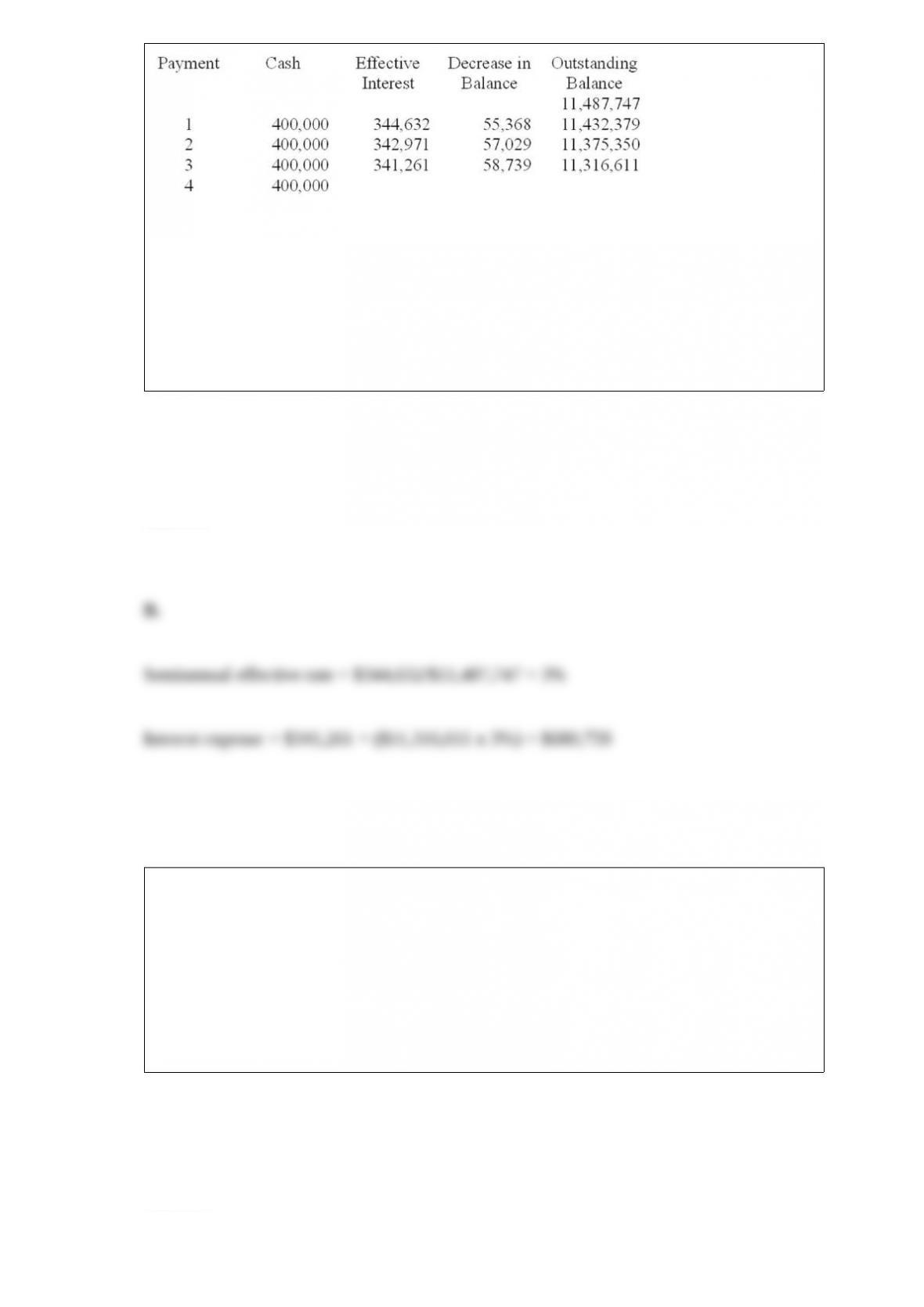
What is the interest expense on the bonds in 2014? A. $800,000.
B. $680,759.
C. $342,961.
D. $119,241.
Answer:
J Corp. entered into an operating lease in February. The company’s December 31
statement of cash flows will report: A. A cash outflow from investing activities.
B. A cash outflow from financing activities.
C. A cash outflow from operating activities.
D. No cash outflow.
Answer:

Sullivan Software sells packages of a software program and one year’s worth of
technical support for $500. Its packaging lists the $500 sales price as comprised of a
software program at a price of $450 and technical support with a price of $100, with a
$50 discount for the package deal. All of Sullivan’s sales are for cash, and there are no
returns. Sullivan sells the software program separately for $475 and offers a year of
technical support separately for $75.
The amount of revenue that GAAP, regarding software revenue recognition, would
require Sullivan to attribute to the software program (as opposed to the technical
support) is (rounded): A. $450.
B. $475.
C. $432.
D. $400.
Answer:
Indiana Co. began a construction project in 2013 that will provide it $150 million when
it is completed in 2015. During 2013, Indiana incurred $36 million of costs and
estimates an additional $84 million of costs to complete the project.

In 2014, Indiana incurred costs of $58.5 million and estimated an additional $40.5
million in costs to complete the project. Using the percentage-of-completion method,
Indiana: A. Recognized $15 million gross profit on the project in 2014.
B. Recognized $13.5 million gross profit on the project in 2014.
C. Recognized $6 million gross profit on the project in 2014.
D. Recognized $1.5 million gross profit on the project in 2014.
The project is 70% complete after 2014 (i.e., $94.5 million costs to date/$135 million
estimated total costs). The estimated gross profit is now $15 million (i.e., $150 million –
$135 million), so gross profit to date is $10.5 million (70% x $15 million). $9 million
was recognized in 2013, per question 114, so $1.5 million more is recognized in 2014.
Answer:
The accounting equation can be stated as: A. A + L – OE = 0.
B. A – L + OE = 0.
C. -A + L – OE = 0.
D. A – L – OE = 0.
Answer:

Which of the following is recorded by a credit to accounts receivable? A. Sale of
inventory on account.
B. Estimating the annual allowance for uncollectible accounts.
C. Estimating annual sales returns.
D. Write-off of bad debts.
Answer:
Dollar-value LIFO: A. Starts with ending inventory measured at current costs and
re-creates LIFO layers for measuring inventory costs.
B. Increases the recordkeeping costs of LIFO.
C. Only is allowed for internal reporting purposes.
D. None of the above is correct.
Answer:
Which of the following is not an indicator that revenue for a service can be recognized
continuously? A. The seller is enhancing an asset that the buyer controls as the service
is performed.
B. The seller is not enhancing an asset that the buyer controls or that has an alternative
use to the seller, and the customer receives a benefit as the seller performs the service.
C. The seller is not enhancing an asset that the buyer controls or that has an alternative
use to the seller, and another seller would need to re-perform the tasks performed to
date if that other seller were to fulfill the remaining obligation.
D. None of the other answers is correct.
Answer:
Alamos Co. exchanged equipment and $18,000 cash for similar equipment. The book
value and the fair value of the old equipment were $82,000 and $90,000, respectively.
Assuming that the exchange lacks commercial substance, Alamos would record a gain/
(loss) of: A. $26,000.
B. $8,000.
C. $(8,000).
D. $0.
Answer:
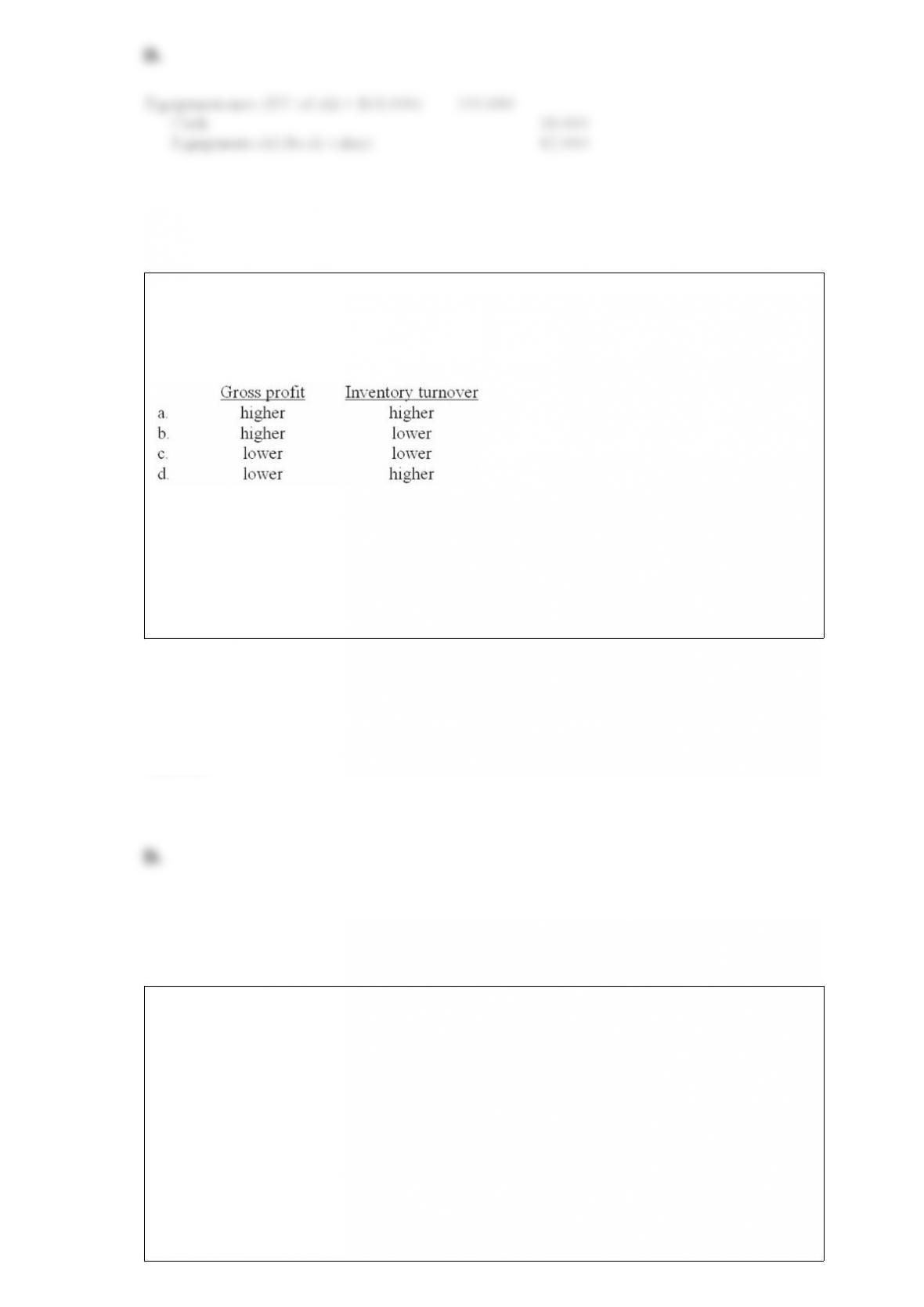
Company C is identical to Company D in every respect except that Company C uses
LIFO and Company D uses average costs. In an extended period of rising inventory
costs, Company C’s gross profit and inventory turnover ratio, compared to Company
D’s, would be:
A. Option a
B. Option b
C. Option c
D. Option d
Answer:
Consider the following:
I. Present value of vested benefits at present pay levels.
II. Present value of nonvested benefits at present pay levels.
III. Present value of additional benefits related to projected pay increases.
Which of the above constitutes the projected benefit obligation? A. III only.
B. I, II.

C. I, II, III.
D. II only.
Answer:
In February 2013, Despot declared cash dividends of $12 million to be paid in April of
that year. What effect did the April transaction have on Despot’s accounts? A.
Decreased assets and liabilities.
B. Decreased assets and shareholders’ equity.
C. Increased liabilities and decreased shareholders’ equity.
D. None of the above is correct.
Answer:
Misty Company reported the following before-tax items during the current year:
Misty’s effective tax rate is 40%.

What is Misty’s income before extraordinary item(s)? A. $198.
B. $210.
C. $330.
D. $360.
Answer:
Characteristics of the corporate form that have led to the growth of this form of
business ownership include all of the following except: A. Ease of raising capital.
B. Low government regulation.
C. Limited liability.
D. Ease of ownership transfer.
Answer:
Which of the following is not an uncertainty that complicates determining how much to

set aside each year to ensure that sufficient funds are available to provide the benefits
promised under a defined benefit plan? A. Employee turnover.
B. Number of employees who retired last year.
C. Future inflation rates.
D. Future compensation levels.
Answer:
Excerpts from Hulkster Company’s December 31, 2013 and 2012, financial statements
are presented below:
Hulkster’s 2013 return on shareholders’ equity is (rounded): A. 17.1%.
B. 14.0%.
C. 12.6%.
D. 7.1%.
Answer:

Vijay Inc. purchased a three-acre tract of land for a building site for $320,000. On the
land was a building with an appraised value of $120,000. The company demolished the
old building at a cost of $12,000, but was able to sell scrap from the building for
$1,500. The cost of title insurance was $900 and attorney fees for reviewing the
contract were $500. Property taxes paid were $3,000, of which $250 covered the period
subsequent to the purchase date. The capitalized cost of the land is: A. $336,400.
B. $336,150.
C. $334,650.
D. $201,150.
Answer:
Accounting for a change in the estimated service life of equipment: A. Is handled
prospectively.
B. Requires retroactive restatement of prior year’s financial statements.
C. Requires a prior period adjustment.
D. Is handled currently as a change in accounting principle.

Answer:
The primary reason for the popularity of LIFO is that it: A. Provides better matching of
physical flow and cost flow.
B. Saves income taxes currently.
C. Simplifies recordkeeping.
D. Provides a permanent reduction of income taxes.
Answer:
Authorized common stock refers to the total number of shares: A. Outstanding.
B. Issued.
C. Issued and outstanding.
D. That can be issued.
Answer:

The primary professional organization for those accountants working in the industry is
the: A.AAA.
B.AICPA.
C.IIA.
D.IMA.
Answer:
On May 1, Foxtrot Co. agreed to sell the assets of its Footwear Division to Albanese
Inc. for $80 million. The sale was completed on December 31, 2013.
The following additional facts pertain to the transaction:
– The Footwear Division qualifies as a component of the entity according to GAAP
regarding discontinued operations.
– The book value of Footwear’s assets totaled $48 million on the date of the sale.
– Footwear’s operating income was a pre-tax loss of $10 million in 2013.
– Foxtrot’s income tax rate is 40%.
In the 2013 income statement for Foxtrot Co., it would report income from discontinued
operations of:A. $9.2 million.
B. $13.2 million.
C. $22 million.
D. $26 million.

Answer:
Which of the following is not true regarding the statement of cash flows? A. The
indirect method derives cash flows indirectly by starting with sales revenue and
“working backwards” to convert that amount to a cash basis.
B. Noncash transactions sometimes are reported in conjunction with the statement.
C. Either the direct or the indirect method can be used to calculate and report the net
cash increase or decrease from operating activities.
D. The statement of cash flows provides information about cash flows that the other
statements either do not provide or provide only indirectly.
Answer:
In early December of 2013, Blue Corp. purchased $40,000 of Yellow Company
common stock, which constitutes less than 3% of Yellow’s outstanding shares. Blue

accounts for the Yellow investment as available for sale. By December 31, 2013, the
value of the Yellow investment had fallen to $30,000, and Blue recorded an unrealized
loss. By December 31, 2014, the value of the Yellow investment had fallen to $15,000,
and Blue determined that it can no longer assert that it has both the intent and ability to
hold the shares long enough for their fair value to recover, so Blue recorded an OTT
impairment. By December 31, 2015, fair value had recovered to $20,000.
Prepare appropriate entry(s) at December 31, 2013, and indicate how the scenario will
affect net income, OCI, and comprehensive income.
Answer:
The following disclosure note appeared in the 2013 annual report to shareholders of
Upton Systems Inc.
Inventories are stated at the lower of cost or market. Cost is computed using standard
cost, which approximates actual cost, on a first-in, first-out basis. The Company
provides inventory allowances based on excess and obsolete inventories.
Another disclosure note in the annual report stated:
The Company recorded a provision for inventory, including purchase commitments,
totaling $1.40 billion during fiscal 2013, which included an additional excess inventory
charge as previously discussed. This additional excess inventory charge was due to a
sudden and significant decrease in demand for the Company’s products and was
calculated in accordance with the Company’s accounting policy.
A skeptic may conclude that Upton’s policy and practices threaten earnings quality.
Discuss how it may do so.
Answer:
Discuss the three major types of leases that may apply to the lessor. How do they differ?
Answer:
Capital Consulting Company had 400,000 shares of common stock outstanding on
December 31, 2013. On that date, there were also 5,000 shares of $100 par, 6%
noncumulative preferred stock outstanding. On March 1, 2013, the company’s common
stock split 3-for-1. On December 15, 2013, a preferred dividend was declared and paid
in the amount of $25,000. Net income for 2013 was $3,000,000.
Required:
Compute basic earnings per share (rounded to 2 decimal places) for the year ended
December 31, 2013.
Answer:
What is restricted stock? Describe how compensation expense is determined and
recorded for a restricted stock plan.
Answer:
Prepare journal entries to record the following transactions of Daisy King Ice Cream
Company. If an entry is not required, state “No Entry.”
1. Started business by issuing 10,000 shares of capital stock for $20,000.
2. Signed a franchise agreement to pay royalties of 5% of sales.
3. Leased a building for three years at $500 per month and paid six months’ rent in
advance.
4. Purchased equipment for $5,400, paying $1,000 down and signing a two-year, 10%
note for the balance.
5. Purchased $1,800 of supplies on account.
6. Recorded cash sales of $800 for the first week.
7. Paid weekly wages, $320.
8. Paid for supplies purchased in item (5).
9. Paid royalties due on first week’s sales.
10. Recorded depreciation on equipment, $50.
Answer:
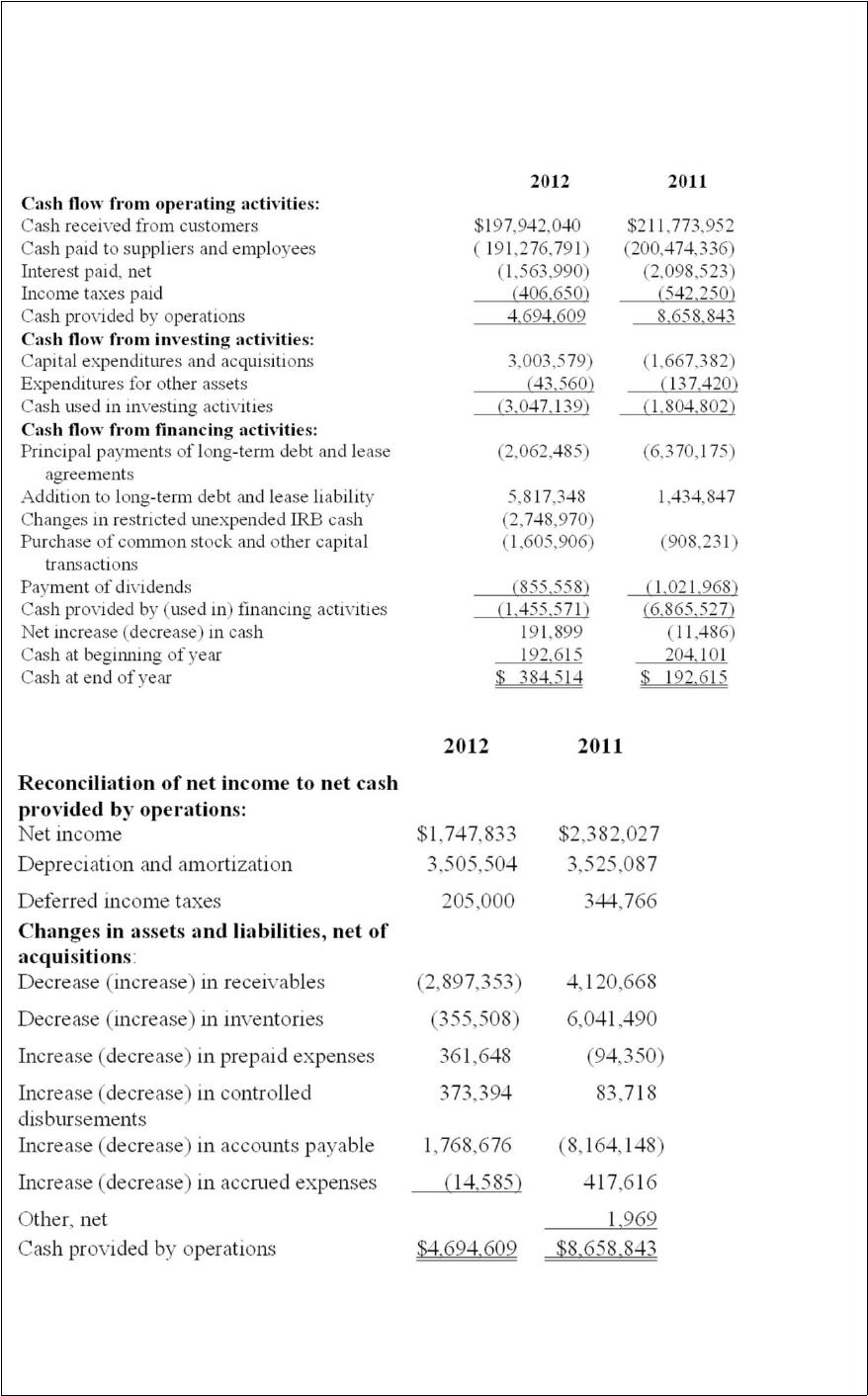
In its 2012 Annual Report to Shareholders, Kinney Inc. reported the following
Consolidated Statement of Cash Flows:
For the years ended December 31,
Assuming the decrease in accrued expenses during fiscal year 2012 included a $14,000
reduction due to interest on debt, compute the interest expense (net) for Kinney in that
year.
Answer:
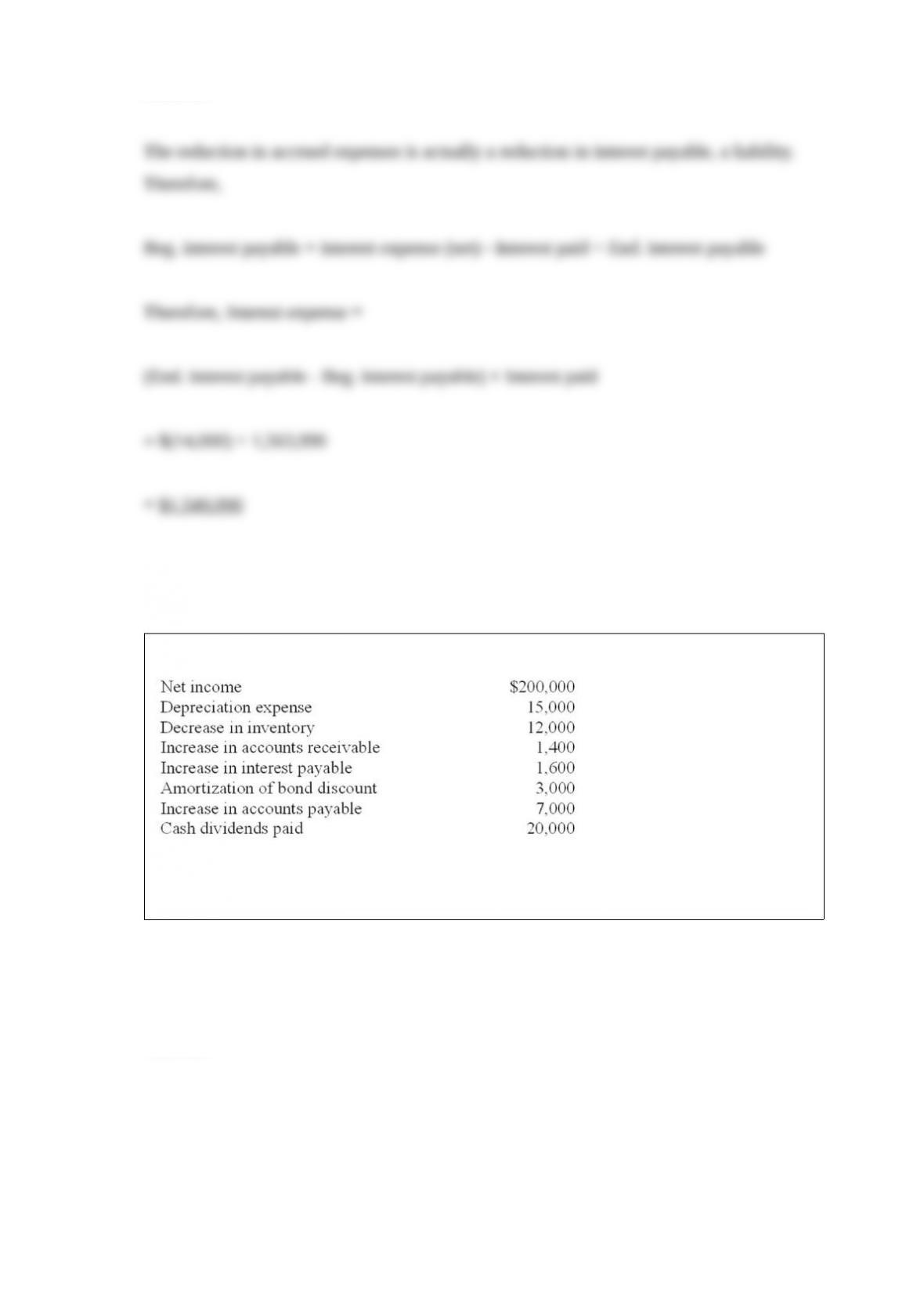
The accounting records of Westlake Industries provided the data below.
Required:
Prepare a reconciliation of net income to net cash flows from operating activities.
Answer:

On January 1, 2013, Hobart Mfg. Co. purchased a drill press at a cost of $36,000. The
drill press is expected to last 10 years and has a residual value of $6,000. During its
10-year life, the equipment is expected to produce 500,000 units of product. In 2013
and 2014, 25,000 and 84,000 units, respectively, were produced.
Required:
Compute depreciation for 2013 and 2014 and the book value of the drill press at
December 31, 2013 and 2014, assuming the units-of-production method is used.
Answer:
Briefly explain the disclosures that are required relative to depreciable assets.
Answer:
Suppan Service began the year with a net pension liability of $56 million (underfunded
pension plan). Pension expense for the year included the following ($ in millions):
service cost, $20; interest cost, $12; expected return on assets, $8; amortization of net
gain, $4.
Required:
Prepare the appropriate general journal entry to record Suppan’s pension expense.
Answer:
Describe the way we account for a change in estimate. What is the appropriate
accounting if we are unable to determine whether a change is a change in estimate or a
change in principle?
Answer:
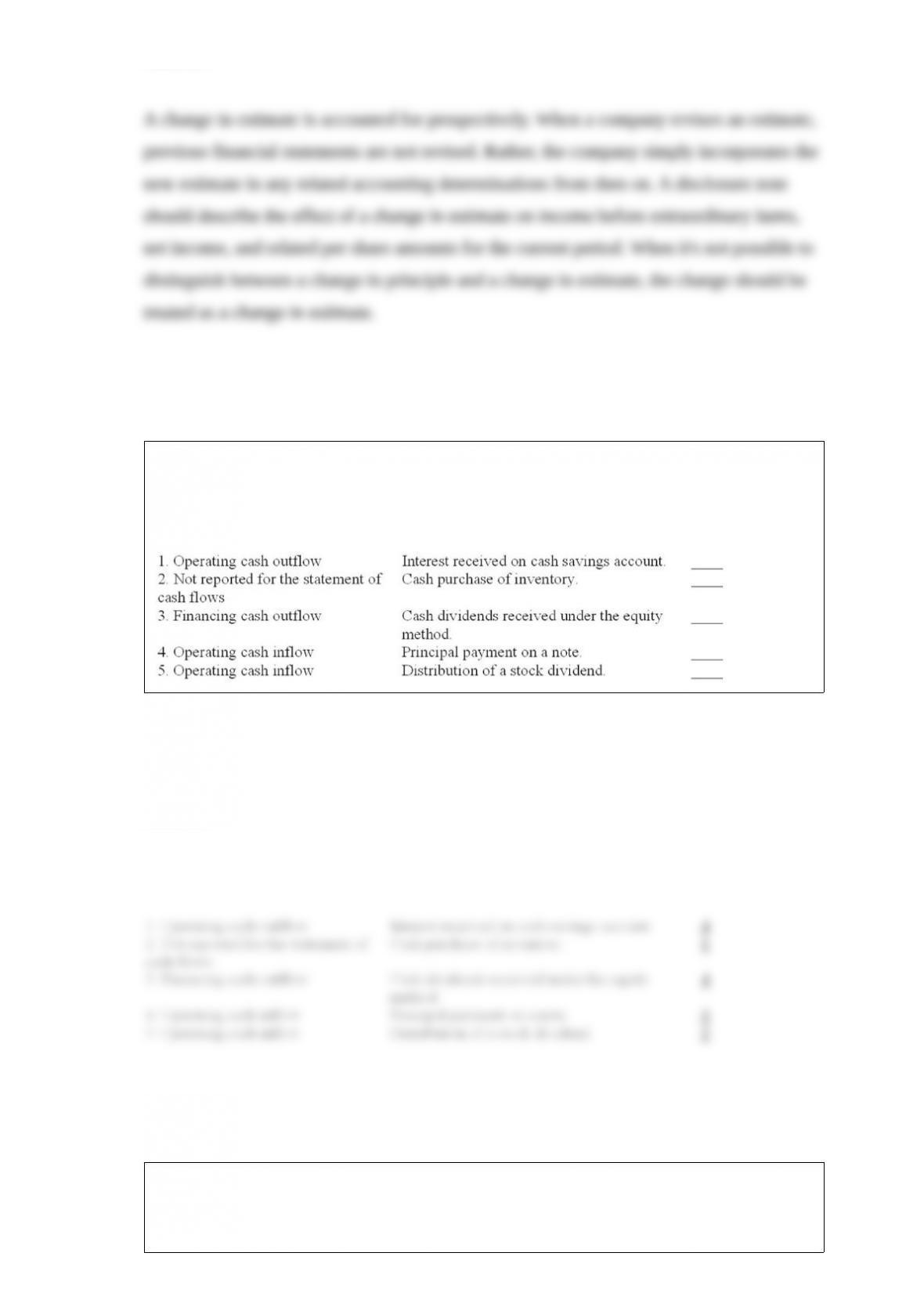
Listed below are the reporting classifications for a statement of cash flows using the
direct method for reporting operating cash flows. Indicate the reporting classification
that would apply to each of the five transactions described below by placing the number
of the reporting classification in the space provided by each transaction.
Answer:
On January 1, 2013, Morrow Inc. purchased a spooler at a cost of $40,000. The
equipment is expected to last eight years and have a residual value of $4,000. During its
eight-year life, the equipment is expected to produce 250,000 units of product. In 2013

and 2014, 42,000 and 76,000 units respectively were produced.
Required:
Compute depreciation for 2013 and 2014 and the book value of the spooler at
December 31, 2013 and 2014, assuming the units-of-production is used.
Answer:
Qualcomm Inc. engages in the development, design, manufacture, and marketing of
digital wireless telecommunications products and services. In its 2011 income statement
the company reported a $114 million goodwill impairment charge. The charge related to
the goodwill of its Firethorn reporting unit.
Required:
1) Why did Qualcomm conduct an impairment test of the goodwill of these reporting
units?
2) Describe the steps Qualcomm performed to conduct its impairment test.
3) Where would the impairment charge be shown in the company’s income statement?
Answer:
In LMC’s 2013 annual report to shareholders, it disclosed the following information
about its income taxes:
INCOME TAXES
Deferred income taxes reflect the net tax effects of temporary differences between the
amounts of assets and liabilities for accounting purposes and the amounts used for
income tax purposes.
Significant components of the Company’s deferred tax liabilities and assets as of
December 31 were as follows:
Indicate why LMC lists net operating loss carryforwards as a component of deferred tax
assets.

Answer:
On January 1, 2013, Morton Sales Co. issued zero-coupon bonds with a face value of
$6 million for cash. The bonds mature in 10 years and were issued at a price of
$3,050,100. Required:
What was the annual effective interest rate in the market when the bonds were issued?
Answer:
Below is a list of accounts in no particular order. Assume that all accounts have normal
balances.
Required:
In column A, indicate whether a debit will:
1. Increase the account balance, or
2. Decrease the account balance.
In column B, classify each account according to the following scheme. For contra
accounts, indicate the classification of the account to which it relates.
1. A current asset in the balance sheet.

2. A noncurrent asset in the balance sheet.
3. A current liability in the balance sheet.
4. A long-term liability in the balance sheet.
5. A permanent equity account in the balance sheet.
6. A revenue account in the income statement.
7. An expense account shown in the income statement.
8. Account does not appear in either the balance sheet or the income statement.
Accounts receivable
Answer:
Steverino Inc. offers a restricted stock award plan to its vice presidents. On January 1,
2013, the corporation granted 10 million of its $5 par common shares, subject to
forfeiture if employment is terminated within two years. The common shares have a
market value of $10 per share on the date the award is granted.
Required:
1) Assume that no shares are forfeited. Determine the total compensation cost
pertaining to the restricted shares.
2) Prepare the appropriate journal entries related to the restricted stock through
December 31, 2014.
Answer: