
In the process of completing a work sheet, you determine that the Income Statement
debit column totals $83,000, while the Income Statement credit column totals $65,000.
To enter net income (or net loss) for the period into the work sheet would require an
entry to
A.the Adjustments debit column and the Adjustments credit column.
B.the Unadjusted Trial Balance debit column and the Adjustments credit column.
C.it is not practical to enter Net Income (or Net Loss) on the work sheet.
D.the Balance Sheet & Statement of Owner’s Equity debit column and the Income
Statement credit column.
E.the Income Statement debit column and the Balance Sheet & Statement of Owner’s
Equity credit column.
Indicate whether a debit or credit entry would be made to record the following changes
in each account.
a. To decrease Cash
b. To increase Owner, Capital
c. To decrease Accounts Payable.
d. To increase Salaries Expense.
e. To decrease Supplies.
f. To increase Revenue.
g. To decrease Accounts Receivable.
h. To increase Owner, Withdrawals.
Assume that a company uses a sales journal, a purchases journal, a cash receipts
journal, a cash disbursements journal, and a general journal. A sales return for credit on
account would be recorded in the:
A.Sales journal.
B.General journal.
C.Cash receipts journal.
D.Accounts receivable ledger.
E.Cash disbursements journal.
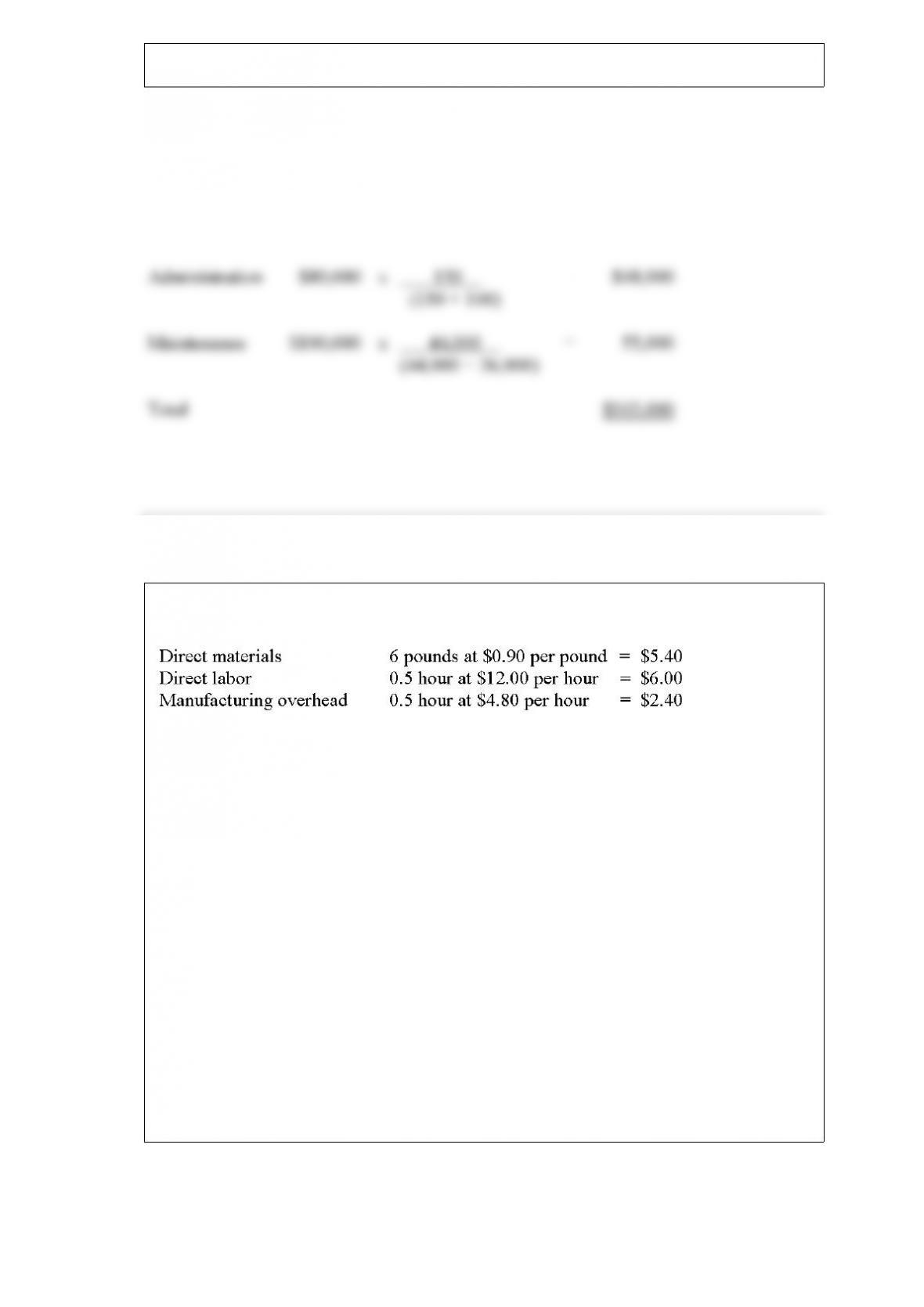
Able Company has two operating (production) departments: Assembly and Fabricating.
Assembly has 150 employees and occupies 44,000 square feet; Fabricating has 100
employees and occupies 36,000 square feet. Indirect factory expenses for the current
period are as follows:
Administration is allocated based on workers in each department; maintenance is
allocated based on square footage. The total amount of indirect factory expenses that
should be allocated to the Assembly Department for the current period is:
A.$ 48,000.
B.$ 55,000.
C.$103,000.
D.$104,000.
E.$110,000.
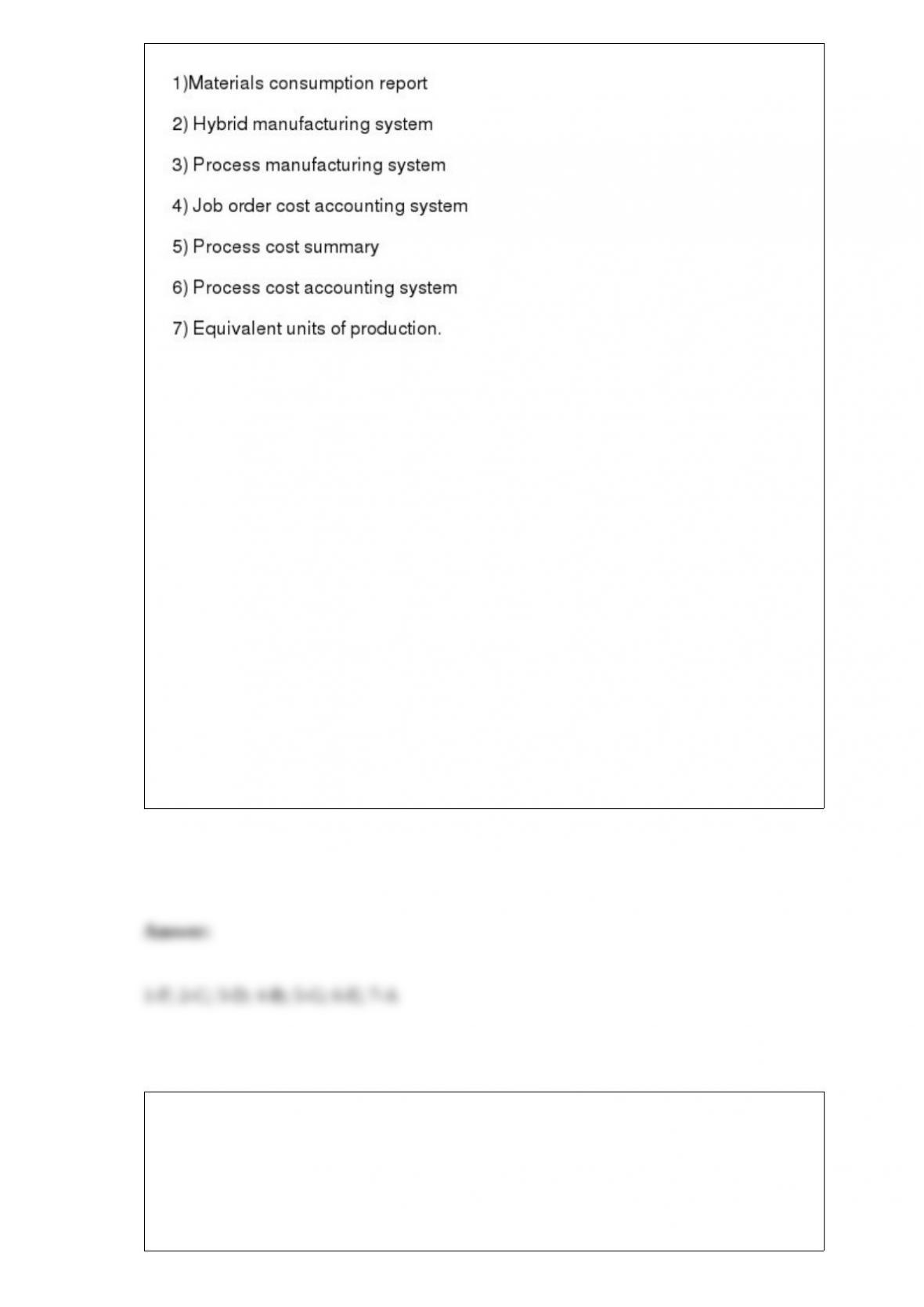
A company has determined that its standard costs to produce a single unit of output is as
follows:
During the latest month, the company purchased and used 58,000 pounds of direct
materials at a price of $1.00 per pound to produce 10,000 units of output. Direct labor
costs for the month totaled $56,350 based on 4,900 direct labor hours worked. Variable
manufacturing overhead costs incurred totaled $15,000 and fixed manufacturing
overhead incurred was $10,400.
Based on this information, the direct materials price variance for the month was:
A.$6,000 unfavorable
B.$1,800 favorable
C.$1,000 favorable
D.$5,800 unfavorable
E.$1,800 unfavorable

Classifying costs by behavior involves:
A.Identifying fixed cost and variable cost.
B.Identifying cost of goods sold and operating costs.
C.Identifying all costs.
D.Identifying costs in a physical manner.
E.Identifying both quantitative and qualitative cost factors.
A company issues at par 9% bonds with a par value of $100,000 on April 1. The bonds
pay interest semi-annually on January 1 and July 1. How much total cash interest is
received on July 1 by the bond holder?
A.$1,500.
B.$3,000.
C.$4,500.
D.$6,000.
E.$7,500.

Various types of documents and other papers that companies use when they conduct
their business:
A.Are called source documents.
B.Can include sales tickets.
C.Are the source of information for recording accounting entries.
D.Can be in electronic form.
E.All of these.
Factory overhead costs normally include all of the following except:
A.Indirect labor costs.
B.Indirect material costs.
C.Selling costs.
D.Machinery oil.
E.Factory rent.

Trend analysis is also called:
A.Financial analysis.
B.Ratio analysis.
C.Index number trend analysis.
D.Industry analysis.
E.Output analysis.
Costs classified by controllability are useful for:
A.The balance sheet.
B.The income statement.
C.Management reports.
D.Evaluation reports.
E.Both C and D.

Principles of internal control include:
A.Apply technological controls.
B.Divide responsibilities for related transactions.
C.Perform regular and independent reviews.
D.Separate recordkeeping from custody of assets.
E.All of these.
Liabilities:
A.Must be certain.
B.Must sometimes be estimated.
C.Must be for a specific amount.
D.Must always have a definite date for payment.
E.Must involve an outflow of cash.
The contract between the bond issuer and the bondholders, which identifies the rights
and obligations of the parties, is called a(n):
A.Debenture.
B.Bond indenture.

C.Mortgage.
D.Installment note.
E.Mortgage contract.
Which of the following characteristics applies to process cost accounting but not to job
order cost accounting?
A.Use of a predetermined overhead rate.
B.Identifiable lots of production.
C.Equivalent units of production.
D.Labor time ticket for each employee.
E.Use of a single Goods in Process account.
Match the following terms with the definitions.
A) Number of units that would be completed if all effort during a period had been
applied to units that were started and finished.
B) Costing system to determine the cost of producing each job or job lot.
C)A manufacturing system that contains features of both process and job order systems.
D) Process of products in a continuous flow of steps.
E) System of assigning direct materials, direct labor, and overhead to specific
processes; total costs associated with each process are then divided by the number of
units. passing through that process to determine cost per equivalent unit.
F) Document that summarizes the materials a department uses during a reporting
period; replaces materials requisition.
G)Report of costs charged to a department, its equivalent units of production achieved,
even the costs assigned to its output.
The currency in which a company presents its financial statements is known as the:
A.Multinational currency.
B.Price-level-adjusted currency.

C.Specific currency.
D.Reporting currency.
E.Historical cost currency.
External users of financial information:
A.Are those individuals involved in managing and operating the company.
B.Include internal auditors and consultants.
C.Are not directly involved in operating the company.
D.Make strategic decisions for a company.
E.Make operating decisions for a company.
The Footwear Department of Lee’s Department Store had sales of $188,000, cost of
goods sold of $132,500, indirect expenses of $13,250, and direct expenses of $27,500
for the current period. The Footwear Department’s contribution to overhead as a percent
of sales is:
A.7.8%.
B.14.9%.
C.29.5%.
D.66.7%.
E.85.4%.
Banking activities include:
A.Bank accounts.
B.Bank deposits.
C.Checking.
D.Electronic funds transfer.
E.All of these.
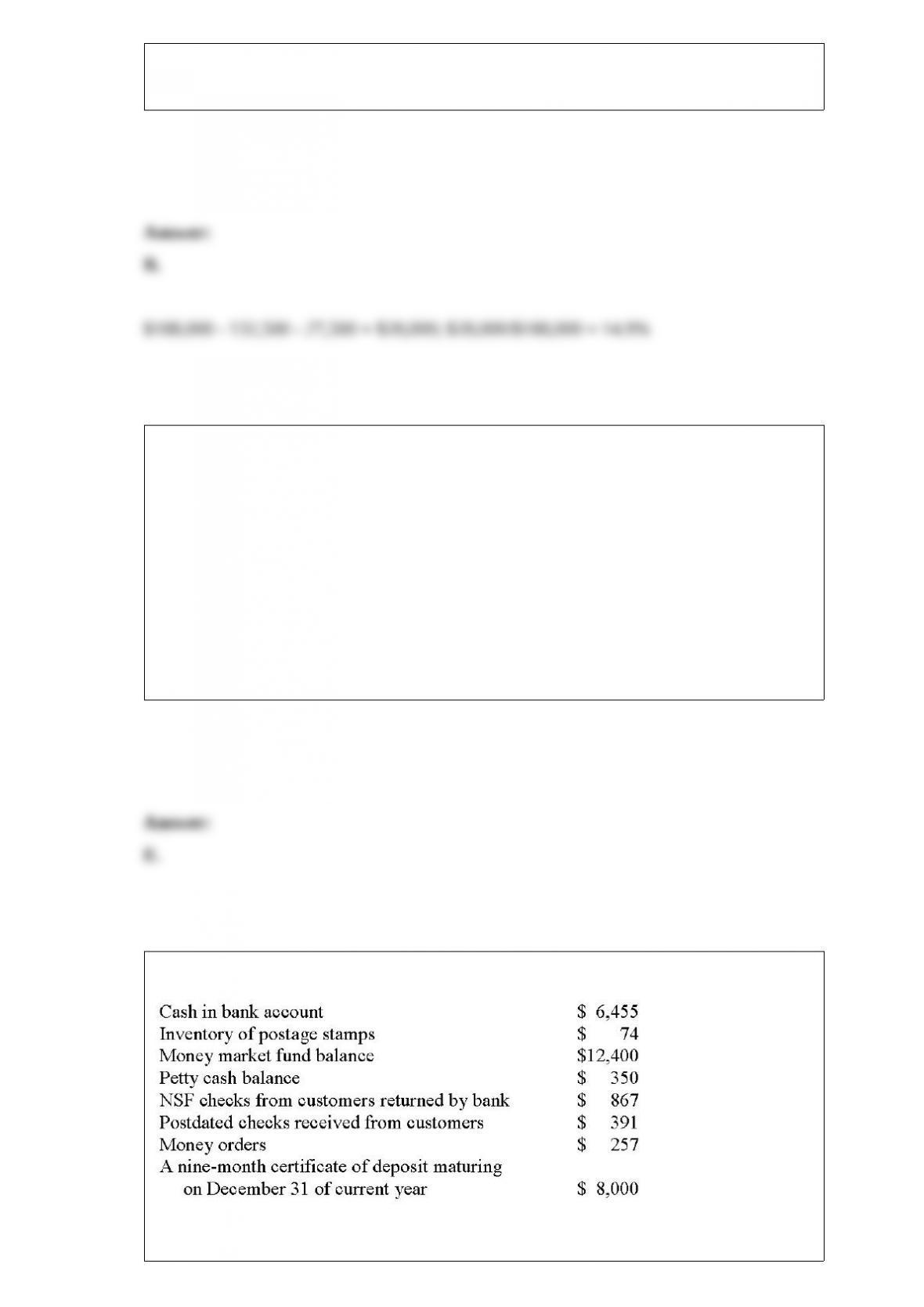
The following information is available for Johnson Manufacturing Company at June 30:
Based on this information, Johnson Manufacturing Company should report Cash and

Cash Equivalents on June 30 of:
A.$15,062
B.$20,146
C.$20,072
D.$19,205
E.$19,462
A company may retire bonds by:
A.Exercising a call option.
B.The holders converting them to stock.
C.Purchasing the bonds on the open market.
D.Paying them off at maturity.
E.All of these.
A company uses the periodic inventory system and had the following activity during the
current monthly period.
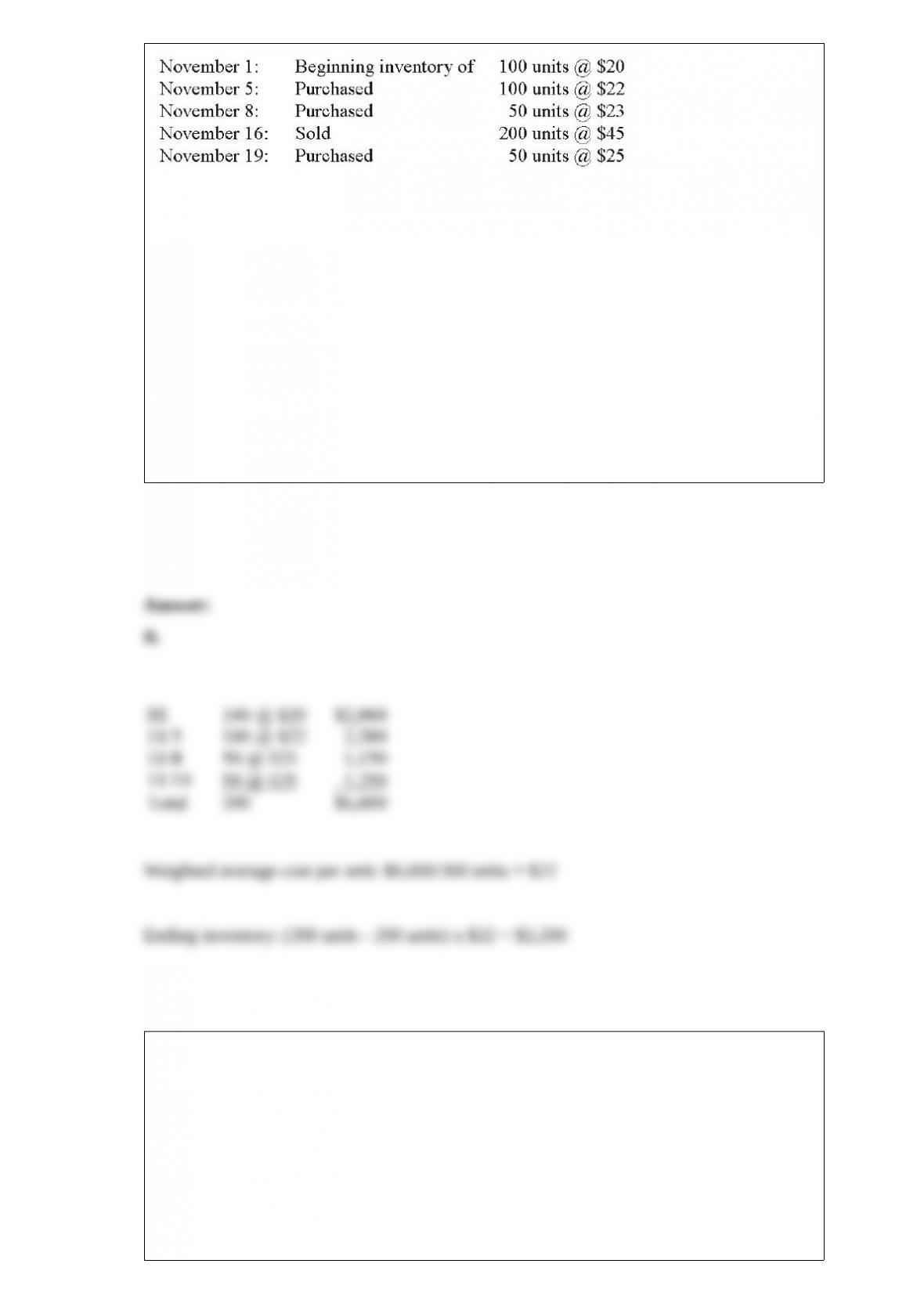
In a periodic inventory system, using the weighted-average inventory method, the
company’s ending inventory would be:
A.$2,000.
B.$2,200.
C.$2,250.
D.$2,400.
E.$4,400.
Available-for-sale debt securities are:
A.Recorded at cost and remain at cost over the life of the investment.
B.Reported at historical cost, adjusted for the amortized amount of any difference
between cost and maturity value.
C.Reported at market value on the balance sheet.

D.Intended to be held to maturity.
E.Always classified with Long”Term Liabilities.
Information processors:
A.Include information storage.
B.Interpret, transform, and summarize information for use in analysis and reporting.
C.Are components of an accounting system that keep data in accessible form.
D.Are the means to take information out of an accounting system and make it available
to users.
E.Include scanners.
Quick assets divided by current liabilities is the:
A.Acid-test ratio.
B.Current ratio.
C.Working capital ratio.
D.Current liability turnover ratio.
E.Quick asset turnover ratio.

Investment center managers are usually evaluated using performance measures
A.that combine income and assets
B.that combine income and capital
C.based on assets only
D.based on income only
E.that combine assets and capital
Match each of the following items 1 through 8 with the financial statement a through d
in which each item would most likely appear. An item may appear on more than one
statement.
a. Income statement
b. Statement of owner’s equity
c. Balance sheet
d. Statement of cash flows
1)Cash from investing activities.
2)Equity.
3)Revenues.
4)Liabilities.
5)Cash from operating activities.
6)Withdrawals.
7)Costs and expenses.
8)Assets.
The first step in accounting for production activity in a period, ________________, is a
reconciliation of the physical units started in a period with the physical units completed
in that period.
Expenditures directly associated with the manufacture of finished goods that include
direct materials and direct labor are _____________________ costs.
Explain the options a company has to convert its receivables to cash.
What is the usual order in which financial statements are prepared from the adjusted
trial balance? Why are they prepared in that order?
A _______________________ incurs costs and generates revenues.
A company borrowed $60,000 by signing a 60-day, 10% note payable from its bank.
Compute the total cash payment due on the note’s maturity date.
Hasbro had net sales of $7,875 and its average accounts receivables is $1,350. Calculate
Hasbro’s accounts receivable turnover:
Three of the most common tools of financial analysis are (1)
_________________________, (2) ___________________________, and (3)
______________________________.
The accounting equation is: Assets = ___________ + Equity.
______________________ is the recording of financial transactions and events, either
manually or electronically.
Describe the use of the Factory Payroll account in a job order cost accounting system.
Identify and describe three common tools of financial statement analysis.
Explain the basic difference between estimating the amount of uncollectible accounts
using the percent of sales method and the accounts receivable method.
List the five basic principles of accounting information systems.
What are prime costs? What are conversion costs?