In order to prepare the sales budget, one needs
a. The number of units expected to be produced and the prices expected to be charged.
b. The number of units expected to be sold and the cost of producing each unit.
c. The number of units expected to be sold and the prices expected to be charged.
d. The number of units sold in the previous period and the price charged for the units.
When using the balanced scorecard to monitor performance, which of the following
perspectives is the foundation for improvement in all other areas?
a. Internal business processes
b. Financial
c. Learning and growth
d. Customer
A more stringent measure of liquidity than the current ratio is referred to as
a. Current asset turnover.
b. Acid-test.
c. Collectability test.
d. None of these answer choices are correct.

Which of the following would be considered a customer-level activity?
a. Ordering direct materials used in all products
b. Engineering changes made that will affect all products
c. Cleaning the machines before beginning production
d. Processing a sales order
Melrose Manufacturing produces gourmet blackberry preserves. Melrose based its
current year budget on a production level of 540,000 jars of preserves using ½ hour
direct labor time for each jar (which includes hand-sorting and trimming the berries).
Total budgeted variable overhead for the year was $1,242,000. During the year, Melrose
used 280,000 direct labor hours to produce 550,000 jars of blackberry preserves. Actual
variable overhead for the year was $1,246,000. What is Melrose’s variable overhead
efficiency variance?
a. $4,000 unfavorable
b. $4,000 favorable
c. $23,000 favorable
d. $23,000 unfavorable
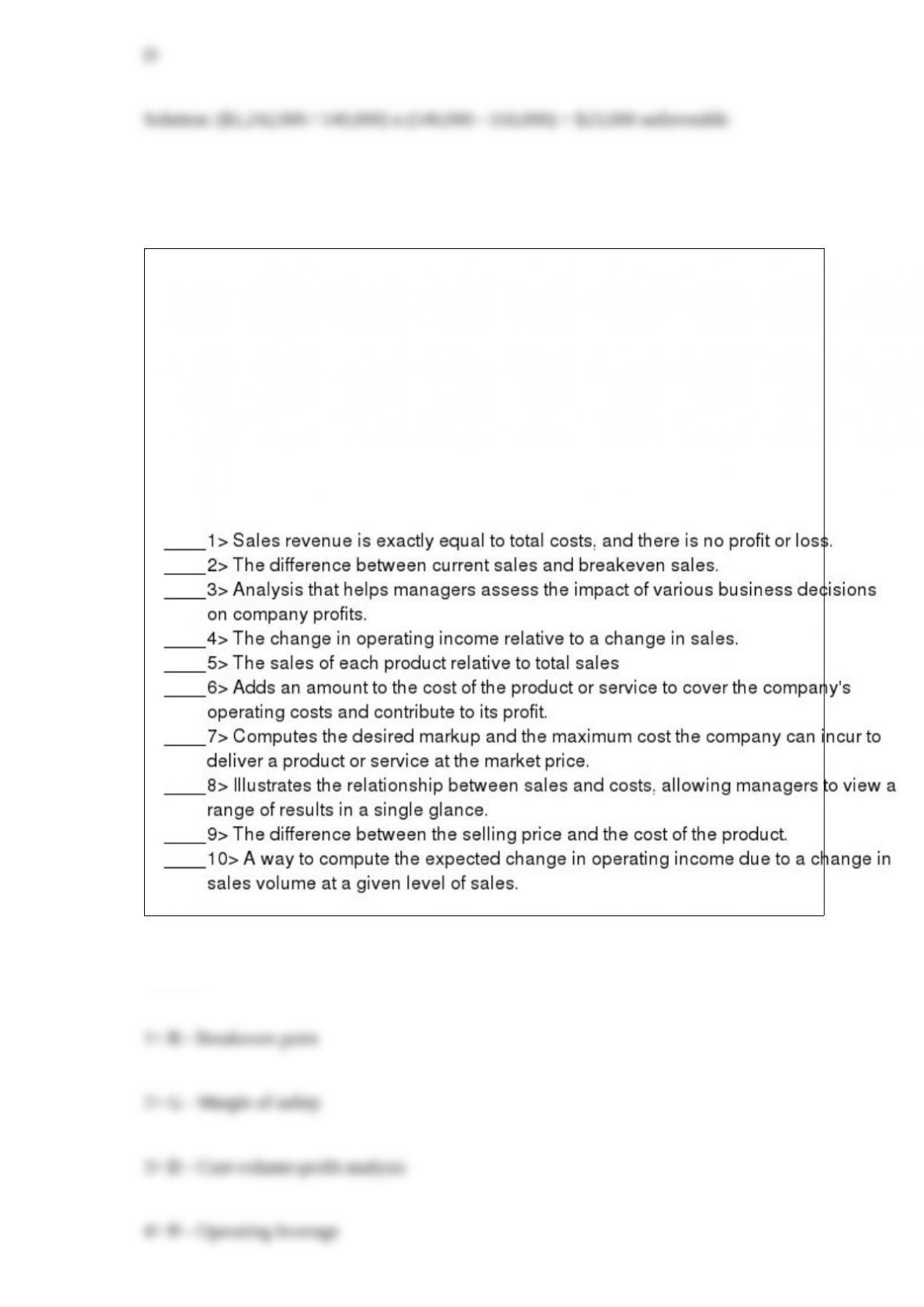
Match the following terms to the appropriate statement by placing the letter to the left
of each statement. a. Breakeven graph f. Markup
b. Breakeven point g. Margin of safety
c. Cost-plus pricing h. Operating leverage
d. Cost-volume-profit analysis i. Sales mix
e. Degree of operating leverage j. Target costing
When costs go down
a. Operating profit goes down.
b. Operating profit goes up.
c. Contribution margin goes down.
d. Contribution margin goes up.
On a scattergraph, once the individual points have been plotted,
a.Enter the information into a statistical calculator to calculate the total cost.
b.Count the points and divide by variable cost per unit.
c.Draw a line through them to estimate the cost relationship.
d.Multiply the high point by the variable cost per unit to calculate the total cost.

Common-size statements are especially useful in comparing
a. A company’s performance across time.
b. Companies of different size.
c. Supplemental information included in the corporate annual report.
d. None of these answer choices are correct.
If the amount of overapplied manufacturing overhead is small, most companies will
generally make which of the following adjusting entries?
a. Manufacturing Overhead Control Cost of Goods Sold
xxx xxx
b. Manufacturing Overhead Control Finished Goods Inventory
xxx xxx
c. Cost of Goods Sold Manufacturing Overhead Control
xxx xxx
d. Finished Goods Inventory Manufacturing Overhead Control xxx xxx

Cost-volume-profit analysis helps managers assess the
a. Impact of a change in variable costs on profit.
b. Impact of a change in sales price on profit.
c. Impact of a change in fixed costs on profit.
d. Impact of changes in sales price, variable costs and fixed costs on profit.
R&N Manufacturing produces music boxes. This year’s budget was based on the
production of 3,000 music boxes using a standard of 3 direct labor hours per music box
and $4 variable overhead per direct labor hour. R&N incurred 9,200 hours to produce
2,950 music boxes. If actual variable overhead for the year is $32,000, what is R&N’s
variable overhead spending variance?
a. $4,000 favorable
b. $4,000 unfavorable
c. $4,800 favorable
d. $4,800 unfavorable

Which of the following cash flows results from an investing activity?
a. Making a payment on a loan
b. Receiving a cash dividend on an investment in another company
c. Selling an investment in another company
d. Receiving payment from a customer for last month’s accounts receivable
If activity level decreases, what happens to the unit variable cost?
a.It remains the same.
b.It decreases.
c.It increases.
d.It depends on how much the activity level increases.
As products are made, capacity is used up. Managers must allocate the constrained
resource to products so as to maximize the company ‘s contribution margin.
Required:
a. List three limited resources that can constrain business operations.
b. How should managers determine the best way to allocate constrained resources
among products or operations?
Which of the following statements is correct regarding benchmarking?
a. Benchmarking is the practice of using a company’s own data to identify the processes
and practices in which it outperforms its competitors.
b. Benchmarking involves selecting measures, setting targets for measures and
adjusting the benchmark as strategies change.
c. Benchmarking participants should adhere to the Benchmarking Code of Conduct
which provides general principles to follow during the benchmarking process.
d. All of these answer choices are correct regarding benchmarking.
Ethical business behavior
a.Is not mere compliance with the law.

b.Suggests that the spirit of the law is more important than the letter of the law.
c.Suggest that moral values and codes are more important than rules and policies.
d.All of these answer choices are correct.
The Sarbanes-Oxley Act requires that all publicly traded companies disclose whether
certain executives are subject to a corporate code of ethics. Which of the following
executive position need not be disclosed?
a.Principal production officer.
b.Principal financial officer.
c.Principal accounting officer.
d.Principal executive officer.
Manufacturing cycle efficiency is calculated as
a. Value-added processing time divided by non-valued added processing time.
b. Non-value-added processing time divided by total manufacturing cycle time.
c. Value-added processing time divided by total manufacturing cycle time.
d. Direct cost of manufacturing divided by total manufacturing cost.
Information overload can lead to
a. Information fatigue syndrome
b. Data overload condition.
c. Data volume disease.
d. Chronic Information syndrome.
Distinguish between value-added and non-value-added activities.
Margie’s Flower Shop is interested in improving her performance in the area of
financial areas. This interest came about after Margie had her year-end financial
statements prepared and, although she had net income, her cash flow was inadequate.
Margie has discussed her problems with her neighboring store, an auto supply retail
store.
Required:
List five financial processes that Margie and the auto supply business have in common.
Net income divided by (1 – tax rate) = Operating income
Dublin Corporation has operating income of $15,000 on $200,000 of sales. Dublin ‘s
average operating assets total $100,000. The corporation has a minimum required return
of 18%.
Required:
Calculate Dublin ‘s return on investment using the DuPont method. Show your work.
Amos, Inc. uses a standard cost system in which direct material is carried at standard
cost. Standards for one unit of product are: standard quantity of 8 ½ gallons and
standard price $1.85 per gallon. During March, Amos purchased 150,000 gallons of
direct material at a cost of $300,000 and used 150,500 gallons in production of 18,000
units.
Required:
Calculate the direct materials price and quantity variances and indicate whether the
variances are favorable or unfavorable.
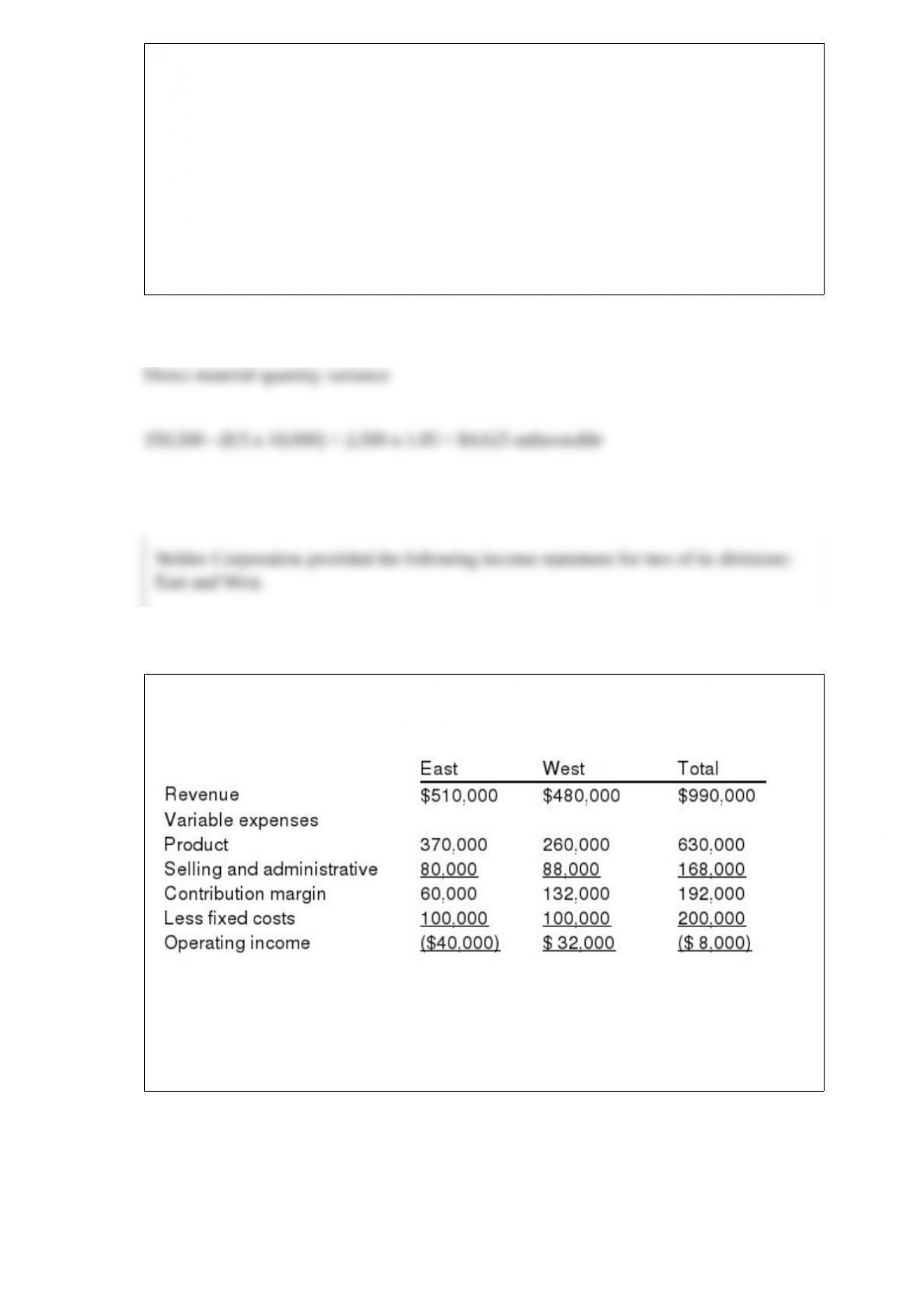
Nobles Corporation provided the following income statement for two of its divisions:
East and West.
Required:
The home office allocated common fixed costs of $80,000 to East and $60,000 to West.
Prepare a segment margin income statement.