Generally, a physical count of inventory is performed annually in both a perpetual
inventory system and a periodic inventory system.
Income tax expense would be found on the income statement of a corporation, but not
on the income statement of a sole proprietorship.
If a company decides to record an expenditure made this period as an expense, when it
should have been recorded as an asset, net income will be overstated in the current
period as a result.
A deferral adjustment may involve one asset and one expense account.
The decision to sell to extend credit to customers will decrease wage costs.
When preparing the operating activities section of the statement of cash flows using the
direct method, net income must be adjusted for gains or losses realized when property,
plant, and equipment is sold.
Which of the following statements about treasury stock is correct?
A) When a company reissues treasury stock for more than it originally paid for the
stock, it does not report a gain.
B) When a company purchases treasury stock, it increases total stockholders’ equity.
C) Treasury stock is reported as an asset on the balance sheet.
D) Treasury stock is reported as issued and outstanding stock.
During the year, the company recorded services provided to customers on account.
What effect will this transaction have on the debt-to-assets and times interest earned
ratios?
A) The debt-to-assets ratio will decrease and the times interest earned will increase.
B) The debt-to-assets ratio will increase and the times interest earned will not change
C) Both ratios will decrease.
D) Both ratios will increase.
A company buys a piece of equipment for $48,000. The equipment has a useful life of
ten years. No residual value is expected at the end of the useful life. Using the
double-declining-balance method, what is the company’s depreciation expense in the
first year of the equipment’s useful life?
A) $9,600
B) $12,000
C) $4,800
D) $24,000
Which of the following represent cash outflows from financing activities?
A) Distributing a stock dividend
B) Paying a bond’s face value at maturity
C) Issuing long-term bonds at a discount
D) Paying interest on promissory notes
A noncurrent liability is one that the company:
A) has owed for over one year.
B) has owed for over five years.
C) will not pay within 12 months.
D) will not pay within five years.
Which of the following statements about the statement of cash flows is not correct?
A) It does not replace the income statement.
B) It provides details as to how cash changed during a period.
C) It provides information about cash receipts and cash payments over a period of time.
D) It measures profitability.
Harney Inc. uses the percentage of credit sales method of estimating doubtful accounts.
The Allowance for Doubtful Accounts has an unadjusted credit balance of $2,700 and
the company had $140,000 of net credit sales during the period. Harney has
experienced bad debt losses of 4% of credit sales in prior periods. After making the
adjusting entry for estimated bad debts, what is the ending balance in the Allowance for
Doubtful Accounts account?
A) $8,300
B) $5,400
C) $2,900
D) $5,600
In Year 2, the Denim Company bought an acre of land that cost $15,000. In Year 5,
another company purchased a nearby acre of land for $28,000 and a different company
purchased another nearby acre of land for $26,000. As a result, an appraiser estimated
hat the acre owned by Denim had increased in value to $27,000. If Denim prepares a
balance sheet at the end of Year 5, the acre of land that it owns should be reported at:
A) $15,000.
B) $28,000.
C) $18,000.
D) the average of all of the amounts.

Match the term and the explanation. There are more definitions than terms.
TERM
1> _____ Cash Basis
2> _____ Net Profit Margin
3> _____ Unadjusted Trial Balance
4> _____ Prepaid Expense
5> _____ Unearned Revenue
6> _____ Revenue Recognition Principle
7> _____ Expense Recognition Principle
DEFINITION
A. Reported when a company sells goods or services in the ordinary course of business
for more than it costs to produce.
B. Reporting expenses and revenue according to the time the underlying activities
occur.
C. A list of account balances when the accounts do not yet include all revenues and
expenses.
D. The concept that expenses should be reported at the same time as the related
revenue.
E. The principle that changes in assets must be matched by changes in liabilities and
equity.
F. Also known as net assets, this is the value of assets minus liabilities.
G. An indication that a company has already paid a cost not yet incurred.
H. A company’s policy on when to report revenue in the financial statements.
I. Reporting expenses and revenues according to the time the money is paid or received.
J. A liability account indicating customers have already paid for services not yet
rendered.
K. A ratio that indicates the percent of each revenue dollar that is left over after
covering costs and expenses.
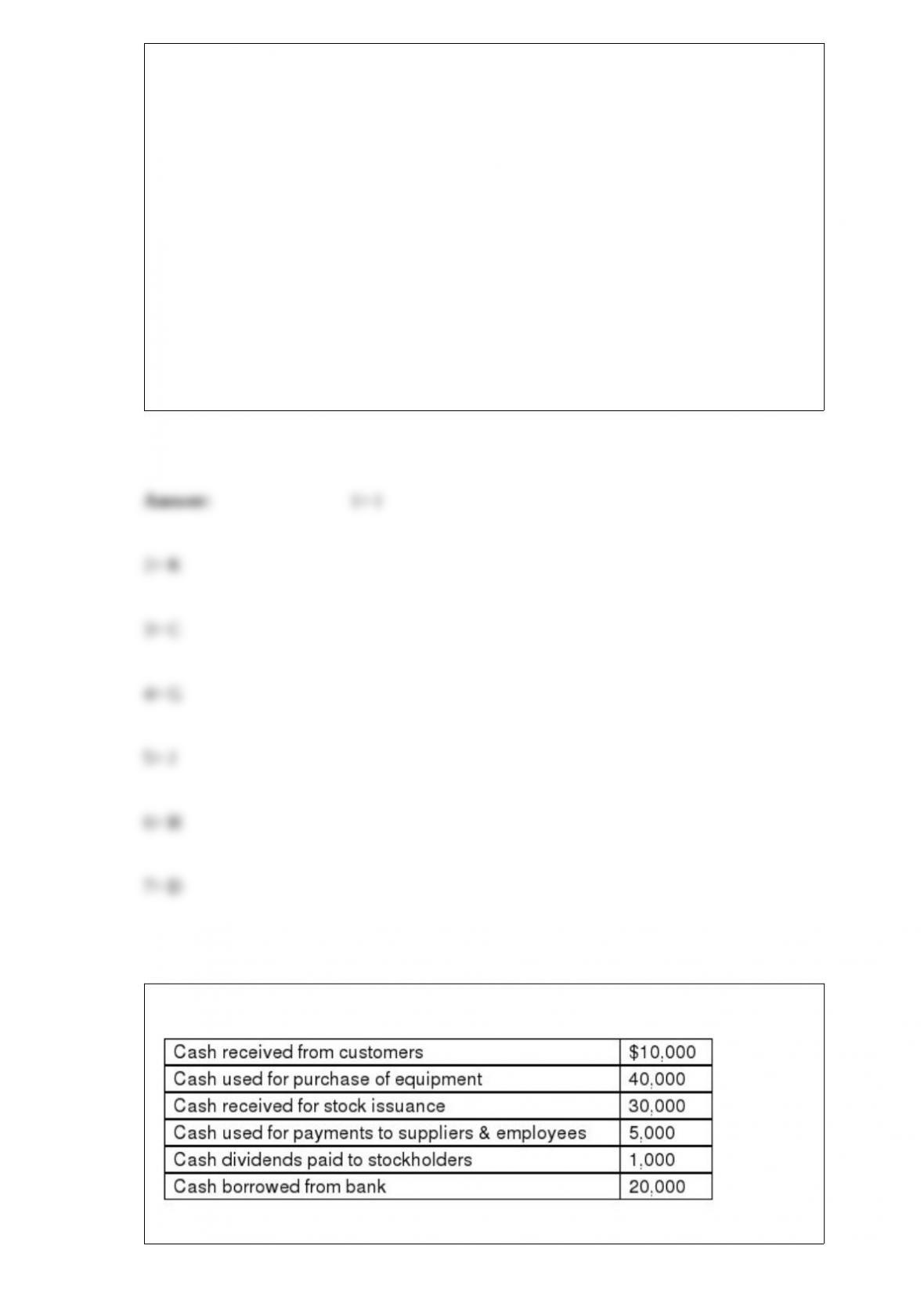
The Statement of Cash Flows for the current year contained the following:
The change in cash for the current year was an increase of $14,000.
Use the information above to answer the following question. What was the amount of
cash flows from (used in) operating activities?
A) $5,000.
B) $35,000.
C) $25,000.
D) $4,000.
Which of the following ratios is calculated by dividing current assets by current
liabilities?
A) Quick ratio
B) Solvency ratio
C) Debt ratio
D) Current ratio