If the net present value of a proposed project is positive, then the actual rate of return
A.is higher than the cost of capital.
B.is lower than the cost of capital.
C.is equal to the cost of capital.
D.is negative.
Shenandoah Company
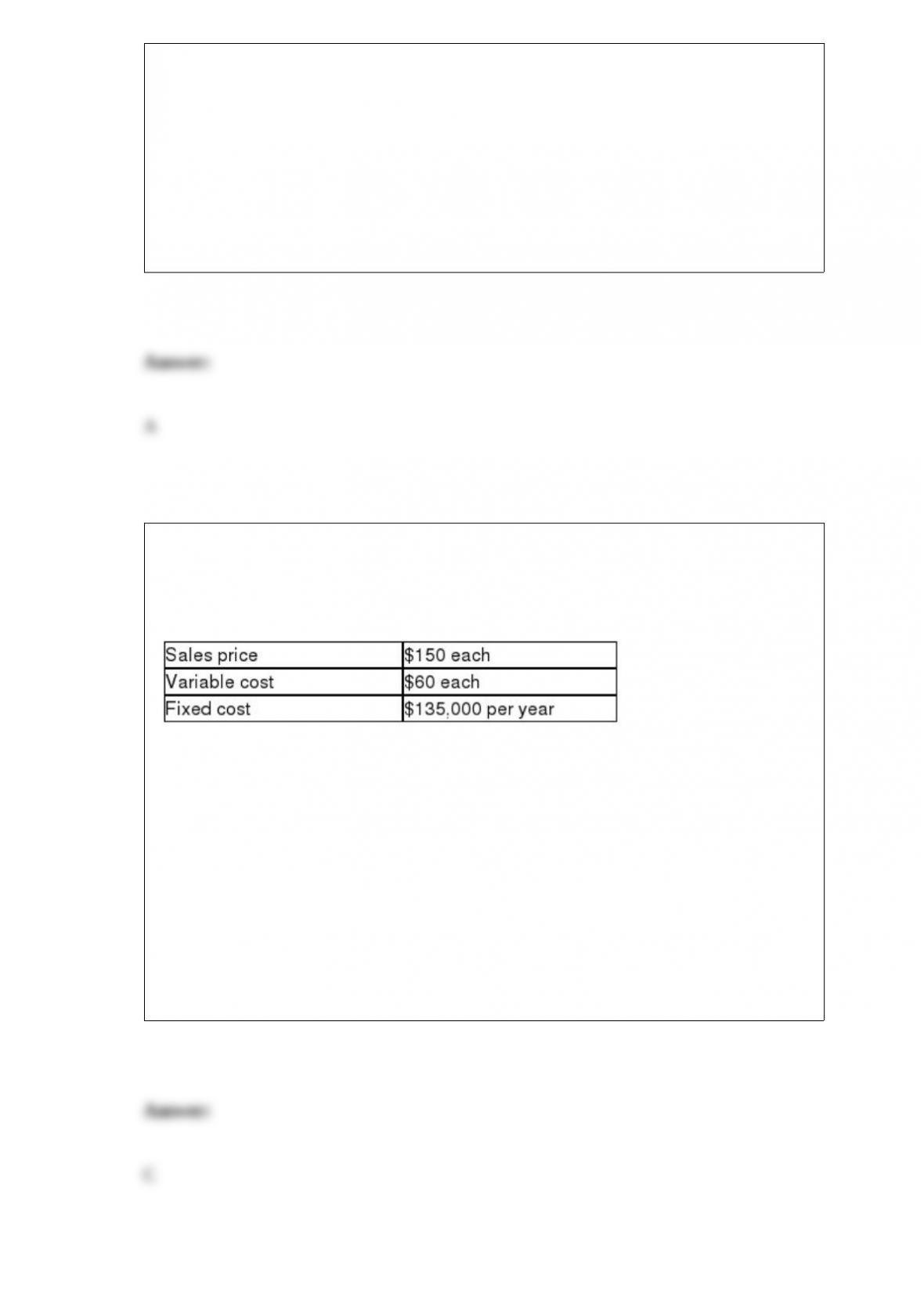
Shenandoah Company is considering the introduction of a new product with the
following price and cost characteristics
The company expects to sell 2,000 units for the year.
Refer to Shenandoah Company. Calculate the break-even point in units if variable costs
per unit increased by $10.00 and fixed costs increased to $140,000.
A. 2,000
B. 934
C.1,750
D.1,500

Which of the following is the organization that sponsors the major certification of
accountants known as the CMA?
A.The Canadian Institute of Chartered Accountants
B.The Cost Accounting Standards Board
C.The Institute of Management Accountants
D.The American Institute of Certified Public Accountants
Which of the following is a behavioral issue that influences capital investment project
planners objectivity when making estimates?
A.desire to implement a project.
B.performance evaluation measures.
C.organizational policies and procedures.
D.all of the above.
The objective of the theory of constraintsis to
throughput contributioninvestments and operating costs
A. maximize maximize
B. minimize minimize

C. minimize maximize
D. maximize minimize
Vilfredo Pareto, an Italian economist and sociologist observed that approximately
A.1 percent of activities cause 99 percent of the problems.
B.5 percent of activities cause 95 percent of the problems.
C.20 percent of activities cause 80 percent of the problems.
D.35 percent of activities cause 65 percent of the problems.
In the long run, the practice of setting price so that it must at least equal the differential
cost of producing and selling the product will cover all costs because
A.fixed costs are differential in the long run.
B.variable costs are differential in the long run.
C.fixed and variable costs are differential in the long run.
D.fixed and variable costs are discretionary in the long run.
Which of the following isnota component of just-in-time (JIT) production methods?
A.Management uses JIT methods to obtain materials just in time for production.
B.Management provides finished goods just in time for sale.
C.JIT requires that workers immediately correct a process making defective unit.
D.Workers and supervisors can hide defective units in inventory.
Stephanie Company
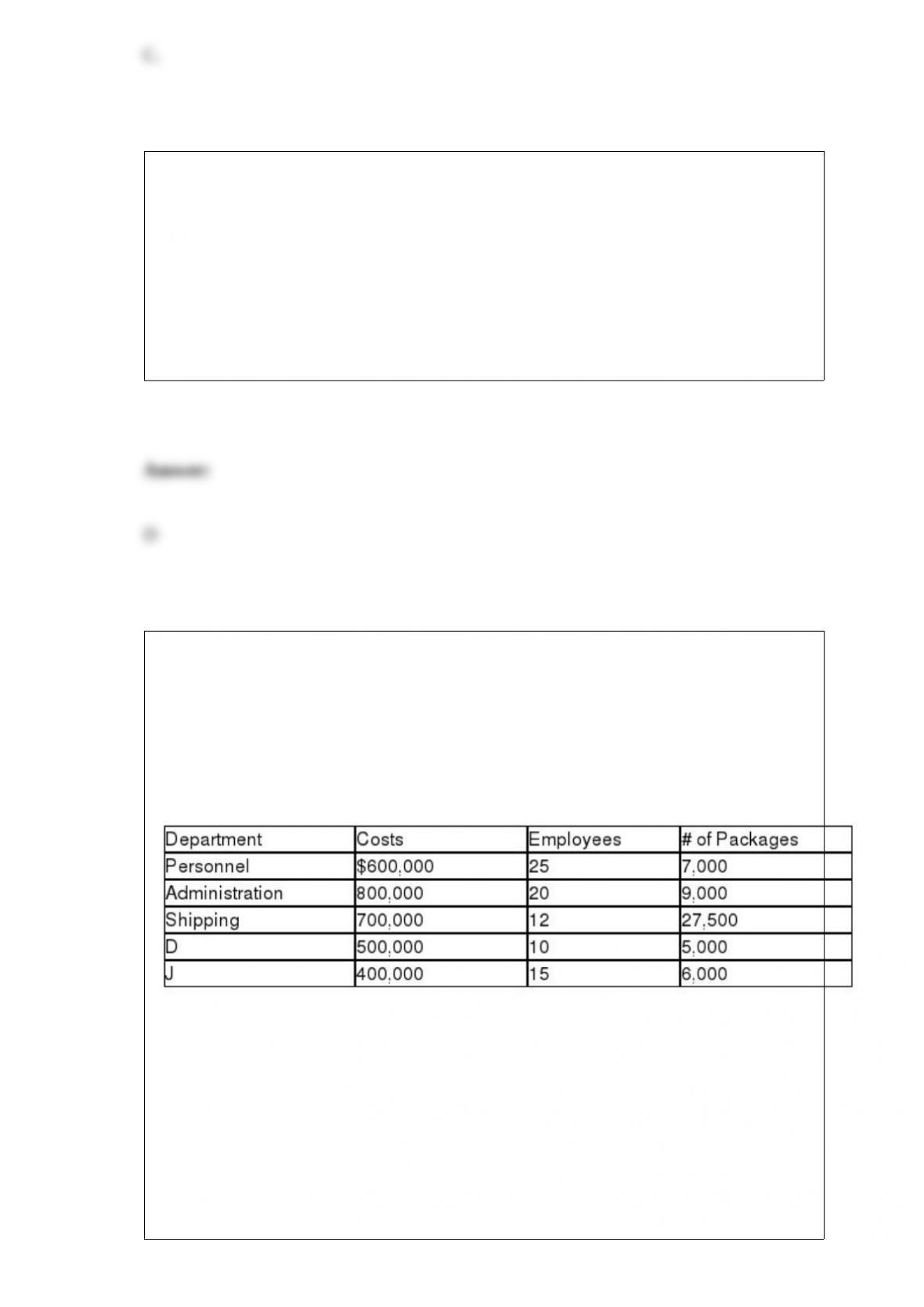
Stephanie Company has two production departments: D and J. Stephanie also has 3
service departments: Personnel, Administration, and Shipping. Shipping costs are
allocated on the basis of number of packages, while Personnel and Administration costs
are allocated using number of employees. Assume that the ranking of the benefits
provided is in the order listed below.
Refer to Stephanie Company. Using the direct method, what amount of Administration
costs is allocated to Department J (rounded to the nearest $)?
A.$ 97,561
B.$320,000
C.$400,000
D.$480,000

Which of the following might explain why unused resource capacity occurs?
A.Managers have committed to use a certain level of resources before supplying them.
B.Managers have committed to supply a certain level of resources before using them.
C.Managers have committed to supply a certain level of resources before supplying
them.
D.Managers have committed to use a certain level of resources before using them.
Which of the following would be a responsibility of a manager in a cost centers?
A.costs only.
B.revenues only.
C.both costs and revenues.
D.revenues, costs, and assets.

The following provides the means for companies to outsource substantial portions of
their information systems and enables the company to focus on its core competencies
while taking advantage of the host’s server and bandwidth capability.
A.Value chain.
B.Web hosting.
C.Total Quality Management.
D.Zero-Base Budgeting.
For an organizational unit to be considered a responsibility center, what must be true?
A.The unit must be separable and identifiable.
B.The unit must lack financial measures of performance.
C.The unit must lack control over an activity.
D.all of the above.
Which statement is true concerning internal failure costs?
A.Internal failure costs are incurred to prevent defects in the products or services being
produced.
B.Internal failure costs are incurred to detect individual units of products that do not
conform to specifications.

C.Internal failure costs are incurred when the firm discovers nonconforming products
and services before delivery to customers.
D.Internal failure costs are incurred when the customers discover nonconforming
products and services at delivery.
Which of the following measures of time indicate the speed and reliability with which
organizations supply products and services to customers?
A.Strategic
B.Support
C.Intelligent
D.Operational
Which of the following describe the broad objectives management establishes and
company employees work to achieve?
A.organizational goals.
B.strategic long-range profit plan.
C.master budget.
D.tactical short-range profit plan.

In 2002, Congress passed the Sarbanes-Oxley Act. Which of the following is not a
provision of that act?
A.The law empowered the American Institute of Certified Public Accountants (AICPA)
to oversee licensure of auditors.
B.The Chief Executive Officer (CEO) must sign the company’s financial statements
attesting to the inclusion of all material information.
C.The Public Company Accounting Oversight Board (PCAOB) was created.
D.The CEO and Chief Financial Officer (CFO) must indicate that they are responsible
for the company’s system of internal control.
Which of the following is the objective of the theory of constraints?
A.maximize throughput contribution while maximizing investments and operating
costs.
B.minimizing throughput contribution while minimizing investments and operating
costs.
C.minimizing throughput contribution while maximizing investments and operating
costs.
D.maximize throughput contribution while minimizing investments and operating costs.
An investment that costs $50,000 will return $22,000 per year for five years.
Required:
Determine the net present value of the investment if the required rate of return is 14
percent (ignoring taxes). Should the investment be undertaken?
How can web hosting help a small start-up company?
The theory of constraints focuses on three factors; list and discuss these three factors.
How can activity-based management and costing be applied to marketing?
Explain the difference between a flexible budget and master budget.
Identify the factors of inventory management decisions.
Universal Distributors
Universal Distributors, a major retailing and mail order operation, has been in business
for the past 10 years. During that time, the mail order operations have grown from a
sideline to represent over 80% of the company’s annual sales. Of course, the company
has suffered growing pains. There were times when overloaded or faulty computer
programs resulted in lost sales, and the scheduling of temporary workers to augment the
permanent staff during peak periods has always been a problem.
Peter Ben Ezra, manager of mail order operations, has developed procedures for
handling most problems. However, he is still trying to improve the scheduling of
temporary workers to take telephone orders from customers. Under the current system,
he keeps a permanent staff of 60 employees who handle the basics; the number of
temporary workers needed for the next day is determined by Ben Ezra each afternoon
based on his estimate of the upcoming telephone volume.
Mr. Ben Ezra has decided to try regression analysis as a way to improve the hiring of
temporary workers. By summarizing the daily labor hours into weekly totals for the
past year, Ben Ezra was able to determine the number of workers that were used each
week. In addition, he listed the number of orders that had been processed each week.
After entering the data into a spreadsheet, Ben Ezra ran two regressions. Regression #1
related the total workers (permanent staff plus temporary workers) to the number of
orders received, and Regression #2 related only temporary workers to the number of
orders received. The output of these analyses is presented below.
Regression Equation: W = a + bT
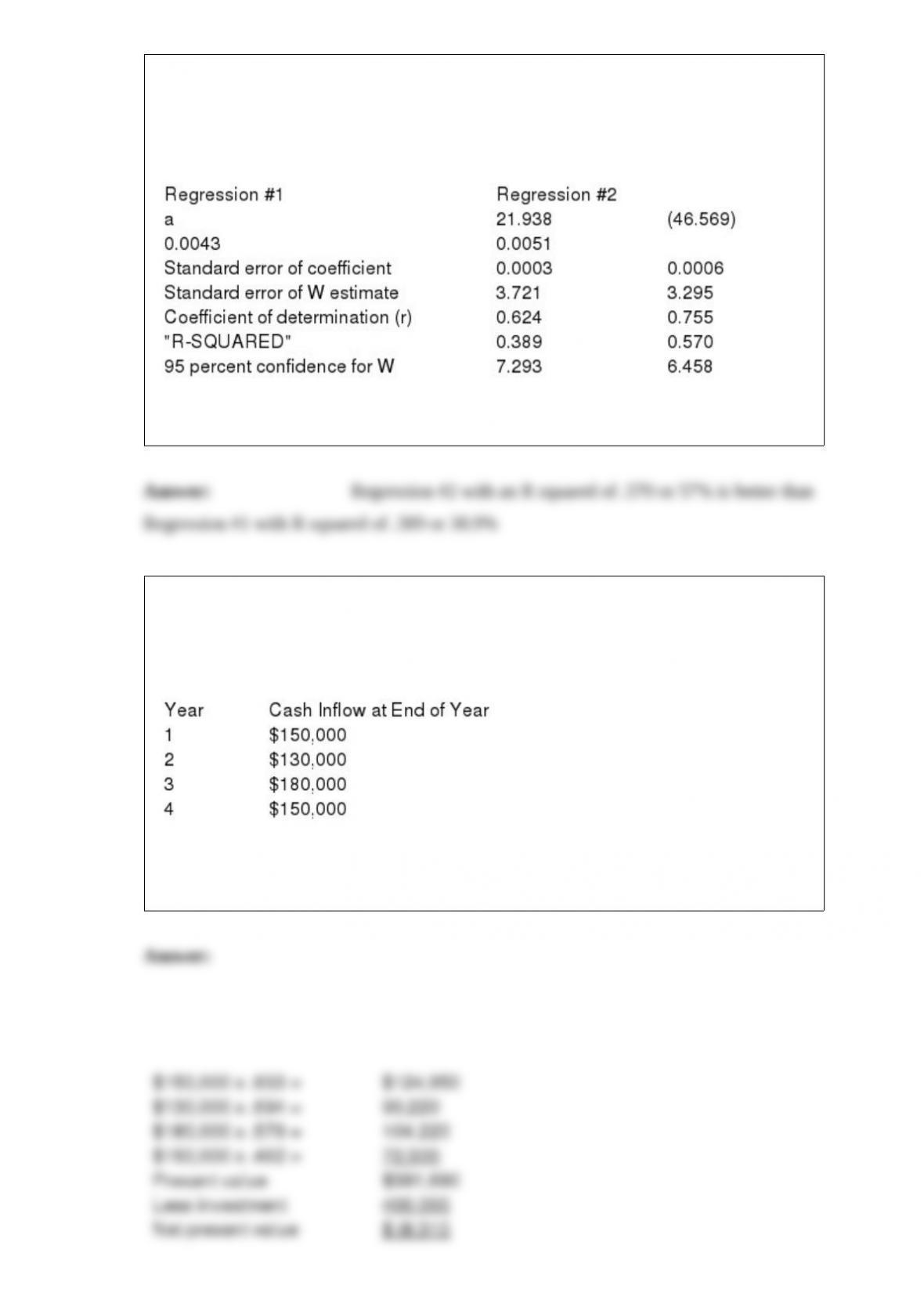
Where: W = Workers
T = Telephone Orders
Refer to Universal Distributors. Which one of the two regression analyses appears to be
better? Explain your answer.
Eastchester Products
Eastchester Products is considering a project that requires an initial investment of
$400,000 and will generate the following cash inflows for the next 4 years:
Refer to Eastchester Products. Ignoring tax effects, calculate the net present value of
this project if Eastchester’s cost of capital is 20 percent. Should the project be accepted
or rejected?

Describe ethical dilemmas in budgeting.
Universal Distributors
Universal Distributors, a major retailing and mail order operation, has been in business
for the past 10 years. During that time, the mail order operations have grown from a
sideline to represent over 80% of the company’s annual sales. Of course, the company
has suffered growing pains. There were times when overloaded or faulty computer
programs resulted in lost sales, and the scheduling of temporary workers to augment the
permanent staff during peak periods has always been a problem.
Peter Ben Ezra, manager of mail order operations, has developed procedures for
handling most problems. However, he is still trying to improve the scheduling of
temporary workers to take telephone orders from customers. Under the current system,
he keeps a permanent staff of 60 employees who handle the basics; the number of
temporary workers needed for the next day is determined by Ben Ezra each afternoon
based on his estimate of the upcoming telephone volume.
Mr. Ben Ezra has decided to try regression analysis as a way to improve the hiring of
temporary workers. By summarizing the daily labor hours into weekly totals for the
past year, Ben Ezra was able to determine the number of workers that were used each
week. In addition, he listed the number of orders that had been processed each week.
After entering the data into a spreadsheet, Ben Ezra ran two regressions. Regression #1
related the total workers (permanent staff plus temporary workers) to the number of
orders received, and Regression #2 related only temporary workers to the number of
orders received. The output of these analyses is presented below.
Regression Equation: W = a + bT
Where: W = Workers
T = Telephone Orders
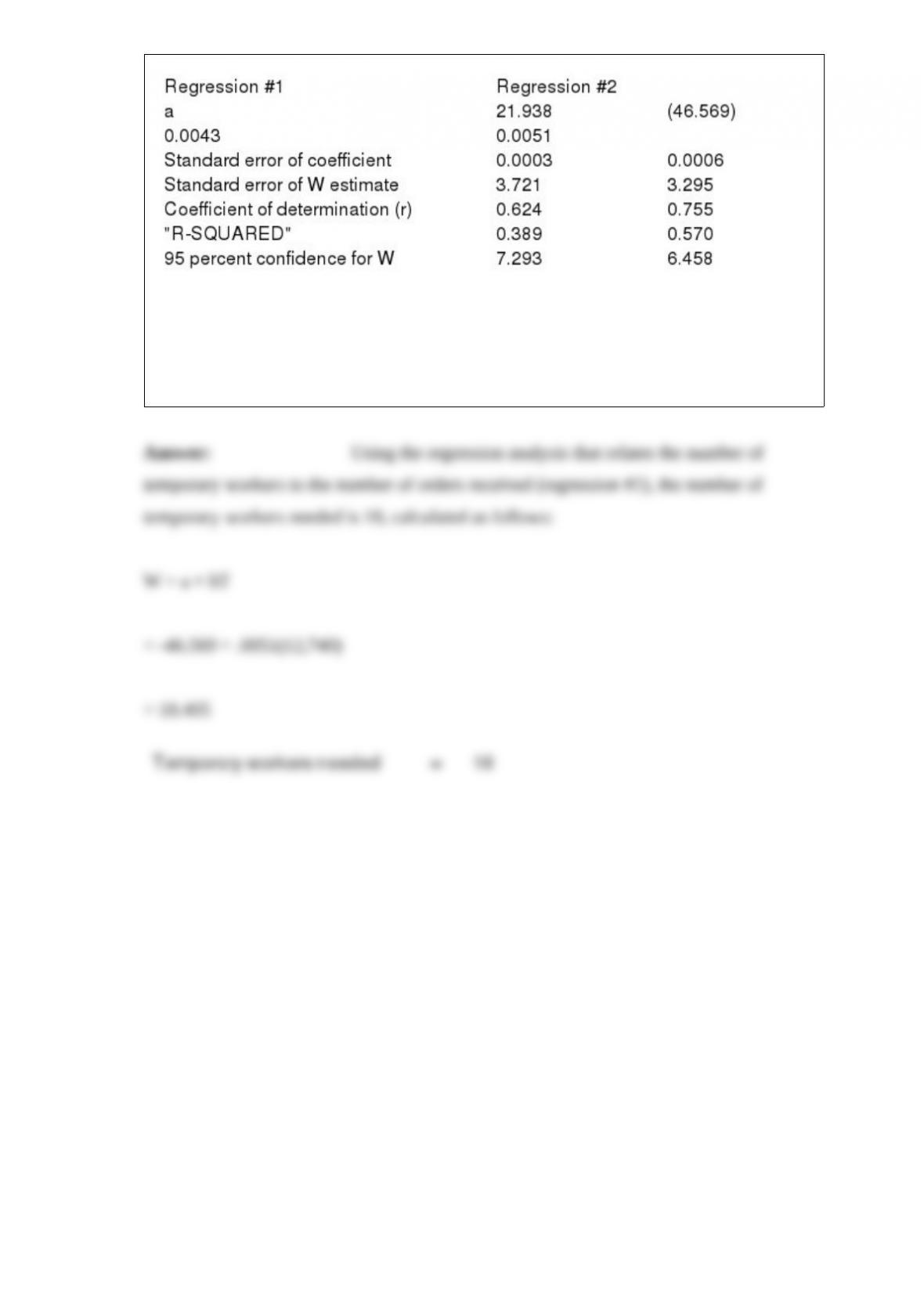
Refer to Universal Distributors. Peter Ben Ezra estimates that Universal Distributors
will receive 12,740 orders during the second week of December. Using the regression
analysis that relates the number of temporary workers to the number of orders received,
compute the number of temporary workers Peter Ben Ezra will need during this week.
Round your answer to the nearest whole number.