
Which of the following is true about short-run and long-run pricing decisions?
A.Short-run decisions include pricing for a special order with no long-term
implications.
B.Short-run decisions typically have a time horizon of two years or more.
C.Short-run decisions include pricing a main product in a major market.
D.Long-run decisions include pricing for a special order with no short-term
implications.
The total cost (TC) of an item is calculated as TC = F + VX, where X is the
A.unexpected cost during the period.
B.unusual cost during the period.
C.units of activity during the period.
D.unknown cost during the period.
The optimal solution to a linear programming problem will always be which of the
following?
A.on the horizontal axis of the graph of a linear programming problem.
B.on the vertical axis of the graph of a linear programming problem.
C.on a corner of the feasible production area of the graph of a linear programming

problem.
D.at the origin of the graph of a linear programming problem.
Which statement is true concerning the establishment of transfer prices?
A.If the selling division is operating at capacity, the transfer price should be the sum of
fixed and variable costs of production.
B.If the selling division has idle capacity, and the idle facilities cannot be used for other
purposes, the transfer price should be at least the variable costs of production.
C.If the selling division is operating below capacity, the transfer price should be
discounted.
D.None of the answers is correct.
While the results of allocating joint-process costs in different ways can be very
important to managers for planning, performance evaluation, and decision making,
A.there is no precise way of tracing joint-process costs to joint products.
B.activity-based costing provides a precise way of tracing joint-process costs to joint
products.
C.traditional costing provides a precise way of tracing joint-process costs to joint
products.
D.standard costing provides a precise way of tracing joint-process costs to joint
products.

Manufacturers using computer-integrated manufacturing systems have a large
investment in plant and equipment. This results in which of the following cost
structures?
A.high fixed costs.
B.high total costs.
C.high variable costs.
D.None of the answers is correct.
When measuring a division’s operating costs, labor used in the division’s production is
A.direct, controllable.
B.indirect, controllable.
C.direct, noncontrollable.
D.indirect, noncontrollable.

What is the focus of the agency view of motivation?
A.relationships between customers and agents.
B.Ways to discourage agents to act in the interests of principals.
C.Ways to encourage principals to act in the interests of agents.
D.Ways to encourage agents to act in the interests of principals.
Which of the following represent two costs of controlling and improving quality?
A.prevention costs and appraisal costs.
B.internal failure costs and external failure costs.
C.prevention costs and internal failure costs.
D.appraisal costs and external failure costs.
Costs incurred for detecting nonconforming products and services beforedelivering
them to customers are called
A.prevention costs.
B.appraisal costs.
C.internal failure costs.
D.external failure costs.

Which statement is true concerning the agency view of motivation?
A.The agency view of motivation focuses on the relationships between principals and
agents.
B.The agency view of motivation looks for ways to encourage agents to act in the
interests of principals.
C.The agency view of motivation looks for ways to encourage agents to act in the
interests of principals.
D.The agency view of motivation focuses on the relationships between shareholders
and management.
Continuous flow processing is most appropriate for
Type of ProductLength of Production Run
A.Customized Short
B.Customized Long
C.Standardized Short
D.Standardized Long
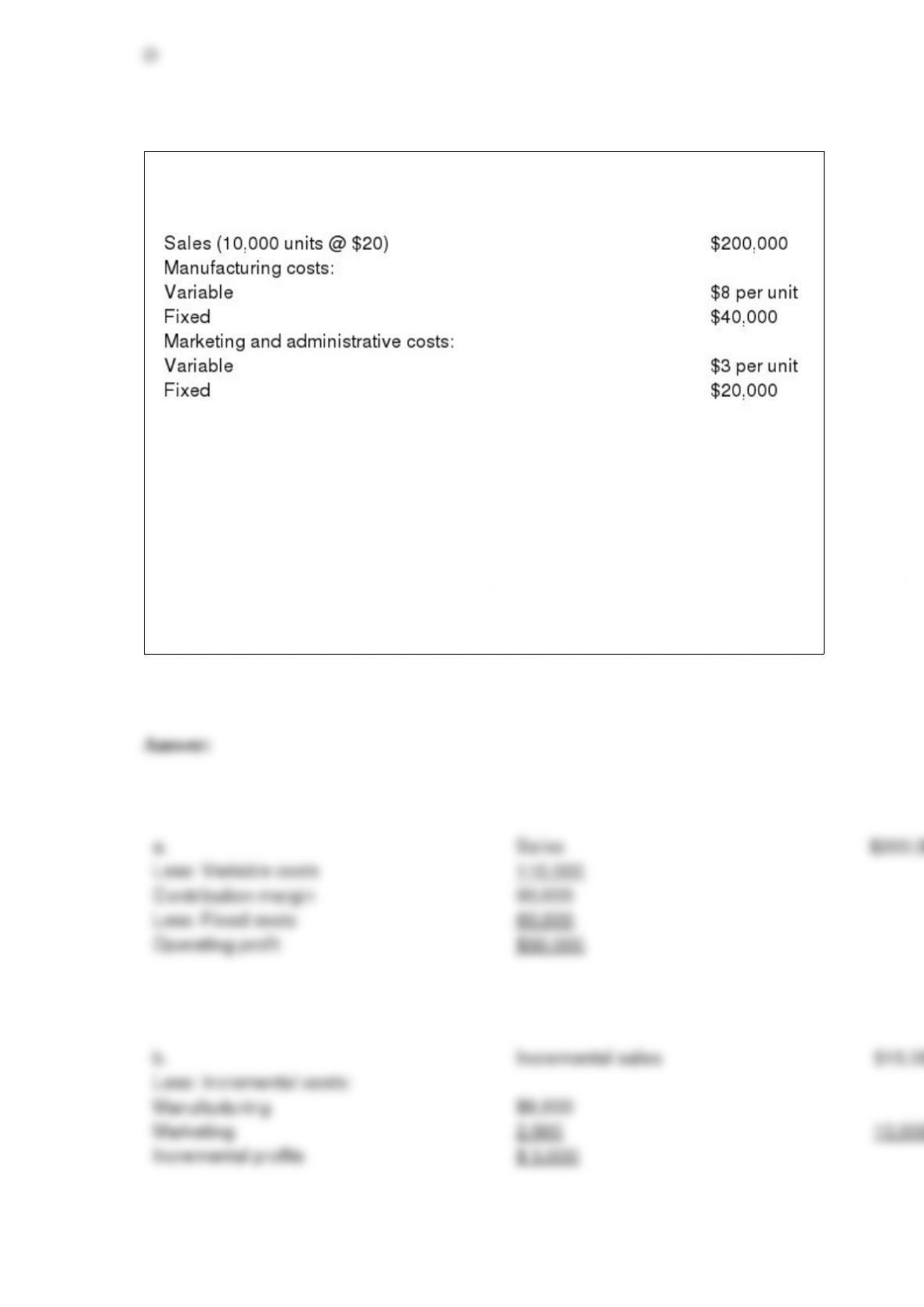
Genia Enterprises, Inc. has the capacity to produce 12,000 units per year. Expected
operations for the year are
REQUIRED:
a. What is the expected level of operating profits?
b. Should the company accept a special order for 1,000 units at a selling price of $15 if
variable marketing expenses associated with this special order would be $2 per unit?
Calculate the incremental profits if the order is accepted.
c. Suppose the company received a special order for 3,000 units at a selling price of $15
with no variable marketing expenses. Calculate the impact on operating profits.
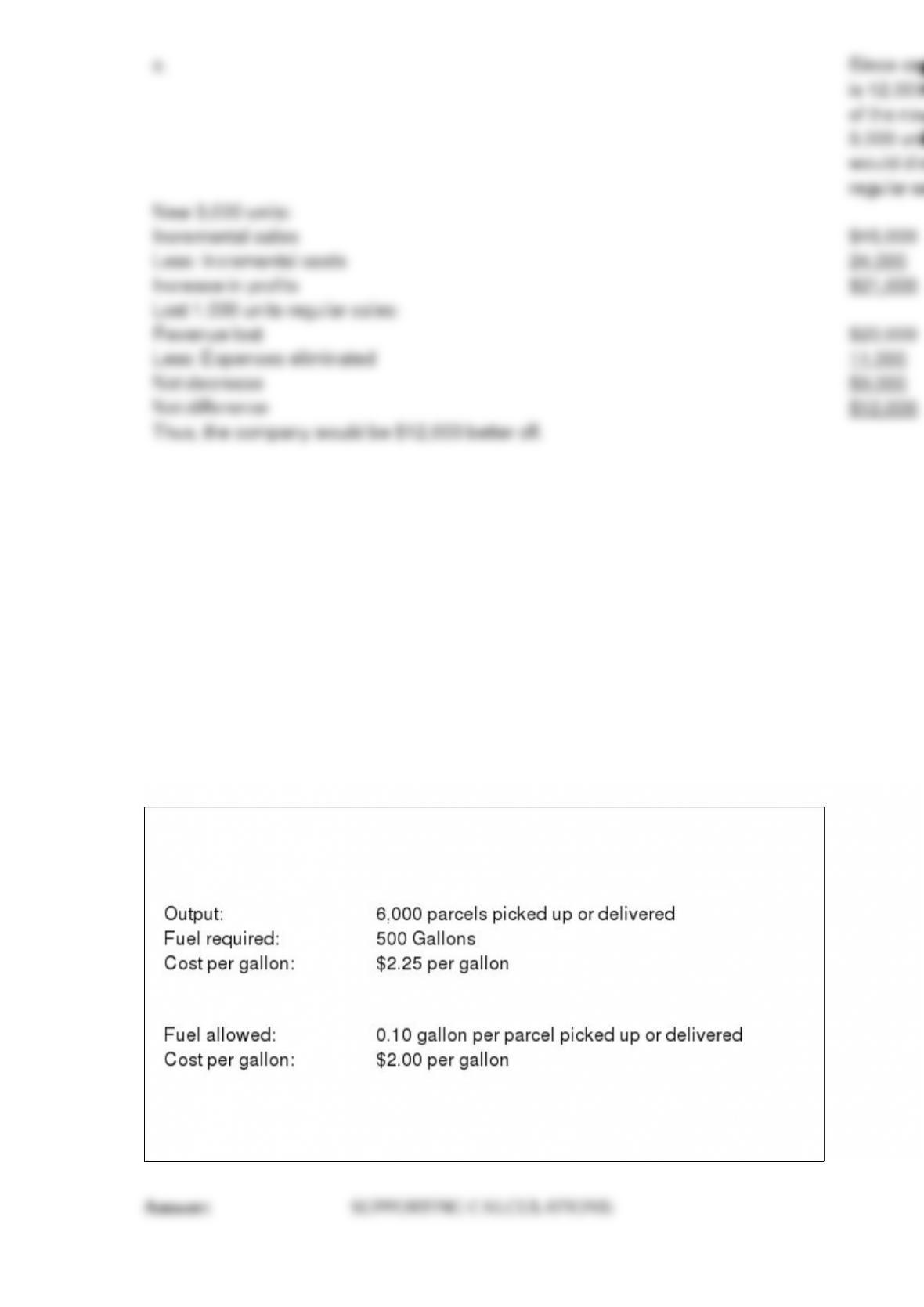
Ben’s Delivery Company reports the following information for 2010:
Actual:
Standard:
REQUIRED:
What was the actual fuel cost, flexible budget for fuel cost, and the fuel cost variance?
What tools do firms use to identify quality control problems?
Explain how spreadsheets help the analyst to conduct sensitivity analyses of capital
budgeting.
Allan Miller, cost accountant for the Southeast Company, has just finished his
break-even analysis for each product line within the company. The analysis reveals a
deficiency with three product lines, A, B and C. Each of these products is manufactured
by a different division. Based on current sales forecasts, the company as a whole will
not reach the sales volume needed to break even. If two of the three product lines, (A,
B, and C) are dropped, the company will be able to remain profitable. Allan
recommended that product lines A and C be dropped.
When Allan started with the company he worked for the division which manufactures
product line B. In fact, his wife, Vaida, still works for Division B. What are the ethical
issues involved in this decision?
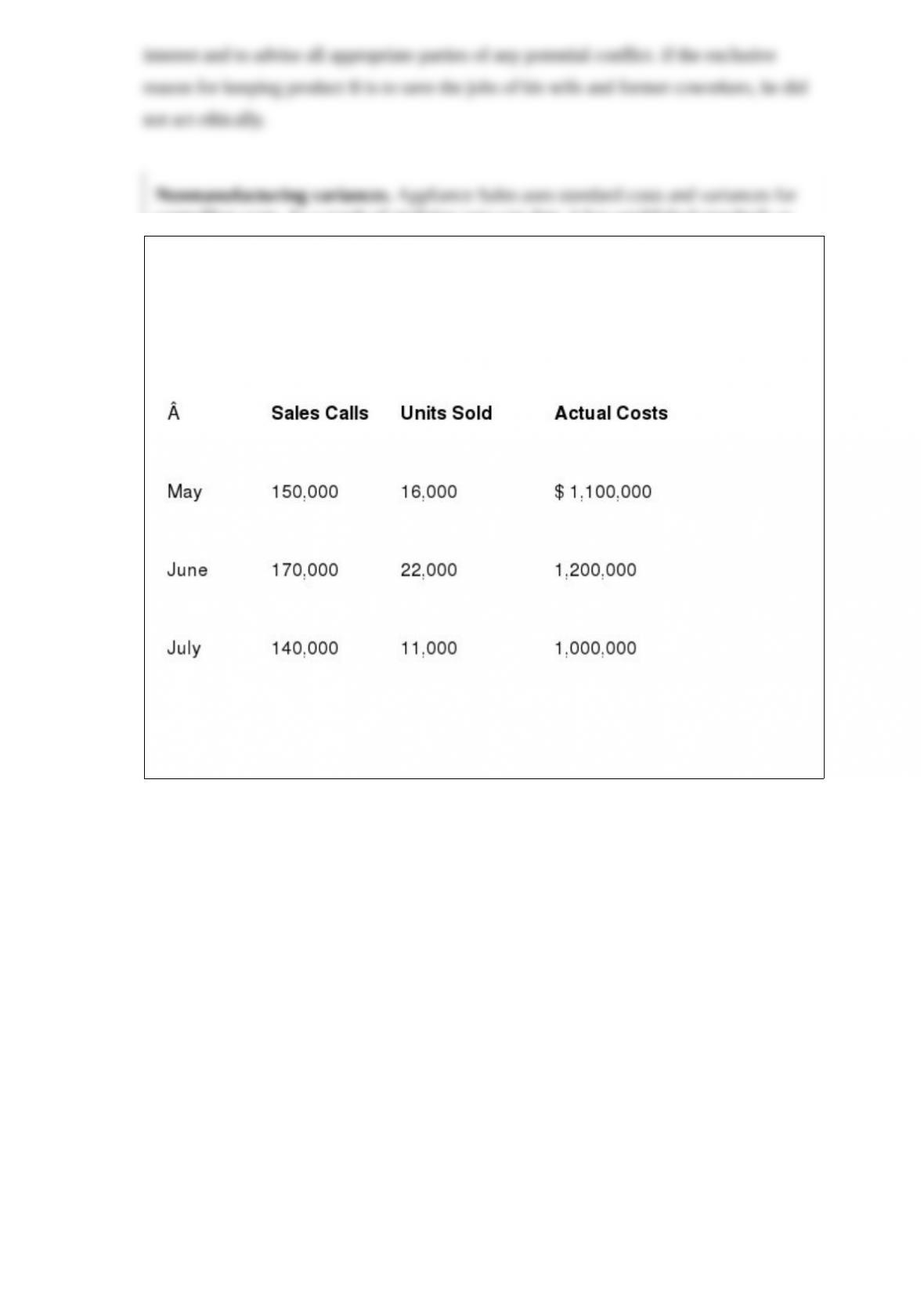
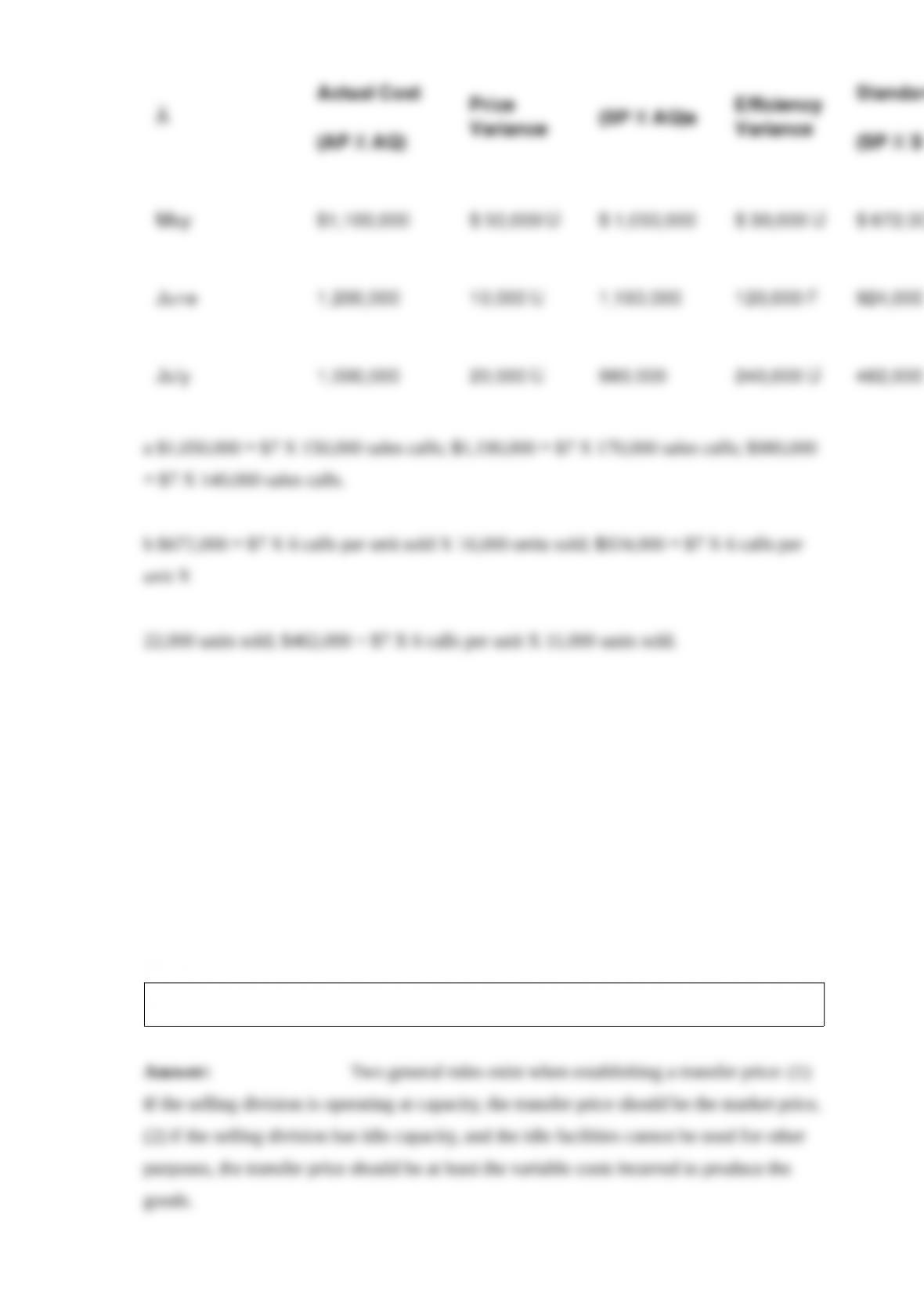
Nonmanufacturing variances. Appliance Sales uses standard costs and variances for
controlling costs. As a result of studying past cost data, it has established standards as
follows: variable costs, $7 per sales call; six sales calls per unit sold. Actual data for
May, June, and July follow:
Required:
Compute the variable cost price and efficiency variances for each month.
What are the transfer pricing issues and methods?
Grimes Company processes a chemical, Techno 9, through a pressure treatment
operation. The complete process has two outputs, Y and Z. The January costs to process
Techno 9 are $75,000 for materials and $90,000 for conversion costs. This processing
results in two outputs, Y and Z, that sell for a total of $332,000. The sales revenue from
Y amounts to $200,000 of the total.
Required:
Using the net realizable method, assign costs to Y and Z for January.