
1) weiser corp. on january 1, 2009, granted stock options for 40,000 shares of its $10
par value common stock to its key employees. the market price of the common stock on
that date was $23 per share and the option price was $20. the black-scholes option
pricing model determines total compensation expense to be $360,000. the options are
exercisable beginning january 1, 2012, provided those key employees are still in
weisers employ at the time the options are exercised. the options expire on january 1,
2013.
on january 1, 2012, when the market price of the stock was $29 per share, all 40,000
options were exercised. the amount of compensation expense weiser should record for
2009 under the fair value method is
a.$0
b.$60,000
c.$120,000
d.$180,000
2) each of the following are included in both the current ratio and the acid-test ratio
except
a.cash
b.short-term investments
c.net receivables
d.inventory
3) use of the effective-interest method in amortizing bond premiums and discounts
results in
a.a greater amount of interest income over the life of the bond issue than would result
from use of the straight-line method
b.a varying amount being recorded as interest income from period to period
c. a variable rate of return on the book value of the investment
d. a smaller amount of interest income over the life of the bond issue than would result
from use of the straight-line method
4) for which of the following transactions would the use of the present value of an
ordinary annuity concept be appropriate in calculating the present value of the asset
obtained or the liability owed at the date of incurrence?
a.a capital lease is entered into with the initial lease payment due one month subsequent
to the signing of the lease agreement
b.a capital lease is entered into with the initial lease payment due upon the signing of
the lease agreement
c.a ten-year 8% bond is issued on january 2 with interest payable semiannually on
january 2 and july 1 yielding 7%
d.a ten-year 8% bond is issued on january 2 with interest payable semiannually on
january 2 and july 1 yielding 9%
5) the accounting problem in a lump sum issuance is the allocation of proceeds between
the classes of securities. an acceptable method of allocation is the
a.pro forma method
b.proportional method
c.incremental method
d.either the proportional method or the incremental method
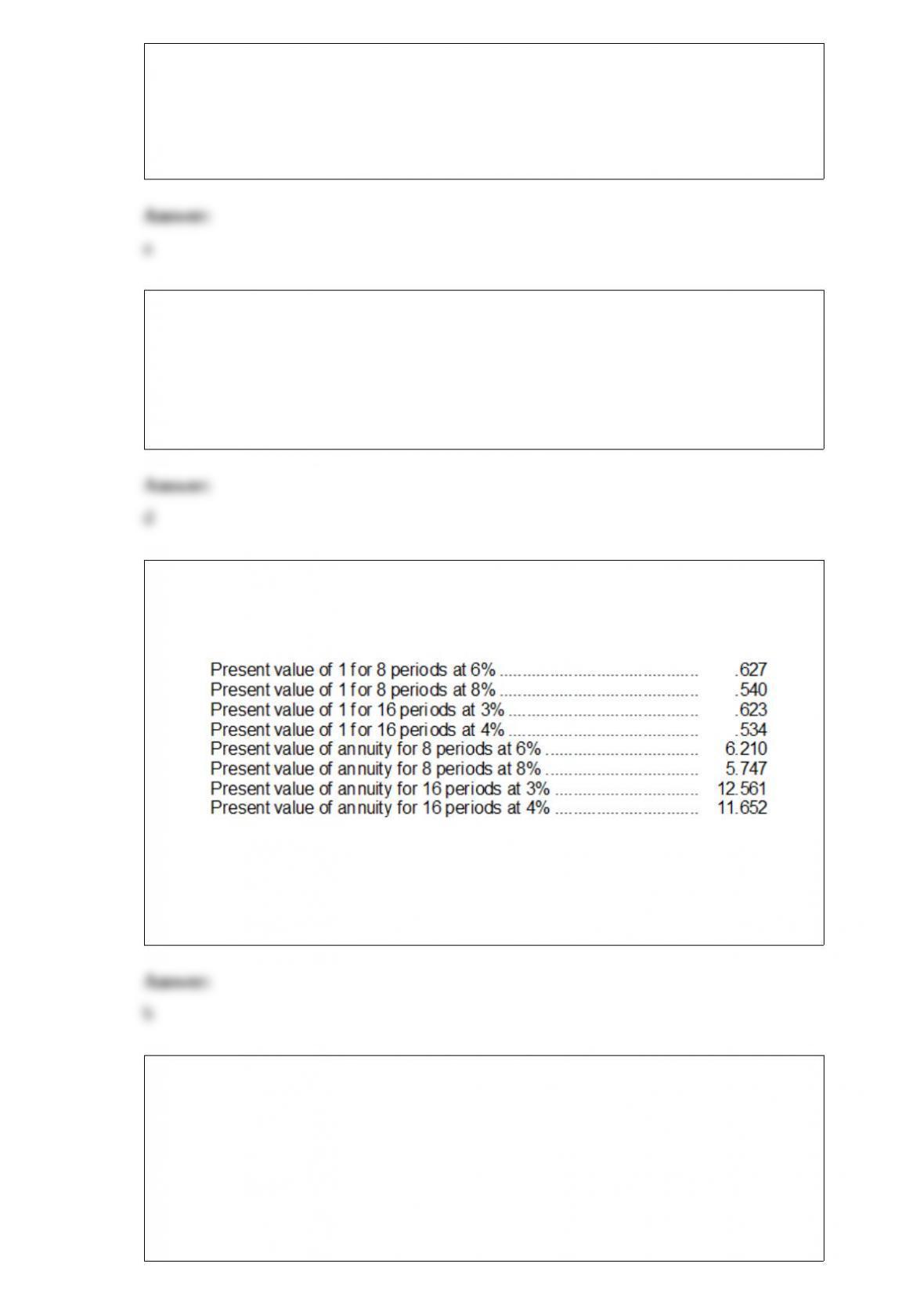
6) on january 1, 2012, ellison co. issued eight-year bonds with a face value of
$2,000,000 and a stated interest rate of 6%, payable semiannually on june 30 and
december 31. the bonds were sold to yield 8%. table values are:
the present value of the interest is
a.$689,640
b.$699,120
c.$745,200
d.$753,660
7) melton company sold some machinery to addison company on january 1, 2012. the
cash selling price would have been $758,160. addison entered into an installment sales
contract which required annual payments of $200,000, including interest at 10%, over
five years. the first payment was due on december 31, 2012. what amount of interest
income should be included in melton’s 2013 income statement (the second year of the
contract)?
a.$20,000
b.$63,398
c.$40,000
d.$55,816
8) in march, 2012, maley mines co. purchased a coal mine for $8,000,000. removable
coal is estimated at 1,500,000 tons. maley is required to restore the land at an estimated
cost of $960,000, and the land should have a value of $840,000. the company incurred
$2,000,000 of development costs preparing the mine for production. during 2012,
450,000 tons were removed and 300,000 tons were sold. the total amount of depletion
that maley should record for 2012 is
a.$1,832,000
b.$2,024,000
c.$2,748,000
d.$3,036,000
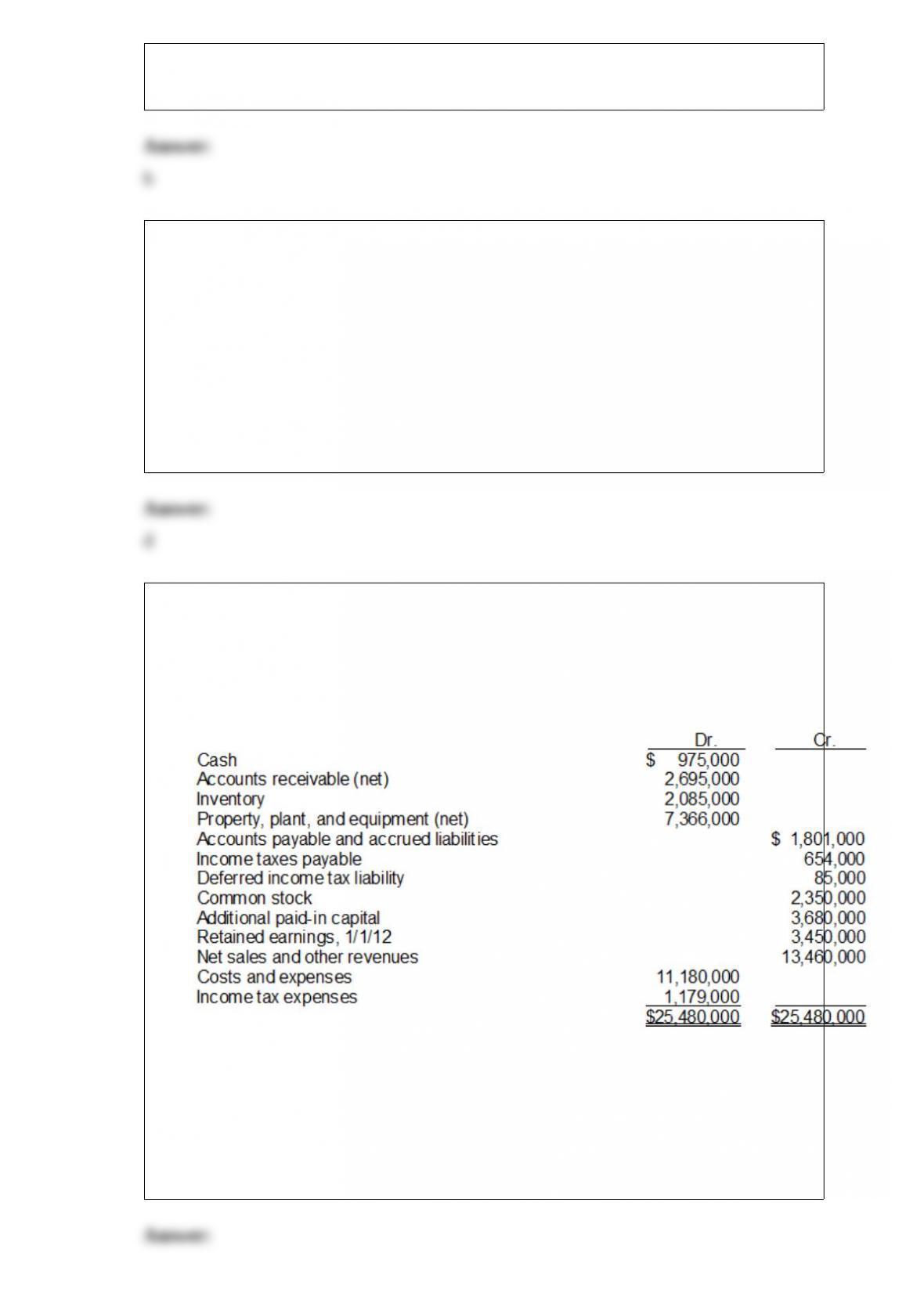
9) the following trial balance of reese corp. at december 31, 2012 has been properly
adjusted except for the income tax expense adjustment.
reese corp.
trial balance
december 31, 2012
other financial data for the year ended december 31, 2012:
in reese’s december 31, 2012 balance sheet,
the current liabilities total is
a.$1,950,000
b.$2,015,000
c.$2,475,000
d.$2,540,000

10) finley, inc.s checkbook balance on december 31, 2012 was $42,400. in addition,
finley held the following items in its safe on december 31.
(1)a check for $900 from peters, inc. received december 30, 2012, which was not
included in the checkbook balance.
(2)an nsf check from garner company in the amount of $1,800 that had been deposited
at the bank, but was returned for lack of sufficient funds on december 29. the check was
to be redeposited on january 3, 2013. the original deposit has been included in the
december 31 checkbook balance.
(3)coin and currency on hand amounted to $2,900.
the proper amount to be reported on finley’s balance sheet for cash at december 31,
2012 is
a.$42,600
b.$40,800
c.$44,400
d.$43,550
11) dilutive convertible securities must be used in the computation of
a.basic earnings per share only
b.diluted earnings per share only
c.diluted and basic earnings per share
d.none of these
12) which of the following is not a time when revenue may be recognized?
a.at time of sale
b.at receipt of cash
c.during production
d.all of these are possible times of revenue recognition
13) which of the following authoritative igaap guidance specifically addresses issues
related to cash?
a.ais no.1 (presentation of financial statements)
b.irfs no. 7 (financial instruments: disclosures)
c.ias no. 39 (financial instruments: recognition and measurement)
d.none of these standards specifically addresses cash issues
14) continuing franchise fees should be recorded by the franchisor
a.as revenue when earned and receivable from the franchisee
b.as revenue when received
c.in accordance with the accounting procedures specified in the franchise agreement
d.as revenue only after the balance of the initial franchise fee has been collected
15) when valuing raw materials inventory at lower-of-cost-or-market, what is the
meaning of the term “market”?
a.net realizable value
b.net realizable value less a normal profit margin
c.current replacement cost
d.discounted present value
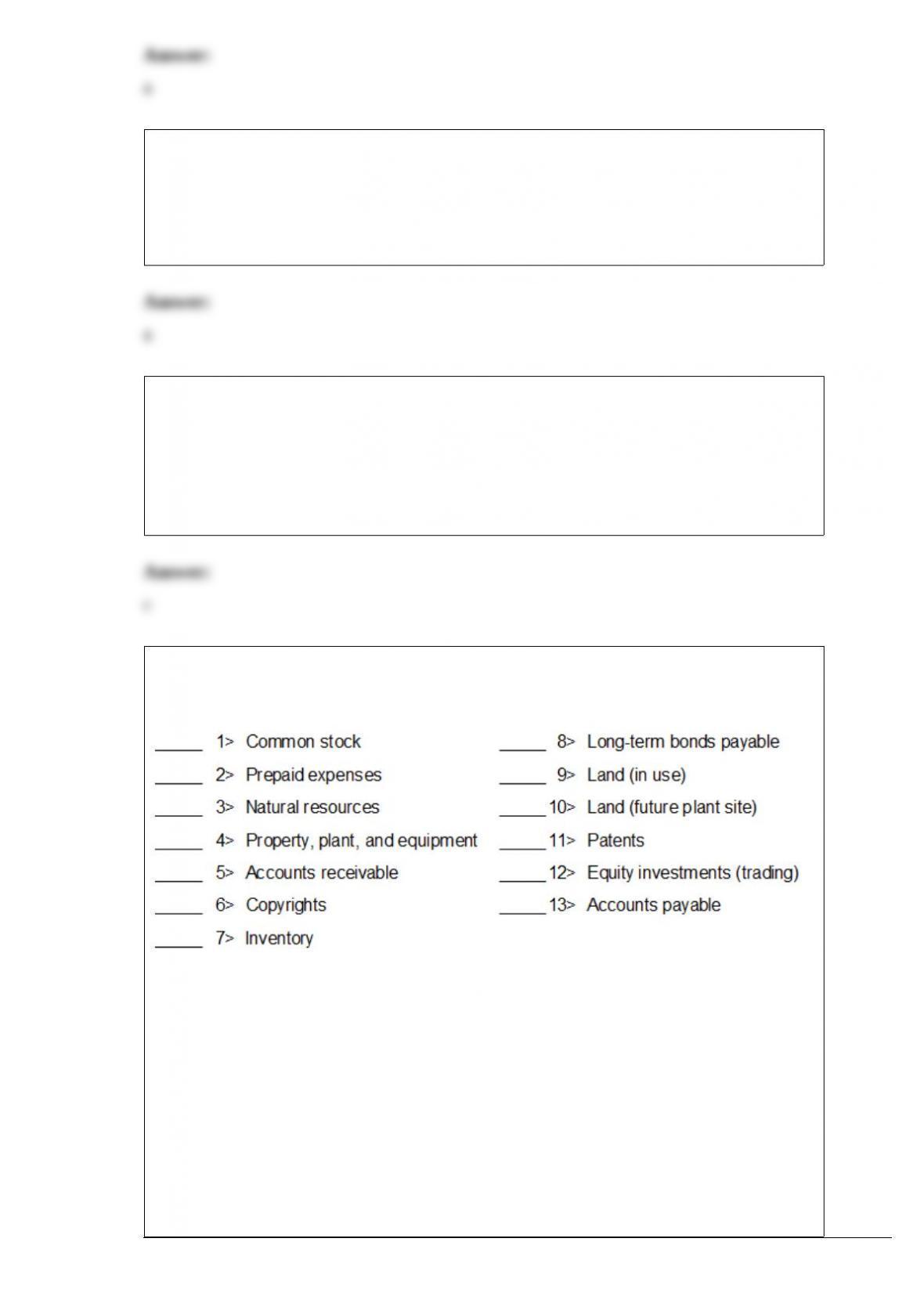
16) use the code letters listed below (a l) to indicate, for each balance sheet item (1 13)
listed below the usual valuation reported on the balance sheet.
a.par value
b.current cost of replacement
c.amount payable when due, less unamortized discount or plus unamortized premium
d.amount payable when due
e.market value at balance sheet date
f.net realizable value
g.lower of cost or market
h.original cost less accumulated amortization
i.original cost less accumulated depletion
j.original cost less accumulated depreciation
k.historical cost
l.unexpired or unconsumed cost

17) the 12% bonds payable of nyman co. had a carrying amount of $2,080,000 on
december 31, 2012. the bonds, which had a face value of $2,000,000, were issued at a
premium to yield 10%. nyman uses the effective-interest method of amortization.
interest is paid on june 30 and december 31. on june 30, 2013, several years before their
maturity, nyman retired the bonds at 104 plus accrued interest. the loss on retirement,
ignoring taxes, is
a.$0
b.$16,000
c.$24,800
d.$80,000
18) assume abc company deposits $50,000 with first national bank in an account
earning interest at 6% per annum, compounded semi-annually. how much will abc have
in the account after five years if interest is reinvested?
a.$67,196
b.$50,000
c.$65,000
d.$66,912