
Cash is used to pay for a car for personal use by the owner. The transaction includes
a. debiting Cash and crediting Drawing.
b. debiting Drawing and crediting Cash.
c. debiting Capital and crediting Cash.
d. debiting Car Expense and crediting Cash.
If the book value of an asset is $12,500 and the accumulated depreciation is $3,500, the
original cost of the asset is
a. $16,000.
b. $9,500.
c. $9,000.
d. $7,500.
A decrease in owner’s equity may result from a(n)
a. purchase of office supplies for cash.
b. withdrawal of cash from the business by the owner.
c. revenue that is derived from sales of goods or services.
d. investment of cash in the business by the owner.

The order in which financial statements should be prepared is
a. balance sheet, income statement, statement of owner’s equity.
b. income statement, balance sheet, statement of owner’s equity.
c. statement of owner’s equity, balance sheet, income statement.
d. income statement, statement of owner’s equity, balance sheet.
Check No. 450, a payment of $45 for the telephone bill, was incorrectly entered on the
check stub as $54. Which of the following adjustments needs to be made?
a. increase the bank statement balance
b. increase the book balance
c. decrease the bank statement balance
d. decrease the book balance

A check involves three parties. The bank in which the drawer has money on deposit is
called the
a. drawer.
b. drawee.
c. payee.
d. endorser.
A check involves three parties. The person who orders the bank to pay a certain amount
of money is called the
a. drawer.
b. drawee.
c. payee.
d. endorser.
Cost accountants provide a wide variety of services including
a. designing and implementing accounting information systems.
b. auditing reviews.
c. performing general accounting services.
d. analyzing the cost effectiveness of products and services that are produced.
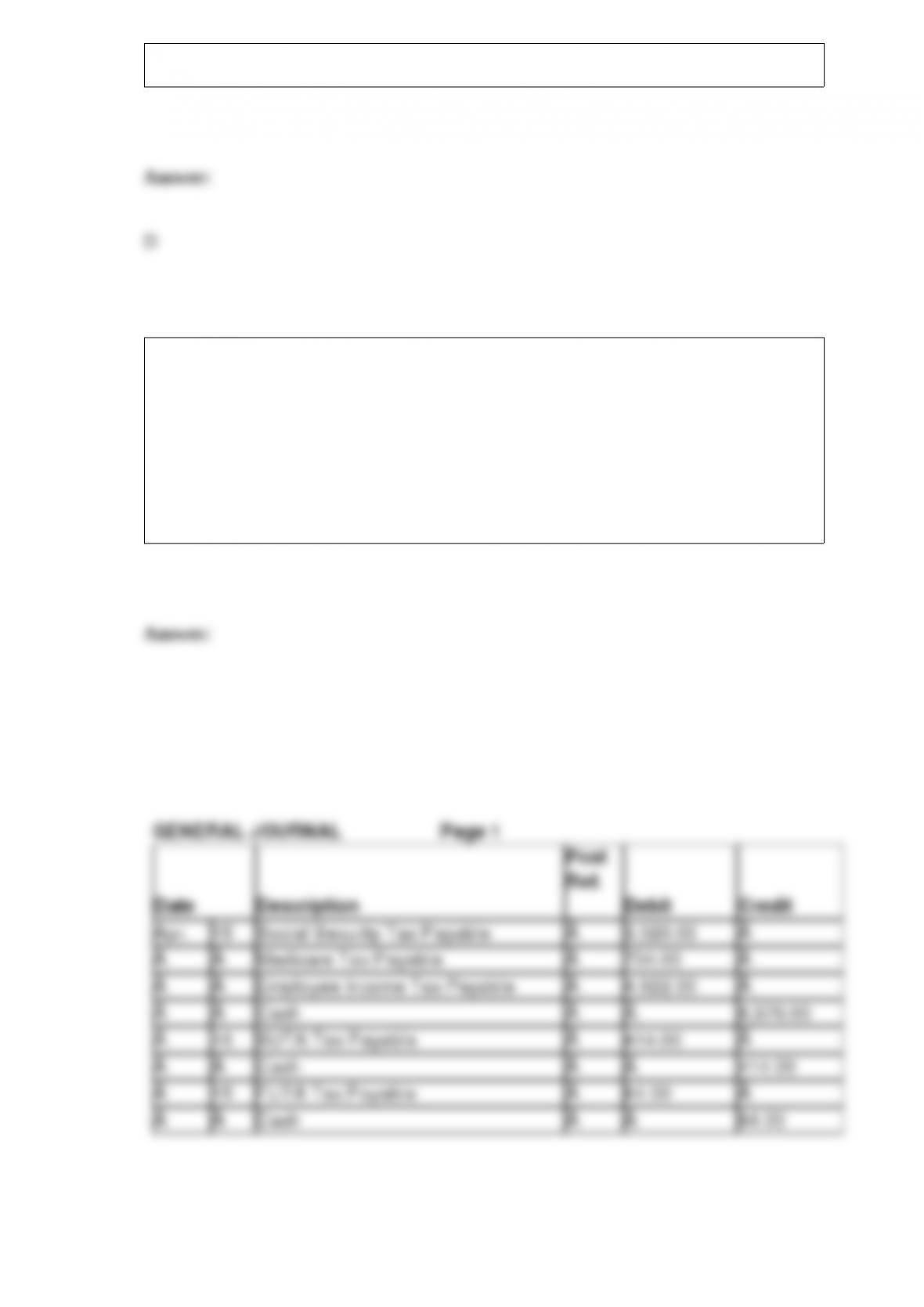
Mark Turney owns Creative Corners. He does his banking at United Federal Bank
(UFB) in Tucson, Arizona. The amounts in his general ledger for payroll taxes and the
employee’s withholding of Social Security, Medicare, and federal income tax as of April
15 of the current year show the following: Social Security tax payable (employer and
employee), $3,020; Medicare tax payable (employer and employee), $734; FUTA tax
payable, $84; SUTA tax payable, $414; and Employees income tax payable, $4,622.
Journalize the payment of the Form 941 deposit to UFB and the payment of the SUTA
tax to the State of Arizona as of April 15, 20–.

Indicate which of the following general ledger accounts are temporary (T) or permanent
(P). a. Cash b. Accounts Receivable c. Accounts Payable d. Prepaid Insurance e. Fees
Earned f. Insurance Expense g. Accumulated Depreciation-Equipment h. Owner,
Drawing i. Owner, Capital j. Income Summary
Professional service business enterprises include the following businesses EXCEPT
a. accounting.
b. real estate.
c. dentistry.
d. medicine.

Match the terms with the definitions.
a. account
b. accounts payable
c. accounts receivable
d. accounting equation
e. assets
f. balance sheet
g. business entity
h. business entity concept
i. business transaction
j. drawing
k. expenses
l. income statement
m. liability
n. net income
o. net loss
p. notes payable
q. owner’s equity
r. revenues
s. statement of owner’s equity
1>The amount by which the business assets exceed the business liabilities.
2>Reports assets, liabilities, and owner’s equity on a specific date.
3>Withdrawals that reduce owner’s equity as a result of the owner taking cash or other

assets out of the business for personal use.
4>The decrease in assets (or increase in liabilities) as a result of efforts to produce
revenues.
5>A formal written promise to pay a supplier or lender a specified sum of money at a
definite future time.
6>The excess of total revenues over total expenses for the period.
7>Reports the profitability of business operations for a specific period of time.
8>Reports beginning capital, plus net income, less withdrawals to compute ending
capital.
9>An economic event that has a direct impact on the business.
10>The concept that nonbusiness assets and liabilities are not included in the business’
accounting records.
11>Consists of the three basic accounting elements: assets = liabilities + owner’s equity.
12>Items a business owns that will provide future benefits.
13>An unwritten promise to pay a supplier for assets purchased or services rendered.
14>A separate record used to summarize changes in each asset, liability, and owner’s
equity of a business.
15>An amount owed to a business by its customers as a result of the sale of goods or
services.
16>An individual, association, or organization that engages in economic activities and
controls specific economic resources.
In some cases, erasures are better for corrections than the ruling method.

Information about cash receipts can be obtained from check stubs and carbon copies of
checks.
Every person authorized to sign checks for a business must complete and sign a
signature card for the bank.
Kate made a $475 payment on her company van. She should credit Accounts Payable
and debit the automobile account.
Once an entry is made to establish a change fund, no other entries are made to this
account.
A(n) ____________________ is a separate record used to summarize changes in assets,
liabilities, and owner’s equity of a business.