1) The accrual of interest results in the following:
A.Increase in assets and liabilities.
B.Increase in assets and stockholders’ equity.
C.Increase in liabilities and decrease in stockholders’ equity.
D.Increase in liabilities and increase in stockholders’ equity.
2) JDR Company purchased 40% of the common stock of YRK Corporation on January
1, 2014, for $2,000,000 as a long-term investment. The records of YRK Corporation
showed the following on December 31, 2014:
At what amount should JDR report the YRK investment on the December 31, 2014
balance sheet?
A.$2,116,000.
B.$2,000,000.
C.$2,096,000.
D.$2,108,000.
Investment in YRK = $2,108,000.
3) Cornhusker Corporation plans to raise $10 million cash on January 1, 2014, by
issuing either bonds payable (8% interest rate) or cumulative preferred stock (8%
dividend rate). How would the annual interest amount on the bonds or annual preferred
dividend amount (if paid) affect the net income for the year ended December 31, 2014?
A.Net income would be reduced by the annual interest on the bonds and by the annual
preferred stock dividends.
B.Net income would be reduced by the annual interest on the bonds but not by the
annual preferred stock dividends.
C.Net income would not be reduced by either the annual interest on the bonds or the
annual preferred stock dividends.
D.Net income would be reduced by the annual preferred dividends but not by the
annual interest on the bonds.
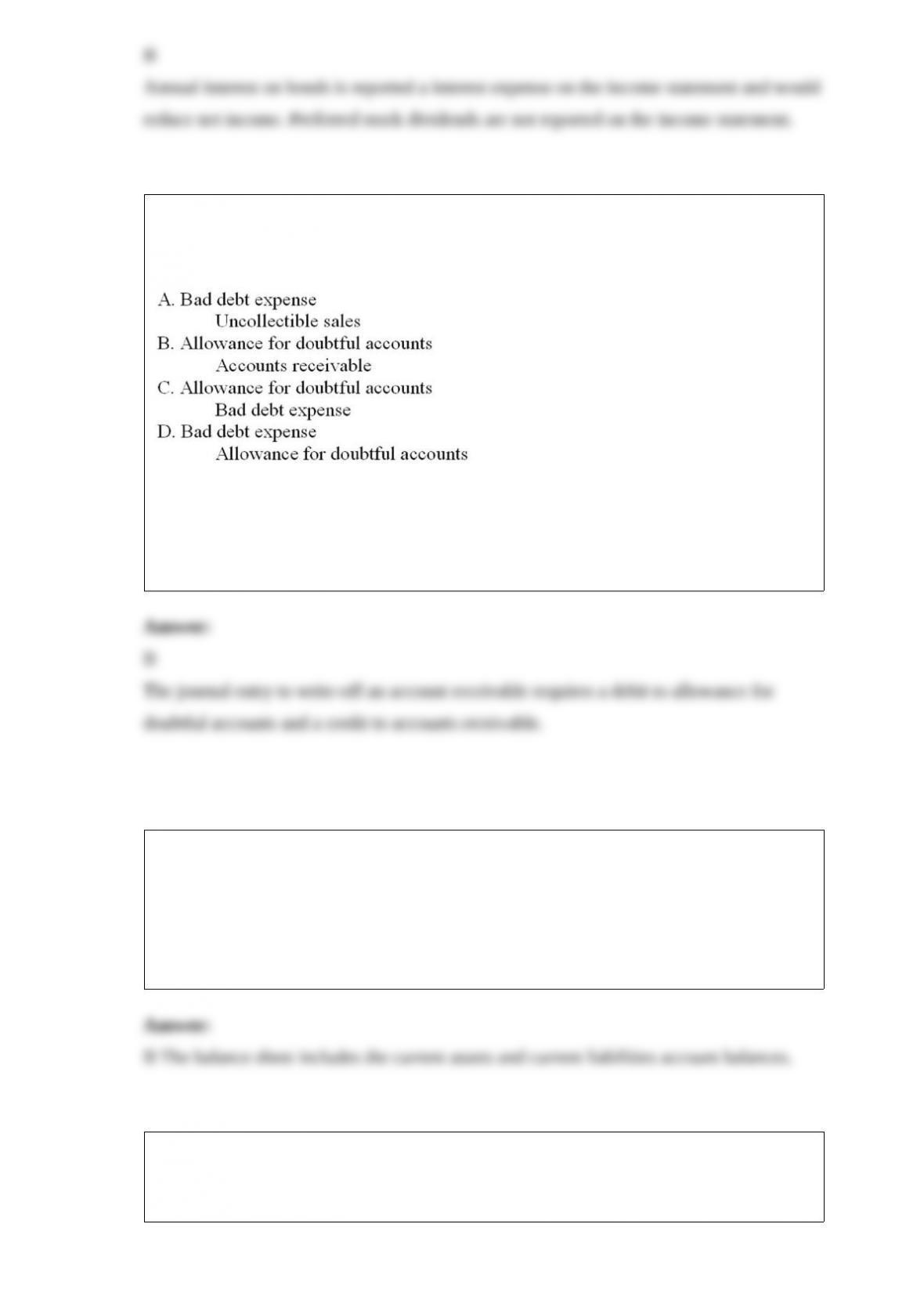
4) Which of the following journal entries correctly records the write-off of an
uncollectible account receivable when using the allowance method?
A.Option A
B.Option B
C.Option C
D.Option D
5) Which financial statement would you utilize to determine whether a company will be
able to pay liabilities which are due in 30 days?
A.Income statement.
B.Balance sheet.
C.Statement of stockholders’ equity.
D.Statement of cash flows.
6) Which of the following journal entries is correct when no-par common stock is
initially issued for cash?
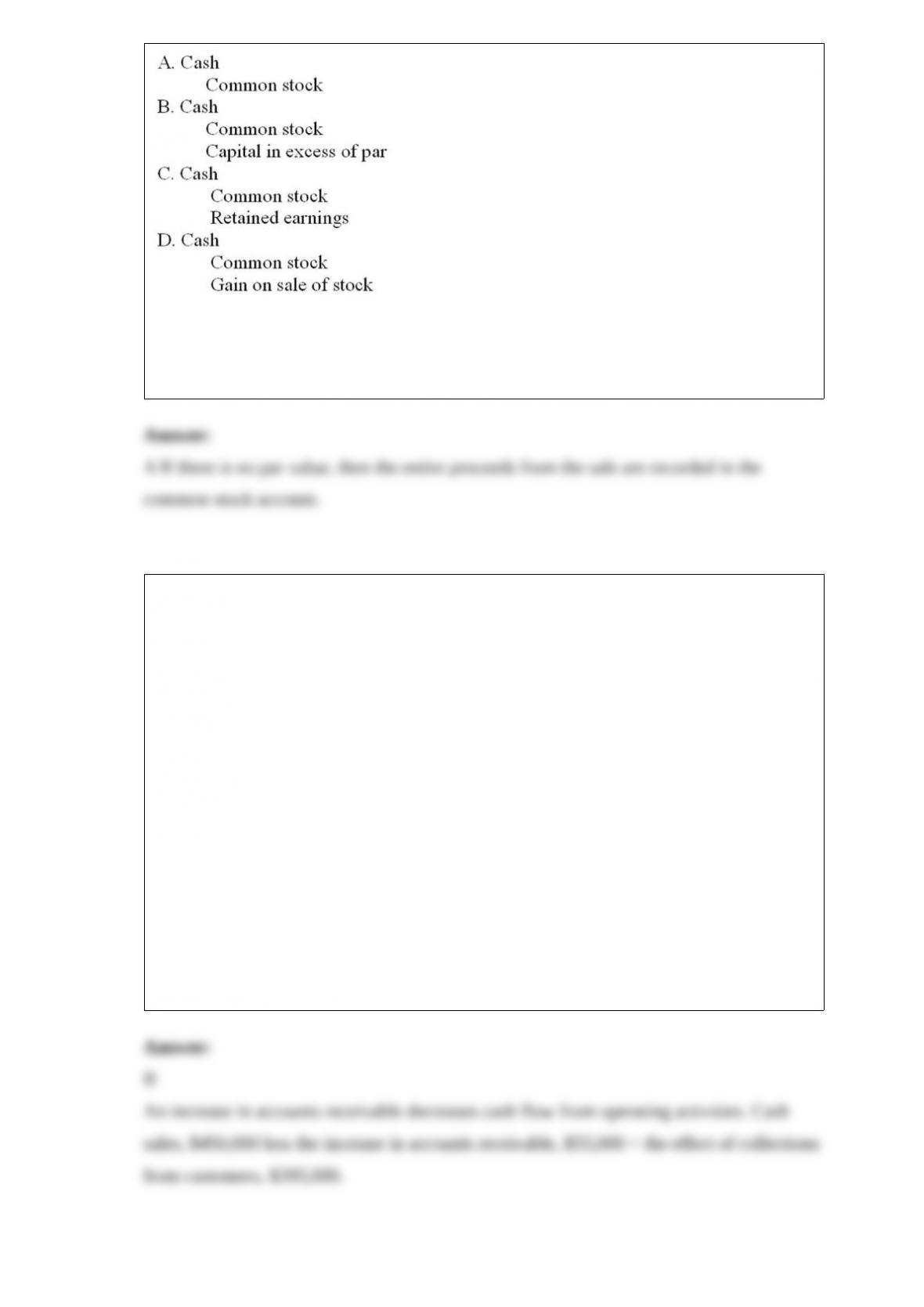
A.Option A
B.Option B
C.Option C
D.Option D
7) Newark Company has provided the following information:
♦ Cash sales, $450,000
♦ Credit sales, $1,350,000
♦ Selling and administrative expenses, $330,000
♦ Sales returns and allowances, $90,000
♦ Gross profit, $1,360,000
♦ Increase in accounts receivable, $55,000
♦ Bad debt expense, $33,000
♦ Sales discounts, $43,000
♦ Net income, $1,030,000
What is the effect of collections from customers on cash flow from operating activities,
using the indirect method?
A.Cash flow increased $975,000.
B.Cash flow increased $395,000.
C.Cash flow decreased $55,000.
D.Cash flow increased $450,000.
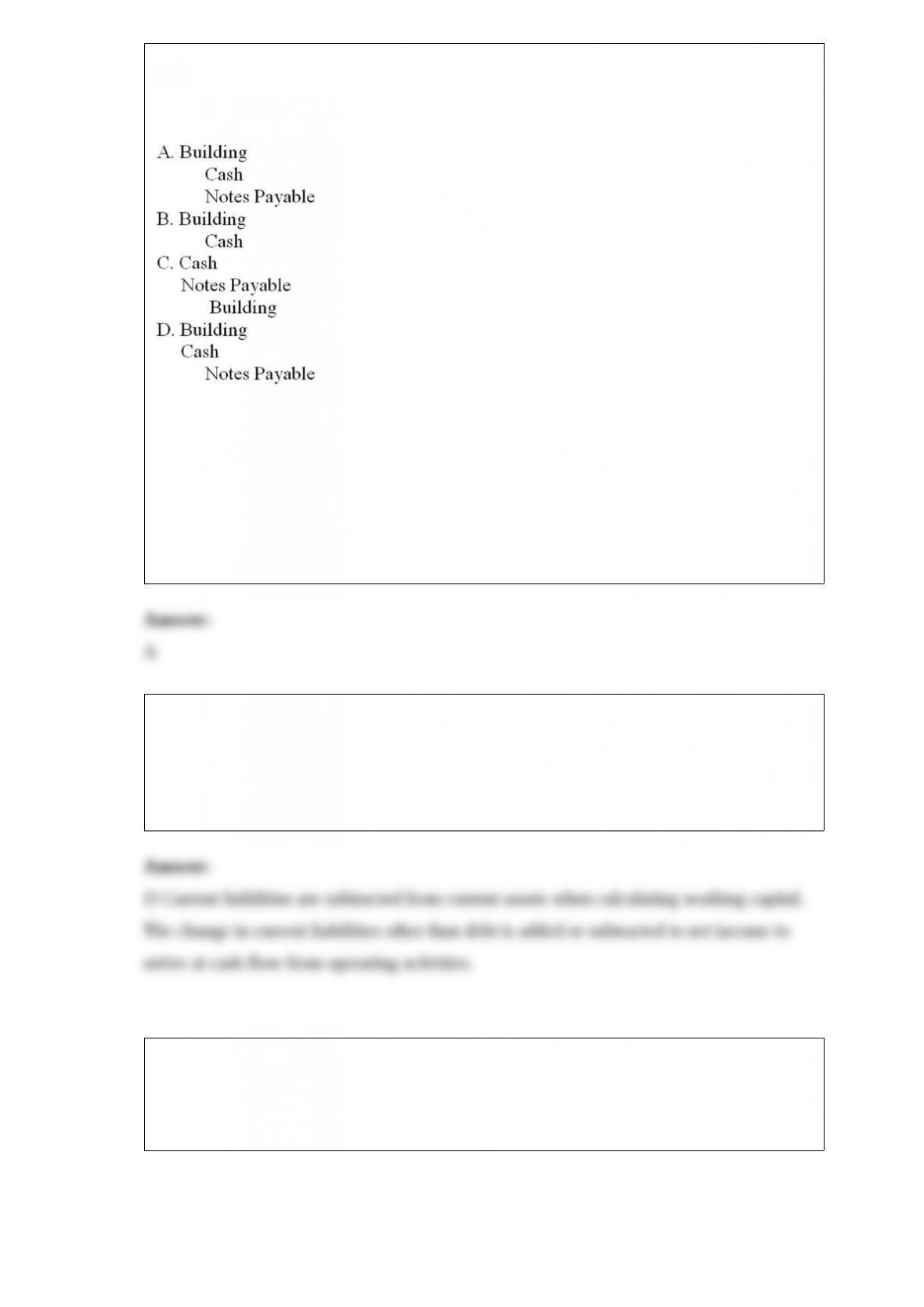
8) Which of the following journal entries is correct when a business entity purchases a
building by paying cash and by signing a note payable for the balance?
A.Option A
B.Option B
C.Option C
D.Option D
The company receives an asset, the building, and to record this asset a debit to the
building account is required. To acquire the building the company gives up an asset,
cash, and credits this account. To complete the transaction the company also took on a
liability and needs to record this with a credit to notes payable.
9) Which of the following statements is correct?
A.Current liabilities are initially recorded at the amount of their principal plus interest.
B.Current liabilities are those liabilities due within one year.
C.Liquidity refers to the ability to pay all debts within one year.
D.Current liabilities affect working capital and the cash flows from operating activities.
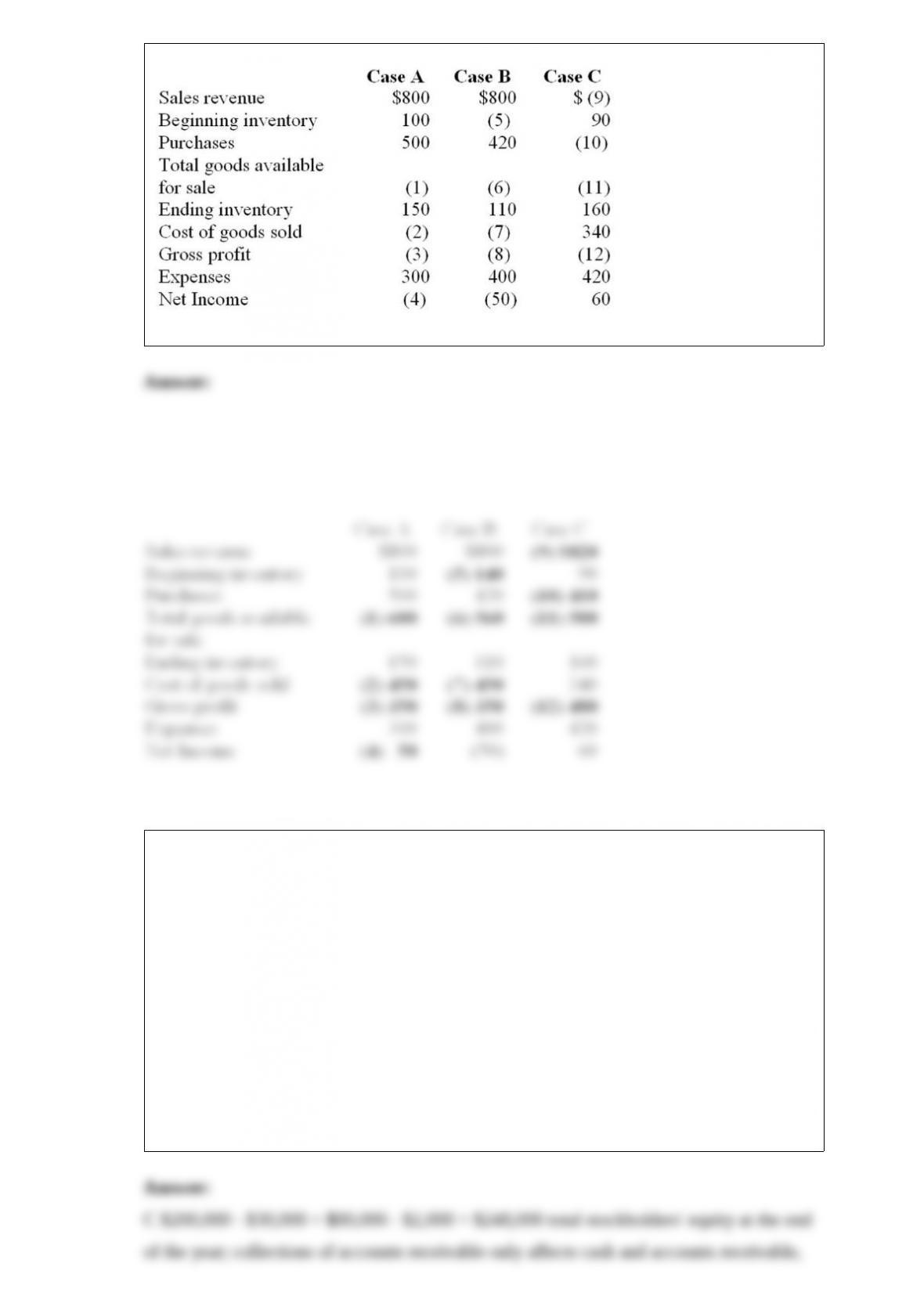
10) Compute the missing amounts that are numbered in parentheses for the income
statement of each independent case. (Hint: Each case need not be calculated in the
numerical order of the missing numbers.)
11) ABC Company’s total stockholders’ equity at the beginning of the year was
$200,000. During the year ABC reported the following:
Net loss of $30,000.
Stock issued in exchange for land totaling $80,000.
Collections of accounts receivable $40,000.
Dividends declared and paid totaling $2000.
What is ABC’s total stockholders’ equity at the end of the year?
A.$348,000.
B.$288,000.
C.$248,000.
D.$168,000.
12) Which of the following transactions increases both cash and net income?
A.Cash receipts from a bank loan.
B.Cash receipts from sale of common stock.
C.Cash receipts from customers for services provided.
D.Cash receipts from cost of goods sold.
13) Which of the following journal entries is prepared when cash is received from a
customer prior to delivery of the goods or services?
A.Option A
B.Option B
C.Option C
D.Option D
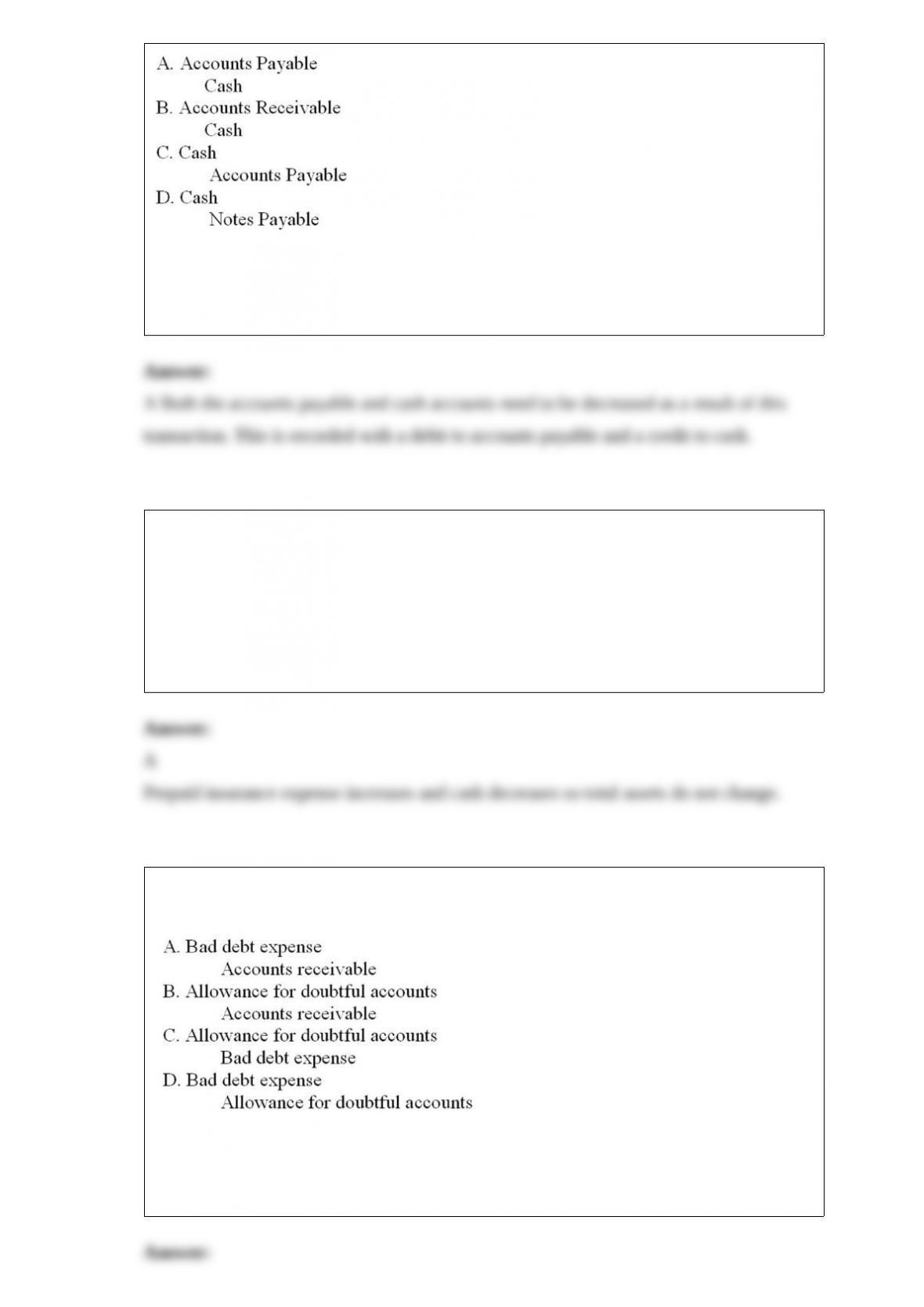
14) Which of the following journal entries is correct when a business entity uses cash to
pay an account payable?
A.Option A
B.Option B
C.Option C
D.Option D
15) Which of the following correctly describes the effects of initially recording prepaid
insurance expense when cash is paid to purchase an insurance policy?
A.Total assets do not change.
B.Net income decreases.
C.Liabilities are decreased.
D.Stockholders’ equity increases.
16) Which of the following journal entries correctly records bad debt expense?
A.Option A
B.Option B
C.Option C
D.Option D
17) Investing activities cash flows = $52,200 = $79,000 – $19,800 – $44,000 + $37,000.
2. Financing activities cash flows = $64,000 = -$25,000 + $110,000 – $92,000 +
$71,000.
18) On January 31, 2014, McBurger Corporation purchased the following shares of
voting common stock as long-term investments in available-for-sale securities. None of
these holdings amounted to more than 5% of the respective company’s outstanding
voting shares. The accounting period ends December 31.
All of the Bailey Corporation stock was sold for $13,500 on January 12, 2016.
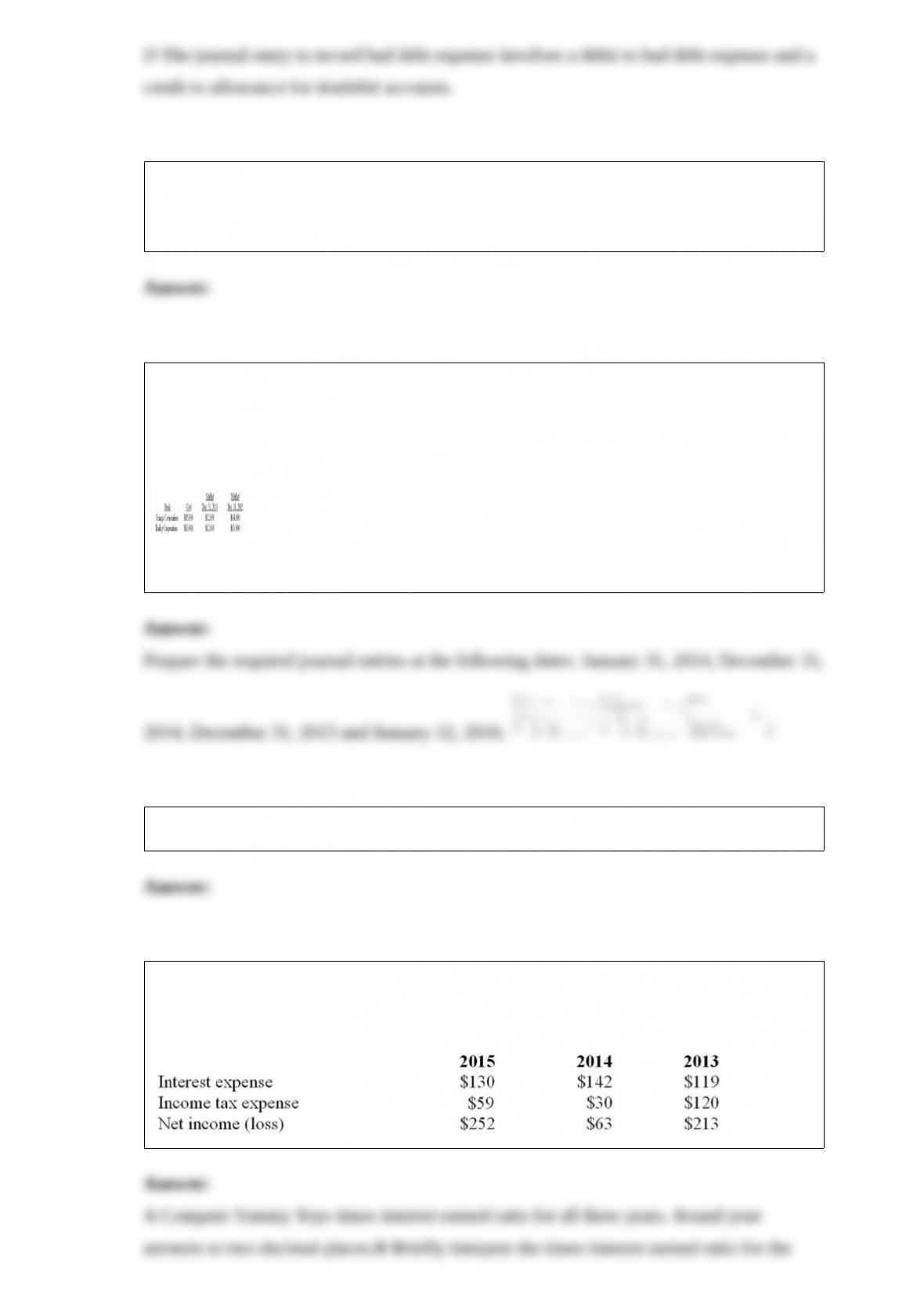
20) The following information was taken from the income statement of Tommy Toys
for the years 2013 through 2015 (in millions):
22) On January 1, 2014, Fall Corporation acquired 100% of the outstanding voting
shares of Foliage Corporation for $600,000. The book and fair values of Foliage’s assets
and liabilities as of January 1, 2014 are listed below:
23) On January 2, 2014, Eagle Company acquired 100% of Solly Company’s common
stock for $900,000 cash in a merger transaction. At this date, the book value of all of
Solly Company’s assets, except a building, was $700,000. The fair value of these assets
without the building was $800,000. In addition to these assets is a building that has a
book value of $400,000 and a fair value of $440,000. The book value and fair value of
Solly’s liabilities is $520,000.
24) Sadler Corporation purchased equipment to be used in manufacturing. The purchase
was made at the beginning of 2013 by paying cash of $150,000. The equipment has an
estimated residual value of 10,000 and an expected useful life of 10 years. At the
beginning of 2015, Sadler concluded that the total useful life of the equipment will be 8
years rather than 10, and that the residual value will be zero. Sadler uses the
straight-line method for depreciation.