1) Hamasaki Company owns 30% of CDW Corp. stock. Hamasaki received $6,500 in
cash dividends from its investment in CDW. The entry to record receipt of these
dividends includes a debit to Cash for $6,500 and a credit to Long-Term Investments
for $6,500.
2) In a process costing system costs are measured upon completion of each job.
3) When the actual cost of direct materials used exceeds the standard cost, the company
must have experienced an unfavorable direct materials price variance.
4) Equity securities reflect a creditor relationship such as investments in notes, bonds,
and certificates of deposit.
5) A process cost summary usually does not include the number of equivalent units of
production for the period.
6) The contract rate on previously issued bonds changes as the market rate of interest
changes.
7) Straight line depreciation, rent and manager salaries are examples of variable costs.
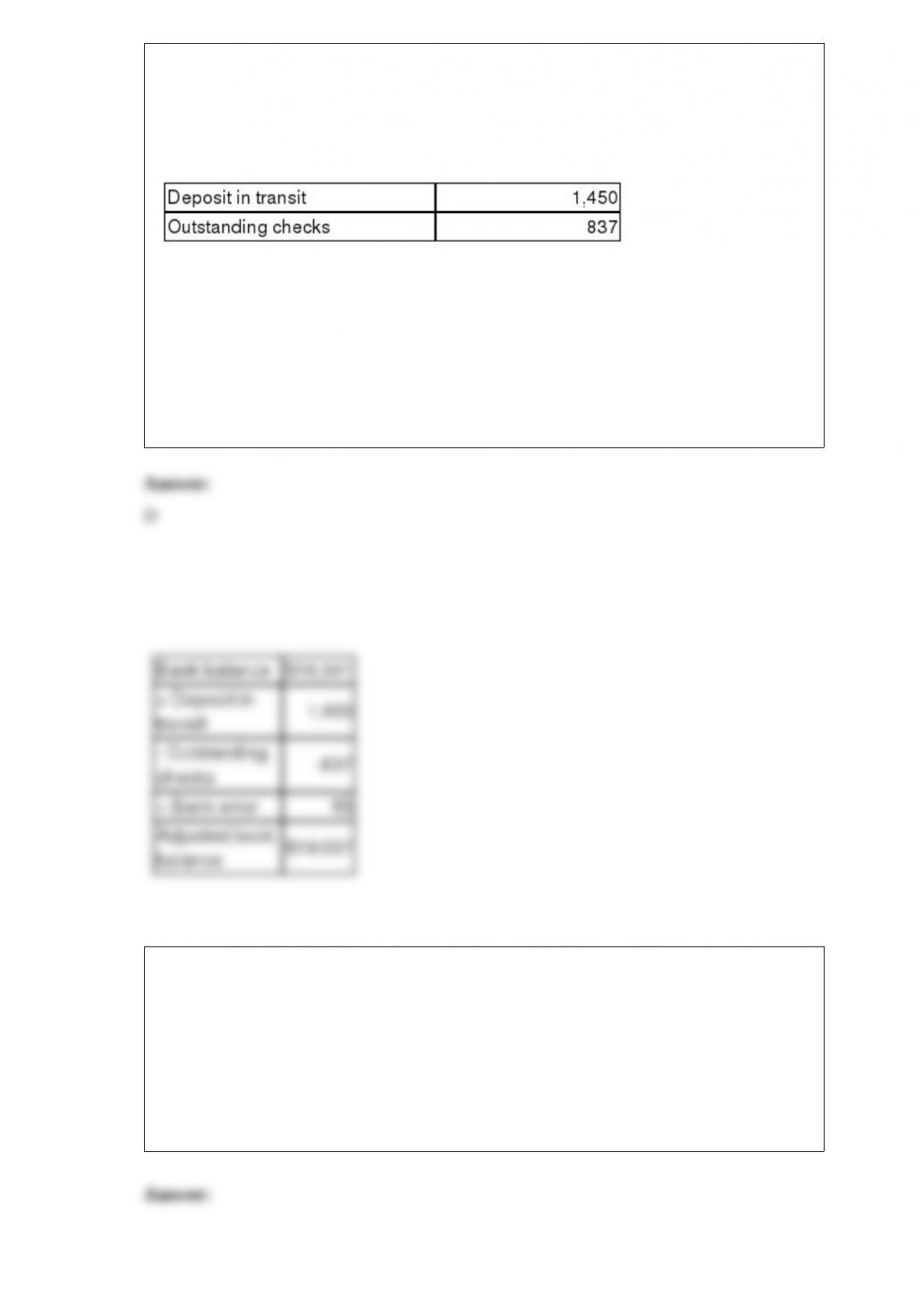
8) Ryan Company deposits all cash receipts on the day they are received and makes all
cash payments by check. Ryan’s June bank statement shows $18,361 on deposit in the
bank. Ryan’s comparison of the bank statement to its cash account revealed the
following:
Additionally, a $29 check written and recorded by the company correctly was recorded
by the bank as a $92 deduction.
The adjusted cash balance per the bank records should be:
A.$18,974
B.$18,911
C.$20,711
D.$19,037
E.$16,137
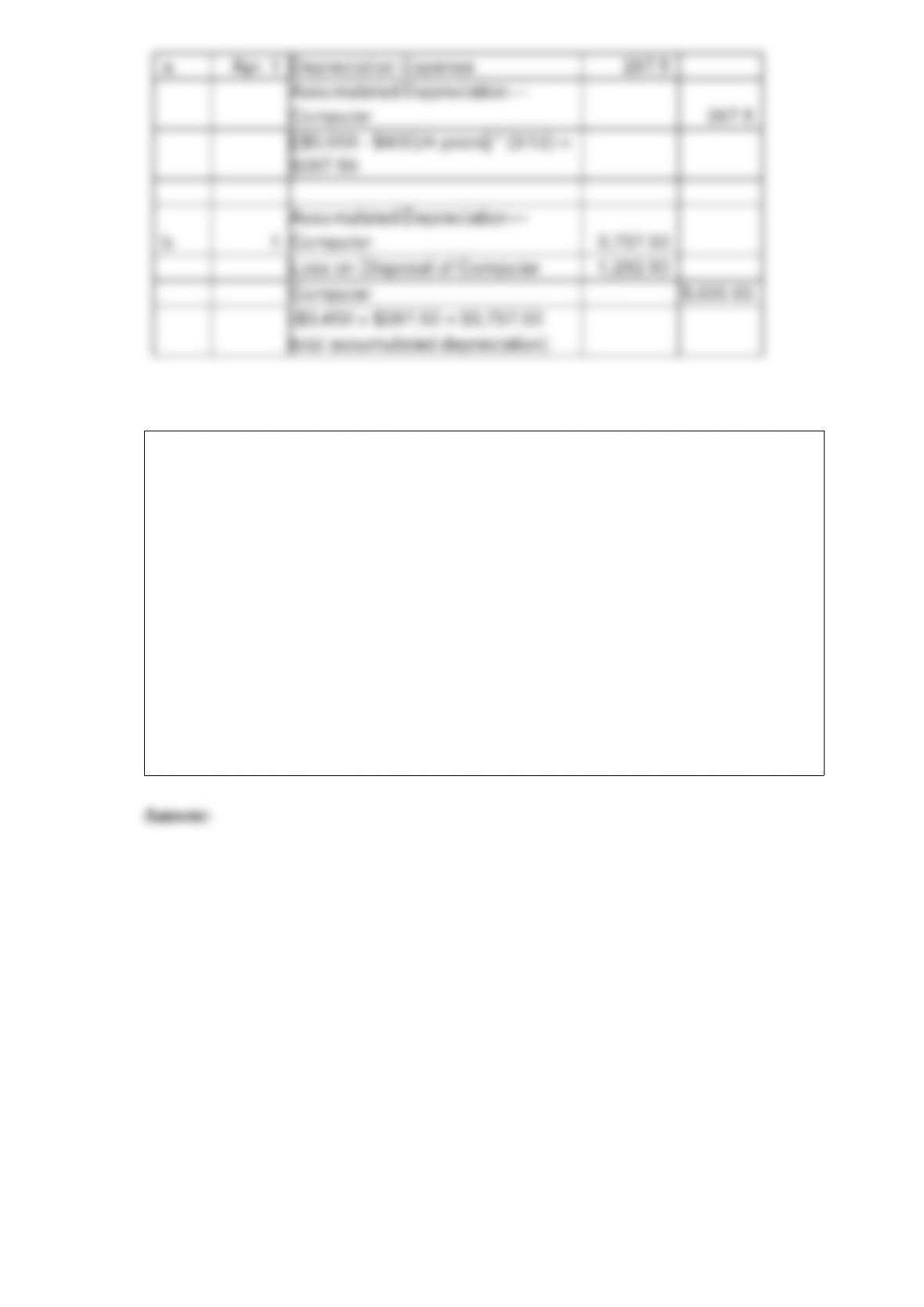
9) On April 1, 2015, due to obsolescence resulting from a new technology, a company
discarded a computer that cost $5,000, had a useful life of 4 years, and a salvage value
of $400. Based on straight-line depreciation, the accumulated depreciation as of
December 31, 2014 was $3,450.
a. Prepare the journal entry to record depreciation up to the date of disposal of the
computer.
b. Prepare the journal entry to record the disposal of the computer.
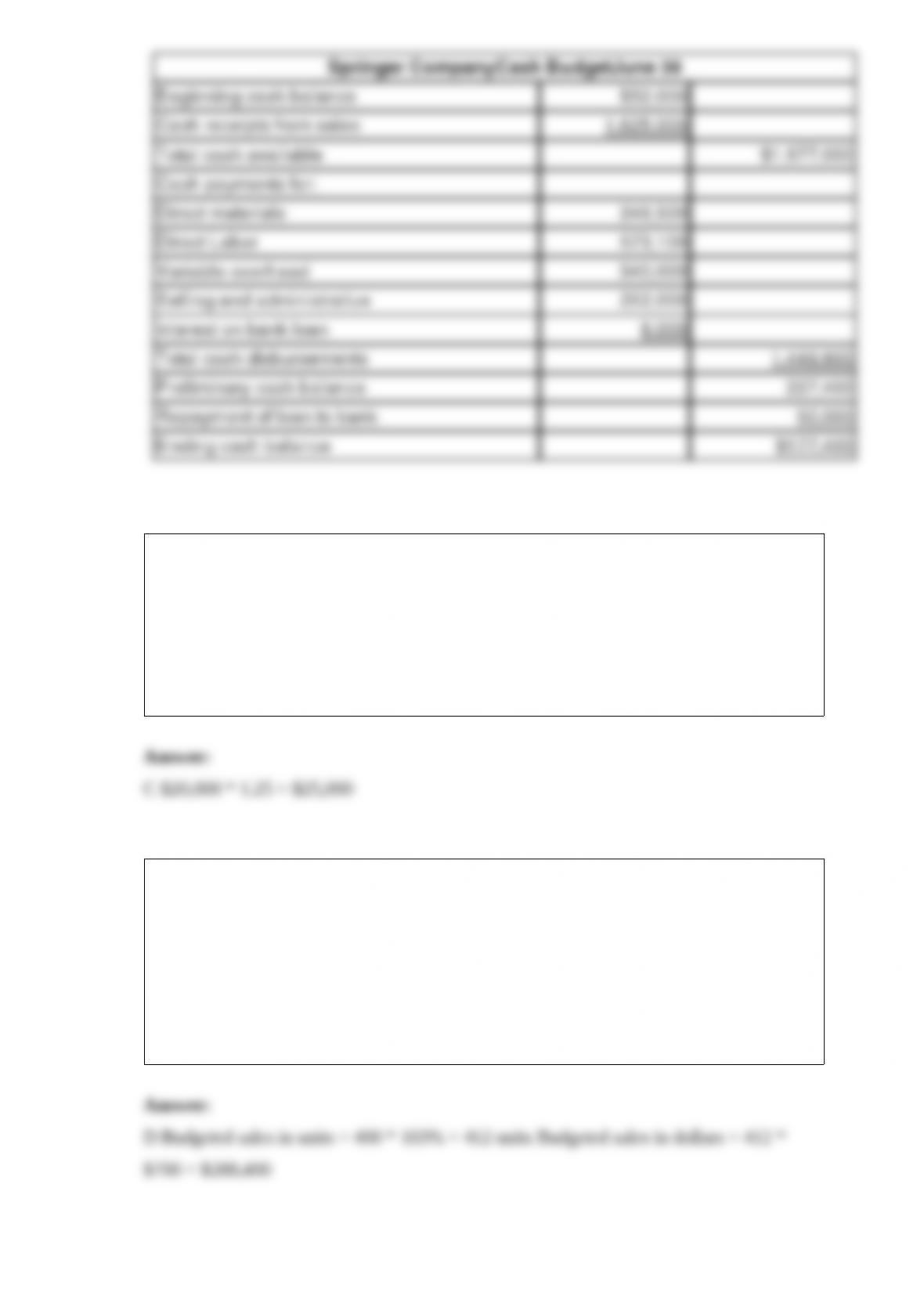
10) Use the following information to prepare the June cash budget for Springer
Company. It should show expected cash receipts and cash disbursement for the month
and the cash balance expected on June 30.
a. Beginning cash balance on June 1 is $52,000.
b. Cash receipts from sales are expected to be $1,625,000.
c. Cash payments for direct materials and direct labor are expected to be $246,500 and
573,100, respectively.
d. Budgeted cash payments for variable overhead is $340,000.
e. Budgeted depreciation, the only fixed overhead estimated for June: $24,000.
f. Cash selling and administrative expenses budgeted for June are $282,000.
g. Bank loan interest due in June: $8,000.
h. Loan payment of $50,000 should be made if the preliminary cash balance is greater
than $200,000.
11) A company has an overhead application rate of 125% of direct labor costs. How
much overhead would be allocated to a job if it required total labor costing $20,000?
A.$5,000.
B.$16,000.
C.$25,000.
D.$125,000.
E.$250,000.
12) Zhang Industries sells a product for $700. Unit sales for May were 400 and each
month’s sales are expected to exceed the prior month’s results by 3%. Compute the total
sales dollars to be reported on the sales budget for month ended June 30.
A.$280,000.
B.$297,000.
C.$271,600.
D.$288,400.
E.$364,000.
13) A sporting equipment store expects to purchase $8,000 of ski boots in October. The
store had $2,000 of ski boots in merchandise inventory at the beginning of October, and
expects to have $3,000 of ski boots in merchandise inventory at the end of October to
cover part of anticipated November sales. What is the budgeted cost of goods sold for
October?
A.$5,000.
B.$7,000.
C.$8,000.
D.$9,000.
E.$10,000.
14) During December, the production department of a process operations system
completed and transferred to finished goods a total of 65,000 units of product. At the
end of March, 15,000 additional units were in process in the production department and
were 80% complete with respect to materials. The beginning inventory included
materials cost of $57,500 and the production department incurred direct materials cost
of $183,000 during December. Compute the direct materials cost per equivalent unit for
the department using the weighted-average method.
A.$3.70.
B.$2.38.
C.$2.82.
D.$3.12.
E.$4.79.
15) Match each of the following terms with the appropriate definition.
1>The number of times a company’s average inventory is sold during a period. A.
Conservatism constraint
2>An inventory valuation method where each item in inventory is identified with a
specific purchase and invoice. B. Net realizable value
3>The expected sales price of an item minus the cost of making the sale. C. Retail
inventory method
4>An inventory pricing method that assumes the unit prices of the beginning inventory
and of each purchase are weighted by the number of units of each in inventory; the
calculation occurs at the time of each sale. D. Days’ sales in inventory
5>A method for estimating an ending inventory based on the ratio of the amount of
goods for sale at cost to the amount of goods for sale at retail price. E. Weighted
average inventory method
6>An estimate of days needed to convert the inventory at the end of the period into
receivables or cash. F. Interim statements
7>An inventory valuation method that assumes that inventory items are sold in the
order acquired. G. LIFO method
8>Financial statements prepared for periods of less than one year. H. Specific
identification method
9>The accounting constraint that aims to select the less optimistic estimate when two or
more estimates are about equally likely. I. FIFO method
10>An inventory valuation method that assumes costs for the most recent items
purchased are sold first and charged to cost of goods sold. J. Inventory turnover
16) Holo Company reported the following financial numbers for one of its divisions for
the year; average total assets of $5,800,000; sales of $5,375,000; cost of goods sold of
$3,225,000; and operating expenses of $1,147,000. Compute the division’s return on
investment:
A.18.6%.
B.21.3%.
C.17.3%.
D.10.4%.
E.14.7%.
17) Turk Manufacturing is considering purchasing two machines. Each machine costs
$9,000 and will produce cash flows as follows:
Turk Manufacturing uses the net present value method to make the decision, and it
requires a 15% annual return on its investments. The present value factors of 1 at 15%
are: 1 year, 0.8696; 2 years, 0.7561; 3 years, 0.6575. Which machine should Turk
purchase?
A.Only Machine A is acceptable.
B.Only Machine B is acceptable.
C.Both machines are acceptable, but A should be selected because it has the greater net
present value.
D.Both machines are acceptable, but B should be selected because it has the greater net
present value.
18) The Fabricating Department started the current month with a beginning Work in
Process inventory of $10,000. During the month, it was assigned the following costs:
direct materials, $76,000; direct labor, $24,000; and factory overhead, 50% of direct
labor cost. Also, inventory with a cost of $109,000 was transferred out of the
department to the next phase in the process. The ending balance of the Work in Process
Inventory account for the Fabricating Department is:
A.$13,000.
B.$56,000.
C.$59,000.
D.$110,000.
E.$165,000.
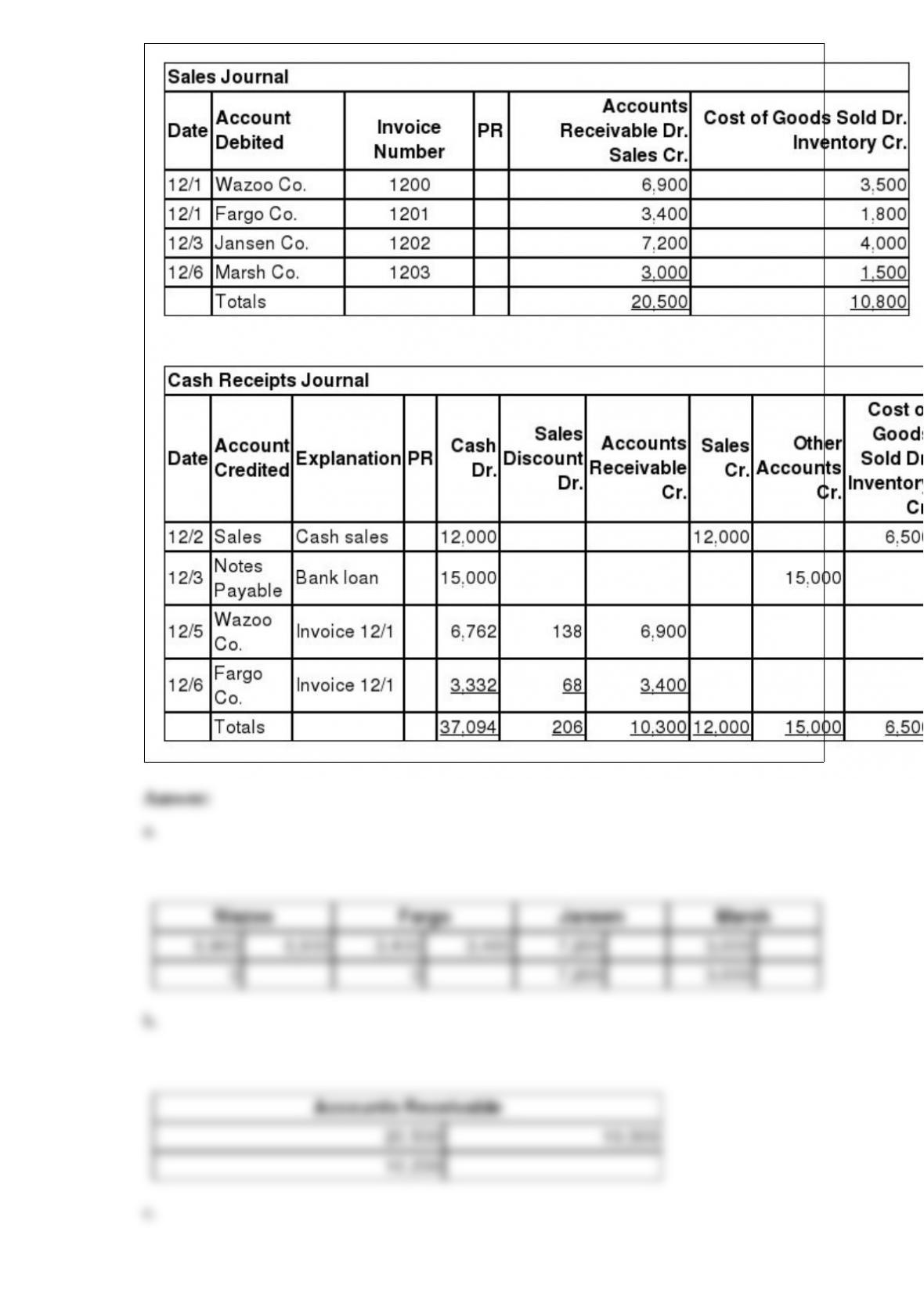
19) Morris Company uses special journals to record transactions. Below are the sales
journal and cash receipts journal for Morris. Prepare the following:
a. Open an accounts receivable subsidiary ledger having a T-account for each customer.
Post the invoices to the subsidiary ledger.
b. Open an Accounts Receivable controlling T-Account. Post the end-of the month
totals that affect the Accounts Receivable account only.
c. Prepare a schedule of accounts receivable and prove that its total equals the Accounts
Receivable controlling account balance.
20) Riverboat Adventures pays $310,000 plus $15,000 in closing costs to buy out a
competitor. The real estate consists of land appraised at $35,000, a building appraised at
$105,000, and paddleboats appraised at $210,000. Compute the cost that should be
allocated to the land.
A.$93,000.
B.$140,000.
C.$32,500.
D.$31,000.
E.$97,500.
21) Classify each of the following items as either:
A. Current liability
B. Long-term liability
C. Not a liability
1> 60-day promissory note
2> Payment of a 4-year term loan due this year
3> Salaries payable
4> Debt guarantees
5> FICA taxes payable
6> Income taxes payable
7> Payment of a 30-year term loan due this year
8> Payment of a 30-year term loan due next year. (The company’s operating cycle is 2
months.)
9> Warranty work completed this year
10> Accounts payable
22) The amount by which a department’s sales exceed its direct expenses is:
A.Net sales.
B.Gross profit.
C.Departmental profit.
D.Contribution margin.
E.Departmental contribution to overhead.
23) The total cost of an asset less its accumulated depreciation is called:
A.Historical cost.
B.Book value.
C.Present value.
D.Current (market) value.
E. Replacement cost.
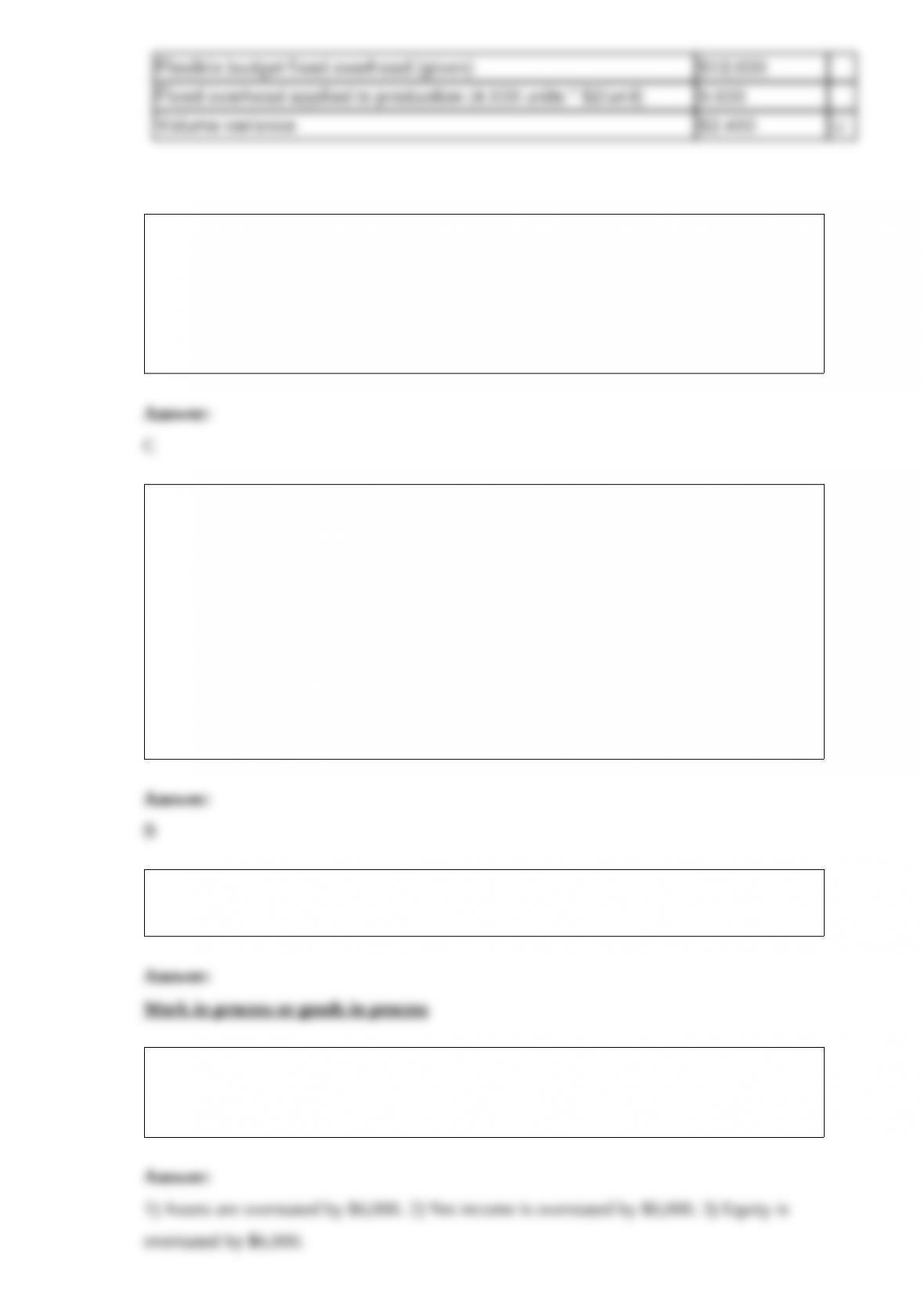
24) Claymore Corp. has the following information about its standards and production
activity for September. The volume variance is:
A.$1,295U.
B.$1,295F.
C.$2,400U.
D.$2,400F.
E.$3,695U.
25) Factoring receivables is beneficial to a seller for all of the following reasons except:
A.Allows firms to receive cash earlier.
B.Passes ownership of the receivables to the factor.
C.There are no fees for factoring.
D.Seller avoids the cost of billing and accounting for receivables.
E.May transfer the risk of bad debts to the factor.
26) Owning a patent:
A.Gives the owner the exclusive right to publish and sell a musical or literary work
during the life of the creator plus 70 years.
B.Gives the owner exclusive rights to manufacture and sell a patented item or to use a
process for 20 years.
C.Gives its owner an exclusive right to manufacture and sell a device or to use a
process for 50 years.
D.Indicates that the value of a company exceeds the fair market value of a company’s
net assets if purchased separately.
E.Gives its owner the exclusive right to publish and sell a musical or literary work
during the life of the creator plus 17 years.
27) ____________________ inventory consists of products in the process of being
manufactured but not yet complete.
28) On December 31, the year end, a company forgot to record $6,000 of depreciation
on machinery. In the current year financial statements, what is the effect of this error on
assets, net income, and equity?
29) A company reported $960,000 in net income for the current year. Total
weighted-average common shares outstanding are 150,000 shares, and the year-end
market price is $67.20 per common share. Calculate the company’s price earnings ratio.
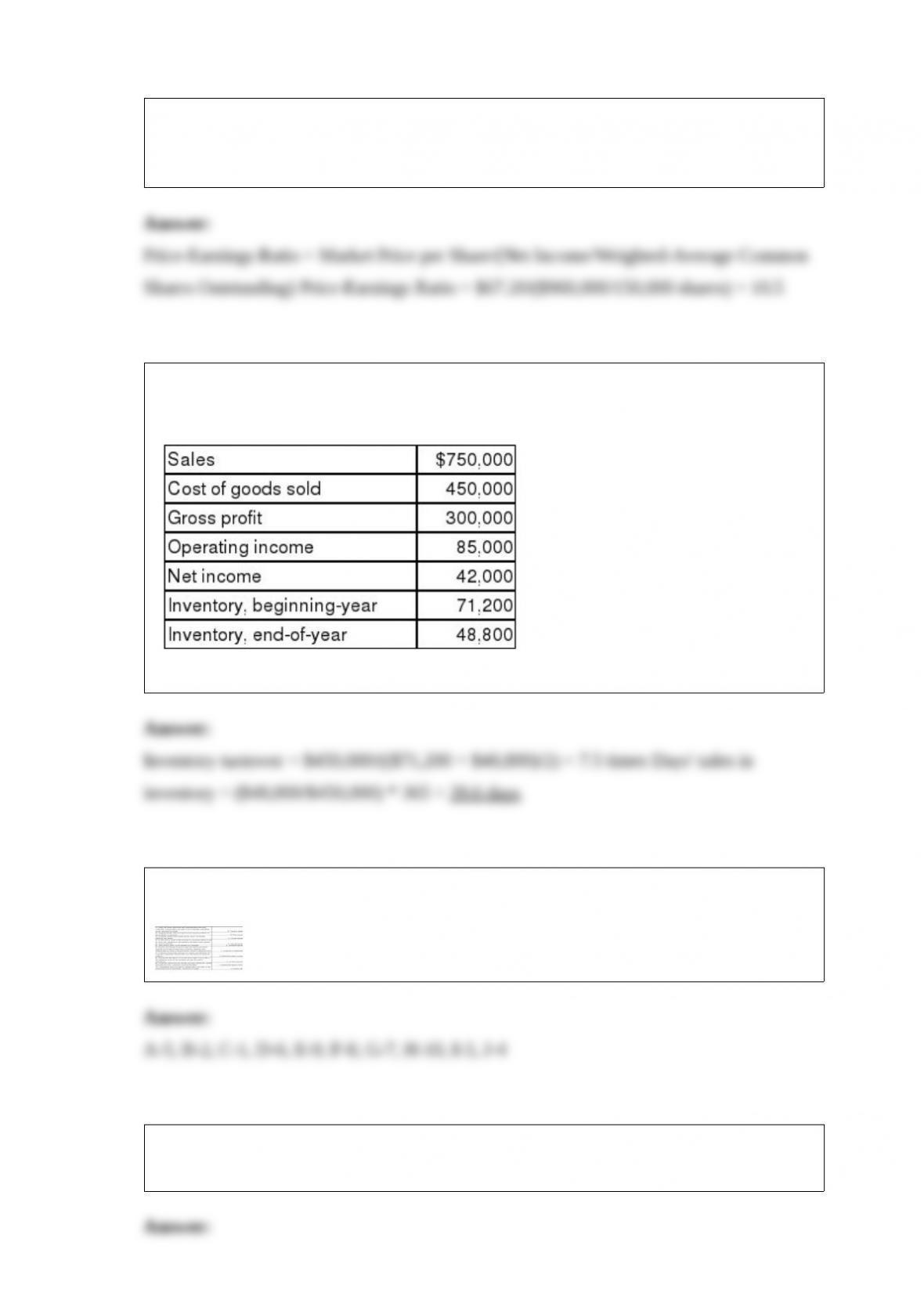
30) The following information is available for the Starr Corporation:
Calculate the company’s inventory turnover and its days’ sales in inventory.
31) Match the following terms with the appropriate definition.
32) A ____________________________ results from revising estimates of the useful
life or salvage value of a plant asset.