Chapter 03 – Supplement – Closing Entries and the Work Sheet
TRUE/FALSE
1. The first step to preparing closing journal entries is to close the credit balance on the income statement
to the Retained Earnings account.
2. The final step when preparing closing entries is to close the Dividends account to the Retained
Earnings account.
3. All credit balance accounts on the income statement are revenue accounts.
4. When preparing the closing entry for all expense accounts, the Income Summary account should be
debited for the amount of all expenses.
5. The process of crossfooting requires horizontal addition and subtraction.
6. Despite the many uses of microcomputers, they cannot be used to prepare work sheets.
7. A work sheet is more useful for a large company than for a small one.
8. Working papers provide a written record of the work performed by the accountant.
9. The work sheet is a type of source document.
10. The amount for Dividends will appear in the Income Statement columns of a work sheet.
11. The Adjustments columns of the work sheet are prepared by combining the Trial Balance and
Adjusted Trial Balance columns of the work sheet.
12. When the Income Statement columns of the work sheet are initially footed, they should be out of
balance by the amount of net income or net loss.
13. When the Balance Sheet columns of the work sheet are initially footed, they should be out of balance
by the amount of net income or net loss.
14. An important use of the work sheet is as an aid in the preparation of the closing journal entries.
15. The heading of a work sheet might include the line “For the Year Ended December 31, 2013.”
16. On a work sheet, the balance of Retained Earnings is its ending amount for the period.
17. The amount of net income for the period can be found on the work sheet.
18. When adjusting entries are entered onto a work sheet, it is not necessary to record them in the general
journal.
19. The work sheet should be prepared after the formal financial statements have been prepared.
20. The balances of the Accumulated Depreciation accounts will appear on the credit side of the work
sheet’s Balance Sheet columns.
21. The amount extended to the Retained Earnings line in the Balance Sheet column of the work sheet is
not the amount to be reflected for Retained Earnings on the balance sheet.
22. The work sheet is prepared after the formal adjusting and closing entries.
23. The balance sheet cannot be prepared by referring solely to the Balance Sheet columns of the work
sheet.
24. The total assets and the total liabilities and stockholders’ equity on the balance sheet are the same as
the totals of the Balance Sheet columns on the work sheet.
25. Closing entries may be prepared by referring to the Income Statement columns and the Dividends
column of the work sheet.
MULTIPLE CHOICE
1. When a company has earned a net income, the net income amount is entered on the work sheet on the
a.
credit side of the Income Statement columns and the debit side of the Balance Sheet
columns.
b.
debit side of both the Income Statement and the Balance Sheet columns.
c.
debit side of the Income Statement columns and the credit side of the Balance Sheet
columns.
d.
credit side of both the Income Statement and the Balance Sheet columns.
2. On the work sheet, account balances are “extended” from the
a.
Income Statement and Balance Sheet columns to the financial statements.
b.
Adjusted Trial Balance columns to the Income Statement or Balance Sheet columns.
c.
Trial Balance columns to the Adjusted Trial Balance columns.
d.
Trial Balance and Adjustments columns to the Adjusted Trial Balance columns.
3. The process of crossfooting on the work sheet results in the
a.
Adjusted Trial Balance columns.
b.
Financial Statements.
c.
Income Statement columns.
d.
Balance Sheet columns.
4. When a company has suffered a net loss, the net loss amount is entered on the work sheet on the
a.
credit side of the Income Statement columns and the debit side of the Balance Sheet
columns.
b.
debit side of both the Income Statement and the Balance Sheet columns.
c.
credit side of both the Income Statement and the Balance Sheet columns.
d.
debit side of the Income Statement columns and the credit side of the Balance Sheet
columns.
5. Which work sheet columns should contain “key letters”?
a.
Adjustments
b.
Income Statement
c.
Trial Balance
d.
Balance Sheet
6. Which of the following accounts most likely would have an amount contained in the Income Statement
columns of a work sheet?
a.
Common Stock
b.
Accounts Receivable
c.
Dividends
d.
Interest Expense
7. Which of the following is the most useful aid to the accountant in preparing closing entries?
a.
Trial Balance
b.
Work sheet
c.
Journal
d.
Financial statements
8. A work sheet is useful for all except which of the following?
a.
Recording transactions from source documents
b.
Recording closing entries
c.
Recording adjusting entries
d.
Preparing financial statements
9. The amount of Retained Earnings for the balance sheet is obtained from the
a.
Statement of retained earnings.
b.
Adjustments columns of the work sheet.
c.
Balance Sheet columns of the work sheet.
d.
Income Statement columns of the work sheet.
10. Typically, formal adjusting entries
a.
are prepared prior to completion of the work sheet.
b.
are prepared at the same time as closing entries.
c.
need not be prepared if a work sheet has been completed.
d.
are entered directly into the ledger.
11. In a manual system which uses a work sheet, the preparation of adjusting entries
a.
typically precedes the preparation of the financial statements.
b.
typically precedes preparation of the work sheet.
c.
is easy because they are simply copied from the work sheet.
d.
is difficult, and therefore they must first be entered into the general journal in pencil.
12. In preparing closing entries, which of the following columns of the work sheet are the most helpful?
a.
Adjustments columns
b.
Income Statement columns
c.
Adjusted Trial Balance columns
d.
Balance Sheet columns
13. In the completed work sheet, which set of columns usually should be out of balance after the initial
footing?
a.
Both Income Statement and Balance Sheet columns
b.
Both Trial Balance and Income Statement columns
c.
Adjusted Trial Balance columns only
d.
Adjustments columns only
14. Which of the following accounts will have an amount in the Adjustments columns of the work sheet
but probably not in the Trial Balance columns?
a.
Accounts Receivable
b.
Accumulated Depreciation–Equipment
c.
Depreciation Expense–Equipment
d.
Revenue from Services
15. On the work sheet, under what circumstances will the last two columns be in balance after the initial
footing?
a.
When no adjustments have been entered on the work sheet
b.
Under all circumstances, assuming no arithmetical errors have been made
c.
Under no circumstances
d.
When net income is zero
16. An amount would not appear along the Dividends account line in which of the following work sheet
columns?
a.
Income Statement
b.
Balance Sheet
c.
Trial Balance
d.
Adjusted Trial Balance
17. An important reason to use a work sheet is to
a.
aid the accountant in the daily preparation of journal entries.
b.
replace the journal when making adjusting and closing entries.
c.
check the accuracy of adjusting entries before they are entered formally into the
accounting records.
d.
accompany the financial statements in the company’s annual report.
18. Which of the following accounts probably would have a smaller balance in the Adjusted Trial Balance
columns of a work sheet than in the Trial Balance columns?
a.
Office Supplies
b.
Utilities Payable
c.
Accumulated Depreciation–Equipment
d.
Rent Expense
19. In preparing adjustments on the work sheet, which of the following accounts most likely would not be
added to the Account Name column?
a.
Cash
b.
Interest Receivable
c.
Interest Income
d.
Rent Expense
20. In preparing adjustments on the work sheet, which of the following accounts most likely would be
added to the Account Name column?
a.
Telephone Expense
b.
Retained Earnings
c.
Income Taxes Payable
d.
Accumulated Depreciation–Equipment
21. The work sheet is prepared
a.
after the formal closing entries have been entered into the journal.
b.
before the preparation of a formal trial balance.
c.
after the formal adjusting entries have been entered into the journal.
d.
before the preparation of formal financial statements.
22. Which of the following accounts most likely would have an amount contained in every set of columns
but the Balance Sheet columns of a work sheet?
a.
Dividends
b.
Depreciation Expense
c.
Unearned Revenue
d.
Wages Expense
23. An amount for Retained Earnings would not appear in which of the following work sheet columns?
a.
Trial Balance
b.
Income Statement
c.
Balance Sheet
d.
Adjusted Trial Balance
24. Which account that does not appear on the balance sheet has an amount in the Balance Sheet columns
of a work sheet?
a.
Dividends
b.
Rent Expense
c.
Retained Earnings
d.
Accounts Receivable
25. Omitting key letters in the work sheet would make which of the following difficult?
a.
The preparation of the trial balance columns
b.
The preparation of the closing entries
c.
The preparation of the adjusting entries
d.
Crossfooting to the adjusted trial balance columns
26. Use this information from the Income Statement columns of the work sheet of Oneida Landscape
Service to answer the following question.
Income Statement
Debit
Credit
Landscape Revenue
5,000
Wages Expense
1,500
Rent Expense
1,000
Supplies Expense
600
Insurance Expense
400
Income Taxes Expense
100
3,600
5,000
Net Income
1,400
5,000
5,000
The entry to close the Laundry Revenue account would be
a.
Landscape Revenue 5,000
Income Summary 5,000
b.
Income Summary 5,000
Landscape Revenue 5,000
c.
Retained Earnings 5,000
Income Summary 5,000
d.
Retained Earnings 5,000
Landscape Revenue 5,000
27. Use this information from the Income Statement columns of the work sheet of Oneida Landscape
Service to answer the following question.
Income Statement
Debit
Credit
Landscape Revenue
5,000
Wages Expense
1,500
Rent Expense
1,000
Supplies Expense
600
Insurance Expense
400
Income Taxes Expense
100
3,600
5,000
Net Income
1,400
5,000
5,000
The entry to close the expense accounts would be
a.
All Expenses 3,600
Retained Earnings 3,600
b.
All Expenses 3,600
Income Summary 3,600
c.
Income Summary 3,600
All Expenses 3,600
d.
Retained Earnings 3,600
All Expenses 3,600
28. Use this information from the Income Statement columns of the work sheet of Oneida Landscape
Service to answer the following question.
Income Statement
Debit
Credit
Landscape Revenue
5,000
Wages Expense
1,500
Rent Expense
1,000
Supplies Expense
600
Insurance Expense
400
Income Taxes Expense
100
3,600
5,000
Net Income
1,400
5,000
5,000
The entry to close Income Summary would be
a.
Income Summary 5,000
Retained Earnings 5,000
b.
Common Stock 1,400
Income Summary 1,400
c.
Income Summary 1,400
Retained Earnings 1,400
d.
Income Summary 1,400
Common Stock 1,400
SHORT ANSWER
1. Why would a large company probably benefit more from a work sheet than would a very small
company?
2. Monty Milko is the only accountant employed at Gamma Enterprises, Inc. When asked by the
company president if the financial statements had been prepared yet, Milko answered that he had
completed all of his work except the preparation of the statements. He added that the net income that
would appear on the current income statement would be $369,075. Identify the two instances where
Milko would have learned the net income before he actually prepared the income statement.
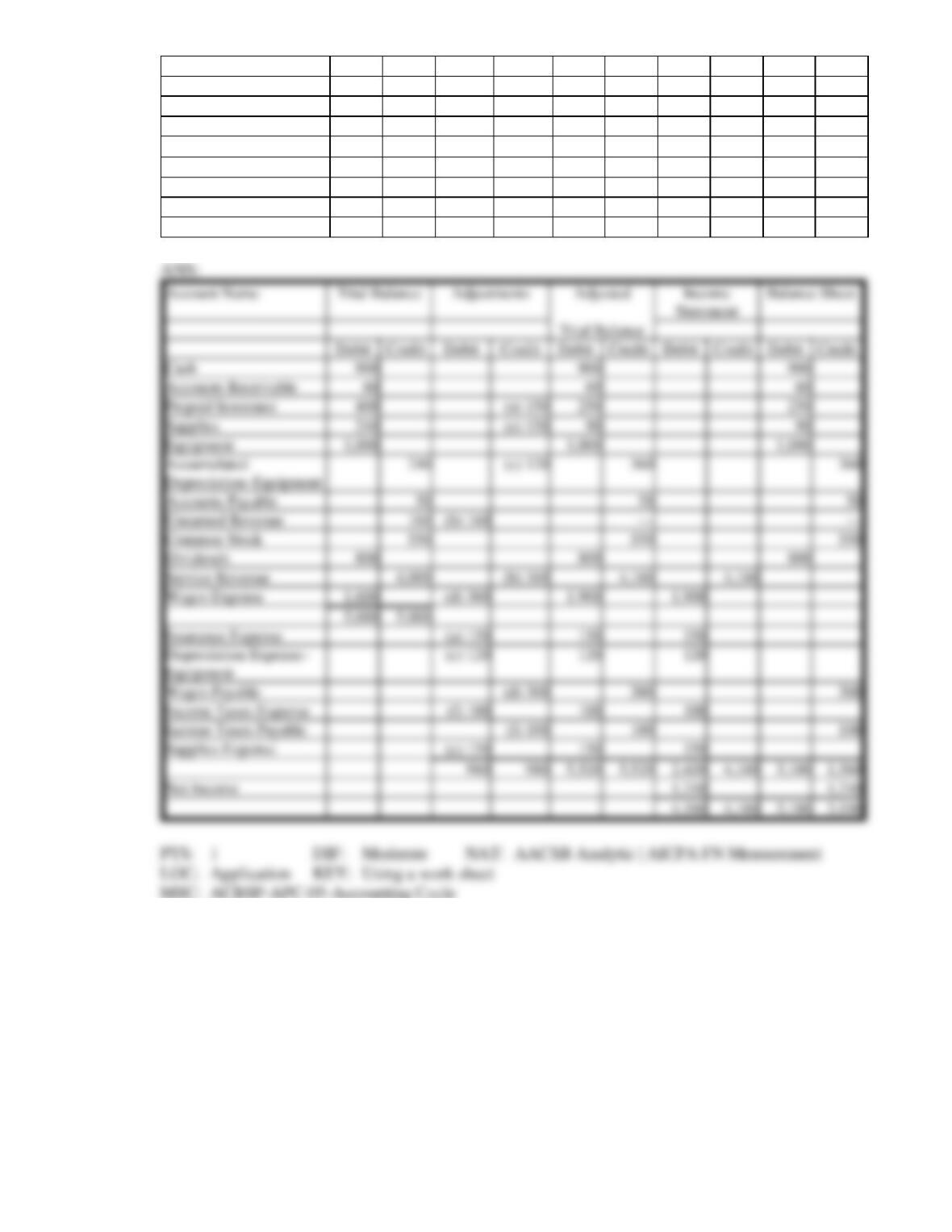
3. Using the following information and the trial balance accounts and balances on the work sheet
provided, complete the work sheet.
a. Expired insurance totals $150.
b. Of the unearned revenue, all has been earned by the balance sheet date.
c. Estimated depreciation of equipment is $120.
d. Accrued wages equal $300.
e. Unused supplies on hand are $90.
f. Estimated income taxes are $100.
Account Name
Trial Balance
Adjustments
Adjusted
Income
Statement
Balance Sheet
Trial Balance
Debit
Credit
Debit
Credit
Debit
Credit
Debit
Credit
Debit
Credit
Cash
900
Accounts Receivable
60
Prepaid Insurance
400
Supplies
240
Equipment
1,000
Accumulated
Depreciation–Equipment
240
Accounts Payable
50
Unearned Revenue
160
Common Stock
550
Dividends
800
Service Revenue
4,000
Wages Expense
1,600
5,000
5,000
4. Using the following information and the trial balance accounts and balances on the work sheet
provided, complete the work sheet.
a. Expired insurance totals $32.
b. Of the unearned revenue, all has been earned by the balance sheet date.
c. Estimated depreciation of equipment is $24.
d. Accrued wages equal $16.
e. Unused supplies on hand are $16.
f. Estimated income taxes are $8.