
COMPREHENSIVE EXAMINATION E
PART 5
(Chapters 18-21)
Approximate
Problem Topic Time
E-I Long-Term Contracts. 15 min.
E-II Installment Sales Method. 20 min.
E-III Deferred Income Taxes. 25 min.
E-IV Pensions. 15 min.
E-V Leases. 25 min.
100 min.

Test Bank for Intermediate Accounting, Fifteenth Edition
E – 2
Problem E-I — Long-Term Contracts.
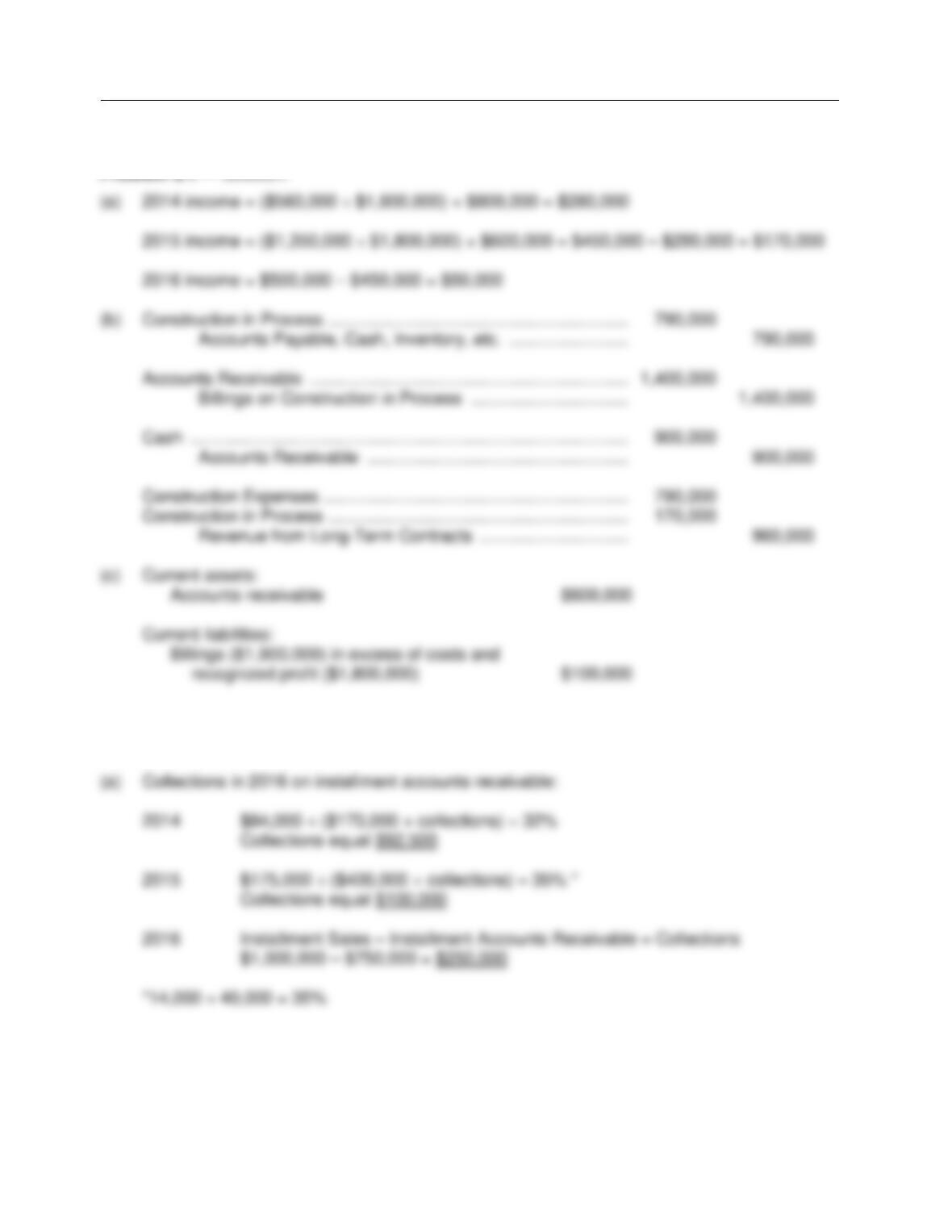
Edwards Company contracted on 4/1/14 to construct a building for $2,400,000. The project was
completed in 2016. Additional data follow:
2014 2015 2016
Costs incurred to date $ 560,000 $1,350,000 $1,900,000
Estimated cost to complete 1,040,000 450,000 —
Billings to date 500,000 1,900,000 2,400,000
Collections to date 400,000 1,300,000 2,200,000
Instructions
(a) Calculate the income recognized by Edwards under the percentage–of-completion method of
accounting in each of the years 2014, 2015, and 2016.
(b) Prepare all necessary entries for the year 2015.
(c) Present the balance sheet disclosures at December 31, 2015. Proper headings or
subheadings must be indicated.
Problem E-II — Installment Sales Method.
Garber, Inc. accounts for all sales of its merchandise on the installment basis. Following is the
unadjusted trial balance at 12/31/16:
Cash $ 64,200
Installment Accounts Receivable—2014 170,000
Installment Accounts Receivable—2015 400,000
Installment Accounts Receivable—2016 750,000
Inventory, 1/1/16 103,000
Repossessed Merchandise 22,000
Accounts Payable $ 136,000
Deferred Gross Profit—2014 84,000
Deferred Gross Profit—2015 175,000
Common Stock 600,000
Retained Earnings 406,200
Installment Sales 1,000,000
Purchases 738,000
Loss on Repossession 4,000
Operating Expenses 150,000
$2,401,200 $2,401,200
Additional Data: 2014 Gross Profit Rate = 32%; Inventory 12/31/16 = $159,000;
Repossessed merchandise 12/31/16 = $14,000;
Merchandise sold in 2015 was repossessed in 2016 and the following
entry was prepared (assume correctly):
Deferred Gross Profit—2015 ………………………….. 14,000
Repossessed Merchandise …………………………….. 22,000
Loss on Repossession ………………………………….. 4,000
Installment Accounts Receivable—2015 … 40,000

Comprehensive Examination E
E – 3
Problem E-II (cont.)
Instructions
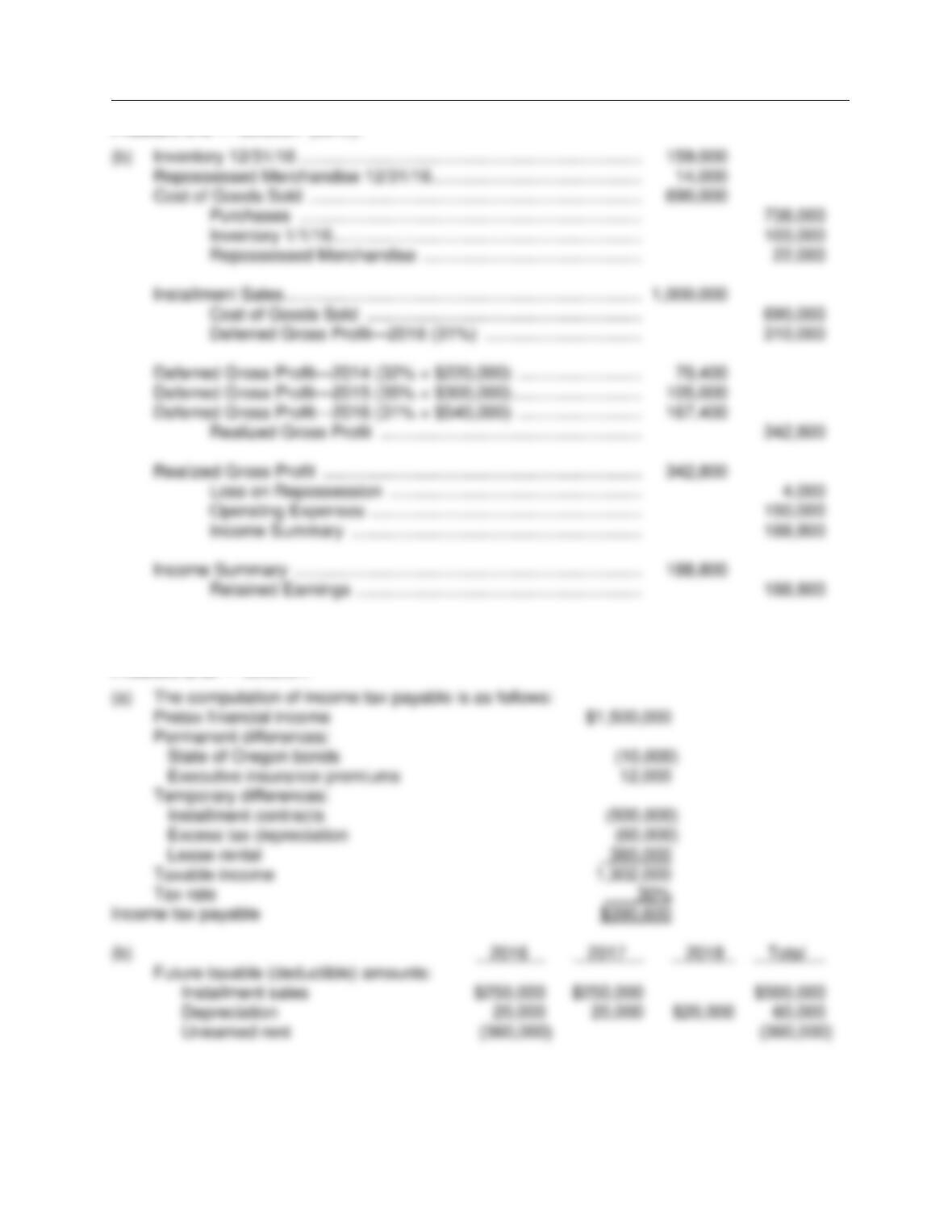
(a) Determine collections during 2016 on Installment A/R for each of the years 2014, 2015, and
2016.
(b) Without prejudice to your answer in Part (a), assume that total collections on Installment
Accounts Receivable during 2016 were $1,060,000; $220,000 from 2014, $300,000 from
2015, and $540,000 from 2016. Prepare all necessary adjusting and closing entries at
12/31/16.
Problem E-III — Deferred Income Taxes.
In 2015, the initial year of its existence, Dexter Company’s accountant, in preparing both the
income statement and the tax return, developed the following list of items causing differences
between accounting and taxable income:
1. The company sells its merchandise on an installment contract basis. In 2015, Dexter elected,
for tax purposes, to report the gross profit from these sales in the years the receivables are
collected. However, for financial statement purposes, the company recognized all the gross
profit in 2015. These procedures created a $500,000 difference between book and taxable
incomes. The future collection of the installment contracts receivables are expected to result
in taxable amounts of $250,000 in each of the next two years. (Note: the company treats
installment contracts receivable as a current asset on its balance sheet.)
2. The company has also chosen to depreciate all of its depreciable assets on an accelerated
basis for tax purposes but on a straight-line basis for accounting purposes. These procedures
resulted in $60,000 excess depreciation for tax purposes over accounting depreciation. The
temporary difference due to excess tax depreciation will reverse equally over the three year
period from 2016-2018.
3. Dexter leased some of its property to Baker Company on July 1, 2015. The lease was to
expire on July 1, 2017 and the monthly rentals were to be $60,000. Baker, however, paid the
first year’s rent in advance and Dexter reported this entire amount on its tax return. These
procedures resulted in a $360,000 difference between book and taxable incomes. (Note: this
lease was an operating lease and Dexter classified the unearned rent as a current liability on
its balance sheet.)
4. Dexter owns $200,000 of bonds issued by the State of Oregon upon which 5% interest is paid
annually. In 2015, Dexter showed $10,000 of income from the bonds on its income statement
but did not show any of this amount on its tax return. (Note: these bonds are classified as
long-term investments on Dexter’s balance sheet.)
5. In 2015, Dexter insured the lives of its chief executives. The premiums paid amounted to
$12,000 and this amount was shown as an expense on the income statement. However, this
amount was not deducted on the tax return. The company is the beneficiary.

Test Bank for Intermediate Accounting, Fifteenth Edition
E – 4
Problem E-III (cont.)
Instructions
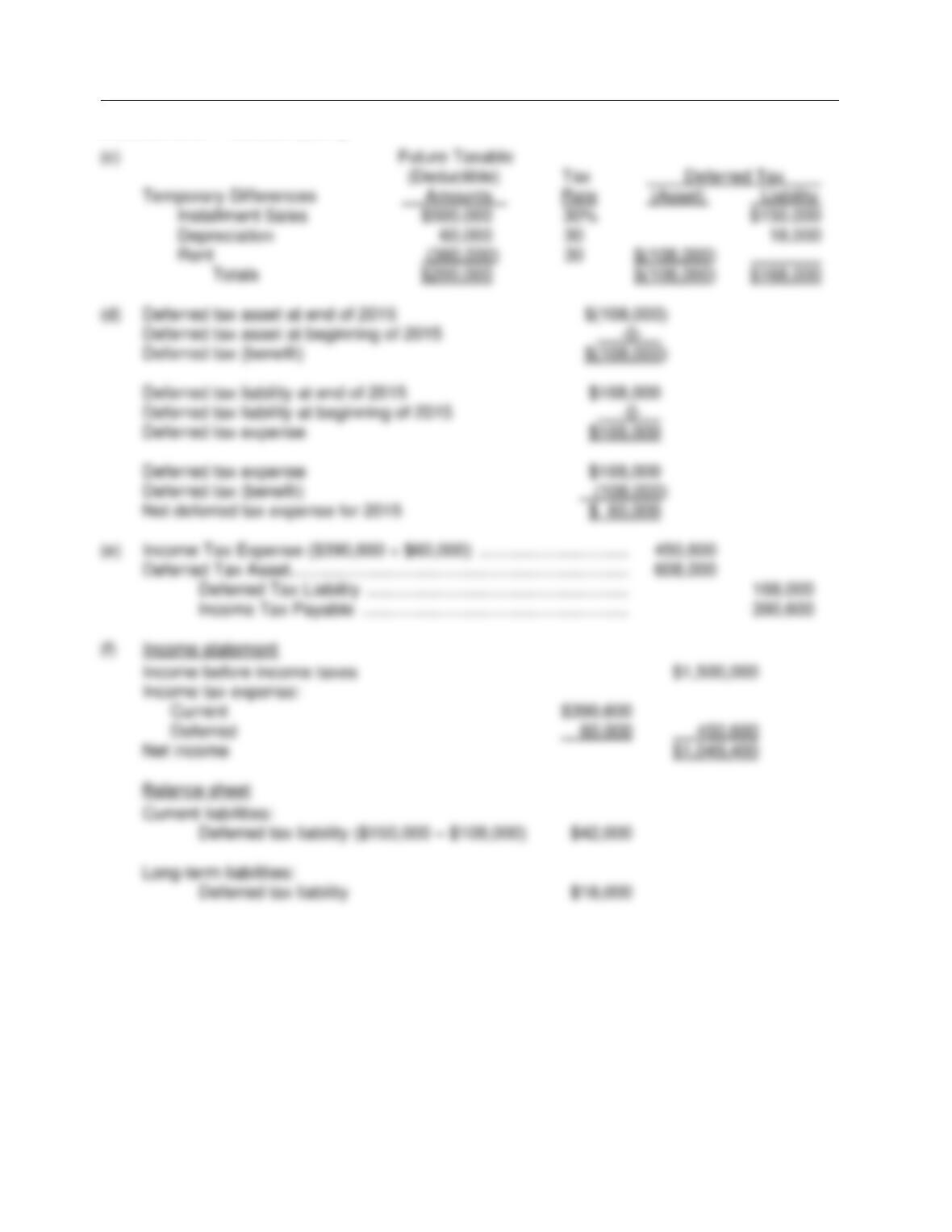
Assuming that the income statement of Dexter Company showed “Income before income taxes”
of $1,500,000; that the enacted tax rates are 30% for all years; and that no other differences
between book and taxable incomes existed, except for those mentioned above:
(a) Compute the income taxes payable.
(b) Prepare a schedule of future taxable and (deductible) amounts at the end of 2015.
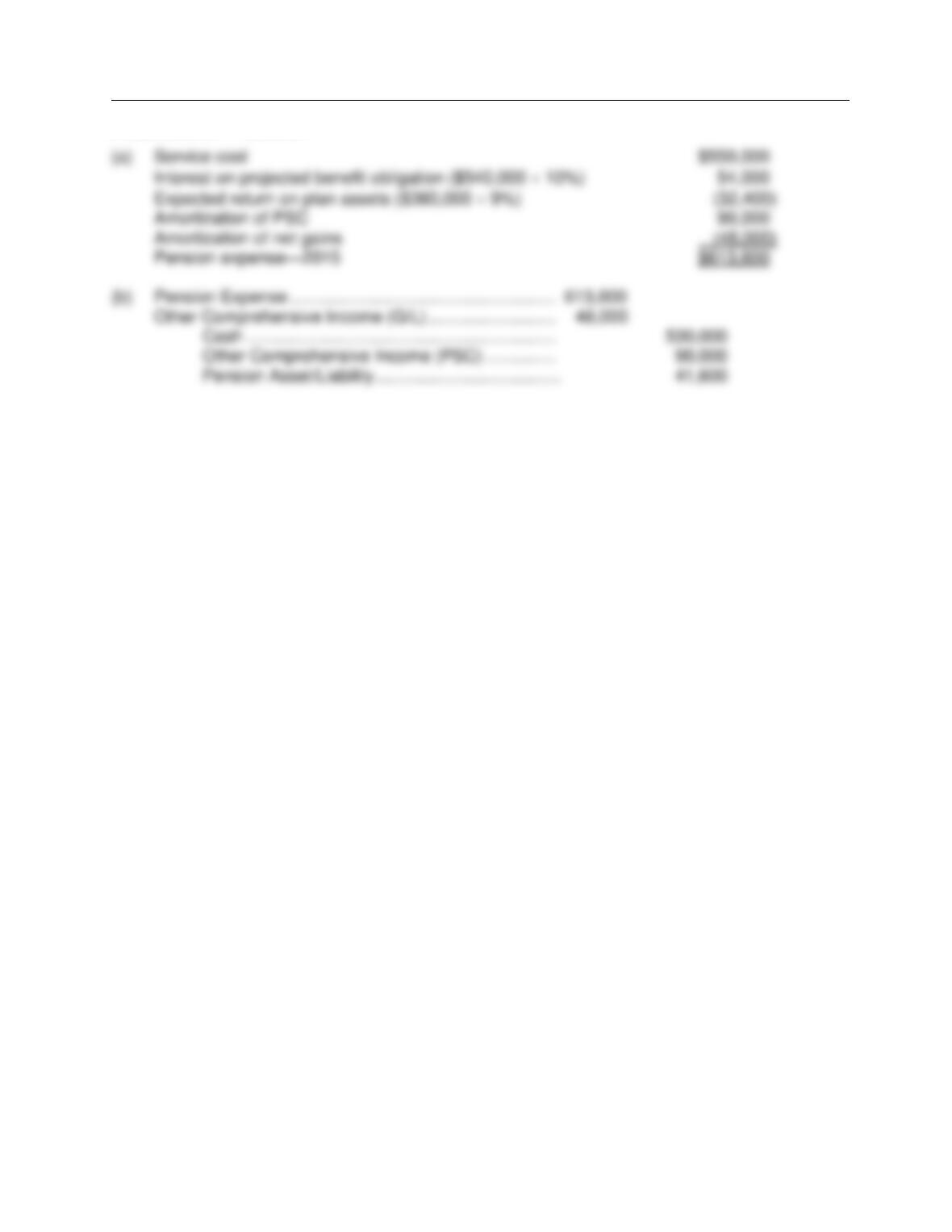
(c) Prepare a schedule of deferred tax (asset) and liability at the end of 2015.
(d) Compute the net deferred tax expense (benefit) for 2015.
(e) Make the journal entry recording income tax expense, income taxes payable, and deferred
income taxes for 2015.
(f) Indicate how income tax expense and any deferred income taxes should be disclosed on
the financial statements under generally accepted accounting principles. Show the amounts
for these items and indicate specifically where they would be disclosed.
Problem E-IV — Pensions.
Presented below is information related to Stage Department Stores, Inc. pension plan for 2015.
Service cost $550,000
Funding contribution for 2015 530,000
Settlement rate used in actuarial computation 10%
Expected return on plan assets 9%
Amortization of PSC (due to benefit increase) 90,000
Amortization of unrecognized net gains 48,000
Projected benefit obligation (at beginning of period) 540,000
Fair value of plan assts (at beginning of period) 360,000
Instructions
(a) Compute the amount of pension expense to be reported for 2015. (Show computations.)
(b) Prepare the journal entry to record pension expense and the employer’s contribution for
2015.

Comprehensive Examination E
E – 5
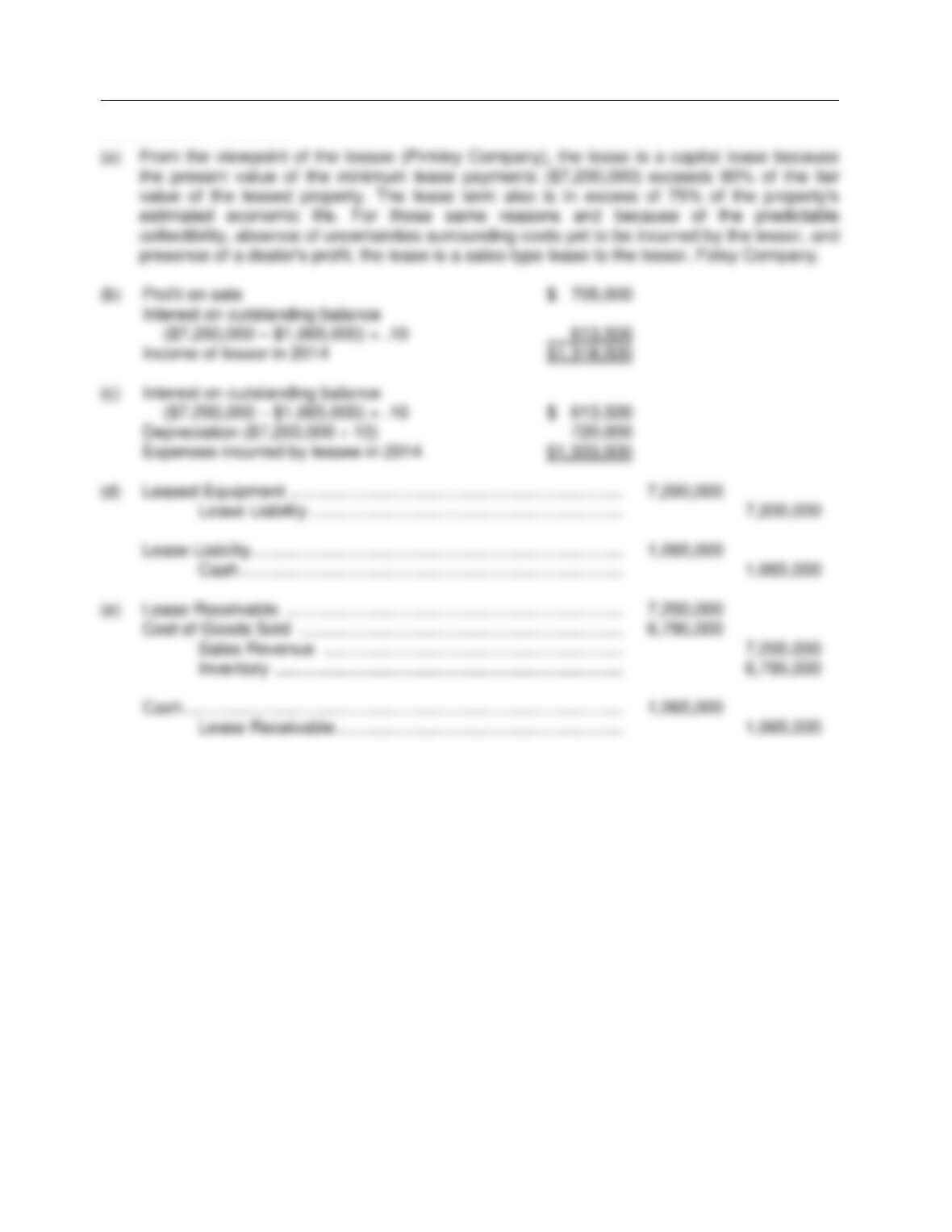
Problem E-V — Leases.
On January 1, 2015, Foley Company (as lessor) entered into a noncancelable lease agreement
with Pinkley Company for machinery which was carried on the accounting records of Foley at
$6,795,000 and had a market value of $7,200,000. Minimum lease payments under the lease
agreement which expires on December 31, 2024, total $10,650,000. Payments of $1,065,000 are
due each January 1. The first payment was made on January 1, 2015 when the lease agreement
was finalized. The interest rate of 10% which was stipulated in the lease agreement is the implicit
rate set by the lessor. The effective interest method of amortization is being used. Pinkley
expects the machine to have a ten-year life with no salvage value, and be depreciated on a
straight-line basis. Collectibility of the rentals is reasonably predictable, and there are no
important uncertainties surrounding the costs yet to be incurred by the lessor.
Instructions
(a) From the lessee’s viewpoint, what kind of lease is the above agreement? From the lessor’s
viewpoint, what kind of lease is the above agreement?
(b) What should be the income before income taxes derived by Foley from the lease for the
year ended December 31, 2015?
(c) Ignoring income taxes, what should be the expenses incurred by Pinkley from this lease for
the year ended December 31, 2015?
(d) What journal entries should be recorded by Pinkley Company on January 1, 2015?
(e) What journal entries should be recorded by Foley Company on January 1, 2015?
Test Bank for Intermediate Accounting, Fifteenth Edition
E – 6
Solutions — Comprehensive Examination E
Problem E-I — Solution.
Problem E-II — Solution.
Comprehensive Examination E
E – 7
Problem E-II — Solution (cont.).
Problem E-III — Solution.
Test Bank for Intermediate Accounting, Fifteenth Edition
E – 8
Problem E-III — Solution (cont.).
Comprehensive Examination E
E – 9
Problem E-IV — Solution.
Test Bank for Intermediate Accounting, Fifteenth Edition
E – 10
Problem E-V — Solution.