COMPREHENSIVE EXAMINATION B
PART 2
(Chapters 7–9)
Problem B-I — Multiple Choice — Cash and Receivables.
Choose the best answer for each of the following questions and enter the identifying
letter in the space provided.
____ 1. When should the loss on an uncollectible account receivable be recorded as
an expense for accrual accounting purposes?
a. When it is determined that an account cannot be collected.
b. In the same period in which the sale on account occurs.
c. When the balance is past due for more than 3 months.
d. When a lawyer indicates that collection efforts would cost more than the
account is worth.
____ 2. How should unearned discounts, finance charges, and interest included in the
face amount of installment accounts receivable be presented in the balance
sheet?
a. As a current liability.
b. As a deduction from the related installment accounts receivable.
c. Within the net amount of installment accounts receivable.
d. As an addition to the related installment accounts receivable.
____ 3. Durler Company’s account balances at December 31 for Accounts
Receivable and the related Allowance for Doubtful Accounts are $1,200,000
and $19,500, respectively. From an analysis of accounts receivable, it is
estimated that $42,000 of the December 31 receivables will be uncollectible.
After adjustment for the above facts, the net realizable value of accounts
receivable would be
a. $1,200,000.
b. $1,180,500.
c. $1,138,500.
d. $1,158,000.
____ 4. Which group of items listed below should be included in the cash account?
a. Silver coins, postage stamps, demand deposits, personal checks.
b. Promissory notes, demand deposits, money orders, silver coins.
c. Money orders, postdated checks, personal checks, time deposits.
d. Silver coins, money orders, demand deposits, personal checks.
____ 5. Which of the following methods of accounting for uncollectible accounts does
not properly match costs with revenues?
a. Percentage of sales
b. Percentage of receivables
c. Direct write-off
d. Aging schedule
Comprehensive Exam B
B-2
____ 6. Certain information relative to the 2014 operations of Ball Co. follows:
Accounts receivable, January 1, 2014 $96,000
Accounts receivable collected during 2014 184,000
Cash sales during 2014 48,000
Inventory, January 1, 2014 72,000
Inventory, December 31, 2014 66,000
Purchases of inventory during 2014 160,000
Gross profit on sales 54,000
What is Ball’s accounts receivable balance at December 31, 2014?
a. $72,000.
b. $84,000.
c. $96,000.
d. $132,000.
Problem B-II — Lower of Cost or Market
Presented below is data relative to the 12/31/14 inventory of Lance Company:
Number Units Original Cost Total Current
Item In Inventory Per Unit Original Cost Replacement Cost
A 5,000 $1.09 $5,450 $1.08
B 5,000 1.30 6,500 1.25
C 5,000 1.50 7,500 1.05
D 5,000 1.60 8,000 1.65
E 5,000 1.80 9,000 1.50
Total 25,000 $36,450
Appropriate
Upper Lower Inventory
Limit Limit Designated Valuation
Item (“Ceiling”) (“Floor”) Market (Totals)
A
B
C
D
E
Total
Additional Data:
Selling price is $2.00/unit for all items. Disposal costs amount to 10% of selling price and
a “normal” profit is 35% of selling price.
Instructions
Complete the last four columns above.

Comprehensive Exam B
B-3
Problem B-III — Notes Receivable.
On December 31, 2013 Berry Corporation sold some of its product to Flynn Company,
accepting a 3%, four-year promissory note having a maturity value of $800,000 (interest
payable annually on December 31). Berry Corporation pays 6% for its borrowed funds.
Flynn Company, however, pays 8% for its borrowed funds. The product sold is carried
on the books of Berry at a manufactured cost of $495,000. Assume Berry uses a
perpetual inventory system.
Instructions
(a) Prepare the journal entries to record the transaction on the books of Berry
Corporation at December 31, 2013. (Assume that the effective interest method is
used. Use the interest tables below and round to the nearest dollar.)
(b) Make all appropriate entries for 2014 on the books of Berry Corporation.
(c) Make all appropriate entries for 2015 on the books of Berry Corporation.
For Use on Problem B-III Table 1
Future Value of 1
Periods 2% 3% 4% 6% 8%
1 1.02000 1.03000 1.04000 1.06000 1.08000
2 1.04040 1.06090 1.08160 1.12360 1.16640
3 1.06121 1.09273 1.12486 1.19102 1.25971
4 1.08243 1.12551 1.16986 1.26248 1.36049
5 1.10408 1.15927 1.21665 1.33823 1.46933
Table 2
Present Value of 1
Periods 2% 3% 4% 6% 8%
1 0.98039 0.97087 0.96154 0.94340 0.92593
2 0.96117 0.94260 0.92456 0.89000 0.85734
3 0.94232 0.91514 0.88900 0.83962 0.79383
4 0.92385 0.88849 0.85480 0.79209 0.73503
5 0.90573 0.86261 0.82193 0.74726 0.68058
Table 3
Future Value of Ordinary Annuity of 1
Periodic Rents 2% 3% 4% 6% 8%
1 1.00000 1.00000 1.00000 1.00000 1.00000
2 2.02000 2.03000 2.04000 2.06000 2.08000
3 3.06040 3.09090 3.12160 3.18360 3.24640
4 4.12161 4.18363 4.24646 4.37462 4.50611
5 5.20404 5.30914 5.41632 5.63709 5.86660

Comprehensive Exam B
B-4
Table 4
Present Value of Ordinary Annuity of 1
Periodic Rents 2% 3% 4% 6% 8%
1 0.98039 0.97087 0.96154 0.94340 0.92593
2 1.94156 1.91347 1.88609 1.83339 1.78326
3 2.88388 2.82861 2.77509 2.67301 2.57710
4 3.80773 3.71710 3.62990 3.46511 3.31213
5 4.71346 4.57971 4.45182 4.21236 3.99271

Comprehensive Exam B
B-5
Problem B-IV — FIFO vs. LIFO.
In comparing and contrasting FIFO vs. LIFO inventory procedures, the following listing
was developed. You are to complete the tabulation with an answer of “YES” or “NO” as
demonstrated by the first item. Any combination of yes-no answers is possible in each
situation.
FIFO LIFO
0. Usually matches the actual physical flow of goods. Yes No _
1. Emphasizes the income statement in that it matches the more
recent costs with revenue. _____ _____
2. Defers tax payments in times of rising prices. _____ _____
3. Possibility of liquidating the base may be a significant negative
aspect. _____ _____
4. Will probably not be adopted if prices are expected to decline. _____ _____
5. Emphasizes the balance sheet in that the more recent costs
are contained in the inventory account. _____ _____
6. Can use price indexes to cost layers. _____ _____
7. Switching to this method could cause problems in the equity
markets, with loan covenants, etc. _____ _____
8. Income figure more accurately reflects cash available for
dividends, investments, etc. _____ _____
9. Tends to smooth income in periods of fluctuating prices. _____ _____
10. Income figure is more “real” in that it doesn’t contain “paper
profits.” _____ _____
11. A change to this method must be justified (i.e., to the auditor)
other than solely on the basis of the tax effect. _____ _____
Comprehensive Exam B
B-6
12. Perpetual inventory results may be different from periodic
inventory results. _____ _____
13. Is acceptable to the IRS (i.e., for income tax purposes). _____ _____
14. Gives lower profits when prices rise. _____ _____
15. In a period of rising prices has an adverse effect on assets,
working capital, and stockholders’ equity. _____ _____
16. Quick inventory turnover may have somewhat of a mitigating
effect on some of the method’s claimed disadvantages. _____ _____
17. Improves cash flow in periods of rising prices. _____ _____
18. If used for tax purposes, it must be used for financial reporting
purposes. _____ _____
19. Somewhat opens door for profit manipulation and may cause
poor purchase decisions. _____ _____
20. Is a current value, rather than a historical cost, valuation method. _____ _____
Problem B-V — Year-end Inventory Cutoff.
Abel Company’s business year ends on December 31. Listed below are purchase
transactions which occurred during the last few days of 2014 or during the first few days
of 2015. The inventory, determined by physical count, was taken after the close of
business on December 31, 2014. The only adjusting entry recorded to date has been to
enter the December 31 physical inventory on the books and to remove the beginning
inventory.
Instructions
(a) On the accompanying chart, indicate the effect of each of these transactions on the
ending inventory and on reported net income for 2014, by writing the words
overstated, understated, or no effect in the appropriate column. Both columns must
be answered for each transaction.
(b) Prepare all necessary correcting entries for 2014.
(c) Indicate which of the correcting entries must be reversed in 2013 by preparing the
necessary reversing entries.

Comprehensive Exam B
B-7
12/31/14
Physical 2014
Inventory Income
1. An invoice for $7,000, terms f.o.b. shipping point, was received
and entered December 30. The invoice shows that the
merchandise was shipped December 29, and the receiving
report indicates the merchandise was received January 2. ______ _______
2. An invoice for $300, terms f.o.b. shipping point, was received
and entered December 30. The invoice shows that
merchandise was shipped December 29, and the receiving
report shows the merchandise was received December 31. ______ _______
3. An invoice for $4,000, terms f.o.b. shipping point, was
received and entered January 2. The invoice shows the
merchandise was shipped December 30, and the receiving
report indicates the merchandise was received December 31. ______ _______
4. An invoice for $800, terms f.o.b. destination, was received and
entered December 30. The receiving report shows the
merchandise was received January 2. ______ _______
5. An invoice for $500, terms f.o.b. destination, was received and
entered December 29. The receiving report indicates that the
merchandise was received December 31. ______ _______
6. An invoice for $1,500, terms f.o.b. destination, was received
and entered January 2. The receiving report indicates the
merchandise was received December 31. ______ _______
7. Merchandise costing $15,000 and with a selling price of
$18,000 was on consignment to Maris Distributing Company
and was on that company‘s premises on December 31. No
entry has been made for the consignment. ______ _______

Comprehensive Exam B
B-8
Problem B-VI — Conventional and LIFO Retail Method.*
*Note to Instructor. Part B is based on Appendix 9-A.
A. Landmark Book Store uses the conventional retail method.
Instructions
Given the following data, prepare a neat, labeled schedule showing the computation of
the cost of inventory on hand at 12/31/14.
Cost Retail
Inventory 1/1/14 $ 28,900 $ 40,000
Purchases 366,600 610,000
Purchases Returns 9,000 20,000
Purchase Discounts 7,000
Sales (Gross) 605,000
Sales Returns 15,000
Employee Discounts 5,000
Freight-in 23,500
Freight-out 50,000
Loss from Breakage 2,500
Markups 38,000
Markup Cancellations 18,000
Markdowns 13,500
Markdown Cancellations 8,500
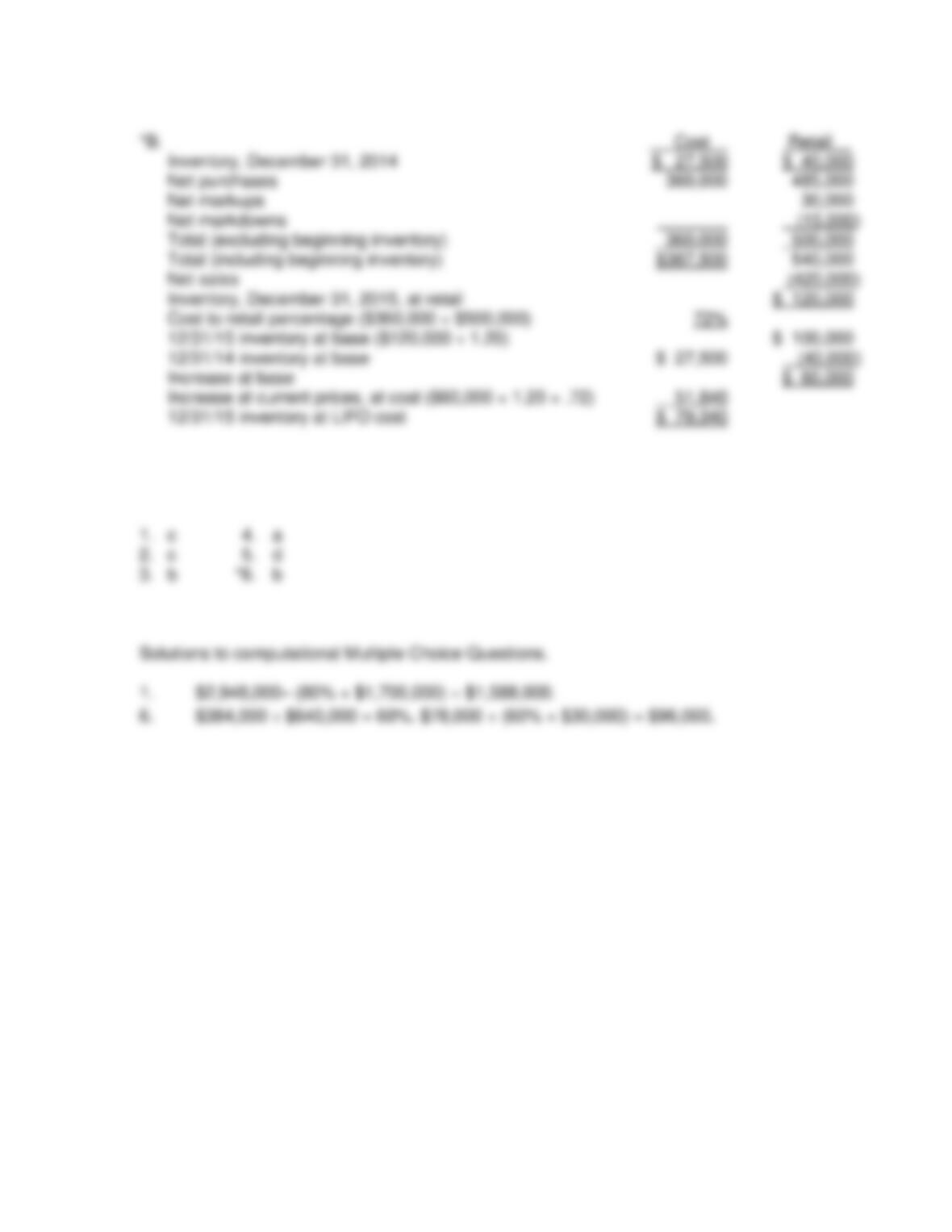
B. Landmark Book Store has decided to switch to the LIFO retail method for the period
beginning 1/1/15.
Instructions
Prepare a schedule showing the computation of the 12/31/15 inventory under the LIFO
retail method adjusted for price level changes (i.e., dollar-value LIFO Retail.) Without
prejudice to your answer in requirement A above, assume that the 12/31/14 inventory
computed under the LIFO Retail method was $40,000 and $27,500 at retail and cost,
respectively, for purposes of this requirement. Data for 2015 follows:
Cost Retail
Purchases (net) $360,000 $485,000
Sales (net) 420,000
Markups (net) 30,000
Markdowns (net) 15,000
2014 Price Index 100
2015 Price Index 120
Comprehensive Exam B
B-9
Problem B-VII — Multiple Choice — Inventory
For each of the following questions, select the letter of the statement which best answers
the question and write it on the line to the left of the question.
____ 1. Wade Company estimates the cost of its physical inventory at March 31 for
use in an interim financial statement. The rate of markup on cost is 25%. The
following account balances are available:
Inventory, March 1 $2,000,000
Purchases during March 1,000,000
Purchase returns 52,000
Sales during March 1,700,000
The estimate of the cost of inventory at March 31 would be
a. $1,248,000.
b. $1,360,000.
c. $1,588,000.
d. $1,673,000.
____ 2. Most methods of pricing inventories are in accord with generally accepted
accounting principles and generally are permissible for income tax purposes.
The method that must be used for financial reporting purposes if used for tax
purposes is
a. moving average.
b. weighted average.
c. LIFO.
d. FIFO.
____ 3. A company has been using the FIFO cost method of inventory valuation since
it was started 10 years ago. Its 2014 ending inventory was $180,000, but it
would have been $130,000 if LIFO had been used. Thus, if LIFO had been
used, this company’s income before taxes would have been
a. $50,000 less in 2014.
b. $50,000 less over the 10-year period.
c. $50,000 greater over the 10-year period.
d. $50,000 greater in 2014.
____ 4. Why are inventories included in the computation of net income?
a. To determine cost of goods sold.
b. To determine sales revenue.
c. To determine merchandise returns.
d. Inventories are not included in the computation of net income.
____ 5. On December 31, 2014, Hill Company, which sells only one product, adopted
the periodic last-in, first-out method of inventory valuation. The inventory was
valued at $40,000 on the December 31, 2014 balance sheet. The number of
items in its inventory remained constant during 2015. The December 31,
2015 inventory valuation would be
a. less than $40,000 if prices were steadily decreasing.
b. less than $40,000 if prices were steadily increasing.
c. greater than $40,000 if prices were steadily increasing.
d. $40,000 regardless of any price changes.

Comprehensive Exam B
B-10
____ *6. Kramer Company values its inventory by using the retail method (LIFO basis,
stable prices). The following information is available for the year 2014.
Cost Retail
Beginning inventory $ 78,000 $140,000
Purchases 368,000 628,000
Freight-in 16,000
Markups (net) — 18,000
Markdowns (net) — 6,000
Sales revenue 610,000
At what amount would Kramer Company report its ending inventory?
a. $95,700.
b. $96,000.
c. $100,300.
d. $102,000.
Comprehensive Exam B
B-11
Solutions — Comprehensive Examination B
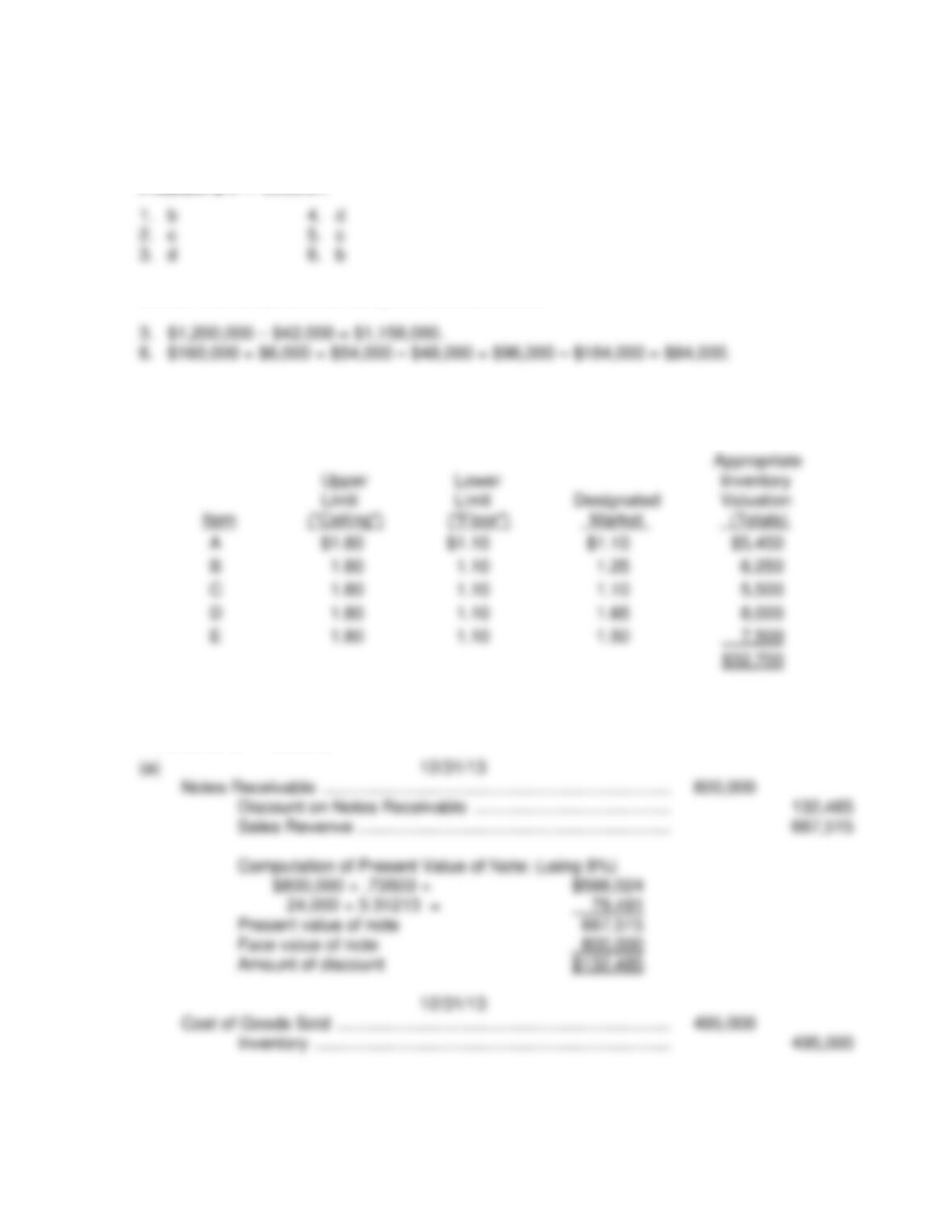
Problem B-I — Solution.
Solutions to computational Multiple Choice Questions.
Problem B-II — Solution.
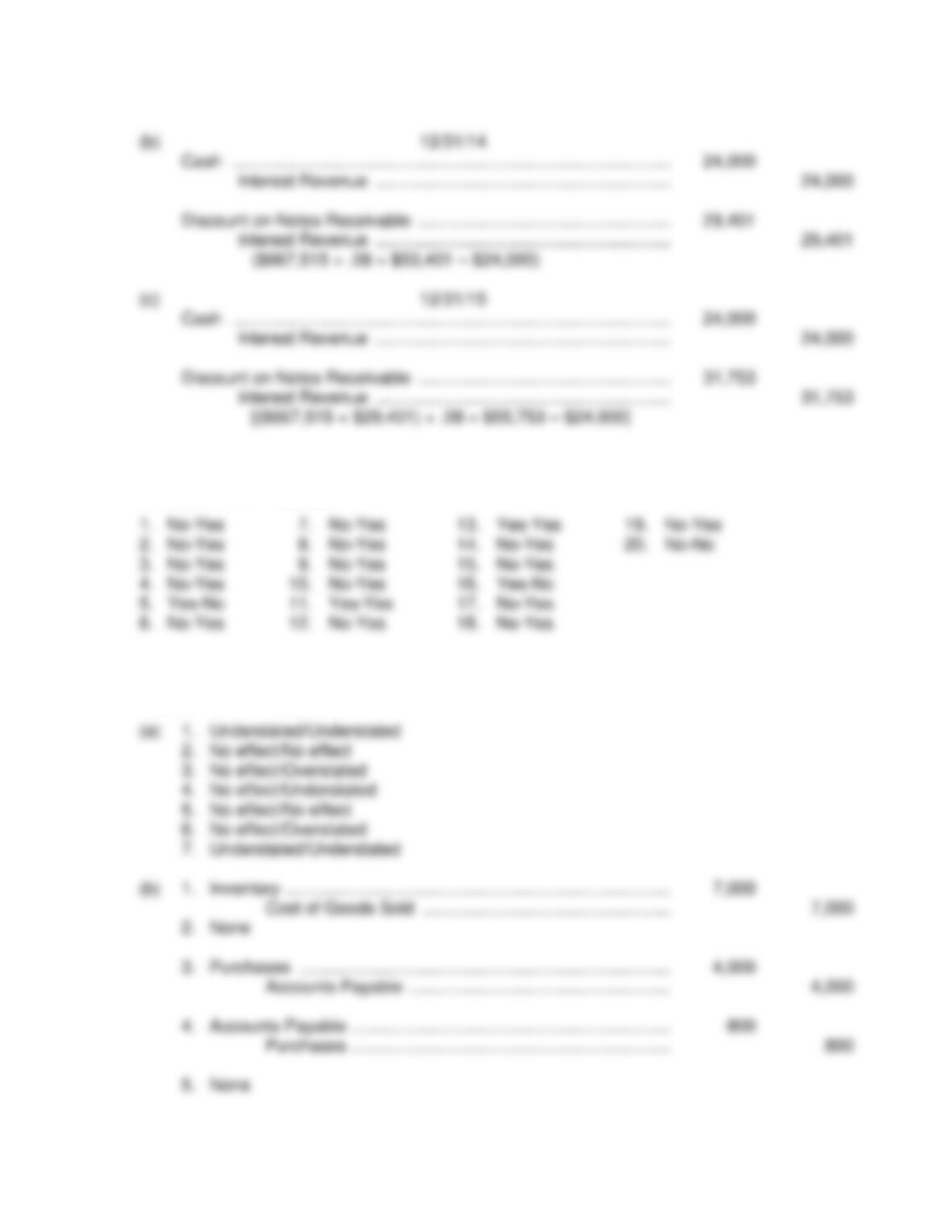
Problem B-III — Solution.
Comprehensive Exam B
B-12
Problem B-IV — Solution.
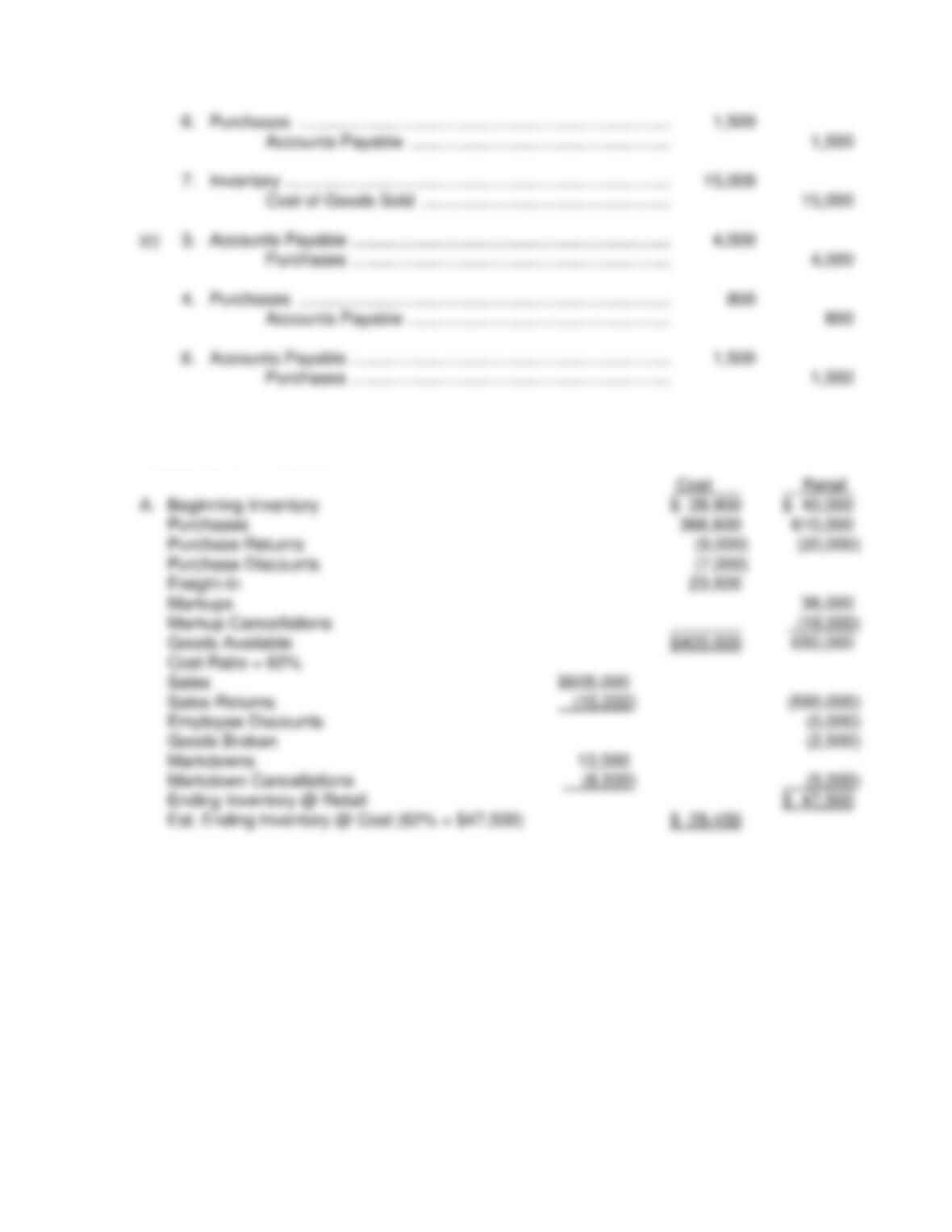
Problem B-V — Solution.
Comprehensive Exam B
B-13
Problem B-VI — Solution.
Comprehensive Exam B
B-14
Problem B-VII — Solution.