b.
down as one goes from left to right.
c.
down and then up as one goes from left to right.
d.
up and down in a zig-zag as one goes from left to right.
49. Accelerated depreciation assumes all of the following except that
a.
asset benefit increases with each year of use.
b.
the asset provides more benefit in the early years.
c.
obsolescence makes an asset less valuable in its later years.
d.
repair expense is less in the early years than in the later years.
50. Which of the following is irrelevant in computing a machine’s depreciation expense using the
production method?
a.
Actual units produced in a given period
b.
Residual value
c.
Estimated useful life in years
d.
Estimated units produced over its life
51. When calculating a partial year’s depreciation, the length of time an asset has been owned usually is
rounded to the nearest month. This rounding practice is justified by the principle or rule of
a.
matching.
b.
materiality.
c.
cost-benefit.
d.
conservatism.
52. Machinery was purchased for $90,000. It had an estimated residual value of $14,000 and has a current
carrying value of $18,000. Its depreciable cost must have been
a.
$72,000.
b.
$76,000.
c.
$64,000.
d.
$58,000.
53. A machine was purchased for $78,000. It has a current carrying value of $36,000 and had a
depreciable cost of $50,000. Its estimated residual value must have been
a.
$36,000.
b.
$28,000.
c.
$22,000.
d.
$42,000.
54. Equipment was purchased for $78,000. It had an estimated residual value of $12,000 and has a current
carrying value of $50,000. Its depreciable cost must have been
a.
$62,000.
b.
$42,000.
c.
$66,000.
d.
$28,000.
55. Office furniture was purchased for $28,000. It had an estimated residual value of $4,000 and has a
current carrying value of $12,000. Its depreciable cost must have been
a.
$30,000.
b.
$18,000.
c.
$24,000.
d.
impossible to determine from the facts given.
56. A truck was purchased for $80,000. It has a current carrying value of $52,000 and had a depreciable
cost of $72,000. Its estimated residual value must have been
a.
$8,000.
b.
$20,000.
c.
$28,000.
d.
impossible to determine from the facts given.
57. A building was purchased for $460,000. It currently has accumulated depreciation of $80,000 and had
a residual value of $100,000. Assuming the use of straight-line depreciation, its estimated useful life
must have been
a.
5 years.
b.
10 years.
c.
14 years.
d.
impossible to determine from the facts given.
58. A delivery truck was purchased for $32,000 two years ago. It has a carrying value of $24,000 and an
estimated residual value of $4,000. Assuming the use of straight-line depreciation, the truck’s
estimated useful life must have been
a.
three and one-half years.
b.
seven years.
c.
14 years.
d.
impossible to determine from the facts given.
59. If an asset costs $70,000, has a residual value of $6,000, and has a useful life of five years, the entry to
record depreciation in the second year, using the double-declining-balance method, is:
a.
Depreciation Expense – Asset 16,100
Cash 16,100
b.
Depreciation Expense – Asset 16,800
Accumulated Depreciation – Asset 16,800
c.
Depreciation Expense – Asset 17,500
Accumulated Depreciation – Asset 17,500
d.
Accumulated Depreciation – Asset 18,200
Depreciation Expense – Asset 18,200
60. A piece of equipment is purchased for $70,000. It has a five-year life and a $10,000 residual value.
Under the straight-line method, what is the asset’s carrying value after three years?
a.
$46,000
b.
$34,000
c.
$24,000
d.
$36,000
61. A truck is purchased for $35,000. It has a five-year life and a $5,000 residual value. Under the
double-declining-balance method, what is the accumulated depreciation after two years?
a.
$19,200
b.
$21,200
c.
$22,400
d.
$25,600
62. Hickman Company purchases a piece of equipment on Jan. 2, 2013, for $60,000. The equipment has
an estimated life of eight years or 50,000 units of production and an estimated residual value of
$6,000. Hickman uses a calendar fiscal year. The entry to record the amount of depreciation for 2013,
using the straight-line method, is:
a.
Depreciation Expense– Equipment 7,500
Cash 7,500
b.
Depreciation Expense — Equipment 6,750
Accumulated Depreciation– Equipment 6,750
c.
Depreciation Expense — Equipment 5,000
Accumulated Depreciation– Equipment 5,000
d.
Accumulated Depreciation – Equipment 4,500
Cash 4,500
63. Hickman Company purchases a piece of equipment on Jan. 2, 2013, for $60,000. The equipment has
an estimated life of eight years or 50,000 units of production and an estimated residual value of
$6,000. Hickman uses a calendar fiscal year. The entry to record the amount of depreciation for 2013,
using the double-declining-balance method, is:
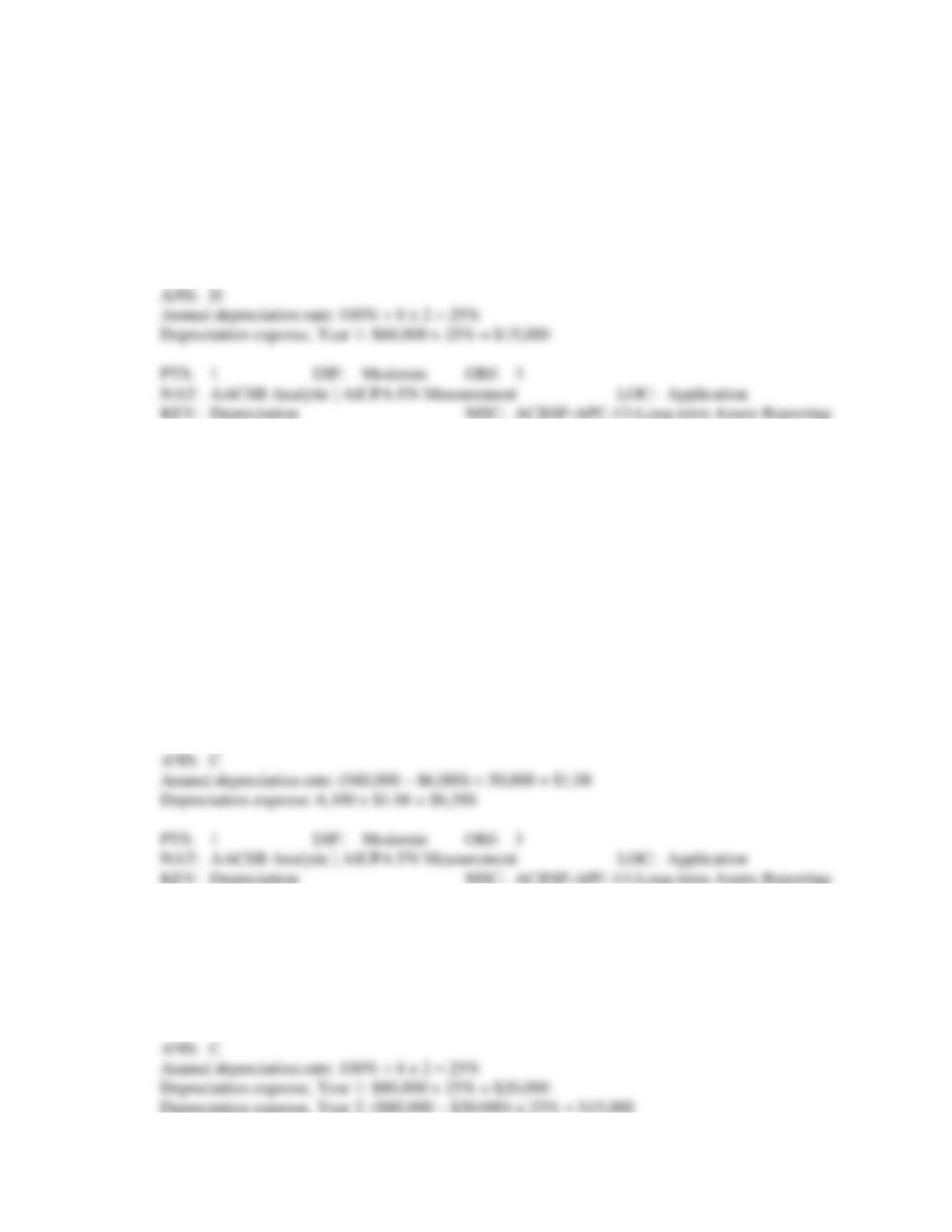
a.
Depreciation Expense– Equipment 9,000
Cash 9,000
b.
Cash 10,000
Accumulated Depreciation– Equipment 10,000
c.
Depreciation Expense — Equipment 11,000
Accumulated Depreciation– Equipment 11,000
d.
Depreciation Expense — Equipment 15,000
Accumulated Depreciation– Equipment 15,000
64. Hickman Company purchases a piece of equipment on Jan. 2, 2013, for $60,000. The equipment has
an estimated life of eight years or 50,000 units of production and an estimated residual value of
$6,000. Hickman uses a calendar fiscal year. The entry to record the amount of depreciation for 2013,
using the production method and assuming that 6,100 units are produced, is:
a.
Equipment 6,100
Accumulated Depreciation– Equipment 6,100
b.
Equipment 6,344
Accumulated Depreciation– Equipment 6,344
c.
Depreciation Expense — Equipment 6,588
Accumulated Depreciation– Equipment 6,588
d.
Depreciation Expense — Equipment 6,832
Accumulated Depreciation– Equipment 6,832
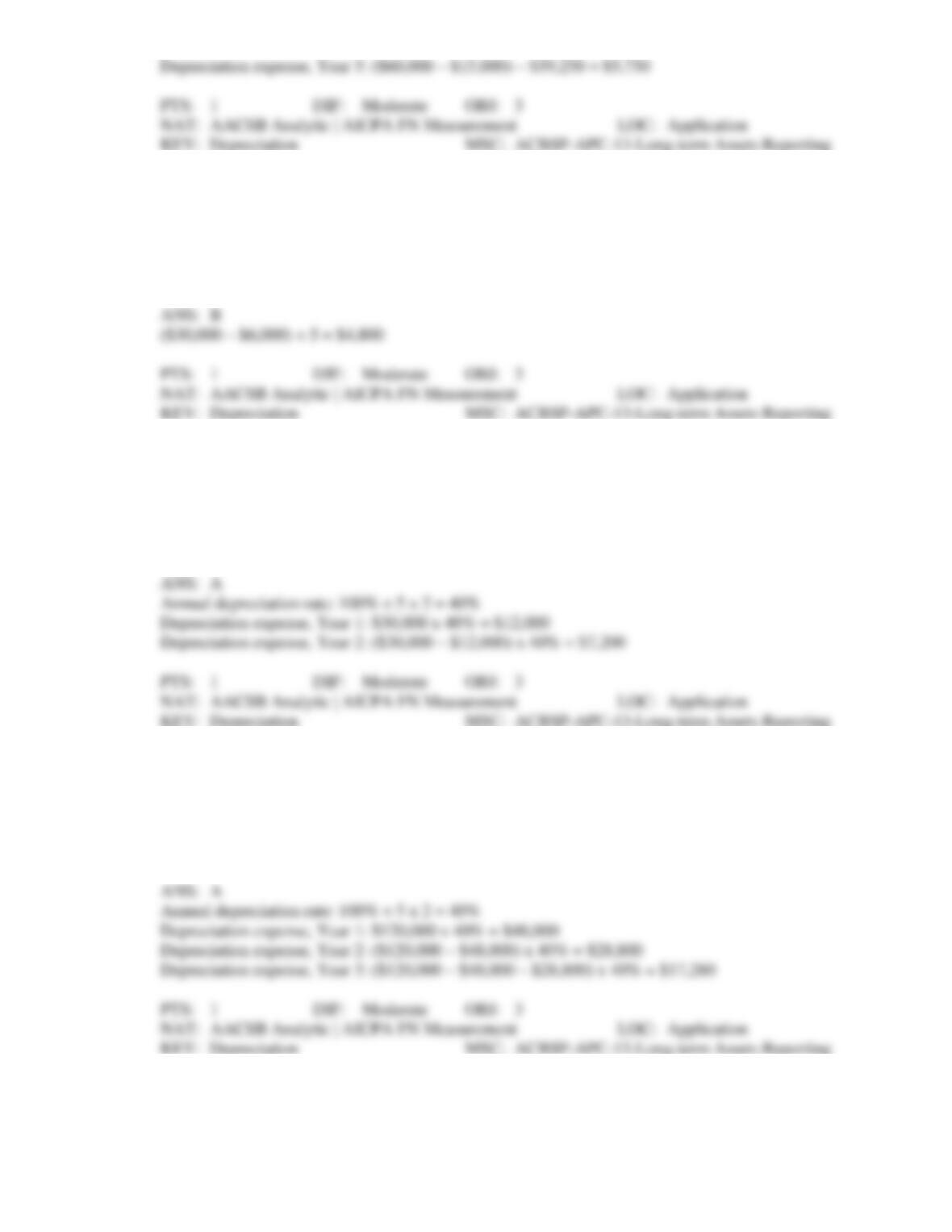
65. Equipment is purchased for $80,000. It has an eight-year useful life and a $39,250 residual value.
Under the double-declining-balance method, what is the depreciation expense for year 3?
a.
$11,250
b.
$5,250
c.
$5,750
d.
$6,250
66. On January 1, a machine with a useful life of five years and a residual value of $6,000 is purchased for
$30,000. What is the depreciation expense in year 3 under straight-line depreciation?
a.
$6,000
b.
$4,800
c.
$14,400
d.
$18,000
67. On January 1, a machine with a useful life of five years and a residual value of $6,000 is purchased for
$30,000. What is the depreciation expense in year 2 using the double-declining-balance method?
a.
$7,200
b.
$9,600
c.
$8,160
d.
$12,000
68. Equipment is purchased for $120,000. It has a five-year useful life and a $20,000 residual value. Under
the double-declining-balance method, what is the depreciation expense for year 3?
a.
$17,280
b.
$15,360
c.
$14,400
d.
$12,800
69. A building was purchased for $500,000. It has accumulated depreciation of $80,000 and had a residual
value of $100,000. Assuming the use of straight-line depreciation, its estimated useful life must have
been
a.
15 years.
b.
ten years.
c.
five years.
d.
impossible to determine from the facts given.
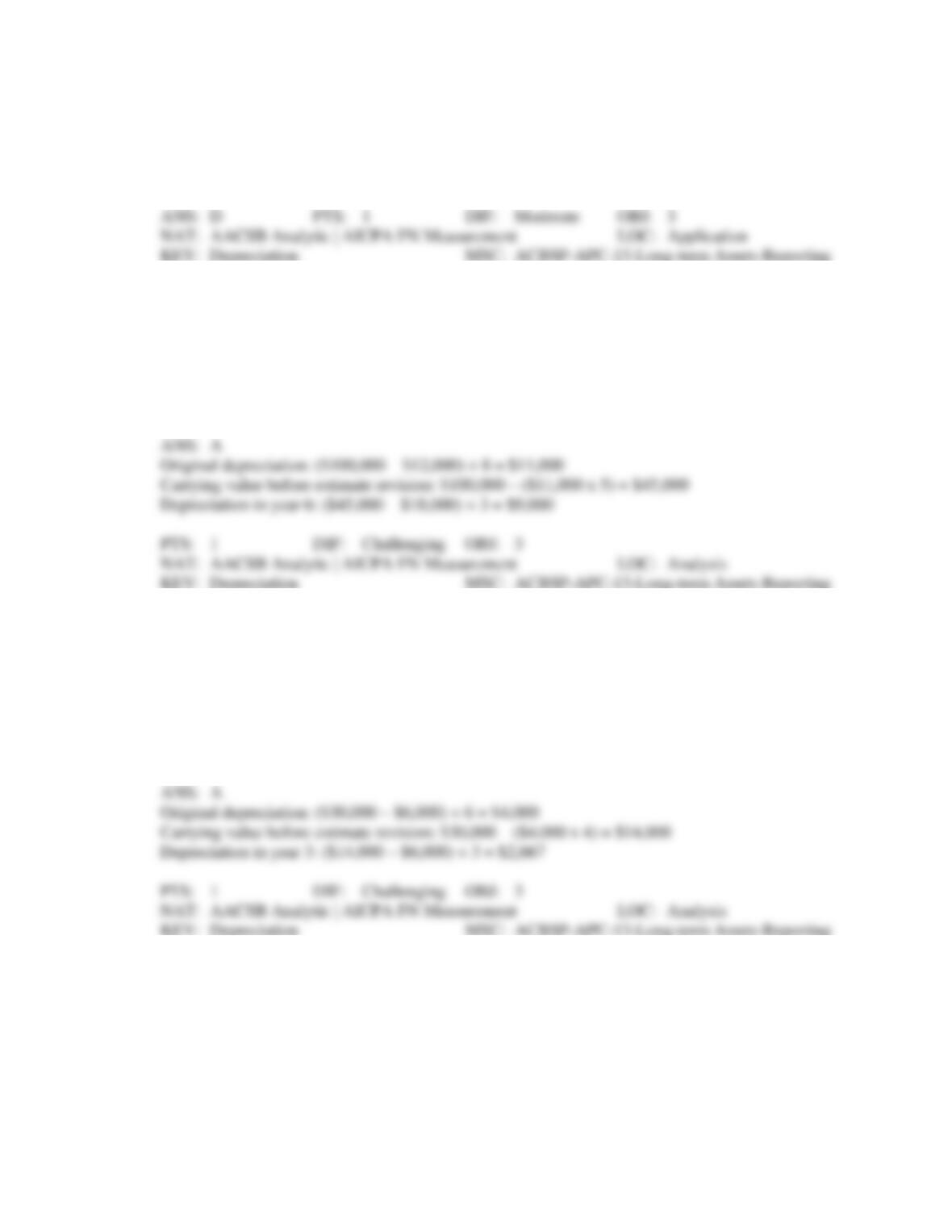
70. McMinn, Inc. purchased equipment for $100,000. The equipment had an estimated useful life of eight
years and an estimated residual value of $12,000. After five years of use, the estimated residual value
is changed to $18,000. Assuming straight-line depreciation, depreciation expense in year 6 would be
a.
$9,000.
b.
$11,000.
c.
$10,250.
d.
$15,000.
71. Danny’s Delivery Service purchased a delivery van for $30,000. The van had an estimated useful life
of six years and an estimated residual value of $6,000. After four years of use, the total estimated
useful life is revised to seven years. Assuming straight-line depreciation, depreciation expense in year
5 would be
a.
$2,667.
b.
$4,667.
c.
$2,000.
d.
$1,143.
72. Equipment costing $60,000 with a residual value of $6,000 and an estimated life of eight years has
been depreciated using the straight-line method for two years. Assuming a revised estimated total life
of five years, the depreciation expense for year 3 would be
a.
$6,750.
b.
$9,000.
c.
$13,500.
d.
$10,800.
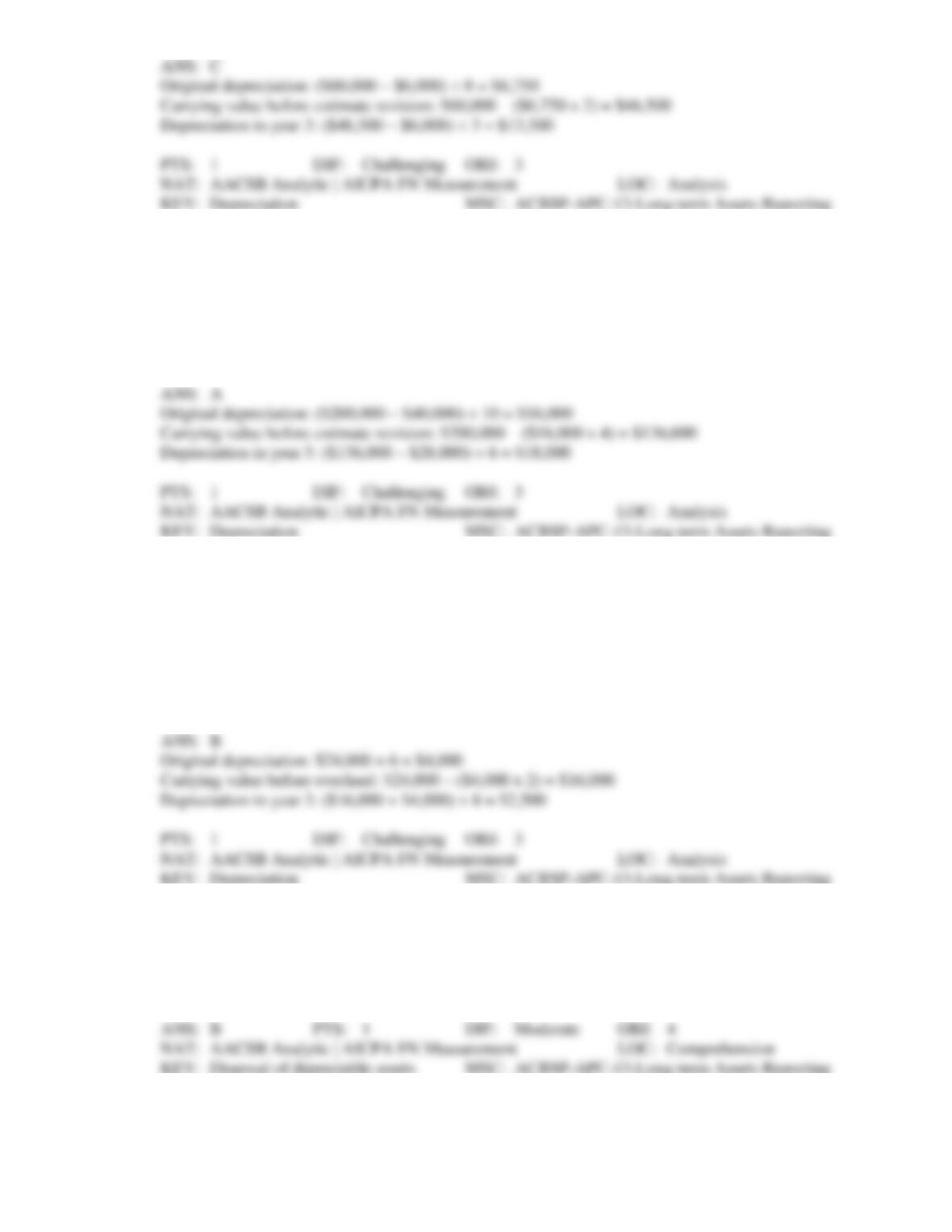
73. An asset was purchased for $200,000. It had an estimated residual value of $40,000 and an estimated
useful life of ten years. After four years of use, the estimated residual value is revised to $28,000.
Assuming straight-line depreciation, depreciation expense in year 5 of use would be
a.
$18,000.
b.
$17,144.
c.
$28,668.
d.
$15,333.
74. A company purchases for $24,000 an asset that has a useful life of six years and no salvage value.
After two years, the company spends $4,000 for a major overhaul that will extend the machine’s useful
life four years beyond the original six. Assuming straight-line depreciation, how much depreciation
should be taken in year 3?
a.
$2,800
b.
$2,500
c.
$2,000
d.
$4,000
75. When an asset is sold, a gain is calculated as the difference between
a.
sale price and the depreciable cost of the asset sold.
b.
sale price and the carrying value of the asset sold.
c.
carrying value and the residual value of the asset sold.
d.
sale price and the original cost of the asset sold.
76. The entry to record the sale of equipment costing $80,000, with accumulated depreciation of $68,000
and sale price of $17,600, is:
a.
Cash 17,600
Accumulated Depreciation— Equipment 68,000
Equipment 80,000
Gain on Sale of Equipment 5,600
b.
Accumulated Depreciation— Equipment 68,000
Equipment 50,400
Gain on Sale of Equipment 17,600
c.
Accumulated Depreciation— Equipment 17,600
Loss on Sale of Equipment 62,400
Equipment 80,000
d.
Accumulated Depreciation— Equipment 68,000
Loss on Sale of Equipment 12,000
Equipment 80,000
77. An asset that cost $24,000 and has accumulated depreciation of $18,000 is sold for $5,200. The entry
to record the sale is:
a.
Accumulated Depreciation— Asset 6,000
Asset 6,000
b.
Cash 5,200
Accumulated Depreciation— Asset 18,000
Loss on Sale of Asset 800
Asset 24,000
c.
Loss on Sale of Asset 18,800
Asset 18,800
d.
Asset 18,000
Accumulated Depreciation— Asset 18,000
78. A truck that cost $24,000 and on which $18,000 of accumulated depreciation has been recorded was
disposed of on January 1. If the truck was discarded as having no value, the entry to record this event
is:
a.
Truck 24,000
Accumulated Depreciation— Truck 24,000
b.
Truck 18,000
Accumulated Depreciation— Truck 18,000
c.
Accumulated Depreciation— Truck 24,000
Truck 18,000
Gain on Sale of Equipment 6,000
d.
Accumulated Depreciation— Truck 18,000
Loss on Sale of Truck 6,000
Truck 24,000
79. A truck that cost $12,000 and on which $9,000 of accumulated depreciation has been recorded was
disposed of on January 1. Assume that the truck was disposed of for $2,000 cash. The entry to record
this event is:
a.
Accumulated Depreciation— Truck 3,000
Truck 3,000
b.
Accumulated Depreciation— Truck 9,000
Loss on Sale of Truck 3,000
Truck 12,000
c.
Cash 2,000
Accumulated Depreciation— Truck 9,000
Loss on Sale of Truck 1,000
Truck 12,000
d.
Truck 9,000
Accumulated Depreciation— Truck 9,000
80. A truck that cost $24,000 and on which $18,000 of accumulated depreciation has been recorded was
disposed of on January 1. Assume that the truck was traded for a similar truck having a price of
$26,000, that an $3,600 trade-in was allowed, and that the balance was paid in cash. The amount of the
gain or loss recognized on this transaction would be
a.
a $2,400 loss.
b.
a $2,400 gain.
c.
no gain recognized.
d.
no loss recognized.
81. How is Accumulated Depletion disclosed in the financial statements?
a.
Contra-asset account
b.
Expense account
c.
Contra-expense account
d.
Revenue account
82. Which of the following items is not classified as a natural resource?
a.
Mineral deposits
b.
A gas reserve
c.
An oil well
d.
Patent
83. Plant assets used in conjunction with a natural resource typically are depreciated
a.
using income tax depreciation.
b.
using an accelerated depreciation method.
c.
on the same basis as depletion is computed.
d.
on a straight-line basis.
84. The depletion calculation is similar to which of the following depreciation methods?
a.
Double-declining-balance
b.
Straight-line
c.
Group
d.
Production
85. The amount of depletion of a coal mine in a year may differ from the depletion expense in the same
year because
a.
depletion expense includes other costs in addition to depletion.
b.
depletion is based on the passage of time, whereas depletion expense is not.
c.
the mine is not in operation all year.
d.
some coal is unsold at the end of the year.
86. A specialized piece of equipment closely associated with a mine is most likely to be depreciated over a
shorter than normal useful life because the
a.
equipment will be fully utilized.
b.
income tax laws require that a shorter life be used.
c.
equipment contains certain defects.
d.
mine is expected to be fully depleted in the shorter length of time.
87. The cost of a natural resource is expensed in the year during which the resource is
a.
purchased.
b.
extracted.
c.
paid for.
d.
sold.
88. Failure to record depletion for a given accounting period will result in
a.
understated total assets.
b.
understated total liabilities.
c.
overstated net income.
d.
overstated total liabilities.
89. Which of the following statements is true about successful efforts accounting?
a.
It is a depreciation method
b.
All costs are recorded as assets and then depleted over the resource’s useful life.
c.
The cost of a dry well would be written off immediately as a loss.
d.
The cost of successful exploration is recorded as an asset and is not written off.
90. Which of the following statements is true about the full-costing method?
a.
The cost of a dry well would be written off immediately as a loss.
b.
All costs are recorded as assets, and then depleted over the resource’s useful life.
c.
All costs are written off immediately as a loss.
d.
All costs are recorded as assets, but remain on the books as assets.
91. Cocke Mining Company purchases a gravel pit for $5,000,000. It estimates that 10,000,000 tons of
gravel can be extracted over the pit’s useful life. If 930,000 tons are extracted and sold during the first
year, the entry to record the depletion expense is:
a.
Depletion Expense – Gravel pit 465,000
Accumulated Depletion – Gravel pit 465,000
b.
Depletion Expense – Gravel pit 116,250
Accumulated Depletion – Gravel pit 116,250
c.
Depletion Expense – Gravel pit 232,500
Accumulated Depletion – Gravel pit 232,500
d.
Depletion Expense – Gravel pit 348,750
Accumulated Depletion – Gravel pit 348,750
92. Cocke Mining Company purchases a gravel pit for $5,000,000. It estimates that 10,000,000 tons of
gravel can be extracted over the pit’s useful life. If 1,000,000 tons are extracted during the first year but
only 750,000 tons are sold, what amount should be recorded for Gravel Inventory and Accumulated
Depletion, respectively?
a.
$125,000 and 375,000
b.
$375,000 and $125,000
c.
$375,000 and 375,000
d.
$125,000 and $500,000
93. In 2012, Hamblen Enterprises purchased an oil well for $24,000,000. It is estimated that 160,000,000
barrels can be extracted from the well. Depletion expense during 2013, when 4,000,000 barrels were
extracted and sold, totaled
a.
$60,000.
b.
$600,000.
c.
$66,666.
d.
$6,666,666.
94. A company purchases an oil well for $400,000. It estimates that the well contains 500,000 barrels, has
a ten-year life, and has no salvage value. If the company extracts and sells 40,000 barrels during the
first year, how much depletion expense should be recorded?
a.
$80,000
b.
$32,000
c.
$40,000
d.
$200,000
95. Underestimating the number of tons of a mineral that can be mined over a mineral deposit’s life will
not result in
a.
understated total assets each year.
b.
understated net income each year.
c.
understated depletion expense each year.
d.
overstated accumulated depletion each year.
96. The exclusive right to sell a product within a certain geographic area is called a
a.
noncompete covenant.
b.
franchise.
c.
trademark.
d.
copyright.
97. The federal government grants patents for
a.
5 years.
b.
20 years.
c.
30 years.
d.
the useful life of the patent.
98. The exclusive right to sell a computer program is covered by which intangible?
a.
Software
b.
Goodwill
c.
Customer list
d.
Trademark
99. Which of the following costs normally is expensed in the year incurred, regardless of the extent of
future benefit?
a.
Technology
b.
Customer lists
c.
Research and development
d.
Leasehold improvements
100. The exclusive right to publish and sell a literary, artistic, or musical work is called a
a.
leasehold.
b.
noncompete covenant.
c.
copyright.
d.
franchise.
101. According to generally accepted accounting principles, the proper accounting treatment for the cost of
a trademark that management feels will retain its value indefinitely is to
a.
write the cost off immediately.
b.
amortize the cost over a reasonable life.
c.
amortize the cost over five years.
d.
carry the cost as an asset indefinitely.
102. According to generally accepted accounting principles, the proper accounting treatment of the cost of
developing intangible assets is to
a.
carry the cost as an asset indefinitely.
b.
amortize the cost over five years.
c.
amortize the cost over a reasonable life.
d.
write off the cost immediately.
103. A leasehold is a payment
a.
for the right to use certain property.
b.
for the right to sublease certain property.
c.
to give up or to get out of a lease.
d.
to improve leased property.
104. According to generally accepted accounting principles, goodwill is recorded as an asset
a.
when favorable factors combine to create goodwill.
b.
when a company has superior earning power.
c.
when it is paid for as part of the purchase of a business.
d.
under no circumstances.
105. A symbol or name used to identify a product or service is called
a.
goodwill.
b.
a noncompete covenant
c.
a trademark.
d.
a license.
106. A contract limiting the rights of others to go into business in a specific industry or line of business for
a specified period is called a
a.
noncompete covenant.
b.
leasehold.
c.
license.
d.
trademark.
107. A copyright is obtained for what becomes a very successful book. The publisher expects the book to
generate sales for ten years. The copyright should be
a.
amortized over the author’s life plus 70 years.
b.
expensed immediately.
c.
amortized over 10 years.
d.
amortized over a reasonable life.
108. The symbol used to identify the publisher of your accounting textbook is an example of a
a.
license.
b.
customer list.
c.
trademark.
d.
copyright.
109. When an intangible asset becomes worthless,
a.
it should remain on the books at its existing carrying value.
b.
its remaining carrying value should be written off immediately as a loss.
c.
prior years’ accounting records should be adjusted retroactively.
d.
its remaining carrying value should be amortized over 20 years.
SHORT ANSWER
1. Indicate whether each of the following assets is subject to depreciation, depletion, amortization, or
none of these.
_____
a. Copyrights
_____
f. Trademark
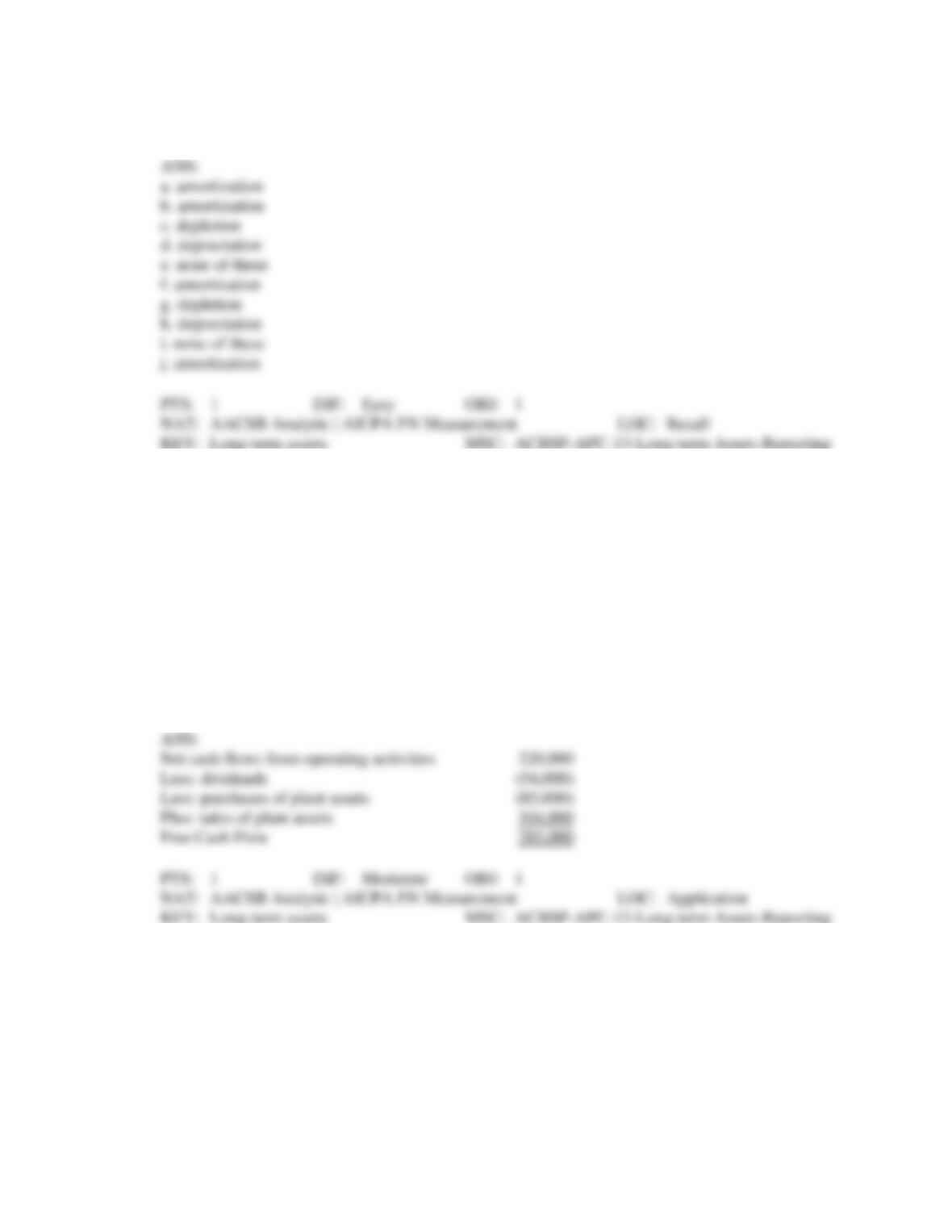
_____
b. Patents
_____
g. Mineral deposit
_____
c. Oil well
_____
h. Office equipment
_____
d. Company vehicle
_____
i. Office supplies
_____
e. Land
_____
j. Leasehold improvement
2. The following financial information is known for Crockett Company.
Net income
$ 54,000
Total current assets
545,000
Net cash flows from operating activities
320,000
Total current liabilities
205,000
Purchases of plant assets
85,000
Sales of plant assets
104,000
Total expenses
356,000
Dividends
54,000
Using the above information, calculate free cash flow for Crockett Company.
Net cash flows from operating activities
320,000
Less: dividends
Less: purchases of plant assets
Plus: sales of plant assets
104,000
Free Cash Flow
285,000
3. Indicate whether each of the following expenditures should be classified as land, land improvements,
buildings, equipment, or none of these.
_____ a. Parking lots
_____ b. Electricity used by equipment
_____ c. Sewage system cost
_____ d. Interest on building construction loan
_____ e. Cost of trial runs for equipment
_____ f. Drainage costs
a. amortization
b. amortization
c. depletion
d. depreciation
e. none of these
f. amortization
g. depletion
h. depreciation
i. none of these
j. amortization
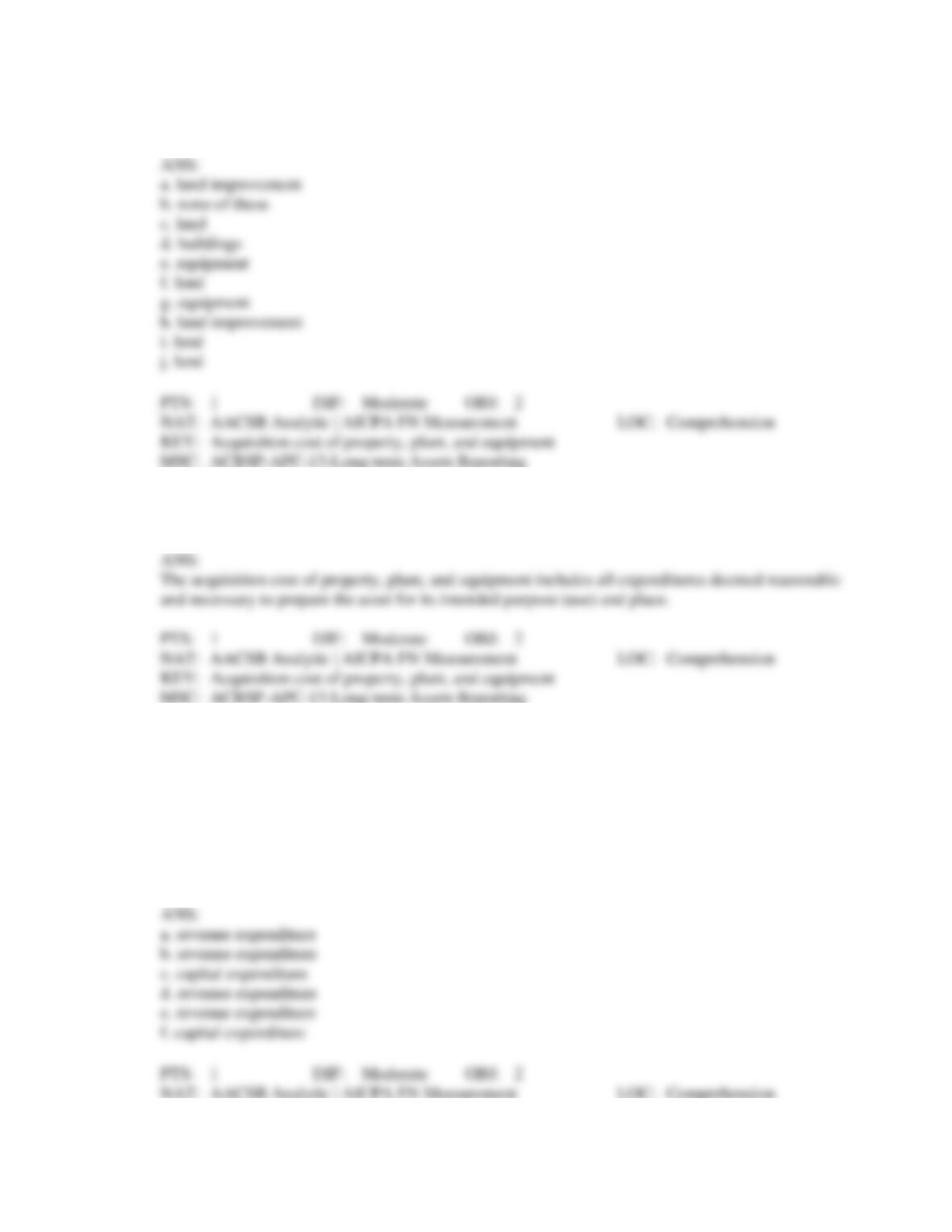
_____ g. Cost to install equipment
_____ h. Fences
_____ i. Unpaid (past) property taxes assumed
_____ j. Cost of tearing down a building when land and a building on it are purchased
4. In general, how does one determine whether or not an expenditure should be included in the
acquisition cost of property, plant, and equipment?
5. Indicate whether each of the following items normally would be considered a capital expenditure or a
revenue expenditure.
_____ a. Oil change for company vehicle
_____ b. Replacement of a few roof shingles
_____ c. Cost to overhaul the heating system
_____ d. Battery replacement for company vehicle
_____ e. Painting factory walls
_____ f. Installation of expensive paneling in executive offices
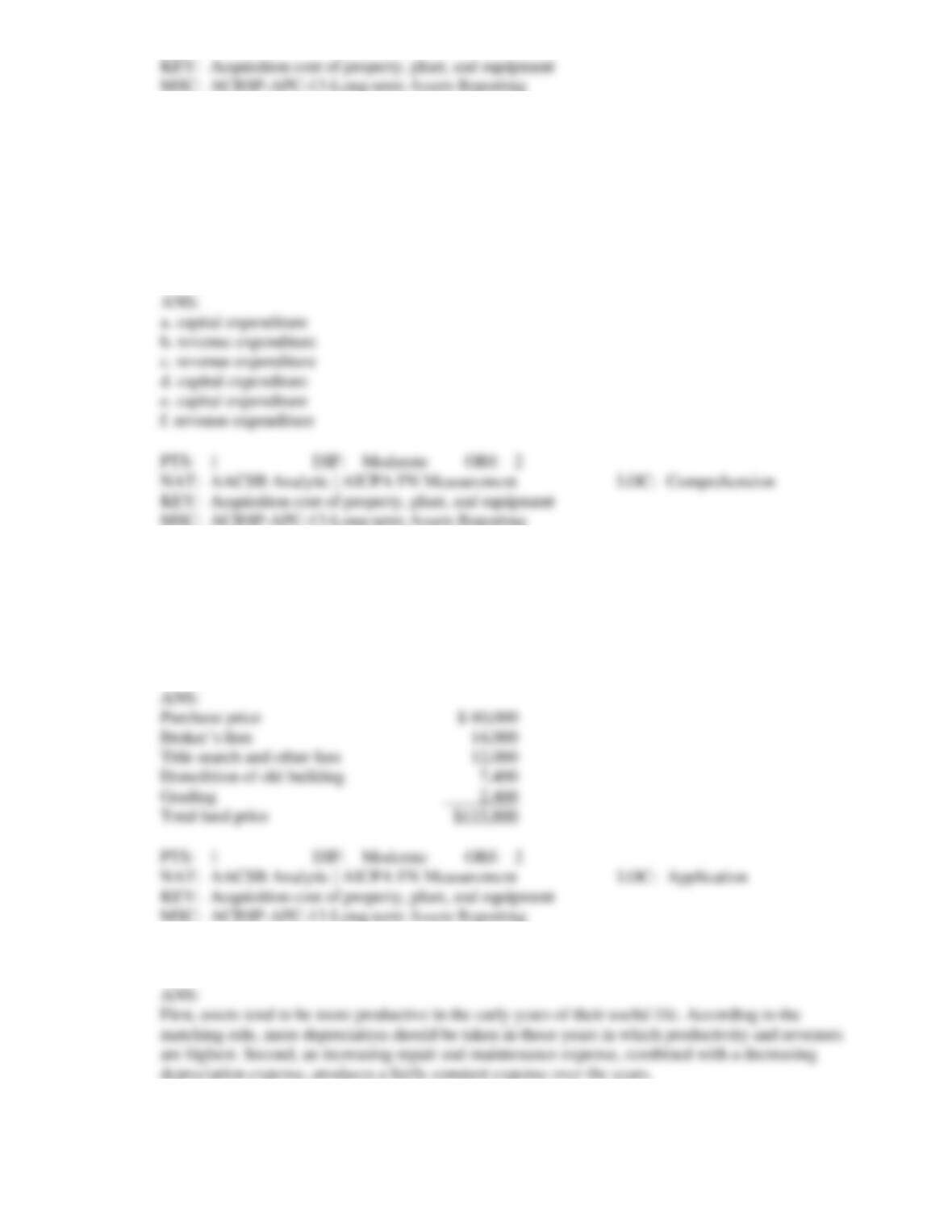
6. Indicate whether each of the following items normally would be considered a capital expenditure or a
revenue expenditure.
_____ a. Replacement of shake roof with tile roof
_____ b. Cost to replace light bulbs
_____ c. Window-cleaning costs
_____ d. Cost to rebuild company vehicle engine
_____ e. Cost to construct parking lot
_____ f. Cost of a wastebasket
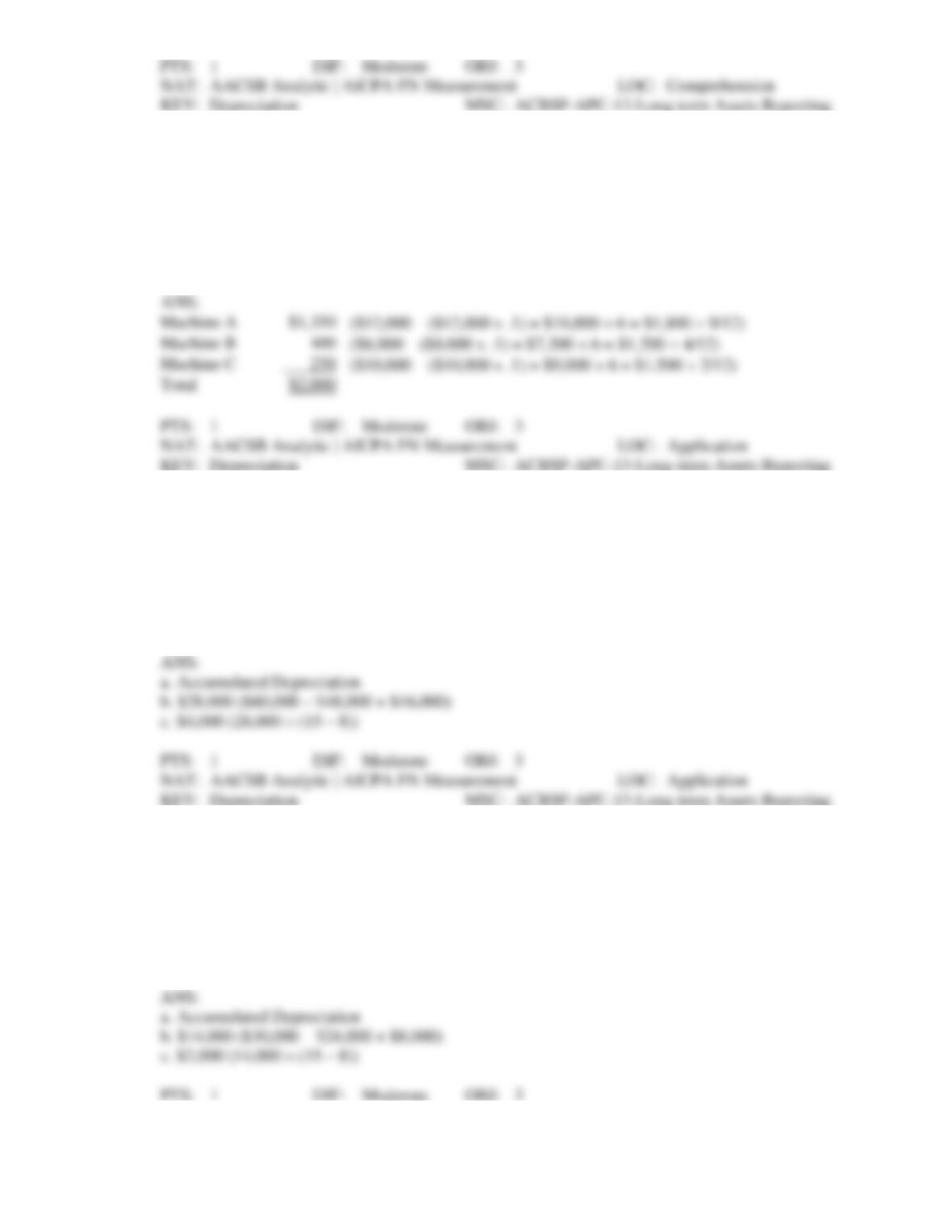
7. Dickson Corporation purchased land adjacent to its plant to improve access for trucks making
deliveries. Expenditures incurred by the company were as follows: purchase price, $80,000; broker’s
fees, $14,000; title search and other fees, $12,000; demolition of an old building on the property,
$7,400; grading, $2,400; digging foundation for the road, $6,000; laying and paving driveway,
$50,000; lighting, $15,000; signs, $3,000. List the items and the amounts that should be included in the
Land account.
8. Present two arguments in favor of the use of accelerated depreciation.
9. The following machines were purchased during 2013:
Machine A for $12,000 on April 7
Machine B for $8,000 on August 28
Machine C for $10,000 on November 5
Assuming that each machine has an estimated useful life of six years and a 10 percent residual value,
calculate total depreciation expense for 2013 (assume that the company depreciates the asset on
straight-line basis, reports on a calendar-year basis and rounds to the nearest month).
10. Oren Company’s air-conditioning system has just completed the eighth year of an estimated ten-year
life. The system cost $60,000 and now has accumulated depreciation of $48,000. At the beginning of
the ninth year, the company expects to spend $16,000 on a complete renovation of the system and
expects the total life of the system to be fifteen years. Neither the capacity of the system nor the
residual value was increased. The company uses the straight-line method to determine depreciation.
Determine the following: (a) the account debited for the cost of renovation, (b) the carrying value of
the system after renovation, and (c) the depreciation expense for the ninth year.
11. Guilford Company’s air-conditioning system has just completed the eighth year of an estimated
ten-year life. The system cost $30,000 and now has accumulated depreciation of $24,000. At the
beginning of the ninth year, the company expects to spend $8,000 on a complete renovation of the
system and expects the total life of the system to be fifteen years. Neither the capacity of the system
nor the residual value was increased. The company uses the straight-line method to determine
depreciation. Determine the following: (a) the account debited for the cost of renovation, (b) the
carrying value of the system after renovation, and (c) the depreciation expense for the ninth year.