Chapter 9
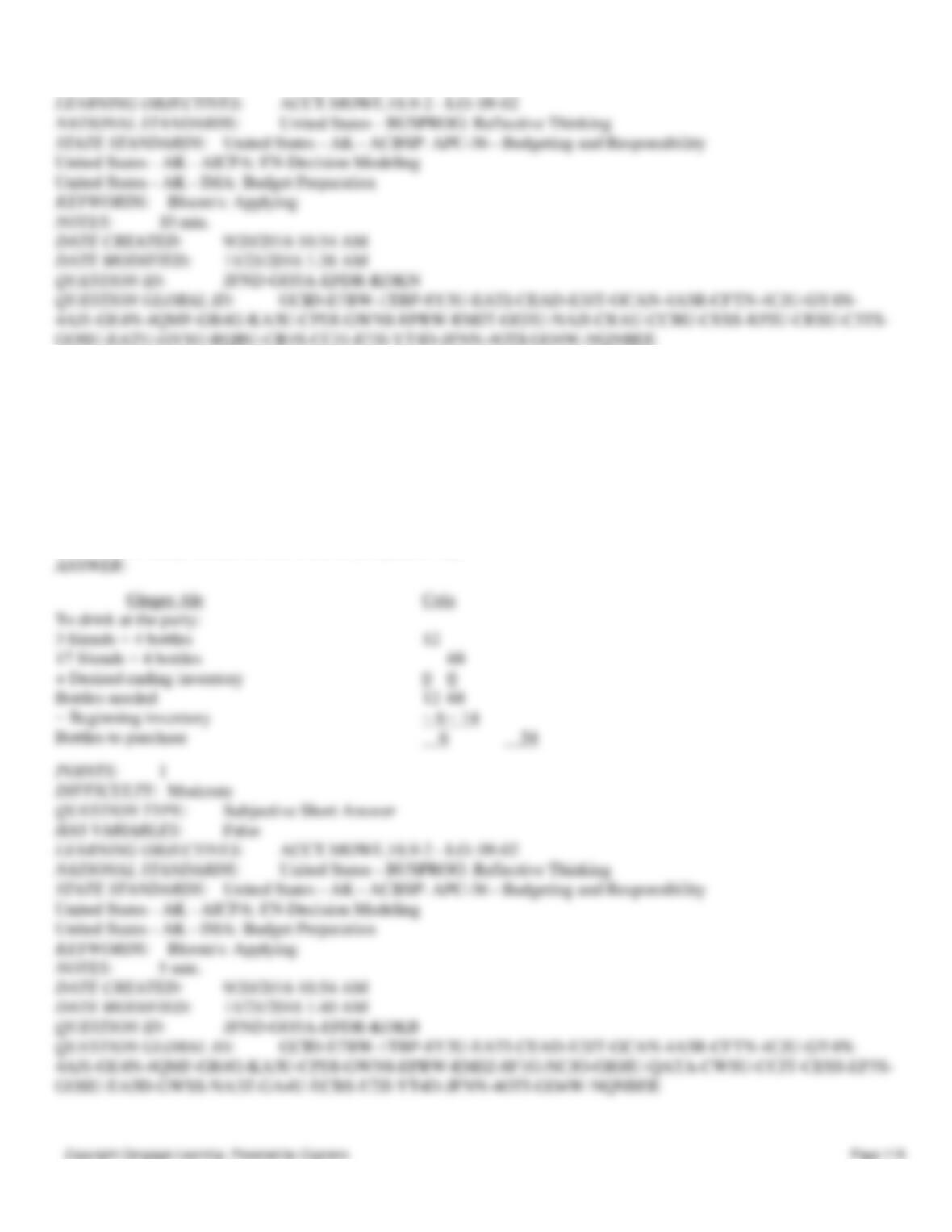
209. You have decided to throw a party next weekend for 19 friends. The friends are going to bring health food, so all you
have to have available are the drinks. You estimate that, on average, each person will drink four bottles of soft drinks.
Three of your friends will drink only natural soda without unneeded color − so Sulo Ginger Ale should work well for
them. For the others and yourself, you decide to buy Sulo Cola. Before going online, you check the refrigerator − you
already have six bottles of Sulo Ginger Ale and 14 of Sulo Cola. Since this is the end of the semester − you decide that
you don’t really want any of the soft drinks on hand after the party. Now, you are ordering on the Internet.
A. How many bottles of Sulo Ginger Ale do you plan to buy?
B. How many bottles of Sulo Cola do you plan to buy?
Chapter 9
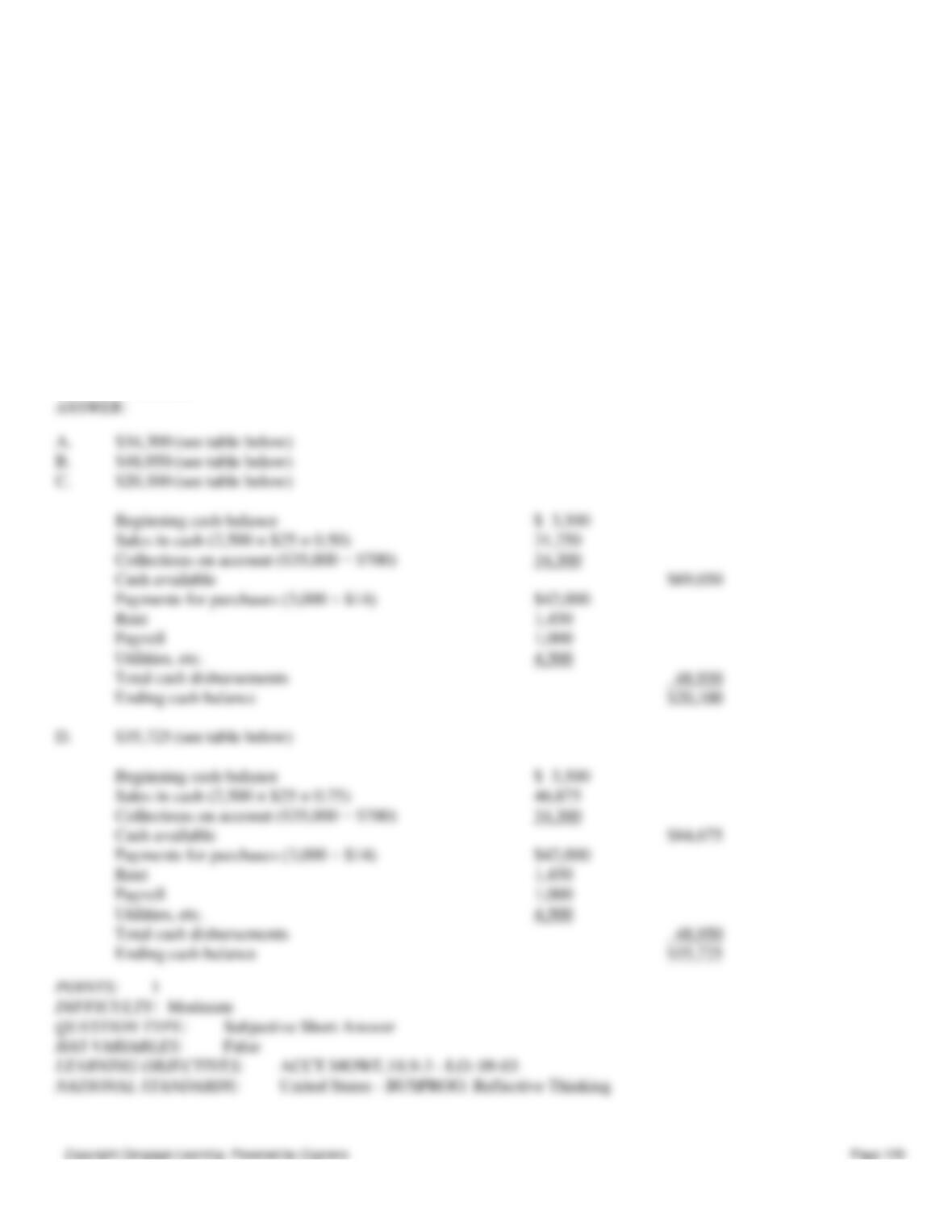
210. Quillin Company had the following budgeted information for October:
1. October 1 cash balance $3,500
2. Expected sales 2,500 units at $25 each (half in cash, remainder on credit due in November)
3. Inventory purchases 3,000 units at $14 each (all in cash)
4. Rent $1,450
5. Payroll $1,000
6. Utilities and other costs $4,500
7. Accounts receivable balance Oct. 1, $35,000 (includes $700 bad debts allowance;
use this amount for both parts A and D).
A. What is the budgeted collection on accounts receivable for October?
B. What are the total cash disbursements for October?
C. What is the ending cash balance for October?
D. Assuming sales are collected 75% in the month of sale and 25% the following month, what is the ending cash
balance for October?
Chapter 9
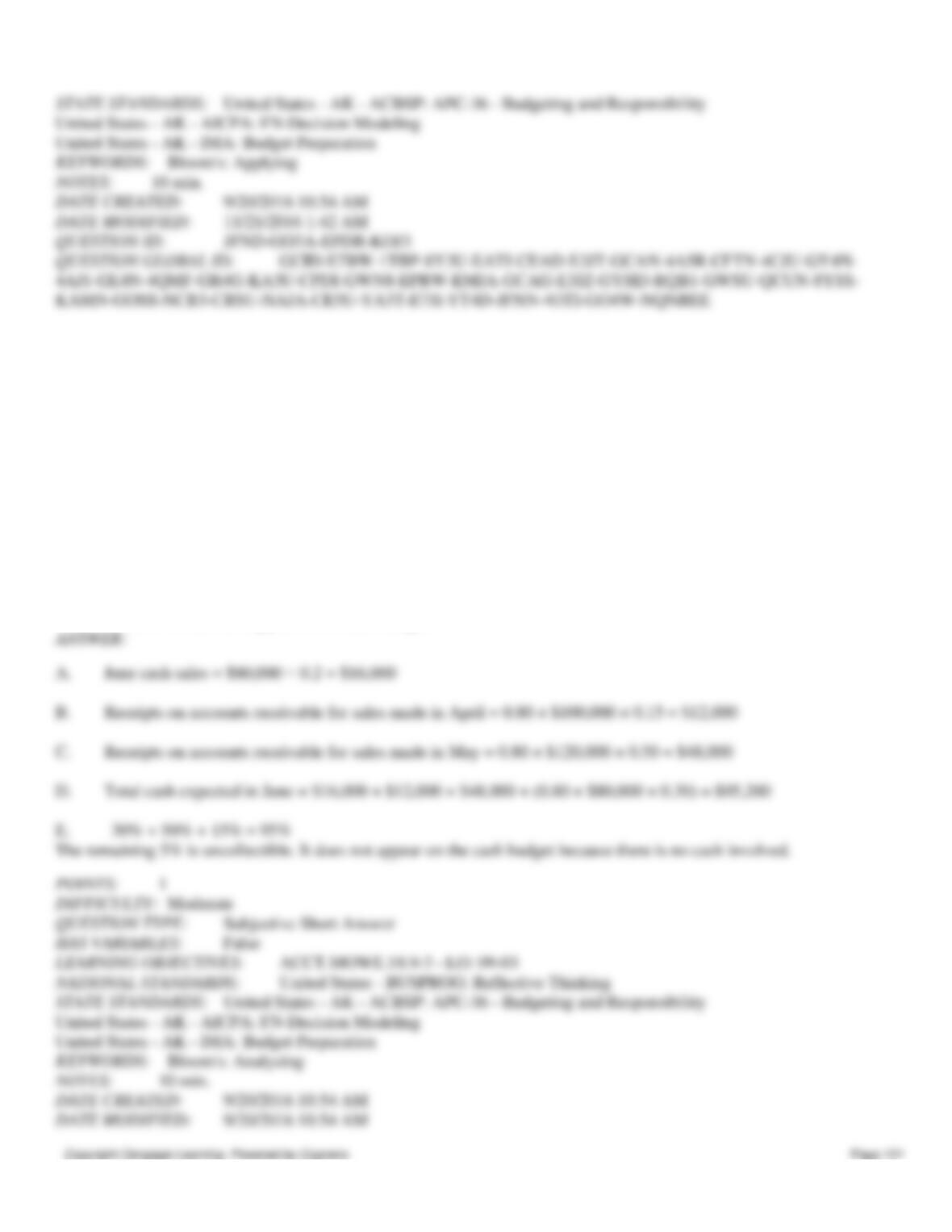
211. Fredder Company usually sells about 20% of its merchandise during a month for cash with the remaining sales on
account. The company’s accounts receivable payment history is as follows: 30% in the month of sale, 50% in the month
following, and 15% in the second month following sale. Total budgeted sales for the second quarter are as follows:
April $100,000
May 120,000
June 80,000
Assume all questions relate to the month of June.
A. What are the expected cash sales?
B. What are the expected receipts from accounts receivable for sales made in April?
C. What are the expected receipts from accounts receivable for sales made in May?
D. What are the total expected cash receipts?
E. From the above accounts receivable history information, receipts from accounts receivable do not equal 100%.
Why not? Does this amount appear on the cash budget?
Chapter 9
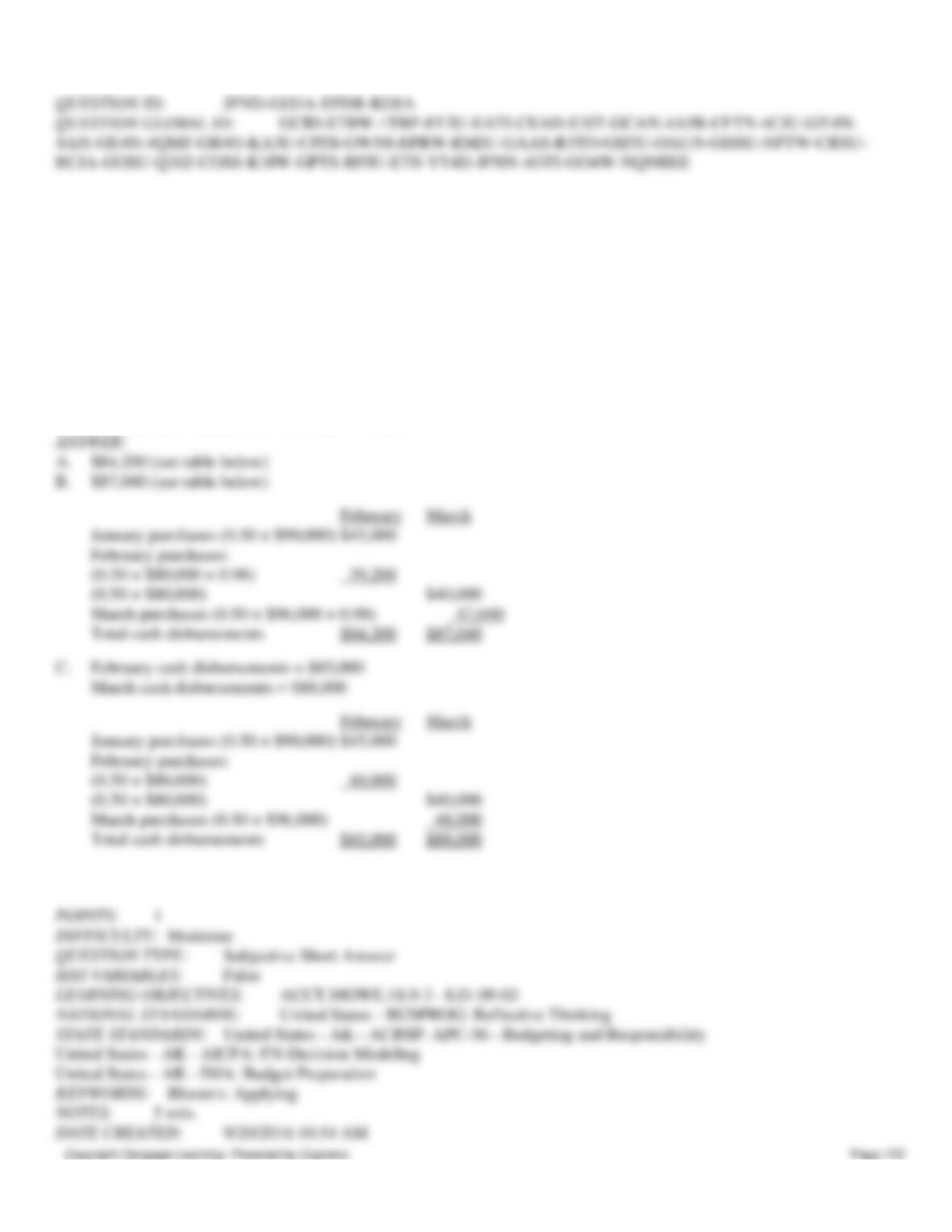
212. Rivers Company purchases merchandise on account. In general, Rivers pays 50% in the month of purchase and 50%
in the following month. All payments in the month of purchase qualify for a 2% cash discount. First quarter budgeted
purchases are:
January $90,000
February 80,000
March 96,000
A. What are the total cash disbursements expected in February?
B. What are the total cash disbursements expected in March?
C. Now suppose that there is no cash discount for purchases made in the month of purchase. Now what are the total
cash disbursements expected in February? In March?
Chapter 9
213. Wexler Company expects sales of $40,000 in July, $50,000 in August, and $30,000 in September. Wexler’s
experience is that 40% of sales are cash, and the remainder is on account. Accounts receivable are paid: 70% in the month
of sale, and 25% in the following month.
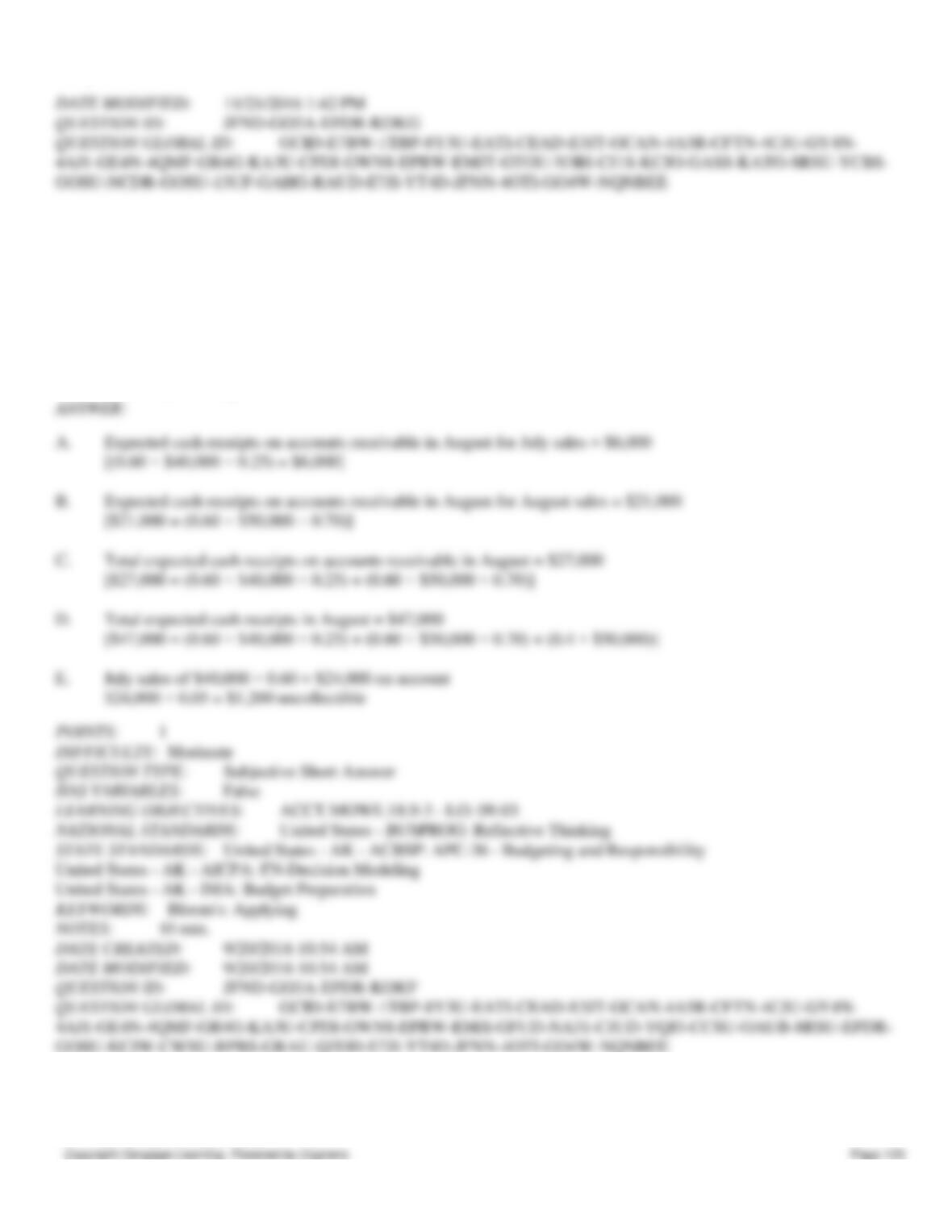
A. What are the expected cash receipts on accounts receivable in August for July sales?
B. What are the expected cash receipts on accounts receivable in August for August sales?
C. What are the total expected cash receipts on accounts receivable in August?
D. What are the total expected cash receipts in August?
E. How much of July sales are deemed to be uncollectible?
214. Shorter Company developed the following data for the month of June.
1. June 1 cash balance $2,300
Chapter 9
2. Cash sales in June $67,000
3. Credit sales for June are $20,000; for May $10,000; and for April $16,000. 60% of credit sales are collected in the
month of sale, 20% in the following month, and 10% in the second month following the sale.
4. Purchases for May were $34,000 and for June are $40,000. Half of purchases are paid in the month of purchase and
the remainder in the following month.
5. June salaries are $28,400, utilities are $1,090, and depreciation on the building is $1,000.
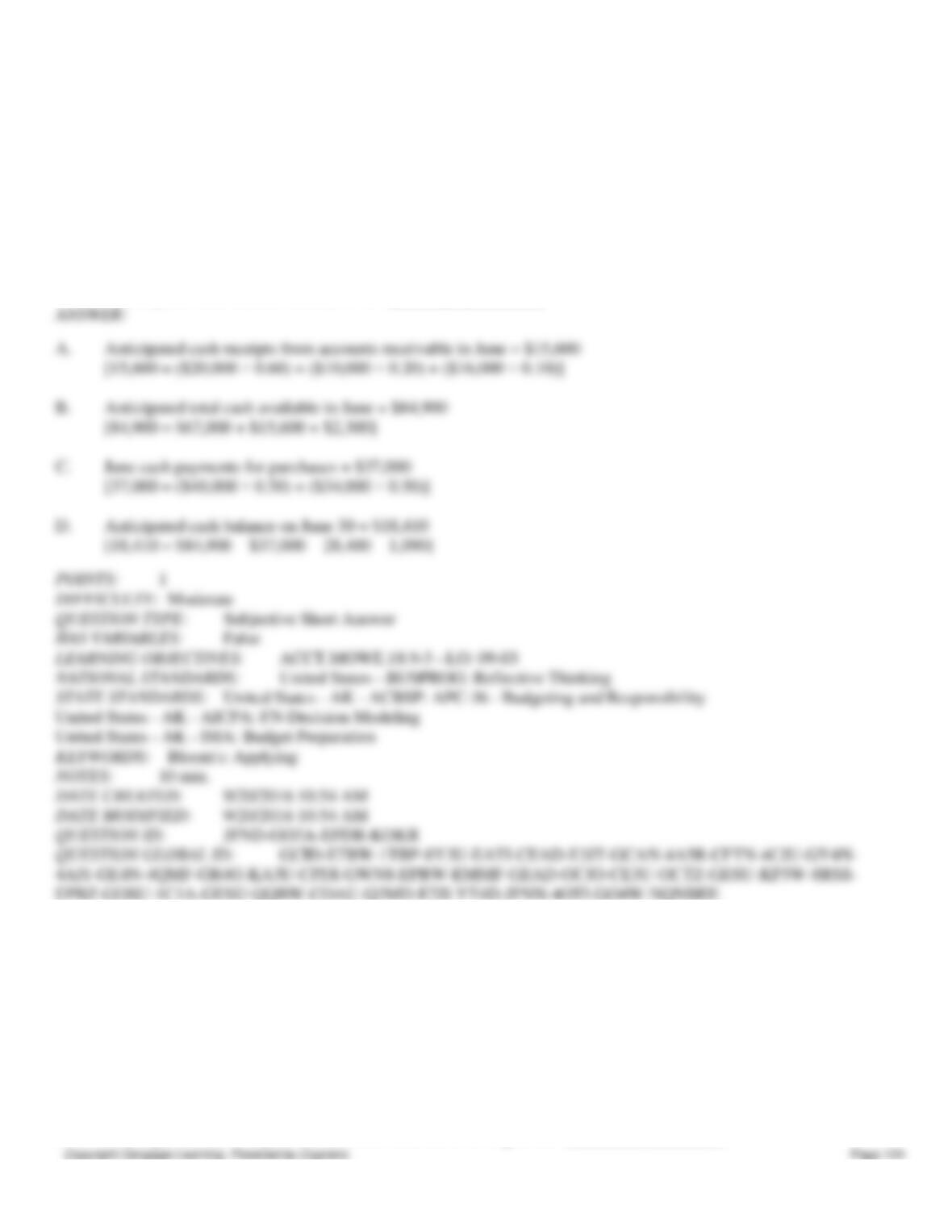
A. Anticipated cash receipts from accounts receivable in June equal $__________________.
B. Anticipated total cash available in June is $__________________.
C. June cash payments for purchases are $__________________.
D. Anticipated cash balance on June 30 is $__________________.
215. Calino Company developed the following data for the month of August.
1. August 1 cash balance $12,300.
2. Cash sales in August $80,000.
3. Credit sales for August are $30,000; for July $40,000; and for June $40,000. 70% of credit sales are collected in the
month of sale, 15% in the following month, and 10% in the second month following the sale.
4. Purchases for July were $50,000 and for August are $40,000. One-fourth of purchases are paid in the month of
purchase and the remaining three-quarters in the following month.
5. August salaries are $31,400, utilities are $3,220, and depreciation on the building and equipment is $10,000.
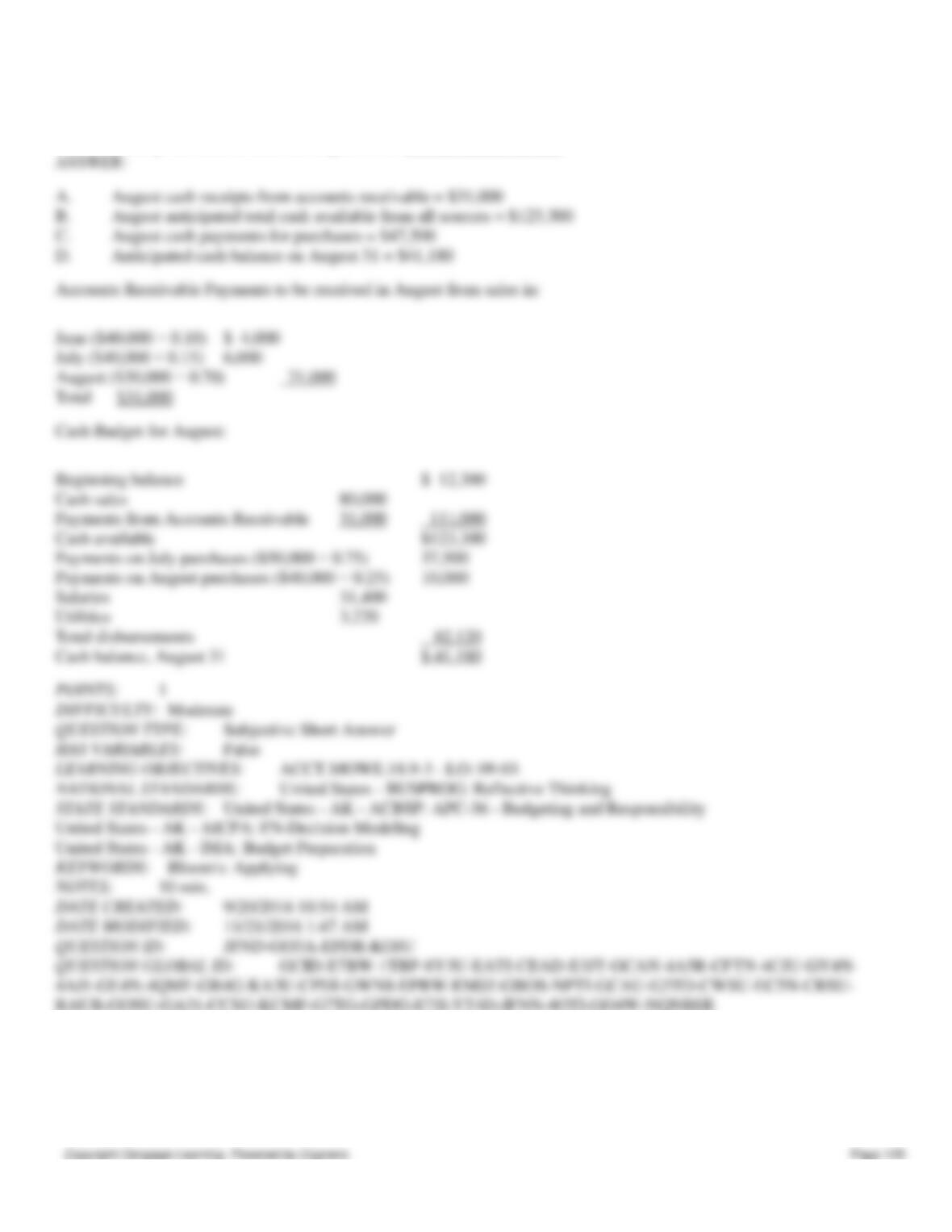
A. Anticipated cash receipts from accounts receivable in August are $__________________.
Chapter 9
B. Anticipated total cash available from all sources in August is $__________________.
C. August cash payments for purchases made in July and August are $__________________.
D. Anticipated cash balance on August 31 is $__________________.
216. It is May 28 and you have just gotten a summer job that will pay you (net of taxes) $800 per month. You start June 1
and will work until school starts − halfway through August. Your scholarship pays for tuition, room and board. But you
must buy books, pay for transportation to and from school, and pay for clothing, any extra meals, entertainment, and so
on. You have gathered the following data:
Chapter 9
1. One round trip airline ticket is $260, and you’d like to come home for Thanksgiving (your parents will drive you
there in August, and you will try to catch a ride home with another student in December).
2. Books are estimated to cost about $500 per semester for your anticipated major
3. Supplies should be another $150
4. Clothing might run $100 − you already have almost everything you think you’ll need.
5. There are 16 weeks in the semester, and you think you’ll need $50 per week for allowance to cover extra meals and
entertainment
6. Before school even starts, you need to cover any summer expenses, including going out with friends. $30 a week
sounds about right, since all your friends will be working and saving for college as well. There are 11 weeks of summer.
Right now, you have $200 in your checking account.
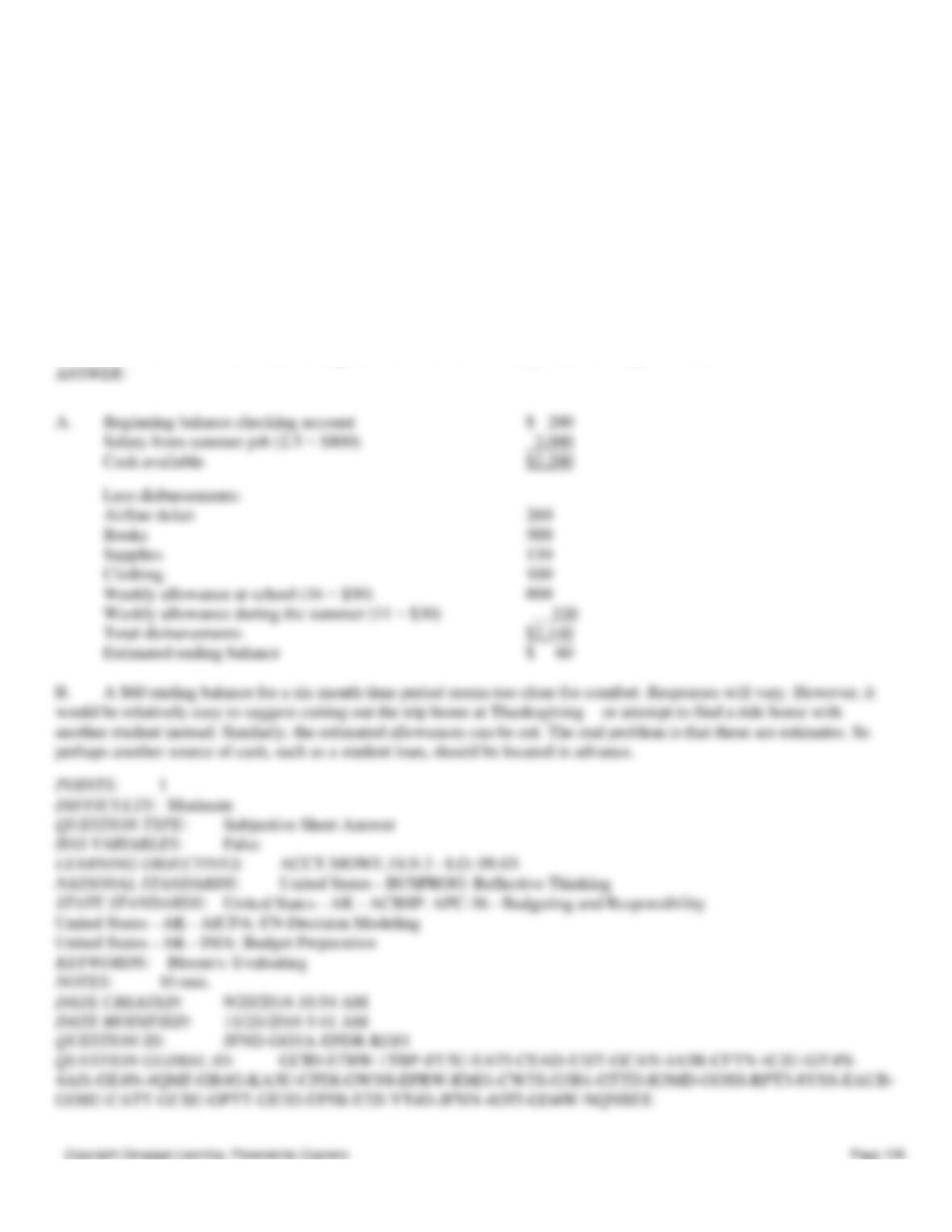
A. Prepare a cash budget for the summer and the first semester of college. (Do the entire time period; do not break it
down by week or by month.)
B. Comment on the estimated ending balance. What actions can you take, if any, to increase it?
Chapter 9
217. Miller Corporation has the following sales budget for the first four months of the current year:
Month Sales
January $400,000
February $320,000
March $440,000
April $360,000
Historically, the following trend has been established regarding cash collection of sales:
65% in month of sale
25% in month following sale
8% in second month following sale
2% uncollectible
The company allows a 2% cash discount for payments made by customers during the month of the sale. November and
December sales were $400,000 and $240,000, respectively. All sales are on account.
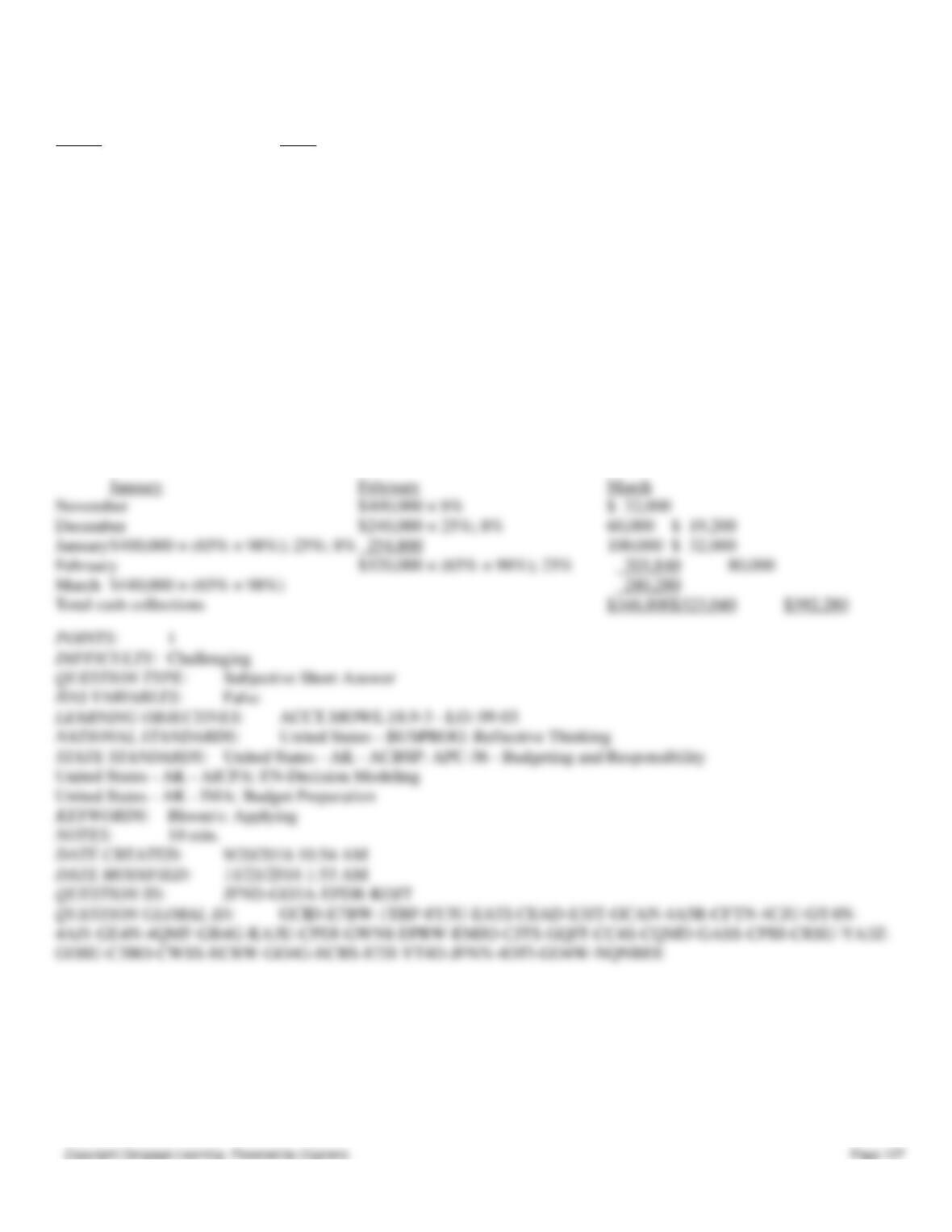
Required: Prepare a schedule of budgeted cash collections from sales for January, February, and March.
ANSWER:
218.
Allan Corporation has a sales budget for March of $440,000. About 10% are cash sales and the remainder is sold on
account.
The company expects that 60% of credit sales will be collected in the month of the sale, 25% in the next month and
10% in the following month.
Materials purchased on account are expected to be $250,000. Allan pays 35% in the month of the purchase, 50% in
the month following the purchase and the remaining 15% in the second month after the purchase.
Chapter 9
Salaries and wages of the workers are approximately $45,000 per month. The employees are paid weekly so on
average 95% of their wages are paid in the month to which they relate and the remaining 5% is paid in the following
month.
Utilities average $4,300 per month.
Rent on the building is $9,000 per month.
Insurance is $3,000 per month and advertising costs are $1,000 per month.
February sales were $320,000 and purchases of materials in February were $170,000; January sales were $200,000
and purchases of materials in January were $130,000.
The cash balance on March 1st is $5,400.
Required:
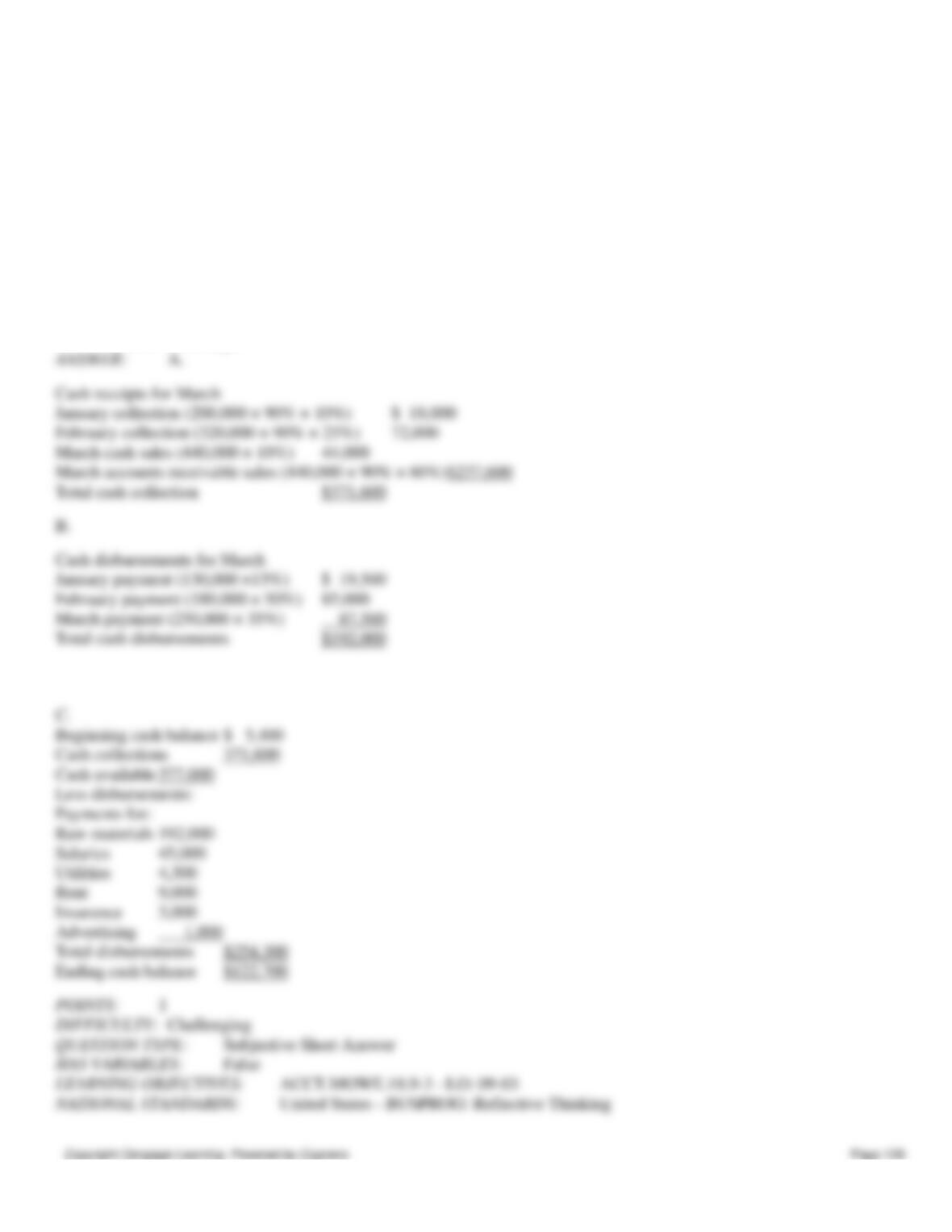
A. Prepare a schedule of cash receipts
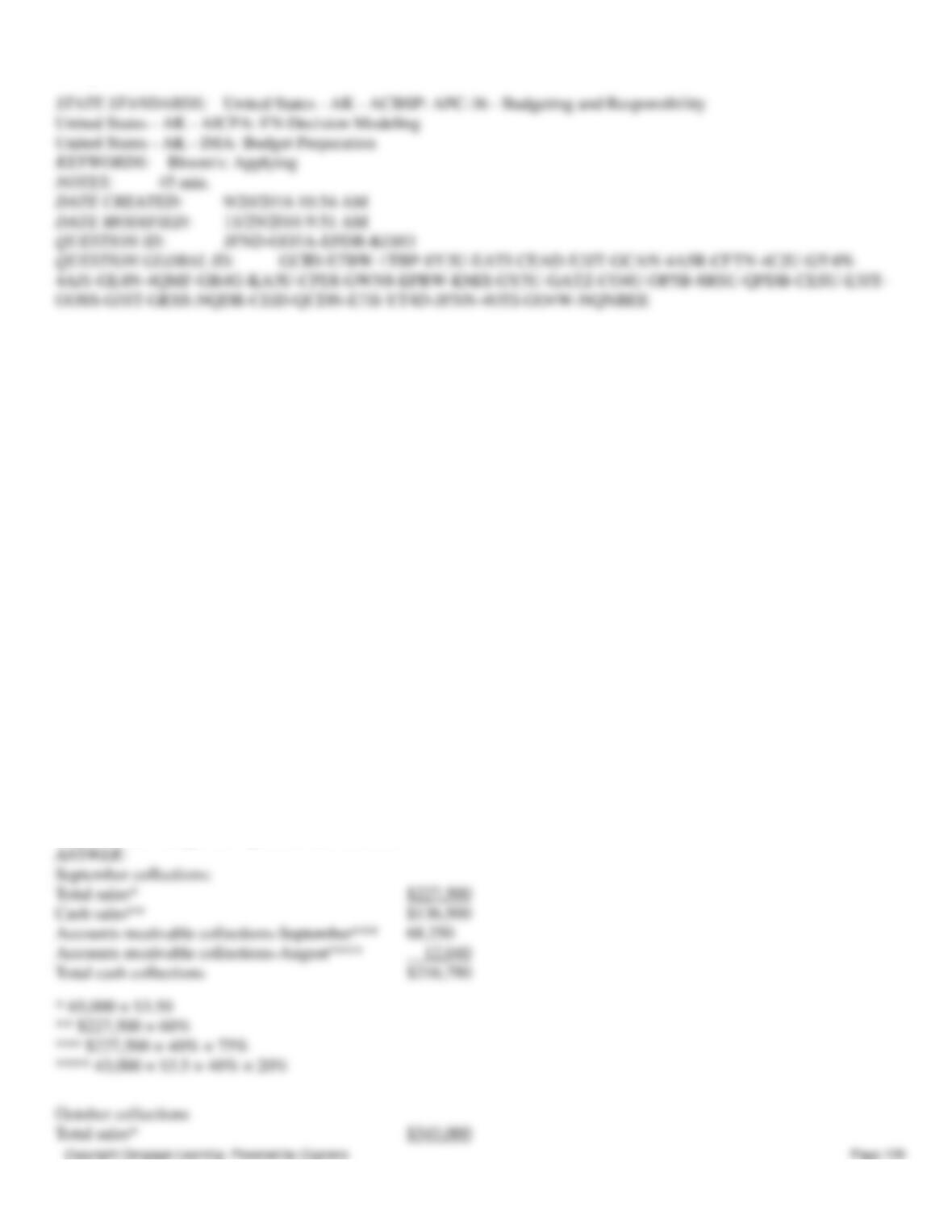
B. Prepare a schedule of cash payments (Accounts payable payments)
C. Prepare a cash budget
Chapter 9
219. Trish Morrow owns and operates Yummy Bakery which sells a wide variety of cupcakes. She has compiled the
following data and information in order to put together a cash budget for September and October.
• Budgeted sales for September are 65,000 cupcakes and 98,000 in October. Each cupcake sells for $3.50.
• On average 60% are cash sales and 40% are sold on account.
• The company expects to collect 75% of credit sales in the month of the sale and 20% in the month after the sale.
• All necessary raw materials are purchased on account. Purchases are paid 85% in the month of the purchase and
15% in the following month. Purchases for September are estimated to be $200,000 and $290,000 in October.
• Monthly expenses include:
• Wages $10,000
• Rent $4,000
• Utilities $3,500
• Insurance $2,500
• Advertising $2,290
• Cash balance on September 1st was $6,000.
• The company has a policy to maintain a minimum cash balance of $5,000. If necessary the company will borrow
to meet its short-term needs. All borrowing is done at the beginning of the month and all payments on principal
and interest are made at the end of the next month. The annual interest rate is 7%. The company must borrow in
multiples of $1,000.
• August sales were 43,000 cupcakes and raw materials purchased equal $230,000.
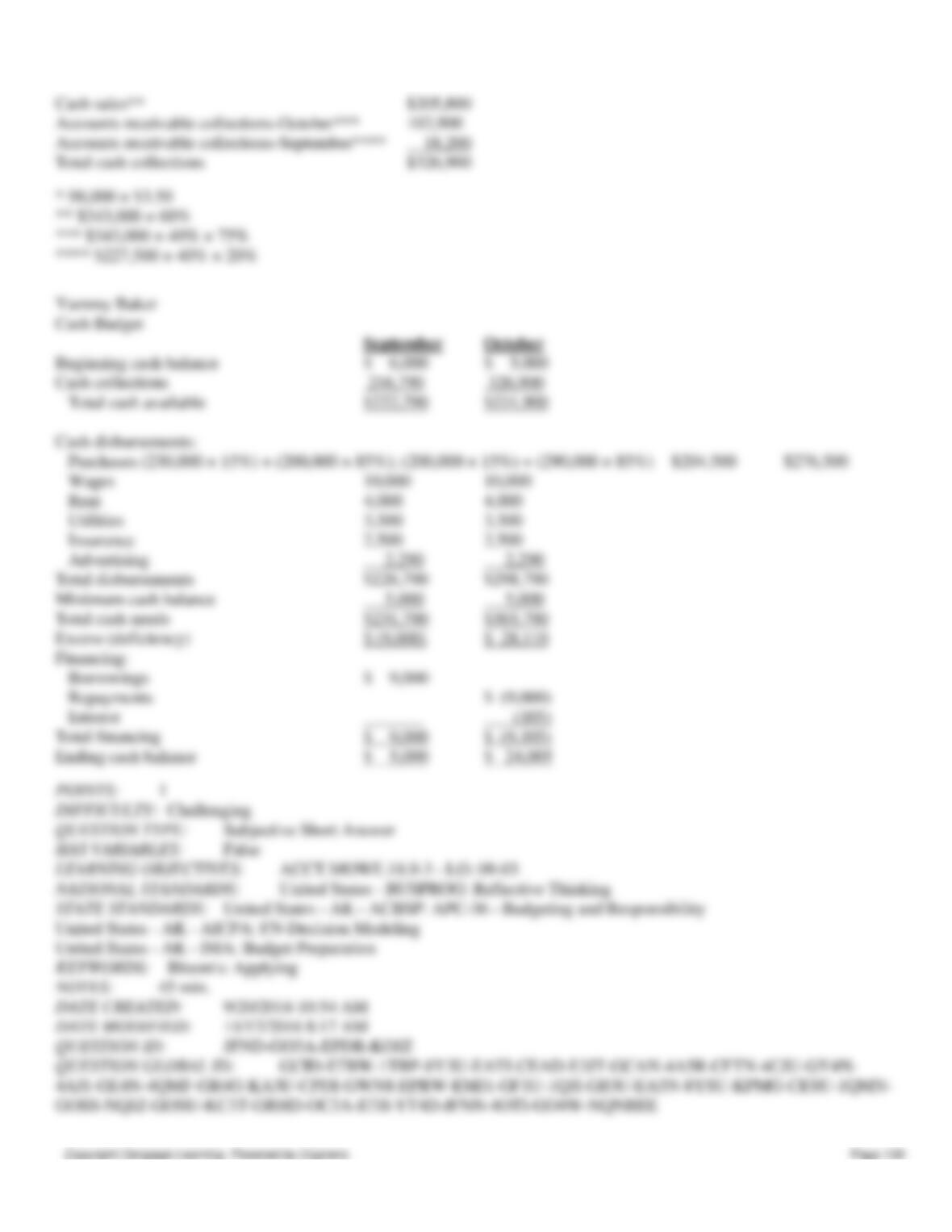
Prepare a cash budget for September and October.
Chapter 9
Chapter 9
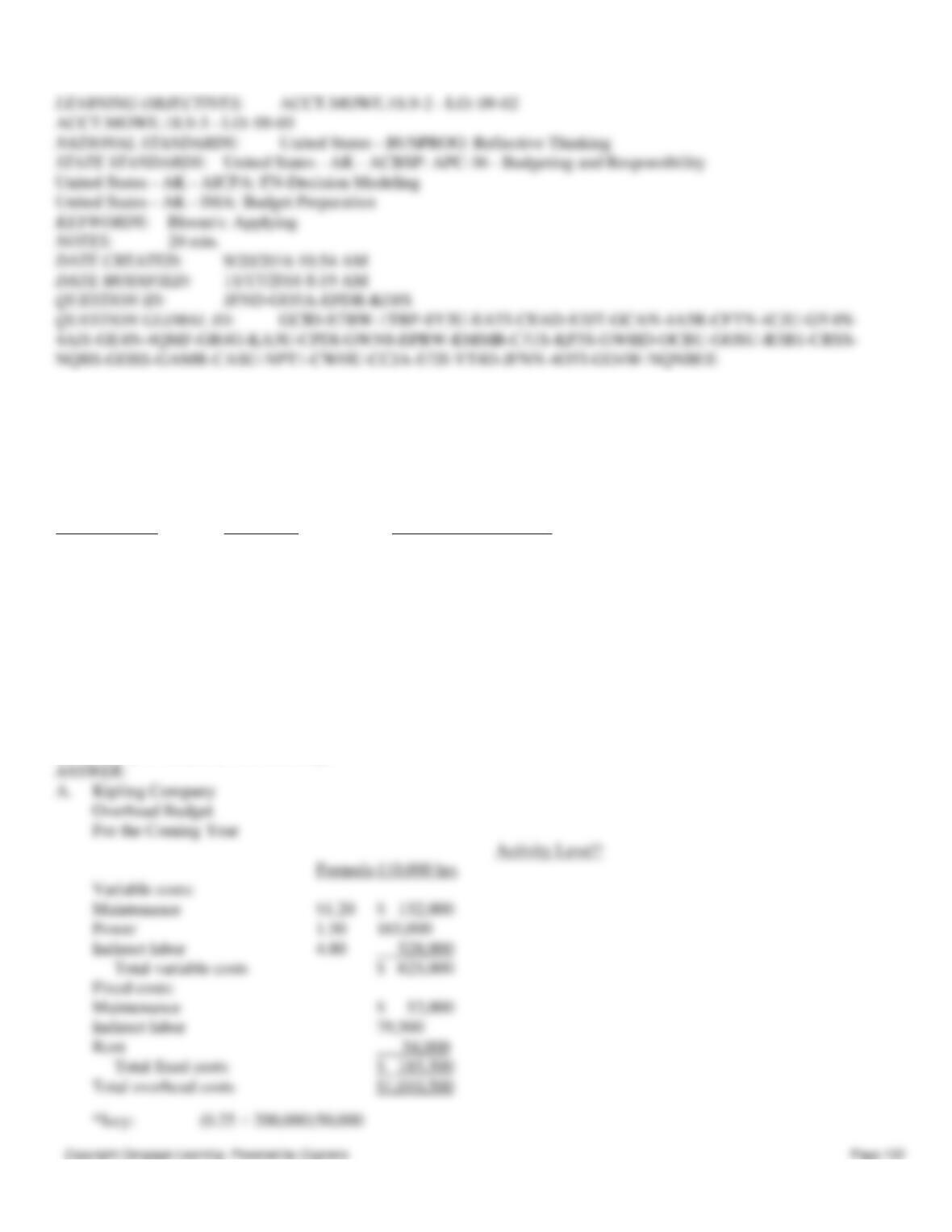
220. Dickson Company has the following projected account balances for September 30 of the current year:
Accounts payable $20,000 Sales $400,000
Accounts receivable 50,000 Capital stock 200,000
Depreciation, factory 12,000 Retained earnings (beginning) 64,000
Inventories (8/31) 90,000 Maintenance, factory 14,000
Inventories (9/30) 90,000 Cash 28,000
Materials used 100,000 Equipment, net 120,000
Office salaries 40,000 Buildings, net 200,000
Insurance, factory 2,000 Utilities, factory 8,000
Factory wages 70,000 Selling expenses 30,000
Bonds payable 80,000
Required:
A. Prepare a budgeted income statement for the month ended September 30.
B. Prepare a budgeted balance sheet as of September 30.
Chapter 9
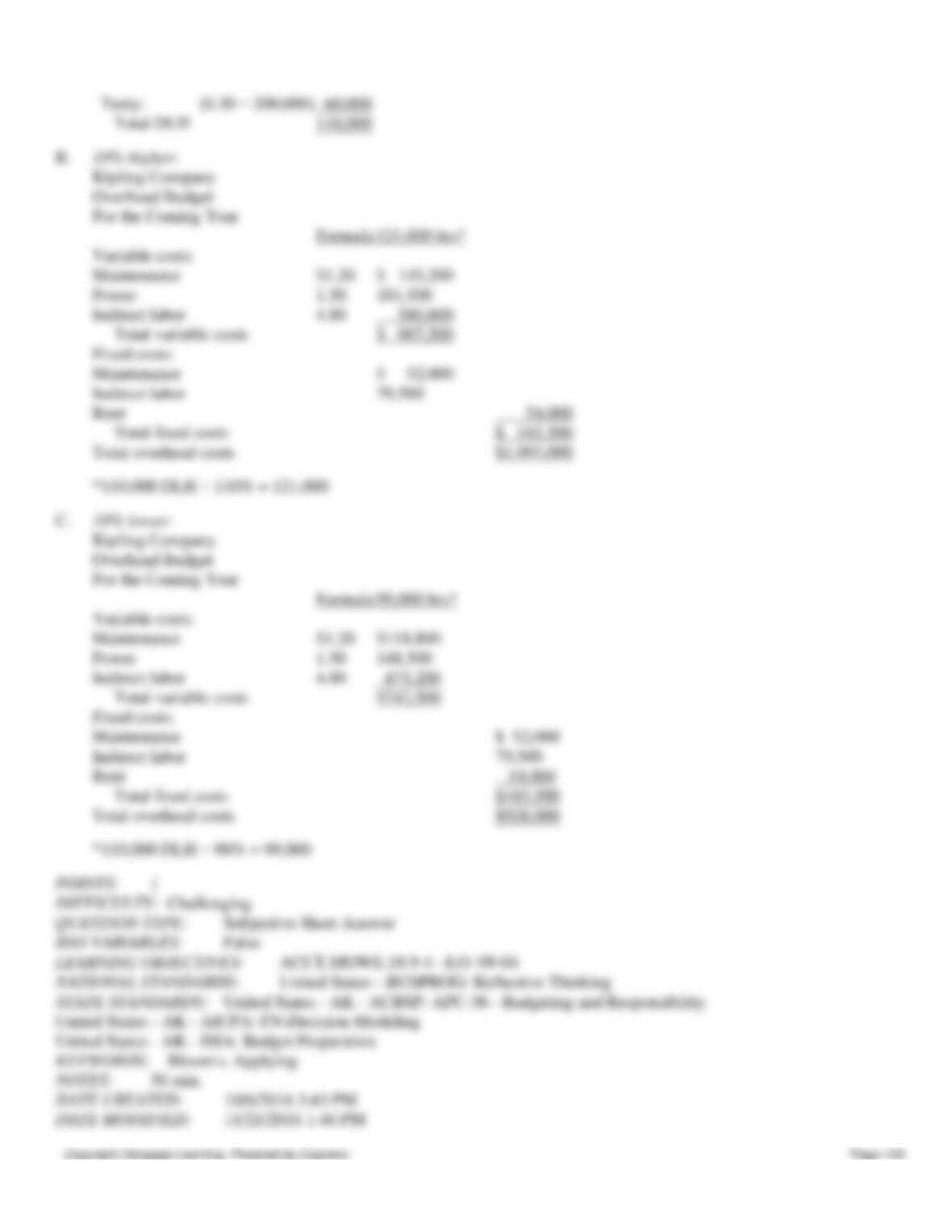
221. Larry Miller, controller for Kipling Company, has been instructed to develop a flexible budget for overhead costs.
The company produces two types of frozen desserts: Icey and Tasty. The two desserts use common raw materials in
different proportions. The company expects to produce 200,000 gallons of each product during the coming year. Icey
requires 0.25 direct labor hour per gallon and Tasty requires 0.30. Larry has developed the following fixed and variable
costs for each of the four overhead items:
Overhead Item Fixed Cost Variable Rate per DLH
Maintenance $52,000 $1.20
Power 1.50
Indirect labor 79,500 4.80
Rent 54,000
Required:
A. Prepare an overhead budget for the expected activity level for the coming year.
B. Prepare an overhead budget that reflects production that is 10% higher than expected (for both products). Assume
this quantity is within the relevant range.
C. Prepare an overhead budget that reflects production that is 10% lower than expected (for both products). Assume
this quantity is within the relevant range.
Chapter 9
Chapter 9
222. Larry Miller, controller for Kipling Company, has been instructed to develop a flexible budget for overhead costs.
The company produces two types of frozen desserts: Icey and Tasty. The two desserts use common raw materials in
different proportions. The company expects to produce 200,000 gallons of each product during the coming year. Icey
requires 0.25 direct labor hour per gallon and Tasty requires 0.30. Larry has developed the following fixed and variable
costs for each of the four overhead items:
Overhead Item Fixed Cost Variable Rate per DLH
Maintenance $52,000 $1.20
Power 1.50
Indirect labor 79,500 4.80
Rent 54,000
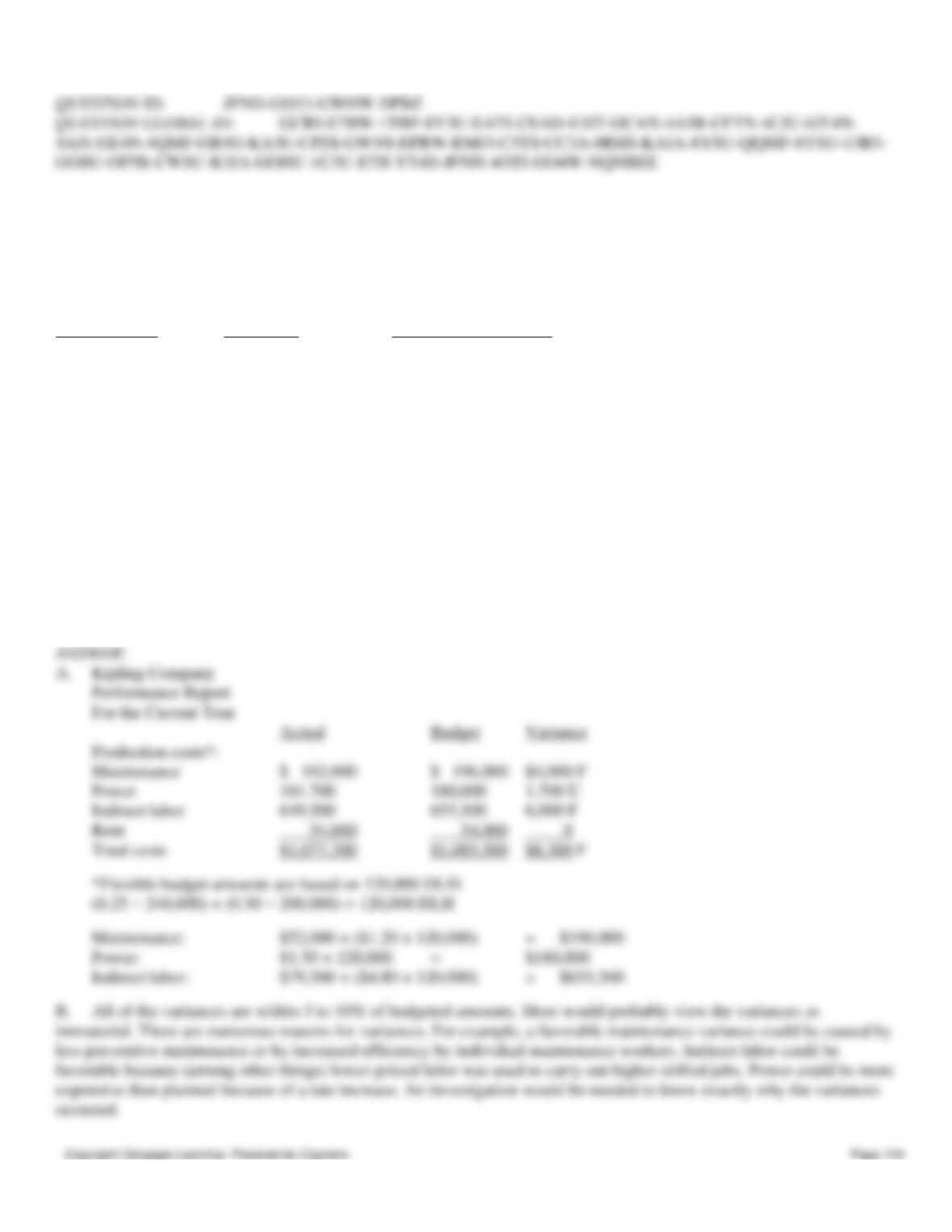
Assume that Kipling actually produced 240,000 gallons of Icey and 200,000 of Tasty. The actual overhead costs incurred
were:
Maintenance $192,000
Power 181,700
Indirect labor 649,500
Rent 54,000
Required:
A. Prepare a performance report for the period.
B. Based on the report, would you judge any of the variances to be significant? Discuss some possible reasons for
the variances.
Chapter 9
223. Favor Company budgeted the following amounts:
Variable costs of production:
Direct materials 6 pounds @ $1.25 per pound
Direct labor 0.75 hours @ $16.00 per hour
Variable overhead 0.75 hours @ $2.65 per hour
Fixed overhead:
Materials handling $9,000
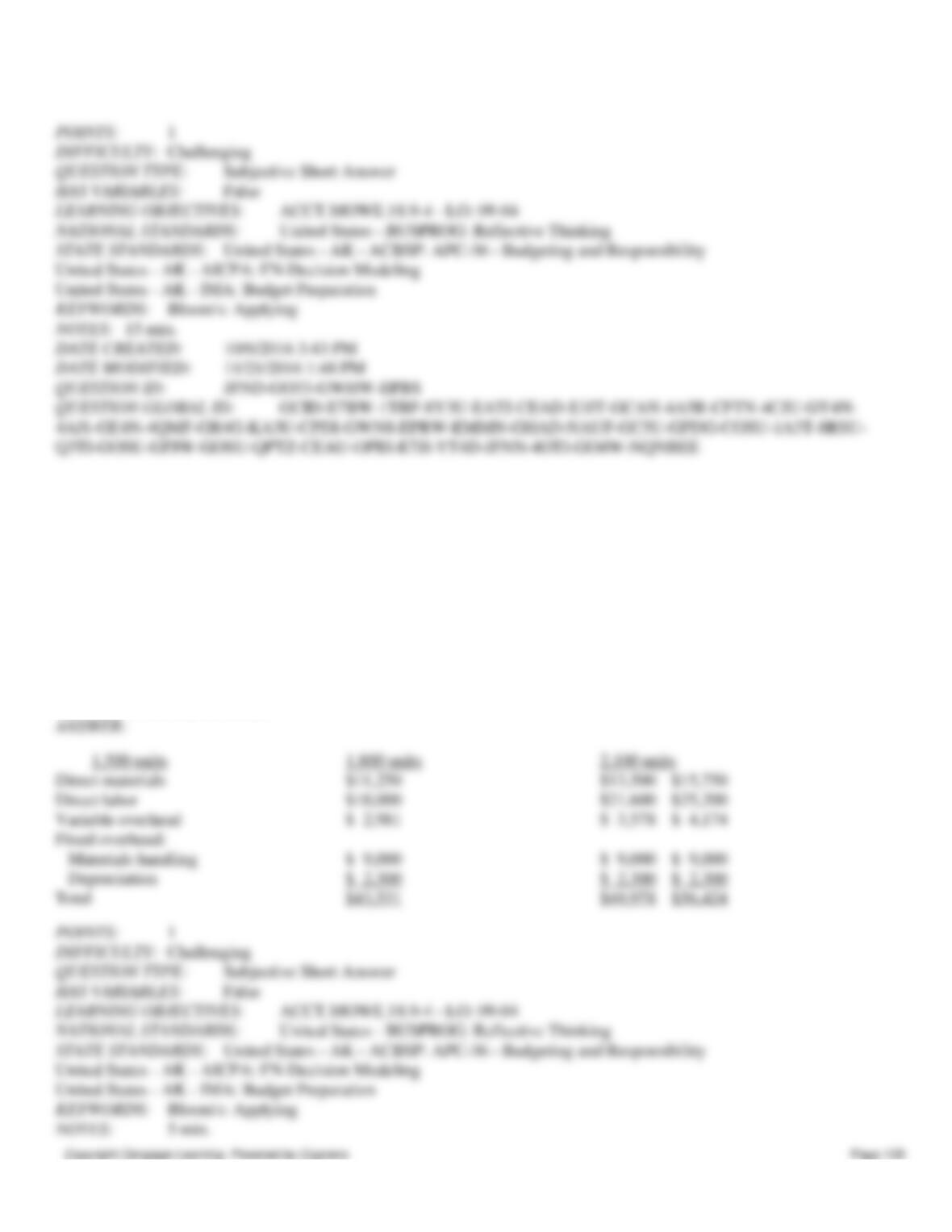
Depreciation $2,300
Required: Prepare a flexible budget for 1,500 units, 1,800 units and 2,100 units. Assume all are within the relevant range
and round to the nearest dollar.
Chapter 9