
Chapter 9: Financial Statement Analysis
59. Based on the following data for the current year, compute the inventory turnover.
Net sales on account during the year
$585,000
Cost of merchandise sold during the year
380,000
Accounts receivable, beginning of year
47,000
Accounts receivable, end of year
36,000
Inventory, beginning of year
92,000
Inventory, end of year
113,000
a.
1.9
b.
2.9
c.
1.1
d.
3.7
60. The balance sheet and income statement for the year ended 2016 indicate the following:
Bonds payable, 10% (issued 1998, due 2022)
$1,200,000
Preferred 5% stock, $100 par (no change during year)
350,000
Common stock, $50 par (no change during year)
2,100,000
Income before income tax for year
3100,000
Income tax for year
72,000
Common dividends paid
58,000
Preferred dividends paid
16,300
Based on the data presented above, what is the number of times interest charges were earned?
a. 2.6
b. 3.6
c. 0.7
d. 2.9
61. An acceleration in the collection of receivables will tend to cause the accounts receivable
turnover to:
a. decrease.
b. remain the same.
c. neither increase nor decrease.
d. increase.
Chapter 9: Financial Statement Analysis
62. Based on the following data for the current year, what is the number of days’ sales in inventory
(rounded to the next whole day)?
Net sales on account during the year
$1,204,000
Cost of merchandise sold during the
630,000
Accounts receivable, beginning of year
75,000
Accounts receivable, end of year
85,000
Inventory, beginning of year
81,600
Inventory, end of year
a. 58
98,600
b. 48
c. 53
d. 30
63. Based on the following data, what is the amount of quick assets?
Accounts payable
$ 32,000
Accounts receivable
56,000
Accrued liabilities
7,000
Cash
20,000
Intangible assets
40,000
Inventory
72,000
Long-term investments
100,000
Long-term liabilities
75,000
Marketable securities
40,000
Notes payable (short-term)
20,000
Property, plant, and equipment
625,000
Supplies
2,000
a. $228,000
b. $188,000
c. $116,000
d. $114,000
Chapter 9: Financial Statement Analysis
64. Based on the following data, what is the amount of working capital?
Accounts payable
$ 32,000
Accounts receivable
64,000
Accrued liabilities
7,000
Cash
20,000
Intangible assets
40,000
Inventory
72,000
Long-term investments
100,000
Long-term liabilities
75,000
Marketable securities
35,000
Notes payable (short-term)
20,000
Property, plant, and equipment
625,000
Prepaid expenses
a. $190,000
2,000
b. $134,000
c. $118,000
d. $62,000
65. Based on the following data, what is the quick ratio, rounded to one decimal place?
Accounts payable
$ 32,000
Accounts receivable
64,000
Accrued liabilities
7,000
Cash
20,000
Intangible assets
40,000
Inventory
72,000
Long-term investments
100,000
Long-term liabilities
75,000
Marketable securities
35,000
Notes payable (short-term)
25,000
Property, plant, and equipment
625,000
Prepaid expenses
a. 3.2
2,000
b. 2.1
c. 1.9
d. 1.4
Chapter 9: Financial Statement Analysis
66. Which of the following ratios provides a solvency measure that shows the margin of safety of
noteholders or bondholders and also gives an indication of the potential ability of the business
to borrow additional funds on a long- term basis?
a. Ratio of fixed assets to long-term liabilities
b. Ratio of net sales to assets
c. Number of days’ sales in receivables
d. Rate earned on stockholders’ equity
67. The number of times interest charges are earned is computed as:
a. net income plus interest expense, divided by interest expense.
b. income before income tax plus interest expense, divided by interest expense.
c. net income divided by interest expense.
d. income before income tax divided by interest expense.
68. The tendency of the rate earned on stockholders’ equity to vary disproportionately from the rate
earned on total assets is sometimes referred as:
a. leverage.
b. solvency.
c. yield.
d. quick assets.
The balance sheets at the end of each of the first two years of operations indicate the following:
2016
2015
Total current assets
$600,000
$560,000
Total investments
60,000
40,000
Total property, plant, and equipment
900,000
700,000
Total current liabilities
125,000
80,000
Total long-term liabilities
350,000
250,000
Preferred 9% stock, $100 par
100,000
100,000
Common stock, $10 par
600,000
600,000
Paid-in capital in excess of par—common stock
60,000
60,000
Retained earnings
325,000
210,000
69. Based on the above information, if net income is $130,000 and interest expense is $40,000 for
2016, what is the rate earned on stockholders’ equity for 2016 (round to one decimal place)?
a. 12.0%
b. 12.7%
c. 13.2%
d. 16.5%
Chapter 9: Financial Statement Analysis
70. Based on the above information, if net income is $130,000 and interest expense is $40,000 for
2016, what is the rate earned on common stockholders’ equity for 2016 (round to one decimal
place)?
a. 12.3%
b. 14.0%
c. 13.0%
d. 17.4%
71. Based on the above information, if net income is $130,000 and interest expense is $40,000 for
2016, what are the earnings per share on common stock for 2016 (round to two decimal
places)?
a. $2.17
b. $2.68
c. $2.02
d. $2.32
72. Based on the above information, if net income is $130,000 and interest expense is $40,000 for
2016, and the market price is $40, what is the price-earnings ratio on common stock (round to
one decimal place)?
a. 14.9
b. 18.4
c. 17.3
d. 19.8
73. For most profitable companies, the rate earned on total assets will be less than:
a. the rate earned on stockholders’ equity.
b. the rate earned on total liabilities and stockholders’ equity.
c. the rate earned on sales.
d. cannot be determined without more information.
Chapter 9: Financial Statement Analysis
74. The following information is available for Morgan Corporation:
2015
Market price per share of common stock
$25.00
Earnings per share on common stock
1.25
Which of the following statements is correct?
a. The price-earnings ratio is 20 and a share of common stock was selling for 20 times the
amount of earnings per share at the end of 2015.
b. The price-earnings ratio is 5.0% and a share of common stock was selling for 5.0% more
than the amount of earnings per share at the end of 2015.
c. The price-earnings ratio is 10 and a share of common stock was selling for 125 times the
amount of earnings per share at the end of 2015.
d. The market price per share and the earnings per share are not statistically related to each
other.
75. Which one of the following is not a characteristic generally evaluated in ratio analysis?
a. Liquidity
b. Profitability
c. Solvency
d. Marketability
76. Sarbanes-Oxley Act of 2002 requires which of the following report to be prepared by the
management of the company?
a. A report evaluating the probability that the company will remain in business.
b. A report showing management’s assessment of internal control.
c. A report assessing the market value of the company’s current stock price.
d. A report identifying the competency of the company’s board of directors.
77. The independent auditor’s report does which of the following?
a. Describes that the common-sized statements are covered by the audit.
b. Gives the auditor’s opinion regarding the fairness of the financial statements.
c. Summarizes what the auditor did.
d. States that the financial statements are effective.
Chapter 9: Financial Statement Analysis
78. The purpose of an audit is to:
a. determine whether or not a company is a good investment.
b. render an opinion on the fairness of the statements.
c. determine whether or not a company complies with income tax regulations.
d. determine whether or not a company has a good credit risk.
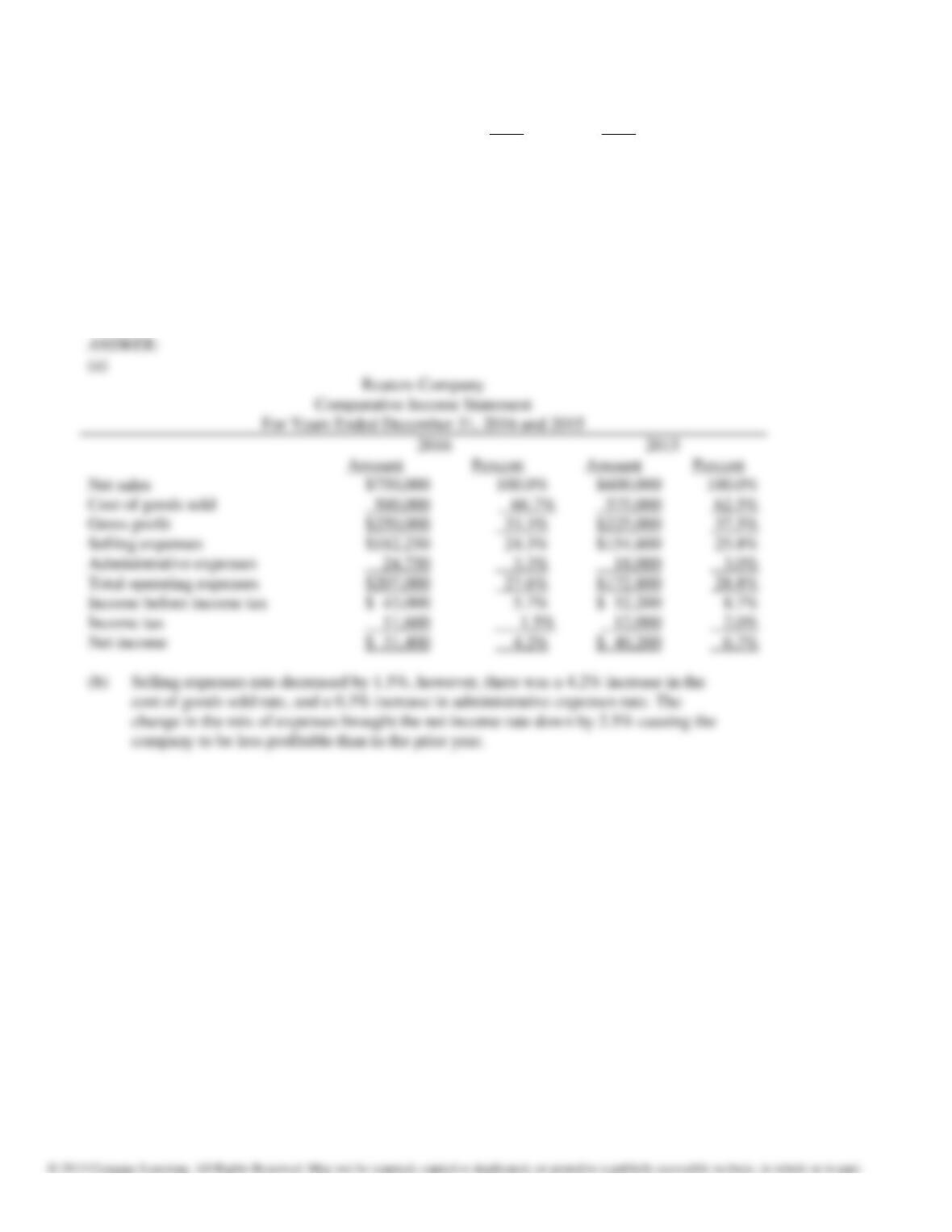
79. Condensed data taken from the ledger of Crawford Company at December 31, 2016 and 2015,
are as follows:
2016
2015
Current assets
$200,000
$180,000
Property, plant, and equipment
450,000
400,000
Intangible assets
20,700
30,000
Current liabilities
70,000
80,000
Long-term liabilities
200,000
250,000
Common stock
275,000
200,000
Retained earnings
125,700
80,000
Prepare a comparative balance sheet, with horizontal analysis, for December 31, 2016 and
2015. (Round percents to one decimal place.)
$ 20,000
$ 75,000
$120,700
Chapter 9: Financial Statement Analysis
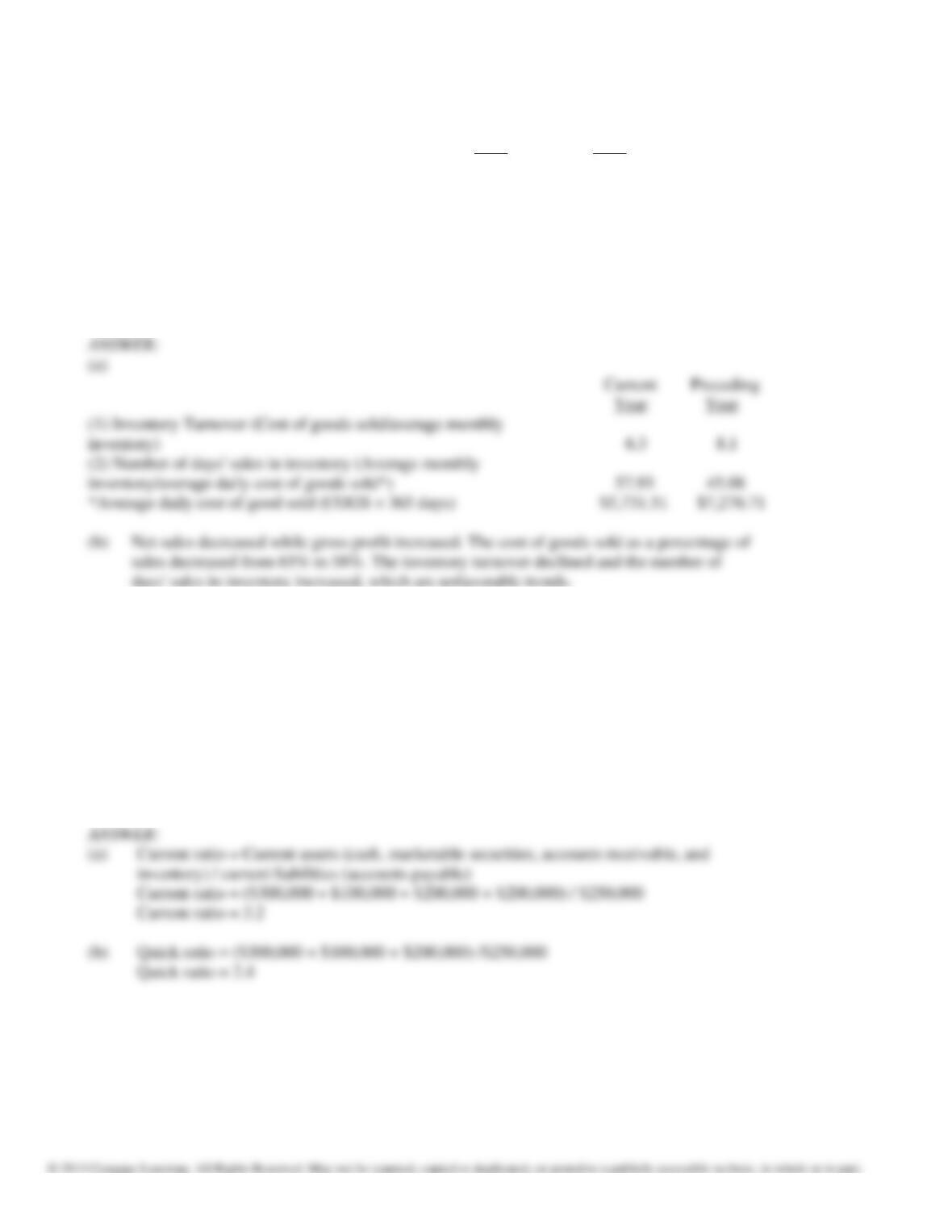
80. Revenue and expense data for Reuters Company are as follows:
2016
2015
Administrative expenses
$ 24,750
$ 18,000
Cost of goods sold
500,000
375,000
Income tax
11,600
12,000
Net sales
750,000
600,000
Selling expenses
182,250
154,800
(a)
Prepare a comparative income statement, with vertical analysis, stating each item for both
2016 and 2015 as a percent of sales.
(b)
Comment upon significant changes disclosed by the comparative income statement.
(a)
Net sales
Cost of goods sold
Gross profit
Selling expenses
Administrative expenses
Total operating expenses
Income before income tax
Income tax
12,000
Chapter 9: Financial Statement Analysis
81. The following data are taken from the financial statements:
Current
Preceding
Year
Year
Net sales
$3,592,000
$4,056,000
Cost of goods sold
2,092,000
2,656,000
Average monthly inventory
332,000
328,000
Inventory, end of year
372,000
347,000
(a)
Determine for each year (1) the inventory turnover and (2) the number of days‘ sales in
inventory.
(b)
Comment on the favorable and unfavorable trends revealed by the data.
(a)
inventory)
*Average daily cost of good sold (COGS ÷ 365 days)
$5,731.51
82. The following items are reported on a company’s balance sheet:
Cash
$300,000
Marketable securities
100,000
Accounts receivable
200,000
Inventory
200,000
Accounts payable
250,000
Determine the (a) current ratio and (b) quick ratio. Round your answer to one decimal place.
Current ratio = ($300,000 + $100,000 + $200,000 + $200,000) / $250,000
Current ratio = 3.2
(b)
Quick ratio = ($300,000 + $100,000 + $200,000) /$250,000
Quick ratio = 2.4
Chapter 9: Financial Statement Analysis
83. A company reports the following:
Net sales $750,000
Average accounts receivable (net) $ 50,000
Determine the (a) accounts receivable turnover and (b) number of days’ sales in receivables.
Round your answers to one decimal place.