Chapter 9—Inventories: Special Valuation Issues Key
1. The most common approach to implementing the lower of cost or market rule for inventory valuation is to
apply it
2. Which application of the lower of cost or market rule will generally result in the lowest valuation for the
ending inventory?
3. When applying lower of cost or market, market value
4. Exhibit 9-1
Waring Inc. uses the lower of cost or market rule in valuing its inventory. One unit has a ceiling constraint of
$42.50. The following is other information concerning this unit:
Estimated transportation costs for delivery
$3.20
Normal profit margin
5.50
Packaging costs prior to delivery
2.20
Refer to Exhibit 9-1. The selling price of this unit must be
5. Exhibit 9-1
Waring Inc. uses the lower of cost or market rule in valuing its inventory. One unit has a ceiling constraint of
$42.50. The following is other information concerning this unit:
Estimated transportation costs for delivery
$3.20
Normal profit margin
5.50
Packaging costs prior to delivery
2.20
Refer to Exhibit 9-1. The floor constraint of this unit must be
6. When comparing the lower of cost to market
7. Marcus Company uses the lower of cost or market rule in valuing its inventory. The floor constraint for one
item in the inventory is $58.20. The following is other information concerning this unit:
Transportation costs
$ 4.00
Normal profit margin
11.70
Packaging costs
4.20
The net realizable value for this item is
8. When applying the lower of cost or market rule to the valuation of inventory, the allowance method is
considered preferable to the direct method because
9. In comparison to the allowance method of applying the lower of cost or market rule to the valuation of
inventory, the direct method has which of the following deficiencies?
10. Given the following information for the Rachel Company:
Date
Cost
Market
December 31, 2010
$500
$500
December 31, 2011
700
650
December 31, 2012
800
730
If the direct method of recording lower of cost or market is in use, which December 31, 2012 entry is correct?
11. Given the following information for the Teresa Company:
Date
Cost
Market
December 31, 2010
$ 800
$ 800
December 31, 2011
1,000
940
December 31, 2012
1,100
1,060
If the allowance method of recording lower of cost or market is in use, which December 31, 2012 entry is not correct?
12. The Martha Company normally sells its inventory at a 20% profit margin on sales. In 2010, the net
realizable value of inventory purchased for $50,000 declined to $44,000. There are no costs to complete and
dispose of this inventory. What is the floor constraint on the valuation of this inventory using the lower of cost
or market rule?
13. Exhibit 9-2
The Jenny Company uses a periodic inventory accounting system and values its inventory by using the lower of
cost or market rule. The allowance method is used in applying the lower of cost or market rule. The company
adjusts and closes its books annually on December 31. Below are the cost and market values of the company’s
year-end inventories for a three-year period:
Date
Cost
Market
December 31, 2010
$70,000
$70,000
December 31, 2011
56,000
46,000
December 31, 2012
64,000
58,000
Refer to Exhibit 9-2. Which of the following journal entries would be correct as of December 31, 2011, to apply the lower of cost or market rule to
the valuation of inventory?
14. Exhibit 9-2
The Jenny Company uses a periodic inventory accounting system and values its inventory by using the lower of
cost or market rule. The allowance method is used in applying the lower of cost or market rule. The company
adjusts and closes its books annually on December 31. Below are the cost and market values of the company’s
year-end inventories for a three-year period:
Date
Cost
Market
December 31, 2010
$70,000
$70,000
December 31, 2011
56,000
46,000
December 31, 2012
64,000
58,000
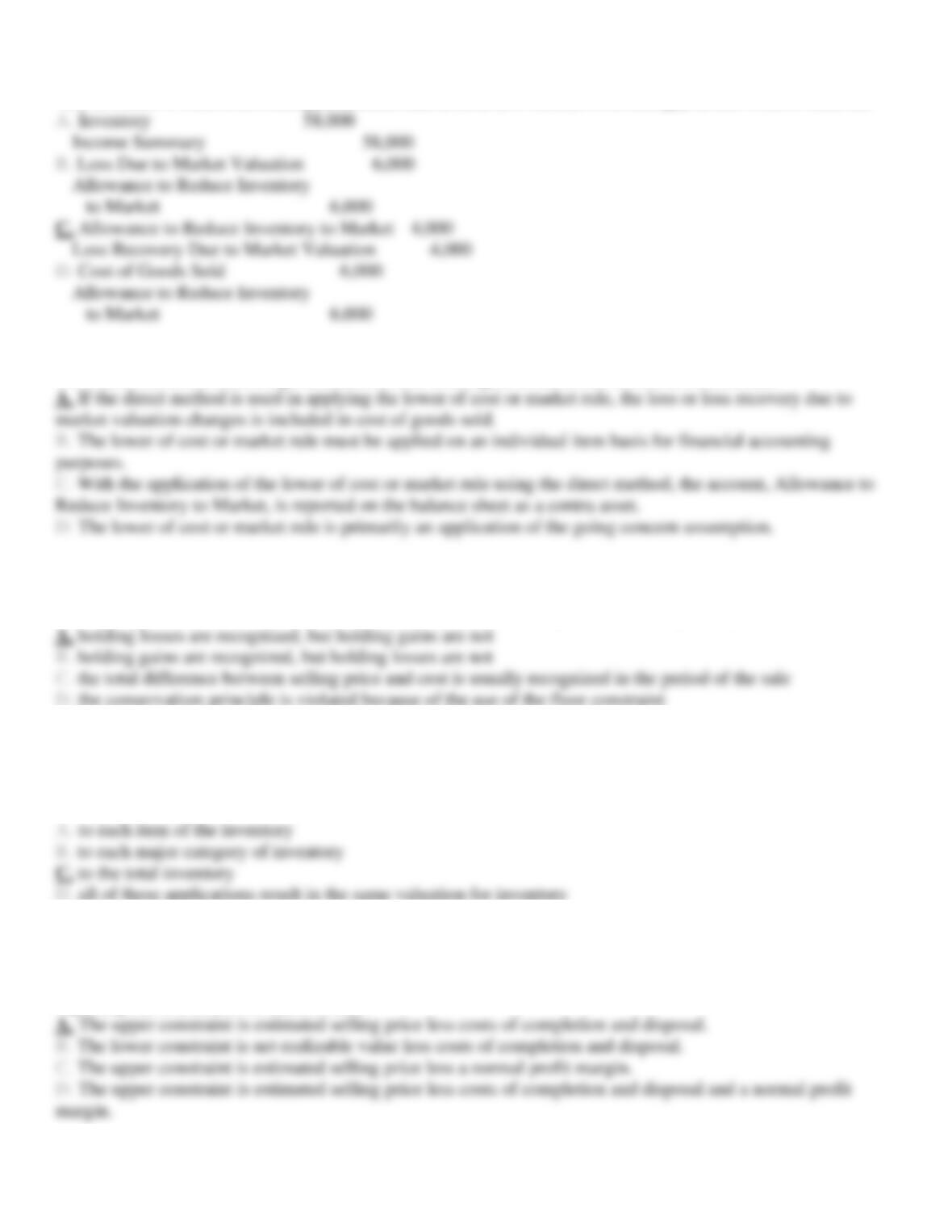
Refer to Exhibit 9-2. Which of the following journal entries would be correct as of December 31, 2012, to apply the lower of cost or market rule?
15. Which one of the following statements is true with regard to the lower of cost or market rule?
16. The major criticism of the lower of cost or market rule for valuation of inventory is that
17. Which application of the lower of cost or market rule will generally result in the highest valuation for the
ending inventory?
18. Concerning application of the lower of cost or market method, which one of the following statements is true
regarding the constraints on market value?
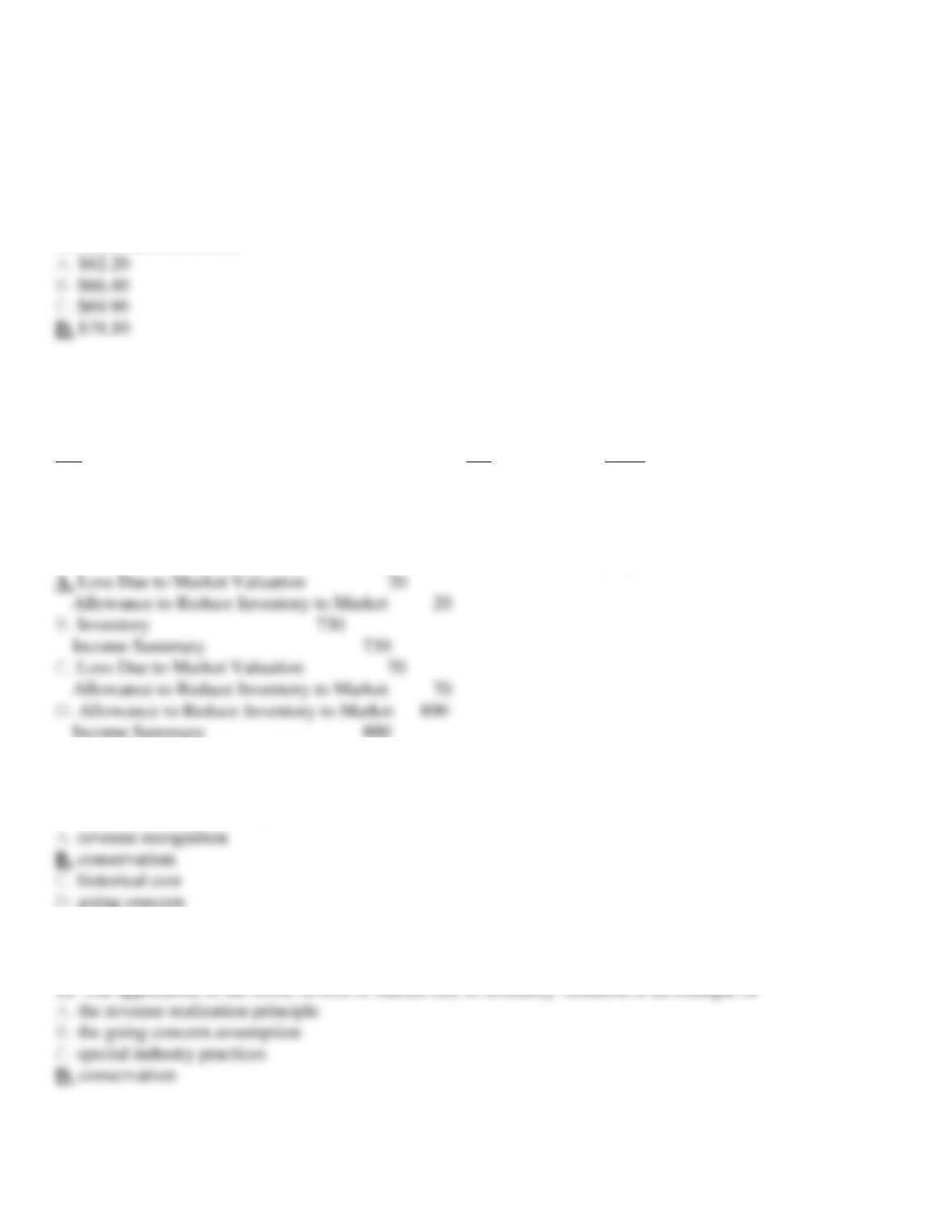
19. Marcus Company uses the lower of cost or market rule in valuing its inventory. The floor constraint for one
item in the inventory is $58.20. The following is other information concerning this unit:
Transportation costs
$ 4.00
Normal profit margin
11.70
Packaging costs
4.20
The market value for this item is
20. Given the following information for the Rachel Company:
Date
Cost
Market
December 31, 2010
$500
$500
December 31, 2011
700
650
December 31, 2012
800
730
If the allowance method of recording lower of cost or market is in use, which December 31, 2012, entry is correct?
21. In general, it is argued that the lower of cost or market rule is supported most closely by which of the
following theoretical assumptions?
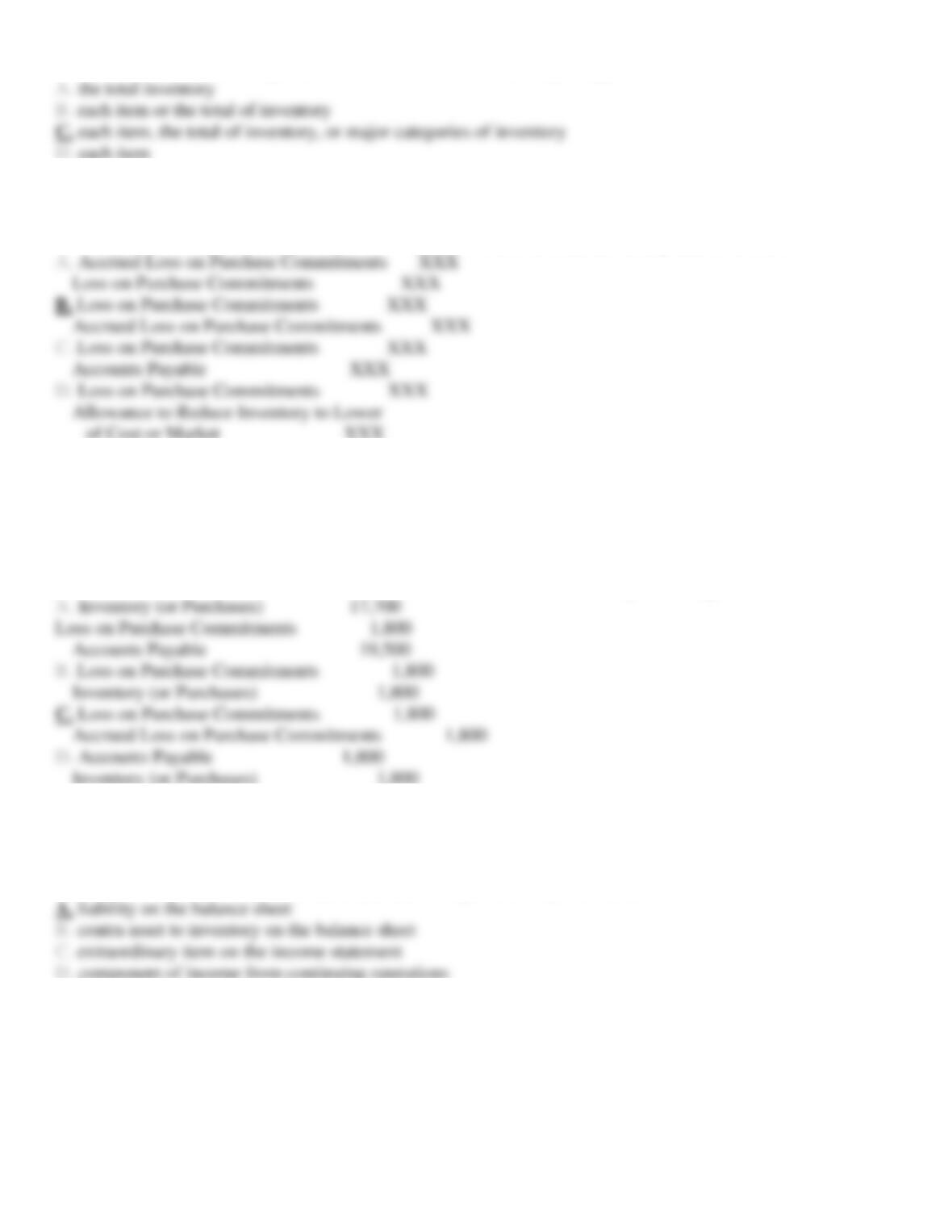
23. For valuation of inventory, the lower of cost or market rule may be applied to
24. The journal entry to record the existence of a loss on a non-cancellable fixed purchase contract is
25. The Wendy Company entered into a non-cancellable fixed price purchase obligation on July 20, 2010, to
purchase 3,000 assemblies at $6.50 per assembly to be delivered on March 2, 2012. On December 31, 2011, the
replacement cost of the assembly was determined to be $5.90 per assembly. Which of the following adjusting
journal entries would be correct as of December 31, 2011, to account for the price change?
26. The account, Accrued Loss on Purchase Commitments, used when the year-end market price is less than the
fixed purchase price for non-cancellable purchase obligations is reported as a(n)
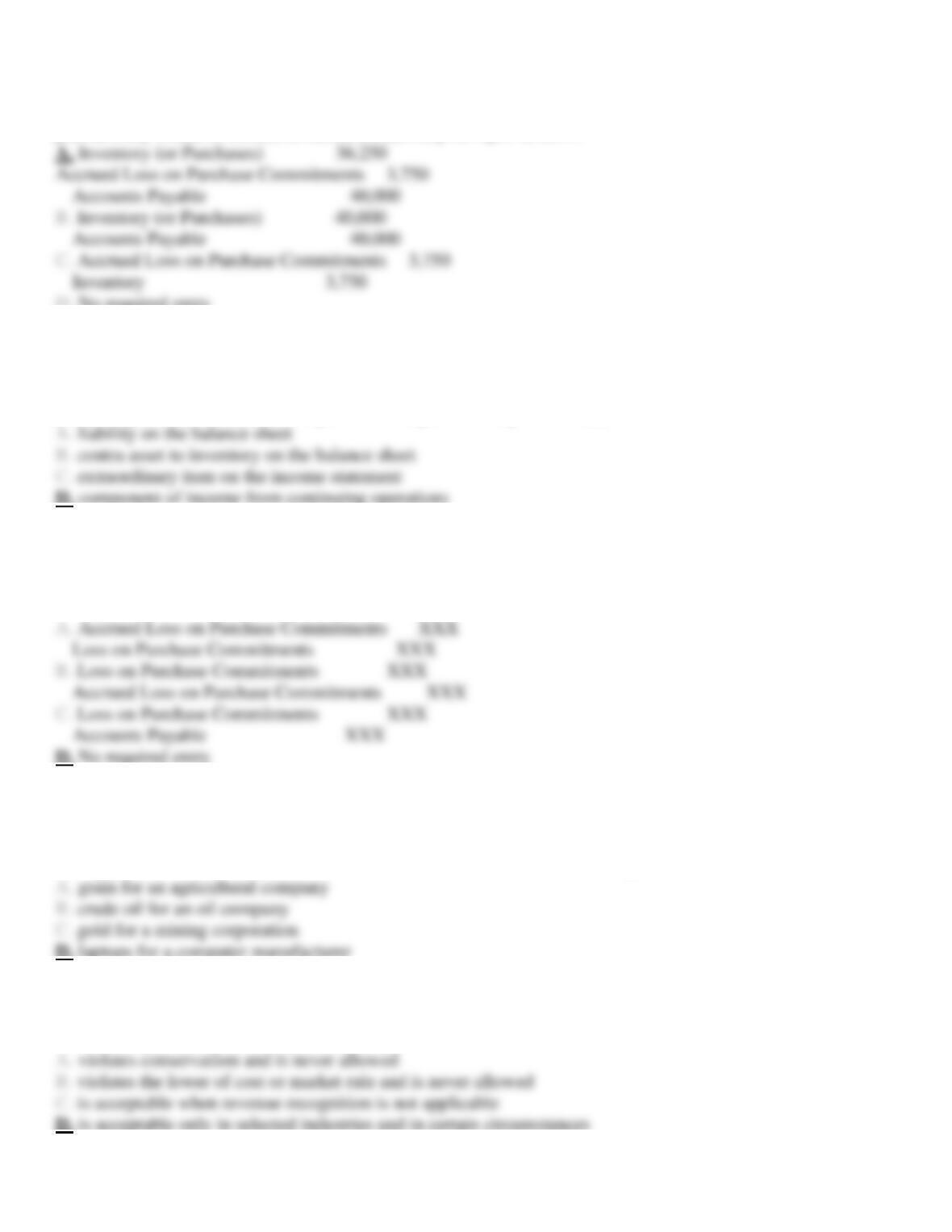
27. The Marjorie Company entered into a non-cancellable fixed price purchase obligation on August 19, 2010.
The agreement was to purchase 2,500 units of material at $16.00 per unit to be delivered on April 1, 2011. On
December 31, 2010, and on April 1, 2011, the replacement cost is determined to be $14.50 per unit. Which
journal entry would be correct to record the delivery on April 1, 2011?
D. No required entry
28. The account, Loss on Purchase Commitments, used when the year-end market price is less than the fixed
purchase price for non-cancellable purchase obligations is reported as a(n)
29. Which journal entry is required to record the existence of a contingent loss on a cancelable fixed purchase
contract?
30. Which one of the following inventories may not be valued for balance sheet purposes at the inventory’s
selling price less distribution costs even if it is above the cost of the inventory?
31. Generally, valuing inventory above cost
32. Which one of the following inventories may be valued for balance sheet purposes at the inventory’s selling
price less distribution costs even if it is above the cost of the inventory?
33. For the period from 2010 through 2012, the Cheryl Company had net sales of $500,000 and a gross profit of
$200,000. During the first quarter of 2013, the company made purchases of $17,500 and recorded sales of
$37,500. The inventory value at the beginning of the year was 11,500. What is the estimated cost of Cheryl’s
inventory on March 31, 2013, using the gross profit method?
34. Exhibit 9-3
The Donna Company uses the gross profit method to estimate its inventory in interim financial statements. The
markup on cost is 50%. The following information is available:
January 1, 2010, inventory balance
$12,500
Purchases
25,000
Sales during January
24,000
Refer to Exhibit 9-3. The estimated inventory at January 31, 2010, is
35. Exhibit 9-3
The Donna Company uses the gross profit method to estimate its inventory in interim financial statements. The
markup on cost is 50%. The following information is available:
January 1, 2010, inventory balance
$12,500
Purchases
25,000
Sales during January
24,000
Refer to Exhibit 9-3. The estimated cost of goods sold at January 31, 2010, is
36. Consider the following:
Code:
A = Gross profit to net sales ratio
B = Gross profit to cost of goods sold ratio
Which equation is correct?
37. If the gross profit to cost of goods sold ratio is 0.30, the gross profit to sales ratio is
38. Relevance of the gross profit margin depends upon
39. Which one of the following statements is not true with regard to the gross profit method of estimating
inventories?

40. The Sara Company’s inventory was partially destroyed on July 4, 2010, when its warehouse caught on fire
early in the morning. Inventory that had a cost of $8,000 was saved. The accounting records, which were
located in a fireproof vault, contained the following information:
Sales (1/1/10 through 7/3/10)
$260,000
Purchases (1/1/10 through 7/3/10)
190,000
Inventory (1/1/10)
40,000
Gross profit ratio
30% of cost
Using the gross profit method, what is the estimated cost of the inventory destroyed by the fire?
41. Daphne Company used the gross profit method to estimate its ending inventory of $800, which was an
increase of $200 from the beginning inventory for the month. Gross purchases for the month amounted to
$6,000 and sales were $7,250, made at a gross profit of 25% on cost. Calculate the amount of purchase returns
made by Daphne for the month.
42. Given the following information for Bonnie Company:
Freight-in
$ 400
Purchases
10,050
Sales returns
100
Beginning inventory
1,750
Sales
13,450
Gross profit on sales
20%
Calculate ending inventory of Bonnie using the gross profit method.
43. As a result of taking a physical inventory count on December 31, 2010, the Samantha Company inventory
was determined to be $50,000. The auditors for Samantha suspected an inventory shortage and used the gross
profit method to estimate the ending inventory. The accounting records for the company contained the
following information:
Inventory (1/1/10)
$ 130,000
Purchases (2010)
770,000
Sales (2010)
1,100,000
Sales returns (2010)
100,000
Gross profit ratio
25% of sales
Using the gross profit method, what did the auditors estimate as the amount of the inventory shortage at December 31, 2010?
44. The gross profit method is most commonly used to
45. The Patti Company’s inventory was destroyed on July 4, 2010, when its warehouse caught on fire early in
the morning. Inventory was totally destroyed. The accounting records, which were located in a fireproof vault,
contained the following information:
Sales (1/1/10 through 7/3/10)
$250,000
Purchases (1/1/10 through 7/3/10)
180,000
Inventory (1/1/10)
45,000
Gross profit ratio
25% of cost
Using the gross profit method, what is the estimated cost of the inventory that was destroyed by the fire?
46. As a result of taking a physical inventory count on December 31, 2010, the Lisa Company inventory was
determined to be $61,500. The auditors for Lisa suspected an inventory shortage and used the gross profit
method to estimate the ending inventory. The accounting records for the company contained the following
information:
Inventory (1/1/10)
$ 130,000
Purchases (2010)
760,000
Sales (2010)
1,020,000
Sales returns (2010)
60,000
Gross profit ratio
25% of sales
Using the gross profit method, what did the auditors estimate as the amount of the inventory that should have been on hand at December 31, 2010?
47. Which one of the following statements regarding the gross profit method is not true?
48. Which one of the following statements regarding the gross profit method is true?
49. At the beginning of 2010, the Nancy Company had an inventory valued at $34,375 at cost ($50,000 at
retail). During the year, Nancy purchased inventory for $50,000 ($70,000 at retail), and made markdowns of
$7,500. Nancy’s sales in 2010 were $62,500. What is Nancy’s estimated ending inventory at FIFO cost using the
retail inventory method?
50. With the retail inventory method, how is the total beginning inventory value used in the calculation of the
cost-to-retail ratio for the current period under the following cost flow assumptions?
FIFO
Average Cost
LIFO
I.
Include
Include
Exclude
II.
Include
Exclude
Exclude
III.
Exclude
Exclude
Exclude
IV.
Exclude
Include
Exclude
51. The lower of cost or market rule for inventory valuation can be used in conjunction with the retail inventory
method if which of the following adjustments is made?
52. If the net markdowns are excluded from the calculation of the cost-to-retail ratio in the retail inventory
method, the ending inventory’s valuation is lower because of which of the following effects on the cost–to-retail
ratio?
53. The Beta Company uses the retail inventory method for valuation of its inventory. If an item had a cost of
$45, was originally marked to sell at $60, was later priced at $55, and finally was priced at $63, the final price
change is a
54. The Alice Company uses the retail inventory method and the average cost flow assumption for preparation
of its interim reports. Information about Alice’s inventory in the second quarter of 2010 is shown below:
Cost
Retail
Beginning inventory
$255
$ 800
Purchases
600
1,400
Net markups
200
Net markdowns
(500)
Sales
1,300
What is the estimated cost of Alice’s inventory on June 30, 2010?
55. The Mary Company provided the following data for its December 31, 2010, inventory maintained on the
retail basis.
At Cost
At Retail
Beginning inventory
$120,000
$224,000
Purchases
280,000
396,000
Markups (net)
20,000
Markdowns (net)
(40,000)
Sales
520,000
What is the estimated inventory at December 31, 2010, valued at lower of average cost or market?
56. When calculating the cost-to-retail ratio, net markups and markdowns are
57. Barbara Co. presents the following information:
Cost
Retail
Net markups
$ 200
Sales
2,100
Purchases
$1,870
2,050
Net markdowns
50
Beginning inventory
240
300
The company uses the average cost retail inventory method. What is the cost of ending inventory?
58. Which one of the following statements is not true concerning the retail inventory method?
59. Which one of the following statements is not true concerning the retail inventory method?
60. Edna Corp. uses the FIFO retail inventory method and reports the following information:
Cost
Retail
Purchases
$21,450
$28,000
Sales
24,800
Net markups
1,000
Beginning inventory
2,100
3,000
Net markdowns
400
What is the cost of ending inventory for Edna Corp.?

61. Amber Company uses the LIFO retail inventory method and reports the following information:
Cost
Retail
Beginning inventory
$ 540
$ 900
Net markups
1,000
Sales
4,500
Net markdowns
500
Purchases
3,150
4,000
What is the cost of ending inventory for Amber Company?
62. Laura, Ltd. used the LIFO retail inventory method to determine its ending inventory. The accounting
records for the company contained the following relevant information:
Cost
Retail
Net purchases
$48,000
$79,000
Sales
91,000
Beginning inventory
12,000
25,000
Net markups
5,000
Net markdowns
4,000
What is the cost of the ending inventory?
63. Debra’s Card Shop uses the average cost retail inventory method to determine the ending inventory. Debra’s
accounting records for 2010 contained the following information:
Cost
Retail
Purchases
$216,000
$317,500
Sales
350,000
Beginning inventory
64,000
78,500
Net markups
12,000
Net markdowns
8,000
In addition, sales returns for 2010 were $28,000, and employee discounts taken were $6,000. What is the cost of the ending inventory at December
31, 2010?

64. Sherrie’s Shoes uses the FIFO retail inventory method to determine its ending inventory. The accounting
records for Sherrie’s Shoes contained the following information:
Cost
Retail
Purchases
$242,000
$348,830
Sales
394,000
Sales returns
5,076
Beginning inventory
60,500
107,294
Net markups
32,800
Net markdowns
12,000
The freight-in charges for the merchandise were $7,500. What is the cost of ending inventory for Sherrie’s Shoes?
D. $59,400
65. Darla’s Dazzle Shop uses the lower of average cost or market retail inventory method to determine its
ending inventory. The accounting records for the current year for Darla’s contained the following information:
Cost
Retail
Beginning inventory
$19,000
$ 27,500
Purchases
71,500
94,000
Sales
105,000
Net markups
5,167
Net markdowns
3,067
In addition, the accounting records for Darla’s disclosed that freight-in charges were $4,500 and sales returns were $2,833. What is the cost–to-retail
percentage to be used for ending inventory calculations?
66. The Latisha Department Store uses the average cost retail inventory method to determine its ending
inventory. The accounting records for the current year for Latisha contained the following information:
Cost
Retail
Purchases
$61,200
$85,000
Beginning inventory
17,000
25,000
Sales
75,700
Net markups
7,500
Net markdowns
2,500

In addition, the accounting records for Latisha disclosed that purchases returns at cost and retail were $1,800 and $4,300, respectively. What is the
cost-to-retail percentage to be used for ending inventory calculations?
67. Carol Music Store uses the average cost retail inventory method to determine its ending inventory. The
accounting records for the current year for Carol contained the following information:
Cost
Retail
Purchases
$108,000
$137,750
Beginning inventory
24,000
32,000
Sales
146,250
Net markups
18,819
Net markdowns
6,500
Employee discounts
12,500
What is the cost-to-retail percentage to be used for ending inventory calculations?
68. The Susan Retail Shop uses the FIFO retail inventory method to determine its ending inventory. The
accounting records for the current year for Susan contained the following information:
Cost
Retail
Purchases
$225,000
$362,250
Beginning inventory
55,000
73,000
Sales
385,750
Net markups
32,500
Net markdowns
19,750
Employee discounts
12,500
What is the cost-to-retail percentage to be used for ending inventory calculations?
69. Which of the following variations of the retail inventory method would generally result in the lowest
cost-to-retail ratio in a period of declining prices?
70. Which of the following variations of the retail inventory method would generally result in the lowest
cost-to-retail ratio in a period of rising prices?
71. Which of the following items would not be used in the calculation of the cost-to-retail ratio if the FIFO
retail inventory method were used to determine the ending inventory?
72. Which of the following general assumptions underlie the retail inventory method?
73. Adell Co. uses the dollar-value LIFO retail method. The beginning inventory, purchased when the price
index was 100, had a retail value of $4,000 and a cost of $3,600. During the period, purchases amounted to
$60,000 at retail ($52,800 at cost). Sales amounted to $56,300. The year-end price index was 110. What is the
cost of ending inventory?