Chapter 9 Capital Budgeting Decisions
9-33
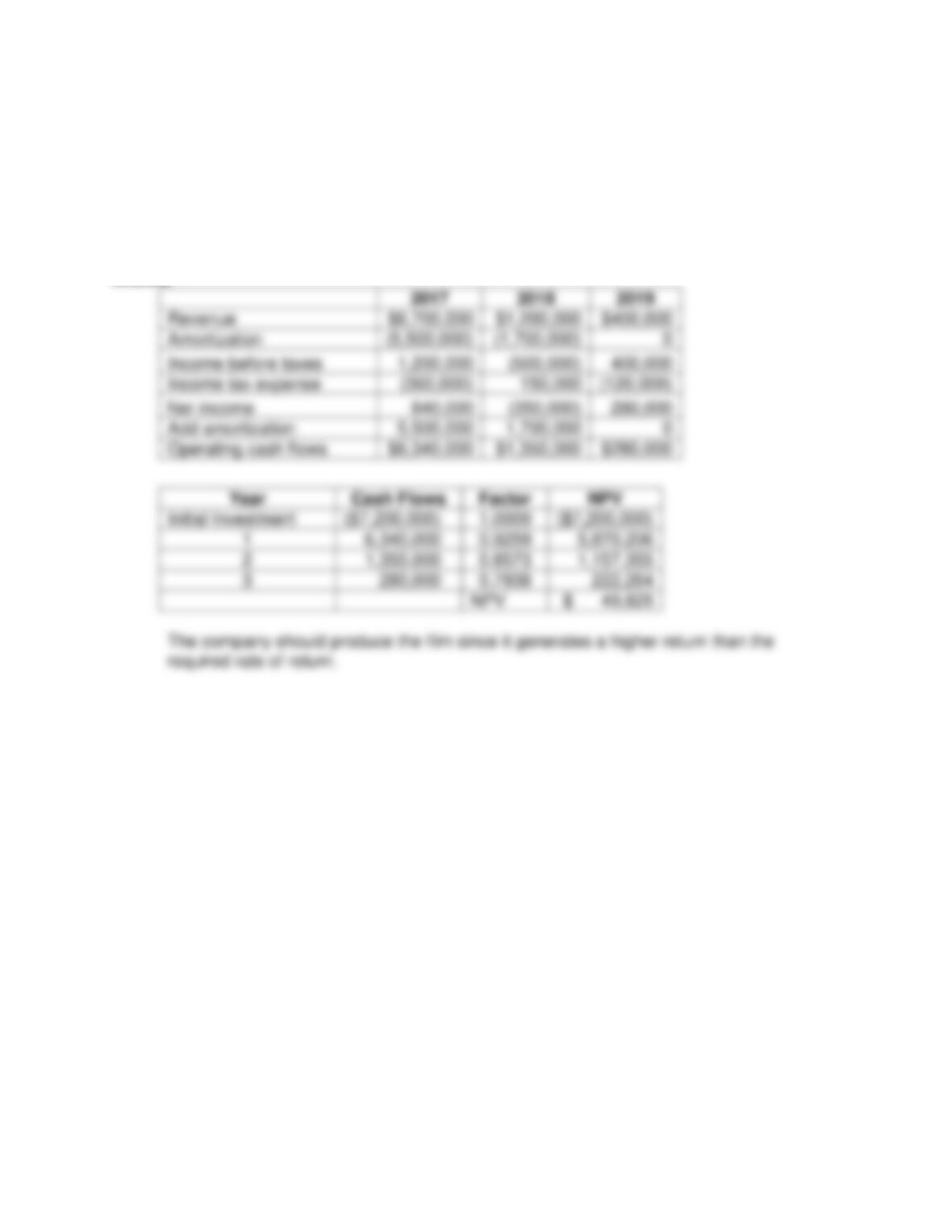
165. 3-D Studios is evaluating a film project. The president estimates the film will cost
$7,200,000 to produce. In its first year, 2017, the film is expected to generate
$5,800,000 in net revenue, after which the film will be released to video. The video is
expected to generate $900,000 in net revenue 2017, $1,200,000 in 2015, and $400,000
in 2016. Amortization of the film cost will be $5,500,000 in 2017 and $1,700,000 in 2015.
The company’s tax rate is 30% and it requires an 8% rate of return on its films. All
outlays to produce the film occur at the beginning of January 2017. How much is the net
present value of the film project? Should the company produce the film?
Answer
Test Bank to accompany Jiambalvo Managerial Accounting, 6th Edition
9-34
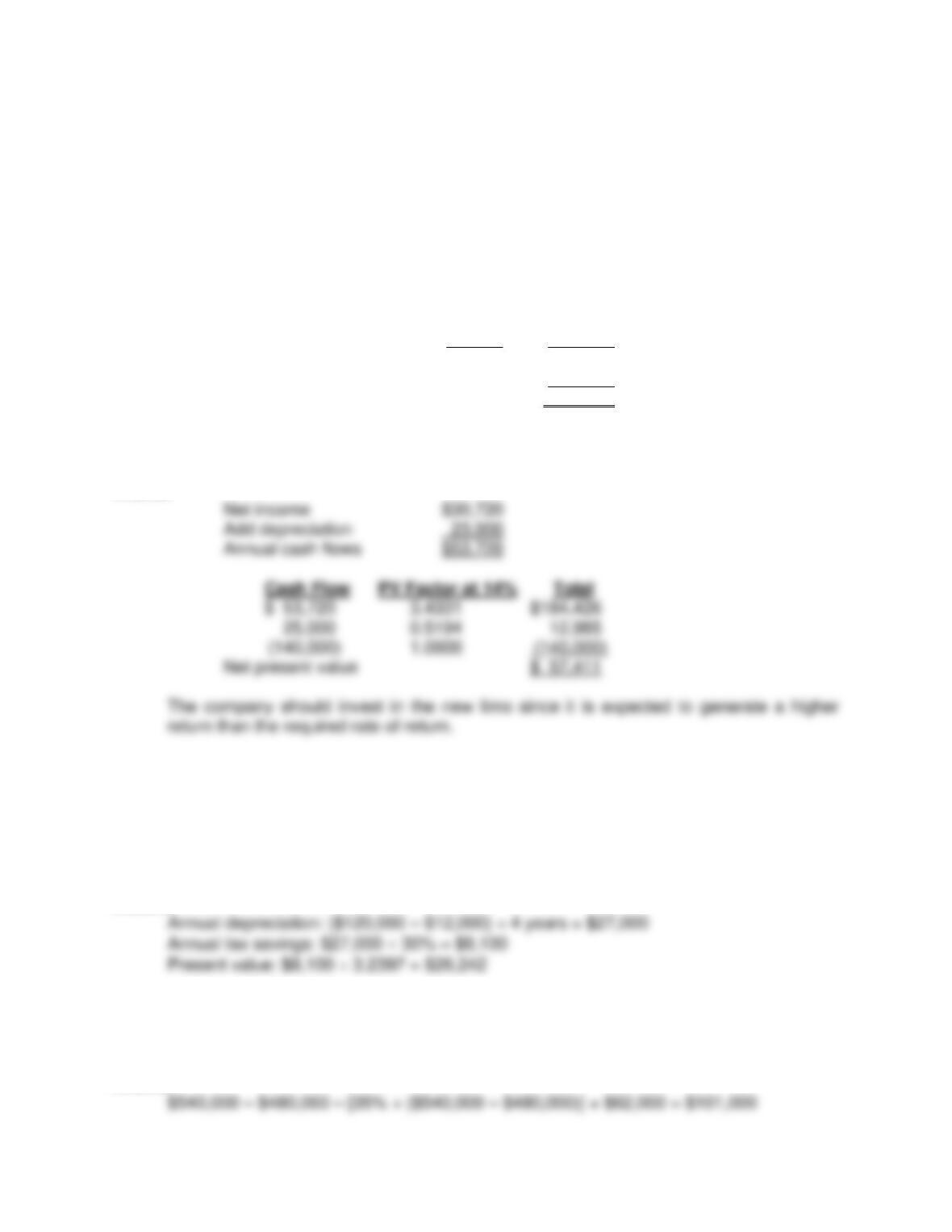
166. Sweet Thing Limo is considering an acquisition of an additional vehicle for its limo
chauffeur service. The model under consideration will cost $140,000, have a 5-year life,
and a $25,000 residual value. The company anticipates that the effect on annual net
income will be as follows:
Revenue $138,000
Expenses
Driver $49,000
Fuel 9,000
Maintenance 2,000
Insurance 1,800
Depreciation 23,000
Miscellaneous 2,000 86,800
Income before taxes 51,200
Income tax expense 20,480
Net income $ 30,720
The company has a required rate of return of 14%. Calculate the net present value of the
investment. Should the company invest in the new limo?
Answer
167. Recording Tunes is planning a $120,000 investment in microphones for its recording
business. The microphones has an expected 4-year life with a salvage value of $12,000.
The company uses the straight-line method of depreciation, has an income tax rate of
30%, and a required rate of return of 9%. How much is the present value of the tax
savings related to depreciation of the equipment?
Answer
168. Chap Creations reported revenues of $540,000 and expenses of $480,000 last year,
which included depreciation expense totaling $62,000. The company pays income taxes
at a 35% rate. How much is the company’s annual operating cash flows?
Answer
Chapter 9 Capital Budgeting Decisions
9-35
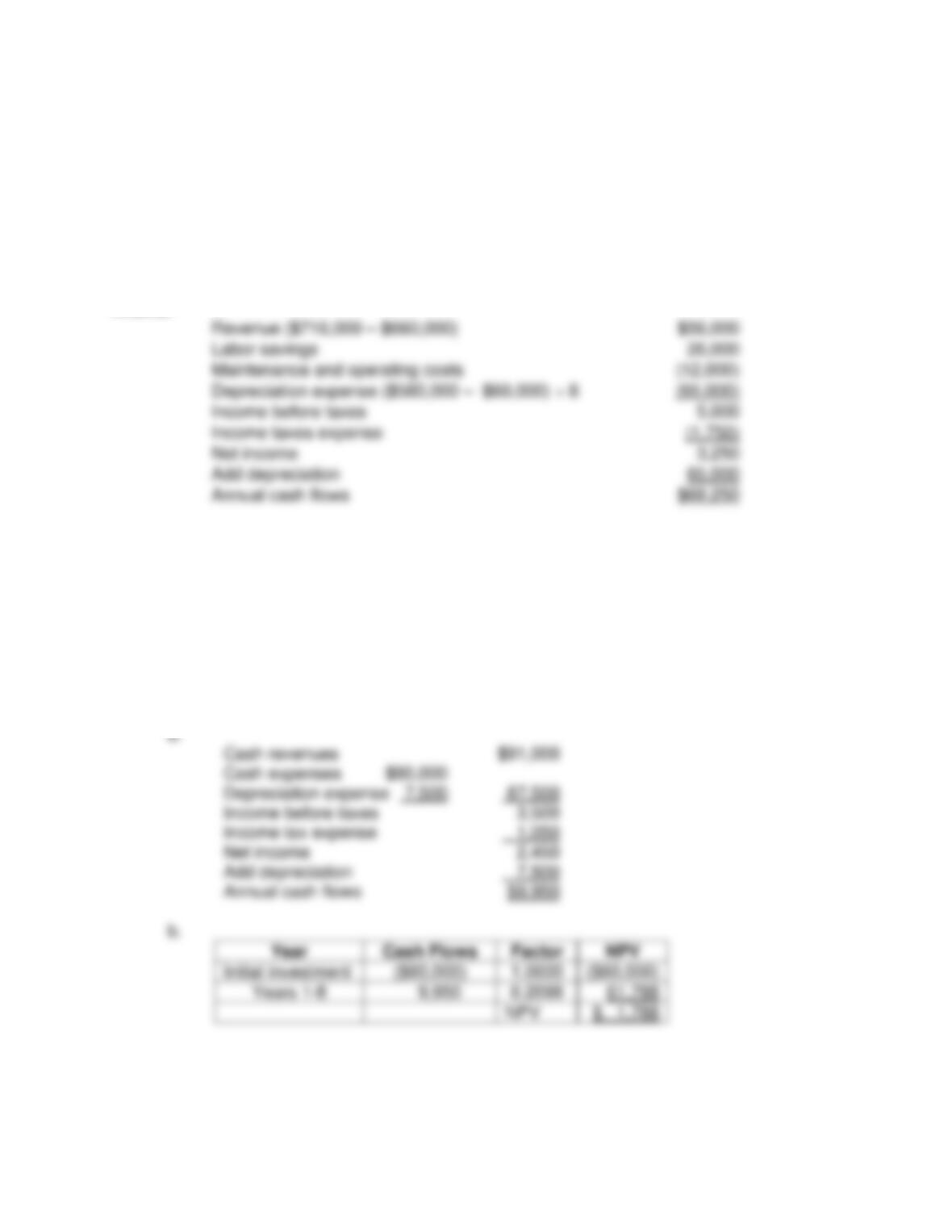
169. U-Vision is deciding whether to buy a machine that packages products so that it can
reduce labor costs. The machine has an initial cost of $580,000. The company estimates
the new machine will speed up production and be able to generate annual revenues
totaling $716,000 up from the current revenue of $660,000. U-Vision estimates the
machine can be sold at the end of its estimated 8-year life for $60,000. Labor saved per
year as a result of acquiring the machine is expected to be $26,000. Additional
maintenance and operating expenses as a result of the pending acquisition are expected
to be $12,000 per year. U-Vision’s required rate of return is 8% and its income tax rate is
35%. Calculate annual operating cash flows for U-Vision.
Answer
170. Deli Pizza is considering an investment that will generate cash revenues of $91,000 per
year for 8 years, and have cash expenses of $80,000 per year for 8 years. The cost of
the asset is $60,000, and it will be depreciated using straight-line depreciation over its 8-
year life. The company pays income taxes at a rate of 30%. The required rate of return is
6%.
a. Prepare a schedule showing the annual cash flows associated with this asset.
b. Compute the net present value of this investment.
Answer
Test Bank to accompany Jiambalvo Managerial Accounting, 6th Edition
9-36
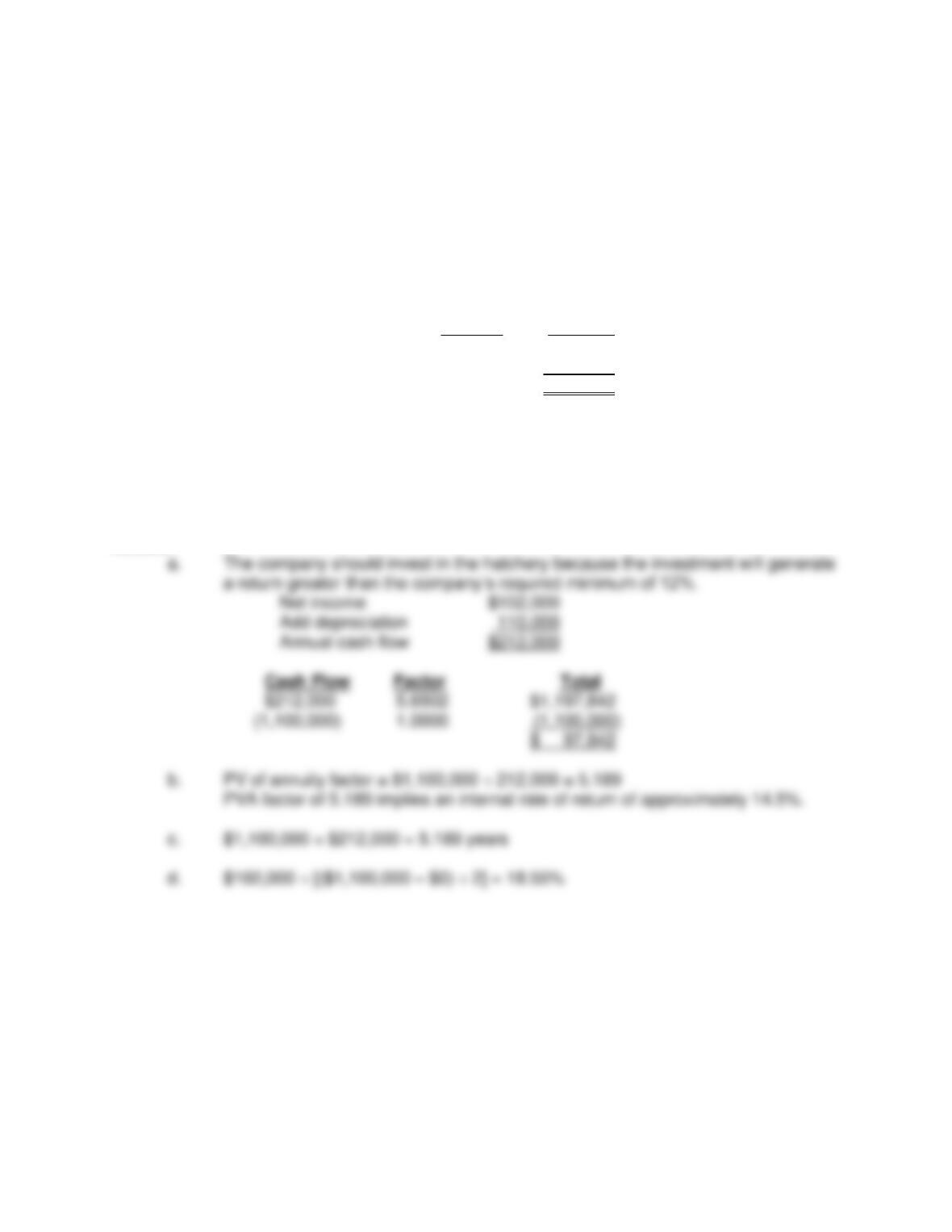
171. Harry’s Seafood is considering the addition of a fish hatchery. Construction of the facility
is estimated to cost $1,100,000 and will be depreciated over 10 years using the straight-
line method. The hatchery is expected to have no estimated residual value. Harry’s
Seafood has a required rate of return of 12%. Incremental net income related to each
year of the investment is as follows:
Revenue $450,000
Expenses:
Material cost $ 60,000
Labor 100,000
Depreciation 110,000
Other 10,000 280,000
Income before taxes 170,000
Income tax expense at 40% 68,000
Net income $102,000
a. Determine the net present value of the investment. Should Harry’s Seafood
invest in the hatchery?
b. Calculate the internal rate of return of the investment to the nearest ½ percent.
c. Calculate the payback period of the investment.
d. Calculate the accounting rate of return.
Answer
Chapter 9 Capital Budgeting Decisions
9-37
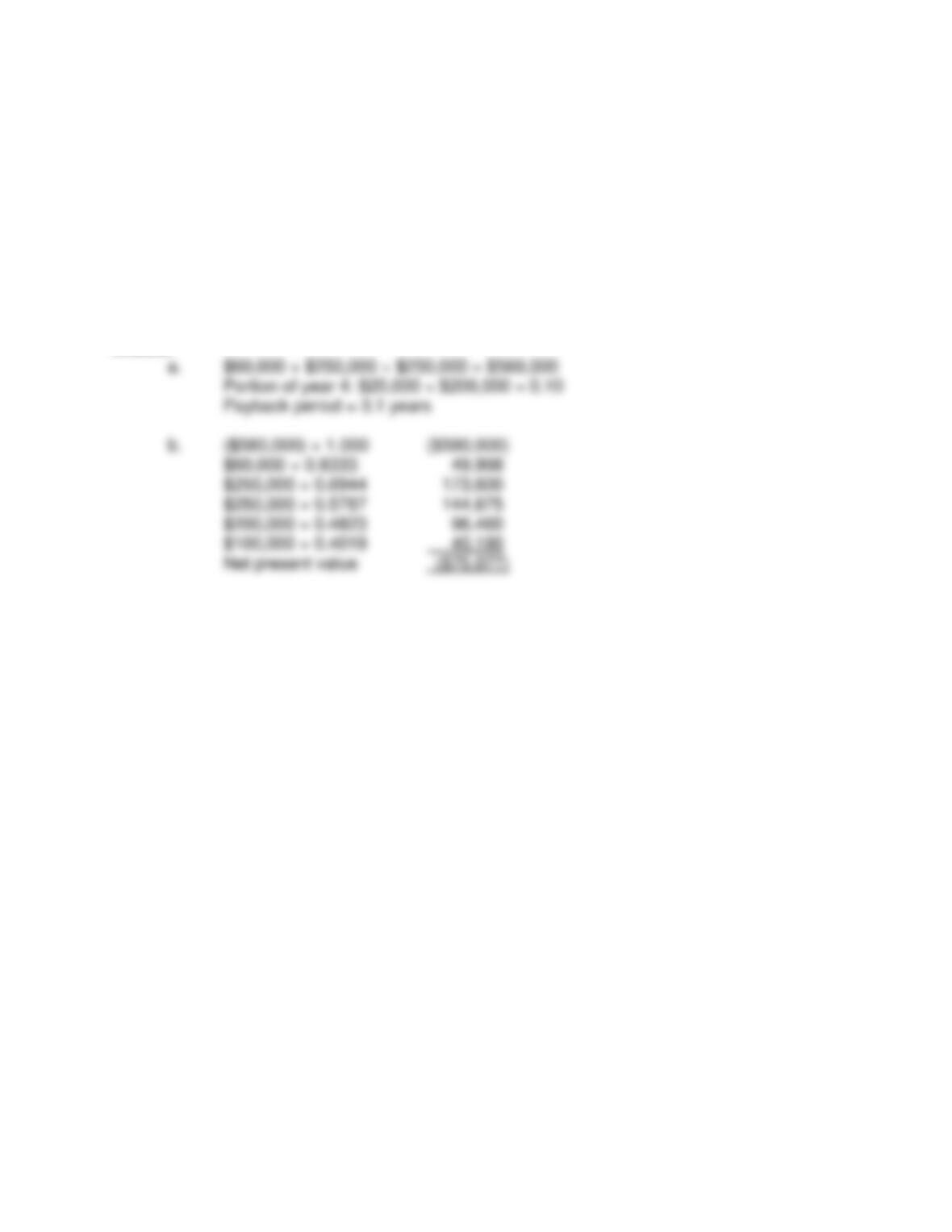
172. A project will require an initial investment of $580,000 and is expected to generate the
following cash flows:
Year 1 $ 60,000
Year 2 250,000
Year 3 250,000
Year 4 200,000
Year 5 100,000
a. What is the project’s payback period?
b. If the required rate of return is 20% and taxes are ignored, what is the project’s
net present value?
Answer

Test Bank to accompany Jiambalvo Managerial Accounting, 6th Edition
9-38
CHALLENGE EXERCISES
173. Tow’em Away is considering the purchase of a tow truck with a cost of $54,400 to be
acquired on January 1, 2017. Tow’em estimates the truck can be sold for $10,400 at the
end of its 5–year estimated life. Tow’em has a cost of capital of 6% and a required rate of
return of 8%. This purchase would allow Tow’em to make 2,200 more tows per year.
Annual cash basis net income relating to the tow truck is estimated at $20,200. Income
taxes are 32%.
a. Calculate the depreciation tax shield for 2017.
b. What is the nature of the depreciation tax shield? Why is the depreciation tax
shield a component of analyzing investment decisions?
c. Calculate Tow’em’s annual operating cash flows relating to the tow truck
purchase.
Answer
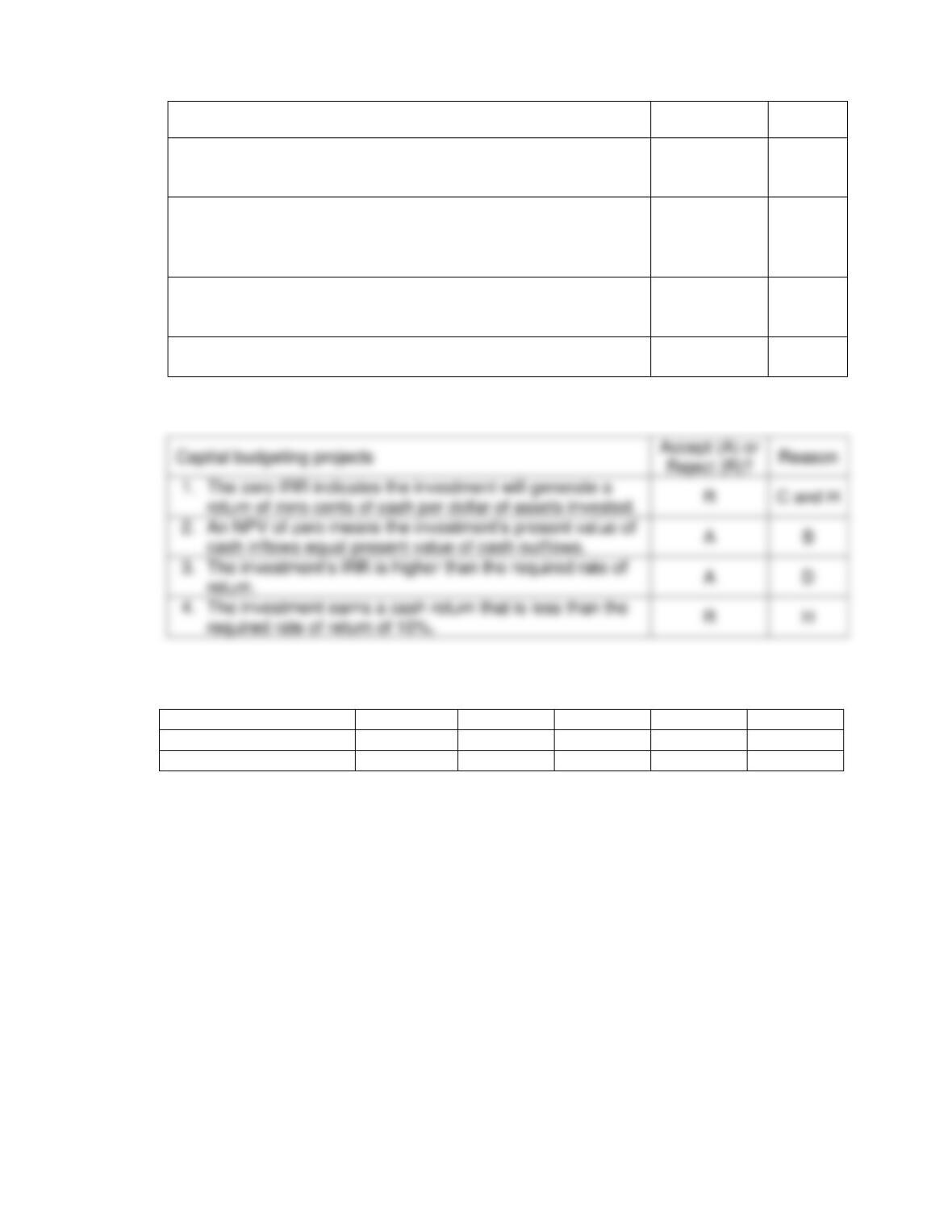
174. For each capital budgeting project below, indicate whether management should Accept
or Reject by placing an A or R, respectively, in the space provided next to each project.
Select the best reason for the respective action from the list of reasons by printing a
legible uppercase letter in the space provided.
Possible Reasons
A. The investment’s return is less than the cost of capital.
B. The investment earns a return rate equal to the company’s hurdle rate.
C. The cash outflows equal the cash inflows.
D. The investment’s internal rate of return is greater than the required rate of return.
E. The investment generates a return on profit less than the required rate of return.
G. The investment generates a cash return greater than the required rate of return.
H. The investment generates a cash return less than the required rate of return.
J. The hurdle rate is greater than the required rate of return.
K. The hurdle rate is less than the required rate of return.
M. The total cash paid out is less than the total cash received.
Chapter 9 Capital Budgeting Decisions
9-39
Capital budgeting projects
Accept (A) or
Reject (R)?
Reason
1. JT Corp. has a cost of capital at 6.2% and a required rate
of return at 7.9%. The company evaluated an investment
and determined the IRR was zero.
2. Save Company evaluated a potential investment and
determined the NPV to be zero. Save Company’s
required rate of return is 9.1% and its cost of capital is
6.4%.
3. An investment project has an internal rate of return of
10.8%. The initial outlay for the investment is $91,000.
The hurdle rate is 10.2%.
4. An investment project has an NPV of ($5,200). The hurdle
rate is 10%.
Answer
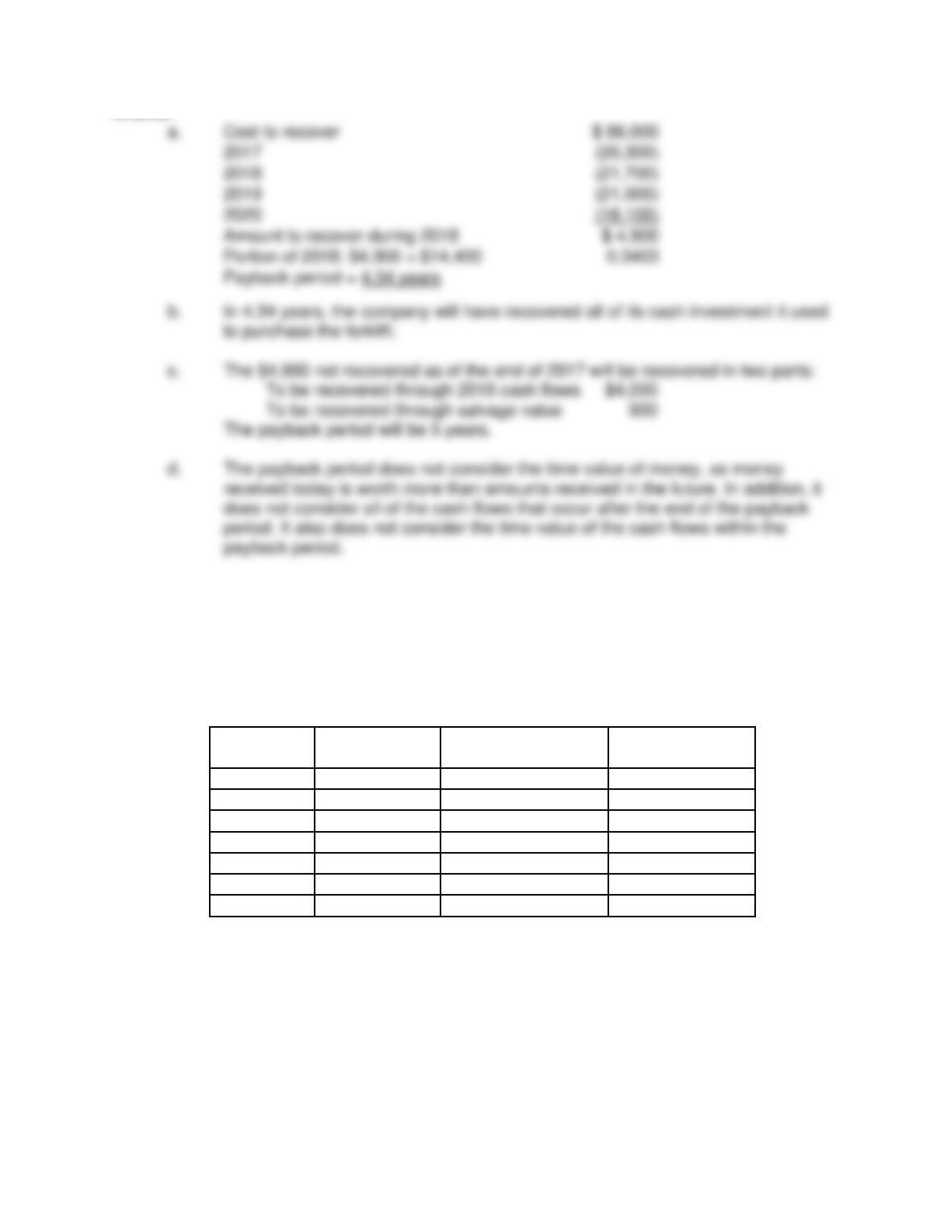
175. A proposed acquisition of a forklift on January 1, 2017 will cost $86,000, and have an
estimated salvage value at the end of its estimated 5-year estimated life of $21,000.
2017
2018
2019
2020
2021
Net income
$ 7,300
$ 8,700
$ 8,000
$ 5,100
$ 1,400
Operating cash flows
20,300
21,700
21,000
18,100
14,400
The company’s required rate of return is 7% and its cost of capital is 6%. The income tax
rate is 32%.
a. Determine the payback period of the proposed acquisition.
b. Interpret the meaning of your answer in part A.
c. Suppose that the amounts for 2018 are a loss of $9,000 and cash flows of
$4,000 instead of the amounts given. How will the payback period differ?
d. What are the criticisms against the payback period?
Test Bank to accompany Jiambalvo Managerial Accounting, 6th Edition
9-40
Answer
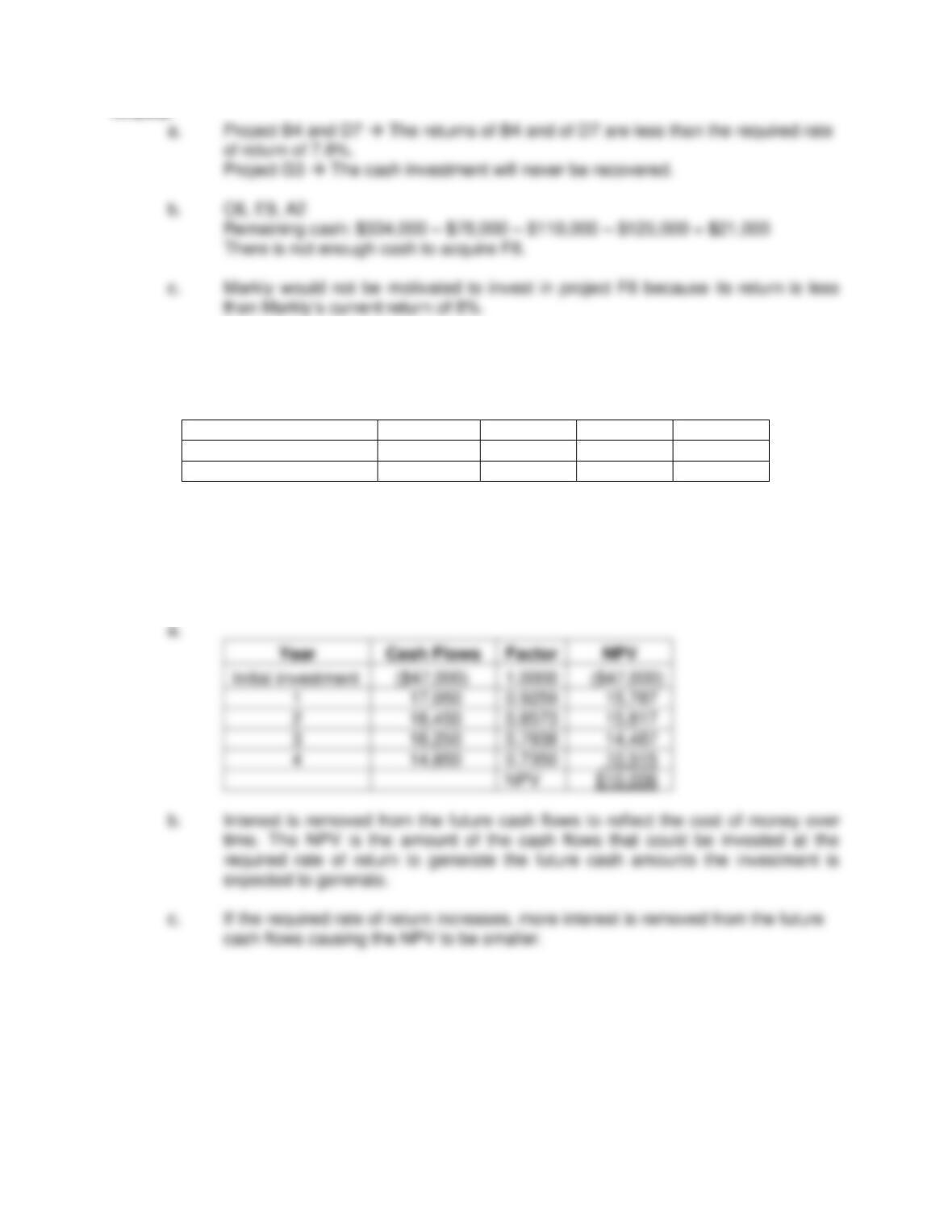
176. Markly, Inc. is planning a new capital investment. The company has a 7.8% required rate
of return and a 6.3% cost of capital. Markly currently has a return of 8% on its other
investments. The proposed new investment has equal annual cash inflows expected.
Management calculated the payback period using the computation of the investment and
annual cash flows, and the IRR for 6 investments that are displayed below. Each
investment has a 7-year expected useful life and no salvage value.
Payback
Period
IRR
Investment
Cost
Project A2
5.2
8.5%
$125,000
Project B4
6.9
3.1%
62,000
Project C6
6.0
11.4%
78,000
Project D7
5.8
5.4%
56,000
Project E9
4.2
10.1%
110,000
Project F8
5.0
7.9%
60,000
Project G3
7.3
7.8%
71,000
a. Identify which project(s) is/are unacceptable and briefly state the conceptual
justification as to why each of your choices is unacceptable.
b. Markly has $334,000 available to spend. List the project(s) in which Markly
should invest, in the order the investments should be undertaken.
c. Will Markly be motivated to invest in all of the projects you selected in Part b if
Markly is evaluated using return on investment?
Chapter 9 Capital Budgeting Decisions
9-41
Answer
177. JayTree, Inc. is considering a purchase of a patent with a cost of $47,000 and an
estimated revenue producing life for JayTree of 4 years. JayTree has a required rate of
return is 8% and a cost of capital of 7%. The patent is expected to generate the following
amounts of annual income and cash flows:
Year 1
Year 2
Year 3
Year 4
Net income
$ 5,300
$ 6,700
$ 6,500
$ 3,100
Operating cash flows
17,050
18,450
18,250
14,850
a. Calculate the NPV of the investment.
b. What does the NPV calculation do, i.e., what is the nature of the NPV amount?
c. If the required rate of return increases, will the NPV increase or decrease? Explain
why.
Answer
Initial investment
Test Bank to accompany Jiambalvo Managerial Accounting, 6th Edition
9-42
SHORT-ANSWER ESSAYS
178. Division managers at Swearingen Investments are evaluated and rewarded based on
returns on investments it accepts. In the current year, Bill Christ, the president of the
commercial products division, has an required rate of return target of 12%. If the division
has an required rate of return of 12% or greater, Christ will receive 250,000 options on
Swearingen stock in addition to a base salary of $500,000.
The Commercial Products Division is considering a major investment in product
development, which has a net present value of $25,000,000. However, the investment
will have a negative effect on reported profit over the next two years, after which the
investment will begin to have a significant positive effect on firm profitability for the next
eight years.
Suppose Christ currently holds stock in Swearingen Investments with a market value of
$1,250,000 and has options on 500,000 shares (awarded in previous years). Is this likely
to aggravate or mitigate the conflict?
Answer
179. What are capital budgeting decisions?
Answer
180. What is meant by “the time value of money” concept?
Answer
181. What is the most significant difference between the net present value and internal rate of
return methods and the payback period and accounting rate of return methods?
Answer
Chapter 9 Capital Budgeting Decisions
9-43
182. How does a firm determine its required rate of return?
Answer
183. What are “soft” benefits? What are the effects of ignoring “soft” benefits in capital
budgeting decisions?
Answer
184. Explain the importance of depreciation in a capital budgeting analysis.
Answer
185. Why is it important to adjust future cash flows for inflation? What is the impact of failing
to do so?
Answer
186. The payback period method of evaluating capital budgeting alternatives has two
significant drawbacks. What are they?
187. Why is the impact of accepting a sound capital project often negative in terms of short–
term profits?
Answer