8) The principal ledger containing all the balance sheet and income statement accounts is the:
A) general ledger.
B) creditors’ ledger.
C) customers’ ledger.
D) subsidiary ledger.
9) Entries to customers’ accounts for sales are posted in the:
A) accounts receivable subsidiary ledger.
B) accounts payable subsidiary ledger.
C) adjustment subsidiary ledger.
D) sales subsidiary ledger.
10) A checkmark in the PR column in the general journal means:
A) the entry was recorded correctly.
B) the amount was posted to the controlling account.
C) the amount was recorded in the subsidiary ledger.
D) the payroll was paid.
11) The accounts receivable subsidiary ledger:
A) is organized in alphabetical order.
B) is not kept in the same book as Accounts Receivable.
C) should equal the controlling account in the general ledger.
D) All of the above are correct.
12) The normal balance of the accounts receivable subsidiary ledger is:
A) credit.
B) debit.
C) It does not have a normal balance.
D) Not enough information provided.
13) The return of merchandise by a credit customer was recorded with a debit to Accounts Payable and a
credit to Accounts Receivable and the subsidiary ledger. This error will cause:
A) the net income for the period to be overstated.
B) the net Sales for the period to be overstated
C) the control account to not agree with the subsidiary ledger.
D) the assets to be overstated.
14) If a credit memorandum is issued, what account will be decreased on the seller‘s books?
A) Accounts Receivable
B) Sales Discounts
C) Sales
D) Sales Returns and Allowances
15) Jane’s Jewelry sold 50 necklaces for $45 each to a credit customer. The invoice included a 4% sales tax
and payment terms of 7/10, n/30. In addition, 5 necklaces were returned prior to payment. The entry to
record the return would include: (Round your calculation to the nearest whole dollar.)
A) a debit to Sales Returns and Allowances for $45.
B) a debit to Sales Returns and Allowances for $225.
C) a credit to Sales Tax Payable for $9.
D) a debit to Accounts Receivable for $45.
16) Sales Returns and Allowances is a contra–revenue account with a normal debit balance.
17) An example of a subsidiary ledger is the revenue ledger.
18) Accounts in the accounts receivable subsidiary ledger are listed alphabetically.
19) The balance in the Accounts Receivable account is $2,300 debit. Therefore, the balances in the
subsidiary ledger should be $2,100.
20) The controlling account is found in the subsidiary ledger and it summarizes or controls the general
ledger account.
21) The accounts receivable subsidiary ledger shows the amount collected from each customer.
22) When you record the entry to the subsidiary ledger and place the checkmark in the PR column, it is
necessary to post to the Accounts Receivable controlling account.
23) The general ledger and the accounts receivable subsidiary ledger are the same book.
24) To show that you have posted to an account in the General Ledger, you use a checkmark.
25) Individual credit customer accounts are kept in the Accounts Receivable Subsidiary Ledger.
26) Define and compare the accounts receivable subsidiary ledger with the controlling account, Accounts
Receivable.
27) Explain why, when a customer returns merchandise after it was paid for, he/she may or may not
receive credit equal to the invoice value of the merchandise returned.
9.3 Learning Objective 9-3
1) Collected a payment from a credit customer. This will be recorded with:
A) a credit to an asset account.
B) a credit to a liability account.
C) a credit to Revenue.
D) a credit to Sales Discounts account.
2) Sold merchandise subject to a sales tax, accepting cash. This will be recorded with:
A) a credit to an asset account.
B) a credit to a liability account.
C) a debit to Sales.
D) a debit to Sales Tax Payable.
3) Sold Merchandise for Cash subject to a sales tax accepting cash. This will be recorded with:
A) a credit to an asset account.
B) a debit to a liability account.
C) a debit to Capital.
D) None of these is correct.
4) Received payment, within the discount period, for merchandise sold previously. This will be recorded
with:
A) a credit to an asset account.
B) a debit to a liability account.
C) a debit to Sales.
D) a credit to a contra-sales account.
5) A characteristic of a schedule of accounts receivable is that:
A) it contains a list of customers’ names with balances.
B) the total is equal to the accounts receivable control account at the end of the month.
C) it is prepared at the end of the month.
D) All of these answers are correct.
6) Payment for merchandise sold on credit for $250 subject to 1/10, n/30 was received within the discount
period—$247.50 was received. This was recorded with a debit to Sales Discounts for $2.50, a debit to Cash
for $247.50, and a credit to Accounts Receivable $250, but no mention was made of the subsidiary ledger
account. This error will cause:
A) the net income for the period to be overstated.
B) the net income for the period to be understated.
C) the control account to not agree with the subsidiary ledger.
D) the assets to be overstated.
7) The collection on account within the 1/10, n/30 discount period was recorded using a 10% discount
rather than a 1% discount in both the controlling and subsidiary accounts. This error will cause:
A) the net income for the period to be understated.
B) the net income for the period to be overstated.
C) the control account to not agree with the subsidiary ledger.
D) the assets to be overstated.
8) Jane’s Jewelry sold 50 necklaces for $30 each to a credit customer. The invoice included a 7% sales tax
and payment terms of 3/10, n/30. In addition, 7 necklaces were returned prior to payment. The entry to
record the payment after the discount period would include: (Round any intermediate calculations to the
nearest cent, and your final answer to the nearest dollar.)
A) a credit to Cash for $1,290.
B) a credit to Cash for $1,380.
C) a credit to Accounts Receivable for $1,290.
D) a credit to Accounts Receivable for $1,380.
9) The discount period is longer than the credit period.
10) Determine the amount to be paid within the discount period for a previous sale with an invoice price
of $12,000, subject to credit terms of 2/10, n/30.
$ ________
11) Determine the amount of cash collected on a credit sale with a price of $80,000 and credit terms of
1/10, n/30, assuming the payment was after the discount period had expired.
$ ________
12) Determine the amount of cash collected at the time of making a sale of $8,500 worth of merchandise
subject to a 6% sales tax.
$ ________
13) Determine the amount of cash collected at the time of making a sale of $1,000 worth of merchandise
subject to a 3% sales tax.
$ ________
14) Determine the amount of cash collected on a credit sale in the amount of $5,000, subject to a 5% sales
tax when $500 worth of merchandise has already been returned for credit. Assume cash is collected after
the discount period.
$ ________
15) Prepare the necessary general journal entry for December 2.
__________________________________________ __________ __________
__________________________________________ __________ __________
__________________________________________ __________ __________
16) Prepare the necessary general journal entry for December 4.
__________________________________________ __________ __________
__________________________________________ __________ __________
__________________________________________ __________ __________
17) Prepare the necessary general journal entry for December 10.
__________________________________________ __________ __________
__________________________________________ __________ __________
__________________________________________ __________ __________
18) Prepare the necessary general journal entry for December 16.
__________________________________________ __________ __________
__________________________________________ __________ __________
__________________________________________ __________ __________
19) Explain how the record keeping differs between a cash sale and a credit sale.
The Bay Co. had the following transactions involving the sale of merchandise. You are to prepare the
necessary general journal entries. All sales are subject to credit terms of 1/10, n/30. No sales taxes are
applicable.
July 16 Sold merchandise on account with an invoice price of $5,500 to Carter and Co.
July 16 Sold merchandise on account with an invoice price of $6,000 to the Ping Co.
July 20 Ping Co. returned merchandise with an invoice price of $1,000.
July 25 Received full payment from Carter and Co.
July 28 Received full payment from Ping Co.
20) Prepare the necessary general journal entry for July 16, Sold merchandise on account with an invoice
price of $5,500 to Carter and Co.
__________________________________________ __________ __________
__________________________________________ __________ __________
__________________________________________ __________ __________
21) Prepare the necessary general journal entry for July 16. Sold merchandise on account with an invoice
price of $6,000 to the Ping Co.
__________________________________________ __________ __________
__________________________________________ __________ __________
__________________________________________ __________ __________
22) Prepare the necessary general journal entry for July 20.
__________________________________________ __________ __________
__________________________________________ __________ __________
__________________________________________ __________ __________
23) Prepare the necessary general journal entry for July 25.
__________________________________________ __________ __________
__________________________________________ __________ __________
__________________________________________ __________ __________
24) Prepare the necessary general journal entry for July 28.
__________________________________________ __________ __________
__________________________________________ __________ __________
__________________________________________ __________ __________
25) Prepare the necessary general journal entry for April 13.
__________________________________________ __________ __________
__________________________________________ __________ __________
__________________________________________ __________ __________
26) Prepare the necessary general journal entry for April 14.
__________________________________________ __________ __________
__________________________________________ __________ __________
__________________________________________ __________ __________
27) Prepare the necessary general journal entry for April 15.
__________________________________________ __________ __________
__________________________________________ __________ __________
__________________________________________ __________ __________
28) Prepare the necessary general journal entry for April 16.
__________________________________________ __________ __________
__________________________________________ __________ __________
__________________________________________ __________ __________
29) Prepare the necessary general journal entry for April 20.
__________________________________________ __________ __________
__________________________________________ __________ __________
__________________________________________ __________ __________
30) Prepare the necessary general journal entry for April 25.
__________________________________________ __________ __________
__________________________________________ __________ __________
__________________________________________ __________ __________
31) Prepare the necessary general journal entry for April 30.
__________________________________________ __________ __________
__________________________________________ __________ __________
__________________________________________ __________ __________

32
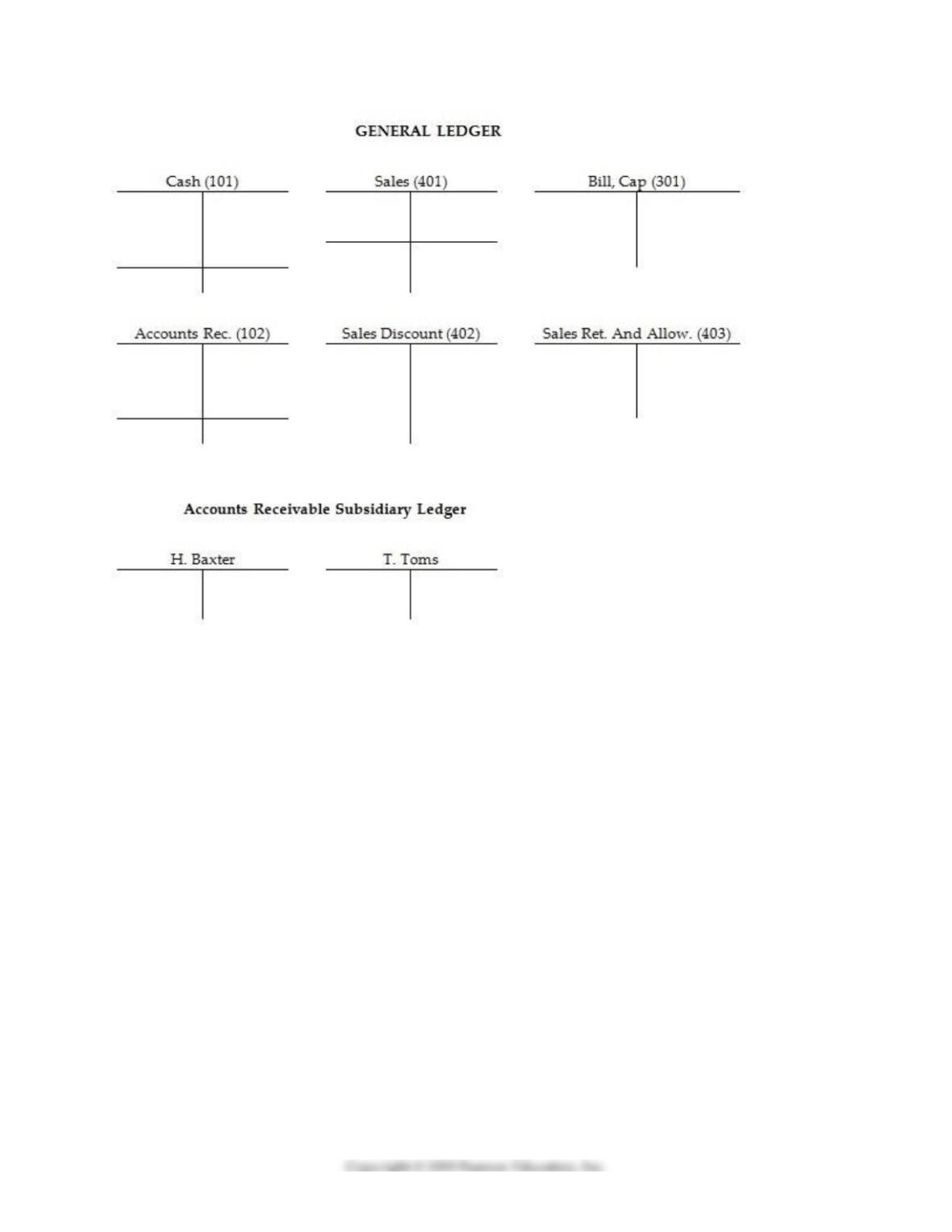
32) The following are transactions for Bill for the month of October. Indicate how the following
transactions would be recorded by completing the necessary journal entries as appropriate (omit
explanations). Also post to the General Journal, General Ledger, and Subsidiary Ledgers as appropriate.
Nov. 1 Bill invested $20,000 in his business.
Nov. 3 Sold $2,500 of merchandise on account to H. Baxter, sales invoice No. 1, terms 1/10, n/30.
Nov. 5 Sold $1,200 of merchandise on account to T. Toms, sales invoice No. 2, terms 1/10, n/30.
Nov. 13 Received cash from H. Baxter in payment for November 3 transaction, less the discount.
Nov. 14 Issued credit memorandum No. 1 to T. Toms for $100 for merchandise returned from
November 5 sale on account.
Nov. 15 Received cash from T. Toms for the amount due, less the discount.
GENERAL JOURNAL
Date Account Titles and Description PR Debit Credit
33
35