
Name:
Class:
Date:
chapter 9
Indicate whether the statement is true or false.
1. The most effective means of presenting factory overhead cost variance data is through a flexible factory overhead
budget.
a.
True
b.
False
2. Because accountants have financial expertise, they are the only ones that are able to set standard costs for the
production area.
a.
True
b.
False
3. The variance from standard for factory overhead cost resulting from operating at a level above or below 100% of
normal capacity is termed volume variance.
a.
True
b.
False
4. Standard costs serve as a device for measuring efficiency.
a.
True
b.
False
5. If the standard to produce a given amount of product is 1,000 units of direct materials at $11 and the actual direct
materials used are 800 units at $12, the direct materials quantity variance is $1,000 unfavorable.
a.
True
b.
False
6. The direct labor time variance measures the efficiency of the direct labor force.
a.
True
b.
False
7. If the standard to produce a given amount of product is 600 direct labor hours at $15 and the actual direct labor incurred
is 600 hours at $17, the direct labor rate variance is $1,200 unfavorable.
a.
True
b.
False
8. If the standard to produce a given amount of product is 1,000 units of direct materials at $11 and the actual direct
materials used are 800 units at $12, the direct materials price variance is $800 unfavorable.
a.
True
b.
False
9. An unfavorable cost variance occurs when the standard cost exceeds the actual cost.
a.
True
b.
False
10. Standards are performance goals used to evaluate and control operations.
a.
True

Name:
Class:
Date:
chapter 9
a.
True
b.
False
11. If the standard to produce a given amount of product is 2,000 units of direct materials at $12 and the actual direct
materials used are 1,600 units at $13, the direct materials quantity variance is $5,200 favorable.
a.
True
b.
False
12. If employees are given bonuses for exceeding normal standards, the standards may be very effective in motivating
employees.
a.
True
b.
False
13. Financial reporting systems that are guided by the principle of exceptions focus attention on variances from standard
costs.
a.
True
b.
False
14. The volume variance measures the use of fixed factory overhead resources.
a.
True
b.
False
15. The fact that workers are unable to meet a properly determined direct labor standard is sufficient cause to change the
standard.
a.
True
b.
False
16. Standards can be used in nonmanufacturing settings where the tasks are nonrepetitive in nature.
a.
True
b.
False
17. The variance from standard for factory overhead resulting from incurring a total amount of factory overhead cost that
is greater or less than the amount budgeted for the level of operations achieved is termed the variable factory overhead
controllable variance.
a.
True
b.
False
18. Ideal standards are developed under conditions that assume no idle time, no machine breakdowns, and no materials
spoilage.
a.
True
b.
False
19. Accounting systems that use standards for product costs are called standard cost systems.
a.
True
b.
False
20. Variances from standard costs are usually not included in reports to stockholders.

Name:
Class:
Date:
chapter 9
b.
False
21. Standard costs should always be revised when they differ from actual costs.
a.
True
b.
False
22. If the standard to produce a given amount of product is 1,000 units of direct materials at $11 and the actual direct
materials used are 800 units at $12, the direct materials quantity variance is $2,200 unfavorable.
a.
True
b.
False
23. Standard costs are a useful management tool that can be used solely as a statistical device apart from the ledger or they
can be incorporated in the accounts.
a.
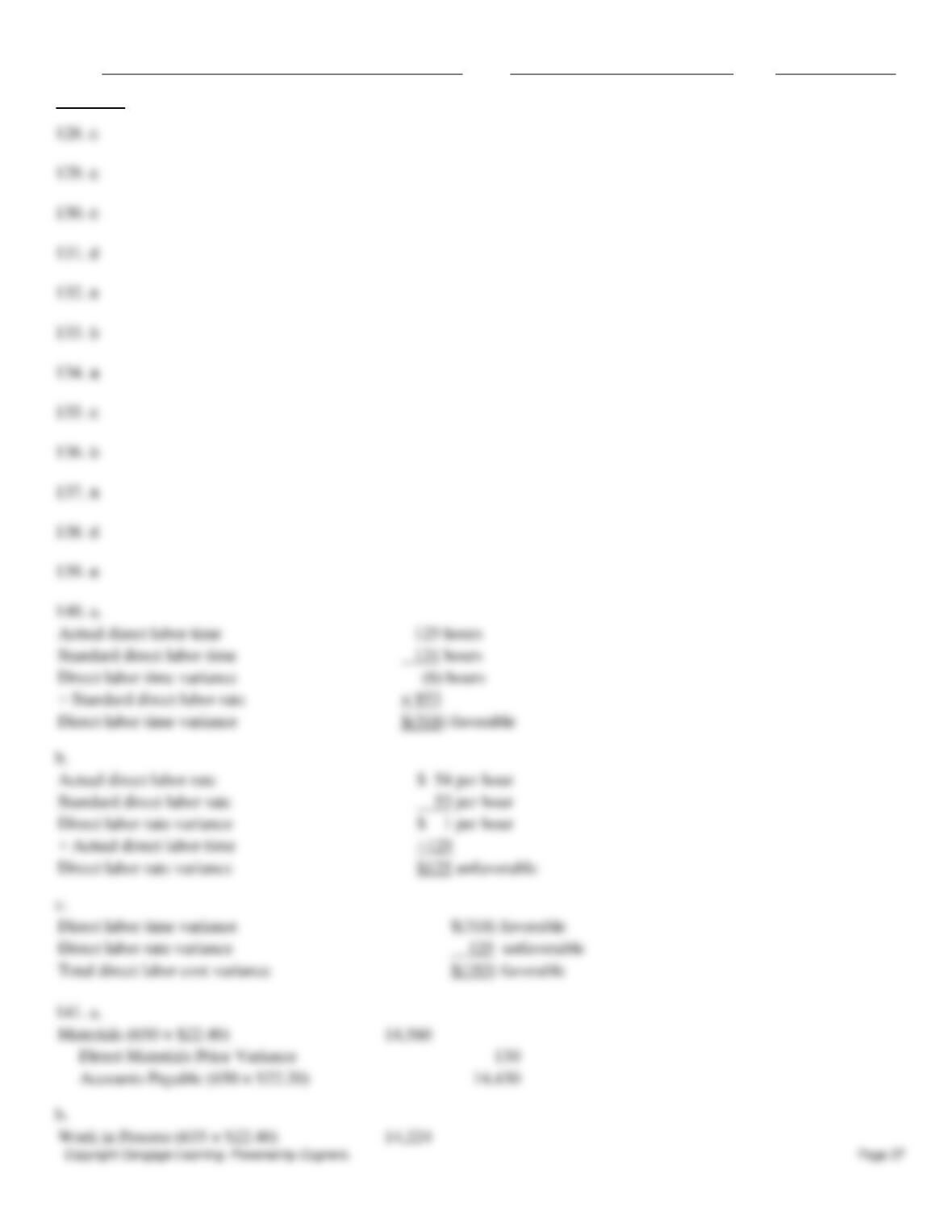
True
b.
False
24. Favorable fixed factory overhead volume variances are never harmful, since achieving them encourages managers to
run the factory above normal capacity.
a.
True
b.
False
25. In most businesses, cost standards are established principally by accountants.
a.
True
b.
False
26. Since the variable factory overhead controllable variance measures the efficiency of using variable overhead
resources, if budgeted variable overhead exceeds actual results, the variance is favorable.
a.
True
b.
False
27. If the standard to produce a given amount of product is 600 direct labor hours at $17 and the actual direct labor
incurred is 500 hours at $15, the direct labor time variance is $1,500 unfavorable.
a.
True
b.
False
28. If the standard to produce a given amount of product is 600 direct labor hours at $15 and the actual direct labor
incurred is 500 hours at $17, the direct labor time variance is $1,700 unfavorable.
a.
True
b.
False
29. The difference between the standard cost of a product and its actual cost is called a cost variance.
a.
True
b.
False
30. While setting standards, managers should never allow for spoilage or machine breakdowns in their calculations.
a.
True

Name:
Class:
Date:
chapter 9
b.
False
31. The standard cost is how much a product should cost to manufacture.
a.
True
b.
False
32. Subtracting actual revenues from planned revenues provides the revenue price variance.
a.
True
b.
False
33. Accounting systems that use standards for product costs are called budgeted cost systems.
a.
True
b.
False
34. Normally, standard costs should be revised when labor rates change to incorporate new union contracts.
a.
True
b.
False
35. The principle of exceptions allows managers to focus on correcting variances between standard costs and actual costs.
a.
True
b.
False
36. Standard direct materials costs are determined by multiplying the standard price by the standard quantity.
a.
True
b.
False
37. A favorable cost variance occurs when the actual cost is less than the standard cost.
a.
True
b.
False
38. If the standard to produce a given amount of product is 500 direct labor hours at $15 and the actual direct labor
incurred is 600 hours at $17, the direct labor rate variance is $1,200 favorable.
a.
True
b.
False
39. An unfavorable fixed factory overhead volume variance may be due to a failure of supervisors to maintain an even
flow of work.
a.
True
b.
False
40. Standards are designed to evaluate price and quantity variances separately.
a.
True
b.
False
41. A budget performance report compares actual costs with the standard costs and reports differences for possible
investigation.

Name:
Class:
Date:
chapter 9
a.
True
b.
False
42. Although favorable fixed factory overhead volume variances are usually good news, if inventory levels are too high,
additional production could be harmful.
a.
True
b.
False
43. At the end of the fiscal year, the variances from standard are usually transferred to the finished goods account.
a.
True
b.
False
44. Standards are set for only direct labor and direct materials.
a.
True
b.
False
45. Accounting systems that use standards for product costs are called variable cost systems.
a.
True
b.
False
46. If the standard to produce a given amount of product is 1,000 units of direct materials at $11 and the actual direct
materials used are 800 units at $12, the direct materials price variance is $800 favorable.
a.
True
b.
False
47. Currently attainable standards do not allow for reasonable production difficulties.
a.
True
b.
False
Indicate the answer choice that best completes the statement or answers the question.
The following data relate to direct materials costs for February:
Materials cost per yard: standard, $2.00; actual, $2.10
Yards per unit: standard, 4.5 yards; actual, 4.75 yards
Units of production: 9,500
48. The direct materials quantity variance is
a.
$4,512.50 unfavorable
b.
$4,512.50 favorable
c.
$4,750.00 unfavorable
d.
$4,750.00 favorable
49. Which of the following would not lend itself to applying direct labor variances?
a.
help desk assistant
b.
research and development scientist
Name:
Class:
Date:
chapter 9
c.
customer service personnel
d.
telemarketer
50. Which of the following is the correct formula for the revenue volume variance?
a.
Planned Revenues – Actual Revenues
b.
(Planned Selling Price per Unit – Actual Selling Price per Unit) × Actual Units Sold
c.
(Planned Units Sold – Actual Units Sold) × Actual Sales Price
d.
(Planned Units Sold – Actual Units Sold) × Planned Sales Price
Flapjack Corporation had 8,200 actual direct labor hours at an actual rate of $12.40 per hour. Original production had
been budgeted for 1,100 units, but only 1,000 units were actually produced. Labor standards were 7.6 hours per completed
unit at a standard rate of $13.00 per hour.
51. The direct labor rate variance is
a.
$4,920 unfavorable
b.
$4,920 favorable
c.
$4,560 favorable
d.
$4,560 unfavorable
The standard costs and actual costs for factory overhead for the manufacture of 2,500 units of actual production are as
follows:
Standard Costs
Fixed overhead (based on 10,000 hours)
3 hours per unit at $0.80 per hour
Variable overhead
3 hours per unit at $2.00 per hour
Actual Costs
Total variable cost, $18,000
Total fixed cost, $8,000
52. The total factory overhead cost variance is
a.
$2,000 favorable
b.
$5,000 unfavorable
c.
$2,500 unfavorable
d.
$5,000 favorable
53. The standard costs and actual costs for direct labor for the manufacture of 2,500 actual units of product are as follows:
Standard Costs
Direct labor
7,500 hours at $11.80
Actual Costs
Direct labor
7,400 hours at $11.40
The direct labor rate variance is
a.
$2,960 unfavorable
b.
$4,500 favorable
c.
$2,960 favorable
d.
$4,500 unfavorable

Name:
Class:
Date:
chapter 9
54. An unfavorable staff time variance may be the result of
a.
overscheduling staff
b.
insufficient staff training
c.
difficult room cleaning situations
d.
all of these choices
The following data relate to direct labor costs for March:
Rate: standard, $12.00; actual, $12.25
Hours: standard, 18,500; actual, 17,955
Units of production: 9,450
55. The direct labor rate variance is
a.
$4,488.75 unfavorable
b.
$6,851.25 favorable
c.
$4,488.75 favorable
d.
$6,851.25 unfavorable
The standard factory overhead rate is $7.50 per machine hour ($6.20 for variable factory overhead and $1.30 for fixed
factory overhead) based on 100% of normal capacity of 80,000 machine hours. The standard cost and the actual cost of
factory overhead for the production of 15,000 units during August were as follows:
Actual:
Variable factory overhead
$360,000
Fixed factory overhead
104,000
Standard hours allowed for units produced:
60,000 hours
56. The variable factory overhead controllable variance is
a.
$12,000 unfavorable
b.
$12,000 favorable
c.
$14,000 unfavorable
d.
$26,000 unfavorable
The standard factory overhead rate is $10 per direct labor hour ($8 for variable factory overhead and $2 for fixed factory
overhead) based on 100% of normal capacity of 30,000 direct labor hours. The standard cost and the actual cost of factory
overhead for the production of 5,000 units during May were as follows:
Standard:
25,000 hours at $10
$250,000
Actual:
Variable factory overhead
$202,500
Fixed factory overhead
60,000
57. The fixed factory overhead volume variance is
a.
$12,500 favorable
b.
$10,000 unfavorable
c.
$12,500 unfavorable
d.
$10,000 favorable
Name:
Class:
Date:
chapter 9
58. At the end of the fiscal year, variances from standard costs are usually transferred to the _____ account.
a.
direct labor
b.
factory overhead
c.
cost of goods sold
d.
direct materials
Standard
Actual
Variable overhead rate
$3.35
Fixed overhead rate
$1.80
Hours
18,900
17,955*
Fixed overhead
$46,000
Actual variable overhead
$67,430
Total factory overhead
$101,450
*Actual hours are equal to standard hours for units produced.
59. The variable factory overhead controllable variance is
a.
$8,981.75 favorable
b.
$7,280.75 unfavorable
c.
$8,981.75 unfavorable
d.
$7,280.75 favorable
The standard factory overhead rate is $7.50 per machine hour ($6.20 for variable factory overhead and $1.30 for fixed
factory overhead) based on 100% of normal capacity of 80,000 machine hours. The standard cost and the actual cost of
factory overhead for the production of 15,000 units during August were as follows:
Actual:
Variable factory overhead
$360,000
Fixed factory overhead
104,000
Standard hours allowed for units produced:
60,000 hours
60. The fixed factory overhead volume variance is
a.
$12,000 unfavorable
b.
$12,000 favorable
c.
$14,000 unfavorable
d.
$26,000 unfavorable
61. The standard price and quantity of direct materials are separated because
a.
GAAP and IFRS reporting requires separation
b.
direct materials prices are controlled by the purchasing department and quantity used is controlled by the
production department
c.
standard prices are more difficult to estimate than standard quantities
d.
standard quantities change more frequently than standard prices
62. If the actual quantity of direct materials used in producing a commodity differs from the standard quantity, the
variance is a _____ variance.
a.
controllable

Name:
Class:
Date:
chapter 9
b.
price
c.
quantity
d.
rate
63. Assuming that the standard fixed overhead rate is based on full capacity, the cost of available but unused productive
capacity is indicated by the
a.
fixed factory overhead volume variance
b.
direct labor time variance
c.
direct labor rate variance
d.
variable factory overhead controllable variance
64. Planned sales are 10,000 units at $7.00 per unit. Actual sales are 11,000 units at $6.50 per unit. Which of the following
statements is not true?
a.
The revenue price variance is unfavorable.
b.
The revenue volume variance is favorable.
c.
The total revenue variance is unfavorable.
d.
The revenue volume variance is $7,000.
The following data relate to direct labor costs for March:
Rate: standard, $12.00; actual, $12.25
Hours: standard, 18,500; actual, 17,955
Units of production: 9,450
65. The total direct labor variance is
a.
$2,051.25 favorable
b.
$2,051.25 unfavorable
c.
$2,362.50 unfavorable
d.
$2,362.50 favorable
66. The controllable variance measures
a.
operating results at less than normal capacity
b.
the efficiency of using variable overhead resources
c.
operating results at more than normal capacity
d.
control over fixed overhead costs
The following data relate to direct labor costs for March:
Rate: standard, $12.00; actual, $12.25
Hours: standard, 18,500; actual, 17,955
Units of production: 9,450
67. The direct labor time variance is
a.
$2,362.50 favorable
b.
$2,362.50 unfavorable
c.
$6,540.00 favorable

Name:
Class:
Date:
chapter 9
d.
$6,540.00 unfavorable
68. Standards that represent levels of operation that can be attained with reasonable effort are called _____ standards.
a.
theoretical
b.
ideal
c.
variable
d.
normal
69. Which of the following is not a reason standard costs are separated into two components?
a.
The price and quantity variances need to be identified separately to correct the actual major differences.
b.
Identifying variances determines which manager must find a solution to major discrepancies.
c.
If a negative variance is overshadowed by a favorable variance, managers may overlook potential corrections.
d.
Variances bring attention to discrepancies in the budget and require managers to revise budgets closer to actual
results.
70. A company records its inventory purchases at standard cost but also records purchase price variances. The company
purchased 5,000 widgets at $8.00 each, and the standard cost for the widgets is $7.60. Which of the following would be
included in the journal entry?
a.
debit Accounts Payable, $38,000
b.
credit Direct Materials Price Variance, $2,000
c.
debit Accounts Payable, $2,000
d.
debit Direct Materials Price Variance, $2,000
71. The principle of exceptions allows managers to focus on correcting variances between
a.
standard costs and actual costs
b.
variable costs and actual costs
c.
competitor’s costs and actual costs
d.
competitor’s costs and standard costs
72. The standard costs and actual costs for direct materials for the manufacture of 3,000 actual units of product are as
follows:
Standard Costs
Direct materials
1,040 kilograms at $8.75
Actual Costs
Direct materials
2,000 kilograms at $8.00
The direct materials price variance is
a.
$2,750 unfavorable
b.
$2,750 favorable
c.
$1,500 favorable
d.
$1,500 unfavorable
The following data relate to direct labor costs for February:
Actual costs
7,700 hours at $14.00

Name:
Class:
Date:
chapter 9
Standard costs
7,000 hours at $16.00
73. The direct labor rate variance is
a.
$14,000 favorable
b.
$14,000 unfavorable
c.
$15,400 favorable
d.
$15,400 unfavorable
74. If the price paid per unit differs from the standard price per unit for direct materials, the variance is a _____ variance.
a.
variable
b.
controllable
c.
price
d.
volume
75. Standard costs are used in companies for a variety of reasons. Which of the following is not one of the benefits for
using standard costs?
a.
They are used to indicate where changes in technology and machinery need to be made.
b.
They are used to estimate the cost of inventory.
c.
They are used to plan direct materials, direct labor, and variable factory overhead.
d.
They are used to control costs.
St. Augustine Corporation originally budgeted for $360,000 of fixed overhead at 100% of normal production capacity.
Production was budgeted to be 12,000 units. The standard hours for production were 5 hours per unit. The variable
overhead rate was $3 per hour. Actual fixed overhead was $360,000, and actual variable overhead was $170,000. Actual
production was 11,700 units.
76. The fixed factory overhead volume variance is
a.
$9,000 favorable
b.
$9,000 unfavorable
c.
$5,500 favorable
d.
$5,500 unfavorable
77. The following data relate to direct labor costs for the current period:
Standard costs
7,500 hours at $11.70
Actual costs
6,000 hours at $12.00
The direct labor time variance is
a.
$18,000 favorable
b.
$18,000 unfavorable
c.
$17,550 unfavorable
d.
$17,550 favorable
Lucy Corporation purchased and used 129,000 board feet of lumber in production at a total cost of $1,548,000. Original
production had been budgeted for 22,000 units with a standard materials quantity of 5.7 board feet per unit and a standard
price of $12 per board foot. Actual production was 23,500 units.

Name:
Class:
Date:
chapter 9
78. The direct materials price variance is
a.
$0
b.
$59,400 unfavorable
c.
$59,400 favorable
d.
$6,000 unfavorable
Flapjack Corporation had 8,200 actual direct labor hours at an actual rate of $12.40 per hour. Original production had
been budgeted for 1,100 units, but only 1,000 units were actually produced. Labor standards were 7.6 hours per completed
unit at a standard rate of $13.00 per hour.
79. The direct labor time variance is
a.
$9,880 favorable
b.
$9,880 unfavorable
c.
$7,800 unfavorable
d.
$7,800 favorable
80. The direct materials price variance is the difference between the
a.
actual costs and the actual quantity at the standard price
b.
actual costs and standard costs
c.
actual price and the standard price
d.
actual quantity at the standard price and the standard costs
81. The direct materials quantity variance is the difference between the
a.
actual costs and standard costs
b.
standard quantity and the actual quantity
c.
actual quantity at the standard price and the standard costs
d.
actual costs and the standard price at the standard quantity
The following data are given for Harry Company:
Budgeted production
26,000 units
Actual production
27,500 units
Materials:
Standard price per ounce
$6.50
Standard ounces per completed unit
8
Actual ounces purchased and used in production
228,000
Actual price paid for materials
$1,504,800
Labor:
Standard hourly labor rate
$22.00 per hour
Standard hours allowed per completed unit
6.6
Actual labor hours worked
183,000
Actual total labor costs
$4,020,000
Overhead:
Actual and budgeted fixed overhead
$1,029,600
Standard variable overhead rate
$24.50 per standard labor
hour
Actual variable overhead costs
$4,520,000

Name:
Class:
Date:
chapter 9
Overhead is applied on standard labor hours. (Round interim calculations to the nearest cent.)
82. The direct labor time variance is
a.
$6,000 favorable
b.
$6,000 unfavorable
c.
$33,000 unfavorable
d.
$33,000 favorable
The standard factory overhead rate is $10 per direct labor hour ($8 for variable factory overhead and $2 for fixed factory
overhead) based on 100% of normal capacity of 30,000 direct labor hours. The standard cost and the actual cost of factory
overhead for the production of 5,000 units during May were as follows:
Standard:
25,000 hours at $10
$250,000
Actual:
Variable factory overhead
$202,500
Fixed factory overhead
60,000
83. The variable factory overhead controllable variance is
a.
$10,000 favorable
b.
$2,500 unfavorable
c.
$10,000 unfavorable
d.
$2,500 favorable
The following data are given for Zoyza Company:
Budgeted production (at 100% of normal capacity)
26,000 units
Actual production
27,500 units
Materials:
Standard price per ounce
$6.50
Standard ounces per completed unit
8
Actual ounces purchased and used in production
228,000
Actual price paid for materials
$1,504,800
Labor:
Standard hourly labor rate
$22.00 per hour
Standard hours allowed per completed unit
6.6
Actual labor hours worked
183,000
Actual total labor costs
$4,020,000
Overhead:
Actual and budgeted fixed overhead
$1,029,600
Standard variable overhead rate
$24.50 per standard labor
hour
Actual variable overhead costs
$4,520,000
Overhead is applied on standard labor hours.
84. The variable factory overhead controllable variance is
a.
$73,250 favorable
b.
$73,250 unfavorable

Name:
Class:
Date:
chapter 9
c.
$59,400 favorable
d.
$59,400 unfavorable
85. If the wage rate paid per hour differs from the standard wage rate per hour for direct labor, the variance is a _____
variance.
a.
variable
b.
rate
c.
quantity
d.
volume
86. A favorable cost variance occurs when
a.
actual costs are more than standard costs
b.
standard costs are more than actual costs
c.
standard costs are less than actual costs
d.
actual costs are the same as standard costs
The following data relate to direct materials costs for February:
Materials cost per yard: standard, $2.00; actual, $2.10
Yards per unit: standard, 4.5 yards; actual, 4.75 yards
Units of production: 9,500
87. The direct materials price variance is
a.
$1,795.50 favorable
b.
$378.00 favorable
c.
$4,512.50 unfavorable
d.
$378.00 unfavorable
The standard costs and actual costs for factory overhead for the manufacture of 2,500 units of actual production are as
follows:
Standard Costs
Fixed overhead (based on 10,000 hours)
3 hours per unit at $0.80 per hour
Variable overhead
3 hours per unit at $2.00 per hour
Actual Costs
Total variable cost, $18,000
Total fixed cost, $8,000
88. The variable factory overhead controllable variance is
a.
$2,000 unfavorable
b.
$3,000 favorable
c.
$0
d.
$3,000 unfavorable
The following data are given for Stringer Company:

Name:
Class:
Date:
chapter 9
Budgeted production
26,000 units
Actual production
27,500 units
Materials:
Standard price per ounce
$6.50
Standard ounces per completed unit
8
Actual ounces purchased and used in production
228,000
Actual price paid for materials
$1,504,800
Labor:
Standard hourly labor rate
$22 per hour
Standard hours allowed per completed unit
6.6
Actual labor hours worked
183,000
Actual total labor costs
$4,020,000
Overhead:
Actual and budgeted fixed overhead
$1,029,600
Standard variable overhead rate
$24.50 per standard labor hour
Actual variable overhead costs
$4,520,000
Overhead is applied on standard labor hours.
89. The direct materials price variance is
a.
$22,800 unfavorable
b.
$22,800 favorable
c.
$52,000 unfavorable
d.
$52,000 favorable
90. The standard costs and actual costs for direct labor in the manufacture of 2,500 units of product are as follows:
Standard Costs
Direct labor
7,500 hours at $11.80
Actual Costs
Direct labor
7,400 hours at $11.40
The direct labor time variance is
a.
$1,180 favorable
b.
$1,140 unfavorable
c.
$1,180 unfavorable
d.
$1,140 favorable
91. Morocco Desk Co. purchases 6,000 feet of lumber at $6 per foot. The standard price for direct materials is $5. The
entry to journalize the purchase and unfavorable direct materials price variance is
a.
Direct Materials 30,000
Direct Materials Price Variance 6,000
Accounts Payable 36,000
b.
Direct Materials 30,000
Accounts Payable 30,000
c.
Direct Materials 36,000
Direct Materials Price Variance 6,000
Accounts Payable 30,000

Name:
Class:
Date:
chapter 9
d.
Work in Process 36,000
Direct Materials Price Variance 6,000
Accounts Payable 30,000
92. The following data relate to direct labor costs for the current period:
Standard costs
36,000 hours at $22.00
Actual costs
35,000 hours at $23.00
The direct labor time variance is
a.
$36,000 unfavorable
b.
$35,000 unfavorable
c.
$23,000 favorable
d.
$22,000 favorable
93. If the total revenue variance is favorable and the revenue price variance is unfavorable, then the revenue volume
variance must
a.
exceed the revenue price variance and be favorable
b.
be less than the revenue price variance and be unfavorable
c.
be less than the revenue price variance and be favorable
d.
be equal to the revenue price variance and be favorable
94. Standard costs are divided into which of the following components?
a.
variance standard and quantity standard
b.
materials standard and labor standard
c.
standard quality and standard quantity
d.
standard price and standard quantity
95. The direct labor time variance is the difference between the
a.
actual labor rate and the standard labor rate
b.
actual costs and standard costs
c.
actual hours at the standard rate and the standard costs
d.
actual costs and the actual hours at the standard rate
96. The following data relate to direct labor costs for the current period:
Standard costs
6,000 hours at $12.00
Actual costs
7,500 hours at $11.40
The direct labor rate variance is
a.
$18,000 unfavorable
b.
$4,500 favorable
c.
$17,100 unfavorable
d.
$3,600 favorable
97. The standard costs and actual costs for direct materials for the manufacture of 2,500 actual units of product are as
follows:

Name:
Class:
Date:
chapter 9
Standard Costs
Direct materials
2,500 kilograms at $8.50
Actual Costs
Direct materials
2,600 kilograms at $8.75
The direct materials quantity variance is
a.
$875 favorable
b.
$850 unfavorable
c.
$850 favorable
d.
$875 unfavorable
98. The unfavorable volume variance may be due to all of the following factors except
a.
failure to maintain an even flow of work
b.
machine breakdowns
c.
unexpected increases in the cost of utilities
d.
failure to obtain enough sales orders
99. Variances from standard costs are included in reports to
a.
suppliers and creditors
b.
stockholders
c.
management
d.
suppliers and creditors, stockholders, and management
100. Myers Corporation has the following data related to direct materials costs for November: actual costs for 5,000
pounds of material at $4.50 and standard costs for 4,800 pounds of material at $5.10 per pound.
The direct materials quantity variance is
a.
$1,020 favorable
b.
$1,020 unfavorable
c.
$900 favorable
d.
$900 unfavorable
101. The following data relate to direct labor costs for August: actual costs for 5,500 hours at $24.00 per hour and
standard costs for 5,000 hours at $23.70 per hour.
The direct labor rate variance is
a.
$1,650 favorable
b.
$1,650 unfavorable
c.
$1,500 favorable
d.
$1,500 unfavorable
102. Myers Corporation has the following data related to direct materials costs for November: actual cost for 5,000
pounds of material at $4.50 per pound and standard cost for 4,800 pounds of material at $5.10 per pound.
The direct materials price variance is
a.
$3,000 favorable
b.
$3,000 unfavorable

Name:
Class:
Date:
chapter 9
c.
$2,880 favorable
d.
$2,880 unfavorable
103. The total manufacturing cost variance is
a.
the difference between total actual costs and total standard costs for the units produced
b.
the flexible budget variance plus the time variance
c.
the difference between planned costs and standard costs for the units produced
d.
none of these choices
The following data are given for Stringer Company:
Budgeted production
26,000 units
Actual production
27,500 units
Materials:
Standard price per ounce
$6.50
Standard ounces per completed unit
8
Actual ounces purchased and used in production
228,000
Actual price paid for materials
$1,504,800
Labor:
Standard hourly labor rate
$22 per hour
Standard hours allowed per completed unit
6.6
Actual labor hours worked
183,000
Actual total labor costs
$4,020,000
Overhead:
Actual and budgeted fixed overhead
$1,029,600
Standard variable overhead rate
$24.50 per standard labor hour
Actual variable overhead costs
$4,520,000
Overhead is applied on standard labor hours.
104. The direct materials quantity variance is
a.
$22,800 favorable
b.
$22,800 unfavorable
c.
$52,000 favorable
d.
$52,000 unfavorable
105. SeaSpray Resort pays housekeeping staff $15 per hour (standard) and expects its 1,000 rooms to be cleaned in 750
hours (standard). If staff logged 800 hours to clean the rooms, the direct labor time variance is
a.
$750 favorable
b.
50 hours unfavorable
c.
50 hours favorable
d.
$750 unfavorable
106. Which of the following is the correct formula for the direct labor time variance in a service business?
a.
Planned Staff Hours – Actual Staff Hours
b.
(Actual Staff Hours – Standard Staff Hours) × Actual Rate per Hour
c.
(Actual Staff Hours – Standard Staff Hours) × Standard Rate per Hour

Name:
Class:
Date:
chapter 9
d.
(Actual Staff – Planned Staff) × Actual Rate per Hour × Standard Shift Hours
The following data relate to direct labor costs for February:
Actual costs
7,700 hours at $14.00
Standard costs
7,000 hours at $16.00
107. The direct labor time variance is
a.
$7,700 favorable
b.
$7,700 unfavorable
c.
$11,200 unfavorable
d.
$11,200 favorable
108. The total manufacturing cost variance consists of
a.
direct materials price variance, direct labor cost variance, and fixed factory overhead volume variance
b.
direct materials cost variance, direct labor rate variance, and factory overhead cost variance
c.
direct materials cost variance, direct labor cost variance, and variable factory overhead controllable variance
d.
direct materials cost variance, direct labor cost variance, and factory overhead cost variance
Lucy Corporation purchased and used 129,000 board feet of lumber in production at a total cost of $1,548,000. Original
production had been budgeted for 22,000 units with a standard materials quantity of 5.7 board feet per unit and a standard
price of $12 per board foot. Actual production was 23,500 units.
109. The direct materials quantity variance is
a.
$63,000 favorable
b.
$63,000 unfavorable
c.
$59,400 favorable
d.
$59,400 unfavorable
110. An unfavorable fixed overhead volume variance can be due to all of the following except
a.
sales orders at a low level
b.
machine breakdowns
c.
employee inexperience
d.
an increase in utility costs
111. Which of the following is not a reason for a direct materials quantity variance?
a.
malfunctioning equipment
b.
purchasing of inferior raw materials
c.
increased material cost per unit
d.
spoilage of materials
The following data are given for Harry Company:
Budgeted production
26,000 units
Actual production
27,500 units
Materials:

Name:
Class:
Date:
chapter 9
Standard price per ounce
$6.50
Standard ounces per completed unit
8
Actual ounces purchased and used in production
228,000
Actual price paid for materials
$1,504,800
Labor:
Standard hourly labor rate
$22.00 per hour
Standard hours allowed per completed unit
6.6
Actual labor hours worked
183,000
Actual total labor costs
$4,020,000
Overhead:
Actual and budgeted fixed overhead
$1,029,600
Standard variable overhead rate
$24.50 per standard labor
hour
Actual variable overhead costs
$4,520,000
Overhead is applied on standard labor hours. (Round interim calculations to the nearest cent.)
112. The direct labor rate variance is
a.
$5,490 unfavorable
b.
$5,490 favorable
c.
$33,000 favorable
d.
$33,000 unfavorable
113. Favorable volume variances may be harmful when
a.
machine repairs cause work stoppages
b.
supervisors fail to maintain an even flow of work
c.
production in excess of normal capacity cannot be sold
d.
all of these choices
114. The direct labor rate variance is the difference between the
a.
actual rate and the standard rate
b.
actual costs and the standard costs
c.
actual hours at the standard rate and the standard costs
d.
actual costs and the actual hours at the standard rate
115. The following data relate to direct labor costs for the current period:
Standard costs
9,000 hours at $5.50
Actual costs
8,500 hours at $5.75
The direct labor rate variance is
a.
$2,250 unfavorable
b.
$2,125 unfavorable
c.
$2,250 favorable
d.
$2,125 favorable
116. A report that summarizes actual costs, standard costs, and the differences for the units produced is called a
a.
zero-based budget report
Name:
Class:
Date:
chapter 9
b.
budget performance report
c.
master budget
d.
budget
Standard
Actual
Variable overhead rate
$3.35
Fixed overhead rate
$1.80
Hours
18,900
17,955*
Fixed overhead
$46,000
Actual variable overhead
$67,430
Total factory overhead
$101,450
*Actual hours are equal to standard hours for units produced.
117. The fixed factory overhead volume variance is
a.
$1,701.00 favorable
b.
$4,866.75 unfavorable
c.
$1,701.00 unfavorable
d.
$4,866.75 favorable
118. If at the end of the fiscal year, the variances from standard are significant, the variances should be transferred to the
a.
work in process account
b.
cost of goods sold account
c.
finished goods account
d.
work in process, cost of goods sold, and finished goods accounts
119. Incurring actual indirect factory wages in excess of budgeted amounts for actual production results in a _____
variance.
a.
quantity
b.
controllable
c.
volume
d.
rate
St. Augustine Corporation originally budgeted for $360,000 of fixed overhead at 100% of normal production capacity.
Production was budgeted to be 12,000 units. The standard hours for production were 5 hours per unit. The variable
overhead rate was $3 per hour. Actual fixed overhead was $360,000, and actual variable overhead was $170,000. Actual
production was 11,700 units.
120. The variable factory overhead controllable variance is
a.
$9,000 favorable
b.
$9,000 unfavorable
c.
$5,500 favorable
d.
$5,500 unfavorable
121. The following data are given for Bahia Company:

Name:
Class:
Date:
chapter 9
Budgeted production
1,000 units
Actual production
980 units
Materials:
Standard price per pound
$2.00
Standard pounds per completed unit
12
Actual pounds purchased and used in production
11,800
Actual price paid for materials
$23,000
Labor:
Standard hourly labor rate
$14.00 per hour
Standard hours allowed per completed unit
4.5
Actual labor hours worked
4,560
Actual total labor costs
$62,928
Overhead:
Actual and budgeted fixed overhead
$27,000
Standard variable overhead rate
$3.50 per standard direct
labor hour
Actual variable overhead costs
$15,500
Overhead is applied on standard labor hours.
The variable factory overhead controllable variance is
a.
$65 unfavorable
b.
$65 favorable
c.
$540 unfavorable
d.
$540 favorable
122. If the actual direct labor hours spent producing a commodity differ from the standard hours, the variance is a _____
variance.
a.
time
b.
price
c.
quantity
d.
rate
The standard costs and actual costs for factory overhead for the manufacture of 2,500 units of actual production are as
follows:
Standard Costs
Fixed overhead (based on 10,000 hours)
3 hours per unit at $0.80 per hour
Variable overhead
3 hours per unit at $2.00 per hour
Actual Costs
Total variable cost, $18,000
Total fixed cost, $8,000
123. The fixed factory overhead volume variance is
a.
$2,000 favorable
b.
$2,000 unfavorable
c.
$2,500 unfavorable
d.
$0

Name:
Class:
Date:
chapter 9
The following data relate to direct materials costs for February:
Materials cost per yard: standard, $2.00; actual, $2.10
Yards per unit: standard, 4.5 yards; actual, 4.75 yards
Units of production: 9,500
124. The total direct materials cost variance is
a.
$9,262.50 unfavorable
b.
$9,262.50 favorable
c.
$3,780.00 unfavorable
d.
$3,562.50 favorable
125. The following data are given for Bahia Company:
Budgeted production (at 100% of normal capacity)
1,000 units
Actual production
980 units
Materials:
Standard price per pound
$2.00
Standard pounds per completed unit
12
Actual pounds purchased and used in production
11,800
Actual price paid for materials
$23,000
Labor:
Standard hourly labor rate
$14.00 per hour
Standard hours allowed per completed unit
4.5
Actual labor hours worked
4,560
Actual total labor costs
$62,928
Overhead:
Actual and budgeted fixed overhead
$27,000
Standard variable overhead rate
$3.50 per standard labor
hour
Actual variable overhead costs
$15,500
Overhead is applied on standard labor hours.
The fixed factory overhead volume variance is
a.
$65 unfavorable
b.
$65favorable
c.
$540 unfavorable
d.
$540 favorable
126. Jaxson Corporation has the following data related to direct labor costs for September: actual costs for 10,200 hours at
$15.75 per hour and standard costs for 10,800 hours at $15.50 per hour.
The direct labor time variance is
a.
$9,300 favorable
b.
$9,300 unfavorable
c.
$9,450 favorable
d.
$9,450 unfavorable
Name:
Class:
Date:
chapter 9
Standard
Actual
Variable overhead rate
$3.35
Fixed overhead rate
$1.80
Hours
18,900
17,955*
Fixed overhead
$46,000
Actual variable overhead
$67,430
Total factory overhead
$101,450
*Actual hours are equal to standard hours for units produced.
127. The total factory overhead cost variance is
a.
$4,866.75 unfavorable
b.
$4,866.75 favorable
c.
$8,981.75 favorable
d.
$8,981.75 unfavorable
The following data are given for Zoyza Company:
Budgeted production (at 100% of normal capacity)
26,000 units
Actual production
27,500 units
Materials:
Standard price per ounce
$6.50
Standard ounces per completed unit
8
Actual ounces purchased and used in production
228,000
Actual price paid for materials
$1,504,800
Labor:
Standard hourly labor rate
$22.00 per hour
Standard hours allowed per completed unit
6.6
Actual labor hours worked
183,000
Actual total labor costs
$4,020,000
Overhead:
Actual and budgeted fixed overhead
$1,029,600
Standard variable overhead rate
$24.50 per standard labor
hour
Actual variable overhead costs
$4,520,000
Overhead is applied on standard labor hours.
128. The fixed factory overhead volume variance is
a.
$73,250 unfavorable
b.
$73,250 favorable
c.
$59,400 favorable
d.
$59,400 unfavorable
129. Which of the following conditions normally would not indicate that standard costs should be revised?
a.
The Engineering Department has revised product specifications in responding to customer suggestions.
b.
The company has signed a new union contract that increases the factory wages on average by $3.50 an hour.
c.
Actual costs differed from standard costs for the preceding week.

Name:
Class:
Date:
chapter 9
d.
The average price of raw materials increased from $4.68 per pound to $4.82 per pound.
Match each of the following phrases with the term (a–e) it describes.
a.
Ideal standard
b.
Normal standard
c.
Budget performance report
d.
Unfavorable cost variance
e.
Favorable cost variance
130. Summarizes actual costs, standard costs, and the differences for units produced
131. Actual cost > standard cost at actual volumes
132. Actual cost < standard cost at actual volumes
133. Currently attainable standard
134. Theoretical standard
Match each of the following formulas and phrases with the term (a–e) it describes.
a.
Direct materials price variance
b.
Direct labor rate variance
c.
Direct labor time variance
d.
Direct materials quantity variance
e.
Budgeted variable factory overhead
135. (Actual Direct Labor Hours – Standard Direct Labor Hours) × Standard Rate per Hour
136. (Actual Rate per Hour – Standard Rate per Hour) × Actual Hours
137. (Actual Price – Standard Price) × Actual Quantity
138. (Actual Quantity – Standard Quantity) × Standard Price
139. Standard variable overhead for actual units produced
140. Standard and actual costs for direct labor for the manufacture of 300 units of product were as follows:
Actual costs
125 hours at $54
Standard costs
131 hours at $53
Determine the direct labor (a) time variance, (b) rate variance, and (c) total cost variance.
141. Titus Company purchased and used 650 pounds of tomatoes (direct materials) to produce a taco sauce with a 635
pound standard direct materials requirement. The standard materials price is $22.40 per pound. The actual price of the
tomatoes was $22.20 per pound.

Name:
Class:
Date:
chapter 9
Journalize the entries to record (a) the purchase of the tomatoes and (b) the tomatoes used in production. Titus records
standard costs and variances in its accounts.
142. Using the following information, prepare a factory overhead cost budget for Jacob Company where the total factory
overhead cost is $206,500 at normal capacity (100%). Include capacity at 60%, 80%, 100%, and 120%. Total variable
cost is $15.25 per unit and total fixed costs are $54,000. The information is for the month ending October 31. (Hint:
Determine units produced at normal capacity.)
143. Sally’s Chocolate Company makes gourmet cupcakes which are sold by the dozen. Compute the standard cost for
one dozen cupcakes, based on the following standards:
Standard materials quantity:
4.25 cups of ingredients at $0.56 per cup
Standard labor:
1.10 hours at $8.30 per hour
Factory overhead:
$3.80 per direct labor hour
144. Compute the standard cost for one pair of boots, based on the following standards for each pair of boots:
Standard materials quantity:
1.25 yards of leather at $35.00 per yard
Standard labor:
9 hours at $25.75 per hour
Factory overhead:
$1.75 per direct labor hour
145. The following information is for the standard and actual costs for Happy Corporation:
Standard Costs:
Budgeted units of production 16,000 [80% (or normal) capacity]
Standard labor hours per unit 4
Standard labor rate $26 per hour
Standard material per unit 8 lbs.
Standard material cost $12 per pound
Standard variable overhead rate $15 per labor hour
Budgeted fixed overhead $640,000
Fixed overhead rate is based on budgeted labor hours at 80% (or normal) capacity.
Actual Costs:
Actual production 16,500 units
Actual material purchased and used 130,000 pounds
Actual total material cost $1,600,000
Actual labor 65,000 hours
Actual total labor costs $1,700,000
Actual variable overhead $1,000,000
Actual fixed overhead $640,000
Determine (a) the direct materials quantity variance, price variance, and total cost variance; (b) the direct labor time
variance, rate variance, and total cost variance; and (c) the factory overhead volume variance, controllable variance, and
total factory overhead cost variance. (Note: Do not round interim calculations.)
146. Using the following information, prepare a factory overhead cost budget for Andover Company where the total
factory overhead cost is $75,500 at normal capacity (100%). Include capacity at 75%, 90%, 100%, and 110%. Total
variable cost is $6.25 per unit and total fixed costs are $38,000. The information is for the month ending August 31. (Hint:
Name:
Class:
Date:
chapter 9
Determine units produced at normal capacity.)
147. Oak Company produces a chair for which the standard is 6 yards of material per unit. The standard price of one yard
of material is $7.50. During the month, 8,500 chairs were manufactured, using 48,875 yards.
Journalize the entry to record the direct materials used in production.
148. Tippi Company produces lamps that require 2.25 standard hours per unit at a standard hourly rate of $15.00 per hour.
Production of 7,700 units required 17,550 hours at an hourly rate of $15.20 per hour.
What is the direct labor (a) rate variance, (b) time variance, and (c) total cost variance?
149. Aquatic Corp.’s standard material requirement to produce one Model 2000 is 15 pounds of material at $110 per
pound. Last month, Aquatic purchased 170,000 pounds of material at a total cost of $17,850,000. It used 162,000 pounds
to produce 10,000 units of Model 2000.
Determine the direct materials price variance and direct materials quantity variance, and indicate whether each variance is
favorable or unfavorable.
150. Ajay Company records standard costs and variances in its accounts. Journalize the entry to record the purchase of
6,000 widgets at $8.00 per unit, assuming widgets have a standard cost of $8.15 per unit.
151. The Finishing Department of Pinnacle Manufacturing Co. prepared the following factory overhead cost budget for
October of the current year, during which it expected to operate at a 100% capacity of 10,000 machine hours.
Variable costs:
Indirect factory wages
$18,000
Power and light
12,000
Indirect materials
4,000
Total variable cost
$34,000
Fixed costs:
Supervisory salaries
$12,000
Depreciation of plant and
equipment
8,800
Insurance and property taxes
3,200
Total fixed cost
24,000
Total factory overhead
$58,000
During October, the plant was operated for 9,000 machine hours and the factory overhead costs incurred were as follows:
indirect factory wages, $16,400; power and light, $10,000; indirect materials, $3,000; supervisory salaries, $12,000;
depreciation of plant and equipment, $8,800; and insurance and property taxes, $3,200.
Prepare a factory overhead cost variance report for October. (The budgeted amounts for actual amount produced should
be based on 9,000 machine hours.)
The following data are given for Taylor Company:
Budgeted production
1,000 units
Actual production
980 units
Materials:
Standard price per pound
$2.00
Standard pounds per completed unit
12
Actual pounds purchased and used in production
11,800
Actual price paid for materials
$23,000
Name:
Class:
Date:
chapter 9
Labor:
Standard hourly labor rate
$14.00 per hour
Standard hours allowed per completed unit
4.5
Actual labor hours worked
4,560
Actual total labor costs
$62,928
Overhead:
Actual and budgeted fixed overhead
$27,000
Standard variable overhead rate
$3.50 per standard labor hour
Actual variable overhead costs
$15,500
Overhead is applied based on standard labor hours.
152. Compute the direct materials price and quantity variances for Taylor Company.
153. Prepare an income statement that includes variances for the year ending December 31 through gross profit for Baxter
Company using the following information. Baxter Company sold 8,600 units at $125 per unit. Normal production is 9,000
units. (Do not round fixed overhead rate calculation when determining fixed factory overhead volume variance.)
Standard: 5 yards per unit at $6.30 per yard
Actual yards used: 43,240 yards
at $6.25 per yard
Standard: 2.25 hours per unit at $15.00
Actual hours worked: 19,100 at
$14.90 per hour
Standard: Variable overhead at $1.05 per unit
Standard: Fixed overhead $211,500
(budgeted and actual amount)
Actual total factory overhead:
$235,500
154. Robin Company records standard costs and variances in its accounts. Robin Company purchased and used 500
pounds of direct materials to produce a product with a 520 pound standard direct materials requirement. The standard
materials price is $1.90 per pound. The actual materials price was $2.00 per pound.
Journalize the entries to record (a) the purchase of the materials and (b) the materials used in production.
155. Robin Company records standard costs and variances in its accounts. Robin purchased and used 520 pounds of direct
materials to produce a product with a 510 pound standard direct materials requirement. The standard price is $2.10 per
pound. The actual materials price was $2.00 per pound.
Journalize the entries to record (a) the purchase of the materials and (b) the materials used in production.
The following data are given for Taylor Company:
Budgeted production
1,000 units
Actual production
980 units
Materials:
Standard price per pound
$2.00
Standard pounds per completed unit
12
Actual pounds purchased and used in production
11,800
Actual price paid for materials
$23,000
Labor:
Standard hourly labor rate
$14.00 per hour
Standard hours allowed per completed unit
4.5
Actual labor hours worked
4,560
Actual total labor costs
$62,928

Name:
Class:
Date:
chapter 9
Overhead:
Actual and budgeted fixed overhead
$27,000
Standard variable overhead rate
$3.50 per standard labor hour
Actual variable overhead costs
$15,500
Overhead is applied based on standard labor hours.
156. Compute the direct labor rate and time variances for Taylor Company.
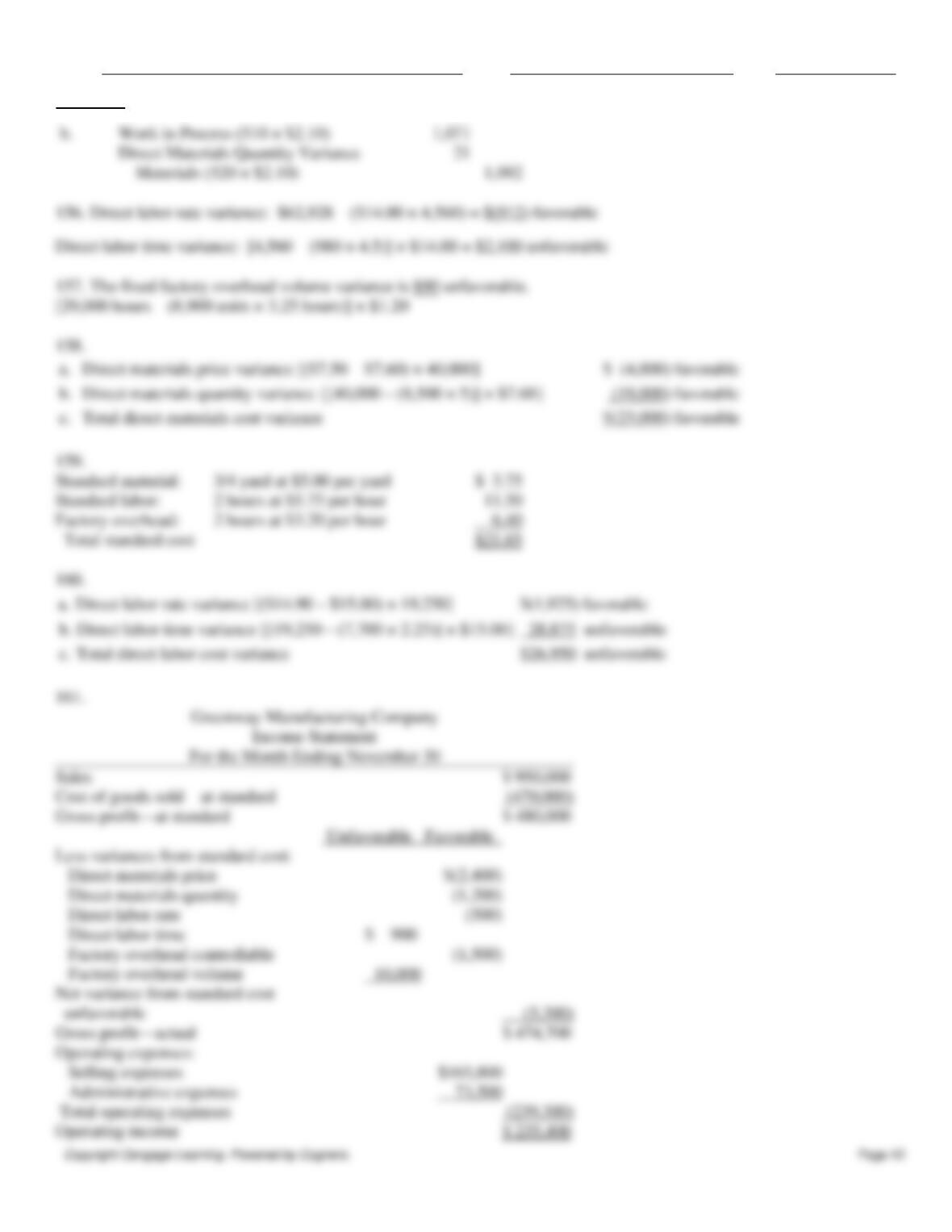
157. Titus Company produced 8,900 units of a product that required 3.25 standard hours per unit. The standard fixed
overhead cost per unit is $1.20 per hour at 29,000 hours, which is 100% of normal capacity.
Determine the fixed factory overhead volume variance.
158. Ruby Company produces a chair for which the standard specifies 5 yards of material per unit. The standard price of
one yard of material is $7.60. During the month, 8,500 chairs were manufactured, using 40,000 yards at a cost of $7.50.
Determine the (a) direct materials price variance, (b) direct materials quantity variance, and (c) total direct materials cost
variance.
159. Compute the standard cost for one hat, based on the following standards for each hat:
Standard materials quantity:
3/4 yard of fabric at $5.00 per yard
Standard labor:
2 hours at $5.75 per hour
Factory overhead:
$3.20 per direct labor hour
160. Japan Company produces lamps that require 2.25 standard hours per unit at a standard hourly rate of $15.00 per hour.
Production of 7,700 units required 19,250 hours at an hourly rate of $14.90 per hour.
What is the direct labor (a) rate variance, (b) time variance, and (c) total cost variance?
161. Prepare an income statement (through operating income) that includes variances for presentation to management,
using the following data from the records of Greenway Manufacturing Company for November of the current year:
Administrative expenses
$ 73,500
Cost of goods sold (at standard)
470,000
Direct materials quantity variance—favorable
1,200
Direct materials price variance—favorable
2,400
Direct labor time variance—unfavorable
900
Direct labor rate variance—favorable
500
Factory overhead volume variance—unfavorable
10,000
Factory overhead controllable variance—favorable
1,500
Sales
950,000
Selling expenses
165,800
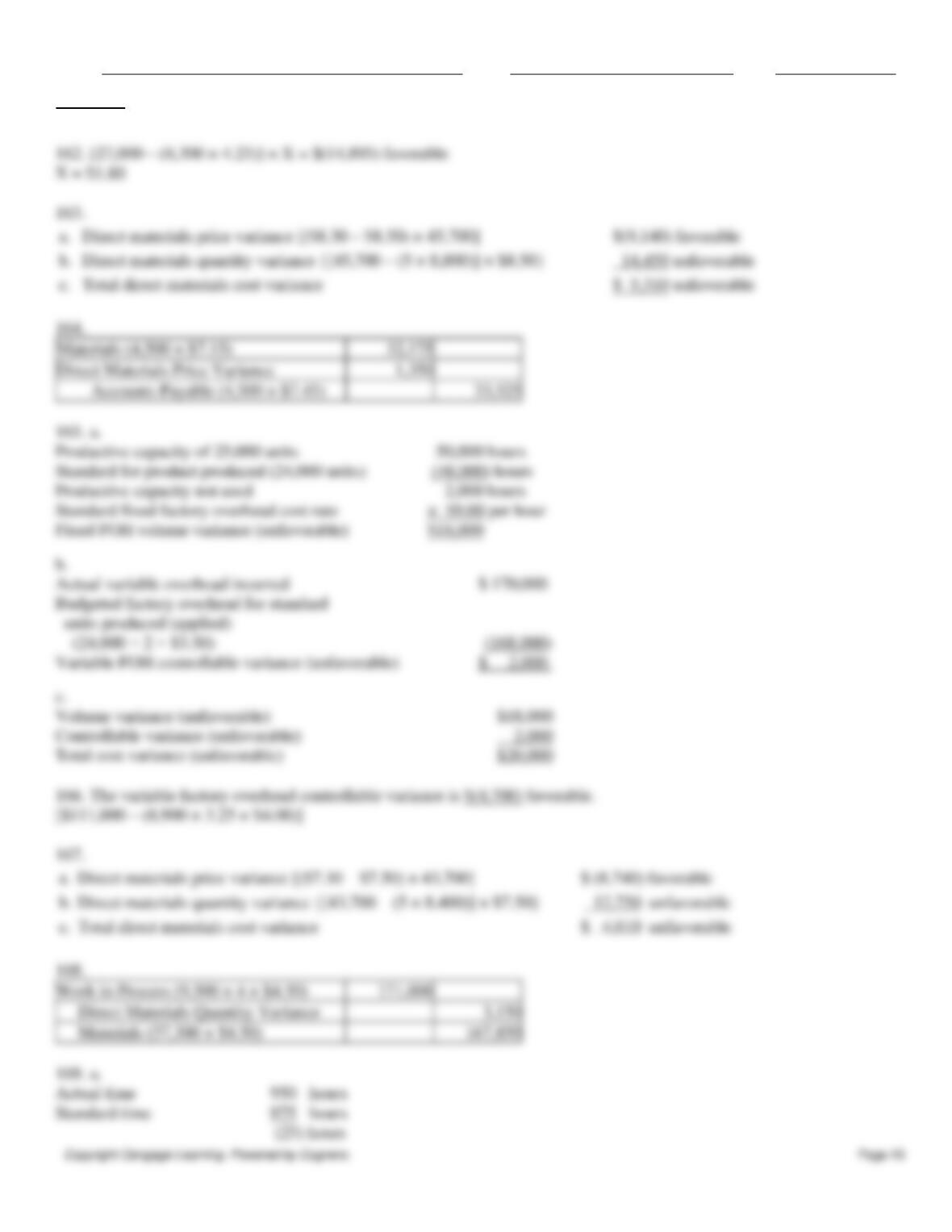
162. Greyson Company produced 8,300 units of product that required 4.25 standard hours per unit. Determine the
standard fixed overhead cost per unit at 27,000 hours, which is 100% of normal capacity, if the favorable fixed factory
overhead volume variance is $14,895.
163. Hsu Company produces a part with a standard of 5 yards of material per unit. The standard price of one yard of
material is $8.50. During the month, 8,800 parts were manufactured, using 45,700 yards of material at a cost of $8.30.
Determine the direct materials (a) price variance, (b) quantity variance, and (c) total cost variance.

Name:
Class:
Date:
chapter 9
164. Ashlee Company records standard costs and variances in its accounts. Journalize the entry to record the purchase of
4,500 widgets at $7.45 per unit, assuming widgets have a standard cost of $7.15 per unit.
165. The following information relates to manufacturing overhead for Chapman Company:
Standards:
Total fixed factory overhead $450,000
Estimated production 25,000 units (100% of normal capacity)
Overhead rates are based on machine hours.
Standard hours allowed per unit produced 2
Fixed overhead rate $9.00 per machine hour
Variable overhead rate $3.50 per hour
Actual:
Fixed factory overhead $450,000
Production 24,000 units
Variable overhead $170,000
Compute (a) the fixed factory overhead volume variance, (b) the variable factory overhead controllable variance, and (c)
the total factory overhead cost variance.
166. Tucker Company produced 8,900 units of product that required 3.25 standard hours per unit. The standard variable
overhead cost per unit is $4.00 per hour. The actual variable factory overhead was $111,000.
Determine the variable factory overhead controllable variance.
167. Ruby Company produces a chair for which the standard specifies 5 yards of material per unit. The standard price of
one yard of material is $7.50. During the month, 8,400 chairs were manufactured, using 43,700 yards at a cost of $7.30
per yard.
Determine the (a) direct materials price variance, (b) direct materials quantity variance, and (c) total direct materials cost
variance.
168. Rosser Company records standard costs and variances in its accounts. Rosser Company produces a container that
requires 4 yards of material per unit. The standard price of one yard of material is $4.50. During the month, 9,500 chairs
were manufactured using 37,300 yards of material.
Journalize the entry to record the direct materials used in production.
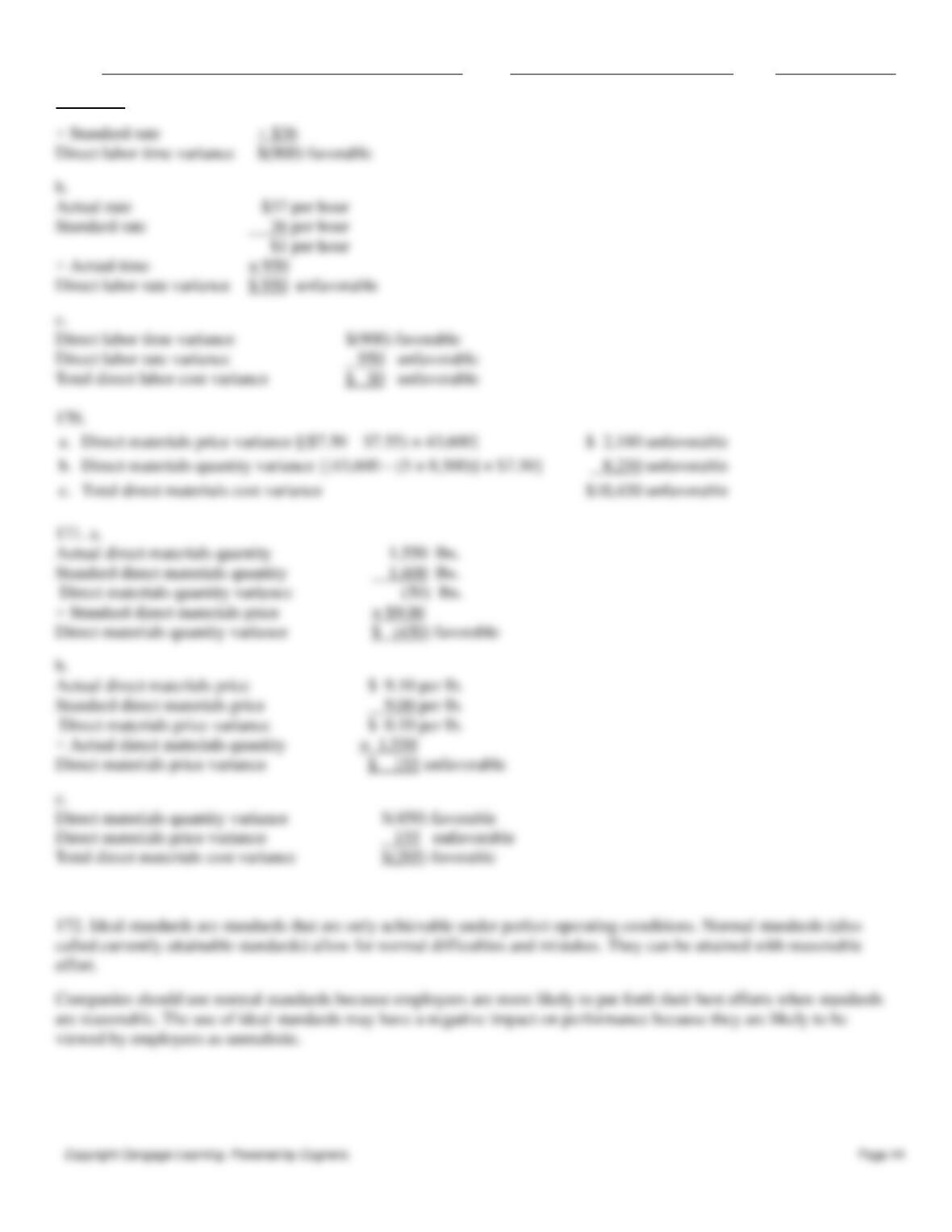
169. Standard and actual costs for direct labor for the manufacture of 1,000 units of product were as follows:
Actual costs
950 hours at $37
Standard costs
975 hours at $36
Determine the direct labor (a) time variance, (b) rate variance, and (c) total cost variance.
170. Ruby Company produces a chair for which the standard specifies 5 yards of material per unit. The standard price of
one yard of material is $7.50. During the month, 8,500 chairs were manufactured, using 43,600 yards at a cost of $7.55
per yard.
Determine the (a) direct materials price variance, (b) direct materials quantity variance, and (c) total direct materials cost
variance.

Name:
Class:
Date:
chapter 9
171. Standard and actual costs for direct materials for the manufacture of 1,000 units of product were as follows:
Actual costs
1,550 lbs. at $9.10
Standard costs
1,600 lbs. at $9.00
Determine the direct materials (a) quantity variance, (b) price variance, and (c) total cost variance.
172. Define ideal and normal standards. Which type of standard should be used and why?
Name:
Class:
Date:
chapter 9
Answer Key
Name:
Class:
Date:
chapter 9
Name:
Class:
Date:
chapter 9
Name:
Class:
Date:
chapter 9
Name:
Class:
Date:
chapter 9
Name:
Class:
Date:
chapter 9
Name:
Class:
Date:
chapter 9
Name:
Class:
Date:
chapter 9
Name:
Class:
Date:
chapter 9
Name:
Class:
Date:
chapter 9
Name:
Class:
Date:
chapter 9
Name:
Class:
Date:
chapter 9
Name:
Class:
Date:
chapter 9